
🔥 India vs China 2026: Hook Introduction
Is the 21st century going to be the century of Asia?
And if that is the case, who will lead this new Asia — India or China?
India vs China 2026 is shaping one of the most important geopolitical rivalries of the 21st century. The world today is undergoing a massive transformation where the long-standing dominance of the United States is gradually being challenged, and the global balance of power is shifting towards the East.
In this changing landscape, Asia is emerging as the new center of economic growth, technological innovation, and geopolitical influence. This shift is not temporary — it represents a long-term transition in global leadership.
At the heart of this transformation are two rising giants — India and China. Both nations are rapidly expanding their economic capabilities, strengthening military power, and increasing global influence. While China has already established itself as a major economic superpower, India is emerging as a fast-growing challenger driven by its young population, digital economy, and democratic stability.
The India vs China rivalry is not just a regional issue — it is a strategic competition that will shape the future of Asia and redefine global power structures. From trade and technology to military strategy and diplomacy, this competition is influencing decisions across the world.
👉 The question is no longer just about which country is more powerful — it is about who will define the future of the global order.
🔹 India vs China 2026: Quick Summary (Key Points)
- India vs China 2026 highlights two major emerging power centers in Asia, both shaping the region’s economic, political, and strategic future.
- China currently leads in economic size and military strength, but India is growing at a much faster pace, making it a strong long-term competitor.
- India’s strengths include its rapidly expanding technology sector, massive young population, and democratic system, which builds global trust and long-term stability.
- China’s centralized political system enables faster decision-making and large-scale execution, giving it an advantage in infrastructure and industrial expansion.
- After 2026, the balance of power in Asia may shift significantly as India’s growth accelerates and global dynamics evolve.
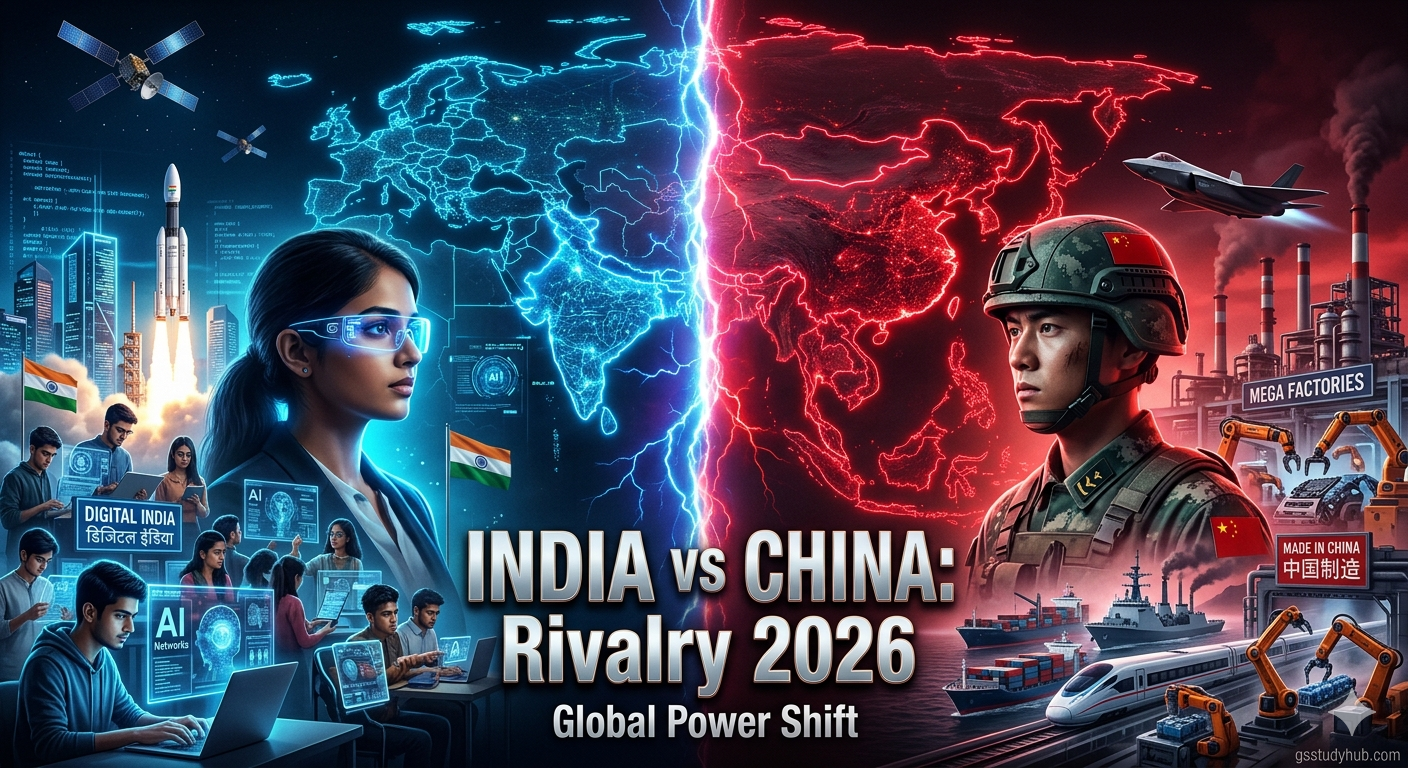
🌏 India vs China 2026: What is the Rivalry?
India vs China 2026 rivalry is not merely a competition between two neighboring countries; it represents a broader strategic struggle for dominance in Asia. As global power shifts towards the East, both nations are positioning themselves to lead the region economically, politically, and militarily.
This India vs China rivalry is deeply rooted in differences in political systems, economic models, historical tensions, and strategic ambitions. While China has already emerged as a global economic powerhouse, India is rapidly rising as a strong contender with long-term growth potential.
👉 To understand India’s global strategy in this rivalry, explore this detailed guide on India’s Foreign Policy 2026 .
Key Areas of Competition:
- Economic Power (GDP & Manufacturing): China dominates global manufacturing and exports, while India is expanding rapidly in services, startups, and the digital economy.
- Military Strength: China has one of the largest and most advanced military forces, whereas India holds strategic advantages due to its geography and nuclear capability.
- Technological Development (AI & Semiconductors): China is investing heavily in AI, 5G, and semiconductors, while India is emerging as a global hub for IT services and digital infrastructure.
- Global Influence (Diplomacy): China expands influence through infrastructure and trade partnerships, while India strengthens its position through diplomacy, alliances, and soft power.
👉 China is already an established economic superpower, whereas India is a rapidly rising power that could reshape the global balance of power in the coming decades.
👉 Rising global tensions also raise concerns about a larger conflict. Explore detailed analysis on World War 3 Chances in 2026 .
📅 India vs China 2026: Why It Matters
India vs China 2026 is emerging as a critical turning point in global geopolitics. Several structural and strategic shifts are happening simultaneously, indicating that the balance of power in Asia—and potentially the world—is beginning to change.
The India vs China rivalry is now influencing global supply chains, military alliances, and economic strategies, making 2026 a decisive phase in the global power transition.
Key Reasons Why 2026 Matters:
- Global Supply Chain Shift: Many multinational companies are moving manufacturing away from China due to rising costs and geopolitical tensions. India is emerging as a key alternative, supported by initiatives like Make in India and a large workforce.
- India’s Growing Role in QUAD & Indo-Pacific Strategy: India’s strategic importance is rising in alliances such as the QUAD. In the Indo-Pacific region, India is seen as a major counterbalance to China’s expanding influence.
- Slowing Chinese Economic Growth: China’s economy is facing a slowdown due to internal challenges like debt, real estate issues, and demographic decline, creating opportunities for emerging economies like India.
- India’s Rapid Economic Growth: India is one of the fastest-growing major economies, driven by digital transformation, infrastructure development, and strong domestic demand, positioning it as a future global powerhouse.
👉 These trends clearly show that India vs China 2026 is not just a regional issue but a major global power shift already in motion.

⚙️ Key Factors / Causes
1. Economic Power
China has an economy exceeding $18 trillion, making it the second-largest economy in the world, while India is one of the fastest-growing major economies and is already among the top five globally.
👉 China is a global manufacturing giant, dominating exports and industrial production.
👉 India, on the other hand, is strong in services, IT, and the rapidly expanding digital economy.
2. Military Strength
China possesses one of the largest and most advanced military forces in the world, with significant investments in naval and missile capabilities. India, while smaller in comparison, holds a strategic advantage due to its geographic position in the Indian Ocean and its nuclear capabilities.
👉 South China Sea vs Indian Ocean represents a major geopolitical power contest between the two nations.
3. Technology & Innovation
China is leading in areas such as artificial intelligence (AI), 5G infrastructure, and electric vehicles (EVs), supported by heavy state investment and industrial policy. Meanwhile, India is emerging as a global leader in IT services, software development, and digital public infrastructure such as digital payments and identity systems.
4. Population Advantage
India has the world’s largest and youngest population, which provides a long-term workforce and consumer base advantage. In contrast, China is facing an aging population problem, which could slow down its economic growth in the future.
5. Political System
China follows an authoritarian political system that allows for fast decision-making and rapid implementation of policies. India, as a democratic nation, may have slower decision-making processes, but it benefits from institutional stability, transparency, and greater global trust.
👉 The political and diplomatic strategies of both nations play a key role in this competition. Explore more in India vs China Diplomatic Relations Strategy .
🌍 India vs China 2026: Impact on India & the World
The India vs China 2026 rivalry is not limited to regional competition—it is reshaping global economics, geopolitics, and strategic alliances. Its impact can be clearly seen on India, China, and the broader world order.
Impact on India
- Increase in Investment: As global companies diversify away from China, India is attracting higher foreign direct investment (FDI), boosting industrial growth and job creation.
- Stronger Global Leadership: India’s role in global forums and strategic alliances is expanding, increasing its influence in international decision-making.
- Opportunity to Become a Manufacturing Hub: With supportive policies and a large workforce, India has the potential to become a global manufacturing alternative to China.
👉 India’s rapid growth is already visible. Explore full analysis on India vs China 2026: India Rising Global Superpower
Impact on China
- Economic Slowdown: Reduced global dependence and internal structural challenges may slow China’s economic growth.
- Rising Global Criticism: Increasing geopolitical tensions could lead to greater international scrutiny.
- Strategic Pressure: China may face growing pressure from regional alliances, especially in the Indo-Pacific region.
👉 Growing economic uncertainty is also raising concerns about a global slowdown. Read full analysis on Global Economic Recession Signs .
Impact on the World
- Emergence of a Bipolar World: The global system may evolve into a structure where power is shared between major blocs, including the United States and rising Asian powers.
- Increase in Trade Wars: Economic competition may lead to more trade restrictions, tariffs, and supply chain disruptions.
- Formation of New Alliances: Countries are likely to form new strategic partnerships to balance power, especially in the Indo-Pacific region.
👉 Overall, India vs China 2026 is accelerating a major global power shift that will influence the future world order.
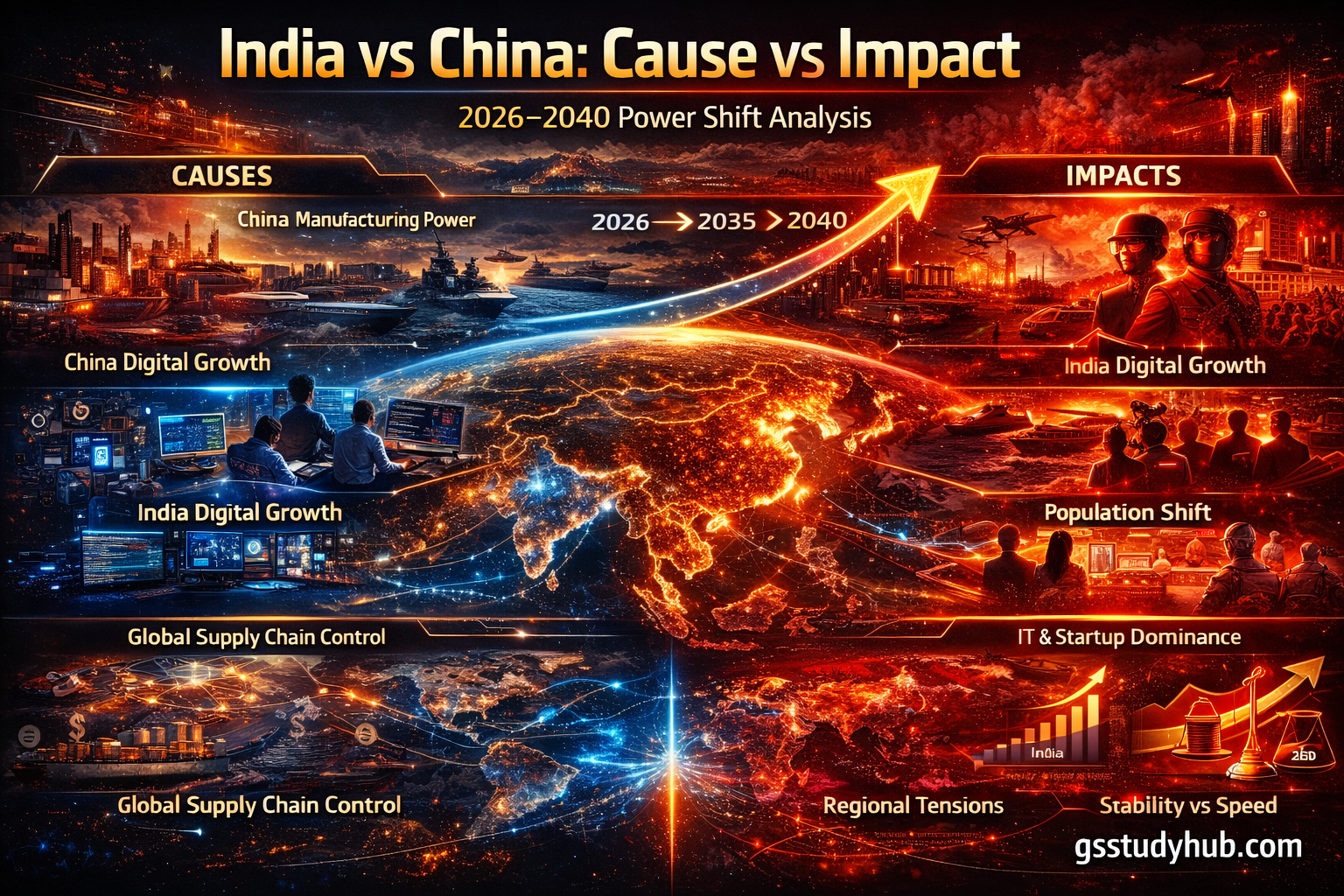
📊 India vs China 2026: Cause vs Impact Analysis
The India vs China 2026 rivalry can be better understood through its key drivers and their global impact. The table below highlights how economic, military, technological, and political factors are shaping the future power balance.
| Cause | Impact |
|---|---|
| China Manufacturing Power China’s dominance in global manufacturing and exports allows it to control large portions of the international supply chain. | Global Supply Chain Control Many countries remain dependent on Chinese production, giving China significant economic influence worldwide. |
| India Digital Growth India’s rapid expansion in IT services, startups, and digital infrastructure is transforming its economy. | IT & Startup Dominance India is emerging as a global technology hub, attracting innovation, investment, and skilled talent. |
| Military Expansion Both nations are increasing defense spending and strengthening military capabilities. | Regional Tensions This leads to heightened geopolitical tensions, especially in the South China Sea and border regions. |
| Population Shift India’s young population offers long-term workforce advantages, while China faces demographic decline. | Long-term Growth Advantage (India) India is better positioned for sustained economic growth in the coming decades. |
| Political Systems China’s centralized governance enables fast decision-making, while India’s democracy ensures stability and transparency. | Stability vs Speed Trade-off China benefits from rapid execution, whereas India gains long-term institutional trust and stability. |
👉 This India vs China 2026 cause vs impact analysis clearly shows how both nations are shaping the future global order.
🔮 India vs China 2026: Future Outlook (2026–2035)
The India vs China 2026 rivalry will play a decisive role in shaping the global balance of power over the next decade. Economic trends, demographic shifts, and geopolitical strategies will determine how this competition evolves.
👉 Short Term (2026–2030)
- China Will Likely Remain Ahead: Due to its strong industrial base, advanced infrastructure, and manufacturing dominance, China is expected to lead in the short term.
- India Will Rapidly Close the Gap: India’s fast economic growth, digital expansion, and global partnerships will significantly reduce the gap with China.
👉 Long Term (2030–2040)
- India’s Demographic Advantage: With the world’s largest young population, India will gain a long-term workforce and consumption advantage.
- Economic Expansion: Continued reforms, infrastructure development, and foreign investments may allow India to surpass China in key economic indicators.
👉 Likely Scenario
Asia is likely to evolve into a dual power system where both India and China play dominant roles in shaping the future global order.
🧠 Expert Insight
“The 21st century will not be dominated by a single superpower, but by multiple regional powers shaping the global order.”
- India’s Soft Power: India’s democratic system, cultural influence, and global partnerships increase its global acceptance and credibility.
- China’s Hard Power: China’s strong economy, military strength, and infrastructure investments provide a dominant strategic edge.
👉 Final Outcome: The India vs China 2026 rivalry may ultimately be defined as a contest between Hard Power vs Soft Power.
❓ India vs China 2026: FAQ Section
Q1. Can India surpass China in 2026?
India vs China 2026 comparison shows that India may not surpass China immediately, but in the long term, it is possible due to its young population, strong workforce, and fast economic growth.
Q2. Why is China ahead right now?
China is ahead because of early investments in manufacturing, infrastructure, and global trade networks, giving it a significant advantage in the current global economy.
Q3. Is an India-China war possible?
The chances of a large-scale war are low, but the India vs China rivalry may continue through border tensions, economic competition, and strategic conflicts.
Q4. What is India’s biggest strength?
India’s biggest strength lies in its young population, digital economy, and innovation-driven growth, making it a strong future global power.
Q5. What is China’s biggest weakness?
China’s major challenges include an aging population, slowing economic growth, and rising global trust issues, which could impact its long-term dominance.
🔚 India vs China 2026: Conclusion
The India vs China 2026 rivalry is far more than a competition between two nations—it is a defining contest that will shape the future global order. As the world shifts from a unipolar to a multipolar system, the balance of power in Asia will play a decisive role in shaping the 21st century.
At present, China holds a clear advantage due to its strong manufacturing base, advanced infrastructure, and established global influence. However, this dominance is increasingly being challenged by India’s rapid economic growth, demographic advantage, and expanding global partnerships.
📊 Current Affairs – 9 April 2026
Stay updated with key national and international developments including economy, governance, defence, environment, and international relations—essential for UPSC, SSC, Banking, and all competitive exams.
👉 Read Full Current Affairs – 9 April 2026 👉 Today, China is ahead
👉 But tomorrow, India could change the game 🚀
Looking ahead, it is unlikely that Asia’s future will be dominated by a single power. Instead, a balanced and competitive structure may emerge where both India and China act as key drivers of regional and global dynamics.
Ultimately, the India vs China 2026 competition will not just define Asia’s geopolitical future—it will reshape the entire global power structure in the decades to come.
👉 The real question is: Who will lead the future world — India or China?