
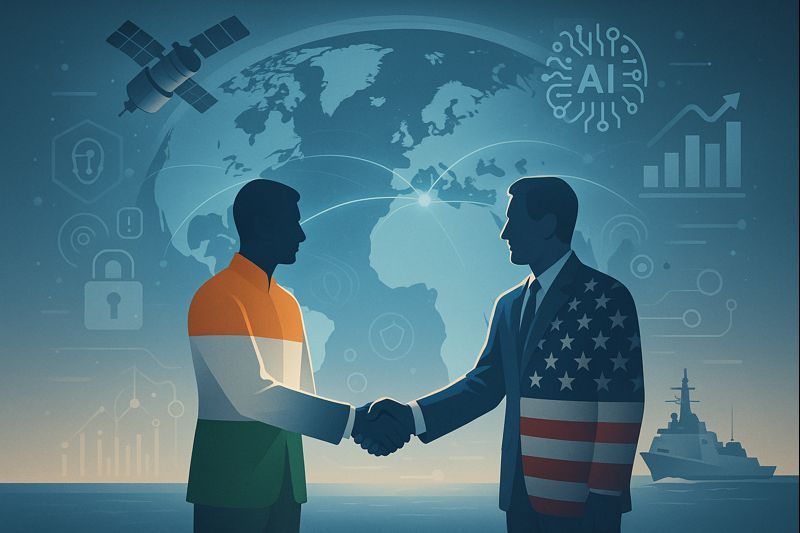
Relations Between India and the United States: A Strategic Partnership of the 21st Century
India and the United States share a multifaceted and internationally significant relationship. Over the years, their ties have evolved from cautious engagement to a comprehensive partnership rooted in shared democratic values, strategic interests, economic cooperation, and people-to-people connections. While studying and observing global politics, I realized that India–US relations are not just about diplomacy—they reflect how modern nations collaborate to shape a stable and innovative world order.
Strategic Partnership
India and the United States are considered important strategic partners of the 21st century. Their cooperation has steadily expanded in defense, security, and geopolitical coordination.
Defence and Security Cooperation
A major milestone in bilateral relations was the India–US Civil Nuclear Agreement signed in 2008. This agreement gave a new dimension to strategic trust and cooperation between the two countries, ending decades of nuclear isolation for India.
The United States recognizes India as a Major Defense Partner. Both nations regularly engage in joint military exercises, defense technology transfers, and intelligence sharing, strengthening regional and global security.
Economic Relations
Economic cooperation forms the backbone of India–US relations. The United States is India’s largest trading partner, and bilateral trade continues to grow every year.
Trade, Investment, and Growth
Trade and investment between the two countries are expanding across sectors such as technology, energy, manufacturing, and infrastructure. American companies view India as a rapidly growing market, while Indian businesses see the US as a hub of innovation and global opportunity.
The US is also a major destination for Indian IT professionals and startups, contributing significantly to the American economy while creating global opportunities for Indian talent.
Technological and Scientific Cooperation
One of the most inspiring aspects of India–US relations is their collaboration in science and technology. Both countries work together in advanced fields that define the future.
Space, AI, and Cybersecurity
India and the US cooperate in areas such as space exploration, cybersecurity, and artificial intelligence. A notable example is the collaboration between NASA and ISRO, including the NISAR satellite project, which aims to study climate change and natural disasters.
These partnerships show how shared knowledge and innovation can address global challenges that no single nation can solve alone.
Cultural and Educational Ties
People-to-people connections give India–US relations their strongest foundation. Cultural exchange and education have created deep mutual understanding.
Diaspora and Education
A large Indian diaspora lives in the United States and acts as a powerful cultural and economic bridge between the two nations. Indian-origin professionals have made significant contributions in fields such as technology, medicine, business, and academia.
Every year, a large number of Indian students choose American universities for higher education. At the same time, elements of Indian culture—such as Yoga, Bollywood, and Indian cuisine—have become an integral part of American society.
Challenges and Issues
Despite strong cooperation, India–US relations are not without challenges. These differences reflect the realities of independent foreign policies.
Policy Differences
There are occasional disputes related to visa regulations and migration policies. Additionally, India and the United States sometimes differ in their approaches to global issues such as Russia, China, and climate change.
However, dialogue and diplomacy have ensured that these differences do not overshadow the broader partnership.
Cooperation in the Indo-Pacific Region
The Indo-Pacific has emerged as a crucial region in global geopolitics. India and the United States are working together to promote stability, freedom of navigation, and a rules-based international order.
The Role of QUAD
India–US cooperation within groups such as the Quadrilateral Security Dialogue (QUAD)—along with Japan and Australia—plays an important role in balancing China’s growing influence in the Indo-Pacific region.
This partnership highlights India’s rising global role and the strategic importance of democratic alliances.
My Personal Learnings from India–US Relations
Cooperation Without Losing Independence
One of my key learnings from studying India–US relations is that strong partnerships do not require complete agreement on every issue. Both countries cooperate where interests align while maintaining independent foreign policies.
A Lesson for the Modern World
In an increasingly polarized world, India–US relations teach us that mutual respect, dialogue, and long-term vision can overcome differences. True partnerships are built on trust, patience, and shared responsibility rather than short-term gains.
Conclusion: A Relationship Shaping the Future
The relationship between India and the United States is no longer limited to diplomacy—it is a comprehensive partnership shaping global politics, economics, and technology. From strategic cooperation and trade to education and culture, the India–US relationship reflects how two diverse democracies can work together for mutual and global benefit.
As this partnership continues to evolve, it will play a decisive role in defining the future of the Indo-Pacific region and the global order of the 21st century.
Related Reading
To better understand global power dynamics, you may also explore our detailed article on Indo-Pacific Strategy Explained.
Frequently Asked Questions (FAQs)
Why are India–US relations important?
India–US relations are important because they influence global security, economic growth, technological innovation, and stability in the Indo-Pacific region.
What is the significance of the India–US nuclear deal?
The 2008 civil nuclear agreement marked a turning point by recognizing India as a responsible nuclear power and strengthening strategic trust between the two countries.
How do India and the US cooperate in defense?
They cooperate through joint military exercises, defense equipment purchases, intelligence sharing, and strategic dialogues.
What role does the Indian diaspora play in the US?
The Indian diaspora acts as a cultural, economic, and political bridge, strengthening people-to-people ties and mutual understanding.
What is the role of QUAD in India–US relations?
QUAD strengthens cooperation between India, the US, Japan, and Australia to promote stability and counterbalance rising strategic challenges in the Indo-Pacific region.
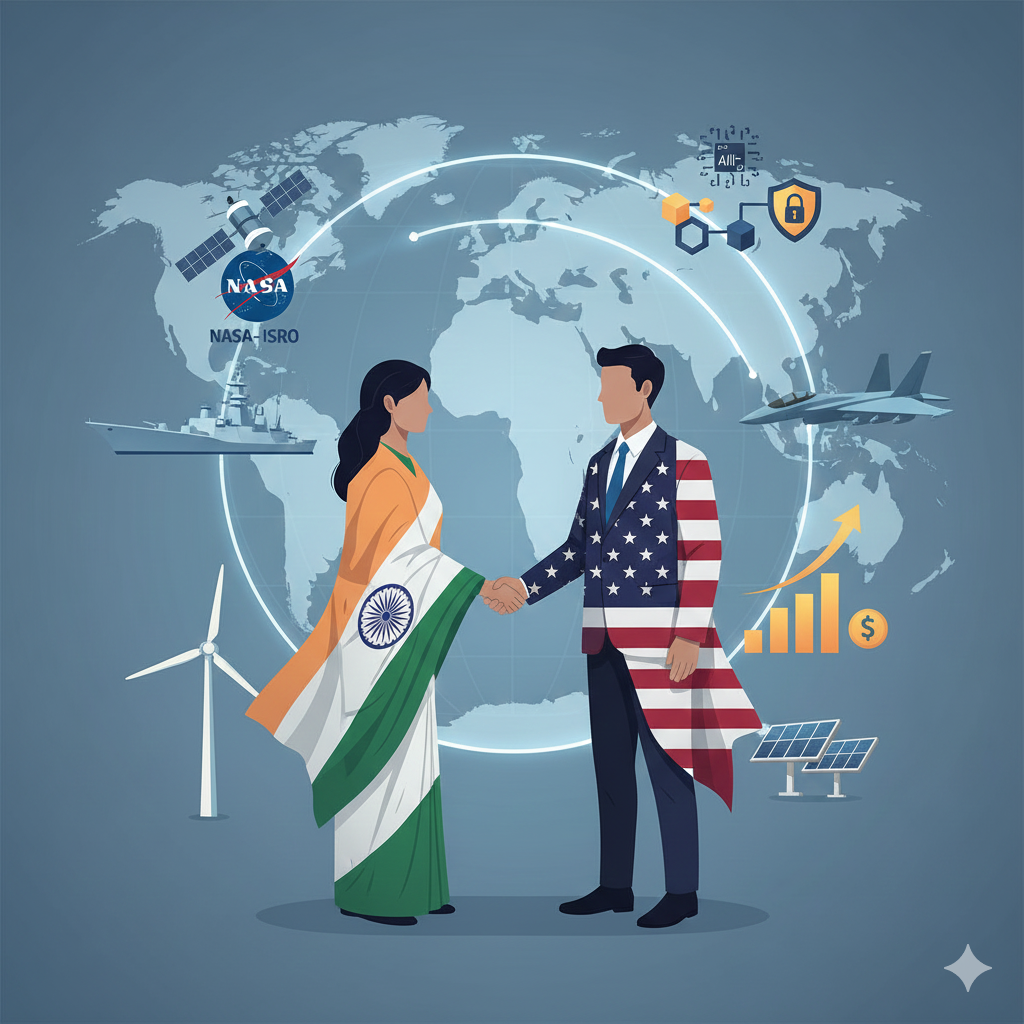
India–United States Strategic and Economic Partnership
The strategic partnership between India and the United States holds immense importance in the context of global politics, security, and economic stability. Over time, this relationship has expanded beyond diplomacy into defence, technology, trade, energy, and people-to-people cooperation. While studying global affairs, I realized that India–US relations reflect how modern partnerships balance national interests with shared global responsibilities.
Strategic Partnership
India and the United States have developed a comprehensive strategic partnership that spans defence, nuclear energy, counterterrorism, cyber security, and regional stability.
Defence Cooperation
The United States has officially recognized India as a “Major Defense Partner”, granting access to advanced defence technologies and strengthening long-term military cooperation.
Shared Military Exercises
Both countries regularly conduct joint military exercises to enhance interoperability and strategic trust.
- Malabar Naval Exercise – Conducted with Japan and Australia, focusing on maritime security.
- Yudh Abhyas – Joint army exercise strengthening land warfare cooperation.
- Cope India – Air force exercise enhancing aerial combat and coordination.
Procurement of Defence Equipment
India has purchased several advanced defence systems from the United States, including:
- C-17 Globemaster aircraft
- Apache attack helicopters
- Predator drones
These acquisitions have significantly enhanced India’s defence preparedness.
Nuclear Cooperation
The Indo–US Civil Nuclear Agreement (2008) marked a turning point in bilateral relations. It enabled India to access nuclear fuel and technology for peaceful purposes while strengthening its global standing as a responsible nuclear power.
Cooperation in the Indo-Pacific Region
India and the United States work closely to maintain peace, stability, and a rules-based order in the Indo-Pacific region.
Role of QUAD
The Quadrilateral Security Dialogue (QUAD)—comprising India, the US, Japan, and Australia—focuses on strategic, economic, and security cooperation to balance China’s growing influence. The US views India as a key regional power in this framework.
Cooperation Against Terrorism
Both countries share intelligence and coordinate counterterrorism efforts. US support against Pakistan-based terrorist organizations has strengthened India’s diplomatic position at international forums.
Cyber and Space Cooperation
Cyber Security
India and the US collaborate to counter cyber threats, protect critical infrastructure, and ensure data security in an increasingly digital world.
Space Sector Cooperation
Strategic and scientific collaboration between NASA and ISRO has strengthened space research and satellite missions, reflecting trust in advanced technological domains.
Partnership in Defence Production
Under India’s “Make in India” initiative, both countries are expanding cooperation in defence manufacturing, joint production, and technology transfer.
Economic Relations
Economic relations form a major pillar of India–US cooperation. Over the last few decades, trade, investment, and entrepreneurship between the two nations have grown rapidly.
Bilateral Trade
The United States is India’s largest trading partner. In 2023, bilateral trade exceeded $190–191 billion, reflecting deep economic interdependence.
Major Trade Items
- India’s Exports to the US: IT services, pharmaceuticals, textiles, jewelry, automobiles
- US Exports to India: Crude oil, aircraft, defence equipment, machinery, agricultural products
Services Sector Cooperation
Indian IT companies such as TCS, Infosys, and Wipro have a strong presence in the US market. The US remains the largest destination for Indian technical and professional services.
H1-B Visa
Indian professionals are the largest beneficiaries of the US H1-B visa program, contributing significantly to innovation and employment in American companies.
Investment and Entrepreneurship
The US is among the largest foreign investors in India, while Indian companies are expanding their footprint in the US economy.
Foreign Direct Investment (FDI)
- US Investment in India: Google, Microsoft, Apple, Amazon in IT, manufacturing, and e-commerce
- Indian Investment in the US: Tata Group, Infosys, Wipro, Mahindra creating jobs
By 2023, bilateral FDI flows exceeded $60 billion.
Technological and Innovation Cooperation
Startups and Innovation
Indian startups receive significant funding from US venture capital firms, strengthening innovation ecosystems in fintech, AI, and cybersecurity.
Digital India Collaboration
Under the Digital India initiative, US technology companies support India’s digital infrastructure and innovation goals.
Energy and Environment Cooperation
Energy Trade
The US exports crude oil, LNG, and energy technologies to India, contributing to India’s energy security.
Renewable and Green Energy
India and the US cooperate in solar, wind, and clean energy projects.
The India–US Green Energy Partnership (2021) and the US–India Clean Energy Finance (USICEF) program promote sustainable energy investments.
Education and Employment
A large number of Indian students pursue higher education in the United States, strengthening long-term academic, economic, and cultural ties. Indian professionals form a significant part of the US technology workforce.
Challenges in India–US Relations
Trade and Policy Issues
- Trade imbalance concerns
- Tariffs and trade barriers
- Digital taxation on US tech companies
Visa and Immigration Policies
Stricter H1-B visa regulations may impact Indian professionals and service-sector cooperation.
New Initiatives and Multilateral Platforms
US–India Trade Policy Forum (TPF)
The TPF helps resolve trade disputes and promote economic cooperation.
I2U2 Group
The I2U2 grouping (India, US, Israel, UAE) focuses on infrastructure, climate change, and economic development projects.
Related Reading
For deeper geopolitical context, read our analysis on Indo-Pacific Strategy Explained.
Frequently Asked Questions (FAQs)
Why is the India–US strategic partnership important?
It enhances global security, balances power in the Indo-Pacific, promotes economic growth, and supports technological innovation.
What role does QUAD play in India–US relations?
QUAD strengthens cooperation among democracies to ensure regional stability and counter strategic challenges in the Indo-Pacific.
How significant is defence cooperation between India and the US?
Defence cooperation includes joint exercises, defence technology transfers, intelligence sharing, and advanced military equipment procurement.
What challenges exist in India–US economic relations?
Trade imbalances, tariffs, digital taxation, and visa policies remain key challenges despite strong economic ties.
How do education and migration strengthen bilateral relations?
Indian students and professionals contribute to innovation, research, and economic growth, strengthening long-term people-to-people ties.
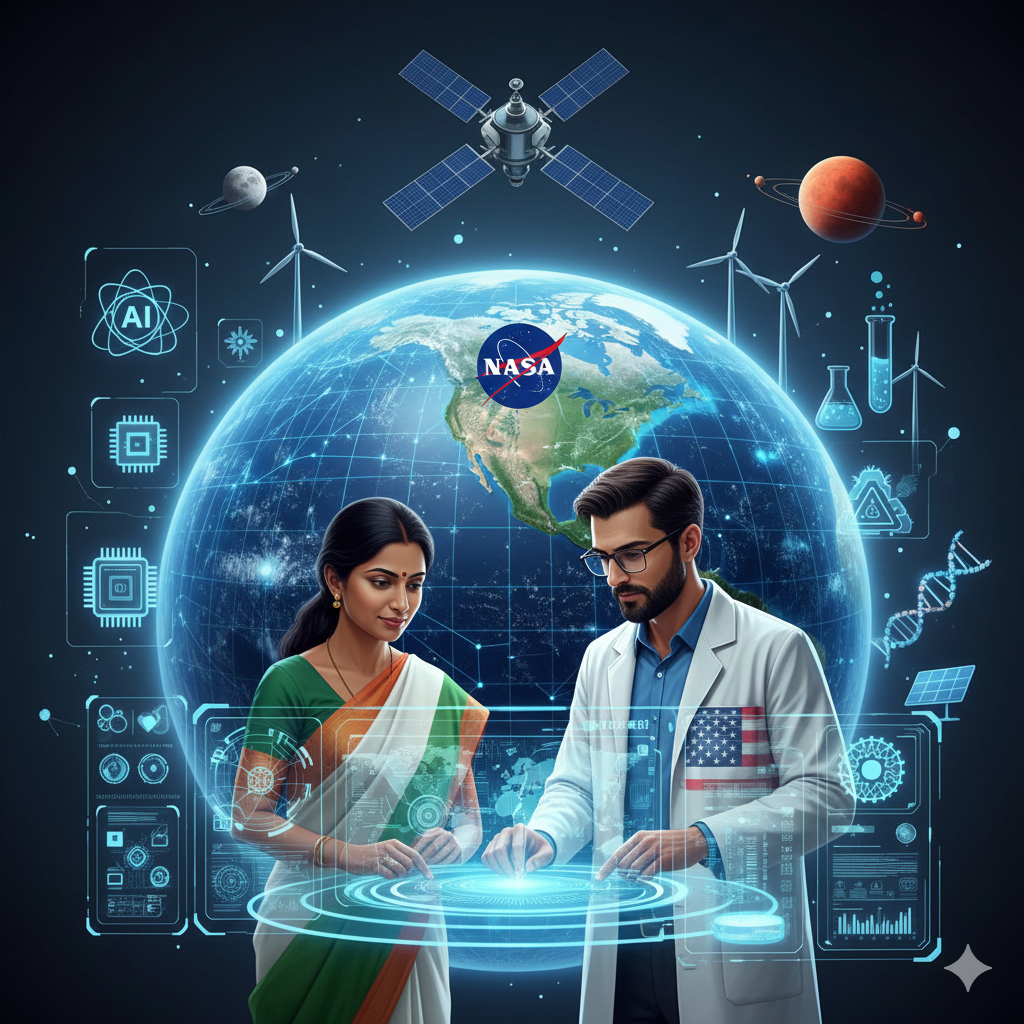
Technical and Scientific Cooperation
Technical and scientific cooperation between India and the United States has significantly strengthened bilateral relations. This partnership extends deep into advanced areas such as science, space, health, cybersecurity, artificial intelligence, and emerging technologies. From my perspective, this cooperation reflects how shared knowledge and innovation can become powerful tools of diplomacy in the modern world.
Cooperation in the Space Sector
NASA–ISRO Collaboration
Space cooperation is one of the most successful dimensions of India–US scientific relations. NASA and ISRO are working together on several advanced projects that focus on Earth observation and space research.
A major milestone is the NISAR (NASA–ISRO Synthetic Aperture Radar) Satellite Mission, designed to monitor changes in Earth’s climate, ecosystems, and natural hazards. This project highlights the trust and technological synergy between the two space agencies.
Moon and Mars Missions
The United States has appreciated the success of India’s Chandrayaan and Mangalyaan missions. These achievements have opened new opportunities for future cooperation in lunar and planetary exploration.
Health and Biotechnology Cooperation
Collaboration During the COVID-19 Pandemic
During the COVID-19 pandemic, India and the US worked closely in vaccine research, production, and distribution. US support played a key role in strengthening India’s position as a global hub for vaccine manufacturing.
Scientific Research and Health Initiatives
Joint initiatives such as the Vaccine Action Program and the Bio-Design Initiative promote collaboration in health innovation, biotechnology, and medical research. These programs encourage joint problem-solving for global health challenges.
Artificial Intelligence (AI) and Digital Technology
India and the United States are actively cooperating in advanced digital fields such as artificial intelligence, machine learning, and data analytics.
iCET Initiative
The US–India Initiative on Critical and Emerging Technologies (iCET), launched in 2023, aims to strengthen cooperation in semiconductor manufacturing, quantum computing, and AI. This initiative represents a forward-looking approach to technological leadership.
Cooperation in Cybersecurity
Cybersecurity has emerged as a critical area of collaboration between the two nations.
The US–India Cyber Dialogue, established in 2016, has enhanced mutual understanding on data protection, cybercrime prevention, and digital resilience. Indian IT companies are also working closely with US firms to develop advanced cybersecurity solutions.
Climate Technology and Energy Cooperation
Climate and Clean Energy Agenda
Under the US–India Climate and Clean Energy Agenda, both countries are focusing on developing new technologies related to renewable energy and climate change mitigation.
The US is supporting India in the development of solar panel manufacturing and energy storage technologies, contributing to long-term sustainability and energy security.
Cooperation in Education and Research
Fulbright–Nehru Fellowship
The Fulbright–Nehru Fellowship encourages academic exchange between Indian and American students, researchers, and professionals. Indian scientists are actively engaged in joint research projects with US institutions.
Semiconductors and High-Tech Manufacturing
In 2023, India and the United States signed agreements to strengthen partnerships in semiconductor manufacturing. The US is providing technical assistance to help India emerge as a global hub for semiconductor production.
Cultural and Academic Ties
Cultural and educational ties between India and the United States play a vital role in bringing the people of both nations closer. These ties have deepened over time through migration, education, arts, and shared social experiences.
Indian Diaspora in the United States
Around 4 million people of Indian origin live in the United States, forming an integral part of its economic, cultural, and social fabric.
The Indian-American community has made a strong impact in politics, science, arts, and business. Prominent examples include Kamala Harris, Vice President of the United States, and Sundar Pichai, CEO of Google.
The diaspora has popularized yoga, Bollywood, Indian cuisine, and festivals such as Diwali across American society.
Educational Ties
Indian Students in the United States
India is the second-largest source country of international students in the US. In 2023, nearly 200,000 Indian students were pursuing higher education in American universities.
US–India Educational Foundation (USIEF)
The USIEF promotes educational exchange through programs such as the Fulbright–Nehru Fellowships, strengthening academic cooperation.
Research Collaboration
US universities are working with Indian institutions on joint research projects in areas such as climate change, public health, and emerging technologies.
Cultural Exchange
Influence of Bollywood
Bollywood films and music have gained widespread popularity in the US. Indian dance, music events, and cultural festivals are held regularly across American cities.
Yoga and Meditation
Yoga and meditation have become a permanent part of the American lifestyle. Every year on June 21, International Yoga Day is celebrated on a large scale across the United States.
Celebration of Indian Festivals
Indian festivals such as Diwali, Holi, and Eid have become part of the broader American cultural landscape.
Language and Literature
Indian languages like Hindi, Tamil, Telugu, and Punjabi are widely spoken within diaspora communities. Indian authors such as Jhumpa Lahiri, Salman Rushdie, and Arundhati Roy have made a lasting impact on American literature.
Technical and Vocational Education
Indian students are prominent in IT and engineering studies in the US. Many Indian professionals hold key positions in American universities, research institutions, and multinational companies.
Presence of Indian Cultural Institutions
Several Indian cultural centers, such as India House and various Hindu temples, have been established in the US. These institutions actively promote Indian culture, history, and traditions.

Challenges and Issues in India–US Relations
India and the United States share strong and multifaceted relations, yet certain challenges and differences continue to shape this partnership. These issues arise from trade policies, geopolitics, domestic concerns, and differing global perspectives. Such differences are natural between two independent democracies with distinct national priorities.
Trade Differences
Import Duties and Tariffs
The United States has often accused India of imposing high import duties, particularly on agricultural products, medical devices, and electronic goods. On the other hand, India views certain US trade policies as unbalanced and restrictive.
Digital Taxes
India has imposed digital service taxes on major US technology companies such as Google, Facebook, and Amazon. The US considers these taxes unfair, while India argues they are necessary to ensure fair taxation in the digital economy.
Visa Policy and Immigration
H1-B Visa Concerns
The H1-B visa remains a critical issue for Indian IT professionals and companies. Changes in visa rules and stricter immigration policies affect Indian tech workers, startups, and service exports.
Uncertainty surrounding US visa policies also remains a concern for Indian students and skilled professionals.
India’s Relations with Russia
The US has expressed concerns over India’s defence and energy cooperation with Russia. India’s neutral stance during the Ukraine conflict has also raised questions among the US and other Western countries.
India, however, maintains that its foreign policy decisions are guided by national interests and strategic autonomy.
Differences in Approach Towards China
While the US supports a more aggressive strategy toward China, India prefers a balanced and cautious approach. Although both countries cooperate to counter China’s growing influence in the Indo-Pacific region, differences in strategic outlook persist.
Human Rights and Domestic Policies
The US has occasionally raised concerns related to religious freedom and minority rights in India. India considers these issues internal matters and strongly rejects external interference.
Energy and Environmental Issues
India has consistently emphasized that developed nations, especially the US, should take historical responsibility for carbon emissions and provide financial and technological assistance to developing countries.
At the same time, the US urges India to accelerate its transition toward clean energy and adopt net-zero emission targets.
Strategic Autonomy
India seeks to preserve its independent foreign policy, while the US expects closer alignment with Western strategic interests. Balancing India’s autonomy with US expectations in defence and global security remains a complex challenge.
Differences in Approach on Terrorism
US policies toward Pakistan have at times caused dissatisfaction in India. Although American support for India on counterterrorism has strengthened in recent years, concerns regarding Pakistan’s role persist.
Cooperation in the Indo-Pacific Region
India–US cooperation in the Indo-Pacific region plays a crucial role in ensuring peace, stability, and prosperity. This cooperation spans strategic, economic, technological, and security dimensions.
Indo-Pacific Strategy
Free and Open Indo-Pacific (FOIP)
Both India and the US support the vision of a Free, Open, Inclusive, and Rules-Based Indo-Pacific. This strategy aims to balance China’s growing military and economic influence in the region.
Role of QUAD
The Quadrilateral Security Dialogue (QUAD)—India, the US, Japan, and Australia—enhances maritime security, disaster response, and regional cooperation. It serves as a key platform to counter aggressive regional policies.
Security and Naval Cooperation
Joint Military Exercises
The Malabar Naval Exercise strengthens maritime coordination and security among QUAD members.
Defence Agreements
Defence cooperation has been reinforced through agreements such as:
- LEMOA – Logistics Exchange Memorandum of Agreement
- COMCASA – Communications Compatibility and Security Agreement
These agreements enable greater interoperability and access to advanced defence technologies.
Maritime Security
India and the US jointly work to protect sea lanes and ensure freedom of navigation across the Indian Ocean and the Pacific Ocean.
Economic and Trade Cooperation
Indo-Pacific Economic Framework (IPEF)
The IPEF promotes cooperation in trade, digital economy, supply chains, and infrastructure development.
Blue Dot Network
India and the US collaborate under the Blue Dot Network to promote high-quality, transparent infrastructure projects in the region.
Supply Chain Resilience
Both countries are working to reduce excessive dependence on China and strengthen resilient regional supply chains.
Countering Chinese Aggression
India and the US coordinate strategies to counter China’s military expansion and economic dominance, particularly in the South China Sea.
Sovereignty and Territorial Integrity
Both nations support the sovereignty and territorial integrity of smaller Indo-Pacific countries.
Technology and Innovation Cooperation
India and the US are focusing on digital connectivity, artificial intelligence, cybersecurity, and emerging technologies in the Indo-Pacific region.
5G and Semiconductor Development
Joint efforts are underway to enhance technological capacity, innovation, and semiconductor manufacturing.
Climate Change and Disaster Management
India and the US cooperate to address climate challenges in the Indo-Pacific region. Their navies conduct joint humanitarian assistance and disaster relief operations.
Conclusion
India–US relations are significant not only for the two countries but also for global stability and development. The strategic partnership between India and the United States extends far beyond bilateral cooperation and plays a critical role in shaping the global order.
Economic relations between the two nations benefit both economies by promoting trade, investment, innovation, and job creation. These ties are expected to grow stronger in the coming years, further integrating both countries into the global market.
Technological and scientific cooperation forms a key pillar of the development strategies of both nations. Collaboration in these areas helps address global challenges while accelerating innovation.
Cultural and educational ties enhance mutual understanding and strengthen people-to-people connections. These ties contribute meaningfully to peace, cooperation, and long-term prosperity.
Differences between India and the US are natural, given their distinct national interests. However, continuous dialogue and diplomacy ensure that these challenges do not weaken the broader partnership.
India–US cooperation in the Indo-Pacific region remains vital for maintaining balance, security, and economic growth. This partnership is rooted in shared democratic values, mutual trust, and a common vision for the future.
Ultimately, India–US relations rest on the foundation of vision, trust, and cooperation. Their evolving partnership is not only beneficial for both nations but also for global peace, security, and prosperity.
References
- Ministry of External Affairs, Government of India. India–United States Relations.
- U.S. Department of State. U.S.–India Strategic Partnership and Foreign Policy Cooperation.
- White House Briefings. U.S.–India Joint Statements and Strategic Dialogues.
- Congressional Research Service (CRS). India–U.S. Relations: Issues for Congress.
- Ministry of Commerce and Industry, Government of India. India–U.S. Trade and Investment Factsheets.
- World Bank. India–United States Trade, Investment, and Economic Cooperation Data.
- NASA and ISRO Official Portals. NISAR Satellite Mission and Space Cooperation.
- Observer Research Foundation (ORF). Indo-Pacific Strategy and QUAD Cooperation.
- Brookings Institution. India–U.S. Relations, Defence Cooperation, and Global Governance.
- United Nations Reports. Climate Change, Sustainable Development, and Global Partnerships.