
India–EU “Mother of All Deals”: A New Chapter in Free Trade, Strategic Security and Global Power Balance

Introduction

The global political and economic order of the 21st century is undergoing a profound transformation. Rising geopolitical tensions, repeated disruptions in global supply chains, climate change challenges, and the rapid digital revolution have compelled countries to rethink their partnerships and strategic priorities. In this context, the proposed agreement between India and the European Union (EU), widely described as the “Mother of All Deals,” is being seen as a historic milestone.

This agreement is not merely a conventional Free Trade Agreement (FTA). Rather, it represents a comprehensive strategic partnership covering trade, security, defence, technology, investment, and people-to-people connectivity. Through this deal, India and the EU aim not only to deepen their bilateral relationship but also to shape the future contours of the global economy and the evolving balance of power.

When both sides refer to it as the “Mother of All Deals,” they signal that its significance goes far beyond tariff reductions or market access. The agreement has the potential to drive long-term economic growth, generate employment, promote technological advancement, and contribute to global stability. Therefore, understanding its broader implications for India, Europe, and the world is essential.

Background / Historical Context

India and the European Union (EU) have maintained formal diplomatic relations since the early 1960s, when India established ties with the then European Economic Community (EEC). Over the decades, this relationship gradually expanded beyond political dialogue to include cooperation in trade, development, science and technology, and cultural exchanges.

Recommended Product Top Choice

Premium Everyday Utility Product

★★★★☆ 4.5/5

Built for durability and daily convenience. Reliable performance with excellent value for money.

  • ✔ Highly rated by customers
  • ✔ Durable and long-lasting
  • ✔ Great value for money
  • ✔ Ideal for everyday use
Check Price on Amazon

A major turning point came in 2004, when India and the EU elevated their relationship to a “Strategic Partnership.” This step reflected a shared recognition of each other’s growing global importance and the need for deeper and more structured engagement. Building on this momentum, negotiations for a comprehensive trade and investment agreement—known at the time as the Broad-based Trade and Investment Agreement (BTIA)—were formally launched in 2007. The goal was to liberalize trade, enhance investment flows, and integrate the two economies more closely.

Despite early optimism, negotiations faced persistent difficulties. The EU sought greater market access, stronger intellectual property protection, and deeper liberalization in services, while India remained cautious about opening sensitive sectors such as agriculture, dairy, public procurement, and data governance. These differences led to repeated deadlocks, and by around 2013 the talks had largely stalled.

The changing global environment in the late 2010s and early 2020s created new incentives for both sides to re-engage. The COVID-19 pandemic exposed the vulnerabilities of global supply chains. The Russia–Ukraine conflict intensified concerns over energy and food security. At the same time, Europe became increasingly conscious of the strategic risks associated with excessive dependence on China for manufacturing and critical inputs. In this context, India emerged as a natural and reliable partner—a large, fast-growing, and relatively stable economy with strong democratic credentials.

From India’s perspective, the past decade has been marked by major policy initiatives such as “Make in India,” “Atmanirbhar Bharat” (Self-Reliant India), and a renewed emphasis on integration with global value chains. India has also signed trade agreements with countries such as the United Arab Emirates and Australia, signalling a more proactive approach to economic diplomacy. Re-engaging with the EU thus fits into India’s broader strategy of expanding its global economic footprint.

Consequently, in 2022, India and the EU officially relaunched negotiations for a Free Trade Agreement (FTA), alongside parallel dialogues on investment protection, geographical indications, digital cooperation, clean energy, mobility, and security. This multi-track approach demonstrates that the current initiative goes far beyond a traditional trade deal and is instead aimed at building a comprehensive, long-term strategic partnership.

Against this historical backdrop, the India–EU “Mother of All Deals” can be seen as the culmination of more than two decades of intermittent negotiations and evolving strategic convergence. It represents an effort to move past earlier disagreements and establish a new model of cooperation based on mutual trust, shared interests, and the realities of a rapidly changing global order.
Definitions & Core Concepts

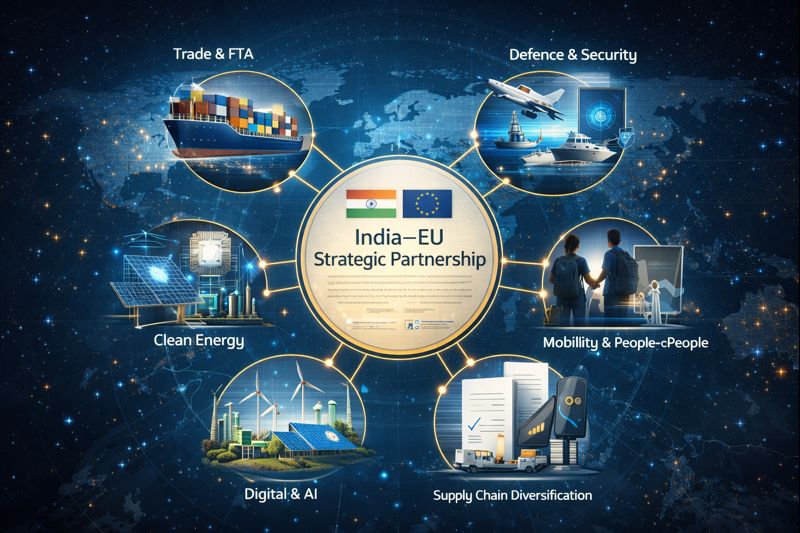
To properly understand the India–EU “Mother of All Deals,” it is essential to clarify some key terms and core concepts. These concepts explain the structure, scope, and strategic significance of this comprehensive agreement.

Free Trade Agreement (FTA)

A Free Trade Agreement is a formal arrangement between two or more countries or regional blocs aimed at reducing or eliminating tariffs, quotas, and other barriers to trade. The primary objective is to facilitate easier market access for goods and services, lower transaction costs, and promote cross-border commerce.

Strategic Partnership

A strategic partnership goes beyond economic cooperation and includes long-term collaboration in political, security, defence, technological, and diplomatic spheres. In the India–EU context, it signifies a shared commitment to work together on global challenges such as maritime security, cybersecurity, terrorism, and regional stability.

Tariff and Non-Tariff Barriers

Tariffs are taxes imposed on imported goods, while non-tariff barriers include standards, technical regulations, licensing requirements, and certification procedures. One of the central goals of this agreement is to reduce both types of barriers to make trade smoother and more predictable.

Recommended Product Top Choice

High Quality Utility Product

★★★★☆ 4.5/5

Designed for durability and everyday use. A reliable choice offering strong performance and great value.

  • ✔ Highly rated by customers
  • ✔ Durable and long-lasting
  • ✔ Excellent value for money
  • ✔ Ideal for everyday use
Check Price on Amazon

Mobility and People-to-People Connectivity

This concept refers to facilitating the movement of students, researchers, professionals, and skilled workers between India and the EU. The mobility framework seeks to simplify visa processes, encourage mutual recognition of qualifications, and expand opportunities for education, training, and employment.

Supply Chain Diversification

Supply chain diversification means reducing excessive dependence on a single country or source by developing multiple production and sourcing hubs. The India–EU deal supports this objective by encouraging companies to build more resilient, secure, and geographically diverse supply chains.

Defence Industry Cooperation

This involves collaboration in joint research and development, co-production, technology transfer, and manufacturing of defence equipment. It aligns closely with India’s “Make in India – Defence” initiative and aims to strengthen domestic defence capabilities.

Clean Energy and Green Transition

Clean energy refers to renewable sources such as solar, wind, and green hydrogen. Under this partnership, India and the EU intend to cooperate on climate action, energy transition, and the reduction of carbon emissions, supporting their respective sustainability goals.

Together, these core concepts demonstrate that the India–EU “Mother of All Deals” is not a conventional trade pact, but a multi-dimensional and long-term strategic framework designed to shape economic growth, security cooperation, and global governance.
Core Issues

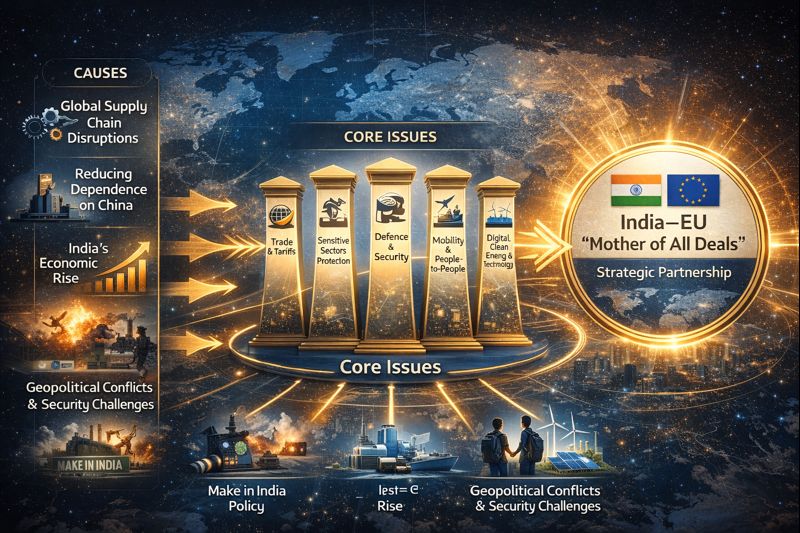
The India–EU “Mother of All Deals” is built around several interconnected priorities that together define its scale and strategic importance. These core issues extend well beyond traditional trade concerns and encompass economic, strategic, technological, and social dimensions.

Trade Liberalisation and Tariff Reduction

One of the central issues is large-scale reduction of tariffs on goods and services. Discussions include lowering India’s duties on European automobiles, machinery, and advanced equipment, while granting better market access to Indian exports such as textiles, pharmaceuticals, leather goods, and engineering products in the EU market. The overarching objective is to significantly expand bilateral trade volumes.

Protection of Sensitive Sectors

India has emphasised the need to safeguard sensitive sectors such as agriculture and dairy. Special provisions are being considered to ensure that these areas are not fully liberalised, thereby protecting farmers’ livelihoods and rural employment.

Security and Defence Cooperation

Alongside the trade agreement, India and the EU are pursuing a dedicated security and defence partnership covering maritime security, cybersecurity, counter-terrorism, and defence-industrial collaboration. This highlights the strategic nature of the broader engagement.

Mobility and People-to-People Connectivity

Another key issue is facilitating mobility for students, researchers, and professionals through simpler visa processes, mutual recognition of qualifications, and expanded opportunities for education, training, and employment.

Digital, Clean Energy, and Technology Cooperation

Strengthening cooperation in future-oriented sectors such as the digital economy, artificial intelligence, clean energy, green hydrogen, and climate technologies forms an important pillar of the agreement.

Together, these core issues demonstrate that the India–EU “Mother of All Deals” represents a comprehensive and multi-dimensional framework aimed at building a long-term strategic partnership.

Core Issues

The India–EU “Mother of All Deals” is widely regarded as a comprehensive and multi-dimensional agreement because it goes far beyond conventional trade arrangements. It integrates economic, strategic, technological, security, and social dimensions into a single cooperative framework. Understanding these core issues is essential to appreciate the true scope and significance of the partnership.

1. Trade Liberalisation and Tariff Reduction

A central pillar of the agreement is the large-scale reduction of tariffs on goods and services. India is considering lowering duties on European automobiles, machinery, medical equipment, and high-technology products, while the EU is expected to provide improved market access for Indian exports such as textiles, pharmaceuticals, leather goods, footwear, and engineering products. The overarching objective is to significantly expand bilateral trade volumes and improve competitiveness.

2. Protection of Sensitive Sectors

India has strongly emphasised the need to protect sensitive sectors such as agriculture and dairy. Special safeguard mechanisms and phased liberalisation are being discussed to ensure that farmers’ livelihoods and rural employment are not adversely affected.

3. Security and Defence Cooperation

Alongside the trade pillar, India and the EU are advancing a dedicated security and defence partnership covering maritime security, cybersecurity, counter-terrorism, and defence-industrial collaboration. This underlines the strategic nature of the overall engagement.

4. Mobility and People-to-People Connectivity

Facilitating mobility for students, researchers, and professionals through simplified visa procedures, mutual recognition of qualifications, and expanded opportunities for education, training, and employment is another key issue.

5. Digital, Clean Energy, and Technology Cooperation

Strengthening cooperation in future-oriented sectors such as the digital economy, artificial intelligence, clean energy, green hydrogen, and climate technologies forms an important pillar of the agreement.

Taken together, these core issues demonstrate that the India–EU “Mother of All Deals” represents a long-term strategic framework designed to reshape trade relations and deepen comprehensive cooperation between the two partners.

Causes / Factors

The India–EU “Mother of All Deals” is not the result of a sudden policy shift, but rather the outcome of multiple global, regional, and domestic developments. These factors have convinced both sides that a comprehensive strategic partnership—going beyond traditional trade relations—is necessary in today’s evolving international environment.

Recommended Product Top Choice

Premium Performance Product

★★★★☆ 4.6/5

Crafted for durability and smooth everyday use. A dependable option delivering strong quality and value.

  • ✔ Highly rated by customers
  • ✔ Durable and long-lasting
  • ✔ Excellent value for money
  • ✔ Ideal for everyday use
Check Price on Amazon

1. Global Supply Chain Disruptions

The COVID-19 pandemic and subsequent global shocks exposed serious vulnerabilities in international supply chains. Shortages of essential goods, medical supplies, and raw materials highlighted the risks of over-concentration in specific regions. Both India and the EU recognised the need to build more resilient and diversified supply chains.

2. Reducing Excessive Dependence on China

The European Union has become increasingly concerned about its heavy economic reliance on China, particularly in manufacturing and critical inputs. Amid rising geopolitical competition and strategic uncertainty, the EU is actively seeking reliable and like-minded partners. India, with its large market, democratic system, and growing industrial base, has emerged as a natural alternative.

3. India’s Rising Economic Potential

India is among the fastest-growing major economies in the world. Its large domestic market, young workforce, and strong services sector make it an attractive destination for European investors. This growing economic weight is a key factor driving deeper EU engagement with India.

4. Geopolitical Instability and Security Challenges

Conflicts such as the Russia–Ukraine war, instability in parts of the Middle East, the persistence of terrorism, and the rise of cyber threats have demonstrated that economic cooperation alone is insufficient. India and the EU increasingly see value in coordinating their approaches to security and defence.

5. India’s Policy Shift toward Self-Reliance and Global Integration

Through initiatives such as “Make in India” and “Atmanirbhar Bharat,” India aims to strengthen domestic manufacturing while simultaneously integrating more deeply into global value chains. The partnership with the EU aligns closely with this dual objective.

Taken together, these factors explain why the India–EU “Mother of All Deals” is not merely about boosting trade, but about addressing long-term strategic needs in a rapidly changing global order.
Impacts

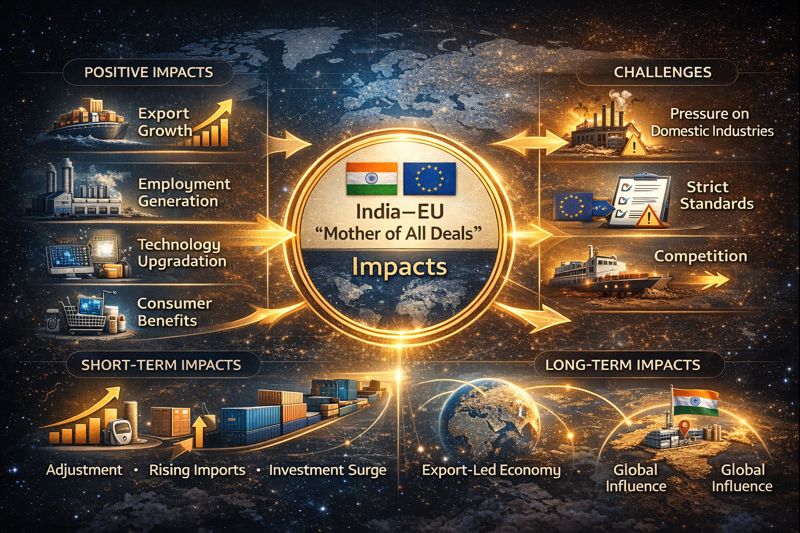
The India–EU “Mother of All Deals” is expected to have wide-ranging implications that go far beyond bilateral trade. It will influence India’s economy, industrial development, employment generation, consumer welfare, and global strategic position. These impacts can be broadly understood under positive, negative, short-term, and long-term dimensions.

Positive Impacts

1. Growth in Exports

Improved market access to the European Union for Indian textiles, pharmaceuticals, leather goods, engineering products, and IT services is likely to lead to a substantial increase in India’s exports. This will strengthen foreign exchange earnings and improve the overall trade balance.

2. Employment Generation

Higher production in manufacturing, textiles, food processing, auto components, and IT services can create millions of new jobs, particularly for youth and women. The agreement therefore has strong potential to support inclusive growth.

3. Technological Upgradation and Innovation

European investments and technology transfer will enable Indian industries to adopt advanced machinery and modern production processes, improving productivity and global competitiveness.

4. Benefits for Consumers

European cars, machinery, medical devices, and other high-quality products may become more affordable, giving Indian consumers access to better-quality goods at lower prices.

Recommended Product Top Choice

High Performance Utility Product

★★★★☆ 4.6/5

Designed for durability and everyday convenience. A dependable choice offering excellent quality and value.

  • ✔ Highly rated by customers
  • ✔ Durable and long-lasting
  • ✔ Excellent value for money
  • ✔ Ideal for everyday use
Check Price on Amazon

Negative Impacts

1. Competitive Pressure on Domestic Industries

Some Indian industries, especially those that are technologically less advanced, may face intense competition from European firms. Without adequate support, certain sectors could experience stress.

2. Compliance with Stringent Standards

EU’s strict environmental, labour, and quality standards could pose compliance challenges for small and medium enterprises (SMEs), requiring additional investments.

Short-Term Impacts

  • Adjustment pressures in selected sectors
  • Temporary rise in imports
  • Initial surge in foreign investment

Long-Term Impacts

  • India’s emergence as a global manufacturing and export hub
  • Strengthening of export-led growth model
  • Enhanced global strategic influence of India

Overall, while certain short-term challenges are inevitable, the long-term impacts of the India–EU “Mother of All Deals” are likely to be positive and transformative, provided appropriate policies and institutional support are in place.
Examples / Case Studies

To better understand the potential impact of the India–EU “Mother of All Deals,” it is useful to examine experiences from other countries and regions, as well as real-world examples of how comprehensive free trade agreements have influenced economic growth, exports, and industrial development.

1. European Union – Vietnam Free Trade Agreement (EU–Vietnam FTA)

After the EU–Vietnam Free Trade Agreement came into force in 2020, Vietnam witnessed a significant increase in exports to the European market. Sectors such as textiles, footwear, and electronics benefited the most from tariff reductions. Vietnamese products became more competitive in Europe, leading to higher production levels and job creation. This case demonstrates how preferential access to the EU market can transform export-oriented economies.

2. India–UAE Comprehensive Economic Partnership Agreement (CEPA)

Following the implementation of the India–UAE CEPA in 2022, bilateral trade expanded rapidly. Indian exports of gems and jewellery, textiles, pharmaceuticals, and food products gained stronger market access in the UAE. The agreement illustrates how a well-designed trade pact can deliver positive results even in the short term.

3. India’s Pharmaceutical Export Model

India has long been recognised as a global hub for generic medicines. Regulatory cooperation and trade arrangements with countries such as the United States and several African nations have enabled Indian pharmaceutical companies to access large markets. A similar framework with the EU could further strengthen India’s pharmaceutical exports and global standing.

4. International Collaboration in the Automobile Sector

India’s partnerships with Japanese and South Korean companies have played a crucial role in building a strong automobile and auto components industry. Technology transfer, joint ventures, and local manufacturing have turned India into a major automotive hub. Enhanced cooperation with European firms could accelerate this transformation, particularly in electric vehicles and advanced automotive technologies.

These case studies suggest that when free trade agreements are designed and implemented in a balanced and strategic manner, they can generate substantial gains in exports, investment, and employment.

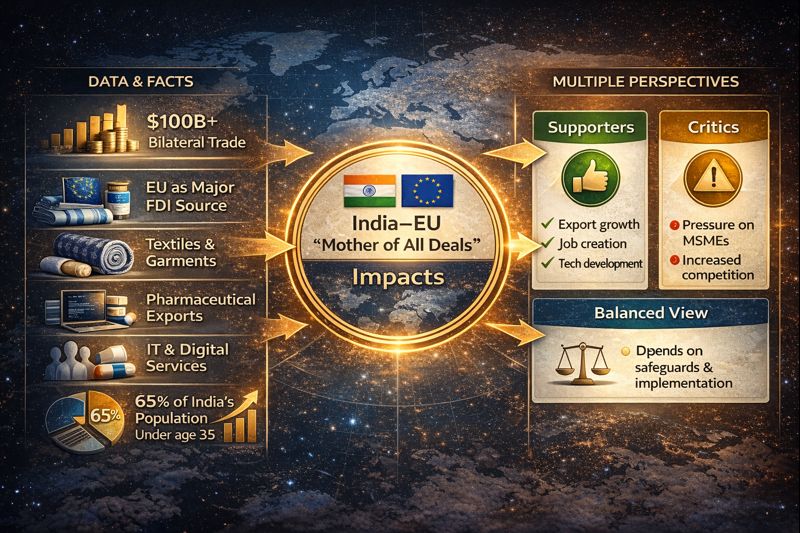
Data & Facts

Key data and factual indicators help illustrate the scale and significance of the India–EU “Mother of All Deals.” These figures highlight the depth of existing economic ties and the strong potential for future expansion.

India–EU Trade and Investment

  • The European Union is among India’s largest trading partners.
  • Bilateral trade between India and the EU is valued at over USD 100 billion.
  • The EU is one of the largest sources of foreign direct investment (FDI) in India.

Export and Sectoral Highlights

  • Textiles and garments constitute a major share of India’s merchandise exports.
  • India is the world’s leading exporter of generic medicines.
  • IT and digital services account for a significant portion of India’s services exports.

Employment and Demographics

  • Nearly 65% of India’s population is below the age of 35.
  • Millions of new jobs are required annually in manufacturing and services.

Global Economic Context

  • India is among the fastest-growing major economies in the world.
  • The EU represents one of the largest integrated markets globally.

These data points underline that the India–EU “Mother of All Deals” is not merely symbolic, but grounded in strong economic fundamentals and significant mutual interests.

Multiple Perspectives

The India–EU “Mother of All Deals” has generated a wide range of reactions among policymakers, industry leaders, economists, and civil society groups. Examining these differing perspectives is essential for a balanced and objective assessment of the agreement.

Supporters’ Perspective

Supporters argue that the agreement represents a historic opportunity for India. They believe it will provide greater access to European markets, boost exports, and attract foreign investment. From this viewpoint, the deal is seen as a catalyst for job creation, technological upgrading, and strengthening India’s position in the global economy.

Critics’ Perspective

Critics caution that excessive liberalisation could harm certain domestic industries and small businesses. They express concerns that increased competition from European firms and cheaper imports may put pressure on local producers and lead to uneven development.

Balanced Perspective

Neutral analysts maintain that the agreement is neither inherently beneficial nor inherently harmful. Its ultimate impact will depend on how effectively the government implements safeguard measures, supports micro, small and medium enterprises (MSMEs), and helps domestic industries enhance their competitiveness.

These diverse perspectives highlight that the India–EU “Mother of All Deals” is a complex and multi-dimensional initiative whose success will depend largely on careful design and prudent implementation.

Recommendations

To maximise the benefits of the India–EU “Mother of All Deals” and minimise potential risks, coordinated and forward-looking actions are required from the government, industry, and other stakeholders.

1. Strengthen MSMEs and Domestic Industries

The government should provide financial support, easier access to credit, technology upgradation assistance, and marketing support to micro, small, and medium enterprises (MSMEs) so that they can effectively compete in a more open market environment.

2. Invest in Skill Development and Human Capital

Skill development programmes must be aligned with evolving industry needs, particularly in manufacturing, IT, green technologies, healthcare, and advanced services, to ensure a job-ready workforce.

3. Safeguard Sensitive Sectors

Effective safeguard mechanisms should be implemented for agriculture, dairy, and other sensitive sectors to protect farmers’ livelihoods and rural employment.

4. Focus on Standards and Quality Upgradation

India should expand testing laboratories, certification facilities, and technical assistance programmes to help domestic producers meet stringent EU quality, environmental, and labour standards.

5. Create an Investment-Friendly Environment

A transparent regulatory framework, policy stability, and faster approval processes will make India more attractive to European investors.

By implementing these recommendations, India can transform the agreement into a strong foundation for sustainable growth, job creation, and enhanced global competitiveness.

Future Outlook

The India–EU “Mother of All Deals” should be viewed not only in terms of its immediate effects, but also through the lens of long-term transformation. The agreement has the potential to reshape India–EU relations and influence the broader global economic and strategic landscape.

1. India’s Emergence as a Global Manufacturing Hub

With increased European investment and technology transfer, India could strengthen its position as a major manufacturing centre, particularly in electronics, automobiles, pharmaceuticals, and green technologies.

2. Strengthening Export-Led Growth

Improved access to one of the world’s largest markets will support a more export-oriented growth model for India, enhancing long-term economic stability.

3. Leadership in Technology and Innovation

Cooperation in artificial intelligence, clean energy, cybersecurity, and digital services can position India as a key player in future technologies.

4. Expanded Global Strategic Role

Through deeper security and defence cooperation with the EU, India is likely to play a more active role in promoting global stability and a rules-based international order.

Overall, the agreement could serve as a cornerstone for a shared and prosperous future for both India and the European Union.

Conclusion

The India–EU “Mother of All Deals” should not be viewed merely as a trade agreement. It represents a comprehensive and multi-dimensional framework that brings together trade, investment, security, technology, energy, and people-to-people cooperation.

Through this deal, India stands to gain improved access to European markets, increased investment inflows, technological upgradation, and expanded employment opportunities. At the same time, the EU benefits from reducing its excessive dependence on China, strengthening supply chains, and deepening engagement with one of the world’s fastest-growing major economies.

While certain challenges remain—particularly for domestic industries and small businesses—these can be effectively addressed through appropriate policy support, safeguard mechanisms, and sustained investment in skills and competitiveness.

Overall, the India–EU “Mother of All Deals” has the potential to reshape bilateral relations and enhance India’s role in the global economic and strategic order. It may well emerge as a defining partnership of the 21st century.

Leave a Comment

Your email address will not be published. Required fields are marked *

Scroll to Top