
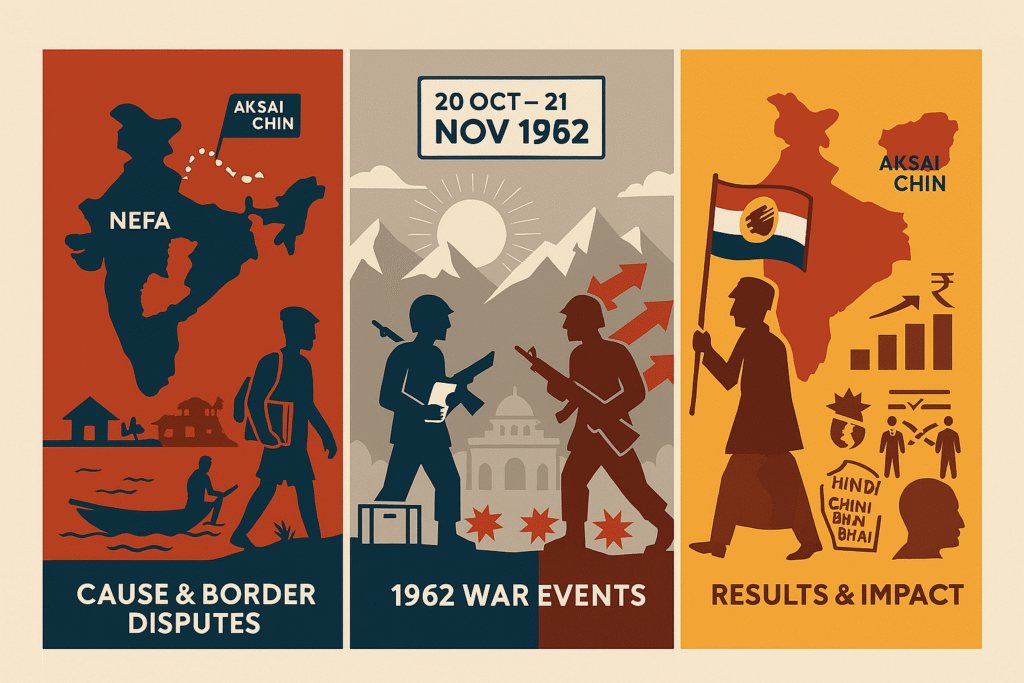
India–China War 1962: Main Controversy
The background of the India - China War 1962 was deeply rooted in border disputes, political disagreements, geographical complexities, and diplomatic tensions. Below is a clear and expanded explanation of the major controversies that led to the conflict.
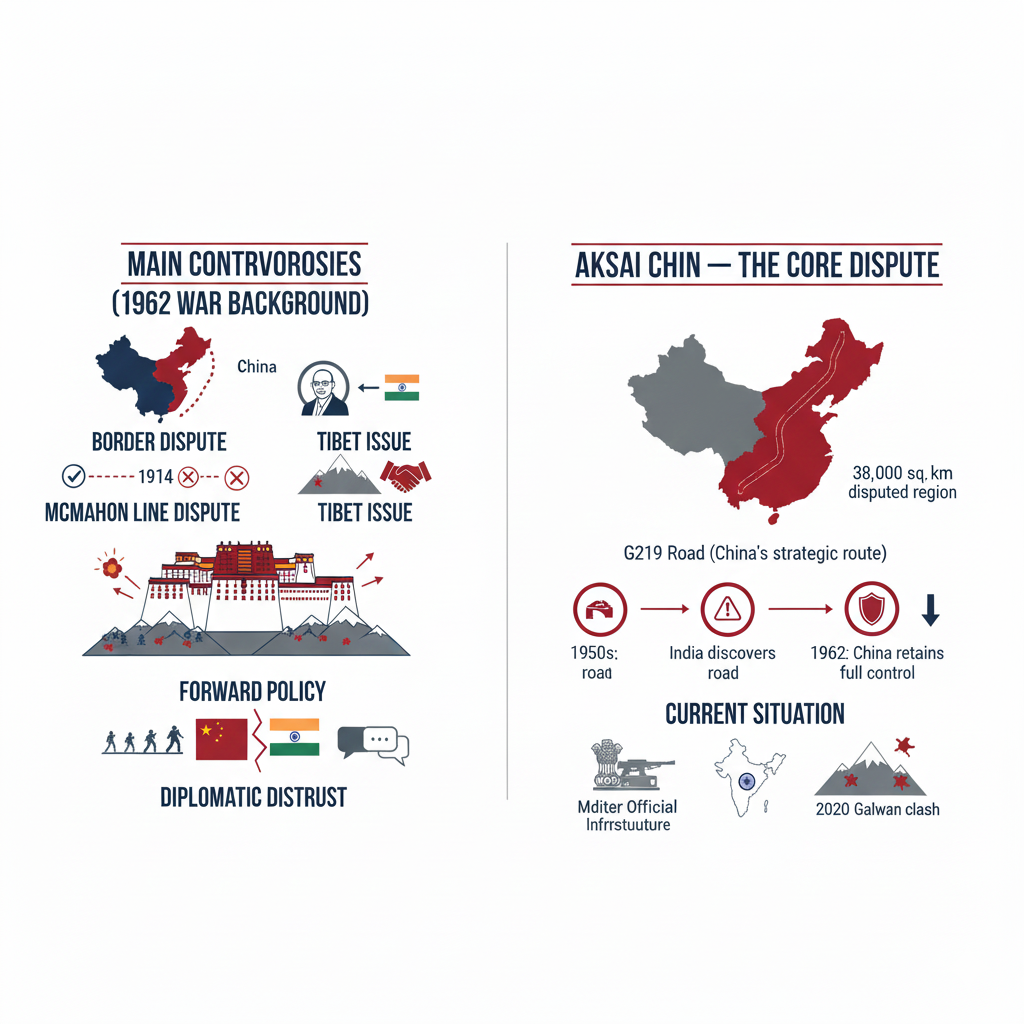
1. 🗺️ Border Dispute
A. Aksai Chin Region (Western Sector)
India’s stance: Aksai Chin is a part of Jammu & Kashmir (now Ladakh).
China’s stance: In the 1950s, China built National Highway G219 through Aksai Chin, connecting Xinjiang to Tibet.
India discovered this road years later, increasing tensions dramatically.
B. Arunachal Pradesh / NEFA Region (Eastern Sector)
- India considers this region an integral part of its territory (today's Arunachal Pradesh).
- China calls it “South Tibet” and claims it historically belonged to Tibet.
- China never formally recognized the McMahon Line (1914), while India accepts it as a legal border.
2. 🏔️ Controversy Over the McMahon Line
The McMahon Line was drawn during the 1914 Shimla Agreement between British India and Tibet.
- China rejected the agreement as illegal, claiming Tibet was not a sovereign party.
- India considers the McMahon Line its legitimate eastern boundary.
3. 🕉️ Tibet Issue
In the 1950s, China took full military control over Tibet.
- In 1959, the Dalai Lama fled Tibet and took asylum in India.
- China viewed India’s action as interference in its internal affairs.
- This event significantly damaged India–China relations.
4. 🛡️ India’s Forward Policy
India began establishing new military outposts near the border to monitor Chinese activities.
- China interpreted this as a provocation and an aggressive strategy.
- It increased military tension along both eastern and western sectors.
5. 🏴☠️ Diplomatic Distrust and Lack of Communication
- Multiple rounds of boundary negotiations between India and China failed.
- China accused India of expanding influence in South Asia.
- Both nations had differing political perspectives and strategic goals, making resolution difficult.
🔚 Conclusion
The major controversies behind the 1962 India–China War were:
- Conflicting territorial claims over Aksai Chin and Arunachal Pradesh
- Disagreement over the validity of the McMahon Line
- Tibet issue and the Dalai Lama’s asylum in India
- Forward Policy and military activities near the border
Together, these factors pushed India and China into a border conflict with long-lasting effects.
Aksai Chin – The Center of the India–China Controversy
Aksai Chin is one of the most sensitive and disputed regions between India and China. It lies between India’s Ladakh and China’s Xinjiang–Tibet region. It was one of the primary triggers of the 1962 war.
1. 📍 Where is Aksai Chin?
Water Quality TDS Meter – Digital Tester
Check your drinking water quality instantly with this easy-to-use TDS (Total Dissolved Solids) meter. Perfect for home, office or travel.
👉 Buy on Amazon(Amazon Affiliate Link – Thanks for supporting!)
| Description | Information |
|---|---|
| Area | Approx. 38,000 sq km |
| India’s Claim | Part of Jammu & Kashmir (now Ladakh) |
| China’s Claim | Land between Xinjiang and Tibet |
| Present Status | Under Chinese control since the 1962 war |
2. 🧭 Geographic Importance of Aksai Chin
- Aksai Chin is a cold, high-altitude desert with minimal rainfall.
- China constructed the G219 highway here, connecting Xinjiang and Tibet.
- This road is of immense strategic value to China.
3. 🕰️ Historical Background
| Period | Event |
|---|---|
| British Era | British India included Aksai Chin in its maps but had no active control. |
| Post-Independence | India declared it part of its territory, but China began developing roads. |
| 1958 | India discovered that China had already built a road through Aksai Chin. |
| 1962 | After the war, China fully consolidated its control. |
4. ⚔️ Aksai Chin and the 1962 War
- India opposed China’s occupation but did not respond aggressively.
- China claimed it was protecting its essential supply route.
- After the war, China retained complete control of Aksai Chin.
5. 🧩 Current Situation
- India still shows Aksai Chin within its official maps and calls China’s presence an “illegal occupation.”
- China has strengthened military infrastructure in the region.
- Post-2020 Galwan clashes have further increased tensions near Aksai Chin.
6. 🔍 Final Conclusion
Aksai Chin remains one of the most complex and sensitive issues between India and China, involving history, geography, strategy, and diplomacy. It is far more than just a piece of land — it symbolizes sovereignty and security concerns for both nuclear powers.
Must-Have Amazon Product
Discover this top-rated product on Amazon — high quality, great value, and perfect for your daily needs. Tap below to check latest price & reviews!
👉 View on Amazon(Amazon Affiliate Link – Thank you for your support!)
Arunachal Region (Then NEFA) – The Eastern Face of the India–China Border Dispute
The Arunachal region, earlier known as NEFA (North-East Frontier Agency), was one of the major disputed areas during the India - China War 1962 . China still refers to this region as “South Tibet” and continues to claim sovereignty over it.
1. 📍 Geographic Situation
| Description | Information |
|---|---|
| Present Name | Arunachal Pradesh (State of India since 1987) |
| Old Name | NEFA (North-East Frontier Agency) |
| Boundaries | North – Tibet (China), South – Assam, East – Myanmar |
| Important Cities | Itanagar (Capital), Tawang, Pasighat, Bumla Pass |
2. 📖 Historical Background
🔹 The McMahon Line
- The McMahon Line was drawn in the 1914 Shimla Agreement between British India and Tibet.
- India considers it a valid and legal boundary.
- China rejects it, arguing that Tibet lacked sovereignty at the time; therefore, the agreement is invalid.
3. 🧘♂️ Tawang and Buddhist Significance
Tawang Monastery is one of the most sacred places of Tibetan Buddhism. The Sixth Dalai Lama was born here, making the region historically and culturally important to Tibet.
China considers this heritage as evidence that Tawang — and parts of Arunachal — belong to Tibet.
4. ⚔️ Role of NEFA During the 1962 War
- On 20 October 1962, China launched a major attack in the NEFA (now Arunachal Pradesh) region.
- Chinese forces advanced rapidly, capturing Tawang and several other areas.
- On 21 November 1962, China declared a unilateral ceasefire and withdrew from the NEFA region.
- However, China did not withdraw from the western sector (Aksai Chin).
5. 🛡️ Present Situation
| India’s Position | China’s Position |
|---|---|
| Arunachal Pradesh is an integral part of India. | China calls it “South Tibet” and claims sovereignty. |
| Democratic government and full state administration exist. | China objects to visits by Indian leaders to Arunachal. |
| India issues regular visas to residents. | China issues “stapled visas” to Arunachal residents, implying they are not Indian citizens. |
| India has strengthened border infrastructure—roads, airports, and military posts. | China has increased pressure through diplomatic statements and border activities. |
6. 🧩 Conclusion
NEFA (now Arunachal Pradesh) remains one of the most politically, religiously, and strategically sensitive regions in the India–China border dispute. India firmly considers it an inseparable part of the nation, whereas China views it as historically linked to Tibet.
India–China War 1962 – Chief Reasons Explained
The India - China War 1962 was not caused solely by border disputes. It was the result of multiple political, strategic, diplomatic, and historical factors. Below is a clear and expanded explanation of the major reasons.
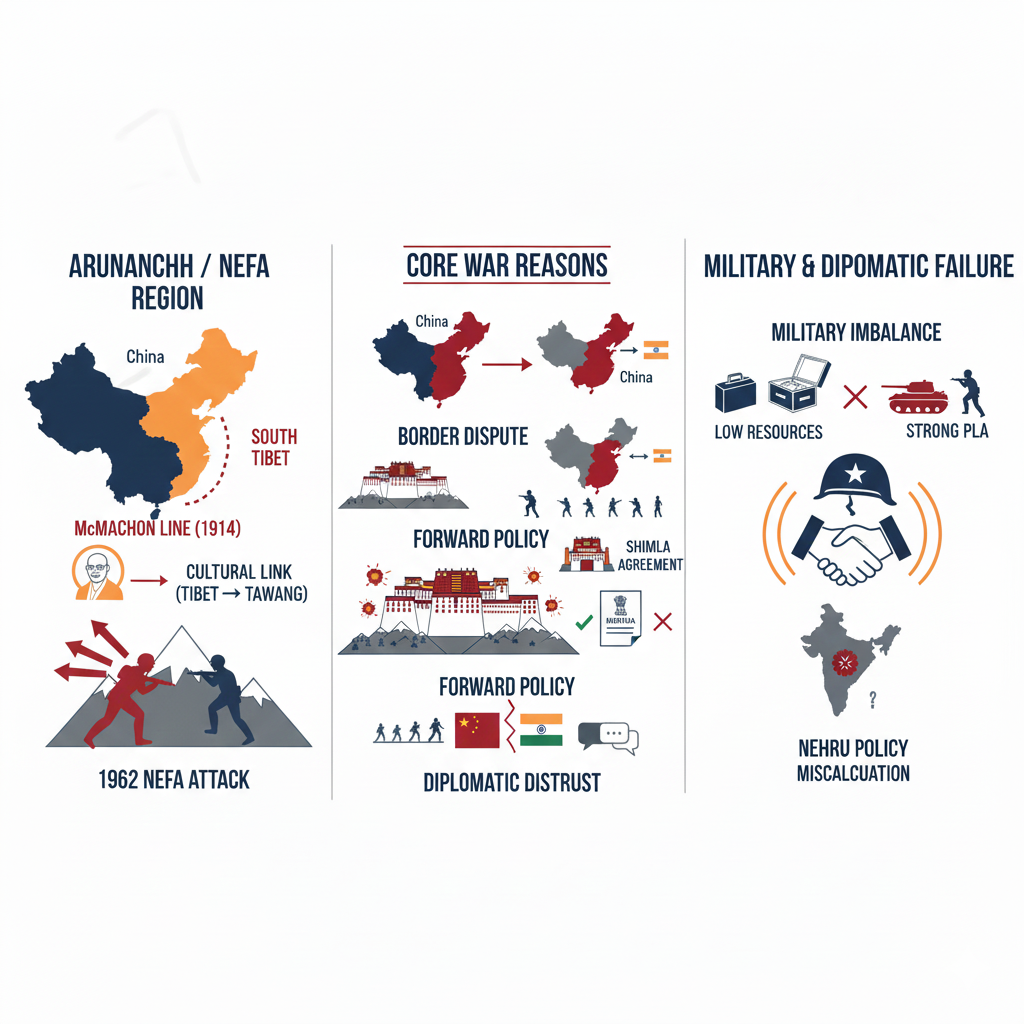
1. 🗺️ Border Dispute
- The border between India and China was not clearly demarcated.
- India recognized the McMahon Line (east) and Aksai Chin (west) as part of its territory.
- China made counterclaims over both regions:
Chinese Claims:
- Aksai Chin: China considered it essential for its Xinjiang–Tibet link route.
- Arunachal/NEFA: China referred to it as “South Tibet.”
2. 🕊️ Tibet and the Dalai Lama Issue
- China occupied Tibet in the 1950s.
- In 1959, the Dalai Lama fled to India and was granted asylum.
- China accused India of interfering in its internal affairs.
- This severely strained diplomatic relations.
3. 🔫 India’s Forward Policy
- Between 1959–1961, India built small military posts along the border.
- The aim was to monitor and block Chinese intrusions.
- China saw these posts as provocative and aggressive.
4. 🛣️ Road Construction in Aksai Chin
- China secretly built a 179 km-long road (G219) through Aksai Chin.
- The road connected Xinjiang to Tibet and was strategically vital for China.
- India discovered this only in 1958 and raised strong objections.
5. 📜 Dispute Over Validity of the McMahon Line
India’s View:
The McMahon Line was legally established in the 1914 Shimla Agreement.
China’s View:
China considered it an “illegal colonial boundary” since it never accepted the Shimla Agreement.
6. 🪖 Uneven Military Preparation
- India’s army lacked adequate mountain warfare training and equipment.
- Shortages included winter clothing, modern weapons, and logistics support.
- China’s PLA was better prepared, experienced, and organized.
7. 🤝 Diplomatic Failures and Miscommunication
- No effective diplomatic solution was reached despite repeated negotiations.
- Mutual distrust and misunderstandings escalated tensions.
8. 🧠 Nehru’s “Idealist Foreign Policy”
- Prime Minister Nehru strongly believed in peaceful coexistence (Panchsheel).
- India underestimated China’s strategic intentions.
- This led to weak defense preparedness and strategic miscalculations.
🧩 Final Conclusion
The India - China War 1962was not just a border conflict. It resulted from:
- Ambiguous border demarcation
- Tibet and Dalai Lama issues
- Forward Policy tensions
- Military imbalance
- Lack of diplomatic communication
The war completely changed India’s defense strategy, China policy, and approach to national security.
India – China War 1962 – Major Incidents
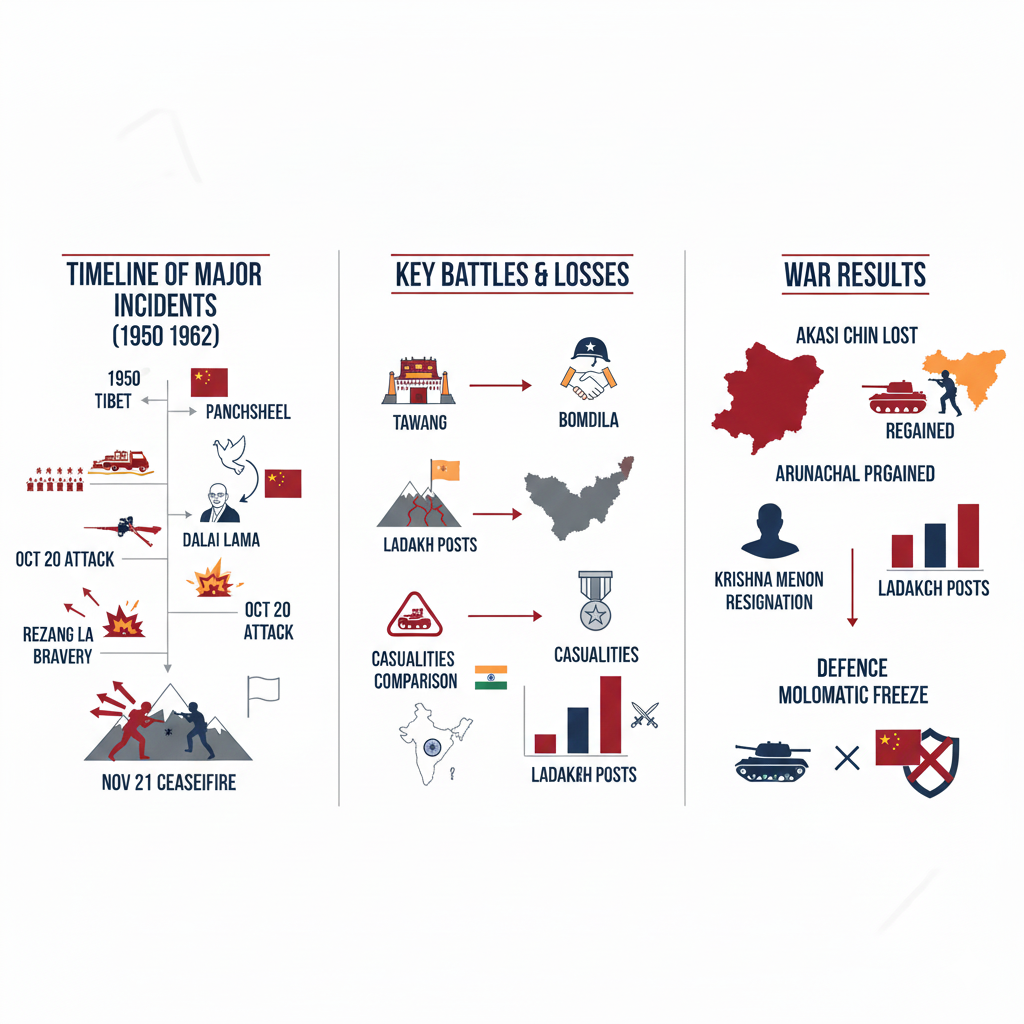
The India - China War 1962 lasted for about one month (20 October to 21 November 1962), but its background and build-up had begun years earlier. Below are the major incidents of the war arranged chronologically.
🧩 Background (1950–1961)
| Year | Event |
|---|---|
| 1950 | China occupied Tibet and established full control. |
| 1954 | Panchsheel Agreement signed – “Hindi-Chini Bhai Bhai” era began. |
| 1957 | China built a road through Aksai Chin; India discovered it in 1958. |
| 1959 | The Dalai Lama fled to India. Border clashes occurred at Longju and Kongka La. |
| 1961 | India initiated the “Forward Policy” – establishing border outposts. |
🔥 Major Incidents of the War (1962)
📅 20 October 1962 – Beginning of the War
- China launched simultaneous attacks on the Eastern (NEFA/Arunachal) and Western (Ladakh) borders.
- Heavy assault on Tawang; China captured the region.
📅 24–28 October 1962
- Chinese forces advanced rapidly in Arunachal, reaching Bomdila.
- In Ladakh, several Indian posts were completely surrounded.
📅 29 October – 13 November 1962
- A temporary ceasefire-like atmosphere emerged, but no settlement occurred.
- India prepared for defence, but resources and readiness were inadequate.
📅 14–20 November 1962
- China launched another major assault, targeting Bomdila and nearby areas.
- Indian forces were forced to withdraw; many soldiers were killed or captured.
⚔️ Battle of Rezang La – 18 November 1962
- The 13 Kumaon Regiment under Major Shaitan Singh fought heroically.
- Most soldiers attained martyrdom.
- Major Shaitan Singh was posthumously awarded the Param Vir Chakra.
📅 21 November 1962 – Ceasefire
- China declared a one-sided ceasefire.
- Chinese troops withdrew from NEFA (Arunachal region).
- However, China retained full control over Aksai Chin.

Awesome Amazon Product
Check out this great product available on Amazon — quality you can trust! Click the button below for the latest price, features, and customer reviews.
👉 View on Amazon(Amazon Affiliate Link – Thank you!)
📉 Summary of War Losses
| Party | Loss/Outcome |
|---|---|
| India | • Around 1,383 soldiers martyred • 1,696 soldiers injured • 3,968 soldiers taken prisoner • Numerous posts and weapons lost |
| China | • Estimated 600–700 casualties • Achieved strategic victory with limited losses |
🧠 Conclusion
The major incidents of the 1962 war show that India’s military and political preparation was weak, while China planned and executed its operations strategically. The war was a painful defeat for India, but it also became a major lesson for future defence reforms.
India – China War 1962 – Results
The results of the India - China War 1962 were felt at military, political, geographical, diplomatic, and psychological levels. China gained significant strategic advantage, while India underwent major restructuring in its defence and foreign policy.
⚔️ 1. Military Results
| Party | Result |
|---|---|
| 🇮🇳 India | • 1,383 soldiers martyred • 1,696 soldiers injured • 3,968 soldiers taken prisoner • Loss of posts, weapons, and strategic positions |
| 🇨🇳 China | • Estimated 722 casualties • Achieved strategic victory with minimal losses |
🗺️ 2. Geographic Results
| Area | Result |
|---|---|
| Aksai Chin (Ladakh) | • China gained permanent control over ~38,000 sq km • Remains a disputed region; India calls it “illegal occupation” |
| Arunachal Pradesh (NEFA) | • China temporarily captured regions in 1962 • Withdrew after ceasefire; India regained full control |
🏛️ 3. Political Results
- Nehru government's prestige suffered a major setback.
- Public and Parliament expressed strong dissatisfaction.
- Defence Minister Krishna Menon resigned.
- The “Hindi-Chini Bhai Bhai” era collapsed; India’s China policy changed completely.
🛡️ 4. Military and Defence Policy Shift
- Massive increase in defence expenditure after the war.
- Formation of the “India–China Border Commission” in 1963.
- Rapid military modernization and expansion.
- Increased collaboration with the USSR and the USA.
- India’s strong performance in the 1965 and 1971 wars reflected improved preparedness.
🌐 5. Diplomatic Effects
- India sought international support, especially from the US and UK.
- The US provided weapons and air support, though limited.
- India adopted a more practical approach to non-alignment.
- India–China relations remained frozen; ambassador-level ties restored only in 1976.
📜 6. Public Sentiments and Psychological Impact
- The war deeply shocked Indian society.
- Public trust in Nehru’s policies declined.
- Awareness about national security and borders increased significantly.
📌 Final Conclusion
The results of the 1962 war included loss of territory, military casualties, and political setbacks. However, these outcomes laid the foundation for a stronger India. Post-1962, India restructured its defence forces, modernized strategy, and emerged as a more powerful nation — evident in the successes of 1965 and 1971.
India – China War 1962 – Effects on India
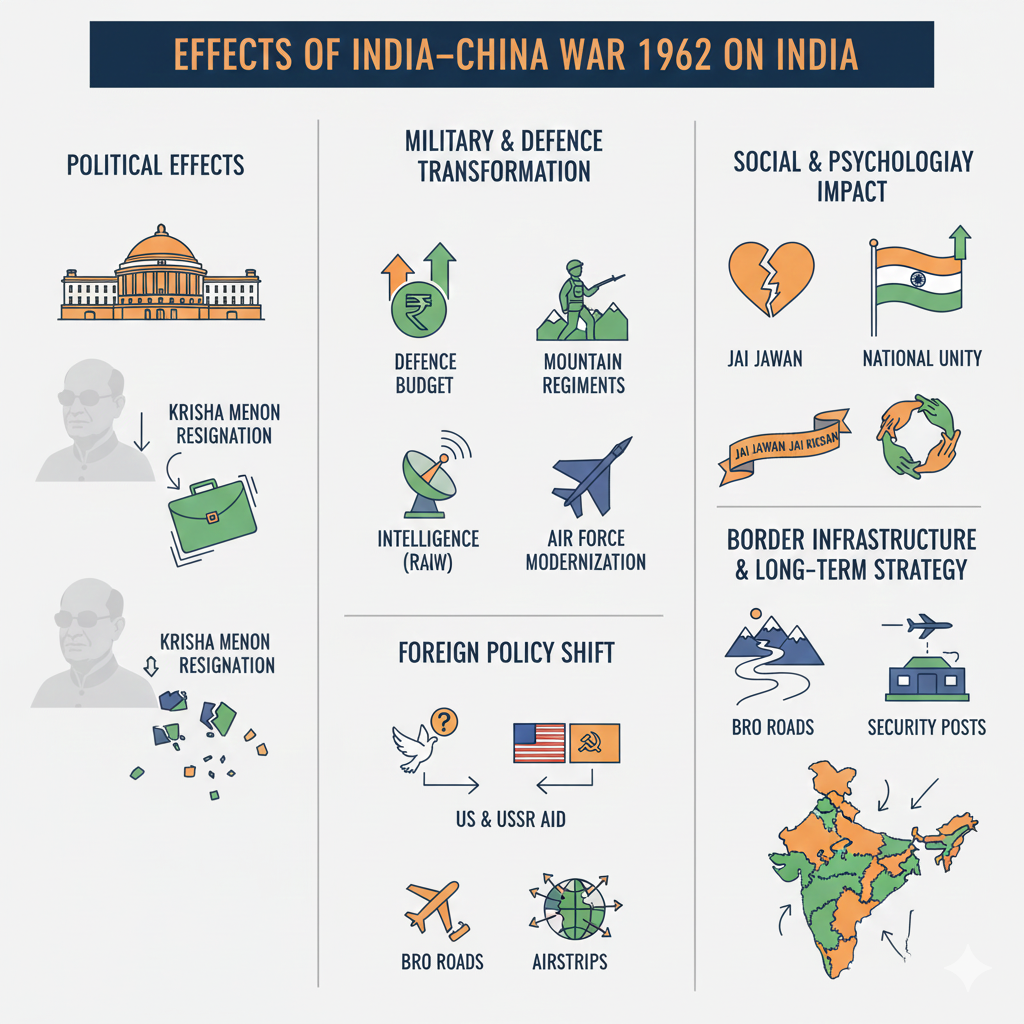
The India - China War 1962 had multi-dimensional impacts on India — political, social, military, diplomatic, and psychological. The war acted as a wake-up call, compelling India to rethink its defence preparedness and foreign policy approach.
🏛️ 1. Political Effects
- Prime Minister Jawaharlal Nehru’s popularity was significantly affected.
- The public and Parliament questioned why the government failed to identify China’s intentions in time.
- Defence Minister V. K. Krishna Menon faced heavy criticism and ultimately resigned.
- The opposition became stronger, and national security issues became central to political debate.
🛡️ 2. Military and Security Policy Shift

Awesome Amazon Product
Check out this great product available on Amazon! Click below for the latest price, features, and reviews.
👉 View on Amazon(Amazon Affiliate Link – Thank you!)
🔹 Increased Defence Budget
- After 1962, India drastically increased its defence spending.
- New weapon systems, expansion of the army, and construction of border posts began.
🔹 Modernization of the Armed Forces
- Reorganization of the army, creation of mountain regiments, and establishment of new training institutions.
- The Indian Air Force and artillery were also upgraded.
🔹 Strengthened Intelligence System
- The Research and Analysis Wing (R&AW) was established in 1968, influenced by lessons from the war.
🌐 3. Shifts in Foreign Policy
- Nehru’s idealistic Panchsheel approach faced criticism.
- India adopted a more realistic, strategic, and interest-driven foreign policy.
- Although non-aligned, India increased cooperation with both the US and the Soviet Union.
- Border vigilance and diplomatic caution increased significantly.
🧠 4. Psychological and Social Effects
- The war affected India’s national confidence.
- The belief that China was a “brotherly nation” collapsed.
- Patriotism and national unity strengthened.
- Respect for the armed forces increased widely—popular slogans like “Jai Jawan Jai Kisan” emerged after this period.
📚 5. Academic and Strategic Changes
- The government established new strategic institutions such as IDSA and NDC.
- Research on geopolitics, border studies, and national security gained momentum.
🛣️ 6. Development of Border Infrastructure
- India lagged behind China in border infrastructure before 1962.
- After the war, the Border Roads Organisation (BRO) accelerated construction.
- Roads, airstrips, and essential facilities in Northeast India and Ladakh expanded rapidly.
📌 Conclusion
The 1962 war was a harsh reality check for India. It taught that:
- Peaceful intentions alone are not enough—border security is paramount.
- Diplomacy must be backed by military strength and intelligence.
- India must remain vigilant and strategically prepared.
After the war, India strengthened its army, made foreign policy more practical, and prepared comprehensive plans for border security.
India – China War 1962 – Final Conclusion
The India - China War 1962 marked a major turning point in India’s history. It was not just a border conflict but a serious test of India’s foreign policy, defence capacity, and national unity.
✍️ Key Takeaways
1. 🔥 Border Security Is Supreme
Peaceful relations are important, but border security cannot be compromised. The war proved that diplomacy must be supported by strong defence capabilities.
2. 🛡️ Need for a Strong Army and Defence System
India modernized its military, increased defence spending, and strengthened frontline capabilities after the war.
3. 🌐 Realistic Foreign Policy
The idealistic “Hindi–Chini Bhai Bhai” phase ended. India shifted to a more practical, balanced, and interest-based approach in global affairs.
4. 🧠 Political and Social Awareness
The war compelled India to self-reflect. Public understanding of defence, borders, and diplomacy deepened significantly.
5. 🇨🇳 Re-evaluation of China
India now saw China as a strategic challenge rather than a friendly neighbour. This shaped long-term caution and distance in bilateral relations.
✅ Holistic Conclusion
“The 1962 war was not just a military defeat; it was a warning that guided India toward becoming a stronger nation.”
After 1962, India learned, reorganized, and prepared — leading to remarkable improvements seen in the 1965 and 1971 wars.