Eternal Religion: The Four Vedas and Their Subdivisions
The Vedas are the foundational Shruti texts of Hinduism. This article explains the four Vedas — Rigveda, Yajurveda, Samaveda and Atharvaveda — and the four canonical subdivisions that each Veda contains.
(A) The Four Vedas
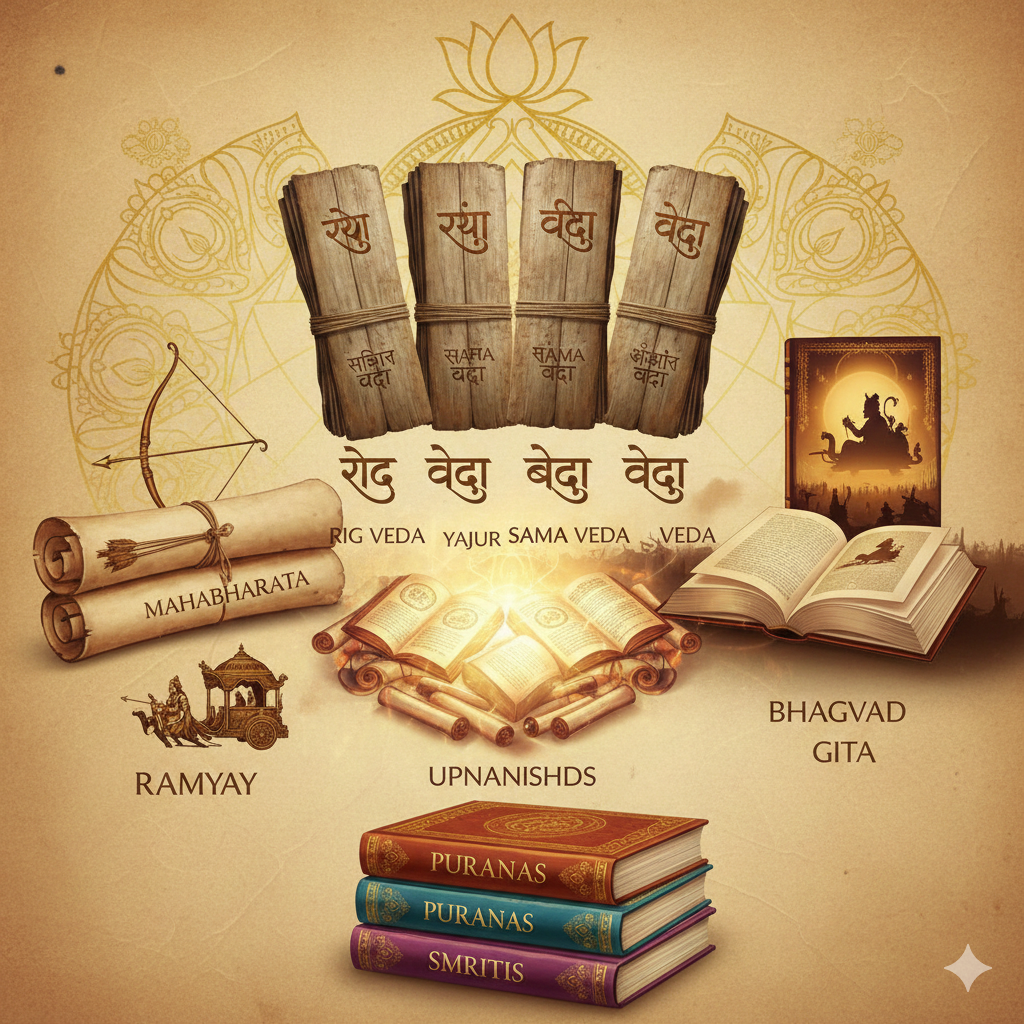
In Hindu tradition the Vedas are regarded as śruti — divinely heard and apauruṣeya (not authored by any human). The four Vedas are Rigveda, Yajurveda, Samaveda and Atharvaveda. Together they contain spiritual, ritual, practical and philosophical knowledge that connects to all spheres of life and the universe.
1. Rigveda
The oldest of the Vedas (approx. 1500–1200 BCE). It contains about 1,028 hymns, traditionally arranged in ten books (maṇḍalas). The hymns praise many deities (Indra, Agni, Varuṇa, Sūrya, Uṣā, etc.) and use Vedic Sanskrit.
- Topics: hymns, praise, prayer, philosophy, natural forces
- Notable suktas: Agni Sūkta, Puruṣa Sūkta, Nasadiya Sūkta
- Features: source for early civilization, ritual practice, and spiritual inquiry into Brahman
2. Yajurveda
The ritual manual of the Vedas: formulas, sacrificial procedures and priestly duties. The Yajurveda exists in two broad recensions — Kṛṣṇa (Black) Yajurveda (with mixed prose and verses) and Śukla (White) Yajurveda (more systematic). Important branches include the Taittirīya Saṃhitā and the Vājasaneyi recension.
- Topics: yajña mantras, sacrifice rules, priestly rites
- Features: practical guidance for sacrificial rites and moral/social discipline
3. Samaveda
Often called the "musical Veda" — many Samaveda verses are taken from the Rigveda but set to melody for singing during rituals. It includes about 1,549 verses and focuses on liturgical chant.
- Use: sung during yajñas and temple rituals
- Features: roots of Indian music and devotional expression
4. Atharvaveda
A Veda closely linked to everyday life, healing and folk practices. It contains prayers, charms, medical formulas and about 730 verses with roughly 6,000 mantras in traditional counts. The Paippalāda branch is a well-known recension.
- Topics: disease prevention, herbs, charms, domestic rites, planetary influences
- Features: early source of Vedic Ayurveda and astrological lore
Comparative Summary
| Veda | Chief Subject | Speciality |
|---|---|---|
| Rigveda | Hymns and praises | Foundational knowledge and devotional hymns |
| Yajurveda | Ritual formulas and procedures | Practical ritualism and sacrificial law |
| Samaveda | Sung mantras and melodies | Musical expression of devotion |
| Atharvaveda | Folk life, healing and charms | Practical, medicinal and mystical knowledge |
Conclusion: Together, the four Vedas form the eternal base of the religion — not merely ritual manuals but guides to science, philosophy, ethics, society, health and public life.
(B) Subdivisions of the Vedas
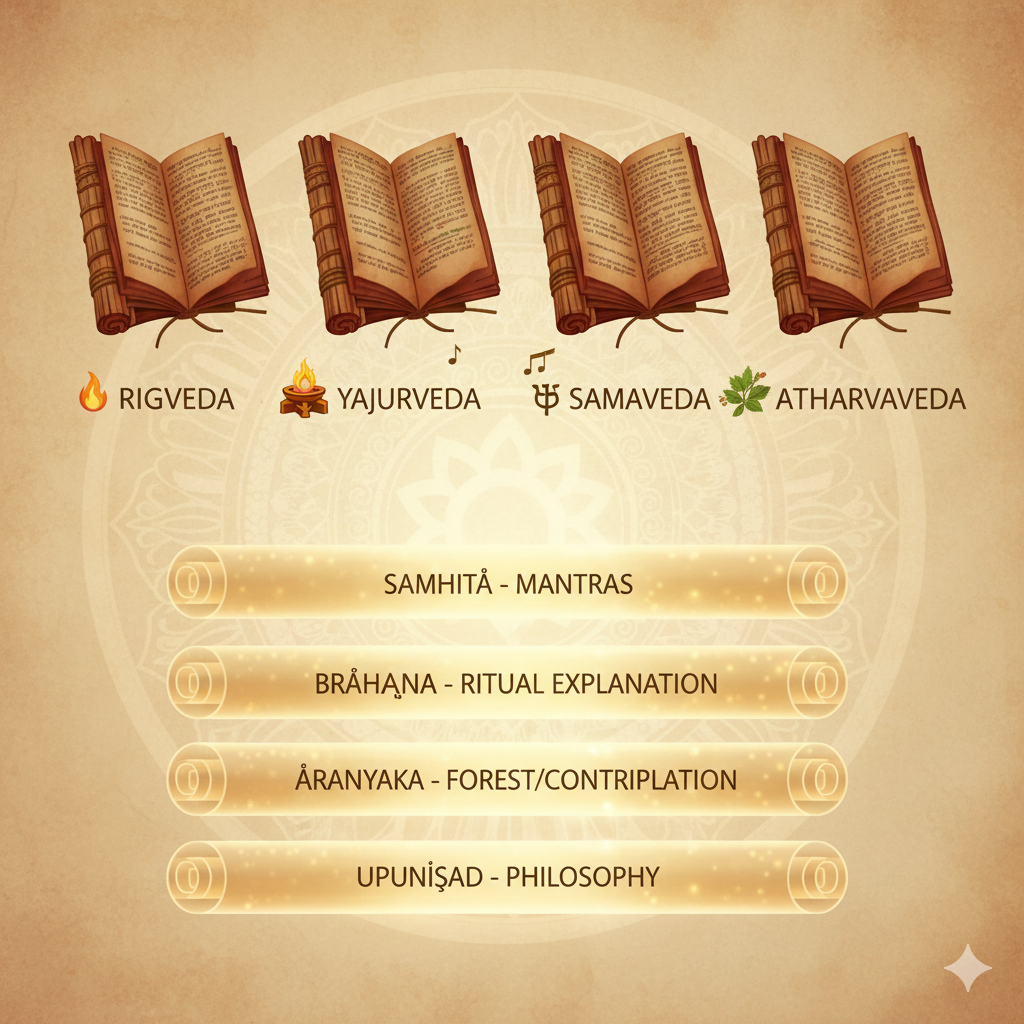
Each Veda is traditionally divided into four major sections (the fourfold division is often called the catur-aṅga or "four limbs"). These subdivisions address different aspects of religious life: mantra (saṃhitā), ritual explanation (brāhmaṇa), contemplative practice (āraṇyaka) and spiritual knowledge (upaniṣad).
The Four Subdivisions
| Subdivision | Meaning | Objective |
|---|---|---|
| Saṃhitā | Collection of mantras | Hymns, sacrificial mantras and rituals |
| Brāhmaṇa | Ritual prose and explanations | Method, meaning and performance of yajñas |
| Āraṇyaka | Forest texts | Meditation, symbolic ritual, retreat and contemplative practice |
| Upaniṣad | Sitting near the teacher — esoteric teaching | Philosophy: Brahman, ātman, moksha — spiritual knowledge |
1. Saṃhitā
The Saṃhitā is the oldest core: collections of mantras and hymns used in ritual. Examples:
- Rigveda Saṃhitā — collection of Rigvedic hymns.
- Samaveda Saṃhitā — melodies and musical arrangements.
- Yajurveda Saṃhitā — yajña mantras for sacrificial rites.
- Atharvaveda Saṃhitā — domestic and tantric mantras.

Amazon Product Title Here
Discover reliable performance and practical features with this high-quality product built for daily use. Its durable construction and comfortable design ensure ease of operation, making it a perfect choice for both everyday needs and professional tasks.
🛒 Check Price on Amazon* As an Amazon Associate I earn from qualifying purchases.
2. Brāhmaṇa
Brāhmaṇas are prose texts that explain the meaning and application of ritual actions and mantras. They often include mythological narratives and symbolic exegesis. Notable examples include the Śatapatha Brāhmaṇa (Śukla Yajurveda) and the Aitareya Brāhmaṇa (Rigveda).
3. Āraṇyaka
The Āraṇyakas ("forest books") are transitional texts between ritual exegesis and philosophical inquiry. Traditionally associated with hermits and forest-dwelling ascetics, Āraṇyakas focus on internalized meanings of ritual and contemplative practices. Examples: Bṛhadāraṇyaka, Taittirīya Āraṇyaka, Aitareya Āraṇyaka.
4. Upaniṣads
The Upaniṣads represent the philosophical culmination of the Vedic tradition (often called Vedānta). They deal with the ultimate reality (Brahman), the nature of the self (ātman), and the path to liberation (moksha). There are around 108 principal Upaniṣads; well-known ones include Īśa, Kaṭha, Muṇḍaka, Māṇḍūkya, Chāndogya and Bṛhadāraṇyaka.
- Famous Upanishadic sayings: “Ahaṁ brahmāsmi” (I am Brahman), “Tat tvam asi” (Thou art that), “Sarvam khalvidam brahma” (All this is Brahman).
Summary Table
| Subdivision | Chief Subject | Objective |
|---|---|---|
| Saṃhitā | Vedic mantras | Ritual and praise |
| Brāhmaṇa | Ritual explanation | Meaning and method of yajña |
| Āraṇyaka | Contemplative practice | Retreat, meditation and symbolism |
| Upaniṣad | Philosophy and liberation | Spiritual knowledge and insight |
Conclusion: The fourfold structure of each Veda—Saṃhitā, Brāhmaṇa, Āraṇyaka and Upaniṣad—reflects a complete system guiding action (karma), devotion (upāsanā) and knowledge (jnāna). This structure gives seekers the full spectrum: from ritual practice to contemplative withdrawal and ultimately to the pursuit of liberation.
Final Thoughts
The Vedas are not a narrow religious code but a vast treasury of spiritual, social and practical wisdom. Understanding their divisions helps modern readers appreciate how ritual, music, medicine, philosophy and ethics were integrated in an ancient but living tradition.
Memory Texts (Smriti) – Human-Composed Scriptures of Eternal Religion
Hindu scriptures are broadly divided into two categories: Shruti (God-given, non-human, e.g., Vedas) and Smriti (human-composed texts based on Shruti).
2. Smriti Granth (Memory Texts — Remembered / Human-Composed)
The word Smriti means “remembered knowledge.” These texts were composed by sages who explained, interpreted and applied the Vedic wisdom to practical life. Smriti literature deals with religion, ethics, society, history, devotion, justice, law and governance.
Chief Types of Smriti Texts
- Dharmaśāstras / Smritis
- Epics (Ramayana & Mahabharata)
- Puranas (18 major + 18 sub-Puranas)
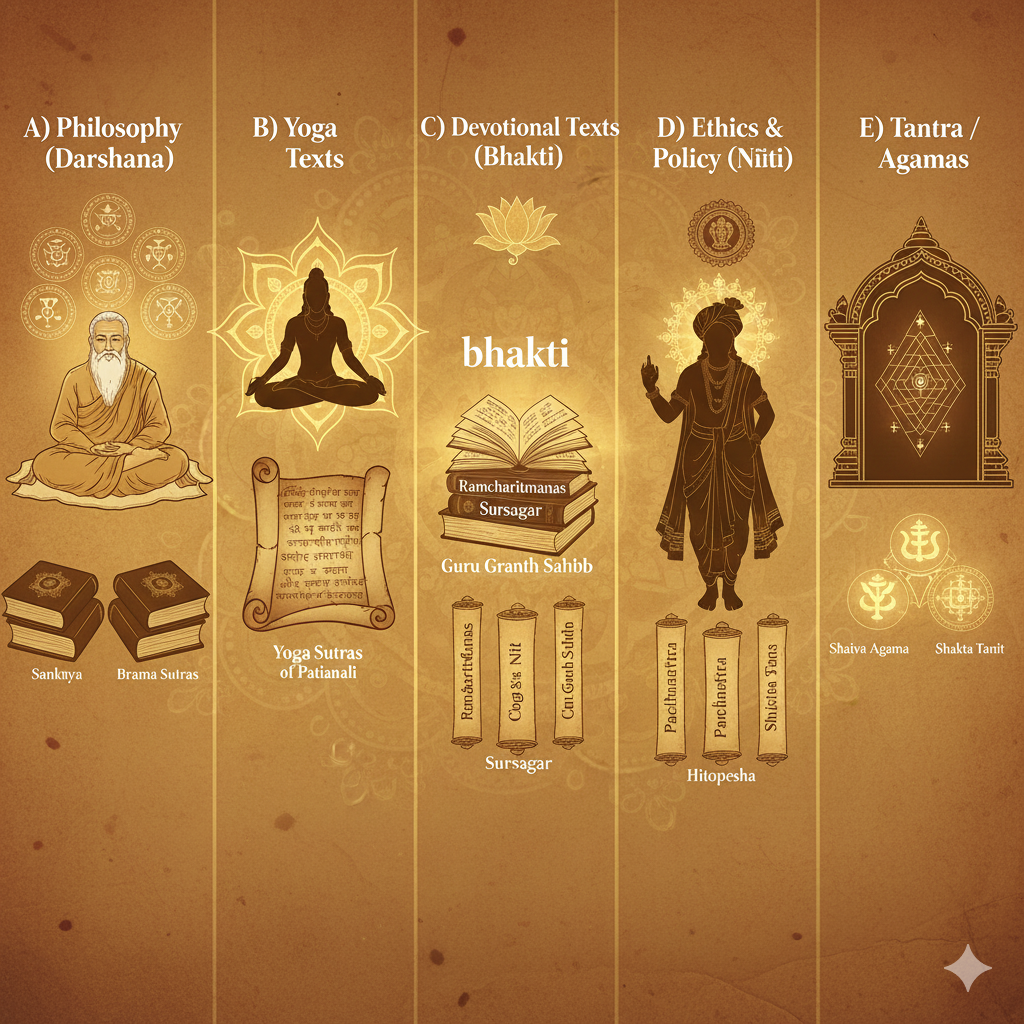
- Ethics, Agamas, Tantra, Bhakti Texts
1. Dharmaśāstras / Smritis
These texts outline social rules, duties, ethics, law and religious conduct.
- Manusmriti – Duties of men and women, social conduct, law, ethics.
- Yājñavalkya Smriti – Religion, legal principles, rituals.
- Nārada, Parāśara, Bṛhaspati Smritis – Law, justice, social rules.
Subject Matter
- Varna–Ashrama Dharma (duties of life stages and social order)
- Marriage, inheritance, punishment, ethics
- Pilgrimage, fasting, rituals and conduct
2. Epics (Itihasa)
Epics hold a special place in Smriti. These are not only historical or mythological accounts but living guides of duty, ethics, devotion and philosophy.
Two Major Epics
| Epic | Author | Verse Count | Main Characters |
|---|---|---|---|
| Ramayana | Maharishi Valmiki | ~24,000 | Shri Ram, Sita, Ravana |
| Mahabharata | Maharishi Vedavyasa | ~100,000 | Krishna, Arjun, Pandavas |
1. Ramayana (Valmiki Ramayana)
- Author: Maharshi Valmiki
- Verses: ~24,000
- Chapters: 7 (Kandas)
| Canto | Subject |
|---|---|
| Bālkāṇḍ | Birth of Rama, Gurukul, Sita’s marriage |
| Ayodhyā Kāṇḍ | Exile, Kaikeyi’s demand |
| Araṇya Kāṇḍ | Forest life, Shurpanakha, Sita’s abduction |
| Kishkindhā Kāṇḍ | Hanuman’s meeting, Sugriva alliance |
| Sundar Kāṇḍ | Hanuman’s journey to Lanka |
| Yuddha Kāṇḍ | War, Ravana’s defeat, Sita’s fire test |
| Uttara Kāṇḍ | Coronation, Sita’s exile, Luv–Kush |
Key Message
- Shri Ram as Maryada Purushottam
- Ideal of duty, truth, discipline, sacrifice and service
2. Mahabharata
- Author: Maharishi Vedavyasa
- Verses: ~100,000 (world’s largest epic)
- Parts: 18 Parvas
- The Bhagavad Gita (700 verses) is included in the Bhishma Parva.
Main Themes
- Kaurava–Pandava conflict
- Dharma crisis, Draupadi’s insult
- Exile, Kurukshetra war
- Krishna’s teachings to Arjuna
Amazon Product Title Here
This product combines reliable performance with user-friendly design for everyday use. Featuring quality construction and practical functions, it delivers convenience and satisfaction for home or work environments. A smart choice for those seeking both durability and ease of use.
🛒 Check Price on Amazon* As an Amazon Associate I earn from qualifying purchases.
Important Parvas (Festivals)
| Parva | Key Events |
|---|---|
| Adi Parva | Genealogy, beginnings |
| Sabha Parva | Dice game, Draupadi’s insult |
| Vana Parva | 12 years exile |
| Bhishma Parva | War begins, Bhagavad Gita |
| Drona Parva | Major battle episodes |
| Shanti Parva | Yudhishthira’s political lessons |
| Anushasana Parva | Bhishma’s teachings |
| Mahaprasthanika Parva | Pandavas’ final journey |
Teachings
- Conflict between dharma and adharma
- Paths of karma, devotion and knowledge
- Krishna as Yogeshwara (Divine Teacher)
- Arjuna as the seeker and karmayogi
Epics vs Puranas – Key Differences
| Point | Epics | Puranas |
|---|---|---|
| Form | Historical narrative | Mythological, symbolic |
| Objective | Religion, politics, war, duty | Creation, stories of gods, devotion |
| Language | Classical Sanskrit | Mixed styles, often folk language |
| Examples | Ramayana, Mahabharata | Bhagavata, Shiva Purana, Vishnu Purana |
3. Puranas
Purana means “ancient yet ever-new.” There are 18 major Puranas and 18 Upapuranas.
Chief Puranas
- Bhagavata Purana – Devotion to Sri Krishna
- Vishnu Purana
- Shiva Purana
- Skanda Purana
- Markandeya Purana
- Brahma Purana, Padma Purana, Narada Purana
Subject Matter
- Cosmic creation
- Myths and divine stories
- Religion, devotion, pilgrimage
- Yugas and cosmic time cycles
4. Other Texts / Philosophical & Ethical Works
Ethics
- Chanakya Niti
- Hitopadesha
- Panchatantra
Philosophical Works
- Patanjali Yoga Sutras
- Sankhya, Mimamsa, Vedanta
Devotional Literature
- Ramcharitmanas (Tulsidas)
- Sursagar (Surdas)
- Sri Guru Granth Sahib (Sikh scripture)
Summary Table
| Text Type | Examples | Main Subject |
|---|---|---|
| Theology | Manusmriti, Yajnavalkya Smriti | Ethics, society, law |
| Epics | Ramayana, Mahabharata | History, duty, religion |
| Puranas | Bhagavata, Shiva, Vishnu | Devotion, creation, divine stories |
| Philosophy | Yoga Sutras, Sankhya | Self, liberation, yoga |
| Policy | Chanakya Niti, Panchatantra | Practical wisdom, governance |
Conclusion
Smriti texts provide practical guidance by applying Vedic teachings to life. Through them, India developed its social order, justice system, devotion, philosophy and ethical values. They remain timeless guides for understanding dharma, duty, and righteous living.
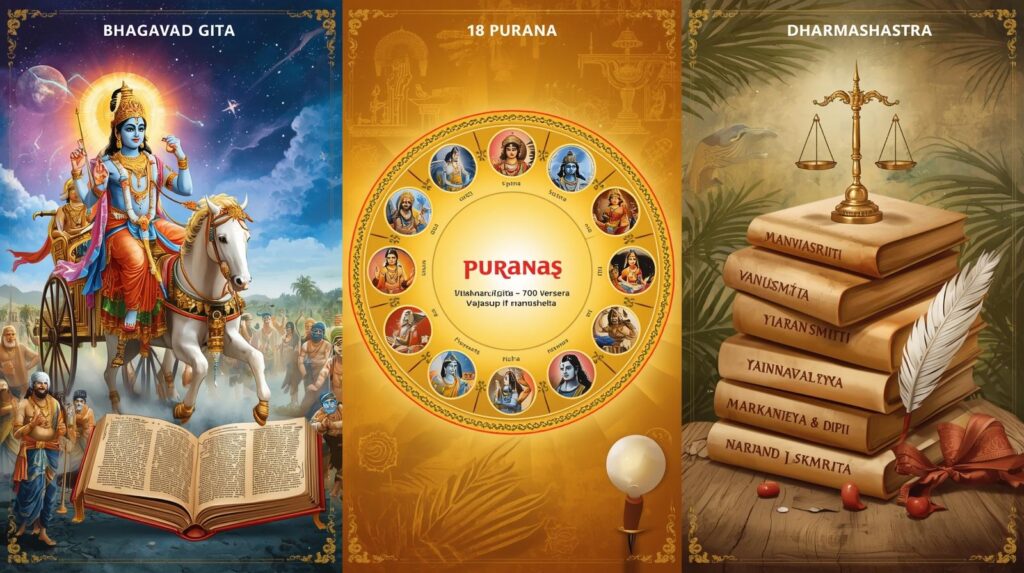
Bhagavad Gita
The Bhagavad Gita is one of the most important philosophical and spiritual texts of Hinduism. It appears in the Bhishma Parva of the Mahabharata (Chapters 23–40) and contains 700 verses.
It records the divine conversation between Lord Krishna and Arjuna on the battlefield of Kurukshetra, where Krishna explains life, duty, ethics, karma, the soul, and liberation.
(B) Introduction to the Bhagavad Gita
| Subject | Description |
|---|---|
| Text Name | Bhagavad Gita (Shrimad Bhagavad Gita) |
| Location | Mahabharata – Bhishma Parva (Ch. 23–40) |
| Total Verses | 700 |
| Speaker | Lord Sri Krishna |
| Audience | Arjuna |
| Commentators | Adi Shankaracharya, Ramanujacharya, Madhvacharya, etc. |
| Paths Taught | Karma Yoga, Jnana Yoga, Bhakti Yoga |
Bhagavad Gita – Chapter-wise Summary
| Chapter | Name | Main Subject |
|---|---|---|
| 1 | Arjuna Vishada Yoga | Arjuna’s grief and confusion |
| 2 | Sankhya Yoga | Knowledge of the soul and wisdom |
| 3 | Karma Yoga | Glory of selfless action |
| 4 | Jnana–Karma Sannyasa | Mystery of avatars, power of knowledge |
| 5 | Karma Sannyasa | Action–renunciation harmony |
| 6 | Dhyana Yoga | Form of a yogi and meditation process |
| 7 | Jnana–Vijnana Yoga | Complete knowledge of God |
| 8 | Akshara Brahma Yoga | Remembrance at death, liberation |
| 9 | Raja Vidya–Raja Guhya Yoga | Supreme devotion and its simplicity |
| 10 | Vibhuti Yoga | Divine glories of God |
| 11 | Vishwarupa Darshana | Vision of the cosmic form |
| 12 | Bhakti Yoga | Types and importance of devotion |
| 13 | Kshetra–Kshetrajna Yoga | Body and soul distinction |
| 14 | Gunatraya Vibhaga | Sattva, Rajas & Tamas qualities |
| 15 | Purushottama Yoga | Soul, world, Supreme Being |
| 16 | Daivasura Sampad Vibhaga | Divine and demonic qualities |
| 17 | Shraddhatraya Vibhaga | Types of faith and diet |
| 18 | Moksha Sannyasa Yoga | Renunciation, dharma, final teaching |
Core Teachings of the Bhagavad Gita
1. Principle of Karma
“Karmanye vadhikaraste…” (2.47) Perform your duty without attachment to results.
2. Immortality of the Soul
“Na jayate mriyate va kadachit…” The soul is eternal, unborn and undying.
3. Equanimity
“Samatvam yoga uchyate.” Maintain balance in success and failure.
4. Devotion
“Bhajanti mam ananya bhaktah…” Pure devotion leads to union with God.
5. Vishwaroopa Darshan
In Chapter 11, Krishna reveals His cosmic form, showing His omnipresence and divine power.
Importance of the Gita
- Universal scripture — transcends religion and culture
- Inspired thinkers like Gandhi, Vivekananda, Tolstoy, Oppenheimer
- Guides the individual through life’s conflicts and moral dilemmas

Amazon Product Title Here
This versatile product delivers reliable performance and great usability for everyday tasks. Featuring a sturdy design and user-friendly features, it offers comfort, convenience, and value for a wide range of daily needs.
🛒 Check Price on Amazon* As an Amazon Associate I earn from qualifying purchases.
Major Commentaries
| Commentator | Tradition | Speciality |
|---|---|---|
| Adi Shankaracharya | Advaita Vedanta | Knowledge-based liberation |
| Ramanujacharya | Vishishtadvaita | Devotion + qualified non-dualism |
| Madhvacharya | Dualism | God and soul are eternally distinct |
| Ramakrishna/Vivekananda | Practical Vedanta | Self-improvement and service |
Conclusion
The Bhagavad Gita offers timeless wisdom on duty, devotion, detachment and self-realization. It remains a universal guide for spiritual life.
(C) Puranas
Puranas are an important category of Hindu scriptures. They combine mythology, history, devotion, philosophy and culture, presenting deeper Vedic truths in simple storytelling.
Meaning of “Purana”
Purana = “Ancient, yet always new.” Puranas are not just myths — they preserve religion, ethics, culture, and cosmic history.
Composition and Purpose of Puranas
| Point | Description |
|---|---|
| Author | Traditionally attributed to Maharishi Vedavyasa |
| Number | 18 Mahapuranas + 18 Upapuranas |
| Subjects | Creation, gods, ages, karma, devotion, pilgrimage |
| Language | Sanskrit (later versions in regional languages) |
List of 18 Major Puranas
| No. | Purana | Main Deity | Key Subject |
|---|---|---|---|
| 1 | Brahma Purana | Brahma | Creation, pilgrimage |
| 2 | Padma Purana | Vishnu | Pilgrimage, religion |
| 3 | Vishnu Purana | Vishnu | Creation, incarnations |
| 4 | Shiva Purana | Shiva | Shiva devotion, Rudra stories |
| 5 | Bhagavata Purana | Krishna | Devotion, Krishna’s life |
| 6 | Narada Purana | Vishnu | Religion, yoga, devotion |
| 7 | Markandeya Purana | Goddess | Durga Saptashati |
| 8 | Agni Purana | Agni | Astrology, Vastu, rituals |
| 9 | Bhavishya Purana | Vishnu | Future predictions |
| 10 | Matsya Purana | Vishnu | Matsya avatar |
| 11 | Kurma Purana | Vishnu | Kurma incarnation |
| 12 | Varaha Purana | Vishnu | Varaha avatar |
| 13 | Linga Purana | Shiva | Glory of Shiva Linga |
| 14 | Vamana Purana | Vishnu | Vamana incarnation |
| 15 | Skanda Purana | Kartikeya | Largest Purana (~81,000 verses) |
| 16 | Vayu Purana | Vishnu | Cosmic cycles |
| 17 | Brahmavaivarta Purana | Krishna–Radha | Radha-Krishna devotion |
| 18 | Garuda Purana | Vishnu | Death, afterlife, rebirth |
Main Themes (Panchalakshana)
- Sarga – Primary creation
- Pratisarga – Secondary creation
- Vamsha – Genealogies of gods, sages and kings
- Manvantara – Cycles of Manus
- Vamshanucharita – Stories of dynasties
Devotional & Cultural Contributions
- Bhagavata Purana → Basis of Shrimad Bhagavat Katha
- Markandeya Purana → Source of Durga Saptashati & Navratri worship
- Skanda Purana → Glory of holy places like Kashi & Badrinath
- Linga Purana → Worship methods of Shiva Linga
- Brahmavaivarta Purana → Radha–Krishna divine love
Mahapurana vs Upapurana
| Aspect | Mahapuranas | Upapuranas |
|---|---|---|
| Number | 18 | 18 |
| Scope | Comprehensive, philosophical | Regional, specialized |
| Authority | More authoritative | Limited scope |
Conclusion on Puranas
Puranas beautifully blend devotion, philosophy and folklore, making Vedic wisdom accessible to everyone. Their storytelling preserves culture, values and spiritual insights.
(D) Dharmashastra
Dharmashastras are texts that present the framework of social ethics, law, duty and righteous living. They are based on Vedic principles but adapted for practical life.
Meaning of Dharmashastra
- Dharma = duty, ethics, conduct
- Shastra = organized knowledge
Thus, Dharmashastra means texts that teach the methods of right conduct.
Major Dharmashastra Texts
| Text | Author | Subject |
|---|---|---|
| Manusmriti | Manu | Social order, duties, punishment, king’s responsibilities |
| Yajnavalkya Smriti | Yajnavalkya | Law, inheritance, conduct |
| Narada Smriti | Narada | Jurisprudence, marriage disputes |
| Parashara Smriti | Parashara | Behavior in Kali Yuga, especially household duties |
| Brihaspati Smriti | Brihaspati | State punishment and administration |
| Katyayana Smriti | Katyayana | Merchant law and commercial ethics |
| Gautama Dharmasutra | Gautama | Rites, marriage, shraddha |
| Apastamba Dharmasutra | Apastamba | Purification, renunciation, rules |
Main Subjects of Dharmashastra
Varnashrama Dharma
- Brahmacharya
- Grihastha
- Vanaprastha
- Sannyasa
Social Behavior
- Marriage, family, shraddha
- Yajna, samskaras, household duties
State Duties
- Role of the king
- Taxation, justice, army, punishment
Law & Justice
- Evidence, crime, punishment
- Inheritance, debts, disputes
Manusmriti – Key Features
| Subject | Description |
|---|---|
| Origin | Brahma taught Manu, who taught humanity |
| Structure | 12 chapters, 2,685 verses |
| Social Order | Division based on qualities and duties |
| Women | Dignity and protection emphasized |
| State Rule | Guidance for kings and administration |
| Punishment | Strict laws for social order |
| Final Goal | Renunciation and liberation |
Dharmashastra & Modern Law
During the British era, Hindu law was largely based on Dharmashastra texts. Today’s Hindu Marriage Act, Succession Acts, etc., draw from Yajnavalkya Smriti and Narada Smriti.
Summary Table
| Text | Objective | Speciality |
|---|---|---|
| Manusmriti | Rules for all aspects of life | Most influential and ancient |
| Yajnavalkya Smriti | Behavior & succession | Clear legal clarity |
| Narada Smriti | Jurisprudence | Evidence-based law |
| Parashara Smriti | Kali Yuga rules | Focus on householders |
| Brihaspati Smriti | State law | King and punishment |
Conclusion
Dharmashastras provide a structured, ethical blueprint for individual and social life. They translate Vedic knowledge into practical laws and conduct, ensuring a balanced and righteous society.