
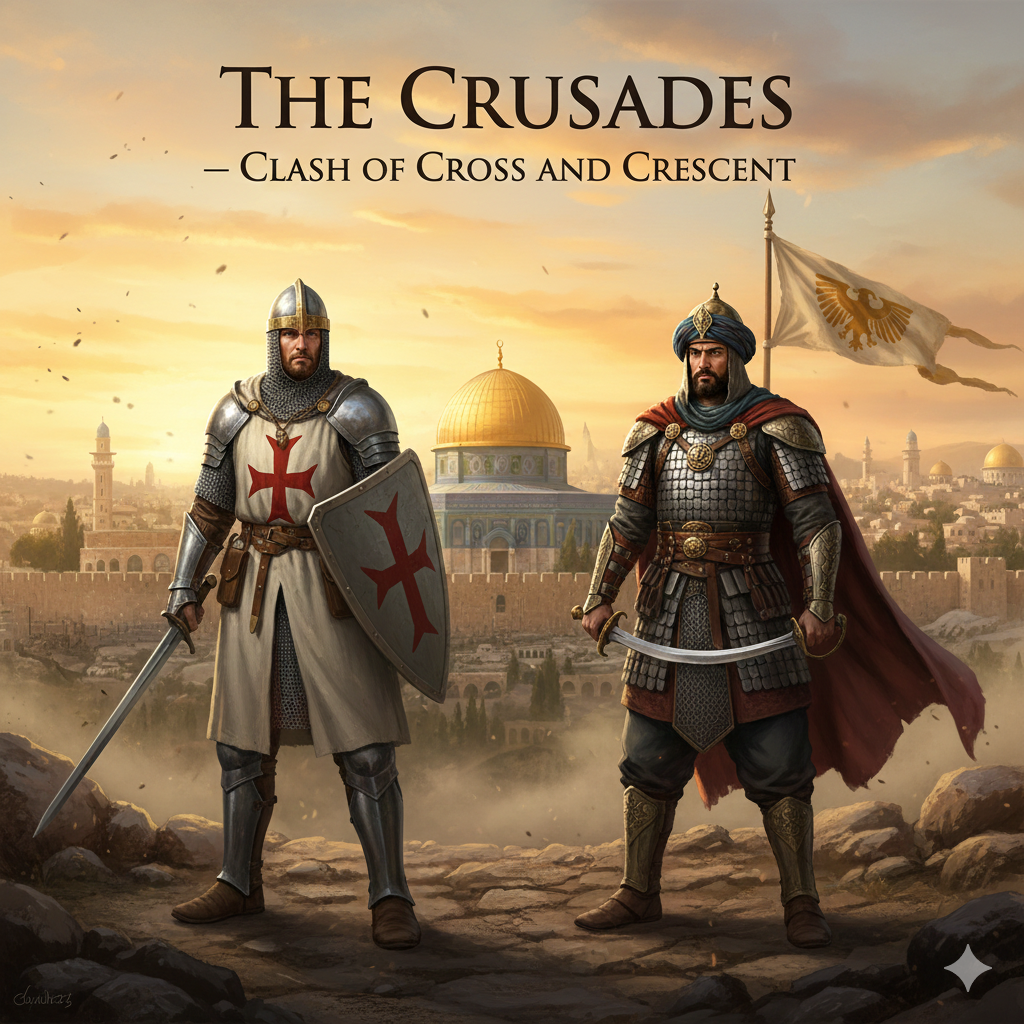
The Crusades (11th to 13th Centuries)
The Crusades were a series of religious wars fought between medieval Europe and the Islamic world, primarily over control of the Holy Land (Jerusalem and its surrounding regions). These wars took place between the 11th and 13th centuries, and a total of nine major Crusades were fought. The conflicts involved fierce clashes between Christian and Muslim armies that profoundly influenced the political, social, and economic landscapes of both Europe and the Middle East.
Reasons for the Crusades (Brief Overview)
Religious Reasons
- The Pope and leaders of the Christian Church wanted to recapture Jerusalem from Islamic rulers, as it was a holy city for Christians.
- Restrictions imposed by some Muslim rulers on the pilgrimage routes of Christians created resentment in Europe.
Political Reasons
- The Pope wanted to increase his power and unify the various Christian states of Europe under the leadership of the Church.
- Many kings and lords of Europe participated in the Crusades to strengthen their political positions and gain new territories.
Commercial and Economic Reasons
- Merchants and lords wanted to gain control of the rich trade routes of the East.
- Many participants sought to gain wealth, land, and prestige through the Crusades.
The Main Crusades (1096–1272)
1. First Crusade (1096–1099)
- In 1095, Pope Urban II delivered a famous sermon at the Council of Clermont, calling on Christian warriors to wage war against Muslim rulers and liberate the Holy Land.
- Many European rulers, feudal lords, and soldiers took part in this Crusade.
- During this Crusade, Christian forces conquered Jerusalem in 1099 and established a Christian state there.
- The First Crusade is considered the greatest success for the Christians.
2. Second Crusade (1147–1149)
- The Second Crusade was launched in response to the conquest of the Christian state of Edessa by the Muslim ruler Imad al-Din Zangi in 1144.
- The kings of Germany and France participated in this war, but they were badly defeated.
- This Crusade was unsuccessful, and Muslim power continued to grow.
3. Third Crusade (1189–1192) – “The Crusade of the Kings”
- Saladin (Sultan Salah al-Din) captured Jerusalem in 1187.
- In response, Richard “the Lionheart” of England, Philip II of France, and German Emperor Frederick Barbarossa launched the Third Crusade.
- Many battles were fought in this war, but the Christians could not recapture Jerusalem.
- A peace agreement was eventually concluded between Richard and Saladin in 1192, allowing Christians to make pilgrimages to Jerusalem.
4. Fourth Crusade (1202–1204)
- The focus of the Crusade shifted from Jerusalem to the Christian city of Constantinople, the capital of the Byzantine Empire.
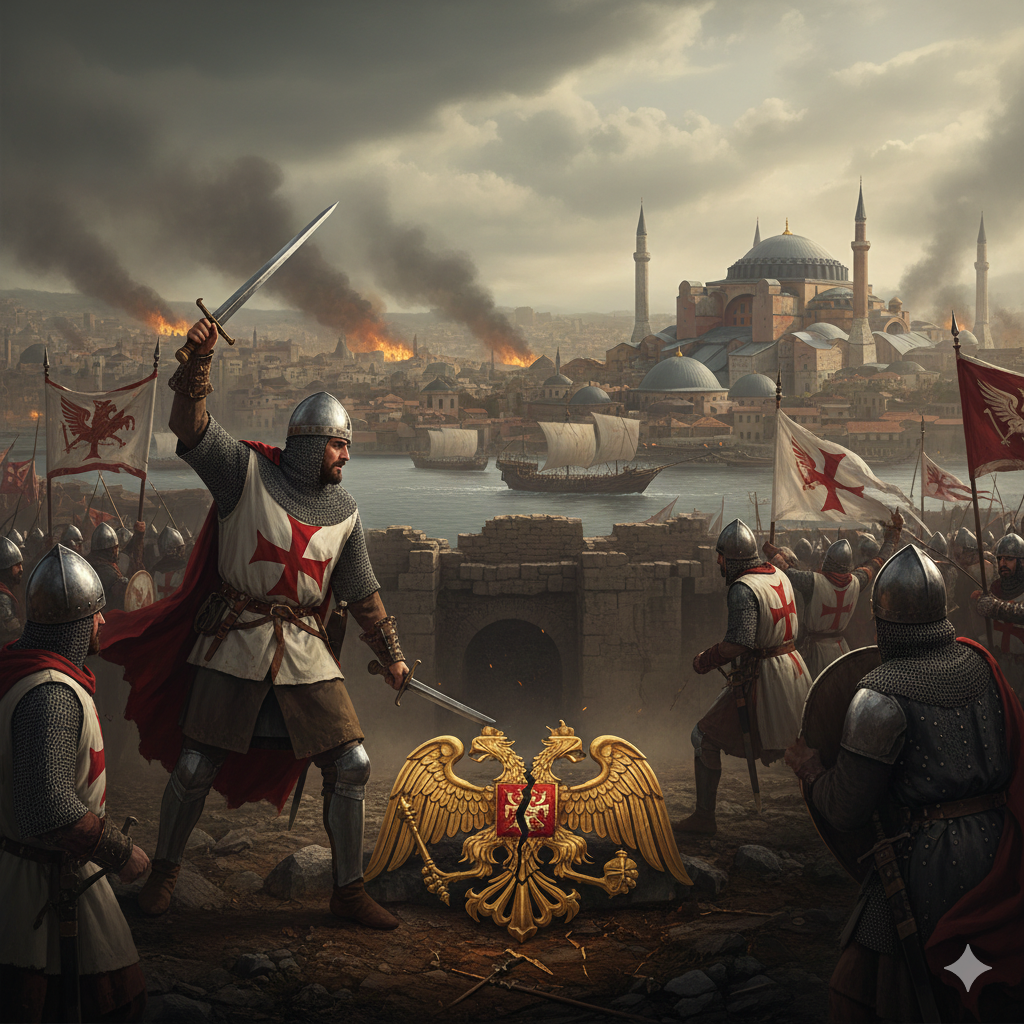
- Crusader armies attacked Constantinople in 1204, plundered it, and established a Western Christian empire there.
- This Crusade further deepened the division between the Eastern (Orthodox) and Western (Catholic) Churches.
5th to 9th Crusades (1217–1272)
- These Crusades were carried out with the aim of weakening Muslim power, but no major or lasting success was achieved.
- In 1291, the last major Christian stronghold in the region, Acre, fell to Muslim rulers, bringing the era of the Crusades to an end.
Effects of the Crusades
1. Religious Influence
- The Crusades intensified religious conflict between Christians and Muslims and left a legacy of mistrust.
- The power and prestige of the Church increased temporarily, but over time criticism and decline also followed.
2. Political Influence
- The power of European kings increased, as many feudal lords and knights were killed or weakened during the wars.
- The Byzantine Empire was significantly weakened, paving the way for the later rise of the Ottoman Empire.
3. Economic Impact
- Trade between Europe and Asia expanded, leading to the prosperity of Italian cities such as Venice and Genoa.
- Europeans became increasingly acquainted with Eastern culture, science, and technology, helping to lay the foundation for the Renaissance.
4. Cultural Influences
- The exchange of knowledge, science, and literature between East and West increased significantly.
- Arabic mathematics, astronomy, and medical science spread into Europe and enriched European learning.
Conclusion
The Crusades were not just religious wars but a significant series of political, economic, and cultural confrontations. These wars deeply affected both Europe and the Islamic world and changed the course of history. Ultimately, the Crusades helped lead Europe toward the Renaissance and played an important role in shaping global history.
Reasons for the Crusades (Detailed Analysis)
The Crusades were primarily religious wars fought between the 11th and 13th centuries, aimed at establishing Christian control over the Holy Land (Jerusalem and its surrounding areas). There were many deep and complex reasons behind these wars, linked to religious, political, economic, and social factors. Let us understand these reasons in detail.
1. Religious Reasons
The most prominent reason for the Crusades was religious. Both the Christian and Islamic worlds considered Jerusalem a holy place, which led to conflict over control of the region.
(i) Religious Significance of Jerusalem
For Christians:
- Jerusalem was the place where Jesus Christ was believed to have been crucified and resurrected.
- It was a holy city for Christians, and there were growing concerns that pilgrims visiting there were being harassed or restricted.
For Muslims:
- Jerusalem holds a special place in Islam because it is associated with the Prophet Muhammad’s “Night Journey” (Isra and Mi’raj).
- The Umayyad caliphs built famous religious structures there, including the Al-Aqsa Mosque and the Dome of the Rock (Gumbad-i-Sakhra).
For the Jews:
- Jerusalem also had great significance for the Jews because it was the location of their holy temple (the Temple of Solomon).
(ii) Muslim Control and Restrictions on Pilgrimage
- Islamic forces took control of Jerusalem in the 7th century, but Christians were generally allowed to make pilgrimages.
- In the 11th century, the Seljuk Turks occupied the area and, in some cases, imposed restrictions on Christian pilgrims.
- This was unacceptable to many Christians in Europe and increased the demand for Crusades.
(iii) Desire to Increase the Religious Power of the Pope
- At the Council of Clermont in 1095, Pope Urban II encouraged Christians to liberate Jerusalem.
- He promised that those who participated in this “holy war” would receive forgiveness for their sins and a place in heaven.
- As a result, thousands of people pledged to take part in the Crusades.
2. Political Reasons
The Crusades were not only religious wars but also the outcome of political struggles for power in Europe and the Islamic world.
(i) Increasing the Power of the Pope and the Church
- At that time, the Christian Church (the Catholic Church) was the most powerful institution in Europe.
- The Pope wanted to unite all the Christians of Europe through the Crusades and increase both his religious and political power.
- Pope Urban II supported the Crusades as a means to keep European kings and lords under the influence of the Church.
(ii) Ambitions of European Kings and Feudal Lords
- Many European kings and feudal lords wanted to strengthen their political positions by participating in the Crusades.
- They aimed to establish control over the rich regions of the East, including the Byzantine Empire and the Middle East.
- During the Crusades, several Western European leaders established their own kingdoms in Jerusalem and surrounding areas, such as the Latin Kingdoms of Antioch, Edessa, Tripoli, and Jerusalem.
(iii) Crisis of the Byzantine Empire
- The Byzantine Empire, the Eastern Christian empire, was weakened by attacks from the Seljuk Turks.
- Byzantine Emperor Alexius I Komnenos sought military help from the Christian rulers of Western Europe, which became one of the triggers for the First Crusade.
3. Economic Reasons
Economic motives were also crucial behind the Crusades, as they offered possibilities for trade expansion and material gain.
(i) Control over Trade Routes
- Important medieval trade routes between Europe and Asia passed through the Middle East.
- The merchant classes, especially those in Italian cities such as Venice, Genoa, and Pisa, wanted control over these routes.
- The Crusades ultimately boosted trade between Europe and the Middle East and strengthened Western Europe’s economy.
(ii) New Opportunities for Feudal Lords and Soldiers
- Europe followed a feudal system with many small feudal lords.
- Many poor knights and soldiers sought new lands and wealth in the East to improve their social and economic standing.
- The Crusades gave these lords and soldiers opportunities to move into new territories and, in some cases, establish their own principalities.
(iii) Scarcity of Land and Population Growth
- By the 11th century, Europe’s population was growing rapidly, which led to land shortages.
- Many nobles and peasants did not have enough land, so they joined the Crusades in search of new opportunities and resources.

Top Rated Amazon Product
Popular and trusted product with excellent reviews. Check the latest price & availability on Amazon.
👉 View on Amazon4. Social Reasons
There were also important social reasons behind the Crusades, closely linked to the structure of medieval European society.
(i) Religious Fervour and Propaganda
- Religion had a deep influence in medieval Europe, and the power of the Church was supreme.
- Many people believed that by participating in the Crusades they would be absolved of their sins and receive a place in heaven.
- Religious preachers convinced people that this war was God’s will and a sacred duty.
(ii) Keeping Warlike Knights Busy
- Europe had many warriors and knights who often fought among themselves, causing internal conflicts.
- The Crusades united these warriors for a common cause and redirected their aggression toward the Middle East.
- This diversion helped reduce internal warfare in Europe for a time.
Conclusion: A Multi-Dimensional Movement
The Crusades were not driven by religious motives alone. Political ambition, economic interests, and social pressures all played crucial roles in shaping this vast medieval movement.
The Church and the Pope sought to increase their power. European kings and feudal lords were looking for new territories and prestige. The mercantile classes wanted control of the rich trade routes of the Middle East. Poor soldiers and peasants hoped to acquire land and wealth.
All of these factors combined to make the Crusades a massive historical phenomenon that deeply influenced both Europe and the Middle East and left a lasting impact on global history.

Economic and Religious Reasons for the Crusades
The Crusades were not only religious and political wars but also deeply connected with economic interests. Many aspects related to trade, strategy, and resources between Europe and the Middle East made the Crusades an economically beneficial campaign for various groups. At the same time, religious motivations, especially the desire to control the Holy Land of Jerusalem, played a central role. Economic needs such as the shortage of land in Europe, the desire to control trade routes, and the search for wealth and resources, along with strong religious beliefs, were among the main reasons that motivated these wars.
Economic Reasons for the Crusades
Along with religious and political reasons, economic reasons were also important behind the Crusades. There were many aspects related to trade, strategy, and resources between Europe and the Middle East, which made the Crusades an economically attractive campaign. Many economic needs such as the shortage of land in Europe, the desire to control trade routes, and the search for wealth and resources were among the main causes behind these wars. Let us understand these economic reasons in detail.
1. Desire for Control over Trade Routes
The backbone of trade in medieval Europe was closely linked to the Middle East and Asia. The ambition to gain control over important trade routes was one of the major economic reasons for the Crusades.
(i) Trade Routes to the Middle East and Asia
- European traders used the Silk Road and the Spice Route to trade with China, India, and the Middle East.
- Through this trade, spices, silk, metals, precious stones, and other valuable items reached Europe.
- However, European traders often faced difficulties on these routes under some Muslim rulers and local powers.
(ii) Role of Italian Maritime Merchants
- Merchants from Italian cities such as Venice, Genoa, and Pisa wanted to increase trade with the Middle East and Asia.
- The Crusades gave these cities the opportunity to take control of key sea routes and expand their trade.
- During the Fourth Crusade (1202–1204), Venetian merchants played a major role in the attack on Constantinople, which further increased Venice’s trading power.
(iii) Expansion of Trade Relations
- Trade contacts between Europe and the Middle East increased during and after the Crusades.
- European merchants established trading centres in Islamic cities such as Damascus, Aleppo, Baghdad, and Cairo.
- The Crusades led to increased demand in Europe for spices, aromatic oils, textiles, metals, and luxury goods.
2. Land Shortage and Economic Inequality in Europe
(i) Scarcity of Land and Population Growth
- Europe’s population was growing rapidly in the 11th century, increasing the demand for agricultural land.
- Most land was under the control of powerful feudal lords and the Church, leaving small farmers and warriors with limited resources and opportunities.
- The Crusades gave many people the opportunity to move to new areas and attempt to acquire land.
(ii) New Opportunities for Feudal Lords and Soldiers
- Many of Europe’s smaller lords and knights needed new sources of income and resources to maintain their status.
- By participating in the Crusades, they could hope to acquire new lands and wealth in the Middle East.
- Some knights and warriors went east and took part in establishing Crusader states such as the Kingdom of Jerusalem, Antioch, Edessa, and Tripoli.
3. Loot and Acquisition of Wealth
(i) Looting of Prosperous Cities
- Many cities in the Muslim and Byzantine empires were extremely wealthy and commercially important.
- During the Crusades, Christian warriors captured and plundered cities such as Jerusalem, Antioch, Edessa, and later Constantinople.
- In the Fourth Crusade (1204), Crusaders attacked Constantinople and looted its immense wealth, artworks, and treasures.
(ii) Earning Money as War Booty
- Many knights and soldiers were motivated to participate in the Crusades because they could obtain gold, silver, precious metals, weapons, and horses as war booty.
- This economic benefit could help ensure their future stability and improve their social standing.
4. Impact on Europe’s Economy and Banking System
(i) Increase in Business Activities
- The Crusades gave new momentum to European trade and maritime activities.
- Many new markets and trade centres developed in Europe to support long-distance trade.
- Merchants and shipbuilders became wealthy, making Italian cities such as Venice and Genoa powerful trading centres.
(ii) Development of the Banking System
- New banking methods and institutions developed in Europe to finance trade and military campaigns during the Crusades.
- The Knights Templar developed an early international banking system, allowing merchants and soldiers to keep money safe and conduct financial transactions while travelling.
- Many bankers and merchants in Europe became very rich through this evolving financial system.
(iii) Tax System and Collection of Funds
- To raise money for the Crusades, European kings increased taxes on the Church, nobles, and common people.
- In many countries, special taxes like the “Saladin Tax” were imposed, which helped governments raise funds for military operations.
- These taxes later helped lay the foundation for more organised and modern tax systems in European states.
5. Agricultural and Industrial Development
(i) Advent of New Technologies
- During the Crusades, Europeans learned advanced agricultural and industrial techniques from the Muslim world.
- Improved irrigation systems, water mills, and better use of water resources spread to Europe.
(ii) Increase in Production and Trade
- Agricultural production increased in Europe, which contributed to the growth of trade and markets.
- Arms manufacturing, shipbuilding, and the textile industry developed rapidly to meet wartime and commercial needs.
Conclusion on Economic Reasons
The economic reasons for the Crusades were as important as the religious and political factors. The main economic motives behind these wars included:
- The desire for control over trade routes – European merchants attempting to dominate the trade routes of Asia and the Middle East.
- Land shortage and the search for new opportunities – Land scarcity in Europe pushed warriors and peasants to seek new lands to settle.
- Loot and wealth – The plunder of rich cities in the Middle East inspired many soldiers to take part in the Crusades.
- Development of the European banking system and tax collection – The Crusades played an important role in the development of banking and new taxation methods in Europe.
- Agricultural and industrial progress – The spread of new technologies and business skills gave new life to Europe’s economy.
These economic reasons ensured that the Crusades were not merely religious wars but a series of conflicts fought for trade, power, and wealth. These wars brought many new changes to the economy of Europe, which later helped lay the foundation for the Renaissance and, eventually, European colonial expansion.
Religious Reasons for the Crusades
The Crusades were primarily religious wars fought between Christian and Muslim armies between the 11th and 13th centuries. The most prominent reason for these wars was the Holy Land – especially Jerusalem. The aim was to establish Christian control over Jerusalem and its surrounding regions. Jerusalem was a highly sacred place for the Christian, Muslim, and Jewish religions, making it a major focus of the conflict.
There were many religious reasons behind the Crusades, including restrictions on pilgrimages, the desire to spread Christianity, the promise of forgiveness of sins, and the aspiration to increase the power of the Pope and the Church. Let us understand these religious reasons in detail.
1. Religious Significance of Jerusalem
Jerusalem was a holy place for three major religions—Christianity, Islam, and Judaism. This shared sacred status made it a central point of religious tension.
(i) The Importance of Jerusalem for Christians
- Jerusalem was believed to be the place where Jesus Christ was crucified and where his resurrection took place.
- Christians considered it the “Holy Land” and believed it was their religious duty to make a pilgrimage there.
- In the 11th century, when the Seljuk Turks captured Jerusalem, it became more difficult and dangerous for Christian pilgrims to visit the city.
- This situation caused outrage in Europe, and the Pope used it as a major reason to call for the Crusades.
(ii) The Importance of Jerusalem to Muslims
- Jerusalem is considered the third holiest place in Islam because it is associated with the Prophet Muhammad’s “Night Journey” (Isra and Mi’raj).
- The Umayyad caliphs built important religious structures there, including the Al-Aqsa Mosque and the Dome of the Rock.
- Maintaining control of Jerusalem was therefore vitally important to Muslim rulers.
(iii) The Importance of Jerusalem to the Jews
- For the Jews, Jerusalem was the site of their ancient holy temple, often referred to as the Temple of Solomon.
- Although the Crusades were primarily fought between Christian and Muslim forces, the Jewish community was also deeply affected by the violence and changing control of the city.
2. Attacks and Restrictions on Christian Pilgrims
- Initially, many Muslim rulers allowed Christian pilgrims to visit Jerusalem without major restrictions.
- However, when the Seljuk Turks captured Jerusalem in the late 11th century, they imposed stricter controls and, in some cases, harassment of Christian pilgrims.
- Reports of pilgrims being robbed, attacked, and even killed caused deep resentment in Europe.
- The Pope and European rulers saw this as an insult to Christianity and used it as a strong justification for launching the Crusades to retake the Holy Land.
3. The Desire to Increase the Power of the Pope and the Church
(i) Call of Pope Urban II
- In 1095, Pope Urban II, at the Council of Clermont, called on Christian warriors to liberate Jerusalem from Muslim control.
- He declared that this war was “God’s will” (Deus Vult), and those who participated would be freed from their sins.
- Thousands of people heard this call and were inspired to join the Crusades with religious enthusiasm.
(ii) Increasing the Power of the Church
- The Catholic Church was the most powerful institution in Europe at the time, and the Pope wanted to further increase its influence.
- Through the Crusades, the Pope united Christians across different kingdoms and regions under a common religious cause.
- The Pope also used the Crusades to influence kings and feudal lords, thereby increasing both his religious and political power.
4. Promise of Freedom from Sins and Attainment of Heaven
(i) Assurance of Heaven to Participants
- The Pope and the Church declared that anyone who participated in the Crusades with a pure religious motive would be absolved of their sins and receive a place in heaven.
- This belief was extremely important for the people of that time, as they were deeply influenced by religious teachings and the authority of the Church.
- Many knights, peasants, and townspeople joined the Crusades in the hope of saving their souls and securing eternal salvation.
(ii) The Concept of “Holy War”
- The Pope and the Church presented the Crusades as a “Holy War,” which made the warriors believe that they were directly serving God by taking part.
- This idea transformed ordinary warfare into a sacred duty in the eyes of many believers.
- As a result, thousands of warriors and common people willingly joined the campaigns.
5. Desire to Stop the Spread of Islam
(i) Expansion of the Islamic Empire
- From the 7th century onwards, Islam spread rapidly, and Muslim rulers became influential across Arabia, North Africa, Spain, and the Middle East.
- European Christian rulers saw this growing influence as a major challenge and wanted to halt it, which led them to support the Crusades.

Highly Rated Amazon Product
Trusted and well-reviewed product with excellent user feedback. Click below to check the latest price and availability on Amazon.
👉 View on Amazon(ii) Defence of Spain and the Byzantine Empire
- Muslim armies had captured large parts of Spain and significant territories of the Byzantine Empire.
- European rulers wanted to stop this military and religious expansion and therefore supported the idea of Crusades on multiple fronts.
6. Religious Fervour and Propaganda
(i) Spread of Christianity
- European Christian rulers and the Church wanted to propagate Christianity in Islamic regions and beyond.
- Many Christian saints, monks, and missionaries joined or supported the Crusades as a means to spread their faith in new areas.
(ii) The Role of Religious Preachers
- Many religious preachers travelled across Europe, urging people to participate in the Crusades as a service to God.
- Their sermons and teachings convinced thousands of poor farmers, knights, and merchants to join the wars.
Conclusion on Religious Reasons
The religious reasons for the Crusades were primarily associated with establishing Christian control over Jerusalem and the Holy Land.
- The religious significance of Jerusalem – It was a holy place for Christians, and they wanted to free it from Muslim control.
- Restrictions on Christian pilgrims – The difficulties and persecution faced by pilgrims under the Seljuk Turks inspired calls for Crusades.
- Increasing the power of the Pope and the Church – The Pope supported the Crusades to strengthen the authority and influence of the Church.
- Promise of salvation and heaven – Participants in the Crusades were assured forgiveness of sins and a place in heaven.
- Stopping the spread of Islam – Christian rulers wanted to reduce the growing influence of Islam in Europe and the Mediterranean.
All of these religious reasons combined to make the Crusades a massive religious movement that deeply influenced both Europe and the Middle East and left a lasting mark on world history.
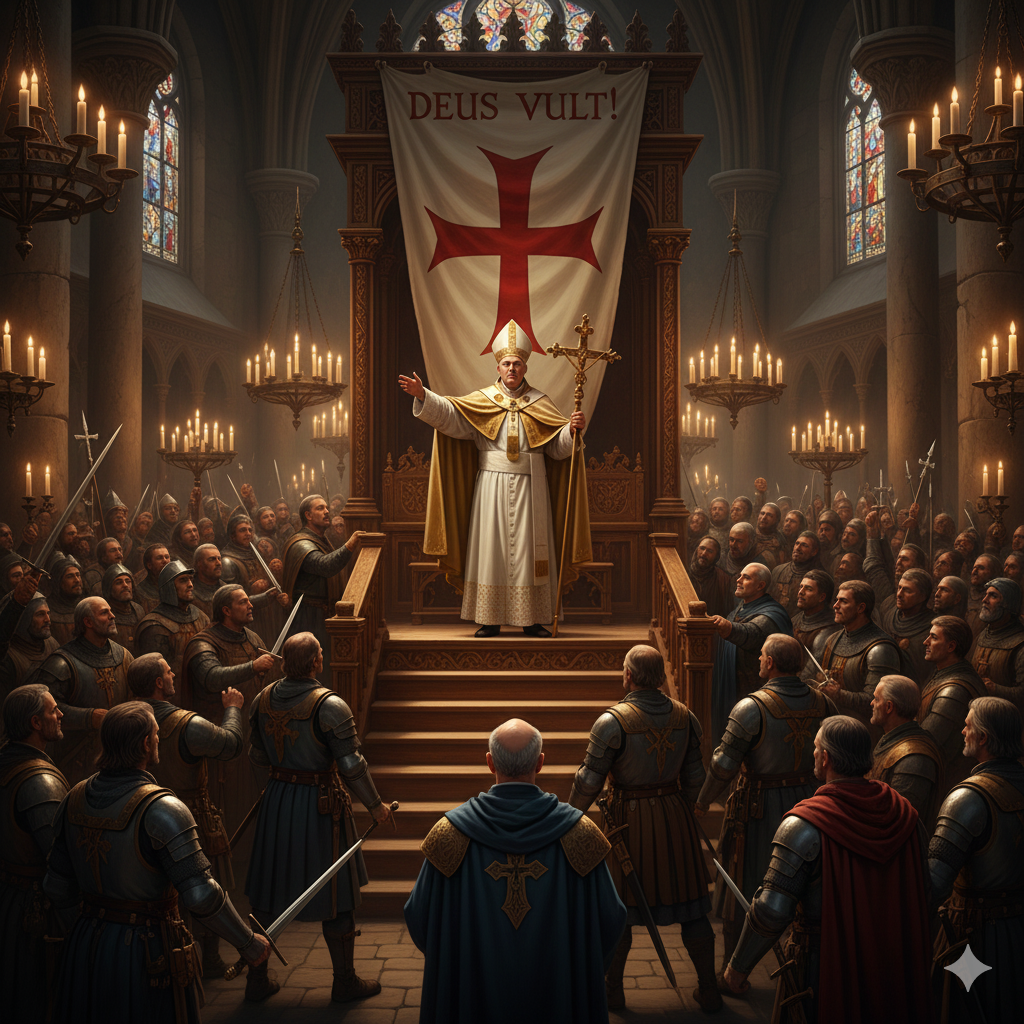
Political Reasons for the Crusades and the Main Crusades (1096–1272)
The Crusades were primarily religious wars, but there were many important political reasons behind them as well. The balance of power in medieval Europe and the Middle East, the political ambitions of rulers, power struggles between kings and popes, and the desire to control new territories were major political causes of these wars.
The Crusades were not only wars between Christians and Muslims, but were also closely linked to the mutual interests and power struggles of European kings, feudal lords, popes, and trading republics. Below we will understand these political reasons in detail, and then look at the main Crusades from 1096 to 1272.
Political Reasons for the Crusades
1. The Desire to Increase the Power of the Pope
(i) Pope Urban II and the Power of the Church
- In 1095, Pope Urban II called for the Crusades at the Council of Clermont.
- At that time, the power of the Church was very high, but European kings and feudal lords were ruling independently and often in conflict with one another.
- The Pope planned to further strengthen his political and religious power through the Crusades by uniting Christians under a common cause.
- He described the Crusades as a “Holy War” and assured participants that they would receive forgiveness of sins and a place in heaven.
(ii) Power Struggle between the Pope and European Kings
- In medieval Europe, there was an ongoing power struggle between kings and the Pope.
- The Pope wanted the Christian states of Europe to remain united under his leadership and to preserve the influence of the Church over secular rulers.
- Through the Crusades, the Pope kept European kings engaged in religious wars and, at the same time, tried to control and balance their power.
2. Political Ambitions of European Kings and Feudal Lords
(i) Desire to Control New Areas
- There was a shortage of land in Europe, and many small lords and knights were looking for new territories and resources.
- The Crusades took them to the Middle East and gave them the opportunity to establish new states in places like Jerusalem, Antioch, Edessa, and Tripoli.
- By capturing these areas, European rulers could increase their political power, wealth, and prestige.
(ii) An Opportunity to Avoid Local Power Struggles
- The kingdoms of many European kings were suffering from internal rebellions and power struggles.
- The Crusades gave them an opportunity to send their political rivals and rebellious lords away to fight in the East.
- For example, many rulers of France, England, and Germany encouraged their rebellious feudal lords to take part in the Crusades so that they could maintain greater stability and control within Europe.
(iii) New Opportunities for Knights and Warriors
- In the Middle Ages, the number of warriors (knights) was very high, but they often lacked sufficient opportunities for honour, land, and wealth.
- Through the Crusades, they got the chance to participate in war, gain prestige, and capture new territories and fiefs.
- Many knights travelled to the Middle East, where they helped establish independent Crusader states and ruled there.
3. Conflict between the Byzantine Empire and the Seljuk Turks
(i) Seeking the Help of the Byzantine Empire
- In the 11th century, the Seljuk Turks invaded the Byzantine Empire and, in the Battle of Manzikert in 1071, defeated the Byzantine army.
- After this defeat, Byzantine Emperor Alexios I Komnenos appealed to the Pope for military help.
- The Pope saw this as an opportunity to expand Western influence and encouraged European kings and knights to wage war against the Muslims, which led to the First Crusade.
(ii) Byzantine and European Relations
- There were historical and religious differences between the Pope (Western Church) and the Byzantine Empire (Eastern Orthodox Church), but they temporarily cooperated because of the common threat from the Seljuk Turks.
- However, during the Fourth Crusade (1202–1204), Crusaders attacked Constantinople, the Byzantine capital, and plundered it.
- This incident showed that the Crusades were not just religious wars, but also conflicts between political and economic powers within Christendom itself.
4. Desire for Control over Trade Routes
(i) Role of European Traders
- The merchant republics of Italy, such as Venice, Genoa, and Pisa, took great advantage of the Crusades.
- These trading cities supported the Crusaders in order to disrupt Muslim trade routes and gain dominance over Mediterranean commerce.
- During the Fourth Crusade (1202–1204), merchants of Venice encouraged Crusaders to attack Constantinople so that they could control Byzantine trade routes and ports.
(ii) Capture of Trading Centres in the Middle East
- During the Crusades, European rulers and merchants tried to capture prosperous trading cities like Jerusalem, Aleppo, Damascus, and, indirectly, influence routes linked to Baghdad.
- Gaining control over these cities and routes helped them trade in spices, silk, precious metals, and other valuable goods.
5. Strategy to Weaken the Muslim Empire
(i) European Alliance against the Islamic Empire
- The Christian rulers of Europe wanted to stop the spread of Islam, which had expanded rapidly across Arabia, North Africa, Spain, and the Middle East.
- By waging war against Muslim rulers through the Crusades, European rulers hoped to weaken Islamic political power and strengthen their own positions.
(ii) Attempts to Create Divisions among Muslim Rulers
- Many Crusader leaders tried to strengthen their political position by creating divisions and rivalries among different Muslim rulers.
- However, Muslim leaders like Salahuddin Ayyubi (Saladin) strengthened Muslim unity against the Crusaders and reconquered Jerusalem in 1187.
Conclusion on Political Reasons
The Crusades were not just religious wars; there were many important political reasons behind them as well:
- The desire to increase the power of the Pope – The Pope called for the Crusades to strengthen his political and religious authority.
- Political ambitions of European kings – Rulers supported the Crusades to capture new territories and weaken their local opponents.
- Conflict between the Byzantine Empire and the Seljuk Turks – The Byzantine Emperor’s appeal for help became a key trigger for the First Crusade.
- Control over trade routes – European merchants and rulers wanted to take over important Muslim trade routes and prosperous ports.
- Strategy to weaken the Muslim empire – European rulers tried to curb the power and expansion of Islamic states.
Because of these political reasons, the Crusades were transformed from being simply religious wars into complex conflicts that brought major changes in the politics of both Europe and the Middle East.
The Main Crusades (1096–1272)
The Crusades were religious wars fought between Christian and Muslim armies between the 11th and 13th centuries. Their declared aim was to free Jerusalem and the Holy Land from Muslim rule. However, with time, this conflict became linked to political and economic interests rather than being only a religious struggle.
From 1096 to 1272, a total of nine major Crusades took place, of which the First, Third, and Fourth Crusades are considered the most important. Let us understand all these Crusades in detail.
First Crusade (1096–1099)
Background
- In 1071, the Seljuk Turks defeated the Byzantine Empire in the Battle of Manzikert.
- In 1095, Byzantine Emperor Alexios I Komnenos asked Pope Urban II for help against the Turks.
- At the Council of Clermont in 1095, Pope Urban II inspired Christian warriors to fight and liberate the Holy Land.
Major Events
- In 1096, thousands of Christian warriors travelled from Europe to the Holy Land.
- In 1097, the Crusaders captured Nicaea and later Antioch.
- In 1099, the Crusaders conquered Jerusalem and established the Crusader State of Jerusalem.
- During this war, thousands of Muslims and Jews were killed in the capture and sack of cities.
Result
- Christians gained control of Jerusalem.
- Christian states were established in Jerusalem, Antioch, Edessa, and Tripoli.
- The First Crusade is considered the only fully successful Crusade from the Christian point of view.
Second Crusade (1147–1149)
Background
- In 1144, the Muslim commander Zangi captured the County of Edessa, which had been under Christian control.
- After this defeat, Christian leaders launched the Second Crusade to try to recover Edessa.
Major Events
- The Second Crusade was led by King Louis VII of France and Emperor Conrad III of Germany.
- The Christian forces failed to retake Edessa and faced strong resistance in the East.
- The Muslim forces defeated the Crusaders badly in several campaigns.
Result
- The Second Crusade ended in a major defeat for the Christians.
- The influence and confidence of Muslim armies increased.
- After this defeat, Muslim leaders such as Salahuddin Ayyubi (Saladin) gradually became stronger.
Third Crusade (1189–1192)
Background
- In 1187, Saladin recaptured Jerusalem from the Crusaders after the Battle of Hattin.
- This defeat caused great anger among Christian rulers and led to the launching of the Third Crusade.
Major Events
- The Third Crusade was led by three powerful Christian rulers:
- King Richard I of England (Richard the Lionheart)
- Philip II of France
- Frederick I Barbarossa, Emperor of Germany
- Frederick Barbarossa died on the way, and his army was scattered.
- In 1191, Richard I captured the port city of Acre.
- However, despite several battles, the Crusaders could not capture Jerusalem.
Result
- Christian pilgrims were allowed to visit Jerusalem under a truce.
- The Christian forces could not conquer or reoccupy Jerusalem.
- A ceasefire agreement (truce) was signed between Saladin and Richard I, recognising Muslim control of Jerusalem but allowing Christian pilgrimage.
Fourth Crusade (1202–1204)
Background
- The Fourth Crusade was originally launched to reconquer Jerusalem.
- However, due to political and financial interests, the Christian warriors changed their path and targeted the Byzantine Empire instead.
Major Events
- In 1204, the Crusaders attacked Constantinople, the capital of the Byzantine Empire.
- They looted and severely damaged the city, destroying much of the Christian Byzantine Empire’s wealth and power.
- A short-lived “Latin Empire” was established in Constantinople under Western control.
Result
- The Fourth Crusade completely failed in its original aim to recapture Jerusalem.
- Instead, Christian Crusaders destroyed another Christian empire, the Byzantines.
- The rift between the Catholic (Western) and Orthodox (Eastern) Churches deepened significantly.
Fifth to Ninth Crusades (1217–1272)
Fifth Crusade (1217–1221)
- An attempt was made by Crusaders to capture the Egyptian city of Damietta and use Egypt as a base to attack Jerusalem.
- The Christian army was eventually defeated, and the campaign failed.
Sixth Crusade (1228–1229)
- The Sixth Crusade was led by Emperor Frederick II of Germany.
- Remarkably, Jerusalem was acquired through a peace agreement with Muslim rulers, without a major battle.
- Christians were allowed control of Jerusalem for a short period under this treaty.
Top Rated Amazon Product
Well-reviewed and trusted product with great customer feedback. Check the latest price, offers & availability on Amazon.
👉 View on AmazonSeventh Crusade (1248–1254)
- Louis IX of France attacked Egypt with the aim of weakening Muslim power and then advancing towards the Holy Land.
- The Crusader army was defeated, and Louis IX himself was captured and later ransomed.
Eighth Crusade (1270)
- Louis IX launched another Crusade, this time against Tunisia in North Africa.
- He died there due to illness, and the Crusade failed without achieving its objectives.
Ninth Crusade (1271–1272)
- Edward I of England led the Ninth Crusade in an attempt to support the remaining Crusader states and save Jerusalem.
- He was unsuccessful, and no major gains were made.
- This Crusade ended in 1272 and is generally considered the end of the era of the Crusades.
Overall Conclusion on the Main Crusades
The First Crusade (1096–1099) was the only fully successful Crusade from the Christian point of view, as it captured Jerusalem and established several Crusader states.
The Third Crusade (1189–1192) resulted in a truce between Richard I and Saladin, allowing Christian pilgrims access to Jerusalem but keeping the city under Muslim control.
The Fourth Crusade (1202–1204) is most remembered for the destruction of the Christian Byzantine Empire by Christian Crusaders themselves, rather than for fighting Muslims.
The Sixth Crusade (1228–1229) stands out because Jerusalem was temporarily gained through negotiation rather than direct war.
By 1272, the Crusades had gradually come to an end, and Muslim forces took full and lasting control of the Holy Land. The Crusades, however, left a deep impact on the politics, religion, and societies of both Europe and the Middle East.
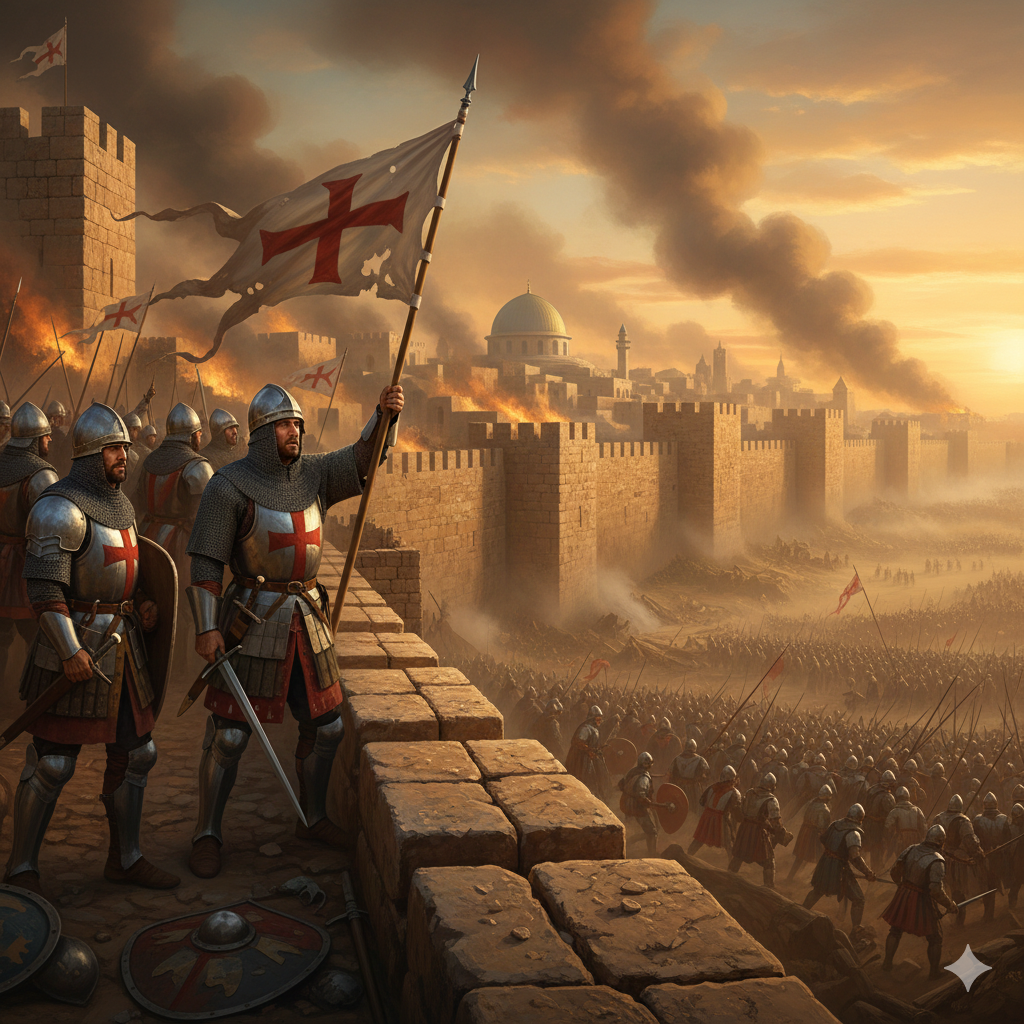
The First to Ninth Crusades (1096–1272): Complete Overview
The Crusades were major military campaigns fought between Christian and Muslim forces between the 11th and 13th centuries. From the First Crusade in 1096 to the Ninth Crusade in 1272, these conflicts shaped medieval politics, religion, economy, and cultural relations between Europe and the Middle East. Below is a detailed and structured explanation of each Crusade.
First Crusade (1096–1099)
The First Crusade was the most successful of all Crusades. Its main objective was to liberate Jerusalem and the Holy Land from Muslim control. It began under the leadership of Pope Urban II and resulted in the Christian capture of Jerusalem.
Background and Causes of the First Crusade
1. Rise of the Seljuk Turks and Persecution of Christians
- In 1071, the Seljuk Turks defeated the Byzantine Empire in the Battle of Manzikert.
- The Turks captured Jerusalem and imposed restrictions on Christian pilgrims.
2. Appeal for Help from the Byzantine Empire
- Byzantine Emperor Alexios I Komnenos requested military assistance from the Christian rulers of Europe.
- He asked the Pope to send Western warriors to stop Muslim expansion.
3. Call of Pope Urban II (1095)
- At the Council of Clermont in 1095, Pope Urban II urged Christians to liberate the Holy Land.
- He promised forgiveness of sins and spiritual rewards for those who joined.
4. Political Ambitions of European Rulers
- Feudal lords and knights joined the Crusade seeking new lands and wealth.
- Trading cities like Venice, Genoa, and Pisa saw opportunities for profit.
Major Events of the First Crusade
1. Departure of Christian Armies (1096)
Armies from France, Germany, Italy, and England marched toward the Holy Land under leaders like Raymond of Toulouse, Godfrey of Bouillon, Bohemond of Taranto, and Baldwin of Boulogne.
2. Failure of the People’s Crusade
Led by Peter the Hermit, an untrained mass movement of commoners was destroyed by the Turks.
3. Victory at Nicaea (1097)
The Crusaders captured Nicaea, then advanced toward Antioch.
4. Conquest of Antioch (1098)
After a long and difficult siege, Antioch fell to the Crusaders, though they suffered heavy losses.
5. Siege and Capture of Jerusalem (1099)
- On 7 June 1099, the Crusaders reached Jerusalem.
- On 15 July 1099, they stormed the city and captured it.
- Thousands of Muslims and Jews were killed.
- Godfrey of Bouillon became the ruler of Jerusalem.
Results of the First Crusade
1. Establishment of Crusader States
- Kingdom of Jerusalem
- County of Edessa
- Principality of Antioch
- County of Tripoli
2. Only Successful Christian Crusade
It was the only Crusade that successfully secured Jerusalem.
3. Outrage in the Muslim World
Muslim rulers reorganised and prepared for counterattacks, leading to future Crusades.
4. Rise of Religious Extremism
The conflict deepened hostility between Christians and Muslims.
Conclusion of the First Crusade
The First Crusade reshaped medieval history and ignited long-term conflict. Its success lasted only a few decades, as Saladin recaptured Jerusalem in 1187, triggering the Third Crusade.
Second Crusade (1147–1149)
The Second Crusade was launched to retake Edessa after its fall to the Muslims. However, it ended in complete failure.
Reasons for the Second Crusade
1. Fall of Edessa (1144)
- Imad-ud-din Zangi captured Edessa in 1144.
- This was the first major Christian defeat after the First Crusade.
2. Fear and Anger in Europe
The loss of Edessa shocked Christians across Europe.
3. Call of Pope Eugenius III
In 1145, the Pope declared a new Crusade and promised forgiveness of sins.
4. Preaching of Bernard of Clairvaux
Bernard encouraged kings and knights to join the Crusade.
Key Leaders
- Emperor Conrad III (Germany)
- King Louis VII (France)
Major Events
1. Defeat of Conrad’s Army (1147)
His army was destroyed by the Seljuks in Asia Minor.
2. Difficult Journey of Louis VII
Louis VII faced constant attacks and hardships.
3. Failed Attack on Damascus (1148)
Christian forces retreated within days due to poor planning.
Reasons for Failure
- Lack of leadership unity
- Weak and exhausted armies
- Strong Muslim resistance
- Strategic error of attacking Damascus
Consequences
- Total failure—Edessa remained under Muslim control.
- Increased Muslim confidence.
- Disappointment among European Christians.
Conclusion of the Second Crusade
The failure of the Second Crusade paved the way for the rise of powerful Muslim leaders like Saladin and prepared the ground for the Third Crusade.
Third Crusade (1189–1192) – “The Crusade of the Kings”
The Third Crusade was launched to retake Jerusalem after its capture by Saladin in 1187.
Reasons for the Third Crusade
1. Saladin’s Conquest of Jerusalem
Saladin defeated Christians at the Battle of Hattin (1187) and captured Jerusalem.
2. Loss of Christianity’s Holiest City
The fall of Jerusalem shocked Europe.
3. Call of Pope Gregory VIII
A new Crusade was declared to restore Jerusalem to Christian rule.
Main Leaders
- Richard I “The Lionheart” (England)
- Frederick Barbarossa (Germany)
- Philip II (France)
Major Events
1. Death of Frederick Barbarossa
He drowned en route, causing his army to disperse.
2. Siege of Acre (1191)
Richard and Philip captured Acre after a long siege.
3. Richard vs. Saladin
Richard fought several battles but could not recapture Jerusalem.
Treaty of Jaffa (1192)
- Jerusalem remained under Saladin’s control.
- Christian pilgrims could visit freely.
- Christians retained control of coastal cities.
Importance of the Third Crusade
- Showed the importance of diplomacy.
- Both Richard and Saladin earned global respect.
- Set the stage for future Crusades.
Conclusion of the Third Crusade
Although brave efforts were made, Christians failed to retake Jerusalem. The Crusade ended with a diplomatic truce rather than military victory.
Fourth Crusade (1202–1204)
The Fourth Crusade was intended to recapture Jerusalem, but it deviated completely and resulted in the sack of Constantinople.
Objectives
- Regain Jerusalem from Muslim rulers.
- Restore Christian unity.
How the Crusade Went Astray
1. Failure to Pay Venice
Crusaders lacked funds, so Venice demanded they capture Zara first.
2. Attack on Zara (1202)
Crusaders attacked a Christian city, leading to excommunication.
3. Intervention in Byzantine Politics
A Byzantine prince promised money if they helped him reclaim the throne. The Crusaders marched to Constantinople.
Sack of Constantinople (1204)
- The Crusaders attacked and brutally plundered the Christian city.
- Churches were destroyed and treasures stolen.
- The Latin Empire was established.
Results of the Fourth Crusade
- Failed to achieve religious goals.
- Worsened relations between Catholic and Orthodox Churches.
- Destroyed the Byzantine Empire's power.
- Strengthened Venice politically and commercially.
Conclusion of the Fourth Crusade
The Fourth Crusade is considered the most disgraceful chapter in Crusader history due to greed, political manipulation, and betrayal.
Fifth to Ninth Crusades (1217–1272)
Popular Amazon Product
Well-reviewed and reliable product with positive customer feedback. Check the latest price, deals & availability on Amazon.
👉 View on AmazonFrom the Fifth to the Ninth Crusade, European Christians attempted repeatedly to recapture Jerusalem, but these campaigns were dominated by political interests rather than religious devotion.
Fifth Crusade (1217–1221)
- Objective: Capture Egypt to weaken Muslim power.
- Events: Crusaders captured Damietta but failed to advance due to Nile floods and Muslim resistance.
- Result: Complete failure.
Sixth Crusade (1228–1229)
- Leader: Emperor Frederick II.
- Unique Feature: A diplomatic success without war.
- Outcome: Jerusalem, Bethlehem, and Nazareth handed to Christians through a treaty.
Seventh Crusade (1248–1254)
- Leader: Louis IX of France.
- Events: Captured Damietta but defeated and captured in Egypt.
- Result: Heavy losses and failure.
Eighth Crusade (1270)
- Leader: Louis IX.
- Event: Died of disease in Tunisia; Crusade collapsed.
Ninth Crusade (1271–1272)
- Leader: Prince Edward of England.
- Event: Fought limited battles in Syria but achieved little.
- Result: Considered the last Crusade.
Collective Results of the Fifth to Ninth Crusades
- Repeated failures to control the Holy Land.
- Decline of religious enthusiasm.
- Rise of political and economic motives.
- Strengthening of Muslim rulers, especially the Mamluks.
Final Conclusion
From 1217 to 1272, the Crusades shifted from religious zeal to political rivalry, trade interests, and declining unity. The Ninth Crusade ended the era, and Muslim forces permanently secured the Holy Land.
Religious and Political Impact of the Crusades
Religious Impact of the Crusades
The Crusades (11th to 13th centuries) were not limited to warfare or territorial occupation. They had deep and far-reaching religious consequences that shaped Christian, Muslim, and Jewish communities, and increased the role of religion in politics, society, and medieval ideology.
1. Influence on Christianity
(a) Rise of the Power of the Pope and the Church (Early Crusades)
- Popes like Pope Urban II gained immense political and religious authority.
- The Crusades strengthened the leadership role of the Catholic Church.
- The Pope’s influence expanded as kings and common people prepared for war in the name of religion.
(b) Decline in the Prestige of the Church (Later Crusades)
- Failed Crusades, especially the Fourth Crusade, caused people to question the Church’s intentions.
- The Church’s approval of attacking Christian cities like Zara and Constantinople damaged its moral authority.
(c) Rise in Pilgrimage Traditions
- The liberation of the Holy Land increased the importance of religious pilgrimages.
- Jerusalem, Nazareth, and Bethlehem gained greater significance in Christian religious life.
2. Impact on Islam
(a) Rise of the Spirit of Jihad
- The Crusades strengthened the idea of jihad (holy struggle) across the Muslim world.
- Leaders like Saladin became not only military icons but also religious symbols.
(b) Growing Religious Tension
- The wars created long-lasting hostility between Christians and Muslims.
- These tensions continued to influence religious relationships for centuries afterward.
3. Impact on the Jewish Community
(a) Persecution and Massacres
- Jewish communities in Germany and France suffered attacks, destruction, and massacres.
- They were wrongly labelled as “killers of God.”
- Several pogroms occurred during the First and Second Crusades.
(b) Increase in Anti-Semitism
- Religious tolerance decreased across Europe.
- Anti-Jewish sentiment escalated and persisted for centuries.
4. Rise in Religious Intolerance and Fanaticism
- Religious slogans like “Deus Vult” (God wills it) became tools for fanaticism.
- People began to view killing or dying for religion as a sacred duty.
5. Use of Religion for Political Power
- Religion became a tool for legitimizing political authority.
- Kings and empires gained religious approval from the Pope for military actions.
Summary: Religious Impact
| Area | Effect |
|---|---|
| Christianity | Initial rise of Papal power, later decline in prestige |
| Islam | Rise of jihad and Muslim unity |
| Judaism | Persecution, massacres, increased intolerance |
| Religious Tolerance | Decreased; fanaticism and extremism increased |
| Religion & Politics | Religion became a tool for political power |

Top Rated Amazon Product
Trusted and popular product with strong customer feedback. Check the latest price, offers & availability on Amazon.
👉 View on AmazonConclusion on Religious Impact
The Crusades expanded religion from being purely spiritual to becoming a tool of war, power, and political strategy. Their impact was deep, complex, and long-lasting, reshaping the religious balance of the medieval world.
Political Impact of the Crusades
The Crusades had a profound effect on the political landscape of medieval Europe and the Islamic world. They changed the balance of power between kings, lords, popes, and empires and paved the way for the transition from feudalism to emerging nation-states.
1. Rise in the Power of Kings
- Many feudal lords died or left Europe to join the Crusades.
- This allowed kings to consolidate control and expand their authority.
- In France and England, royal power increased significantly.
2. Expansion and Decline of Papal Political Power
(a) Peak of Papal Authority (Early Crusades)
- Pope Urban II and Pope Innocent III gained dominance over kings.
- The papacy became heavily involved in politics, military affairs, and diplomacy.
(b) Decline in Papal Prestige (Later Crusades)
- The Fourth Crusade, which targeted Christian cities, damaged the Church’s credibility.
- Political manipulation and greed weakened papal influence.
3. Fall of the Byzantine Empire
- The Fourth Crusade weakened the Byzantine Empire by attacking Constantinople in 1204.
- The empire was never fully restored and collapsed in 1453 under the Ottomans.
4. Unity and Centralization in the Muslim World
- The Crusades encouraged Muslim unity under leaders like Saladin and the Mamluk Sultans.
- Previously fragmented Muslim territories became more politically organized.
5. Decline of the Feudal System
- Feudal lords sold or mortgaged lands to finance Crusades.
- This weakened feudal authority and strengthened centralized monarchies.
- The process laid the foundation for the rise of modern nation-states.
6. Establishment of the Latin Empire
- After the Fourth Crusade, Crusaders established the Latin Empire in Constantinople (1204–1261).
- This worsened divisions between Catholic and Orthodox Christians.
7. Beginning of European Expansionism
- The Crusades showed Europeans that they could conquer foreign territories.
- This mindset later evolved into colonial expansion by Spain, Portugal, Britain, and others.
Summary: Political Impact
| Aspect | Effect |
|---|---|
| Power of Kings | Increased, feudal lords weakened |
| Papal Authority | Initially strong, later declined |
| Byzantine Empire | Weakened and eventually collapsed |
| Muslim Unity | Strengthened and politically organized |
| Feudal System | Began to weaken |
| Expansionism | Laid the foundation for European colonialism |
Conclusion on Political Impact
The political impact of the Crusades reshaped medieval power structures. Kings grew stronger, the papacy became deeply political, feudal lords weakened, and new foundations for the modern world were laid. The Crusades marked a major turning point in the transition from medieval to early-modern political systems.

Economic, Cultural, and Overall Impact of the Crusades
Economic Impact of the Crusades
The Crusades influenced not only religion and politics, but also the economy of medieval Europe and Asia. These wars, fought between the 11th and 13th centuries, reshaped trade, currency, land ownership, taxation, and economic relations.
1. Unprecedented Growth in Trade
- Trade between Europe and the Middle East increased significantly.
- Products such as spices, silk, precious stones, sugar, tea, medicines, and perfumes became more common in Europe.
- Italian cities like Venice, Genoa, and Pisa dominated Mediterranean trade.
- A new merchant class emerged in Europe.
2. Growth and Urbanization of Cities
- Markets, ports, and towns developed rapidly.
- Rural populations migrated to cities, increasing urban growth.
- This led to the revival of medieval European towns.
3. Development of a Currency-Based Economy
- The demand for cash increased — weakening the barter system.
- Gold and silver currency circulation grew.
- Tax collection and trade became cash-based, modernizing revenue systems.
4. Redistribution of Land and Property
- Many feudal lords sold or mortgaged land to fund their Crusade participation.
- Kings and the Church acquired new lands.
- The feudal landlord class weakened, and traditional land ownership patterns changed.
5. Increase in Tax and Revenue Collection
- Popes and kings imposed special taxes, such as the “Saladin Tithe” in England and France.
- The tax system became more organized and regular.
- States became financially stronger.
6. Economic Rise of Italian City-States
- Venice, Genoa, and Florence emerged as major naval and trade centers.
- They played a key role in transporting crusaders, ships, and supplies.
- These cities later became the birthplace of the Renaissance.
7. Promotion of Industries and Craftsmanship
- Industries such as weapons, armor, ships, textiles, and leather gained momentum.
- New agricultural technologies and land cultivation techniques spread.
- Local production increased significantly.
8. Introduction of the Banking System
- The long wars and expanded trade required credit and loan systems.
- Concepts such as interest-based loans, cheques, and bills of exchange emerged.
- This laid the foundation of the modern banking system.
Summary: Economic Impact
| Aspect | Effect |
|---|---|
| Trade | Expansion of East–West commerce |
| Urban Development | Growth of towns and ports |
| Currency | Growth of a cash-based economy |
| Land | Redistribution; weakening of feudal lords |
| Taxation | Organized revenue collection, stronger states |
| Italy | Rise of Venice and Genoa as economic powers |
| Industry | Growth of arms, ships, and textile production |
| Banking | Beginning of the modern credit system |
Conclusion: Economic Impact
The Crusades triggered economic restructuring and revived European trade. They strengthened local production, introduced currency-based economies, expanded global trade networks, and laid the foundation for Europe’s long-term economic growth.
Cultural Impact of the Crusades
The Crusades also promoted a large-scale exchange of ideas, knowledge, art, architecture, language, and lifestyle between Europe and the Middle East — forming a “bridge of culture” that connected East and West.
1. Fusion of Eastern and Western Cultures
- European warriors and traders encountered Eastern civilizations, science, literature, and food.
- This contact led to a rich cultural exchange.
- Arabic numerals, paper, medicines, and spices reached Europe.
2. Spread of Knowledge and Education
- Europeans were introduced to Arabic, Greek, and Persian manuscripts.
- Subjects like medicine, mathematics, astronomy, philosophy, and science spread across Europe.
- Works of Aristotle, Avicenna (Ibn Sina), Al-Farabi, and Al-Khwarizmi were translated.
3. Influence on Architecture and Art
- Eastern architectural styles — domes, arches, minarets — influenced European buildings.
- Churches and palaces adopted Middle Eastern designs.
- The growth of Gothic architecture is linked to Crusader contact with the East.
4. Exchange of Languages and Words
- Many Arabic and Turkish words entered European languages.
- Examples: Sugar (shakar), Coffee (qahwa), Cotton (qutn), Algebra (al-jabr)
- This enriched European linguistic diversity.
5. Changes in Diet and Lifestyle
- Spices, coffee, fruits, fabrics, and Eastern goods became fashionable in Europe.
- Demand for silk, perfume, carpets, and porcelain increased.
- These influences shaped European cuisine and fashion.
6. Tolerance and Intolerance — Both Increased
- Some Europeans admired Eastern knowledge and culture.
- Others became increasingly rigid and intolerant, deepening cultural conflict.
Popular Amazon Product
Well-reviewed and customer-trusted product with excellent feedback. Click below to check the latest price, deals & availability on Amazon.
👉 View on Amazon7. Growth of Exploration and Discovery
- The Crusades sparked a desire to explore new lands.
- This curiosity helped launch the later “Age of Exploration.”
- Navigators like Columbus and Vasco da Gama were indirect products of this cultural shift.
Summary: Cultural Impact
| Aspect | Effect |
|---|---|
| Union of Cultures | Exchange of Eastern and Western ideas |
| Education | Spread of Arabic & Greek knowledge |
| Architecture | Growth of Gothic style & Eastern design |
| Language | Arabic words entered European languages |
| Food | Spices, coffee, silk, and new tastes |
| Social Impact | Tolerance in learning; intolerance in religion |
| Exploration | Rise of global travel and discovery |
Conclusion: Cultural Impact
The Crusades transformed Europe culturally by introducing new knowledge, art, lifestyle, and architecture. While they brought conflict, they also sparked intellectual and cultural awakening, ultimately contributing to the Renaissance.
Conclusion of the Crusades
The Crusades were a defining chapter in world history. They deeply influenced religion, politics, economy, society, and culture, shaping the direction of global civilization.
1. Difference Between Purpose and Reality
- Purpose: Liberate Jerusalem and restore Christian dominance.
- Reality: Most Crusades failed; Christian control was temporary.
2. Awakening of Europe
- The Crusades helped Europe emerge from the Dark Ages.
- They stimulated trade, education, urbanization, and scientific thinking.
- The foundations of the Renaissance and modern Europe were laid.
3. Shift from Religion to Politics
- Initially religious, the Crusades gradually became politically and economically motivated.
- The Church’s moral authority declined, and kings became stronger.
- This shift led to the rise of nation-states.
4. Increased Distance Between Religions
- Christian–Muslim relations became more strained.
- Even within Christianity, Catholic–Orthodox divisions deepened.
5. Bridge of Knowledge and Ideas
- The Crusades connected Europe with Islamic and Greek knowledge.
- Fields like mathematics, astronomy, medicine, philosophy, and architecture evolved.
- This knowledge exchange became a foundation for the European Renaissance.
6. Lasting Effects — Positive & Negative
| Area | Positive Effects | Negative Effects |
|---|---|---|
| Education | Spread of knowledge | Religious narrow-mindedness |
| Economy | Growth of trade | Loss of property and lives |
| Politics | Strengthening of monarchies | Decline of Church prestige |
| Religion | Wider worldview | Legacy of conflicts |
| Culture | Cultural exchange | Bigotry and prejudice |
7. Lessons from History
- Religion used for political or economic gain becomes destructive.
- Dialogue, knowledge, and tolerance can transform societies.
Final Summary
Despite their religious failures, the Crusades laid the foundation for Europe’s political, economic, and cultural awakening. They were not just conflicts but also conduits of exchange, transformation, and global change — an era of destruction and growth together.