

Introduction — Human and Ecological Significance of the Himalayas
Whenever we speak of the Himalayas, what comes to mind is not only a magnificent chain of snow-covered peaks, but also the heartbeat of civilizations that have evolved around them for thousands of years. The Northern Mountain Region is far more than a geographical formation; it is a living, breathing ecosystem where nature, culture, and human life meet in a deeply interconnected way. Through my journeys—whether walking through the quiet valleys of Himachal, the remote villages of Uttarakhand, or the vast cold deserts of Ladakh—I realized that the Himalayas are not merely to be seen, but to be understood.
In this article, I bring together my personal experiences, scientific insights, and the voices of local communities to paint a vivid portrait of the Himalayas. The mornings in the mountains, where the first rays of sunlight turn icy slopes into a shimmering gold, create a sense of energy and calm that words often fail to capture. And the evenings—filled with the distant sound of bells, a gentle breeze passing through high ridges, and smoke rising slowly from village homes—offer a reminder that a simple life can also be beautifully fulfilling.
 | 👉 Buy on Amazon |
| As an Amazon Associate I earn from qualifying purchases. | |
Yet, the life of the Himalayas is not defined only by harmony and serenity. Climate shifts, fragile ecosystems, rapid tourism growth, melting glaciers, and the economic pressures on local communities form a complex reality that needs to be understood with sensitivity. Young people leaving villages in search of better opportunities, unpredictable weather patterns affecting crops, and the changing identity of traditional cultures are all part of the evolving Himalayan story. Amid these challenges, however, lies a remarkable strength—community unity, traditional wisdom, and a deep-rooted respect for nature.
The purpose of this article is to present the Himalayas not just as a travel destination, but as a “living ecological system” that shapes and sustains millions of lives. I hope that as you read this introduction, you not only gain knowledge about its beauty and hardships, but also recognize how vital the Himalayas are for all of us, and why their preservation is a shared responsibility. This article blends inspiration, education, and authentic experience—so that you don't simply read about the Himalayas, but feel them.

Part A — Land, Water, and Weather: The Geographic and Climatic Story of the Himalayas
The geography of the Himalayas is as grand as it is intricate. This mountain range is not merely a collection of high peaks, but a vast living system that influences climate, culture, and survival across the entire Northern Mountain Region. Every valley, every ridge, and every layer of rock has a story hidden within it. During my journeys through the region, I realized that understanding the Himalayas is like learning the slow, patient language of nature—filled with depth, rhythm, and silent wisdom.
The Geological Formation of the Himalayas: A Living Museum
Around 50 million years ago, the Indian tectonic plate collided with the Eurasian plate, giving birth to the mighty Himalayas. This collision continues even today, which is why the mountains are still rising and the region frequently experiences seismic activity. For geographers and earth scientists, the Himalayas act like an open-air laboratory where the dynamic forces of Earth can be observed in real time.
Glaciers: The Beating Heart of the Himalayas
Often called the “Water Tower of Asia,” the Himalayas host more than 15,000 glaciers. These glaciers give birth to some of Asia’s most important rivers such as the Ganga, Yamuna, Indus, Brahmaputra, and Sutlej. These rivers support the lives of hundreds of millions of people across India, Nepal, Bhutan, Pakistan, and Bangladesh. During my visit to the Gangotri glacier, the slow trickle of icy water felt like a pulse—an intimate reminder that every drop carries life. It was as if nature herself whispered, “I nourish you; protect me in return.”
Valleys, Elevation, and Ecological Shifts
One of the most striking aspects of Himalayan geography is how elevation changes everything. Between 1500–2500 meters, you find dense pine and cedar forests. From 2500–3500 meters, the forests transform into birch, rhododendron, and Himalayan oak. But once you cross 4000 meters, the landscape shifts dramatically— barren slopes, sharp winds, scattered shrubs, and snowfields dominate the terrain. This elevation-based transformation teaches an important lesson: survival in the mountains is rooted in adaptation.
Weather and Climate: The Mood of the Mountains
The weather in the Himalayas changes faster than one can predict. Sunshine, clouds, rainfall, and snowfall can all appear within the same day. Locals often say, “Mountain weather changes without warning.” During one of my treks, the morning sky was crystal clear, yet by noon dark clouds had gathered, and by evening, a light snowfall had begun. While such shifts make the mountains enchanting, they also create difficulties for local communities whose livelihoods depend on stable weather.
 | 👉 Buy on Amazon |
| As an Amazon Associate I earn from qualifying purchases. | |
Visible Signs of Climate Change
Over the past decade, Himalayan glaciers have been retreating at an alarming rate. Places that I had visited years earlier, once covered in thick layers of snow, now reveal exposed rock and thinning ice. Many villagers shared that winters have become shorter and less predictable, while summers feel warmer than ever before. These changes are affecting agriculture, livestock, tourism, and even drinking water availability.
Mountain rivers, once steady throughout the year, now experience irregular flows. Rainfall patterns have become erratic: instead of gentle, regular showers, the region now faces sudden cloudbursts or long dry spells. Farmers told me that crops like wheat, barley, and potatoes are directly impacted by this unpredictability, making traditional farming more uncertain than before.
The Deep Relationship Between Humans and Geography
The geography of the Himalayas is not merely a landscape; it is a foundation upon which local communities have built their lifestyles. Terraced farming (designed to prevent soil erosion), traditional wooden architecture suited for earthquakes, and local water-harvesting systems all demonstrate a deep respect for the land.
I once visited a mountain household where the elders explained how homes are designed to stay warm in winter and cool in summer. They said, “A house in the mountains is not just a shelter; it is a negotiation with nature.” Listening to them made me realize that while the mountains challenge human life, they also guide it—teaching balance, patience, and harmony.
In essence, the geography and climate of the Himalayas are inseparable. This region is both beautiful and fragile. Every river, every glacier, and every slope reminds us of nature’s strength and vulnerability. Understanding the Himalayas’ geography is essential for understanding their challenges—and more importantly, for shaping the solutions that will protect this extraordinary region for future generations.
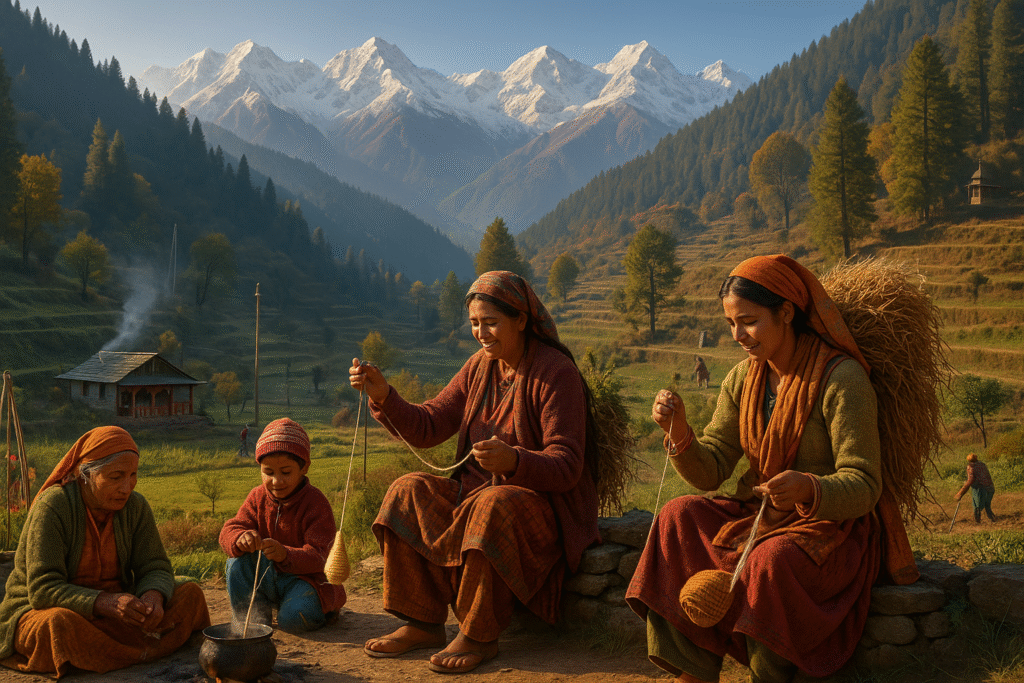
Part B — Local Communities and Culture: Lifestyle, Traditions, and Experiences
The culture of the Himalayas is one of its most vibrant and enduring identities. It is not confined to folk songs, festivals, or traditional attire—it is woven into the everyday rhythm of life. Just as terraced fields reflect patience and hard work, the culture here symbolizes simplicity, community strength, and a deep harmony with nature. During my first visit to a quiet Himalayan valley, the fragrance of wood smoke, the welcoming smiles of villagers, and the slow echo of temple bells made me realize that life in the mountains moves to a very different rhythm— slower, calmer, and full of depth.
Daily Life: Discipline, Hard Work, and Living with Nature
Life in the mountains is not easy, but perhaps that is why the lifestyle here is incredibly grounded and disciplined. People rise with the first rays of the sun and structure their day according to the pulse of nature. Farming on terraced slopes, tending livestock, collecting fodder or firewood, and maintaining the household— everything follows a naturally balanced pattern.
I once spent an entire day with a local family. Working in the fields with them in the morning, sharing a simple lunch of buttermilk and millet bread, and listening to folk stories around the hearth in the evening became an unforgettable experience. They told me that in the mountains, “discipline” and “cooperation” are not just values but necessities for survival.
Traditional Food: A Blend of Energy, Simplicity, and Health
The Himalayan diet is deeply shaped by geography and climate. People eat food that is nutritious, seasonal, and suited to the challenges of cold weather and high altitude. Millet bread, horse gram lentils, buckwheat dishes, local vegetables, and rhododendron juice are staples of daily life. These foods not only provide strength but also help the body adapt to the environment.
The beauty of mountain cuisine lies in its purity. Most food is organic and prepared fresh at home, which naturally keeps the lifestyle healthy and balanced.
 | 👉 Buy on Amazon |
| As an Amazon Associate I earn from qualifying purchases. | |
Festivals, Traditions, and Folklore: The Emotional Heartbeat of the Mountains
Festivals in the Himalayas are closely connected to nature, seasons, agriculture, and community life. In Uttarakhand, celebrations such as Harela, Ghughutiya, and Phool Dei express gratitude to nature, while in Himachal Pradesh, festivals like Kullu Dussehra, Lohri, and Fagli celebrate cultural identity and seasonal changes.
During the Harela festival, I watched villagers sow seeds, plant trees, and pray for prosperity and ecological balance. It became clear to me that festivals here are not only spiritual but also ecological—they bind communities to the rhythms of nature.
Folk Tales and Music: The Voice of the Mountains
Himalayan folk tales have been passed down for generations, preserving legends of gods, warriors, love, and the realities of mountain life. Folk dance and music—whether it is Nati, Jhora, Garhwali songs, or traditional flute melodies—form the cultural heartbeat of villages.
The first time I saw a traditional “Nati” dance in Himachal, I realized that such performances are not just entertainment—they are celebrations of unity, joy, and community identity.
Economic Life: Simplicity with a Strong Sense of Fulfillment
Agriculture, livestock rearing, local crafts, and small-scale businesses form the backbone of Himalayan livelihoods. Women play a vital role in this ecosystem—managing fields, households, markets, and community activities with remarkable resilience. Economically, life here may seem simple, but emotionally and culturally, it is incredibly rich.
Local crafts such as wool weaving, wood carving, hand-knitted caps, and metalwork are treasured traditions passed down through generations. These crafts are not only sources of livelihood but also symbols of cultural continuity.
Community Life: The Spirit of “We”
Community is the soul of Himalayan culture. Whether it's a wedding, a festival, a harvest season, or a household facing difficulty—the entire village comes together. A common phrase I heard often was, “In the mountains, no one lives alone; we are each other’s support.”
Ultimately, the culture and lifestyle of the Himalayas remind us that a fulfilling life does not require excess or abundance. It requires balance, gratitude, and a deep connection with nature and people. The Himalayan way of life is a powerful inspiration—showing how simplicity, resilience, and community spirit can create a truly meaningful existence.

Part C — Challenges: Environmental Pressures, Displacement, and a Changing Himalayan Landscape
The Himalayas, despite their grandeur and cultural richness, are among the most fragile ecosystems on the planet. Every component—its forests, rivers, glaciers, soil, wildlife, and human settlements—exists within a delicate balance. However, in recent decades, this balance has been tested by multiple pressures. Climate change, unplanned development, rapid tourism, resource scarcity, migration, and economic shifts are transforming the Himalayan region at a pace never seen before.
1. Climate Change and Rapid Glacier Retreat
The most urgent challenge facing the Himalayas is climate change. Glaciers are melting at accelerated rates, winters are growing shorter, and temperature patterns are becoming increasingly unpredictable. In many regions, elders recall a time when snow covered peaks for six to seven months; today, snow may last for only two or three months.
This affects far more than just the visual landscape. Water availability, agriculture, livestock management, and daily livelihood patterns are all directly impacted. Farmers now deal with unexpected rainfall, unusual heatwaves, sudden hailstorms, and extended droughts—all of which create uncertainty in mountain agriculture and food security.
 | 👉 Buy on Amazon |
| As an Amazon Associate I earn from qualifying purchases. | |
2. Irregular River Flows and Increased Natural Disasters
Himalayan rivers are lifelines for millions, yet their behavior is changing rapidly. Monsoon seasons now bring unpredictable floods, cloudbursts, and rising incidents of GLOFs (Glacial Lake Outburst Floods). Landslides have become more frequent, often cutting off villages, destroying farms, and isolating communities.
During my travels, many residents expressed fear about the monsoon. “We used to trust the river,” one villager said, “but now we never know when it will rise.” These disasters are not simply environmental events—they disrupt transportation, damage infrastructure, and threaten lives and livelihoods across entire valleys.
3. Unregulated and Unsustainable Tourism
Tourism is both a blessing and a burden for the Himalayas. While it provides income and opportunities for local communities, uncontrolled tourism brings pollution, excessive waste, water scarcity, soil degradation, and strain on natural resources.
Popular destinations now face overwhelming crowds, especially during peak seasons. A café owner in Himachal once told me, “Tourists love the mountains, but many do not understand how fragile they are.” Overuse of water, irresponsible trekking, and the rise of large commercial hotels in ecologically sensitive zones amplify the pressure on already delicate ecosystems.
4. Migration and the Changing Social Fabric
Migration is another major challenge. Young people are increasingly moving to cities for education and employment, leaving behind shrinking villages and aging populations. As a result, once-thriving communities face social decline. Terraced farms become barren, traditional architecture deteriorates, and many cultural practices begin to fade.
During one of my visits, an elderly woman said, “The mountains are still beautiful, but the people are becoming fewer.” This shift is emotional as well as structural, signaling a transformation in the Himalayan social ecosystem.
5. Unscientific Construction and Landslides
Rapid construction of highways, hotels, and commercial centers—often without geological assessment— has weakened natural slopes. Deforestation, blasting for road expansion, and heavy vehicle movement have significantly increased soil instability.
Many landslides today are not purely natural; they are triggered or intensified by human intervention. When mountains are cut without understanding their geological behavior, the consequences can be devastating.
6. Water Scarcity and Resource Pressure
Despite being home to glaciers and rivers, many Himalayan villages face water shortages, especially in summer. Traditional springs are drying up, forcing communities to depend on tankers or walk long distances for water. As populations and tourism grow, pressure on local resources increases.
In summary, the Himalayas are under immense strain. The environment is changing, communities are shifting, and natural systems are becoming unpredictable. These challenges are interconnected, complex, and urgent—but they also open pathways for thoughtful solutions rooted in science, local wisdom, and sustainable development.
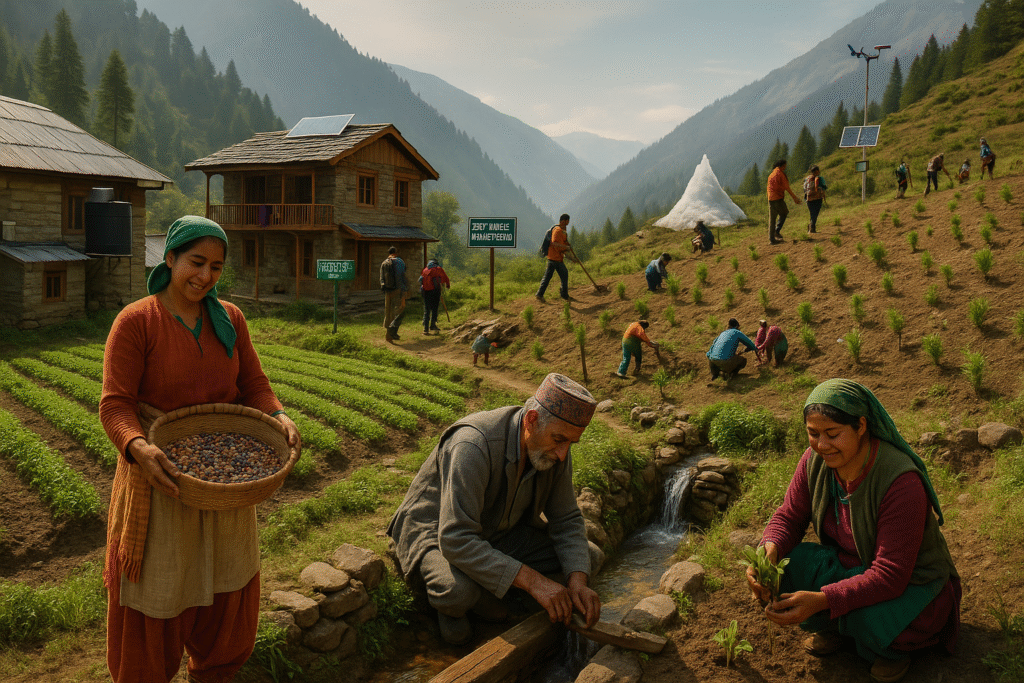
Part D — Solutions and Innovations: Local Wisdom, Modern Technology, and the Path to a Sustainable Himalayan Future
The challenges faced by the Himalayas are undeniably complex, yet they are not insurmountable. The strength of the Himalayan region lies in its communities—their deep traditional knowledge, their adaptive lifestyles, and their capacity to work collectively. When combined with thoughtful governance and modern innovations, these strengths can create powerful and long-lasting solutions. During my travels across several Himalayan villages, I realized that the future of the mountains depends not only on large policies but also on hundreds of small, community-driven efforts rooted in care and respect for nature.
1. Reviving Traditional Knowledge and Indigenous Practices
Himalayan communities have lived in harmony with nature for centuries. Their traditional systems are built upon a deep understanding of climate, soil, water, and forest ecology. Reviving these practices is one of the most effective paths toward sustainability. Some key practices include:
 | 👉 Buy on Amazon |
| As an Amazon Associate I earn from qualifying purchases. | |
- Terrace Farming: Prevents soil erosion and manages water efficiently.
- Traditional Water Systems: Such as “guhls”, “naulas”, and spring conservation.
- Local Seed Preservation: Drought-resistant and climate-adapted crop varieties.
- Earthquake-resilient architecture: Wood-stone houses that stay warm in winter and cool in summer.
I once spoke with an elderly farmer who said, “Our ancestors learned from the mountains—not from books, but from experience.” His words reflected a timeless truth: sustainable living begins with listening to nature.
2. Promoting Sustainable Tourism
Tourism cannot be eliminated, but it can be redesigned to protect the fragile ecosystem. Sustainable tourism models benefit both visitors and local communities while reducing ecological pressure. Key strategies include:
- Carrying Capacity Limits: Restricting the number of tourists in sensitive zones.
- Homestay Programs: Encouraging community-based tourism instead of large hotels.
- Zero-waste Trekking Routes: Mandatory return of waste carried by travelers.
- Local Guides and Eco-educators: Ensuring safety while promoting environmental awareness.
In Spiti Valley, I witnessed a remarkable model where trekkers sign a pledge to leave no waste behind. The result is a cleaner, healthier environment that reflects the true spirit of the mountains.
3. Water Conservation and Restoration of Traditional Springs
Water scarcity is emerging as a major challenge, even in glacier-fed regions. Communities are responding with innovative yet culturally rooted solutions:
- Reviving traditional springs and water channels.
- Constructing artificial glaciers (popularized in Ladakh).
- Rainwater harvesting tanks in households and schools.
- Micro-irrigation systems such as drip and sprinkler technologies.
In Uttarkashi, villagers told me how they collectively restored a dried spring. Within months, water began flowing again. It was a powerful reminder that nature heals quickly when treated with care.
4. Community-led Forest Management and Reforestation
Forests are the protective shield of the Himalayas. Many communities actively manage forests through local groups such as “Van Panchayats” and women-led forest committees. Their responsibilities include:
- Regulating wood collection and grazing areas.
- Planting native species instead of commercial/non-native trees.
- Protecting water catchment zones through reforestation.
- Preventing forest fires through awareness and monitoring.
These community-led models have proven more effective than many top-down policies, as they are driven by genuine connection and responsibility for the land.
5. Integrating Modern Technology with Environmental Responsibility
While traditional knowledge is vital, modern innovations can greatly strengthen Himalayan resilience. Useful technologies include:
- Early-warning systems for landslides, earthquakes, and floods.
- Climate monitoring sensors in high-altitude zones.
- Drones for forest surveillance and disaster assessment.
- Solar-powered homes, water heaters, and microgrids.
- Eco-engineering techniques for slide-resistant roads.
When used wisely, technology does not replace tradition—it enhances it.
6. Strengthening the Local Economy
A sustainable Himalayan future depends heavily on strong local economies. If livelihoods flourish within villages, migration will reduce, and cultural continuity will strengthen. Key measures include:
- Online markets for local craft, wool products, and organic foods.
- Promotion of natural farming and high-value mountain crops.
- Training programs for youth in eco-tourism and digital skills.
- Women-led self-help groups for financial independence.
When people earn well locally, they stay, they protect, and they invest in the land.
In conclusion, the future of the Himalayas depends on a thoughtful blend of traditional wisdom, modern innovation, community participation, and strong governance. Solutions already exist—what is needed is consistent support, awareness, and collective commitment to preserving one of the world’s most important ecological treasures.
 | 👉 Buy on Amazon |
| As an Amazon Associate I earn from qualifying purchases. | |