
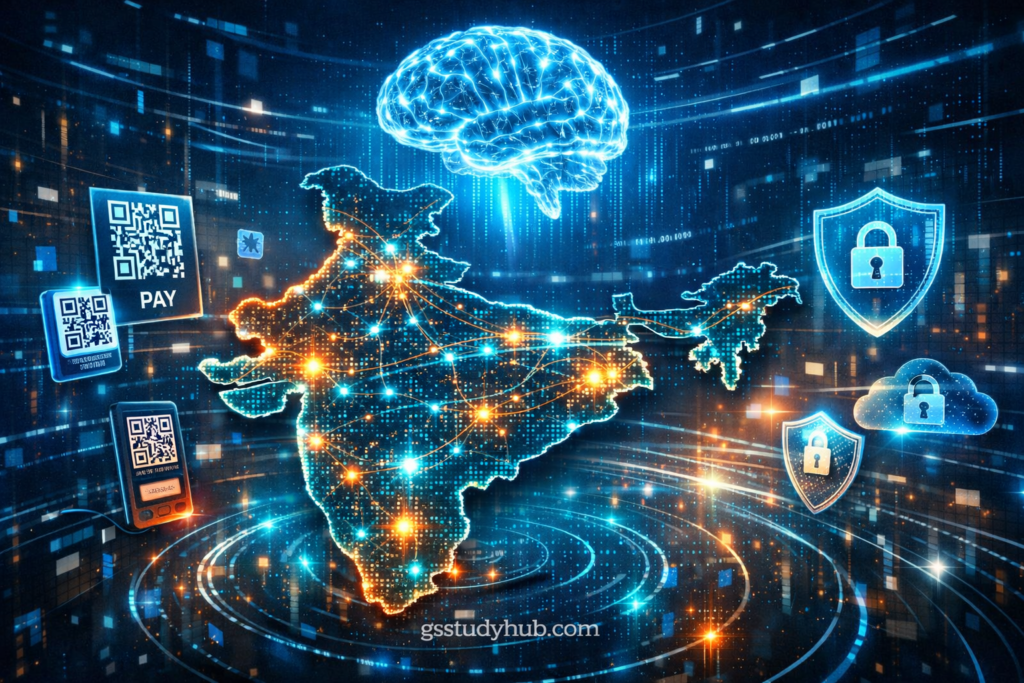
📘 Digital India & AI Revolution 2026 – Introduction
Digital India AI Revolution 2026 marks a major turning point in India’s technological and economic transformation.Digital India & AI Revolution 2026 – A Game-Changing ShiftHow Digital India & AI Revolution 2026 Is Reshaping Governance
India’s digital transformation story is no longer just a national success narrative — it has become a global case study in how technology, governance, and innovation can reshape an entire nation. From small villages accessing high-speed internet to metropolitan cities adopting AI-powered governance systems, the Digital India Mission has transformed the country’s digital backbone into a powerful economic engine. In less than a decade, India has moved from limited connectivity to becoming one of the world's fastest-growing digital ecosystems.
Why is 2026 a turning point? Because this is the year where Artificial Intelligence, digital payments, cyber security frameworks, and data protection laws converge into a single strategic direction. AI startups are scaling rapidly, UPI is expanding internationally, and India’s Data Protection framework is shaping global trust. The nation is not just consuming technology anymore — it is building, regulating, and exporting it. 2026 marks the shift from digital adoption to digital leadership.
The connection between Technology, Policy & Economy has never been stronger. Government policies now directly influence innovation cycles, AI regulations impact startup growth, and digital payment systems redefine global trade flows. Technology is powering economic expansion, policy is ensuring ethical governance, and the economy is adapting to a data-driven future. Together, they form a triad that positions India as a potential Global Digital Superpower in the coming decade.
🚀 In 2026, Digital India is not just about connectivity — it is about capability, credibility, and competitiveness on the global stage.
🌏 Taiwan Strait Crisis 2026 – Is It the Next Ukraine?
Rising geopolitical tensions in Asia and the evolving China–Taiwan conflict are reshaping global security dynamics. Could the Taiwan Strait Crisis 2026 escalate into a conflict similar to Ukraine?
🌍 Background of India’s Digital Revolution – The Rise of a Tech Powerhouse
India’s digital transformation journey is one of the most remarkable success stories of the 21st century. What began as an ambitious governance initiative has now evolved into a full-scale economic and technological revolution. When the Digital India vision was introduced, the primary goal was simple — expand internet connectivity, digitize public services, and empower citizens through technology. However, by 2026, this initiative has transformed into a strategic pillar of national growth.
Fiber-optic networks have reached rural villages, mobile internet has become among the most affordable in the world, and digital payment systems have redefined financial accessibility. Platforms like UPI have enabled billions of seamless transactions every month, turning India into one of the largest digital payment ecosystems globally. Digital infrastructure is no longer just a convenience — it has become the backbone of the Indian economy.
Post-2020, emerging technologies such as Artificial Intelligence, cloud computing, big data analytics, and cybersecurity accelerated this transformation. Government policies encouraged innovation, startups scaled rapidly, and private investments surged. India shifted from being a technology consumer to becoming a global technology creator and exporter.
By 2026, the digital landscape has reached a defining moment. Digital platforms now drive employment, education, trade, governance, and global connectivity. Data protection frameworks are being implemented, AI regulations are under discussion, and India’s digital systems are expanding internationally. This powerful background sets the foundation for India’s emergence as a Global Digital Superpower.
🚀 The Digital India background is not just a story of connectivity — it represents capability, credibility, innovation, and global competitiveness.
💱 De-Dollarization 2026 – The Global Economic Shift
The world economy is undergoing major changes as countries reconsider reliance on the US dollar. Explore how de-dollarization could reshape global finance, trade alliances, and currency power by 2026.
👉 Read the 2026 De-Dollarization Analysis (Economic Shift Explained)

🚀 Digital India Mission 2.0 – The Next Phase of India’s Digital Revolution
Digital India Mission 2.0 represents the evolution of India’s digital transformation strategy. While the first phase focused on expanding connectivity and digitizing government services, the second phase is centered on innovation, artificial intelligence integration, cyber resilience, and global digital leadership. India is no longer just building infrastructure — it is building a future-ready digital ecosystem.
Under Mission 2.0, high-speed broadband has expanded deeper into rural and remote regions, bridging the digital divide like never before. 5G deployment is accelerating smart cities, IoT-enabled governance systems are improving public services, and cloud-based digital platforms are enhancing transparency and efficiency. Digital governance is becoming faster, more accountable, and citizen-centric.
Economically, Digital India AI Revolution 2026 is accelerating fintech expansion, AI startups, and digital infrastructure investment.🌐 Key Pillars of Digital India Mission 2.0
- ✔ Nationwide 5G & Future 6G Preparation
- ✔ AI Integration in Agriculture, Healthcare & Education
- ✔ Expansion of Digital Payment Infrastructure
- ✔ Strengthened Cyber Security Framework
- ✔ Startup & Innovation Ecosystem Boost
The mission emphasizes AI-driven governance, where data analytics supports better policy decisions. Smart agriculture platforms provide farmers with predictive insights, AI-powered health systems improve diagnostics, and digital education platforms reach millions of students nationwide. Technology is no longer optional — it is becoming the core driver of inclusive growth.
Economically, Mission 2.0 aims to position India as a global digital services exporter. With a rapidly growing startup ecosystem, increasing foreign investments, and international digital collaborations, India is strengthening its role in the global tech supply chain. The focus is not only domestic growth but global competitiveness.
✨ Digital India Mission 2.0 is transforming India from a digitally connected nation into a digitally empowered and globally competitive superpower.
🚢 Red Sea Crisis 2026 – Impact on Global Trade
The ongoing tensions and security challenges in the Red Sea are disrupting shipping routes and supply chains. Learn how the Red Sea Crisis 2026 is reshaping global trade, energy flows, and maritime security.
🤖 AI in India 2026 & AI Regulation – From Innovation to Responsible Leadership
In 2026, Artificial Intelligence (AI) in India has reached a transformative stage. AI is no longer just a technological trend — it has become a strategic pillar driving growth across governance, healthcare, agriculture, education, finance, and defense. Thousands of AI startups are emerging, data-driven systems are strengthening policy decisions, and digital innovation is attracting global investment into India’s expanding tech ecosystem.
India’s ambition is not limited to adopting AI technologies — it aims to build, regulate, and export AI-driven solutions globally. AI-powered chatbots, smart healthcare diagnostics, predictive agriculture tools, automation platforms, and intelligent fintech systems are reshaping productivity and generating new employment opportunities. AI is increasingly becoming the backbone of India’s digital economy.
Economically, Digital India AI Revolution 2026 is accelerating fintech expansion, AI startups, and digital infrastructure investment.🚀 Major Application Areas of AI in India
- ✔ Smart Agriculture – Weather forecasting & crop prediction
- ✔ Healthcare – AI-driven diagnostics & data analytics
- ✔ Education – Personalized digital learning platforms
- ✔ Defense – Automated surveillance & intelligent security systems
- ✔ FinTech – Fraud detection & secure digital transactions
However, rapid AI growth also presents serious challenges. Concerns around data privacy, algorithmic bias, deepfake technology, cyber fraud, and job displacement are increasing. This is why AI Regulation has become one of the most debated policy topics in 2026.
⚖️ Why AI Regulation is Essential
- ✔ To ensure data protection and privacy compliance
- ✔ To maintain transparency in AI algorithms
- ✔ To prevent deepfake misuse and digital fraud
- ✔ To balance automation with employment stability
- ✔ To strengthen global trust and international credibility
India is adopting a balanced approach — encouraging innovation while promoting ethical and responsible AI development. Policymakers, industry leaders, and startups are collaborating to design frameworks that protect citizens without slowing technological growth. The goal is to create a regulatory model that supports innovation, ensures accountability, and positions India as a responsible AI leader.
Economically, AI has the potential to significantly contribute to India’s GDP growth. Automation-driven productivity gains, AI-powered digital exports, and the rapid expansion of tech startups are strengthening India’s position in the global technology supply chain. By 2026, India is steadily moving toward becoming a Global AI Hub.
✨ In 2026, India’s AI journey is not just about technological advancement — it is about responsible innovation, ethical governance, and global digital leadership.
🤖 AI Arms Race 2026 – US-China Tech War & Global Power Shift
The global tech landscape is rapidly evolving as the United States and China compete for dominance in artificial intelligence, defense systems, and strategic innovation. Explore how the AI arms race could redefine global power structures by 2026.
👉 Read the AI Arms Race 2026 Analysis (US-China Tech Competition)

💳 UPI International Expansion – India’s Digital Payment Revolution Goes Global
The international expansion of UPI (Unified Payments Interface) marks one of the most significant milestones in India’s digital journey. What started as a domestic real-time payment system has now evolved into a globally recognized digital financial infrastructure. UPI has transformed the way Indians transact — fast, secure, and cashless — and by 2026, it is extending that transformation beyond national borders.
With billions of transactions processed every month, UPI has become one of the world’s largest digital payment platforms. Its success lies in simplicity, interoperability, low transaction cost, and instant settlement capability. Unlike traditional card networks, UPI allows direct bank-to-bank transfers without intermediaries, making it highly efficient and scalable.
🌍 Countries Adopting or Integrating UPI
- ✔ Singapore – Cross-border payment linkage
- ✔ UAE – Merchant payment integration
- ✔ France – Retail & tourism payment support
- ✔ Nepal & Sri Lanka – Regional financial connectivity
- ✔ Ongoing discussions with multiple global economies
UPI’s global rollout strengthens India’s financial diplomacy. It enhances trade, tourism, remittances, and cross-border business transactions. Indian travelers can now make payments abroad using familiar QR systems, while international merchants gain access to India’s massive consumer base. This expansion improves financial inclusion and reduces dependency on traditional global card networks.
⚡ Why UPI’s Global Expansion Matters
- ✔ Strengthens India’s global economic influence
- ✔ Reduces transaction costs in international payments
- ✔ Boosts cross-border trade & tourism
- ✔ Promotes financial inclusion in developing nations
- ✔ Positions India as a global fintech innovator
From a strategic perspective, UPI represents more than just a payment system — it symbolizes India’s ability to build scalable digital public infrastructure. As more countries explore digital transformation, UPI serves as a replicable model for affordable and inclusive financial systems.
Economically, UPI International Expansion strengthens India’s role in the global fintech ecosystem. It supports digital exports, enhances bilateral cooperation, and reinforces India’s image as a trusted technology partner. By 2026, UPI is no longer just a national success story — it is emerging as a Global Digital Payment Standard.
✨ UPI’s international expansion reflects India’s digital confidence — combining innovation, efficiency, and global economic strategy into a single platform.
🧠 Cold War Lessons for Today’s Geopolitics
Historical strategic insights from the Cold War era still shape modern global power dynamics. Discover key Cold War lessons that can help interpret current geopolitical challenges and conflicts.
🔐 Cyber Security Challenges – Protecting India’s Digital Future
As India accelerates its digital transformation, cyber security has become one of the most critical national priorities. With billions of digital transactions, expanding AI systems, cloud-based governance platforms, and global payment integrations, India’s digital infrastructure is more connected than ever before. However, increased connectivity also brings increased vulnerability.
Cyber threats are evolving rapidly — from phishing attacks and ransomware to sophisticated state-sponsored cyber espionage. As businesses digitize operations and citizens rely more on online platforms, protecting sensitive data and ensuring digital trust has become essential for economic stability and national security.
⚠️ Major Cyber Security Challenges in 2026
- ✔ Rising ransomware attacks targeting enterprises and institutions
- ✔ AI-powered cyber fraud and deepfake manipulation
- ✔ Data breaches affecting financial and healthcare systems
- ✔ Phishing scams targeting digital payment users
- ✔ Cross-border cyber warfare and espionage risks
The expansion of UPI and digital banking systems has made financial platforms a prime target for cybercriminals. Fraud detection systems are improving, but attackers are also leveraging AI tools to bypass traditional security measures. This ongoing digital arms race requires continuous innovation in cyber defense technologies.
🛡️ Strengthening Cyber Resilience
- ✔ Advanced AI-driven threat detection systems
- ✔ Multi-layer encryption & secure cloud infrastructure
- ✔ Stronger data protection regulations
- ✔ Cyber security awareness & digital literacy programs
- ✔ International cyber cooperation agreements
India is investing heavily in cyber defense strategies, including AI-powered monitoring tools and national-level response frameworks. Public-private partnerships are strengthening cyber infrastructure, and regulatory frameworks are evolving to ensure compliance and accountability.
From an economic perspective, cyber security is directly linked to investor confidence and digital trade growth. A secure digital ecosystem encourages innovation, attracts foreign investment, and supports sustainable expansion of India’s digital economy.
✨ In 2026, cyber security is not just about preventing attacks — it is about building trust, resilience, and a secure foundation for India’s digital superpower ambitions.
📈 Global Inflation & Its Impact on Developing Countries
Rising global inflation continues to affect prices, supply chains, and economic stability — especially in emerging economies. Understand how global inflation is reshaping development trends and national policies today.
👉 Read the Full Analysis: Global Inflation & Development Impact

📜 India Data Protection Act Explained – Securing the Digital Future
As India’s digital ecosystem expands rapidly, data has become one of the most valuable strategic assets. With billions of digital transactions, AI-driven platforms, e-commerce growth, and cloud-based governance systems, protecting personal data is now a national priority. The India Data Protection framework aims to safeguard citizens’ digital rights while ensuring responsible innovation and business growth.
The Digital Personal Data Protection framework establishes clear rules for how organizations collect, process, store, and transfer personal data. It introduces accountability mechanisms, heavy penalties for non-compliance, and greater transparency in data usage practices. The objective is to create a balance between innovation and privacy protection.
🔑 Key Features of the Data Protection Framework
- ✔ Mandatory user consent before collecting personal data
- ✔ Clear purpose limitation and data minimization principles
- ✔ Strict penalties for data breaches and misuse
- ✔ Special protection measures for children's data
- ✔ Regulated cross-border data transfers
One of the most important aspects of the Act is the emphasis on explicit user consent. Organizations must clearly inform users about how their data will be used and obtain permission before processing it. This enhances transparency and empowers citizens with control over their personal information.
⚖️ Why the Data Protection Act Matters
- ✔ Builds trust in digital platforms
- ✔ Strengthens cyber security compliance
- ✔ Aligns India with global privacy standards
- ✔ Protects individuals from identity theft and misuse
- ✔ Encourages responsible AI development
As AI systems rely heavily on large datasets, data governance becomes crucial. Ethical AI development depends on transparent data practices and regulatory oversight. The Act ensures that AI innovation does not compromise individual privacy rights.
From a global perspective, a strong data protection framework improves investor confidence and strengthens India’s role in international trade. It reassures global partners that India follows robust digital governance standards. By 2026, the Act is positioned as a foundational pillar of India’s trusted digital economy.
✨ The India Data Protection Act is not merely a regulatory tool — it is a strategic framework ensuring privacy, accountability, and long-term digital sustainability.
🇮🇳 India’s Defence Modernization & Strategic Reforms
India is rapidly transforming its defence capabilities with major modernization programs and strategic policy reforms. Learn how these developments are strengthening national security and shaping regional dynamics.
🌍 Global Impact & Future Outlook – India’s Digital Rise on the World Stage
India’s digital transformation is no longer a domestic story — it has evolved into a global phenomenon. From AI innovation and digital public infrastructure to UPI’s international expansion and strong data protection frameworks, India is redefining how emerging economies approach technology-driven growth. By 2026, the country’s digital model is being studied, replicated, and integrated across multiple regions worldwide.
India’s success in building scalable and affordable digital systems has positioned it as a trusted technology partner for developing nations. Digital Public Infrastructure (DPI), real-time payments, and AI-enabled governance models are becoming exportable solutions. This shift enhances India’s global influence, strengthens diplomatic ties, and supports international trade partnerships.
🌐 Global Impact Areas
- ✔ Expansion of digital payment connectivity across borders
- ✔ AI collaboration with global technology ecosystems
- ✔ Stronger cyber security cooperation frameworks
- ✔ Digital trade agreements and fintech partnerships
- ✔ Leadership in inclusive and affordable digital innovation
India’s digital governance approach emphasizes affordability, interoperability, and inclusiveness — qualities that make it especially attractive for developing economies seeking scalable solutions. The ability to combine innovation with regulatory responsibility enhances India’s credibility in global digital discussions.
🚀 Future Outlook – What Lies Ahead?
Looking forward, India’s digital ecosystem is expected to expand further through advanced AI research, 6G readiness, deeper fintech integration, quantum computing exploration, and stronger cyber defense systems. The next decade may witness India becoming not just a participant but a rule-maker in global digital governance.
- ✔ Emergence as a Global AI Hub
- ✔ Expansion of UPI as a global payment benchmark
- ✔ Strengthened cross-border data governance agreements
- ✔ Growth of digital exports and tech-driven GDP contribution
- ✔ Leadership in ethical and responsible AI policy models
The synergy between technology, policy, and economic strategy positions India for long-term digital leadership. With a young tech-savvy population, expanding startup ecosystem, and proactive regulatory framework, India’s digital rise appears sustainable and globally significant.
✨ The future of Digital India is not limited to national growth — it represents a blueprint for inclusive, secure, and innovation-driven digital transformation worldwide.
🌍 Climate Change & Rising Natural Disasters in South Asia
South Asia faces increasing climate risks — from heatwaves to floods — as global warming accelerates. Discover how climate change is intensifying natural disasters and reshaping regional resilience strategies.
🎯 Conclusion – India’s Digital Decade Has Just Begun
In conclusion, Digital India AI Revolution 2026 stands as a defining chapter in India’s long-term strategic growth story.India’s digital transformation journey in 2026 is not simply a story of technological adoption — it is a story of strategic vision, policy innovation, economic ambition, and global leadership. From Digital Public Infrastructure and AI-driven governance to UPI’s international expansion and strong data protection frameworks, India has built a comprehensive digital ecosystem that balances innovation with responsibility.
The synergy between technology, regulation, and economic strategy has created a powerful foundation for sustainable growth. AI is enhancing productivity, digital payments are reshaping global finance, cyber security frameworks are strengthening resilience, and data governance laws are building international trust. Together, these pillars are transforming India from a digital participant into a digital architect on the world stage.
As global economies increasingly rely on technology, India’s inclusive and scalable digital model offers a blueprint for emerging nations seeking balanced progress. The country’s focus on affordability, interoperability, and ethical innovation makes its digital approach globally relevant and sustainable.
🚀 The Road Ahead
- ✔ Expansion of AI research and ethical governance frameworks
- ✔ Strengthening global digital trade partnerships
- ✔ Continued innovation in fintech and cross-border payments
- ✔ Advanced cyber defense and secure digital infrastructure
- ✔ Leadership in responsible digital policy-making
The coming decade will determine whether India merely participates in global digital evolution or leads it. With a young and tech-savvy population, rapidly growing startups, and proactive policy direction, India appears ready to take on that leadership role.
✨ India’s digital decade has just begun. The convergence of AI, fintech innovation, cyber resilience, and strong governance frameworks positions the nation as a future Global Digital Superpower.
🌍 Climate Change & Rising Natural Disasters in South Asia
South Asia faces increasing climate risks — from heatwaves to floods — as global warming accelerates. Discover how climate change is intensifying natural disasters and reshaping regional resilience strategies.
❓ Frequently Asked Questions (FAQ) – Digital India & AI Revolution 2026
1️⃣ What is Digital India Mission 2.0?
Digital India Mission 2.0 is the advanced phase of India’s digital transformation strategy. It focuses on AI integration, 5G expansion, cyber security strengthening, digital governance, and global digital leadership. The mission aims to transform India into a technology-driven and globally competitive digital economy.
2️⃣ Why is AI in India 2026 considered a turning point?
AI in India 2026 marks a shift from technology adoption to technology leadership. AI is being implemented across agriculture, healthcare, education, fintech, and defense. Simultaneously, AI regulation discussions are ensuring ethical development, data protection, and transparency in algorithmic systems.
3️⃣ What is UPI International Expansion?
UPI International Expansion refers to the integration of India’s Unified Payments Interface with global financial systems. Countries like Singapore, UAE, and France have adopted or linked UPI for cross-border payments. This strengthens India’s position in the global fintech ecosystem and promotes low-cost digital transactions worldwide.
4️⃣ How does the India Data Protection Act protect citizens?
The India Data Protection framework ensures user consent, transparent data processing, strict penalties for data breaches, and protection of children's data. It balances innovation with privacy rights and aligns India with global digital governance standards.
5️⃣ What are the major cyber security challenges in 2026?
Major cyber security challenges include ransomware attacks, AI-powered fraud, deepfake manipulation, financial phishing scams, and cross-border cyber threats. India is strengthening AI-driven cyber defense systems to ensure digital resilience.
6️⃣ How does Digital India impact the global economy?
India’s scalable digital public infrastructure, AI innovation, and fintech advancements contribute to global trade partnerships, cross-border payments, and digital collaboration frameworks. It enhances India’s global economic influence and technology diplomacy.
7️⃣ Will AI Regulation slow down innovation in India?
India aims to adopt a balanced regulatory approach. AI regulation is designed to promote responsible innovation without hindering technological progress. Ethical AI governance builds trust and supports long-term sustainable growth.
✨ Have more questions about AI in India 2026, UPI Global Expansion, Cyber Security, or Data Protection Law? India’s digital revolution is evolving rapidly — stay informed and stay ahead.