
Deobandi Islam
Deobandi Islam is an Islamic ideology and movement that emerged in the Indian subcontinent in the early 19th century. It primarily follows the Sunni Hanafi school of Islamic jurisprudence, with a strong emphasis on preserving the traditional teachings of Islam.
< Buy Now on AmazonBackground of the Deobandi Movement
Key Details
- Establishment Year: 1866 AD
- Place: Darul Uloom Deoband, Saharanpur district, Uttar Pradesh, India
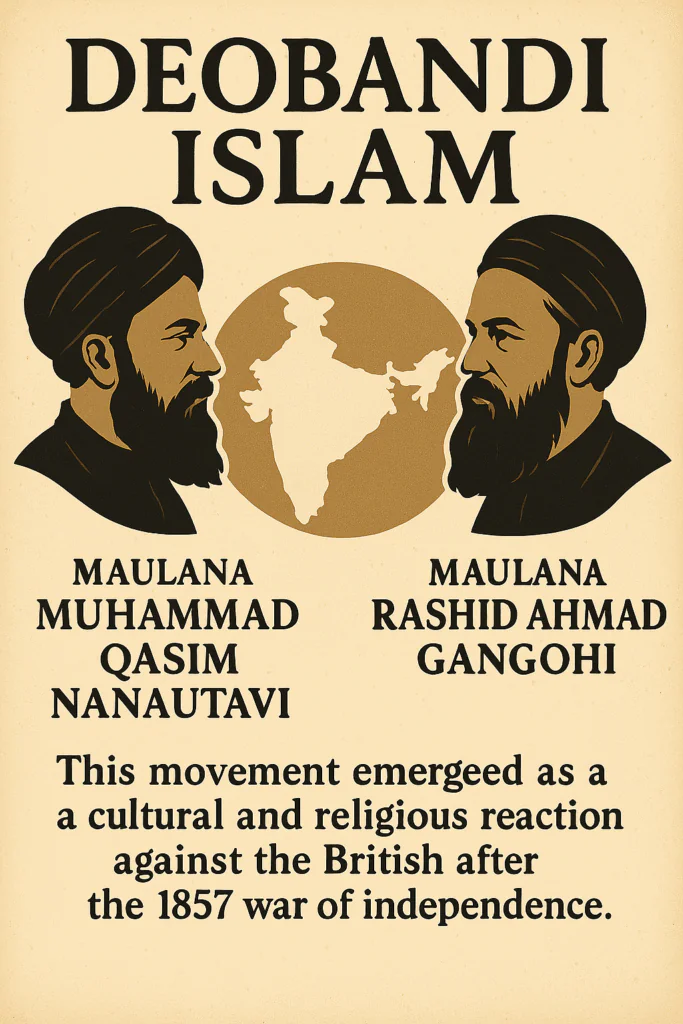
- Chief Founders: Maulana Mohammed Qassim Nanautawi and Maulana Rashid Ahmed Gangohi
The Deobandi movement emerged as a cultural and religious response after the 1857 freedom struggle against British colonial rule.
Main Ideological Principles
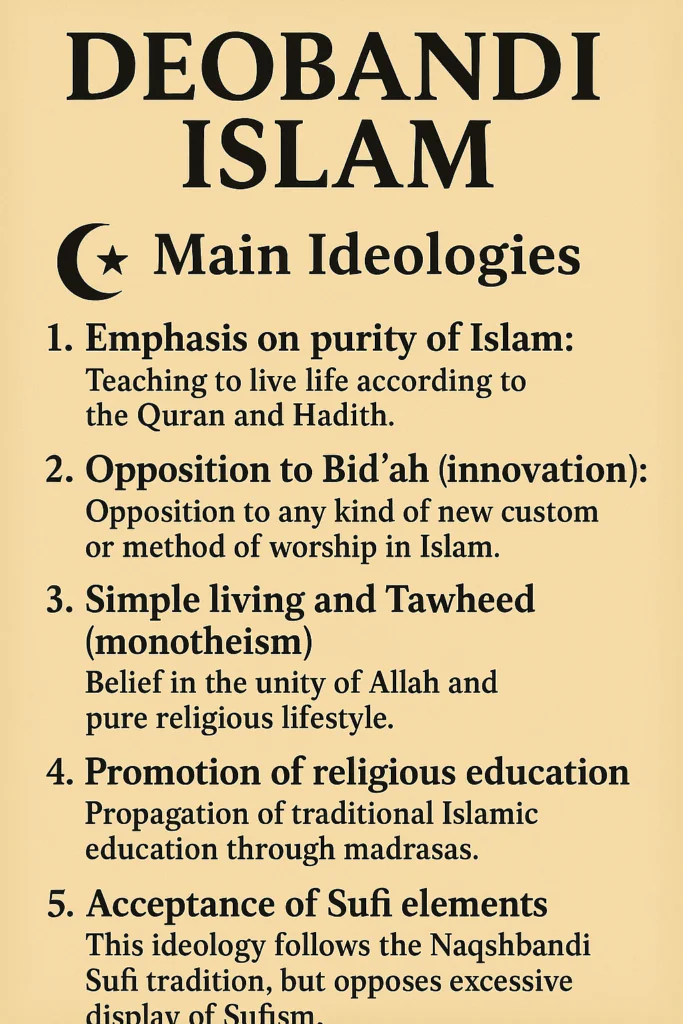
1. Emphasis on Islamic Authenticity
Followers are encouraged to live life according to the Quran and Hadith.
2. Opposition to Bida’ah (Innovation)
The movement strongly opposes any new customs or worship practices not found in traditional Islamic teachings.
3. Simple Lifestyle and Tawhid (Monotheism)
Deobandi thought stresses belief in the oneness of Allah and encourages a pure, disciplined religious lifestyle.
4. Promotion of Religious Education
Traditional Islamic education is spread through a network of madrasas associated with the movement.
5. Selective Acceptance of Sufism
The movement accepts the Naqshbandi Sufi heritage but rejects excessive or outward displays of Sufism.
Darul Uloom Deoband: The Central Institution
Located in the town of Deoband in India, Darul Uloom Deoband is the intellectual and spiritual center of Deobandi ideology. It provides education in:
- Islamic Law (Sharia)
- Hadith Studies
- Arabic Language
- Other traditional Islamic subjects
Today, it is known worldwide and has thousands of branches and affiliated madrasas across South Asia, Central Asia, Africa, and Europe.
Global Impact of the Deobandi Movement
- Large Deobandi communities exist in India, Pakistan, and Bangladesh.
- In Afghanistan, many leaders of the Taliban studied in Deobandi madrasas.
- Deobandi mosques and seminaries also exist in the United Kingdom and South Africa.
Deobandi vs. Other Islamic Ideologies
| Ideology | Main Difference |
|---|---|
| Deobandi | Traditional Hanafi school; strong opposition to Bida’ah (innovation) |
| Barelvi | More acceptance of Sufi practices; reverence for dargahs and saints |
| Salafi / Wahhabi | Inspired by Saudi Arabia; more strict and purist interpretation |
Conclusion
Deobandi Islam emerged in the 19th-century Indian subcontinent with the objective of preserving traditional Islamic teachings. It played a significant role in education, religious revival, and cultural resistance against colonial rule. Today, Deobandi ideology holds an important place in the global Islamic landscape.
Deobandi Agitation: Background
To understand the background of the Deobandi Agitation, it is essential to consider the political, social, and religious circumstances of 19th-century India. This movement was not only religious in nature but also a cultural and ideological response to British colonialism.
1. The Revolution of 1857 and Its Impact
The 1857 revolt, regarded by Indians as the first major battle for freedom, ultimately ended in failure. Many Muslim religious scholars and communities actively participated in the uprising, leading the British to develop deep suspicion toward Muslims afterward.
Following the revolt, the British administration attempted to weaken the religious, educational, and social structures of the Muslim community. As a result, feelings of frustration, insecurity, and cultural crisis began to grow among Muslims.
2. Need to Preserve Islamic Identity
The spread of English education and Western culture led to the gradual erosion of traditional Islamic education and values. Among Muslims, a strong sense emerged that their religious and cultural identity was under threat.
In such a situation, a movement was needed that could safeguard the authenticity and legacy of Islam.
3. Reasons Behind the Establishment of Deoband
In 1866, Maulana Mohammed Qassim Nanautawi, Maulana Rashid Ahmed Gangohi, and other leading scholars founded Darul Uloom Deoband.
Their objectives were:
- To provide pure Islamic education based on the Quran and Hadith.
- To oppose innovations (bid’ah) and superstitions.
- To guide people toward a simple, moral, and religious lifestyle.
4. Blend of Sufi Legacy
Although Deobandi ideology emphasizes strict Islamic authenticity, it was also influenced by the Naqshbandi Sufi tradition. This created a balanced approach where spirituality and discipline coexisted within the movement.
5. Influence of Other Religious Movements
This era also witnessed the rise of several religious reform movements:
- In Hindu society: Brahmo Samaj, Arya Samaj
- In Muslim society: Farangi Mahal School, Aligarh Movement (led by Sir Syed Ahmed Khan)
The Deobandi movement drew inspiration from these developments and aimed to build a purist and traditional Islamic framework.
Conclusion
The background of the Deobandi movement is closely linked to the failure of the 1857 revolt, the growing influence of British rule, the need to preserve Islamic identity, and the broader wave of religious reform across India. The movement was not only about religious improvement but also a significant effort toward the cultural restoration of the Muslim community.
Deobandi Agitation: Main Thinking
Buy Now on AmazonThe main thinking of the Deobandi Agitation is based on the purity of Islam, protection of traditional teachings, and establishing moral and religious discipline in society. This ideology follows the Sunni Hanafi school of thought and strongly opposes innovations (bid’ah) and Western cultural influences.
Main Ideologies of the Deobandi Movement
1. Quran and Hadith-Based Life
The primary objective of the movement is to encourage Muslims to live their lives according to the Quran and Hadith. Every belief and act of worship must be aligned with these two authentic sources.
2. Opposition to Bid’ah (Innovations) and Superstitions
The Deobandi ideology strictly opposes innovations, superstitions, and folk traditions in Islam. Practices such as worshiping at shrines, offering sheets at dargahs, and other non-Islamic rituals are considered incorrect and against true religious teachings.
3. Emphasis on Tawhid (Monotheism)
Belief in the oneness of Allah (Tawhid) is central to Deobandi thought. Accepting any other power or saint as equal to Allah is regarded as shirk (polytheism).
4. Simple and Religious Life
The movement encourages Muslims to live a simple, honest, and disciplined life, free from materialism and extravagance. Moral values such as truthfulness, humility, and self-control are deeply emphasized.
5. Spread of Islamic Education
Through the establishment of Darul Uloom Deoband and other madrasas, the movement promotes pure Islamic education. Its goal is to prepare Ulama (religious scholars) who possess deep knowledge of the Quran, Hadith, and Sharia.
6. Restrained Acceptance of Sufism
The Deobandi school accepts the Naqshbandi Sufi tradition but rejects the excessive display of Sufi practices. Spiritual discipline is encouraged, but exaggerated devotional acts are discouraged.
7. Culturally Aware but Politically Distant (Initially)
The early aim of the Deobandi movement was religious reform, not political activism. However, over time, many scholars became involved in anti-British freedom movements through organizations such as Jamiat Ulama-e-Hind.
Conclusion
The main thinking of the Deobandi movement is to establish a pure, traditional, and Quran-Hadith-based Islamic way of life. It aims to protect Islamic culture, spread religious discipline, and encourage Muslims to avoid superstitions and deviations.
Deobandi Movement: Emphasis on the Accuracy of Islam
The core and central belief of the Deobandi movement is maintaining and promoting the authenticity of Islam. According to this ideology, Muslims must lead their lives strictly according to the Quran and Hadith, not following folk traditions or later-added customs.
1. Quran and Hadith as the Final Guide
The movement believes Islam is only what Prophet Muhammad (ﷺ) taught and practiced. Any new religious custom is considered bid’ah (innovation) and therefore rejected. Sharia must be applied in its pure form.
2. Opposition to Folk Traditions and Dargah Practices
Deobandi scholars reject practices such as:
- Offering sheets on graves and shrines
- Asking saints for help or intercession
- Celebrating Milad with music or displays
These acts are considered deviations from original Islamic principles and are categorized as superstition or shirk.
3. Protection of Tawhid (Monotheism)
For Deobandis, true Islam means worshipping only Allah. Assigning miraculous powers or religious status to saints violates the principle of monotheism.
4. Ideal Moral and Disciplined Life
A pure Islamic life includes regular prayers, simple clothing, distancing from materialism, and applying Sharia in every aspect of life—not restricting religion to the mosque alone.
5. Center of Pure Religious Education: Darul Uloom Deoband
To preserve Islamic authenticity, Deobandi institutions emphasize traditional education in Quran, Hadith, and Fiqh. Their curriculum avoids influence from modern or Western ideologies.
Conclusion
The Deobandi movement strives to preserve the original and untouched legacy of Islam based strictly on the Quran and Hadith. It rejects superstitions and folk-based religious practices and encourages Muslims to worship only Allah and follow the path shown by Prophet Muhammad (ﷺ).
Deobandi Movement: Opposition to Bid’ah (Innovation)
The term Bid’ah refers to any new religious custom or act that has no basis in the Quran or Hadith. The Deobandi movement strongly opposes such innovations to protect the authenticity of Islam.
Bida’ah: Deobandi Approach
1. Innovation in Islam is Haram
According to Deobandi scholars: “Every new religious practice that did not exist during the time of Prophet Muhammad (ﷺ) or the Sahaba is wrong and should not be made part of religion.” Innovations mislead people and corrupt the purity of Islam.
2. Examples of Practices Considered Bid’ah
| Practice | Reason for Being Considered Bid’ah |
|---|---|
| Offering sheets on graves | Considered close to shirk |
| Urs (celebration of saints’ death anniversaries) | No such practice existed among the Prophet or Sahaba |
| Milad-un-Nabi with ceremonies | Introduced centuries later |
| Amulets, threads, charms | Associated with superstition |
| Music and dance during religious events | Against Sharia |
3. Advocacy of Pure Worship
Acts of worship must follow the method practiced by Prophet Muhammad (ﷺ) and his companions. Any new form or method distorts true worship.
4. Education Against Bid’ah
Deobandi madrasas teach students how to identify bid’ah, avoid it, and guide society toward the correct Islamic path. Through fatwas, speeches, and scholarly works, they actively rebut innovations.
5. Opposition to Bid’ah = Protection of Islam
According to Deobandis, bid’ah gradually corrupts religion. Preventing innovations is essential to preserve Islam in its original form.
Conclusion
Opposition to bid’ah is a defining feature of the Deobandi movement. The ideology believes that to keep Islam pure and authentic, every innovation or practice not rooted in the Quran and Hadith must be rejected.
Deobandi Movement: Plain Life and Tawhid (Monotheism)
Buy Now on AmazonThe Deobandi movement emphasizes two extremely important teachings:
- Living a simple, moral, and disciplined life
- Full recognition and defense of Tawhid (the Oneness of Allah)
Through these principles, the movement inspires Muslims to walk on the path of original Islamic teachings.
1. Simple (Plain) Living
Objective:
A true Islamic life should be filled with devotion, restraint, and ethics—free from showiness and luxury.
Deobandi views on simple living:
- Staying away from extravagance and materialism
- Wearing simple clothes and adopting modest language, food, and lifestyle
- Maintaining simplicity in marriage, funerals, and other religious events
- Avoiding show-off, pomp, and worldly status
- Focusing on prayer, fasting, and other religious duties
“The kind of simple life lived by Prophet Muhammad (ﷺ) is the true ideal for a Muslim.”
2. Tawhid (Monotheism)
Meaning of Tawhid:
Allah is One, without partners. Worship, prayer, and devotion belong to Him alone.
Explanation of Tawhid in the Deobandi movement:
- No one other than Allah can be considered worthy of worship.
- Giving saints, pirs, or prophets divine powers equal to Allah is considered shirk.
- Expecting miracles from graves or supplicating in the name of anyone else is against Tawhid.
Opposition to Shirk and Bid’ah:
Deobandi scholars believe that protecting Tawhid requires removing shirk and bid’ah from society. True faith is that which is based entirely on Allah alone.
Education of Tawhid and Simplicity in Darul Uloom
Students at Darul Uloom Deoband are trained to understand the importance of Tawhid and simple living. They are taught the pure teachings of the Quran, Hadith, and Sharia.
Conclusion
The Deobandi movement promotes a simple, ethical, self-controlled lifestyle and considers Tawhid the fundamental basis of Muslim faith. Together, these elements inspire Muslims to stay away from superstition, deviation, and shirk.
Deobandi Movement: Spread of Religious Education
A major objective of the Deobandi movement was the spread and protection of pure Islamic religious education. Through this movement, Islamic knowledge was delivered to people, and society was guided back to the teachings of the Quran and Hadith through a strong seminary system, the best example being Darul Uloom Deoband.
Need for Religious Education
- After the 1857 rebellion, the Muslim community became politically, socially, and religiously weak.
- British influence and Western education created a threat to Islamic identity.
- Scholars felt that without preserving Islamic teachings, future generations would drift away from their religion.
Darul Uloom Deoband: Center of Islamic Education
Establishment:
Founded in 1866 by Maulana Qassim Nanautawi and Maulana Rashid Ahmed Gangohi in Deoband, Uttar Pradesh.
Objectives:
- To provide pure Islamic education
- Teaching Quran, Hadith, Fiqh (Islamic law), Tafsir, and Arabic language
- Preparing Ulama who can guide the community on the correct path
Features of the Education System
| Subject | Objective |
|---|---|
| Quran and Hadith | Understanding the original teachings of Islam |
| Fiqh (Islamic Law) | Living life according to Sharia |
| Arabic Language | Ability to read Islamic texts in their original form |
| Tajweed | Correct pronunciation of the Quran |
| Moral Education | Developing discipline, honesty, and self-control |
Spread Across India and the World
The Deobandi network spread not only across India but also to Pakistan, Bangladesh, Afghanistan, South Africa, the UK, and the United States. Today, thousands of Deobandi madrasas worldwide promote Islamic education and Tawhid.
Social Impact Through Education
Deobandi scholars promote not only religious knowledge but also social upliftment, morality, unity, and self-respect among Muslims.
Conclusion
The Deobandi movement transformed religious education into a cultural movement. Institutions like Darul Uloom Deoband preserved pure Islamic teachings and strengthened society morally and religiously.
Deobandi Movement: Acceptance of Sufi Elements
Although the Deobandi movement strongly opposes innovations (bid’ah) and shirk, it accepts certain limited Sufi elements—mainly those aligned with Sharia and found within traditions such as Naqshbandi, Chishti, Qadri, and Suhrawardi.
Reasons for Limited Acceptance of Sufi Practices
Approved Elements:
- Zikr (remembrance of Allah)—in a calm and personal manner
- Tazkiyah-e-Nafs (spiritual purification)
- Genuine spiritual guidance that aligns with Sharia
- Tasawwuf as an inner spiritual practice, not as social celebration or miracle-based tradition
Rejected Sufi Practices:
| Sufi Element | Reason for Rejection |
|---|---|
| Praying at Mazars | Considered close to shirk |
| Urs, Qawwali, dance | Considered bid’ah and showmanship |
| Seeking help from saints | Against monotheism |
| Believing in miracles of pirs | Considered against Islamic Tawhid |
Darul Uloom Deoband and Tasawwuf
Deobandi scholars themselves were linked to Sufi chains but supported only those Sufi practices that complied with the Quran and Hadith. Maulana Ashraf Ali Thanvi presented a form of Tasawwuf fully aligned with Sharia.
Balanced Approach of Deobandi Thought
| Accepted Sufi Elements | Not Accepted |
|---|---|
| Self-purification, humility | Mazar worship, dargah culture |
| Focus on Allah | Pir-worship, miracle stories |
| Restrained spiritual guidance | Drums, show-based rituals |
Conclusion
The Deobandi movement did not reject Sufism completely; rather, it adopted a revised, Sharia-compliant form of it. This Sufism is limited to spiritual purification and personal discipline—not dargahs, miracles, or folk-based celebrations.
Chief Organization: Darul Uloom Deoband
Darul Uloom Deoband is the main and historical institution of the Deobandi movement. It was established in India to promote Islamic religious education and a pure Islamic lifestyle. Even today, this institution is considered the central hub of Deobandi thought worldwide.
Establishment
- Year: 30 May 1866
- Location: Deoband, Saharanpur (Uttar Pradesh, India)
- Founders:
- Maulana Qassim Nanautawi
- Maulana Rashid Ahmed Gangohi
- Shah Abdul Ghani
- Haji Imdadullah Muhajir Makki
Objectives of Establishment
- To restore Islamic education according to the Quran and Hadith
- To protect Islamic culture from the influence of British rule and modernity
- To preserve the authenticity of Islam by opposing bid’ah, shirk, and social distortions
Main Features
| Aspect | Description |
|---|---|
| Education System | Traditional Dars-e-Nizami curriculum including Quran, Hadith, Fiqh, Arabic, Tafsir, and Tasawwuf |
| Teachers | Scholarly Ulema connected to Sufi spiritual chains, serving as Sharia-based guides |
| Core Viewpoint | Emphasis on Tawhid, simple living, opposition to bid’ah, and adherence to Sharia |
| Global Influence | Deobandi institutions have spread across India, Pakistan, Bangladesh, Afghanistan, South Africa, the UK, the US, and many other countries |
Global Impact of Darul Uloom Deoband
Thousands of students educated at Darul Uloom Deoband have traveled across the world and established madrasas, mosques, and Islamic organizations. The institution has become a global center of Deobandi ideology.
- Pakistan: Jamiat Ulema-e-Islam
- Bangladesh: Hefazat-e-Islam
- UK & US: Numerous mosques and seminaries follow Deobandi teachings
Role of Darul Uloom Deoband
1. Training Religious Scholars
The institution prepares Aalim and Mufti scholars equipped with pure Sharia knowledge.
2. Opposing Bid’ah and Shirk
Darul Uloom actively campaigns against folk traditions, exaggerated miracle claims, and shrine worship.
3. Publication of Islamic Literature
It publishes books on Hadith, Fiqh, Tafsir, and other Islamic sciences.
4. Sufi and Moral Training
Students are trained in self-purification, discipline, spiritual refinement, and moral conduct.
5. Promoting Islamic Ethics in Society
Through sermons, edicts (fatwas), and teaching programs, the institution spreads Islamic ethics and guidance among the masses.
Conclusion
Darul Uloom Deoband is not merely an educational institution but the central foundation of the Deobandi movement. It continues to safeguard Islamic teachings, traditions, and Tawhid. Even today, it guides Muslims worldwide toward a Quran- and Hadith-based Islamic lifestyle.
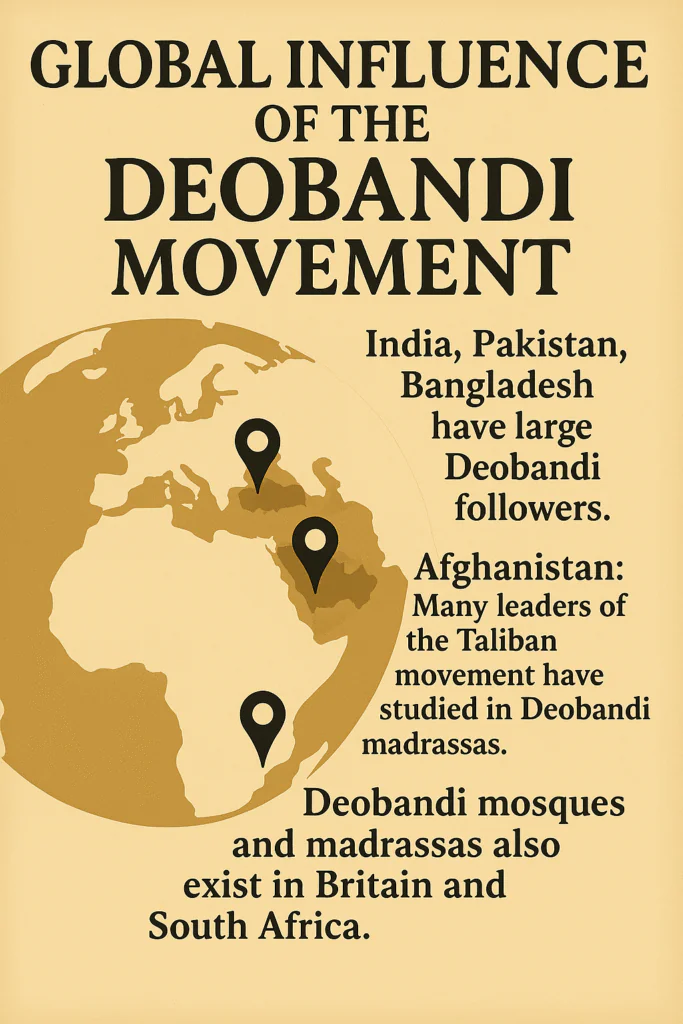
Deobandi Agitation: Global Effect
The Deobandi movement, which began in India in the 19th century, has today evolved into a globally influential Islamic ideology. Its teachings and institutions are no longer limited to India; instead, they have spread across Asia, Africa, Europe, and North America.
1. Major Reasons for International Expansion
| Reason | Description |
|---|---|
| Religious Education | Ulema trained at Darul Uloom Deoband and affiliated institutions spread worldwide. |
| Migrant Muslims | Indian, Pakistani, and Bangladeshi Muslim migrants established Deobandi madrasas abroad. |
| Mosque Construction | Many mosques in Europe and America were built along with Deobandi madrasas. |
| Global Communication | Internet, Hajj visits, and international religious conventions accelerated Deobandi outreach. |
2. Deobandi Institutions and Their Impact (Country-wise)
India 🇮🇳
- Original center: Darul Uloom Deoband
- Thousands of madrasas and mosques across the country
- Social influence through Jamiat Ulema-e-Hind
Pakistan 🇵🇰
- Major Deobandi madrasas such as:
- Darul Uloom Haqqania (Akhora Khattak)
- Jamiat Ulema-e-Islam as a political party
- Strong influence on government, society, and religious education
Bangladesh 🇧🇩
- Hefazat-e-Islam — major Deobandi-based organization
- Many madrasas and fatwa centers
South Africa 🇿🇦
- Indian-origin Muslims established Deobandi madrasas and schools
- Darul Uloom Zakariyya as a major institution
United Kingdom 🇬🇧
- Nearly 45% of UK mosques follow Deobandi ideology
- Major institutions:
- Darul Uloom Bury
- Islamic Da’wah Academy (Leicester)
- Active roles in education, fatwa services, and community welfare
United States & Canada 🇺🇸🇨🇦
- Many Deobandi mosques and Islamic centers
- Growing focus on guiding Muslim youth through traditional Islamic teachings
3. Key Features of the Global Impact of the Deobandi Movement
| Aspect | Effect |
|---|---|
| Religious | Spread of pure Islam, Tawhid, and Sharia-based education |
| Education | Global expansion of the traditional Dars-e-Nizami curriculum |
| Politics | Formation of political parties and influence in Pakistan and Bangladesh |
| Mosque Network | Thousands of mosques worldwide run by Deobandi Ulema |
| Fatwa Services | Sharia-based responses to modern issues through global Deobandi institutions |
Conclusion
The Deobandi movement has developed into a global Islamic force, promoting religious purity, Tawhid, and a Sharia-based lifestyle. Its institutions, scholars, and educational networks have created a strong foundation for Islamic tradition and ethics among Muslim communities worldwide.
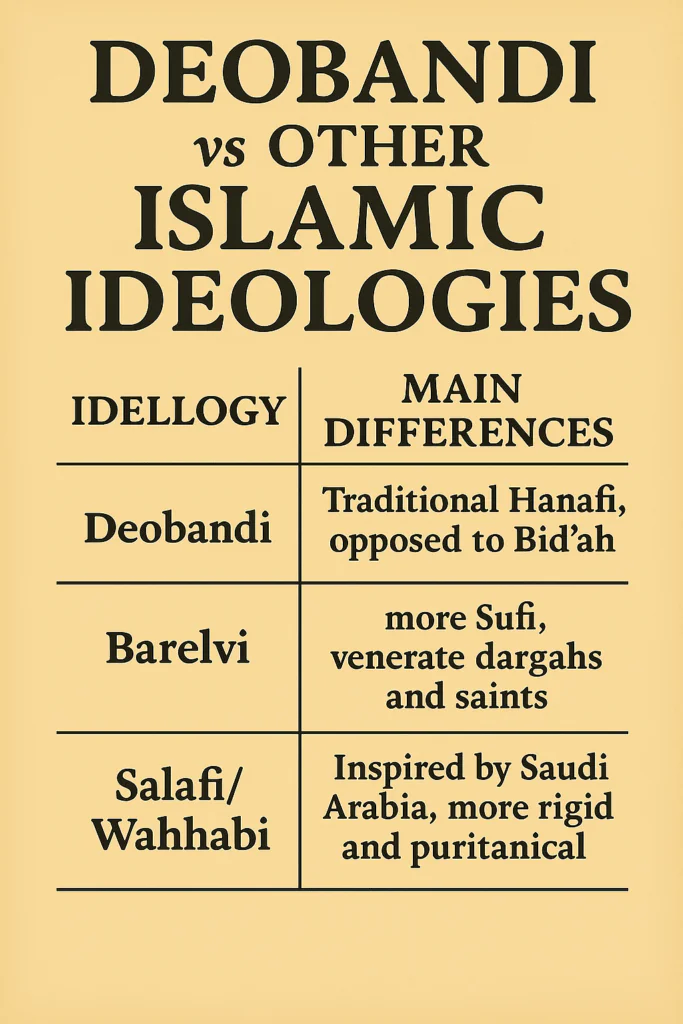
Deobandi vs Other Islamic Ideologies
The Deobandi movement, which emerged in the second half of the 19th century in India, is a traditionalist Islamic reform movement. Although it shares certain similarities with other Islamic ideologies, it differs significantly in principles, traditions, and methods of religious interpretation.
Comparison of Major Islamic Ideologies
| Aspect | Deobandi | Barelvi | Aligarh Movement (Sir Syed) | Salafi / Wahhabi |
|---|---|---|---|---|
| Origin | India (1866, Deoband) | India (1880s) | India (1875, Aligarh) | Saudi Arabia (18th century) |
| Main Objective | Preservation of Islamic purity and tradition | Support for Sufism and traditional rituals | Modern education + reinterpretation of Islam | Applying Islam in a “pure” form |
| Religious Approach | Hanafi Fiqh + limited Sufi elements | Hanafi Fiqh + strong Sufi rituals (Urs, Dargah) | Rationalism, science, religious reinterpretation | Pure Tawhid, no shrine/pir culture |
| Tawhid (Monotheism) | Central principle, with balanced Sufi influence | Tawhid + strong role of saints and pirs | Accepts Tawhid but not a core focus | Strict Tawhid, opposes any mediation |
| Sufi Elements | Limited, Sharia-compliant | Deeply integrated (Urs, Qawwali) | Distant from mysticism | Completely rejected |
| Educational Focus | Traditional madrasa system (Dars-e-Nizami) | Sufi Khanqah education | Modern science + Islam (AMU) | Quran-Hadith education, strict approach |
| Approach to Bid’ah | Strongly opposed | Many traditions accepted | Open to modern reinterpretation | Strict opposition |
| Global Effect | India, Pakistan, SA, UK, USA | India, Pakistan, UK | India, Muslim intellectual class | Arab countries, Europe, USA |
Deobandi vs Barelvi
| Subject | Deobandi | Barelvi |
|---|---|---|
| Respect for Mazars | Oppose | Support |
| Role of Pirs/Saints | Limited | Important |
| Qawwali & Urs | Considered Bid’ah | Religious ritual |
| Priority of Sharia | Very high | High, but influenced by Sufi tradition |
Deobandi vs Aligarh Movement (Sir Syed Ahmad Khan)
| Subject | Deobandi | Aligarh Movement |
|---|---|---|
| Education | Religious (Quran, Hadith) | Modern (Science, English) |
| View on Western Culture | Opposed | Selective adoption |
| View on British Rule | Opposed | Cooperative |
Deobandi vs Salafi / Wahhabi
| Subject | Deobandi | Salafi / Wahhabi |
|---|---|---|
| Fiqh | Hanafi | No fixed Fiqh; only Quran & Hadith |
| Sufi Influence | Limited acceptance | Completely rejected |
| Religious Method | Traditionalist | Purist |
| Approach | Restrained | Strict and harsh |
Conclusion
The Deobandi movement adopts a centrist Islamic ideology that prioritizes Sharia and Tawhid, while still allowing limited, Sharia-compliant Sufi elements. Compared to others, it is less Sufi than Barelvi, more traditional than the Aligarh Movement, and more balanced than the Wahhabi/Salafi tradition.
Deobandi Movement – Overall Conclusion
The Deobandi movement emerged in the second half of the 19th century as a form of religious renaissance in India. Its main objectives were to defend the accuracy of Islam, oppose bid’ah (innovation) and shirk (polytheism), and expand Islamic education. Over time, it became influential not only on a religious level but also socially, educationally, and globally.
Main Points Summary
| Subject | Description |
|---|---|
| Background | After the 1857 revolt, Muslims felt the need for religious revival |
| Main Thinking | Tawhid, Sharia adherence, protest against bid’ah, limited support for Sufism |
| Chief Institution | Darul Uloom Deoband — an international center of Islamic education |
| Global Effect | Expanded from India to Pakistan, Bangladesh, South Africa, UK, and America |
| Comparative Analysis | Clear ideological differences from Barelvi, Aligarh, and Wahhabi movements |
Final Message
The Deobandi movement sought to protect Islam from modernity and cultural deviation. It emphasized traditional education, morality, and a disciplined religious lifestyle. Although it began as an Indian movement, its impact spread across the Muslim world. Due to its balanced yet firm approach, it continues to shape the religious identity and thinking of millions of Muslims worldwide.
References
- Darul Uloom Deoband, Official Website – Historical Records and Institutional Information.
- Metcalf, Barbara D. Islamic Revival in British India: Deoband, 1860–1900. Princeton University Press.
- Nadwi, Abul Hasan Ali. Hakim-ul-Ummah Maulana Ashraf Ali Thanvi.
- Qasmi, Muhammad Qasim & Gilles Kepel (Eds.). Islam, Politics and Society in South Asia.
- Darul Uloom Zakariyya (South Africa) – Institutional Publications.
- Jamiat Ulema-e-Hind – Organizational Publications and Historical Notes.
- Oxford Encyclopedia of the Modern Islamic World – Deobandi Movement Overview.
- Aligarh Movement Archives – Sir Syed Ahmad Khan’s Writings and Speeches.
- Hefazat-e-Islam Bangladesh – Official Public Records.
- UK Mosque Statistics – Islamic Da’wah Academy, Leicester & Darul Uloom Bury Publications.