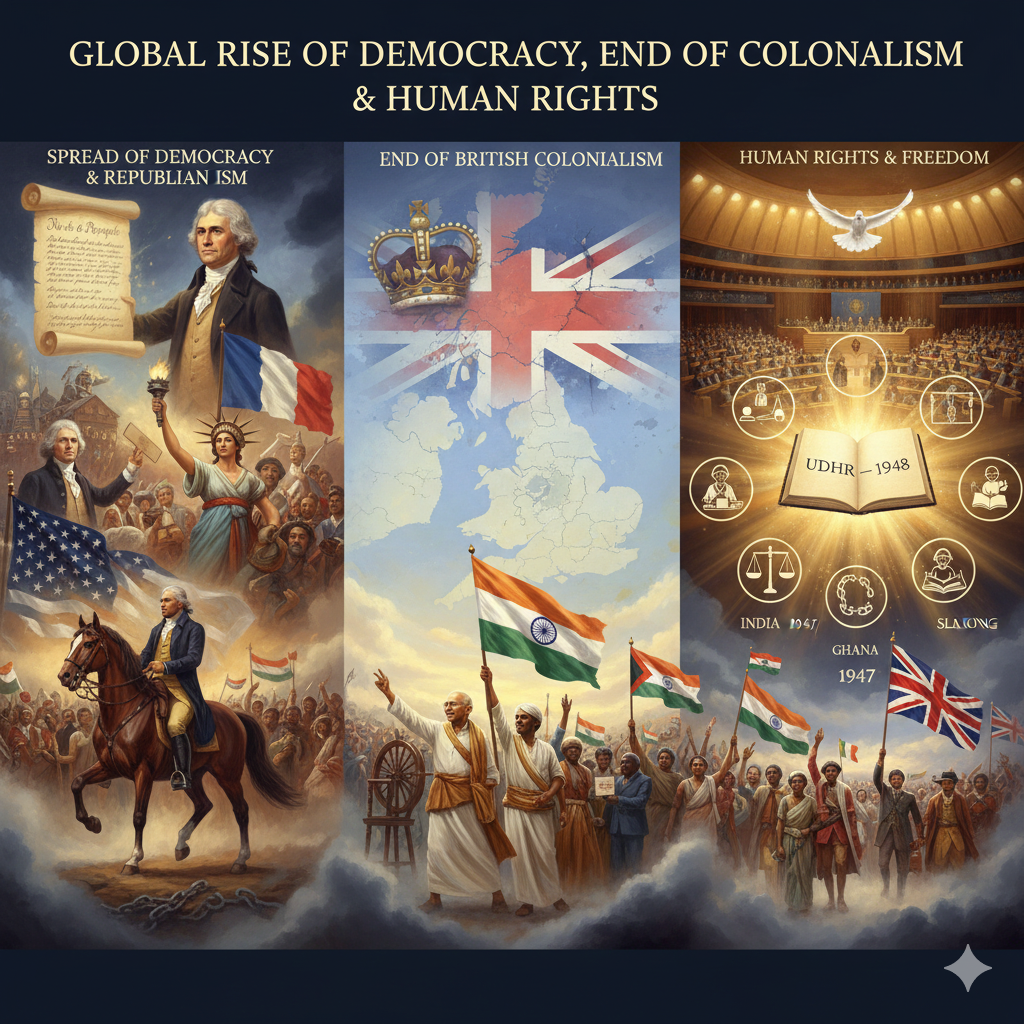

American Revolution
A Detailed Introduction to the American Revolution
The American Revolution (1775–1783) was a landmark historical event that led to America’s independence from British rule and the establishment of a new republic, the United States of America. It is also known as the American War of Independence.
This revolution was not just a political struggle; it was a powerful story of courage, sacrifice, and a strong desire for freedom. The journey from being colonies to becoming an independent nation inspired many other movements across the world.
Background of the American Revolution
By the middle of the 18th century, 13 British colonies had been established in North America. Although these colonies were part of the British Empire, over time a strong sense of independence began to develop among the people living there.
The British government imposed various taxes and trade restrictions on the American colonies, which increased discontent. Some of the major reasons were as follows:
Major Causes of Discontent
- Burden of Taxes: The British government imposed many taxes like the Stamp Act (1765) and the Tea Act (1773), which angered the American colonists.
- Demand for Representation: The colonists opposed taxation without political representation and raised the slogan "No Taxation Without Representation".
- Boston Tea Party (1773): In protest against the British tax on tea, colonists dumped tea chests into Boston Harbor. This event is known as the Boston Tea Party.
- Harsh Attitude of the British Army: The British government adopted harsh policies and worsened the situation by sending more troops to the colonies.
The Beginning of the Revolution (1775)
The American Revolution began on April 19, 1775, with the Battle of Lexington and Concord. This conflict was between the British army and the American colonists, who were now called “Patriots.”
In 1776, America took a bold step and declared its independence from British rule.
American Declaration of Independence (July 4, 1776)
On July 4, 1776, the Declaration of Independence, written primarily by Thomas Jefferson, was accepted. In this declaration, America formally announced its independence from British rule.
The Declaration emphasized the ideas of liberty, equality, and the right of people to form a government of their choice. These ideas later became the foundation of modern democratic values.
Important Wars and Events
Battle of Saratoga (1777)
The Battle of Saratoga (1777) was a turning point in the American Revolution. American forces won this battle, and as a result, France decided to openly support America with military and financial aid. This foreign support strengthened the American struggle for independence.
Siege of Yorktown (1781)
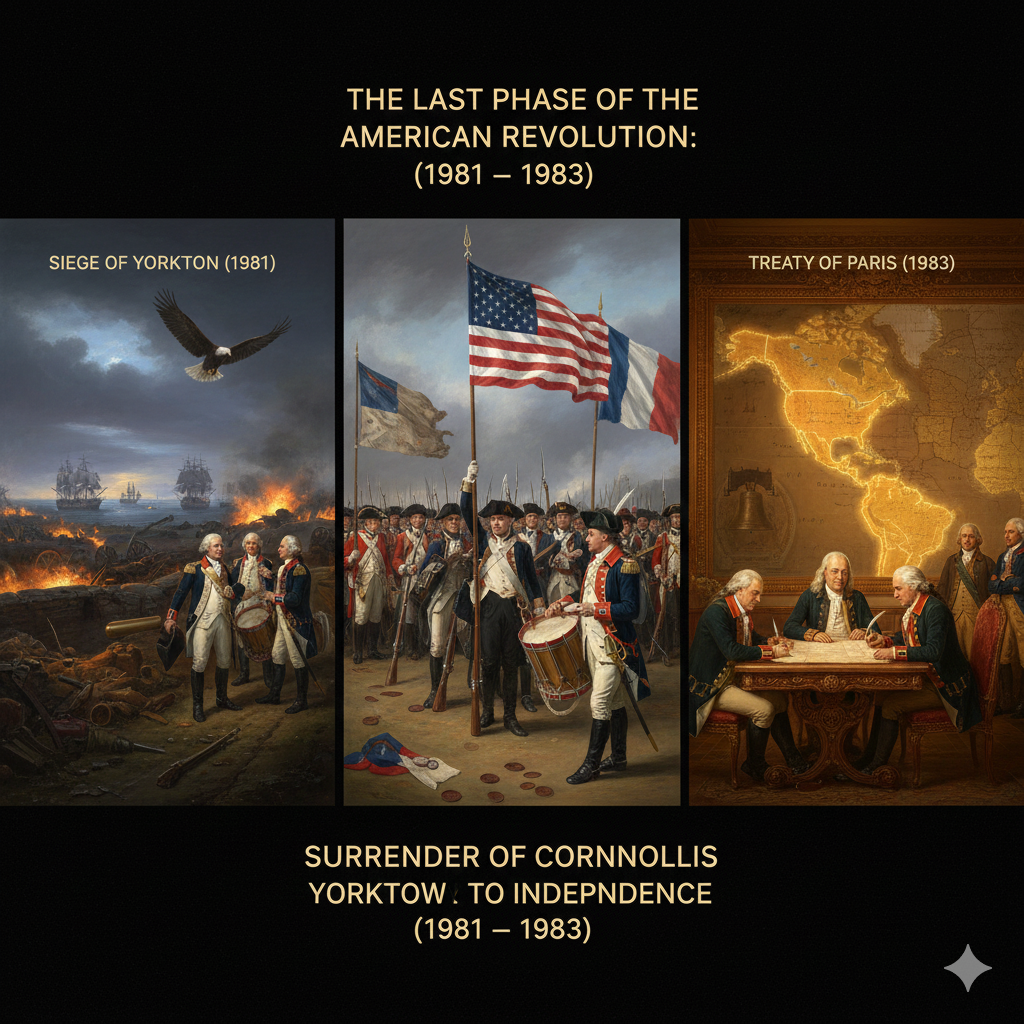
The Siege of Yorktown (1781) was the last decisive battle of the American Revolution. In this battle, General George Washington and French forces surrounded British General Cornwallis and forced him to surrender. This defeat effectively ended major military operations by the British in America.
The End of the Revolution and Its Consequences
Treaty of Paris (1783)
The American Revolution formally ended with the Treaty of Paris (1783). Under this treaty, Britain officially acknowledged the independence of the United States of America. America now emerged as a new and sovereign nation.
Constitution and Establishment of the Republic
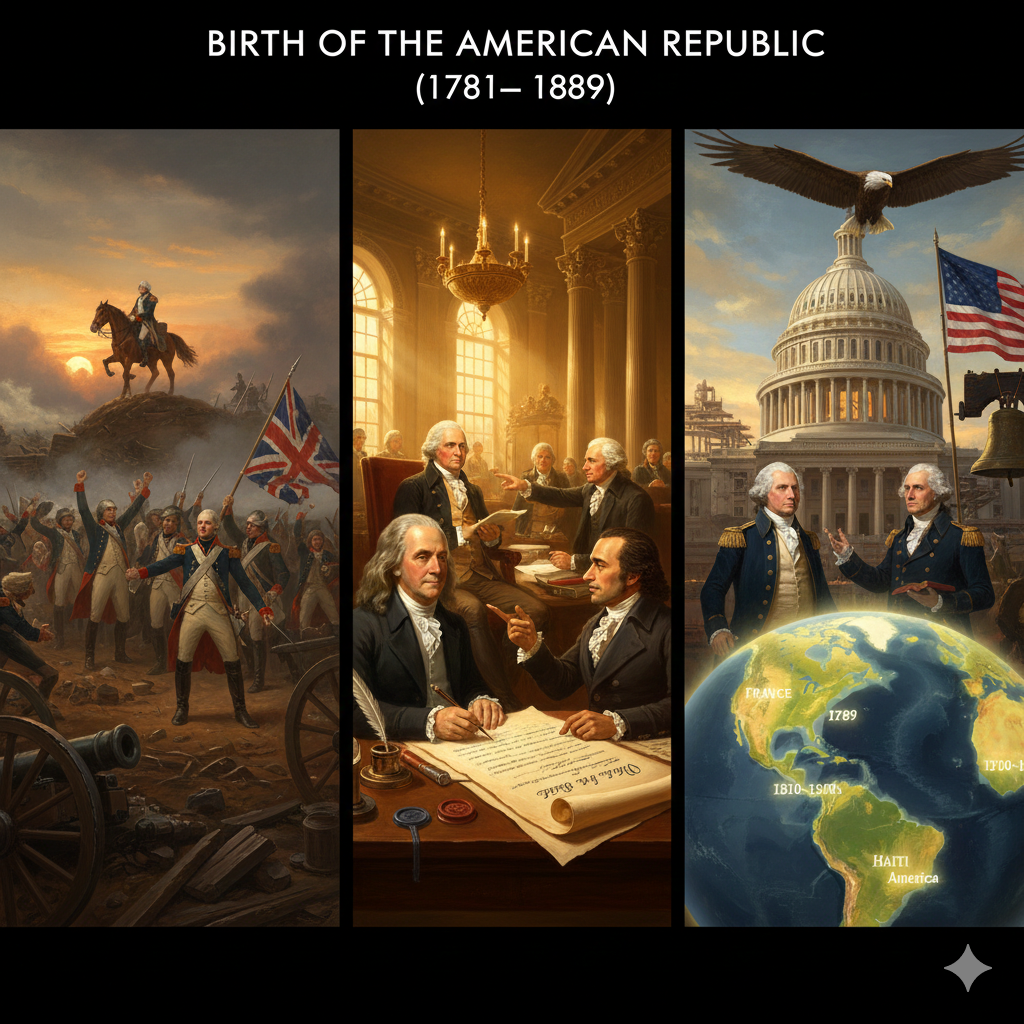
After independence, the next major step was nation-building. The Constitution of the United States of America was framed in 1787. This constitution provided a strong structure for democratic governance and division of powers.
In 1789, George Washington became the first President of the United States. Under his leadership, the new republic took its early steps towards stability, unity, and progress.
Impact of the American Revolution
The American Revolution had far-reaching effects, not only on America but on the entire world.
Spread of Democracy and Republicanism
Inspired by this revolution, independence and democratic movements began in France, Latin America, and other regions. The success of the American struggle showed that people could challenge powerful empires and establish governments based on popular will.
Beginning of the Decline of British Colonialism
The American Revolution laid the foundation for the gradual downfall of the British Empire. It exposed the limits of colonial control and encouraged other colonies to question and resist foreign rule.

✔ Easy & reliable for daily use
✔ Great value for money
✔ Highly rated by buyers
Concept of Human Rights and Freedom
The revolution greatly promoted the ideas of individual freedom, human rights, and equality. Concepts such as the right to life, liberty, and the pursuit of happiness became central to modern political thought and later influenced many constitutions and human rights charters around the world.
Conclusion
The American Revolution was not only a fight for America’s independence; it was a major step towards modern democracy and freedom. This revolution transformed a group of colonies into a united and independent nation.
Beyond political change, the American Revolution inspired people in other countries to dream of freedom, justice, and self-rule. It remains a powerful example of how determination, unity, and a belief in rights and dignity can reshape history and build a better future.
Background of the American Revolution (In Depth)
The deeper roots of the American Revolution (1775–1783) lay in the political, economic, and social conditions of the 17th and 18th centuries. The British colonists in America gradually developed a sense of independence, but the repressive policies of the British government turned their discontent into a full-scale revolution.
To understand this background, we need to pay attention to the following points:
1. Establishment and Initial Development of British Colonies
In 1607, Britain established its first permanent colony in America at Jamestown, Virginia. By the mid-18th century, 13 British colonies had been established in North America.
These colonies prospered through agriculture and trade and were under British rule. Although they had their own local legislatures, the final authority always rested with the British King and the British Parliament.
2. Policies of British Rule and American Discontent
Britain imposed many taxes and policies on its American colonies, mainly to protect and promote Britain’s own economic interests. These policies led to growing resentment and discontent among the American colonists.
(i) Trade and Economic Control
The British government implemented the Navigation Acts (1651–1673), which forced American merchants to trade only with Britain. This tight control of trade caused heavy losses to American merchants and increased their anger towards Britain.
(ii) The Seven Years’ War (1756–1763) and the Burden of Taxes
A major war took place between Britain and France, which in the American context is known as the French and Indian War. Britain won this war, but it suffered huge economic losses.
To recover these losses and cover its deficit, the British government decided to impose new taxes on the American colonies.
(iii) Major Taxes and Economic Sanctions
- Sugar Act (1764): Tax was imposed on sugar and other imported commodities.
- Stamp Act (1765): Taxes were imposed on legal documents, newspapers, and other printed materials.
- Townshend Acts (1767): New taxes were imposed on tea, glass, paper, and dyes.
- Tea Act (1773): The British East India Company was given the privilege of selling tea in the American market, effectively controlling the tea trade.
The American colonists strongly opposed these taxes and raised the slogan “No Taxation Without Representation” because they had no representation in the British Parliament and thus no voice in the tax decisions affecting them.
3. Growing Discontent and Rebellion of the Colonists
(i) Boston Tea Party (1773)
In protest against the British government’s Tea Act, the colonists threw tea boxes loaded on British ships into Boston Harbor. This incident is known as the Boston Tea Party and was an open act of rebellion against British rule.
In response, the British government passed the Coercive Acts or Intolerable Acts (1774), which imposed strict measures on the colonies. These acts further increased the anger and resistance of the colonists.
(ii) First Continental Congress (1774)
In 1774, representatives of the colonies met in Philadelphia and formed the First Continental Congress. They demanded that the British government protect their rights and withdraw unfair laws.
However, the British government rejected these demands, which further aggravated the conflict and deepened the mistrust.
(iii) Battle of Lexington and Concord (1775)
On April 19, 1775, the first armed conflict between British troops and American colonists occurred at Lexington and Concord. This battle is considered the formal beginning of the American Revolution.
4. Steps Leading to the American Revolution
- On July 4, 1776, the Declaration of Independence was adopted, formally announcing the separation of the American colonies from Britain.
- The American colonies, under the leadership of George Washington, fought a long and determined war against Britain.
- In 1783, through the Treaty of Paris, America officially gained recognition as an independent nation.
Final Conclusion
The repressive policies of the British government, the strong feeling of independence among the colonists, and deep economic and political discontent were the main reasons behind the American Revolution. Britain’s harsh tax laws and restrictive policies pushed the American colonists onto the path of revolution.
Ultimately, this discontent turned into armed conflict in 1775, and by 1783 America achieved independence. The story of the American Revolution reminds us that when people stand united for their rights and freedom, they can change the course of history and build a new future based on justice, liberty, and democracy.
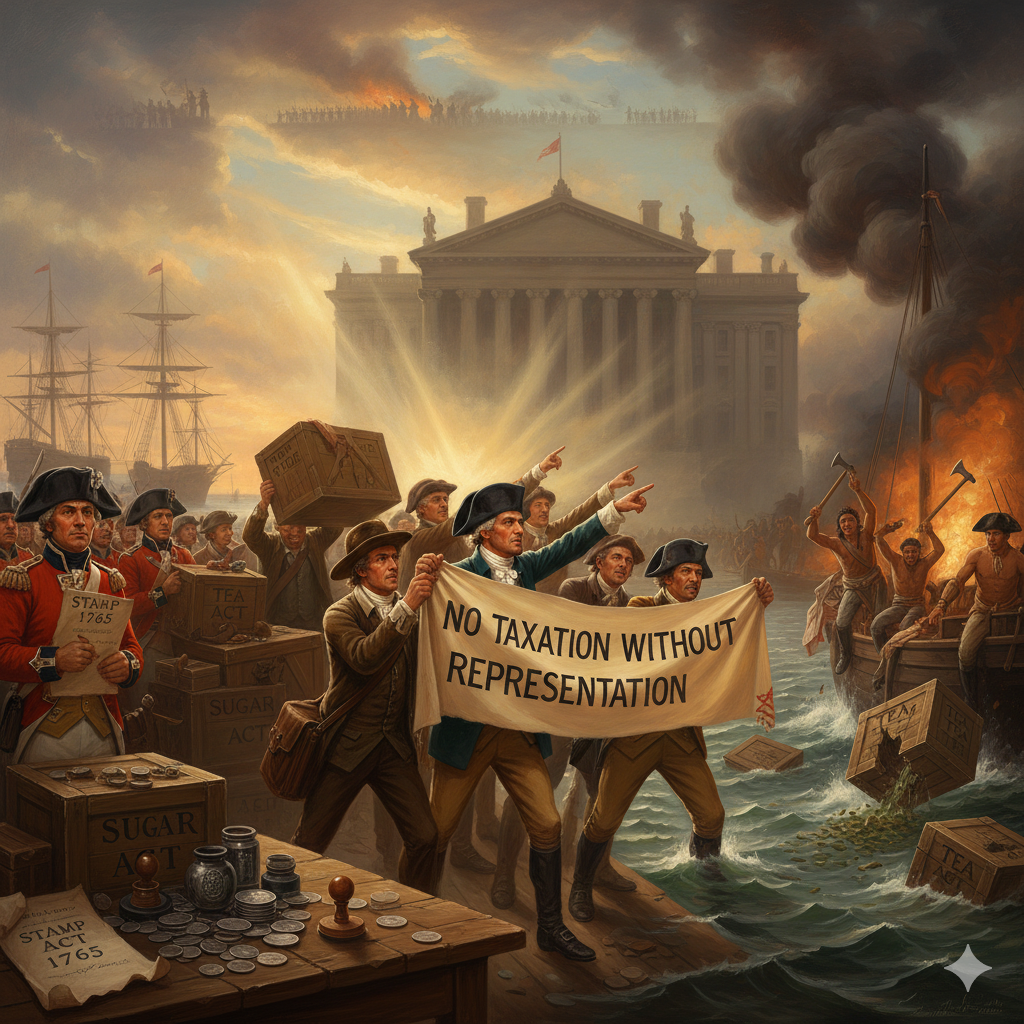
Burden of Taxes
The Burden of Taxes in the American Revolution: Detailed Description
The American Revolution (1775–1783) included harsh taxes and economic restrictions imposed by the British government on the American colonies. Britain imposed many taxes to obtain revenue, which caused great discontent among the colonists. This discontent eventually turned into a revolution.
Let us understand in detail what taxes were imposed by the British government and what their impact was.
1. Main Reasons for Imposing Taxes
Some of the main reasons why Britain taxed the American colonies were:
- Expenses of the Seven Years’ War (1756–1763): Britain spent heavily to protect its colonies during this war against France. To recover these costs, new taxes were imposed.
- Economic Needs of the British Empire: Britain needed more revenue to run its vast empire.
- Maintaining Control Over the Colonies: Britain wanted to ensure that the American colonies remained economically dependent on the British Crown.
2. Major Taxes and Economic Sanctions
(i) Sugar Act, 1764
- The first major tax imposed on the colonies.
- Taxes were levied on sugar, molasses, wine, and similar imports.
- Its aim was to increase British revenue and reduce smuggling.
- American merchants considered it unfair because it hurt trade.
(ii) Stamp Act, 1765
- Required government stamps on legal documents, newspapers, magazines, and even playing cards.
- Imposed to increase British revenue.
- Colonists strongly opposed it and raised the slogan “No Taxation Without Representation.”
- Due to widespread protests, the Act was repealed in 1766.
(iii) Townshend Acts, 1767
- Taxes imposed on tea, glass, paper, paint, and lead.
- Britain increased troop deployment to enforce these taxes.
- American merchants boycotted British goods.
- Most taxes were removed in 1770, except the tax on tea.
(iv) Tea Act, 1773 and the Boston Tea Party
- The East India Company was given exclusive rights to sell tea in America.
- American merchants faced heavy losses.
- On December 16, 1773, the Boston Tea Party took place—colonists dumped tea into Boston Harbor.
- Britain responded with the harsh Coercive Acts / Intolerable Acts (1774).
(v) Other Economic Sanctions
- Navigation Acts (1651–1673): Forced colonists to trade only with Britain.
- Currency Act (1764): Prevented colonies from printing their own currency.
- Quartering Act (1765): Required colonists to house British soldiers.
3. American Response to Tax Protests
“No Taxation Without Representation”
Colonists protested because they were being taxed without having any representation in the British Parliament.

✔ Easy to use and reliable
✔ Suitable for everyday needs
✔ Great value for price
Boycott of British Goods
Colonists stopped buying British goods to pressure British merchants.
Petitions to Parliament
Colonial leaders sent petitions demanding removal of unfair taxes.
Secret Societies and Protests
Groups like the Sons of Liberty attacked tax collectors and organized protests.
Boston Tea Party
The biggest protest against British taxation, which triggered Britain’s harsh punishment laws.
4. Effects of Taxes and the Beginning of the American Revolution
- Growing discontent due to taxation and harsh British policies.
- The First Continental Congress (1774) was formed to demand rights.
- The Battle of Lexington and Concord (April 19, 1775) marked the official start of the revolution.
- The Declaration of Independence was adopted on July 4, 1776.
- America gained independence in 1783.
Conclusion
The harsh taxes and economic restrictions imposed by Britain were the major reasons behind the American Revolution. Acts like the Stamp Act, Tea Act, and Townshend Acts increased dissatisfaction among the colonists. Their organized resistance, guided by the slogan “No Taxation Without Representation,” eventually led to the American independence struggle and laid the foundation for a new democratic nation.
Demand for Representation
Demand for Representation and the American Revolution
During the American Revolution (1775–1783), the colonies demanded representation in the British Parliament. Even though they were being heavily taxed, they were not allowed to send representatives. This injustice led to the powerful slogan:
“No Taxation Without Representation”
This slogan became the central ideology of the American Revolution.
1. Position of the American Colonies in the British Parliament
- In the 18th century, decisions made in the British Parliament applied to all colonies.
- But American colonies had no representation in the Parliament.
- Britain argued they had “virtual representation,” meaning Parliament represented them indirectly, which the colonists rejected.
- The colonists demanded control over their own local affairs.
2. Relation Between Taxes and Demand for Representation
Britain imposed several tax laws, but the colonists opposed them because they had no voice in Parliament.
| Tax Act | Main Objective | Reaction of Colonists |
|---|---|---|
| Sugar Act (1764) | Tax on sugar and other goods | Strong protest from American traders |
| Stamp Act (1765) | Tax on legal documents and newspapers | Raised slogan “No Taxation Without Representation” |
| Townshend Acts (1767) | Taxes on tea, glass, paper, colours | Boycott of British goods |
| Tea Act (1773) | Tax benefits to British tea companies | Led to the Boston Tea Party |
3. Steps Taken to Seek Representation
(i) Stamp Act Congress (1765)
- Nine colonies met in New York.
- Declared that Parliament had no right to tax them without representation.
- Due to massive protests, the Stamp Act was repealed in 1766.
(ii) First Continental Congress (1774)
- Held in Philadelphia with representatives of 12 colonies.
- Demanded self-governance and withdrawal of harsh laws.
- Britain rejected their demands.
(iii) Second Continental Congress (1775–76)
- Held after conflicts began between colonists and British forces.
- On July 4, 1776, the Declaration of Independence was adopted.
- This marked the colonies’ decision to form an independent government.
4. Impact of the Demand for Representation
- Rejection of demands increased anger and distrust.
- The first battle of the revolution: Lexington and Concord (1775).
- The war continued until the Treaty of Paris (1783), where Britain recognized American independence.
Conclusion
The demand for representation was one of the most important causes of the American Revolution. Colonists demanded that if they were being taxed, they should have representation in the British Parliament. Britain’s refusal led to growing protests, which ultimately turned into a full-scale revolution. The movement gave the world new ideas about democracy, self-governance, and civil rights, inspiring freedom struggles around the world.

Boston Tea Party (1773)
Boston Tea Party (1773): Detailed Description
The Boston Tea Party was an important event in the American Revolution. It took place on 16 December 1773 as a protest against the British government’s Tea Act of 1773. During this incident, American colonists boarded British ships and threw 342 chests of tea into Boston Harbor. This dramatic act became a symbol of growing resentment toward British rule and marked a major step toward American independence.
1. Background of the Boston Tea Party
(i) British Government Taxes and American Discontent
- The British government imposed taxes under the Townshend Acts (1767), including a tax on tea.
- These taxes led to strong opposition and widespread boycotts of British goods.
- Although Britain repealed most taxes in 1770, the tax on tea remained, increasing discontent.
(ii) Tea Act, 1773
The British Parliament passed the Tea Act in 1773, giving the British East India Company the right to sell tea tax-free in the American market.
Effects of the Tea Act:
- Loss to American merchants: They could no longer profit from tea sales.
- Anger over economic control: Colonists felt Britain was forcing them to buy British tea.
- Demand for independence grew: People felt Britain was imposing laws without their consent.
2. The Boston Tea Party Incident
(i) Arrival of Ships Laden with Tea
- In November 1773, the ship Dartmouth arrived in Boston Harbor with tea cargo.
- Two more ships, Eleanor and Beaver, arrived shortly after.
- Colonists refused to unload the tea and demanded the ships be sent back to Britain.
(ii) Leadership of the “Sons of Liberty”
- The protest was led by Samuel Adams and his group, the Sons of Liberty.
- Governor Thomas Hutchinson refused to send the ships back and insisted the tea must be unloaded.
(iii) 16 December 1773 – Tea Thrown into the Sea
- At night, over 100 colonists disguised as members of the Native American “Mohawk” tribe boarded the ships.
- They threw 342 chests of tea into Boston Harbor, worth approximately £10,000 at that time.
- The entire incident took place without any violence.
3. Reaction of the British Government
The Boston Tea Party angered the British government, resulting in harsh punishment for the colonies.
(i) Intolerable Acts (1774)
The key laws under these acts included:
- Boston Port Act: The port of Boston was closed until the tea losses were paid.
- Massachusetts Government Act: The colony’s self-government was dissolved.
- Quartering Act: Colonists were forced to house British soldiers.
- Administration of Justice Act: British officials could avoid trial in America.
4. Results and Effects of the Boston Tea Party
(i) Increased Opposition to Britain
- Colonists saw Britain’s actions as dictatorial and unjust.
- Other colonies supported Boston and began boycotting British goods more aggressively.

✔ Easy & convenient usage
✔ Ideal for everyday needs
✔ Great value for money
(ii) Formation of the Continental Congress
In September 1774, the First Continental Congress was held, uniting representatives from the 13 colonies to plan collective action.
(iii) Beginning of the American Revolution
- On April 19, 1775, the Battle of Lexington and Concord took place—marking the start of the American Revolution.
- On July 4, 1776, the Declaration of Independence was adopted.
Conclusion
The Boston Tea Party was not just a protest against tea; it symbolized the growing anger against Britain’s oppressive policies. This event sparked the American Revolution and played an important role in America’s path to independence. It remains one of the most significant symbols of the struggle for democracy, freedom, and civil rights.
The Harsh Attitude of the British Army
The Harsh Attitude of the British Army and the American Revolution
The harsh attitude of the British army became a major cause of discontent and rebellion in the American colonies. The repressive policies and military suppression imposed by the British government contributed significantly to the outbreak of the American Revolution (1775–1783).
1. The Role and Harsh Attitude of the British Army
(i) Growing Military Presence in the Colonies
- After the Seven Years’ War (1763), Britain stationed troops permanently in the colonies.
- Though claimed to be for protection, their real purpose was to maintain British rule and suppress rebellion.
- Colonists saw the military presence as a symbol of dictatorship and oppression.
(ii) Violation of Citizens’ Rights
- British soldiers often behaved harshly and unlawfully with colonists.
- They misused homes, property, and treated colonists rudely.
- The Quartering Act (1765) forced colonists to house British soldiers at their own expense, violating personal liberty.
(iii) Boston Massacre (1770)
On March 5, 1770, tensions peaked when British soldiers fired into a protesting crowd, killing five colonists. This incident became known as the Boston Massacre and intensified anger against British rule.
(iv) Intolerable Acts (1774) and Repression
- The British government passed the Intolerable Acts to punish colonists after the Boston Tea Party.
- Boston Port Act: The port was closed, causing severe unemployment.
- Massachusetts Government Act: Local government was dissolved.
- Administration of Justice Act: British officials were protected from colonial courts.
- Quartering Act: Even stricter requirements for housing British soldiers.
(v) Violent Actions of the British Army
(a) Battle of Lexington and Concord (1775)
When Britain attempted to seize colonial arms depots, fighting broke out on 19 April 1775. This marked the official start of the American Revolution.
(b) Repression in New York and Philadelphia
- British forces occupied major cities and imposed strict control.
- Many colonists were imprisoned without trial.
(c) Inhuman Treatment of Prisoners of War
Captured American fighters were tortured, starved, and kept in unsanitary conditions on British prison ships. Thousands died due to these conditions.
2. Consequences of the Harsh British Attitude
(i) Strengthening the Spirit of Independence
The cruelty of British soldiers united the colonies in their struggle for independence.
- In 1774, the First Continental Congress convened.
- On July 4, 1776, the Declaration of Independence was released.
(ii) Guerrilla Warfare
American militia used guerrilla tactics effectively, causing significant losses to British forces.
(iii) Foreign Support
Nations like France, Spain, and the Netherlands supported America after witnessing British cruelty. France formed a military alliance with America in 1778.
(iv) Defeat of Britain and Independence of America
The British army was decisively defeated at the Battle of Yorktown (1781). In 1783, the Treaty of Paris was signed, and Britain formally recognized American independence.
Conclusion
The harsh attitude of the British army was a major cause of the American Revolution. The widespread abuse of power, suppression of rights, and military cruelty forced the colonies to unite and fight for freedom. Ultimately, the revolution resulted in America’s independence and established a new era of democracy and civil rights.
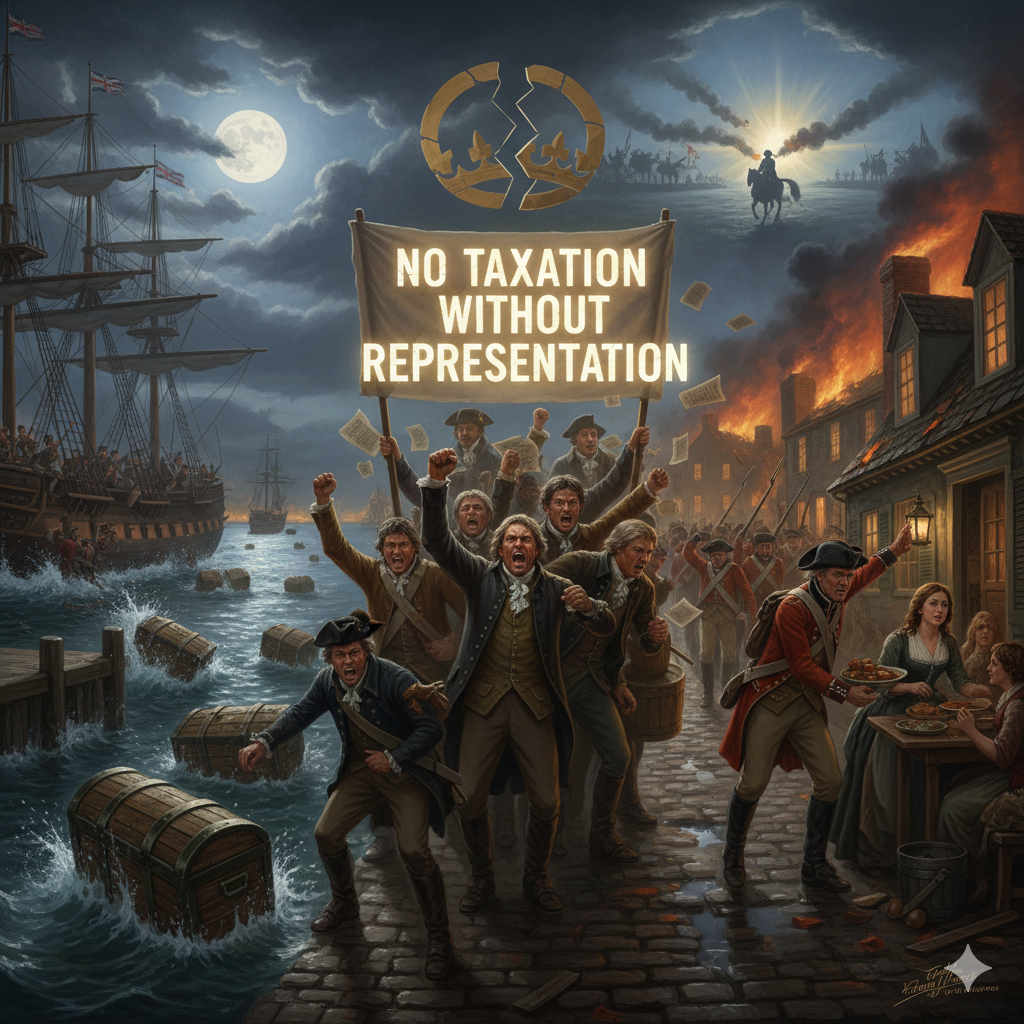
Boston Tea Party (1773)
Boston Tea Party (1773): Detailed Description
The Boston Tea Party was a major event in the American Revolution. It took place on 16 December 1773 as a direct protest against the British government’s Tea Act of 1773. During this incident, American colonists boarded British ships and threw 342 chests of tea into the waters of Boston Harbor. This bold act became a powerful symbol of growing anger against British rule and pushed America further toward independence.
1. Background of the Boston Tea Party
(i) British Government Taxes and American Discontent
- The British government imposed taxes under the Townshend Acts (1767), including a tax on tea.
- Colonists strongly opposed these taxes and began boycotting British goods.
- In 1770, Britain repealed most Townshend taxes, but kept the tea tax, increasing resentment.
(ii) Tea Act, 1773
The British Parliament passed the Tea Act in 1773, giving the British East India Company the privilege to sell tea tax-free in the American colonies.
Effects of the Tea Act
- Loss to American merchants: They could no longer compete with cheap British tea.
- Economic frustration: Colonists felt Britain was forcing them to buy British tea.
- Demand for independence increased: People believed Britain was imposing laws without consent.
2. Boston Tea Party Incident
(i) Arrival of Ships Laden with Tea
- In November 1773, the ship Dartmouth arrived at Boston Harbor carrying British tea.
- Soon after, two more ships—Eleanor and Beaver—arrived.
- Colonists refused to unload the tea and demanded that the ships return to Britain.
(ii) Leadership of the “Sons of Liberty”
- The protest was led by Samuel Adams and his group, the Sons of Liberty.
- Governor Thomas Hutchinson refused to send the ships back and insisted the tea must be unloaded.
(iii) 16 December 1773 – Tea Thrown into the Sea
- At night, over 100 colonists disguised as Native American “Mohawk” tribe members.
- They boarded the ships and threw 342 chests of tea into Boston Harbor.
- The destroyed tea was worth more than £10,000 at that time (millions in today's value).
- The entire event occurred without violence.
3. Reaction of the British Government
The Boston Tea Party deeply angered Britain, leading to severe punishment for the colonies.
(i) Intolerable Acts (1774)
- Boston Port Act: Closed Boston Harbor until the tea was paid for.
- Massachusetts Government Act: Abolished local self-government.
- Quartering Act: Forced colonists to house British soldiers.
- Administration of Justice Act: Protected British officials from colonial trials.
4. Results and Effects of the Boston Tea Party
(i) Increased Opposition to Britain
- Colonists believed the British government was becoming dictatorial.
- Other colonies supported Boston and called for stronger boycotts.
(ii) Formation of the Continental Congress
The First Continental Congress met in September 1774 and united all 13 colonies to plan resistance.
(iii) Beginning of the American Revolution
- 19 April 1775: The Battle of Lexington and Concord signaled the start of the Revolution.
- 4 July 1776: The Declaration of Independence was adopted.

✔ Easy to use daily
✔ Excellent value for money
✔ Popular among buyers
Conclusion
The Boston Tea Party was not just a protest against tea—it was a fight against oppressive British policies. It ignited the American Revolution and played a crucial role in America's journey toward independence. The event stands as a global symbol of courage, democracy, and resistance against injustice.
The Harsh Attitude of the British Army
The Harsh Attitude of the British Army and the American Revolution
The harsh attitude and repressive actions of the British Army became a major cause of rebellion in the American colonies. Britain’s policies and military suppression played a significant role in the outbreak of the American Revolution (1775–1783).
1. The Role and Harsh Attitude of the British Army
(i) Growing Military Presence in the Colonies
- After the Seven Years’ War (1763), Britain stationed troops permanently in the colonies.
- Though claimed to be for protection, troops were mainly used to maintain control and suppress dissent.
- Colonists saw this as a sign of dictatorship and increasing British control.
(ii) Violation of Citizens’ Rights
- British soldiers frequently abused their power and mistreated colonists.
- They occupied private homes and misused public property.
- The Quartering Act (1765) forced colonists to house British soldiers, violating personal liberty.
(iii) Boston Massacre (1770)
On March 5, 1770, British soldiers fired on unarmed colonists during a protest, killing five colonists. This event, known as the Boston Massacre, increased anti-British sentiment across the colonies.
(iv) Intolerable Acts (1774) and Severe Repression
- The British government passed harsher laws after the Boston Tea Party.
- Boston Port Act: Closed the port, stopping trade and causing unemployment.
- Massachusetts Government Act: Replaced local governance with British authority.
- Administration of Justice Act: Protected British officials from colonial courts.
- Quartering Act: Forced housing of soldiers, increasing resentment.
(v) Violent Actions of the British Army
(a) Battle of Lexington and Concord (1775)
On 19 April 1775, British troops attempted to seize colonial arms, leading to the first battle of the Revolution. Soldiers burned homes and attacked civilians.
(b) Repression in New York and Philadelphia
- British forces occupied major American cities and enforced strict control.
- Many colonists were jailed without trial on suspicion of rebellion.
(c) Inhuman Treatment of Prisoners of War
Captured American rebels were tortured, starved, and kept in filthy prison ships. Thousands died due to inhumane treatment.
2. Consequences of the Harsh Attitude
(i) Strengthened the Spirit of Independence
The brutality of the British Army united the colonies against British rule.
- In 1774, the First Continental Congress met.
- On July 4, 1776, the Declaration of Independence was issued.
(ii) Guerrilla Warfare
American militia used guerrilla tactics, causing heavy losses to British forces.
(iii) Support from France and Other Nations
France, Spain, and the Netherlands supported America after witnessing Britain’s cruelty. France formed a military alliance in 1778, helping defeat the British.
(iv) American Victory
The decisive Battle of Yorktown (1781) ended major British resistance. In 1783, the Treaty of Paris recognized America as an independent nation.
Conclusion
The harsh attitude of the British Army became a driving force behind the American Revolution. Abuse of power, violation of rights, and repressive military actions pushed the colonies toward independence. Ultimately, America’s victory established a new era of democracy and civil rights.
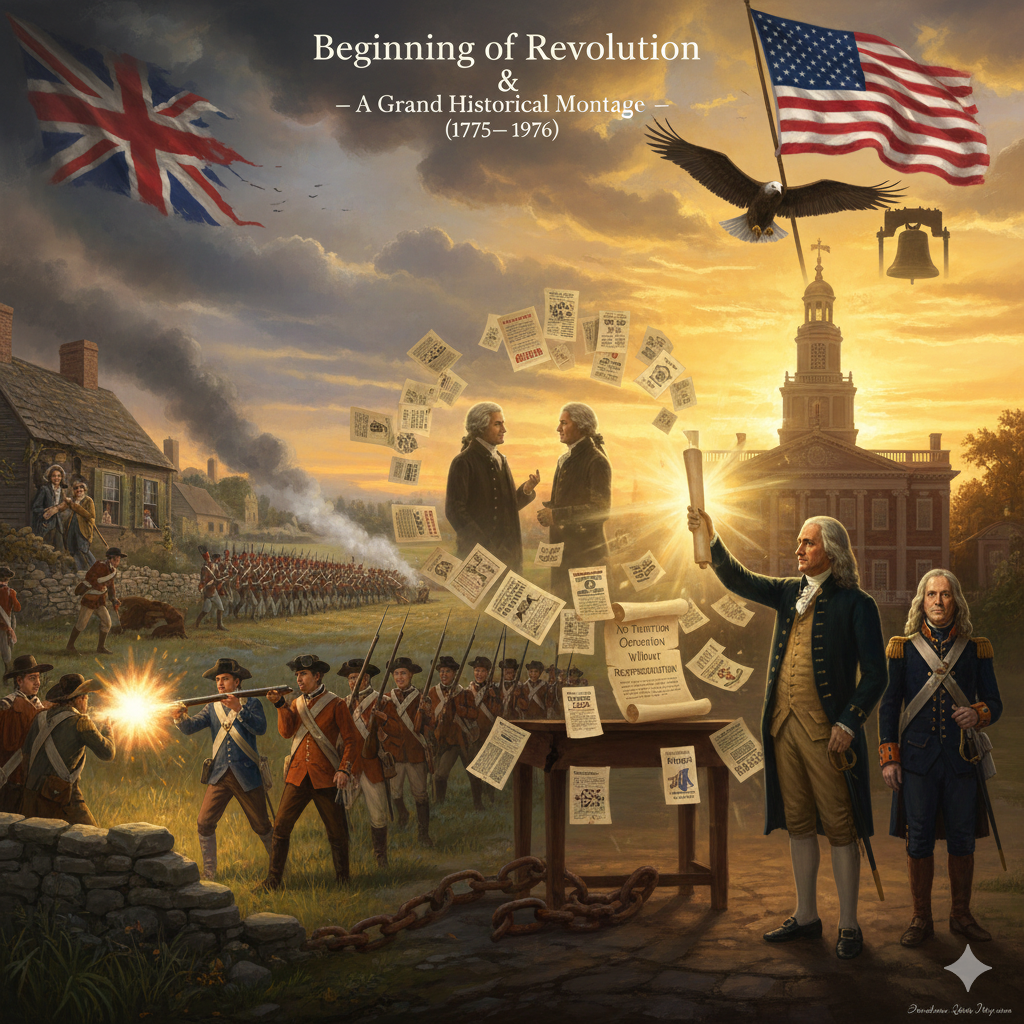
The Beginning of the Revolution (1775)
The Beginning of the American Revolution (1775): Detailed Description
The American Revolution (1775–1783) was the struggle of the American colonies against British rule, which ultimately led to the establishment of the United States as an independent nation. The revolution formally began in 1775, when the first battles took place between the British Army and American militia.
1. Main Reasons for the Start of the Revolution
(i) Dissatisfaction Against Taxes and Oppressive Laws
- The British government passed the Tea Act (1773), giving the East India Company monopoly control over tea sales.
- American resistance led to the Boston Tea Party (1773), where colonists dumped tea into Boston Harbor.
- Britain responded with the Intolerable Acts (1774), which increased anger in the colonies.
(ii) Growing Dictatorship of the British Army
- British troops were stationed in major cities like Boston.
- Soldiers were allowed to stay in colonists’ homes and use their resources.
- The Boston Massacre (1770) increased public anger when British soldiers fired on unarmed civilians.
(iii) Rising Spirit of Independence in the Colonies
- Demand for democratic rights increased rapidly.
- Leaders such as Samuel Adams, John Adams, Thomas Jefferson, and Benjamin Franklin promoted independence.
- The slogan “No Taxation Without Representation” became widely popular.
(iv) First Continental Congress (1774)
- Held on September 5, 1774 with representatives from 12 colonies.
- They demanded the repeal of the Intolerable Acts and self-governance.
- When Britain refused, the colonies began preparing for military conflict.

✔ Easy to use daily
✔ Great value for money
✔ Highly recommended by users
2. The First Battle of the Revolution: Lexington and Concord (April 19, 1775)
(i) British Attempt to Crush the Rebels
British Governor General Thomas Gage received information that colonists were storing weapons in Concord near Boston. On April 19, 1775, he sent about 700 British soldiers to seize the weapons and suppress the rebellion.
(ii) Battle of Lexington
- British troops reached Lexington and encountered about 77 American militia members.
- The first shot—known as “The Shot Heard Round the World”—initiated the fight.
- Although the militia retreated, the battle marked the formal beginning of the American Revolution.
(iii) Battle of Concord
- British troops marched on to Concord but were met with strong resistance.
- The American militia used guerrilla tactics to attack the British soldiers.
- The British suffered over 250 casualties and were forced to retreat to Boston.
- American casualties were approximately 90.
3. Other Major Events Leading to the Beginning of the Revolution
(i) Second Continental Congress (May 10, 1775)
- The colonies officially decided to continue the struggle against Britain.
- George Washington was appointed Commander-in-Chief of the Continental Army.
(ii) Battle of Bunker Hill (June 17, 1775)
- A major battle near Boston between British forces and American troops.
- Although Britain won, it suffered heavy casualties.
- This battle proved that Americans could fight the British army effectively.
(iii) Reaction of King George III
- King George III declared the colonies to be in rebellion.
- He sent more troops to America, escalating the conflict.
4. Consequences of the Beginning of the Revolution
(i) Independence Movement Intensified
In 1776, Thomas Paine published Common Sense, arguing for complete independence from Britain. The movement gained strong public support.
(ii) Declaration of Independence (July 4, 1776)
On July 4, 1776, under the leadership of Thomas Jefferson, the colonies issued the Declaration of Independence, supporting liberty and equality.
(iii) Full-Scale War
- From 1776 onward, a full war broke out between Britain and the colonies.
- France, Spain, and the Netherlands supported America.
- In 1781, the British army surrendered at the Battle of Yorktown.
- In 1783, the Treaty of Paris recognized America as an independent nation.
Conclusion
The American Revolution began with the colonies’ resistance to British rule. The battles of Lexington and Concord, the First and Second Continental Congress, and growing unity among the colonies set the foundation for independence. By 1776, America declared its freedom, and after years of struggle, emerged as an independent nation. This revolution inspired democratic movements across the world.
American Declaration of Independence (July 4, 1776)
US Declaration of Independence (July 4, 1776): Detailed Description
The American Declaration of Independence was issued on July 4, 1776. It was a formal announcement by the 13 colonies declaring complete independence from the British Empire. This document gave new direction to the American Revolution and became a global symbol of democracy and freedom.
1. Background of the Declaration of Independence
(i) Dissatisfaction Toward British Rule
- Colonists protested unjust taxation and repressive laws.
- The Boston Tea Party (1773) and the Intolerable Acts (1774) increased anger.
- The Boston Massacre (1770) strengthened the demand for independence.
(ii) First and Second Continental Congress
- First Continental Congress (1774) demanded protection of colonial rights.
- Second Continental Congress (1775) appointed George Washington as commander of the American army.
- The battles of Lexington and Concord marked the start of the revolution.
(iii) Growing Need for Independence
- Peace with Britain was no longer possible.
- In January 1776, Thomas Paine published Common Sense, arguing strongly for independence.
- Public demand for independence increased rapidly.
2. The Process of Declaring Independence
(i) Drafting the Declaration
- On June 7, 1776, Richard Henry Lee proposed complete independence.
- A committee was formed:
- Thomas Jefferson (main author)
- John Adams
- Benjamin Franklin
- Roger Sherman
- Robert Livingston
- The responsibility of writing the draft was given to Thomas Jefferson.
(ii) Final Approval of the Declaration
- Jefferson drafted the Declaration in June 1776.
- The document criticized British policies and justified the colonies’ right to independence.
- On July 4, 1776, the Continental Congress formally adopted the Declaration.
3. Key Points of the Declaration of Independence
(i) Principle of Natural Rights
- “All men are created equal and have the right to life, liberty, and the pursuit of happiness.”
- Inspired by philosopher John Locke’s theory of natural rights.
- It emphasized that governments exist to protect these rights.
- If a government becomes tyrannical, people have the right to overthrow it.
(ii) List of British Atrocities
- The Declaration listed 27 grievances against King George III.
- Complaints included unjust taxes, violation of citizens’ rights, and forced military rule.
(iii) Declaration of Complete Independence
- The document stated that the 13 colonies were now “free and independent states.”
- All political ties with Britain were officially dissolved.
4. Effects of the Declaration of Independence
(i) Strengthening the American Revolution
The Declaration inspired American troops and civilians to continue the fight for liberty with renewed energy.
(ii) International Support
- France, Spain, and the Netherlands supported America’s struggle for independence.
- France signed a military alliance with America in 1778.
(iii) Spread of Democracy and Human Rights
- The Declaration inspired democratic movements worldwide.
- It influenced the French Revolution (1789) and independence movements in Latin America.
(iv) America Became an Independent Nation
- The war continued until the British defeat at Yorktown in 1781.
- The Treaty of Paris (1783) formally recognized the United States as an independent nation.
Conclusion
The Declaration of Independence is not just a historical document—it is a symbol of freedom, equality, and democracy. It showed the world that people have the right to challenge tyranny and build a government based on liberty. Even today, it remains a powerful pillar of human rights and democratic values.

Important Wars and Events
Important Battles and Events of the American Revolution
The American Revolution (1775–1783) saw many important battles and events that played a vital role in securing America’s independence from British rule. The conflict was fought between the 13 American Colonies and the British Empire, in which America ultimately emerged victorious.
1. Early Wars of the Revolution (1775–1776)
(i) Battle of Lexington and Concord (April 19, 1775)
Importance:
- First battle of the American Revolution.
- British forces attempted to seize American weapons.
- American militia used guerrilla tactics and forced the British to retreat.
- Known as “The Shot Heard Round the World.”
(ii) Battle of Bunker Hill (June 17, 1775)
Importance:
- First major battle near Boston.
- British won the battle but suffered heavy casualties.
- Gave Americans confidence that they could face the British army.
(iii) Siege of Boston (April 1775 – March 1776)
Importance:
- American forces surrounded the city of Boston.
- Under George Washington’s leadership, the British army left Boston in March 1776.
- Became the first major American victory.
2. Declaration of Independence & Major War Events (1776–1778)
(iv) Declaration of Independence (July 4, 1776)
Importance:
- Written primarily by Thomas Jefferson.
- Official announcement of America becoming an independent nation.
- Declared that “all men are created equal” with rights to life, liberty, and happiness.
(v) Battle of Long Island (August 27, 1776)
Importance:
- Fought in New York; British achieved a major victory.
- George Washington retreated strategically and saved his army.
(vi) Battle of Trenton (December 26, 1776)
Importance:
- Washington crossed the Delaware River on Christmas night.
- American forces defeated the Hessians (German mercenaries).
- Boosted American morale with a major victory.
(vii) Battle of Saratoga (September 19 – October 17, 1777)
Importance:
- The turning point of the American Revolution.
- American forces defeated British General John Burgoyne.
- About 5,800 British soldiers surrendered.
- France decided to support America after this victory.
3. Decisive Phase Against British Forces (1778–1781)
(viii) Support of France and Spain (1778–1779)
Importance:
- France and Spain provided military and economic aid to America.
- Forced Britain to fight on multiple fronts.
- Weakened British global power.
(ix) Battle of Kings Mountain (October 7, 1780)
Importance:
- Key battle in the southern colonies.
- American Patriot militia defeated British Loyalist forces.
- Strengthened the revolutionary movement in the South.
(x) Battle of Yorktown (September 28 – October 19, 1781)
Importance:
- The final and decisive battle of the American Revolution.
- American forces (Washington) and French forces (Lafayette) surrounded General Cornwallis.
- The British army surrendered on October 19, 1781.
- Ensured America’s victory and independence.
4. End of the War and Peace Treaty (1783)
(xi) Treaty of Paris (September 3, 1783)
Importance:
- Britain formally recognized the United States as an independent nation.
- America received land from the Atlantic Ocean to the Mississippi River.
- British forces withdrew from all American territories.
5. Significance of the American Revolution
(i) Victory of Freedom and Democracy
- America became the world’s first modern democratic nation.
- Inspired global movements for human rights and freedom.
(ii) Impact on the French Revolution
- Inspired the French Revolution of 1789.
- Strengthened ideas of liberty, equality, and justice.
(iii) Decline of the British Empire
- Britain’s global power weakened.
- Encouraged independence movements in other colonies.
(iv) Rise of America’s Global Identity
- America emerged as a strong and independent nation.
- Later influenced world politics, trade, and democracy.
6. Conclusion
The American Revolution was not merely a political struggle but a fight for democracy, freedom, and equality. The wars from 1775 to 1781 united the colonies and weakened the British Empire. The victories at Saratoga and Yorktown ensured American independence. The Treaty of Paris (1783) established the United States as a sovereign nation. This revolution inspired democratic ideas and independence movements around the world.

✔ Easy & convenient everyday use
✔ Great value for money
✔ Trusted by many buyers
Battle of Saratoga (1777)
Battle of Saratoga (1777): Detailed Description
The Battle of Saratoga was the most important battle of the American Revolution (1775–1783). Fought on September 19 and October 17, 1777 in the Saratoga region of New York, it resulted in a major American victory and became the turning point of the revolution.
1. Background of the Battle of Saratoga
(i) British Strategy and the American Challenge
- In 1777, Britain adopted a Divide and Conquer strategy to isolate New England.
- The goal was to control the Hudson River Valley and separate northern and southern colonies.
- General John Burgoyne marched from Canada, while General Howe was supposed to support from the south.
- Howe instead attacked Philadelphia, leaving Burgoyne without support.
2. Events of the Battle of Saratoga
(i) First Battle: Battle of Freeman’s Farm (September 19, 1777)
- Fought near Freeman’s Farm in Saratoga.
- Burgoyne attacked but faced strong resistance from American Generals Horatio Gates and Benedict Arnold.
- The battle lasted nearly four hours.
- British technically won but suffered heavy losses, weakening their progress.
(ii) Second Battle: Battle of Bemis Heights (October 7, 1777)
- Burgoyne’s army was exhausted and lacked supplies.
- On October 7, he launched another attack, known as the Battle of Bemis Heights.
- American forces counterattacked strongly.
- Benedict Arnold played a heroic role and inflicted major damage on the British.
- The British army was forced to retreat and eventually became surrounded.
(iii) Surrender of the British Army (October 17, 1777)
- General Burgoyne surrendered with 5,800 British soldiers.
- It was the first major surrender by the British during the war.
- Americans captured large quantities of weapons, ammunition, and supplies.
3. Effects of the Battle of Saratoga
(i) The Turning Point of the Revolution
- The battle proved the American army could defeat the British.
- Boosted the morale of American soldiers and the public.
(ii) Support of France (1778)
- After Saratoga, France formally allied with America.
- In February 1778, France and America signed a military treaty.
- Spain and the Netherlands also supported America later.
- Britain now had to fight multiple enemies, weakening its strength.
(iii) Failure of British Strategy
- The “Divide and Conquer” policy completely failed.
- Britain shifted focus to southern colonies but faced defeats there as well.
(iv) A Major Step Toward American Independence
- Saratoga victory brought international support for America.
- Led to the British defeat at Yorktown in 1781.
- Concluded with the Treaty of Paris (1783), granting America independence.
Conclusion
The Battle of Saratoga was the most important turning point of the American Revolution. It weakened the British army, boosted American morale, and attracted support from France and other nations. Without this victory, American independence would have taken much longer. Saratoga laid the foundation for the final American victory and strengthened the global ideas of democracy and freedom.
Siege of Yorktown (1781)
The Siege of Yorktown (1781): The Decisive Battle of the American Revolution
The Siege of Yorktown was the last and decisive battle of the American Revolution (1775–1783). Fought from 28 September to 19 October 1781, it ended with the surrender of British General Lord Charles Cornwallis. In this battle, American and French forces together defeated the British army, nearly ensuring America’s independence.
1. Background of the War
(i) Strategy of the British Army
- By 1781, Britain had adopted a strategy of conquering the American colonies from the South.
- General Charles Cornwallis had some victories but also suffered heavy losses.
- He eventually stationed his army at Yorktown, Virginia, awaiting assistance from the British Navy.
(ii) American and French Military Plan
- General George Washington learned that Cornwallis’s army was in a vulnerable position.
- France, already an ally of America, agreed to assist in the campaign.
- Washington and French General Comte de Rochambeau planned to surround the British army at Yorktown.
2. The Siege of Yorktown and the Events of the Battle
(i) March Toward Yorktown (19 August – 28 September 1781)
- 19 August 1781: Washington moved his army from New York to Virginia.
- 5 September 1781: The French Navy defeated the British fleet in the Battle of Chesapeake.
- This cut off all sea-based support for Cornwallis and trapped the British army in Yorktown.
(ii) Siege of Yorktown (28 September 1781)
- American and French forces surrounded Yorktown on all sides.
- About 17,000 allied troops surrounded 8,000 British soldiers.
- The British received no reinforcements or supplies.
(iii) Continuous Bombardment (6 October – 14 October 1781)
- 6 October: Allied forces began heavy artillery bombardment on British positions.
- British fortifications were destroyed gradually.
- 14 October: American and French troops stormed and breached British defensive lines.
(iv) Surrender (17–19 October 1781)
- 17 October: Cornwallis expressed willingness to surrender.
- 19 October: The British army formally surrendered.
- Nearly 8,000 British soldiers laid down their arms.
3. Results of the Battle of Yorktown
(i) America’s Independence Became Almost Certain
This was the final major battle of the American Revolution. Britain was now under pressure to negotiate peace.
(ii) Collapse of British Morale
The defeat led to political turmoil in Britain. Parliament and the public demanded an end to the war.
(iii) Treaty of Paris (1783)
The war officially ended with the Treaty of Paris (3 September 1783), in which Britain recognized the United States as an independent nation.
4. Importance of the Siege of Yorktown
(i) Last Major Battle of the Revolution
After Yorktown, the British army did not engage in any major battles in America.
(ii) Success of the American–French Alliance
The French army and navy played a crucial role, proving the power of international alliances.
(iii) Global Impact
The victory inspired democratic and independence movements globally, including the French Revolution in 1789.
Conclusion
The Siege of Yorktown was a decisive turning point in the American Revolution. It marked the final step toward American freedom and demonstrated the power of strategic planning and international cooperation.
The End of the Revolution and Its Consequences
The End of the American Revolution and Its Consequences
The American Revolution (1775–1783) ended with the Treaty of Paris (1783), in which Britain officially recognized America’s independence. The revolution had far-reaching consequences that influenced nations across the world.
1. End of the Revolution (1781–1783)
(i) British Defeat at Yorktown (October 1781)
- On 19 October 1781, General Cornwallis surrendered.
- This was the last major battle of the American Revolution.
(ii) Political Change in Britain & Peace Talks
- The defeat caused political pressure and protests in Britain.
- Prime Minister Lord North resigned in March 1782.
- The new government began peace negotiations.
(iii) Treaty of Paris (3 September 1783)
- Britain recognized America as an independent nation.
- American borders extended from the Atlantic Ocean to the Mississippi River.
- British troops withdrew from American territory.
2. Major Consequences of the American Revolution
(i) America Gained Independence
The 13 colonies became the United States of America, founded on democracy and republic principles.
(ii) First Democratic Republic
- The U.S. Constitution was created in 1787—the world’s first written constitution.
- Established democracy, human rights, and separation of powers.
(iii) Threat to Colonial Empires
The success of the American Revolution inspired other colonies under British, French, Spanish, and European rule to seek independence.
(iv) Impact on France and Other Countries
- Inspired the French Revolution (1789).
- Encouraged independence movements in Haiti and Latin America.
(v) Rise of Social Change
Although rights for women and African-Americans came later, the revolution strengthened the ideals of equality and liberty.
(vi) Economic Freedom
America gained full control over trade, taxation, and economic policies.
(vii) Future Relations Between Britain and America
Relations were tense initially but improved in the 19th century as both nations engaged in trade and diplomacy.
Conclusion
The American Revolution transformed not only the United States but also the entire world. It spread the ideas of democracy, republicanism, and human rights and became a guiding force for global independence movements.
Treaty of Paris (1783)
Treaty of Paris (1783): Formal End of the American Revolution
The Treaty of Paris (1783) was the historic agreement that formally ended the American Revolution and recognized the United States of America as an independent nation. It was signed on 3 September 1783 between Britain and the United States.
1. Background of the Treaty
(i) Battle of Yorktown (1781) and British Defeat
- The defeat at Yorktown forced Britain to consider peace.
(ii) Change in the British Government
- Anti-war sentiment increased.
- Prime Minister Lord North resigned in March 1782.
(iii) Peace Negotiations (1782–1783)
- Talks were held in Paris among Britain, America, France, and Spain.
- U.S. representatives included Benjamin Franklin, John Adams, and John Jay.
- Negotiations ended with the signing of the treaty on 3 September 1783.

✔ Convenient & easy to use
✔ Excellent value for the price
✔ Popular choice among users
2. Main Terms of the Treaty of Paris (1783)
(i) Recognition of America’s Independence
Britain acknowledged the United States as an independent and sovereign nation.
(ii) Expansion of U.S. Boundaries
- Atlantic Ocean to the east
- Mississippi River to the west
- Canada to the north
- Florida to the south
(iii) Withdrawal of British Forces
British troops agreed to leave American territory, though some stayed until the 1790s.
(iv) Fishing Rights
American fishermen were permitted to fish off the coasts of Newfoundland and Nova Scotia.
(v) Payment of Debts & Restoration of Loyalist Property
- America agreed to pay debts owed to British merchants.
- Loyalists were to have their property restored or compensated (partially implemented).
3. Effects and Consequences
(i) America’s Independence Ensured
The United States gained full sovereignty and began building its constitution and government.
(ii) Inspiration for Global Independence Movements
The treaty inspired revolutions in France, Haiti, and Latin America.
(iii) Shift in British Global Strategy
Britain focused more on India, Canada, and other territories after losing America.
(iv) Better U.S.–UK Relations
Relations improved in the 19th century, especially after the War of 1812.
(v) Economic and Territorial Expansion in America
The U.S. expanded westward and strengthened democratic institutions.
Conclusion
The Treaty of Paris (1783) officially ended the American Revolution and paved the way for the United States to rise as a democratic and independent nation. It became a milestone in world history, inspiring nations to fight for liberty and self-rule.
Constitution and Establishment of the Republic
The Constitution and the Founding of the Republic: America’s Democratic Foundation
After the success of the American Revolution (1775–1783), the United States of America needed an organized, stable, and democratic system of governance. This led to the establishment of the U.S. Constitution and the founding of the American Republic.
After the Declaration of Independence (1776), the new nation experimented with a political framework:
- Articles of Confederation (1781) – America’s first constitution, but weak.
- U.S. Constitution drafted in 1787 – Approved in 1788, implemented in 1789.
- The United States became a constitutional republic where elected representatives govern the nation.
1. Background of the Founding of the American Republic
(i) Challenges After Independence
- After the Treaty of Paris (1783), America became independent but faced instability.
- The 13 states acted independently; there was no strong central government.
- An organized constitution was required for defense, economy, and lawmaking.
(ii) Articles of Confederation – 1781
- The first written constitution of the U.S.
- It gave most powers to the states, making the central government very weak.
- The central government could not levy taxes, raise an army, or regulate trade.
- Shays’ Rebellion (1786–87) exposed the weaknesses of this system.
2. Creation of the U.S. Constitution (1787)
(i) Constitutional Convention – 1787
- Held on May 25, 1787, in Philadelphia.
- 55 delegates participated, including Washington, Madison, Franklin, Hamilton.
- George Washington was elected Chairman.
- James Madison is called the “Father of the Constitution.”
- The Constitution was finalized on September 17, 1787.
(ii) Main Features of the American Constitution
Federal System
Two levels of government were established: federal and state governments.
Democratic Republic
The people elect representatives who govern on their behalf.
Separation of Powers
- Executive: President
- Legislature: Congress
- Judiciary: Supreme Court
Judicial Review
The Supreme Court has the power to interpret the Constitution and determine the constitutionality of laws.
Protection of People’s Rights (Bill of Rights – 1791)
The first ten amendments ensured freedoms such as speech, religion, press, fair trials, and equality.
3. The Process of Making America a Republic
(i) Ratification of the Constitution – 1788
- Approval of at least 9 states was needed.
- On June 21, 1788, New Hampshire became the 9th state to ratify.
- In 1789, the Constitution was officially implemented.
(ii) First President and New Government (1789)
- George Washington became the first President in April 1789.
- A constitution-based democratic government officially began.
- New economic and administrative reforms were introduced.

✔ Easy & comfortable to use
✔ Great value for price
✔ Popular choice among buyers
(iii) Bill of Rights (1791)
The first ten amendments protected civil liberties such as freedom of speech, religion, and judicial rights.
4. Influence of the U.S. Constitution and Republic
(i) First Successful Democratic Republic
America became the world’s first modern constitutional republic, based on the principle of “government of the people, by the people, for the people.”
(ii) Impact on Global Democracy
The American Constitution inspired many nations including France, Latin America, and later India.
(iii) Powerful Federal Government
The Constitution balanced power between federal and state governments and created a strong administrative system.
(iv) Protection of Human Rights
Personal liberty, judicial rights, and limitations on government power made the U.S. Constitution a model for the world.
Conclusion
The U.S. Constitution and the establishment of the Republic laid the foundation of a strong, democratic, and constitutional system. Its principles of liberty, human rights, and federalism continue to inspire nations around the world.
Impact of the American Revolution
Impacts of the American Revolution
The American Revolution (1775–1783) was not only a war but a landmark victory for freedom, democracy, and human rights. Its impact extended far beyond America and transformed global politics, society, and ideology.
1. Impact on America
(i) America Gained Independence
- Under the Treaty of Paris (1783), the USA became an independent nation.
- British rule ended completely.
- Americans gained economic, political, and social freedom.
(ii) Establishment of Democracy and Republic
- The U.S. Constitution (1787) came into effect in 1789.
- Democratic principles were institutionalized.
- A constitution-based republic was founded.
(iii) Development of Federalism
The Constitution created a balance of power between the federal and state governments.
(iv) Economic Development and Rise of Capitalism
- America was freed from restrictive British economic policies.
- Free trade, industry, and capitalism expanded.
- Westward expansion boosted agriculture and resource development.
(v) Social Change and Equality
- The idea of equality gained popularity.
- Debates over women’s rights and slavery began, though real reforms came later.
2. Global Impact
(i) Inspired the French Revolution (1789)
- The ideas of liberty and equality inspired France.
- Led to the overthrow of monarchy in 1789.
(ii) Independence Movements in Latin America (1810–1830)
- Leaders like Simón Bolívar and José de San Martín took inspiration from America.
- Countries such as Argentina, Chile, Mexico, Venezuela, and Brazil gained independence.
(iii) Wave of Democracy and Nationalism in Europe
- Democratic ideas influenced Britain, Germany, Italy, and others.
- Many European revolutions in the 19th century were inspired by this revolution.
(iv) Haitian Revolution (1791–1804)
Slaves in Haiti revolted and established the world’s first Black republic in 1804.
3. Political Influence
(i) Establishment of Democratic Governments
The revolution gave global recognition to democracy, civil liberties, and constitutional governance.
(ii) Spread of Republicanism
The American republican model influenced many nations transitioning away from monarchy.
(iii) Concept of Human Rights Strengthened
The U.S. Bill of Rights influenced the Universal Declaration of Human Rights (1948).
4. Economic Impact
(i) Growth of Trade and Capitalism
Independence removed trade restrictions, giving rise to new industries and stronger capitalism.
(ii) Development of Agriculture and Industrialization
Agriculture expanded and American industrialization accelerated in the 19th century.
5. Social Impact
(i) Demand for Women’s Rights
Women played crucial roles in the revolution and later demanded equal rights.
(ii) Abolition Movement Against Slavery
Ideas of equality led to movements that eventually ended slavery after the Civil War.
(iii) Spread of Education and New Ideologies
Post-independence America saw growth in education, journalism, science, and philosophy.
Conclusion
The American Revolution was a turning point not only for America but for the entire world. It promoted the ideals of freedom, democracy, and human rights; inspired global revolutions; and laid the foundation for modern democratic nations.