
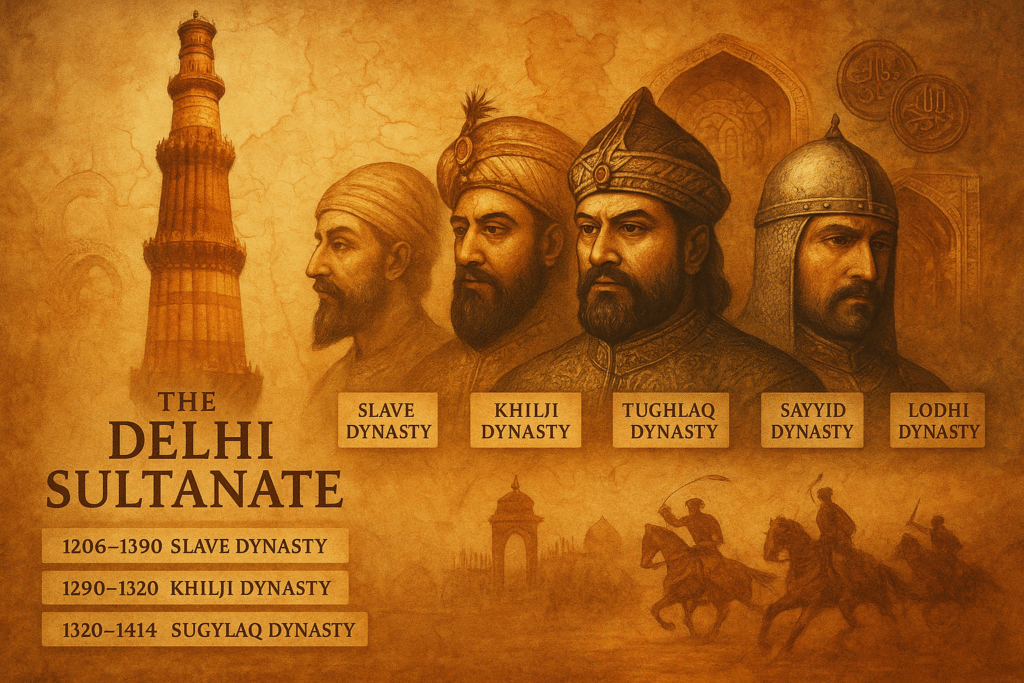
The Delhi Sultanate: Establishment, Background, and Major Dynasties
The Delhi Sultanate was founded in 1206 AD when Qutbuddin Aibak laid the foundation of the Slave (Mamluk) Dynasty. This era marked an important political and cultural chapter in medieval India.
Background
The Delhi Sultanate began after Muhammad Ghori defeated Prithviraj Chauhan in the Second Battle of Tarain in 1192 AD. Ghori expanded his empire into northern India and, after his death in 1206 AD, appointed his general Qutbuddin Aibak as the ruler of his conquered territories in India.
Major Dynasties of the Delhi Sultanate
The Delhi Sultanate is divided into five main dynasties:
1. Slave Dynasty (1206–1290)
- Founder: Qutubuddin Aibak
- Famous Rulers: Iltutmish, Razia Sultan, Balban
- Achievements: Initiated the construction of the Qutub Minar
2. Khilji Dynasty (1290–1320)
- Founder: Jalaluddin Khilji
- Famous Rulers: Alauddin Khilji
- Achievements: South Indian campaigns, market reforms
3. Tughlaq Dynasty (1320–1414)
- Founder: Ghiyasuddin Tughlaq
- Famous Rulers: Muhammad bin Tughlaq, Firoz Shah Tughlaq
- Achievements: Administrative reforms, capital shifting
4. Sayyid Dynasty (1414–1451)
- Founder: Khizr Khan
- Characteristics: Considered a relatively weak lineage
5. Lodhi Dynasty (1451–1526)
- Founder: Bahlol Lodhi
- Last Ruler: Ibrahim Lodi (defeated by Babur in the First Battle of Panipat, 1526)
The Delhi Sultanate had a profound impact on Indian society, administration, and culture. This era witnessed the spread of Islam, new architectural styles, and increased interaction between Hindu and Muslim civilizations.
Background of the Establishment of the Delhi Sultanate
To understand the origins of the Delhi Sultanate, it is important to examine the political and social conditions of India and Central Asia during the 12th century. India was then divided into small Rajput states, while repeated invasions continued from the north-west.
1. Political Situation in India
During the 12th century, India consisted of many small kingdoms engaged in constant rivalry and warfare. The lack of unity among these regional powers weakened resistance against foreign invasions. Important political centers included Kannauj, Delhi, Ajmer, Gujarat, and Bengal.
Rise of Rajput States
Rajput rulers dominated much of India during this era. Although known for bravery and military skills, they were divided into several states and often fought among themselves.
Effect of Political Fragmentation
This political disunity made India vulnerable. Foreign invaders found it easy to conquer fragmented territories and expand their power.
2. Situation in Central Asia
Central Asia witnessed major political upheavals during the 11th and 12th centuries.
Rise of the Ghaznavids
The Ghaznavid dynasty invaded northwestern India in the 10th and 11th centuries. Mahmud Ghaznavi invaded India 17 times between 1001–1027 AD. His objective was mainly to plunder wealth, not establish permanent rule.
Top Amazon Product
High quality and reliable Amazon product with excellent customer reviews. Great choice for daily use, performance, and value for money.
👉 Buy Now on AmazonExpansion of the Ghori Empire
The Ghori dynasty of Afghanistan rose to power in the 12th century after defeating the Ghaznavids. Muhammad Ghori's ambitions differed—he aimed to establish permanent rule in India rather than simply loot resources.
3. Invasions of Muhammad Ghori
Muhammad Ghori launched several invasions into India during the late 12th century. His campaigns laid the foundation for the Delhi Sultanate.
First Battle of Tarain (1191)
Fought between Muhammad Ghori and Prithviraj Chauhan, this battle ended in Chauhan’s victory, forcing Ghori to retreat.
Second Battle of Tarain (1192)
Ghori attacked again the following year with better preparation. This time he defeated Prithviraj Chauhan, opening the gateway to North India for further expansion.
Capture of Delhi
After his victory at Tarain, Ghori captured Delhi and nearby regions.
Appointment of Qutubuddin Aibak
Ghori appointed his trusted commander Qutubuddin Aibak to administer his territories in India.
4. Fall of the Ghori Empire and Rise of the Delhi Sultanate
- Muhammad Ghori was murdered in 1206 AD.
- After his death, Qutbuddin Aibak took control of the Indian territories.
- Aibak declared independence and formally established the Delhi Sultanate.
Thus, the fragmented political condition of India, internal conflicts among Rajputs, and the Ghori dynasty’s ambition for long-term rule created the circumstances that led to the establishment of the Delhi Sultanate.
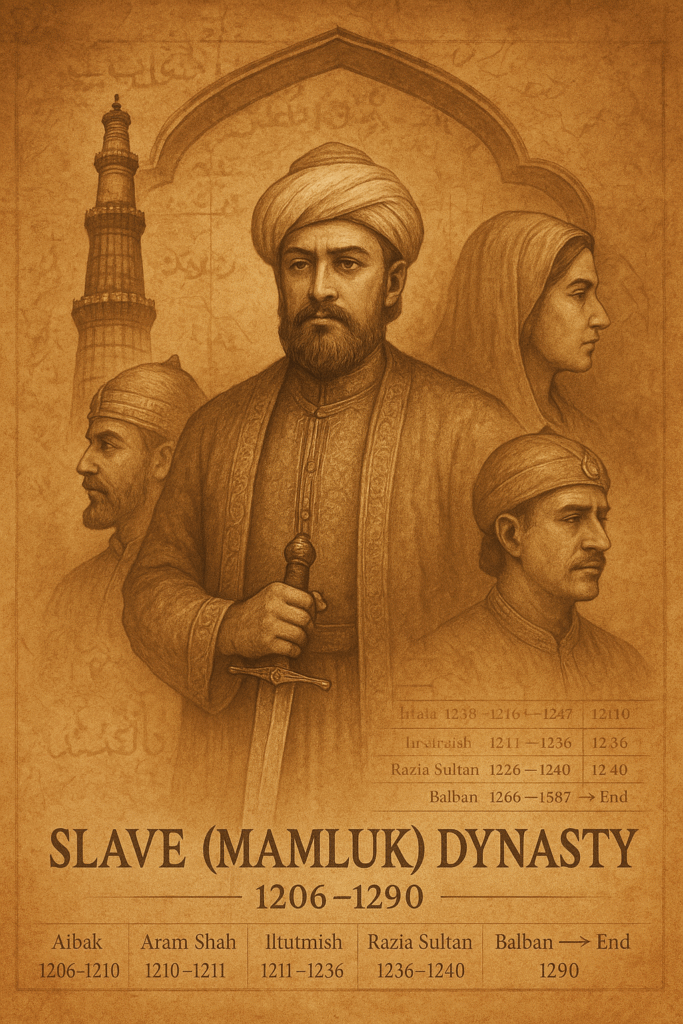
Slave Dynasty (1206–1290): Establishment, Rulers, Achievements & Legacy
The Slave Dynasty, also known as the Mamluk Dynasty, was the first ruling dynasty of the Delhi Sultanate. It was called the “Ghulam Dynasty” because many of its rulers came from a slave background. Founded by Qutbuddin Aibak, a trusted general and former slave of Muhammad Ghori, this dynasty laid a strong administrative foundation in India.
Period of the Slave Dynasty and Its Important Rulers
Qutbuddin Aibak (1206–1210)
- Established the Delhi Sultanate in 1206 AD.
- A Turkish slave freed by Muhammad Ghori and appointed as his chief commander.
- Achievements:
- Started the construction of the Qutub Minar in Delhi.
- Made Lahore his capital.
- Known as “Lakh Baksh” (giver of wealth).
- Died in a horse-riding accident in Lahore in 1210 AD.
Aram Shah (1210–1211)
- Succeeded Aibak after his death.
- His weak rule led to his removal from the throne.
- Iltutmish was chosen as the new ruler.
Iltutmish (1211–1236)
Iltutmish was the most influential ruler of the Slave Dynasty, transforming it into a stable and strong Sultanate.
- Shifted the capital from Lahore to Delhi.
- Organised and strengthened the administration.
- Achievements:
- Assumed the authoritative title of “Sultan.”
- Established the Chahalgani (Council of Forty Turkish nobles).
- Issued the silver Tanka and copper Jital coins.
- Successfully defended India from Mongol invasions.
- Completed the construction of the Qutub Minar.
- Declared his capable daughter, Razia Sultan, as his successor.

Featured Amazon Product
Premium quality item with excellent durability and top customer reviews. Great choice for daily use with reliable performance.
👉 Buy Now on AmazonRazia Sultan (1236–1240)
- India’s first and only woman Sultan.
- Known for her intelligence, leadership, and administrative skills.
- Achievements:
- Strengthened the administration.
- Became a symbol of women’s capability in leadership roles.
- Faced opposition from Turkish nobles and was killed due to rebellion.
Ghiyasuddin Balban (1266–1287)
Balban was the last great ruler of the Slave Dynasty and a skilled administrator belonging to the Chahalgani group.
- Strengthened central authority and promoted absolute monarchy.
- Achievements:
- Enforced strict discipline in the royal court.
- Promoted the concept that the Sultan held “divine power.”
- Defended the Sultanate from Mongol invasions.
- After his death, the dynasty weakened rapidly.
Kaiqubad and Kayumars (1287–1290)
- Kaiqubad, Balban’s grandson, proved to be a weak ruler.
- His ineffective rule led to the decline of the dynasty.
- In 1290, Jalaluddin Khilji overthrew the last ruler and founded the Khilji Dynasty.
Characteristics and Contributions of the Slave Dynasty
1. Administrative Foundation
The Slave Dynasty laid the basic administrative structure of the Delhi Sultanate. Strong rulers like Iltutmish and Balban consolidated the Sultan’s authority and expanded the territory.
2. Architecture and Culture
- The Qutub Minar is the most prominent architectural achievement of this era.
- Many mosques, tombs, and early Indo-Islamic structures were built.
- Islamic traditions and culture spread widely in India.
- Turkish and Indian cultural interaction increased.
3. Defence Against Mongols
Iltutmish and Balban successfully repelled Mongol invasions, ensuring stability and protection for the Sultanate.
4. Influence of Chahalgani
Iltutmish created the Chahalgani, a group of forty powerful Turkish nobles. While they supported governance initially, their growing ambition later caused political instability and rebellions.
Fall of the Slave Dynasty
- The dynasty weakened after the death of Balban.
- Khilji nobles gradually gained influence.
- In 1290, Jalaluddin Khilji ended the Slave Dynasty and established the Khilji Dynasty.
The Slave Dynasty played a crucial role in shaping medieval Indian history. It provided a solid political, cultural, and administrative foundation for the Delhi Sultanate.
Khilji Dynasty (1290–1320): Rulers, Reforms, Expansion & Legacy
The Khilji Dynasty (1290–1320) was the second ruling dynasty of the Delhi Sultanate. Formed by a new group of Turkish-origin nobles after the decline of the Slave Dynasty, the Khiljis ruled for about 30 years. Their reign is known for major military, economic, and administrative reforms that significantly shaped medieval India.
Establishment of the Khilji Dynasty
After the fall of the Slave Dynasty, Jalaluddin Firoz Khilji rose to power in 1290 AD. The primary goal of the Khilji rulers was to expand the Sultanate and strengthen the empire through political stability and administrative reforms.
Major Rulers of the Khilji Dynasty
1. Jalaluddin Firoz Khilji (1290–1296)
- Founder of the Khilji Dynasty.
- An elderly and mild-mannered ruler.
- Policies:
- Adopted peace and harmony in governance.
- Maintained a policy of co-existence with the Rajputs and local rulers.
- His lenient approach dissatisfied the Turkish nobles.
- Death: Treacherously murdered by his nephew Alauddin Khilji, who then assumed the throne.
2. Alauddin Khilji (1296–1316)
Alauddin Khilji is considered the most powerful and ambitious ruler of the Khilji Dynasty. He strengthened central authority, expanded the Sultanate, and implemented far-reaching reforms.
Major Achievements
Military Victories
- Conquered Gujarat, Ranthambore, Malwa, Chittor, Devagiri, and Warangal.
- Captured Malwa in 1305.
- Expanded the Sultanate deep into South India.
- His general Malik Kafur carried out successful campaigns as far as Madurai and the Hoysala Empire.
Facing Mongol Invasions
- Successfully repelled repeated Mongol invasions.
- Strengthened India’s north-western defences.
Economic and Market Reforms
- Introduced agricultural and market reforms to boost revenue.
- Market Control:
- Imposed strict regulations on market prices.
- Fixed prices of grains, cloth, horses, and essential commodities.
- Prohibited black marketing and profiteering.
- Revenue Reforms:
- Tax levied based on land produce.
- Introduced a system of direct tax collection from farmers.
Administrative Reforms
- Established a centralized administrative structure.
- Maintained strict supervision over officials and officers.
Social Policies
- Strict measures to suppress rebellious nobles and chieftains.
- Banned the use of alcohol and intoxicants.
Religious Policy
- Not a fanatic; maintained separation between religion and politics.
- Adopted a relatively tolerant approach in administration.
Death: Alauddin Khilji died in 1316 AD.
3. Qutubuddin Mubarak Shah (1316–1320)

Top Rated Amazon Product
Premium quality item with excellent customer reviews and durability. Great choice for everyday use with reliable performance.
👉 Buy Now on Amazon- Son and successor of Alauddin Khilji.
- Ended the strict policies implemented by his father.
- Fell into luxury and intoxication, which weakened his rule.
- Assassinated by his Hindu general Khusro Khan.
Characteristics of the Khilji Dynasty
Expansion of the Empire
- The Khilji rulers extended the Delhi Sultanate into South India.
- Malik Kafur’s campaigns brought powerful southern kingdoms like the Pandyas and Hoysalas under the Sultanate’s influence.
Resistance to Mongol Invasions
Alauddin Khilji successfully thwarted repeated Mongol invasions, strengthening the northern frontiers of the Sultanate.
Economic and Administrative Reforms
- Price control and revenue reforms strengthened the Sultanate financially.
- Although taxes were burdensome for farmers and traders, they increased the state’s income substantially.
Religious and Social Attitudes
- Promoted religious tolerance to some extent.
- Included both Hindus and Muslims in administration.
- However, Alauddin also attacked several Rajput kingdoms and temples.
Science and Architecture
- Architecture flourished during Alauddin’s reign.
- Built the new capital named Siri.
- Constructed the famous Alai Darwaza near the Qutub Minar complex.
Fall of the Khilji Dynasty
- The dynasty weakened after Alauddin’s death.
- Qutubuddin Mubarak Shah proved ineffective as a ruler.
- Khusro Khan killed Mubarak Shah, but his own rule was short-lived.
- In 1320 AD, Ghiyasuddin Tughlaq defeated Khusro Khan and established the Tughlaq Dynasty.
Importance of the Khilji Dynasty
The Khilji Dynasty transformed the Delhi Sultanate into a strong and centralized empire. The reign of Alauddin Khilji represents the peak of Sultanate power in medieval India. His reforms and military conquests are considered important milestones in Indian history.
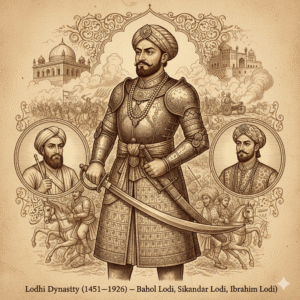
Lodhi Dynasty (1451–1526): Rulers, Achievements & Historical Significance
The Lodhi Dynasty (1451–1526) was the last ruling dynasty of the Delhi Sultanate. Founded in 1451 AD by Bahlol Lodi, the dynasty was of Afghan origin and marked the first major contribution of Afghans to the Delhi Sultanate. The Lodhis ruled for about 75 years, and their decline ended with the First Battle of Panipat (1526), after which Babur established the Mughal Empire.
Establishment of the Lodhi Dynasty
The Lodhi Dynasty began when the last ruler of the Sayyid Dynasty, Alam Shah, voluntarily handed over the throne of Delhi to Bahlol Lodi in 1451 AD. Bahlol Lodi was an efficient warrior and administrator who brought political stability to the Sultanate.
Major Rulers of the Lodhi Dynasty
1. Bahlol Lodi (1451–1489)
Bahlol Lodi was the founder of the Lodhi Dynasty. Of Afghan origin, he previously served as the governor of Punjab.
Major Achievements
- Reorganized the disintegrated regions of the Delhi Sultanate.
- Recaptured breakaway provinces such as Jaunpur.
- Maintained balance and unity among Afghan chieftains.
- Attempted to reunite the Delhi Sultanate.
Policies
- Called himself “first among equals” instead of “Sultan.”
- Lived a simple life and stayed connected with his subjects and nobles.
Death
Bahlol Lodi died in 1489 AD. His son Sikandar Lodi succeeded him.
2. Sikandar Lodi (1489–1517)
The second ruler of the Lodhi Dynasty, Sikandar Lodi was an efficient administrator and ambitious ruler.
Major Achievements
Capital Transfer
- Shifted the capital from Delhi to Agra.
- Developed Agra into an important administrative and cultural center.
Administrative Reforms
- Promoted trade and simplified the tax system.
- Organized land tax and revenue collection more efficiently.
- Strengthened control over Bihar, Bengal, and Jaunpur.
Religious Policies
- A staunch Muslim.
- Ordered the destruction of Hindu temples and idols.
- Strictly enforced the Jaziya tax.
Literature and Art
- Patronized Persian and early Urdu literature.
- The Urdu language developed significantly during his rule.
Death
Sikandar Lodi died in 1517 AD. His son Ibrahim Lodi became the next ruler.
3. Ibrahim Lodi (1517–1526)
Ibrahim Lodi was the last ruler of the Lodhi Dynasty. He was the grandson of Bahlol Lodi and son of Sikandar Lodi.
Major Events
- His strict and dictatorial nature created tension among Afghan nobles.
- Faced multiple rebellions by Afghan chieftains.
- Suppressed his uncle Alauddin Lodi’s rebellion.
- Due to dissatisfaction with Ibrahim Lodi, many nobles invited Babur to invade India.
First Battle of Panipat (1526)
- Fought on 21 April 1526 between Babur and Ibrahim Lodi.
- Babur used cannons and modern warfare techniques.
- Ibrahim Lodi fought using traditional warfare methods.
- Ibrahim Lodi was killed in the battle, bringing an end to the Lodhi Dynasty.
Top Selling Amazon Product
Premium quality, reliable and well-reviewed product — perfect for everyday use with great value for money.
👉 Buy Now on AmazonCharacteristics of the Lodhi Dynasty
Afghan Rule
- First Afghan dynasty to rule Delhi.
- Followed a policy of co-existence with Afghan nobles.
Administrative Reforms
- Strengthened the tax and revenue system.
- Shifted the capital to Agra under Sikandar Lodi, developing it as a major city.
Religious and Social Policies
- Introduced stricter religious policies.
- Imposed Jaziya tax on Hindus.
- Destroyed temples during conflicts.
Contraction of the Empire
During the rule of Ibrahim Lodi, rebellions increased, weakening the empire and causing fragmentation.
Literature and Culture
- Persian and Urdu literature flourished.
- Patronage of poets and scholars increased under Sikandar Lodi.
Fall of the Lodhi Dynasty
- Lack of trust between the ruler and Afghan nobility during Ibrahim Lodi’s reign.
- Babur’s invasion exposed the weaknesses of the Lodhi administration.
- The First Battle of Panipat ended the Lodhi Dynasty and paved the way for the establishment of the Mughal Empire.
Importance of the Lodhi Dynasty
The Lodhi Dynasty attempted to revive and stabilize the Delhi Sultanate. The political and cultural developments during their rule laid foundations for future changes in North India. The fall of the Lodhi Dynasty is a major turning point in Indian history, marking the end of the medieval era and the beginning of Mughal rule.
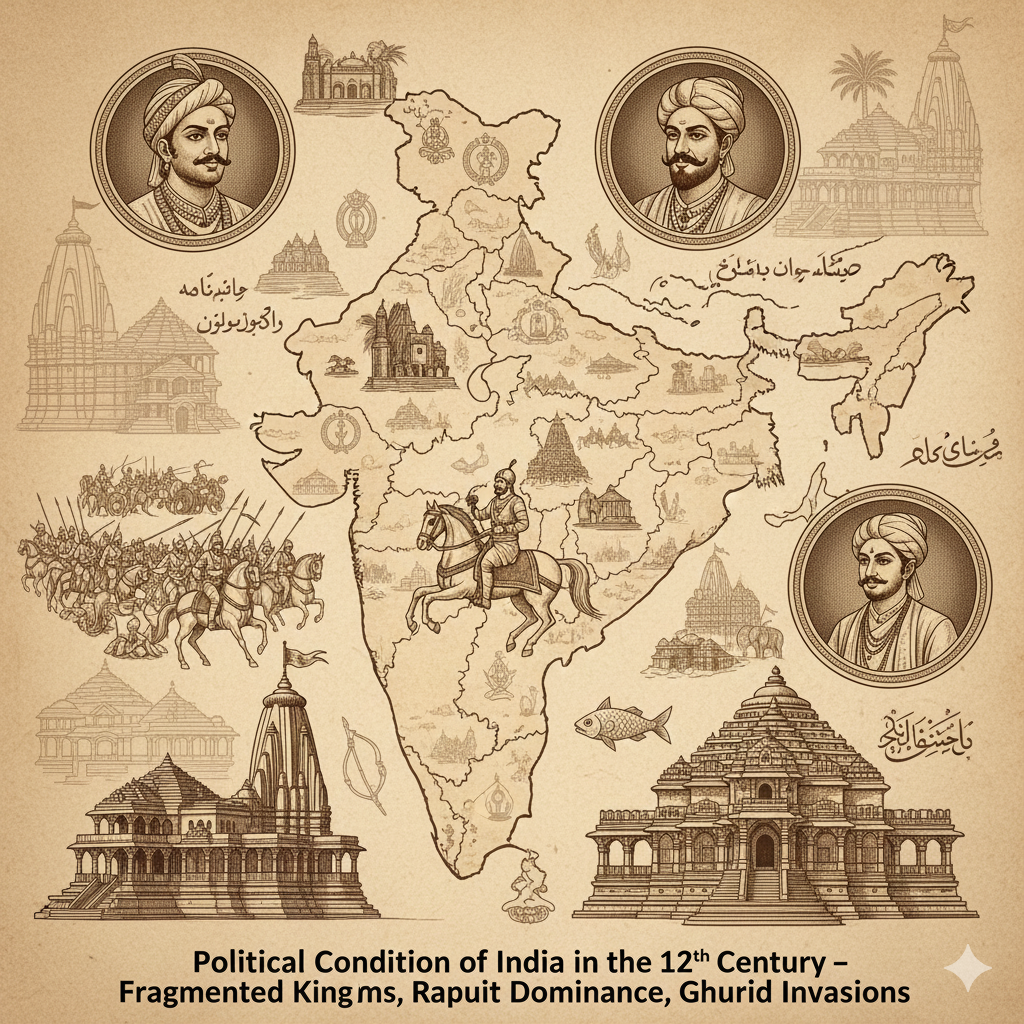
Political Condition of India in the 12th Century
The 12th century was a crucial era in Indian history when the political landscape was highly decentralised and fragmented into several regional powers. There was no all-India empire or strong central authority. Instead, numerous small and large kingdoms frequently clashed with one another. This period also witnessed the growing influence of Islamic invasions and the dominance of Rajput kingdoms, along with the arrival of Turks who began establishing control over North India.
The Situation in North India
Influence of Ghurids and Ghaznavids
- Ghaznavid Dynasty (10th–12th Century): Mahmud Ghaznavi invaded India several times between 1000–1027 AD, mainly for plunder and wealth.
- Ghurid Empire: In the late 12th century, the Ghurids expanded their power in India after defeating the Ghaznavids.
- Muhammad Ghori fought two Battles of Tarain (1191 and 1192) against Prithviraj Chauhan.
- Prithviraj Chauhan’s defeat in the Second Battle of Tarain (1192) laid the foundation of Turkish rule in Delhi and northern India.
Rajput Empire
Rajput clans were dominant in North India but were not united. Internal rivalries weakened their collective strength.
Major Rajput States
- Chauhan Dynasty (Ajmer & Delhi): Prithviraj Chauhan
- Parmar Dynasty (Malwa): King Bhoja
- Chandela Dynasty (Bundelkhand): Builders of the Khajuraho temples
- Gahadavala Dynasty (Kannauj): Jaichand
Effects of Foreign Invasions
- Islamic rule in India began with the invasions of the Ghurids.
- The Second Battle of Tarain (1192) became a decisive turning point, leading to the establishment of the Delhi Sultanate.
The Situation in South India
Chola Empire
- The Cholas, dominant in Tamil Nadu, began to weaken during the 12th century.
- They had earlier expanded influence to Sri Lanka and Southeast Asia.
Hoysala Empire
- In Karnataka, the Hoysalas rose to prominence.
- They emerged as successors to the declining Cholas and Chalukyas.
- Their rule is famous for spectacular temples at Belur and Halebidu.
Kakatiya Empire
- In present-day Andhra Pradesh, the Kakatiya dynasty was rising in power.
- Warangal served as their capital.
Pandya and Chera Dynasties
- The Pandyas dominated Tamil Nadu.
- The Cheras ruled the Kerala region.
- These kingdoms grew independent after the decline of the Cholas.
Situation in Eastern and Western India
Sen Dynasty (Bengal)
- The Sen Dynasty ruled Bengal during this period.
- Lakshman Sen was its most famous ruler.
- Bengal emerged as a centre of cultural and literary growth.
Gurjara-Pratihara Region (Western India)
- The Pratihara Empire had weakened significantly by the 12th century.
- The region fragmented into smaller independent states.
Solanki Dynasty (Gujarat)
- The Solanki rulers governed Gujarat.
- They built impressive architectural monuments, including the Sun Temple at Modhera.

Top Amazon Product
Premium quality and highly rated product with excellent performance and reliability. Great choice for daily use and long-term satisfaction.
👉 Buy Now on AmazonPolitical Weakness of India
The most defining feature of 12th-century India was its severe political fragmentation.
- Internal conflicts among Rajput states made India vulnerable to external invasions.
- No powerful Indian kingdom was able to resist the Ghori or Ghaznavid forces effectively.
- The feudal system and weak central authority made it easy for foreign powers to invade and capture northern India.
Cultural and Social Condition
Religious and Cultural Advancement
- Temple architecture flourished during this era.
- Major monuments such as Khajuraho, Konark, and Modhera were significant achievements.
- The Bhakti movement began taking root.
Financial Condition
- Agriculture, trade, and handicrafts were the foundation of the economy.
- South India was a major hub for maritime trade.
Society
- Society was deeply caste-based.
- Brahmins and rulers held the highest social status.
Conclusion
The 12th century marked a politically weak and fragmented India. The defeat of Rajput kingdoms and the invasions of the Ghurids opened the way for a new political era. With the Second Battle of Tarain in 1192 AD, the Delhi Sultanate was established, beginning the era of Islamic rule in India.
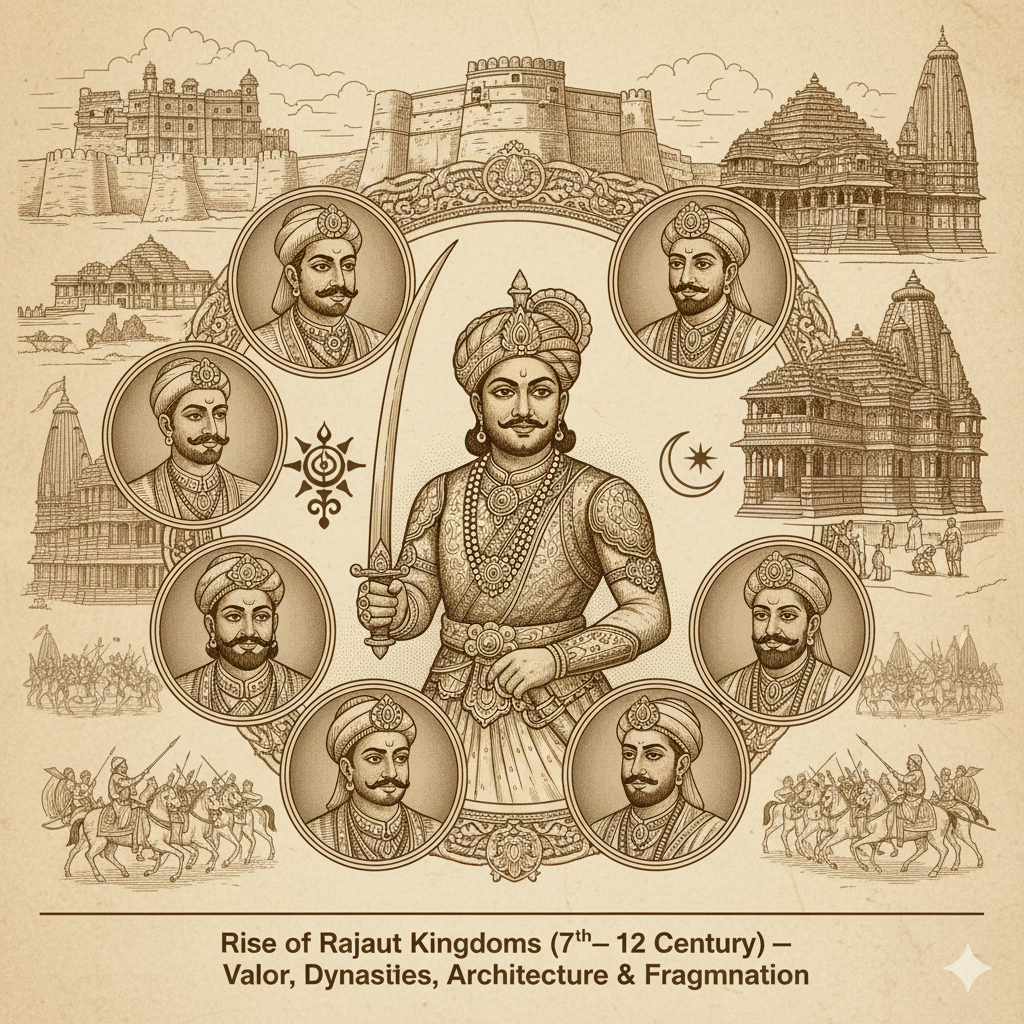
Rise of Rajput Kingdoms
The period between the 7th and 12th centuries was a significant era in Indian history. During this time, Rajput kingdoms emerged as powerful political forces across northern, western, and central India. Known for their valor, military strength, and architectural achievements, the Rajputs left a lasting impact on Indian culture. However, internal conflicts and political fragmentation made them vulnerable to foreign invasions.
How Did the Rajputs Emerge?
1. Dynastic Origin
The term “Rajput” means “son of a king” or “prince.” Three major theories explain their origin:
- Agnikula (Fire-Pit) Theory: Rajputs originated from the sacred fire-pit at Mount Abu, as mentioned in the Prithviraj Raso. The four Agnikula clans were:
- Parmaras
- Pratiharas
- Chauhans
- Solankis
- Surya and Chandra Vansha: Many Rajput clans traced descent from the Sun (Suryavanshi) or Moon (Chandravanshi).
- Foreign Origin Theory: Some historians believe that Huns, Shakas, and Kushans assimilated into Indian society and were later identified as Rajputs.
2. Decline of the Gupta Empire
After the fall of the Gupta Empire (5th–6th centuries), political fragmentation spread across India. Regional powers rose, and the Rajputs emerged as dominant rulers in many regions.
3. Rise of Regional Leadership
Rajputs established local leadership in the Gangetic plains, Rajasthan, and Central India, defending their territories from Huns, Turks, and Ghaznavids.
4. Feudal System
The Rajputs rose through the feudal structure, where local chiefs gradually became independent and formed powerful Rajput dynasties.
Dominance of Rajputs
Rajput states ruled over vast regions. Major Rajput dynasties included:
Chauhan Dynasty (Ajmer & Delhi)
- Major Ruler: Prithviraj Chauhan
- Ruled Ajmer and Delhi
- Fought the Battles of Tarain (1191, 1192) against Muhammad Ghori
Parmar Dynasty (Malwa)
- Major Ruler: Raja Bhoj
- Capital: Dhar
- Patron of education, art, and architecture
Gahadavala Dynasty (Kannauj)
- Major Ruler: Jaichand
- His defeat accelerated the rise of the Delhi Sultanate
Solanki Dynasty (Gujarat)
- Capital: Anahilwara (Patan)
- Built the famous Sun Temple at Modhera
Chandela Dynasty (Bundelkhand)
- Major Rulers: Yashovarman, Dhang
- Built the grand temples of Khajuraho
Rathore Dynasty (Marwar)
- Ruled Marwar in Rajasthan
- Constructed Mehrangarh Fort
Sisodia Dynasty (Mewar)
- Major Ruler: Bappa Rawal
- Known for bravery and pride
- Chittor Fort symbolized their strength
Characteristics of the Rajputs
1. Military Strength and Valour
- Rajput rulers were expert warriors.
- Focused on fort construction and martial traditions.
2. Social Structure
- Feudal system dominated society.
- Clan pride and lineage were highly valued.
3. Religious and Cultural Contribution
- Revival of Hinduism.
- Built magnificent temples: Khajuraho, Dilwara, Modhera, Konark.
- Patronage of Sanskrit, regional literature, and art.
4. Regional Politics
Rajput kingdoms frequently fought among themselves. This internal rivalry prevented the formation of a strong united empire and enabled foreign invasions (Ghaznavids, Ghurids).
Decline of the Rajputs
1. Mutual Conflict and Lack of Unity
- Internal wars weakened the Rajputs.
- The Battles of Tarain (1192) and Chandawar (1194) revealed their vulnerabilities.
2. Foreign Invasions
- Ghaznavid and Ghurid invasions weakened Rajput power.
3. Feudal System
- Local feudal lords became powerful and independent.
- The central authority weakened.
4. Religious Rigidity
- Focus on temple building and rituals led to neglect of military and administrative reforms.
Conclusion
The rise of Rajput states was a glorious period marked by cultural and architectural achievements. However, political disunity and inability to resist foreign invasions weakened their power. By the late 12th century, Ghurid invasions ended Rajput dominance and paved the way for the Delhi Sultanate.

Featured Amazon Product
High quality and value-for-money product with excellent user satisfaction. Ideal for everyday use and reliable performance.
👉 Buy Now on AmazonEffect of Political Fragmentation
Political fragmentation had far-reaching and multifaceted effects on India. This was most evident after the fall of the Gupta Empire and during the internal conflicts of the Rajputs in the 12th century. Decentralization and the rise of regional powers weakened India internally and produced major social, economic, and political consequences.
Effects of Political Fragmentation
1. Paved the Way for Foreign Invasions
- Absence of strong central power.
- Internal conflicts made India vulnerable to Ghaznavids, Ghurids, Turks, and later Mughals.
- Mahmud Ghaznavi invaded India 17 times (11th century).
- Muhammad Ghori’s victory in the Second Battle of Tarain (1192) enabled Turkish rule.
2. Social and Religious Crisis
- Temples, monasteries, and cultural centers were destroyed.
- Sites like Somnath, Kashi, and Nalanda suffered heavy damage.
- Increased religious tension and insecurity.
3. Financial Loss
- Repeated plunder damaged India’s wealth and urban economy.
- Trade routes became unsafe.
- Large-scale wealth was taken out of India.
4. Expansion of the Feudal System
- Regional chieftains became independent.
- Feudal lords challenged the central authority.
- Administrative structures weakened.
5. Cultural Contribution Despite Fragmentation
- Regional kingdoms promoted art, literature, and architecture.
- Cholas built grand temples in South India.
- Rajputs developed forts and temples like Khajuraho, Dilwara, and Chittor.
- Local languages flourished.
6. Internal Rebellion and Conflict
- Constant wars among regional states weakened India.
- Rajput internecine warfare is a major example.
7. Spread of Foreign Cultural Influences
- Islamic culture, Persian art, and Turkish administration entered India.
- New administrative systems and legal structures emerged.
Particular Examples of Political Fragmentation
1. Rajput Conflicts
- Rajputs failed to unite against foreign invaders.
- Example: Jaichand did not support Prithviraj in the Battles of Tarain.
2. Post-Gupta Period
- After the Guptas, regional states like Maukharis, Chalukyas, and Vakatakas emerged.
- They never united against external threats.
3. Conflicts in South India
- Cholas, Chalukyas, Pallavas, and Pandyas competed for dominance.
- Although not invaded by Ghaznavids or Ghurids, their internal conflicts hindered growth.
Conclusion
Political fragmentation weakened India and made it vulnerable to invasions. It marked the decline of unified governance and laid the foundation for major social and economic changes. Although art and culture flourished, India’s strategic and political power diminished. Eventually, the Delhi Sultanate and later the Mughal Empire ended this fragmentation and established stronger central authority.
Situation in Central Asia in the 11th and 12th Centuries
The 11th and 12th centuries were a transformative period in Central Asia. Major political, cultural, and military shifts reshaped the region, influencing not only Asia but also Europe and the Indian subcontinent. Central Asia witnessed the rise of powerful empires, tribal confederations, and large-scale invasions that played a decisive role in shaping medieval history.
Political Situation of Central Asia
1. Turkish Invasions and Power Struggles
Turkish tribes played a dominant role in Central Asia during this period. Their invasions brought significant political and cultural changes across Asia, including India.
Ghaznavid Empire (971–1186)
- Mahmud of Ghazni invaded the Indian subcontinent multiple times between 1000–1027 AD.
- He ruled from Ghazni (present-day Afghanistan) and attacked regions such as Punjab and Kannauj.
- His primary objective was plunder, enriching Ghazni with wealth taken from Indian temples and cities.
- These invasions left a lasting impact on early medieval Indian history.
Ghurid Empire (879–1215)
- Originated from the Ghor region of Afghanistan.
- Became powerful after defeating the Ghaznavids.
- Muhammad Ghori’s invasions in India during the 12th century laid the foundation of the Delhi Sultanate.
- Ghurids established political and military influence particularly in North India and Delhi.
2. Empires and Tribal Clans
- Samanid Empire: Dominant in the 9th–10th centuries, but declined due to Ghaznavid and Ghurid invasions.
- Karakhanid Empire: Controlled regions like Samarkand and Bukhara; promoted Islamisation.
- Turkish Clans: Seljuks, Kimaks, and Qarakhan Turks were influential.
- Seljuk Turks: Established a large empire across Central Asia, Iran, and Iraq in the late 11th century. Promoted Islam and introduced administrative reforms.
3. Spread of Islam
Islam spread rapidly across Central Asia as Turkish tribes adopted the religion. Seljuk Turks strengthened Islamic culture and governance across Central Asia, Iran, and Iraq.
4. Rise of the Mongols (Late 12th Century)
- The foundation of the Mongol Empire began in the late 12th century.
- Genghis Khan expanded the empire across Central Asia, China, Europe, and Western Asia.
- Mongol invasions caused widespread destruction and disrupted existing political structures.
Cultural and Economic Situation in Central Asia
Cultural and Scientific Advancement
- Islamic culture flourished in cities like Samarkand, Bukhara, and Baghdad.
- Central Asia became home to great scholars such as:
- Al-Biruni
- Ibn Sina (Avicenna)
- Omar Khayyam
- These cities became centers of Islamic science, art, and architecture.
Trade and Economy
- Central Asia played a key role in the Silk Route, linking China, India, and Europe.
- Bukhara and Samarkand prospered due to trade, crafts, and urban development.
Conclusion
The 11th–12th centuries witnessed sweeping changes in Central Asia that influenced many regions, including India. The Ghaznavid and Ghurid empires brought Islamic rule to the subcontinent, while the rise of Mongols reshaped the region’s political, cultural, and economic landscape.
Invasion of Muhammad Ghori
Muhammad Ghori’s invasions marked a turning point in Indian history. His campaigns led to the establishment of the Delhi Sultanate and introduced new political, cultural, and administrative systems.
History and Early Life
- Born in 1162 in the Ghor region of Afghanistan.
- Belonged to the ruling family of the Ghurid Empire.
- He strengthened the Ghurid Empire through military skill and campaigns.
- Led battles against the Khwarazm Empire and later focused on expanding into India.
Muhammad Ghori’s Invasions of India
1. Early Invasions (1175–1186)
- Began attacks on Punjab and North-Western India.
- Captured Lahore in 1175.
- Expanded control over Punjab, North India, and Kashmir.
2. First Battle of Tarain (1191)
- Fought between Muhammad Ghori and Prithviraj Chauhan.
- Ghori was defeated and forced to retreat.
3. Second Battle of Tarain (1192)
- Ghori returned with superior strategy and Turkish cavalry.
- Defeated Prithviraj Chauhan decisively.
- Captured Delhi, paving the way for Islamic rule in India.
4. Capture of Delhi and Expansion
- After Tarain, Ghori took control of Delhi.
- Conquered Kannauj in 1194.
- Expanded his influence across the Ganga–Yamuna plains.
5. Death of Muhammad Ghori (1206)
- Murdered during an expedition near the Ghor region.
- His empire fragmented due to weak successors.
Effects of Ghori’s Invasions
1. Establishment of the Delhi Sultanate
- Qutbuddin Aibak, Ghori’s trusted slave-general, became the ruler of Delhi.
- Laid the foundation of Islamic rule in India.
2. Decline of Rajput Power
- Rajputs suffered heavy defeats in Tarain and Chandawar.
- Islamic culture and administration began to spread in India.
3. Urbanisation and State Formation
- New administrative structures developed in Delhi and surrounding areas.
- Introduction of Islamic architecture and learning.
4. Cultural Impact
- Temples and religious structures were destroyed in some regions.
- Islamic traditions entered Indian society, creating both harmony and conflict.
Fall of the Ghori Empire & Rise of the Delhi Sultanate
The decline of the Ghori Empire and the establishment of the Delhi Sultanate marked a major shift in Indian political history.
Fall of the Ghori Empire
1. Death of Muhammad Ghori (1206)
- His death caused political instability.
- His territories were divided among slave-generals who declared independence.
2. Succession Crisis
- Weak successors failed to maintain Ghori’s empire.
- Power struggles intensified among regional commanders.
Rise of the Delhi Sultanate
1. Rule of Qutbuddin Aibak (1206–1210)
- A former slave and trusted general of Ghori.
- Declared Sultan of Delhi.
- Began construction of the Qutub Minar.
- Established a stable administration.
2. Expansion under Iltutmish (1211–1236)
- Strengthened and expanded the Sultanate.
- Laid foundations for future dynasties like the Tughlaqs.
Impact of the Delhi Sultanate
- Introduced Islamic administration and judicial systems.
- Brought economic reforms and improved trade.
- Reshaped social, cultural, and political structures in India.
Conclusion
The fall of the Ghori Empire and the rise of the Delhi Sultanate marked the beginning of Islamic rule in India. It reshaped political structures, influenced culture and religion, and defined the course of medieval Indian history.
References

Popular Amazon Product
Excellent quality product with reliable performance and great value for money. Loved by customers for everyday use and durability.
👉 Buy Now on Amazon- Jackson, Peter. The Delhi Sultanate: A Political and Military History. Cambridge University Press, 2003.
- Majumdar, R.C. History of Medieval India. Bharatiya Vidya Bhavan, 2006.
- Srivastava, A.L. The Sultanate of Delhi, 711–1526 A.D. Shiva Lal Agarwala & Co., 1963.
- Chandra, Satish. Medieval India: From Sultanat to the Mughals. Har-Anand Publications, 2007.
- Habib, Irfan. Medieval India: The Study of a Civilization. National Book Trust, 2006.
- Eaton, Richard M. The Rise of Islam and the Bengal Frontier, 1204–1760. University of California Press,2000.
- Eraly, Abraham. The Mughal Throne. Penguin Books India, 2010.
- Encyclopaedia Britannica – “Delhi Sultanate”.
- IndiaNetZone – “History of Delhi Sultanate”.