

Geopolitical Earthquake: Is the Dollar Counting Its Final Days?
Imagine a world where buying oil does not require US dollars, where Washington has no control over international trade, and where the fear of the 'SWIFT' banking system cannot shake a nation's sovereignty. A decade ago, this idea seemed like part of a fictional novel. But in 2026, this is no longer fiction, but taking the form of a geopolitical reality.
For decades, the global economy had one unwritten rule—"Dollar is King." Whether you were sipping coffee in Mumbai or manufacturing electronics in Shanghai, every financial thread in the world was ultimately tied to the US Federal Reserve. But history bears witness that no empire lasts forever. Today, we are seeing cracks in a foundation that was once considered impenetrable.
2022: The Year That Changed Everything
The real beginning of this shift—or the 'trigger point'—occurred on February 24, 2022. When the Russia-Ukraine war erupted, Western nations imposed the harshest economic sanctions in modern history against Russia. The US and its allies not only expelled Russia from the SWIFT system but also froze (seized) over $300 billion of Russian foreign exchange assets.
"The Weaponization of Finance might have been a strategic victory for Washington, but it sent a terrifying message to the entire world: 'If your assets are in dollars, they are not yours; they are at America's mercy.'"
This event woke up the Global South. Countries like China, India, Brazil, and Saudi Arabia realized that excessive reliance on the dollar is no longer an economic convenience, but has become a national security threat.
The End of the Petrodollar and the Rise of the Yuan
Where there is fear, alternatives are born. Today, BRICS+ (Brazil, Russia, India, China, South Africa, and new members) is no longer just a discussion forum, but has become an economic bloc challenging the G7. During 2023-2024, what we witnessed was unprecedented:
- China and Saudi Arabia using the Yuan (Petroyuan) in oil trade.
- India promoting trade in Rupees (Local Currency Settlement) with the UAE and Russia.
- Record-breaking Gold purchases by central banks, which is the biggest sign of moving away from the dollar.
The agreement made between the US and Saudi Arabia in 1974 gave birth to the 'Petrodollar', ensuring global demand for the dollar. Today, that monopoly is breaking. When the world's largest energy buyer (China) and the largest energy seller (Russia/Saudi Arabia) shake hands bypassing the dollar, it is not just a trade deal; it is a signal of a shift in the global balance of power.
📘 Dive into Cold War history — explore USA vs Soviet Union: The Cold War for an in-depth look at this pivotal global conflict.

What is De-dollarization?
Simple Definition: De-dollarization is the process where countries reduce their reliance on the US Dollar (USD) in international trade and finance. The main objective is to end the dollar's monopoly and promote alternative mediums like local currencies or Gold.
To understand this in simple terms: If India buys oil from Russia and pays in 'Rupees' or 'Rubles' instead of 'Dollars', this is called de-dollarization. It is an attempt to remove the dollar from its role as the global 'Middleman'.
History: How Did the Dollar Become 'King'?
Today, the dollar is the world's most powerful currency, but it wasn't always so. The story of the dollar's dominance begins from the rubble of **World War II**.
By 1944, the war had completely destroyed the economies of Europe and Asia. At that time, only America was the country holding massive amounts of Gold and a stable economy. The world needed a trustworthy system to rebuild, and this is where the 'Bretton Woods Agreement' came into existence.
1944: Bretton Woods and the Start of US Dominance
Delegates from 44 nations met in New Hampshire, USA, and set new rules for the global economy. Three major decisions were made here that immortalized the dollar:
- The Dollar was pegged to Gold: It was decided that $35 would equal 1 ounce of gold. Meaning, the dollar was considered as safe as gold ("Good as Gold").
- Other currencies were pegged to the Dollar: The value of the world's other currencies began to be determined based on the dollar.
- Birth of Global Institutions: Two massive institutions were created to run and monitor this system:
1. International Monetary Fund (IMF)
2. World Bank
The headquarters of these institutions were placed in Washington D.C., ensuring America's Veto Power and maximum influence within them.
The Role of the Federal Reserve
The focal point of this entire system is America's central bank—The Federal Reserve (The Fed). Global trade happens in dollars, but the right to print dollars belongs only to the Federal Reserve.
This is also the main reason for de-dollarization. When the Federal Reserve raises interest rates in America, capital starts flowing back to the US from countries like India or Brazil, weakening their currencies. The world is now tired of the fact that the remote control of their economy is in America's hands.
📊 Want a deeper economic perspective? Explore Global Inflation and Its Impact on Developing Countries for insights on price rise, purchasing power and GDP effects.
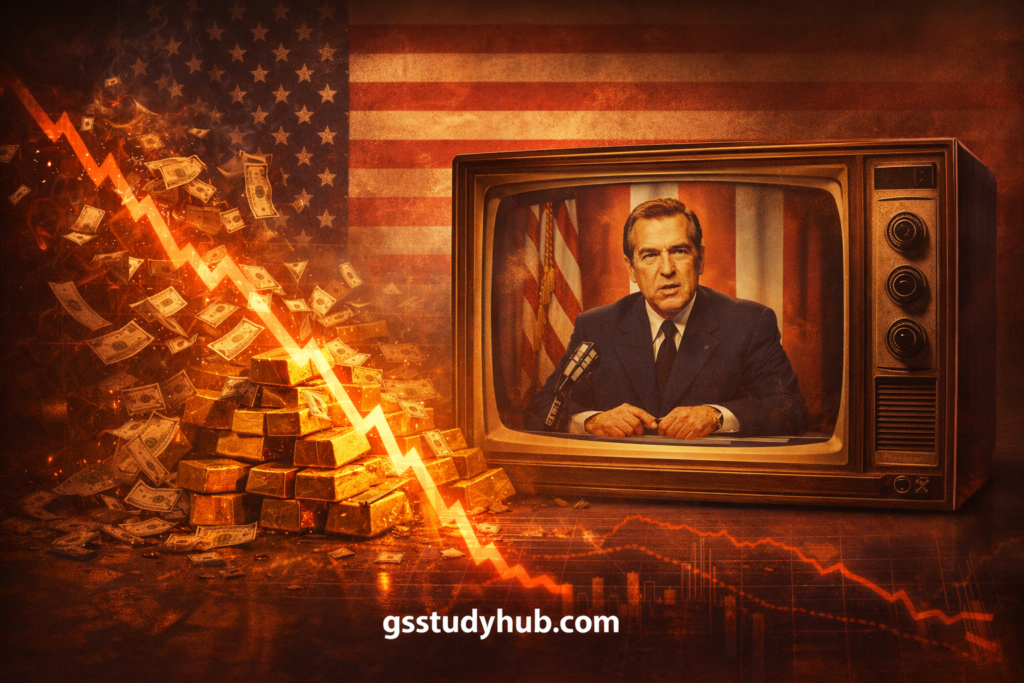
How Did the Dollar Become the World's 'Economic Dictator'? (How Dollar Became King)
The dollar's dominance was not a coincidence; it was the result of carefully crafted strategies and geopolitical deals. The dollar we see today gained its power in three major phases.
Phase 1: The Bretton Woods Agreement (Gold Standard)
As we discussed earlier, after World War II, the US held 80% of the world's gold. Under the Bretton Woods agreement, the world accepted the dollar as its reserve currency because the dollar was "Good as Gold."
Any country could return its dollars to the US and demand gold in exchange. This gave the world confidence in the dollar.
The Big Shock: 'Nixon Shock' and the End of Gold
When US gold reserves started depleting, US President Richard Nixon went on TV on August 15, 1971, and made a historic announcement: "The United States will no longer exchange dollars for gold."
Suddenly, the dollar was just a piece of paper. It had no 'backing'. The value of the dollar began to plummet globally, and it seemed the dollar's empire would collapse. America needed a new plan.
The Masterstroke: The Petrodollar System
This was the smartest geopolitical deal in modern history. In 1974, the US made a secret agreement with Saudi Arabia (the largest oil producer).
- Condition 1: The US would provide military security and weapons to Saudi Arabia.
- Condition 2: In return, Saudi Arabia would sell its oil exclusively in US Dollars.
Since every country needs oil (Energy), every country was forced to buy dollars to buy oil. This created "Artificial Demand" for the dollar.
Today's Situation: Global Trade Invoicing (Network Effect)
Even today, approximately 80% of global trade is invoiced (billed) in dollars, even if the US is not involved.
For example, if Vietnam buys coffee from Brazil, they do not use their local currencies (Dong or Real). They use dollars.
Why? (Network Effect): Because the dollar is the most 'Liquid'. It is easy to sell and buy. Everyone accepts it because they know everyone else will accept it too. Breaking this 'habit' is the biggest challenge of de-dollarization.
To understand NATO’s evolving role and its implications beyond Europe, read our detailed overview NATO Strategy in Eastern Europe & Its Global Impact, covering key policy shifts and worldwide geopolitical effects.

Main Reasons Behind De-dollarization: Why is Trust Breaking?
If the dollar is so powerful, why is the world suddenly running away from it? The answer lies not in economics, but in Geopolitics. The biggest reason is—"The Weaponization of Finance."
1. The Fear of US Sanctions
The US has started using the dollar not just for trade, but to enforce its foreign policy. If a country does not agree with America, it gets locked out of the dollar system (SWIFT). This is referred to as the "Financial Nuclear Bomb."
What happened after the Russia-Ukraine war in 2022 woke up central banks across the world. Let's see the impact on Russia and China:
What Happened to Russia?
Within days of the war starting, the US and EU froze (seized) over $300 Billion (approx 25 Lakh Crore INR) of Russia's foreign exchange reserves.
The Message: Russia earned this money by selling oil, but because it was held in Western banks in dollars and euros, it vanished in an instant. This proved that "Money held in dollars is not truly yours."
Why is China Scared?
China observed the Russian situation very carefully. China knows that if it invades Taiwan tomorrow, the US will do the exact same thing to them.
China holds the world's largest forex reserves ($3 Trillion+). To protect its assets from seizure, China has now rapidly started:
- Selling US Treasury Bonds.
- Buying massive amounts of Gold.
- Developing its own payment system (CIPS).
Not just Russia and China, but the Global South (Brazil, South Africa, Saudi Arabia) is now asking: "If America can do this to Russia, they can do it to us tomorrow." This fear is acting as fuel for the fire of de-dollarization.
🌏 Want to understand shifting global power centers? Check out BRICS Expansion and the Changing World Order – Impact & Insight for comprehensive coverage of BRICS’ evolving role.
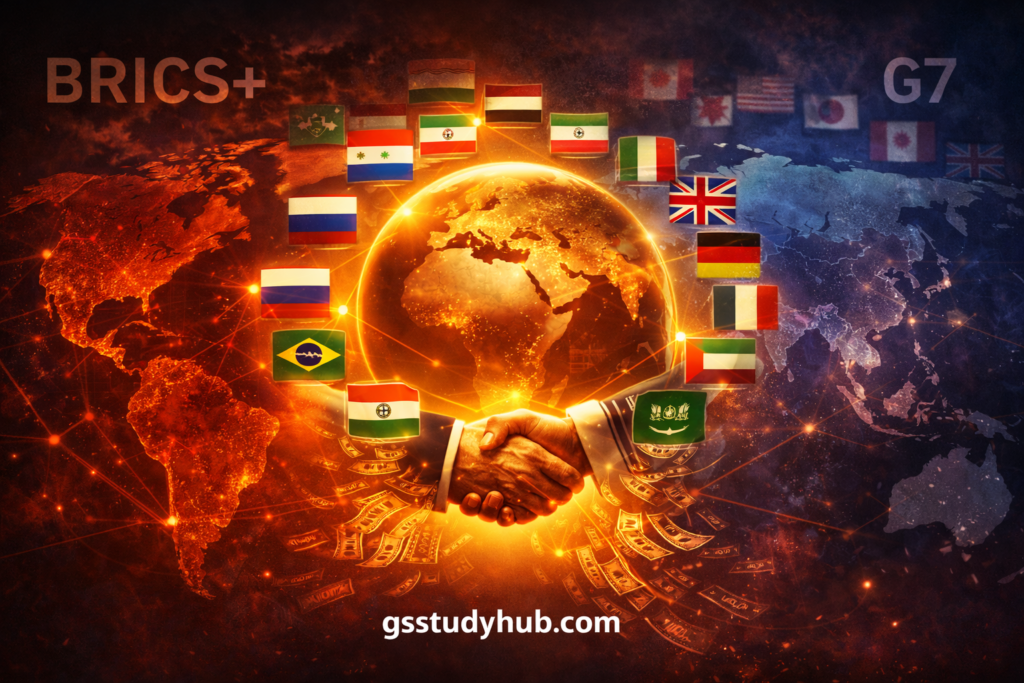
2. The Rise of BRICS: A Direct Challenge to the G7
For a long time, the rules of the global economy were written by the 'G7' (USA, UK, France, Germany, Japan, Italy, Canada). But now, the equations have changed.
BRICS (Brazil, Russia, India, China, South Africa) is no longer just a discussion forum; it is an economic powerhouse. And now, with the addition of Egypt, Ethiopia, Iran, Saudi Arabia, and the UAE, it has become 'BRICS+', controlling a massive share of the world's oil production.
| Group | Global GDP Share (2023-24) | Population |
|---|---|---|
| G7 (Western Nations) | Approx 29.9% | Less than 10% |
| BRICS+ (Emerging Nations) | Approx 37% (Surpassed G7) | More than 45% |
When more than half of the world's production and population reside in BRICS nations, why should they use America's currency for trade? This is the question now being asked openly.
🇧🇷 Brazil's Challenge (The Vocal Critic)
Brazilian President Lula da Silva recently shocked the Western world with a speech in Shanghai. He publicly challenged the dollar's hegemony:
🇮🇳 India's Perspective: Diplomatic Balance
India's stance is slightly different from China and Russia. India is not "Anti-US", but rather "Pro-India".
India does not want the Chinese Yuan to replace the US Dollar. Therefore, India is emphasizing 'Local Currency Settlement'.
- India has started using Rupees (INR) to buy oil from the UAE.
- Instead of a common BRICS currency, India is focusing more on globalizing its digital currency (UPI and e-Rupee).
Conclusion: BRICS nations are running a "New Development Bank" (NDB) that lends in local currencies instead of dollars. This is a concrete step toward breaking the monopoly of the IMF and World Bank.
🤝 For a comprehensive view of India-China diplomatic engagement, explore India-China Relations: Diplomatic Strategy, Challenges & Cooperation to see how strategic interests are shaping ties.
3. The 'Dragon's' Move: Internationalization of the Yuan (RMB)
If Russia is the "storm," then China is "climate change." Russia gave the dollar a shock, but China is building the entire infrastructure to slowly replace the dollar.
China's strategy is clear: it does not want to fight the dollar, it wants to make the dollar irrelevant. To achieve this, China's central bank—People's Bank of China (PBOC)—is working on three fronts.
- Petroyuan:
China is the world's largest oil buyer. It has told Saudi Arabia and Gulf nations: "We will buy oil from you, but we will pay in Yuan, not dollars." This is a direct attack on the demand for dollars. - Expansion of CIPS (Alternative to SWIFT):
China knows that the US can kick it out of SWIFT whenever it wants. Therefore, China has created its own payment system, CIPS (Cross-Border Interbank Payment System).
🇺🇸 SWIFT System
This is the world's main banking messaging network. Although based in Belgium, the US has heavy influence over it. The US can monitor and block every transaction.
🇨🇳 CIPS System
This is China's alternative. It settles transactions directly in Yuan (RMB). Over 100 countries' banks have joined it so far. It is completely safe from Western sanctions.
📱 The Digital Currency Race: e-CNY
While the US is still debating a digital dollar (CBDC), the People's Bank of China (PBOC) has fully launched its Digital Yuan (e-CNY).
The Advantage? Using the digital Yuan to send money requires no international banks or SWIFT. It goes directly from one phone to another, which the US cannot track.
Conclusion: China is making its currency not a 'weapon', but a 'convenient alternative' so that countries automatically leave the dollar and move towards the Yuan.
📊 For a deeper look at how regional conflicts affect energy costs, explore Regional Instability and Oil Prices – Impact & Role of Powers.
Is Dollar Dominance Really Declining? (Data Reality Check)
Newspaper headlines say "The Dollar is dying," but the data tells a different story. The dollar's decline is not a "Free-Fall," but rather a "Slow Erosion."
Let's put emotions aside and look at the real data across three key metrics:
1. Global FX Reserves (Central Bank Vaults)
According to IMF COFER data, central banks have reduced their dollar holdings, but it still makes up the largest share.
2. SWIFT Payments Data (Trade Reality)
When it comes to international payments, the dollar is still 'King'. Fresh data from the SWIFT network shows how hard it is to break the dollar's Network Effect.
Note: The Yuan (CNY) has jumped from just 2% in 2021 to 4.6% in 2024-25. It is still small, but its Growth Rate is much faster than the dollar.
3. Oil Trade (The Real Game Changer)
This is the area where the dollar has taken the deepest hit. Cracks in the 'Petrodollar' system are clearly visible.
- Before 2023: Almost 100% of oil trade happened in dollars.
- Today: JP Morgan estimates that approximately 20% of global oil trade is now being settled in Non-Dollar Currencies.
- Russia and Iran are selling almost all their oil in Yuan, Rubles, or local currencies.
Conclusion: The data suggests that the dollar is not "ending," but its "Monopoly" is now shifting into a "Multi-Currency System."
🌍 For insights on how the Russia-Ukraine War continues to influence global strategy and Indian interests, explore Russia-Ukraine War 2026: Global Impact & India’s Role.

What Do Experts Say? (Expert Consensus)
Will the dollar collapse tomorrow morning? Or will it reign for another 50 years? From Wall Street to Dalal Street, economists are divided into two camps. In 2026, expert opinion lies between these two arguments:
Side 1: "Immediate Collapse Unlikely"
Argument (The 'TINA' Factor): Economists like Paul Krugman (Nobel Laureate) believe the dollar is still safe because "There Is No Alternative" (TINA).
- Trust: People may hate America, but they trust the American legal system and market depth (Liquidity).
- The China Problem: The Yuan is not fully 'convertible'. You cannot move money out of China at will.
- Conclusion: Until a better alternative emerges, the dollar will remain 'King'.
Side 2: "The Slow Death Has Begun"
Argument (The Ray Dalio View): Investors like Ray Dalio warn that history repeats itself. Every empire has an end.
- Debt Burden: America has a $36 Trillion debt. This system cannot run for long.
- Death by a Thousand Cuts: The dollar will not fall with a bang, but weaken gradually. Just like the Pound Sterling (British currency) slowly became irrelevant in the 1920s.
"We are not heading towards a dollar 'Collapse', but rather towards a 'Multipolar Currency System'. In the future, the world will be divided into three zones: The Dollar Zone, The Euro Zone, and The Yuan/BRICS Zone."
To understand how countries are reshaping their power sectors and achieving cleaner growth, explore our guide on Energy Transition Secrets – Strategies for Greener Economies, covering key policies and innovations driving the global energy shift.
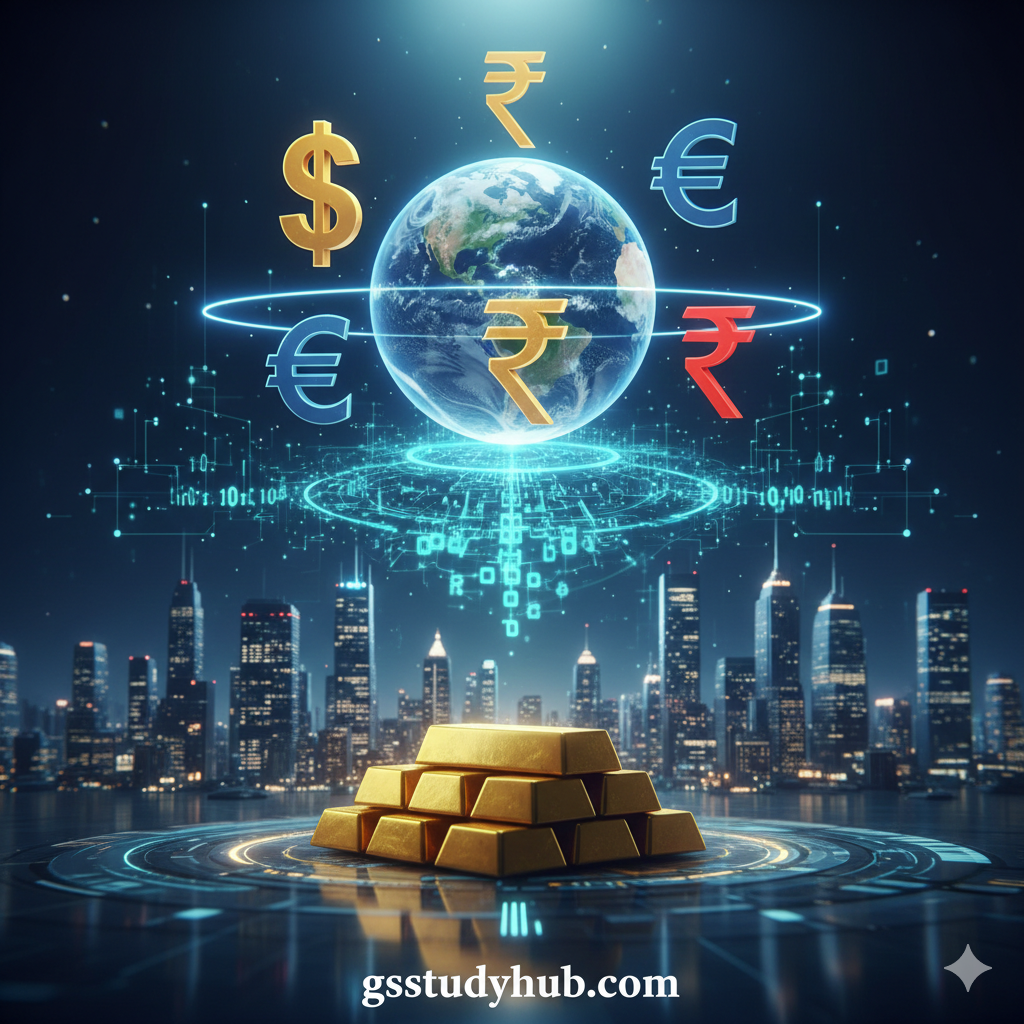
What Does This Mean for India? (India's Strategy)
India is walking a very fine "Tightrope" amidst this global turmoil. India neither wants to become an enemy of the US nor does it want to put its economy at risk by relying solely on the dollar.
The Strategy: "Not to Kill the Dollar, But to Save the Rupee"
Unlike China, India is not trying to destroy the dollar. India's goal is "Strategic Autonomy." That is, if the US imposes sanctions on us tomorrow, India's economy should not come to a halt.
RBI's 'Kavach' (Shield) Policy
The Reserve Bank of India (RBI) is quietly making major preparations. To reduce dollar dependency, the RBI has taken two significant steps:
- Gold Reserves: The RBI has been buying gold at a record pace for the last 3 years and moving it back from foreign banks to India.
- Diversification: Our foreign exchange reserves now include not just dollars, but also Euros, Yen, and other assets.
Internationalization of the Rupee (Rupee Goes Global)
Since 2022, India has aggressively promoted Rupee Trade Settlement.
- Vostro Accounts: Over 22 countries, including Russia, Sri Lanka, and Mauritius, have opened special Vostro accounts to trade with India in Rupees.
- The Oil Game: We purchased oil from the UAE and paid in Rupees. This happened for the first time in history.
- Exchange Rate Savings: If we trade in Rupees, we don't have to pay fees to buy and sell dollars.
- Security: Even during war or sanctions, we can buy oil/fertilizers from Russia or Iran.
- Prestige: The Rupee is on the path to becoming a Global Currency.
- Limited Acceptance: No country in the world is yet ready to sell "electronics" or "weapons" in Rupees. They still want dollars.
- Rupee Volatility: The Rupee keeps falling against the dollar, so other countries fear holding it as a reserve.
- Trade Deficit: Russia has accumulated a lot of Indian Rupees but can't figure out where to spend them because we don't sell them enough goods.
🌿 For insights into how environmental pressures fuel resource disputes, explore Wildlife and Natural Resource Conflicts – Full Guide.
Myth vs. Reality: The Social Media Truth
Videos about "Dollar Doom" viralize easily on the internet, but economics runs on data, not emotions. Let's perform a neutral 2026 Fact Check on the current state of affairs.
"The Dollar will vanish by tomorrow morning"
Many believe the dollar will crash overnight like the currencies of Venezuela or Zimbabwe, with its value dropping to zero instantly.
59% of reserves are still in Dollars
The decline of the dollar is a "Slow Erosion", not a crash. 59% of global central bank reserves remain in USD. Replacing this takes decades, not days.
Source: IMF Data 2025"BRICS currency will replace the Dollar immediately"
There is talk that BRICS nations are launching a gold-backed common currency that will end the dollar's era.
Only discussions, no consensus yet
India has made it clear it does not want a "common currency." India's focus is on strengthening the "Rupee." Bringing 5 different economies onto one currency is harder than creating the Euro.
"China's Yuan will become the new King"
It is assumed that everyone is dumping dollars to buy Yuan, making China the new global banker.
A Trust Deficit persists
The Yuan accounts for only 4.6% of global payments. Investors still hesitate to trust China because its government can change regulations at any time. Without lifting capital controls, the Yuan cannot be 'King'.
🌏 For a deeper look at the Indo-Pacific balance of power and India’s strategic partnerships, explore QUAD Indo-Pacific Strategy & India’s Role – Full Analysis.
Future Outlook: Roadmap 2025–2035
The next decade is set to be the biggest "Reset" in the history of the global economy. We are moving away from a world dominated by a single currency and entering an era where power will be distributed across multiple centers.
Multipolar Currency System
By 2035, the dollar's share could drop to 40-45%. However, this does not mean the end of the dollar. The Dollar, Euro, and Yuan will collectively drive the world. The European Central Bank (ECB) will implement major policy shifts to position the Euro as a stable alternative.
Regional Trade Blocs
The world will shift from "Globalization" to "Regionalization." Countries in Asia will increasingly use their own currencies for mutual trade. India, the UAE, and Southeast Asia will form an independent economic corridor where the dollar's role will be minimal.
The Era of Digital Currencies (CBDCs)
In the next 10 years, paper notes will be replaced by Central Bank Digital Currencies (CBDCs). When India's 'e-Rupee' and China's 'e-Yuan' are directly linked, the need for SWIFT or US banks for international payments will vanish.
Return of Gold
In this era of instability, gold will once again become the world's safest asset. Central banks will keep a large portion (25%+) of their reserves in gold to remain protected from sanctions imposed by any nation.
A New Economic Order
"By 2035, world trade will no longer be a slave to any single nation's currency. Technology (Blockchain) and multipolar politics will combine to create a system where the Rupee, Yuan, and Euro stand shoulder-to-shoulder with the Dollar."
📊 Want expert insights on the global shift away from the US dollar? Explore J.P. Morgan’s De-dollarization Report.
Conclusion: The End of the Dollar or the Start of a New Era?
After understanding the full story of de-dollarization, we arrive at the conclusion that this is not an overnight miracle. The US dollar remains the backbone of the global economy, but cracks in that backbone are now clearly visible.
For emerging nations like India, this is a golden opportunity to recognize the strength of their own currency (the Rupee) and establish economic sovereignty on the global stage.
Frequently Asked Questions (FAQs)
No, the dollar's value will not drop to zero. However, its share in international trade may decrease due to the rise of other currencies.
Not for now. The Rupee is still in the early stages of internationalization. India's goal is not to replace the dollar, but to reduce dependency on it for bilateral trade.
In the long run, if the Rupee strengthens, prices of imported goods (like petrol and electronics) could stabilize, and 'imported inflation' caused by dollar fluctuations could decrease.