
India’s digital transformation is not merely an economic initiative but a strategic security shift. To understand how artificial intelligence and digital infrastructure are reshaping the country’s global position, read our detailed analysis on Digital India & AI Revolution 2026 . This transformation directly influences India’s preparedness in cyber and hybrid warfare domains.
⚡ A Powerful Beginning: The Rise of Cyber Warfare
“In the 21st century, wars no longer begin with the roar of tanks — they begin with the click of a keyboard.”
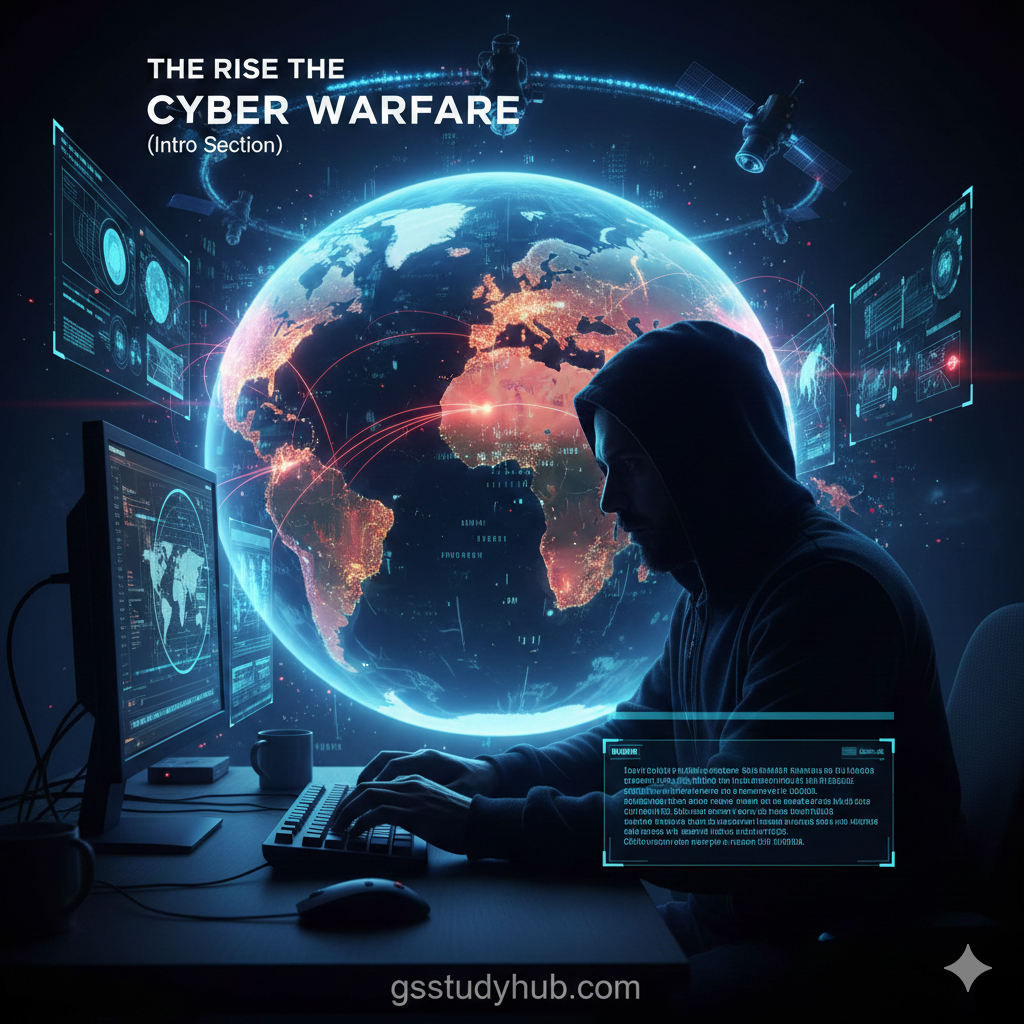
Cyber and Hybrid Warfare in 21st Century has transformed the nature of global conflict. Wars no longer begin only on physical battlefields but increasingly in digital networks, information systems, and economic domains.
The battlefield of modern geopolitics has transformed dramatically. Borders are no longer protected solely by soldiers and missiles, but by firewalls, algorithms, satellites, and encrypted networks. Power is no longer measured only in military strength, but in control over information, digital infrastructure, and cyber capabilities.
📌 Case Study 1: Estonia Cyber Attacks (2007)
In 2007, Estonia — one of the world’s most digitally advanced nations — experienced a wave of coordinated cyber attacks. Government websites, banking systems, media platforms, and public services were paralyzed. This incident demonstrated a critical reality: a nation can be destabilized without a single bullet being fired. It marked one of the first large-scale examples of modern cyber warfare.
📌 Case Study 2: Crimea Crisis (2014)
During the Crimea crisis, cyber operations and information warfare accompanied military movements. Communication networks were disrupted, digital propaganda spread rapidly, and narratives were strategically shaped. This revealed a new dimension of conflict — Hybrid Warfare, where cyber tactics and conventional force operate simultaneously.
📌 Case Study 3: U.S. Election Interference (2016)
Allegations of foreign interference in the 2016 U.S. Presidential Election shook global democracy. Social media platforms became tools of influence. Misinformation campaigns targeted public opinion. The event underscored a powerful truth: Information is power — and digital platforms can become political weapons.
📌 Case Study 4: Russia–Ukraine War (2022)
The 2022 Russia–Ukraine war further illustrated that cyber warfare is no longer secondary to conventional warfare. Cyber attacks targeted energy grids, communication systems, and satellite networks. Digital resilience became as crucial as military defense. The war confirmed that modern conflict exists in both physical and virtual domains.
Today, war is not fought only at borders — it is fought within data centers, smartphones, financial systems, and even in the minds of citizens. The 21st century has entered an era where cyber power defines geopolitical influence.
To better understand how regional tensions can influence cyber and hybrid conflict dynamics, also see our related analysis on the Taiwan Strait Crisis 2026 — Is the Next Ukraine? This crisis highlights how hybrid strategies and information warfare can escalate geopolitical competition in Asia.
Historical Background – From Traditional War to Digital Warfare
The evolution of Cyber and Hybrid Warfare in 21st Century reflects a strategic transformation in how nations compete for influence, security, and technological dominance.
Experience teaches us that warfare has never remained static. From trenches filled with soldiers to satellites orbiting the Earth, conflict has continuously evolved with technology. To understand digital warfare, we must first trace its historical roots.
1️⃣ World War I – The Industrialization of War
World War I (1914–1918) marked the beginning of industrial-scale warfare. Machine guns, chemical weapons, tanks, and telecommunication systems transformed how battles were fought. Military power became closely tied to industrial capacity and technological innovation.
Although cyber technology did not exist, this war introduced a key principle: technology defines battlefield advantage.
2️⃣ World War II – Intelligence and Code Warfare
World War II (1939–1945) expanded the technological dimension of conflict. Radar systems, cryptography, and code-breaking operations became central strategies. The famous breaking of encrypted communications demonstrated that information control could determine victory.
This period laid the intellectual foundation for digital warfare, as nations realized that invisible battles in communication systems were just as decisive as physical combat.
3️⃣ The Cold War – Technology, Espionage, and Superpower Rivalry
The Cold War era intensified technological competition between the United States and the Soviet Union. This was not a direct battlefield war, but a war of intelligence, nuclear deterrence, and technological supremacy.
Satellites, early computer systems, and advanced communication networks were developed for military purposes. The space race and arms race demonstrated how scientific advancement became a strategic weapon.
4️⃣ The Information Revolution – Birth of the Digital Age
The late 20th century witnessed the Information Revolution. Computers, networking systems, and eventually the Internet transformed global communication.
Interestingly, the Internet itself began as a military project. Early networking systems were designed to ensure secure communication during potential nuclear conflict. This military-driven innovation gradually evolved into the modern global Internet.
What began as a defense mechanism eventually became the backbone of global civilization — powering economies, governments, and societies.
📌 Knowledge Perspective
From trench warfare to nuclear deterrence, and from satellite intelligence to cyberspace operations, each historical phase contributed to the rise of modern digital conflict.
Today’s cyber warfare is not an isolated phenomenon. It is the logical outcome of a century-long transformation where technology and power became inseparable.
The journey from traditional battlefields to digital networks reveals a powerful truth: The future of war belongs to those who control information.
The ongoing technological rivalry between major powers also shapes cyber and hybrid conflict strategies. For a deeper analysis of how digital supremacy and AI capabilities are redefining global power balance, read our article AI Arms Race: US–China Tech War & Global Power Shift , which explores the strategic implications of AI dominance in the 21st century.

Concept of Cyber Warfare
Experience shows us that warfare has never remained confined to battlefields alone. In the modern world, conflict no longer begins with tanks crossing borders or fighter jets entering airspace. Instead, it may start silently — within computer systems, communication networks, and digital infrastructures.
Today, data, algorithms, and network control have become instruments of power. Cyber warfare represents a new strategic domain where nations compete not only for territorial dominance but for informational superiority and technological control.
1️⃣ Definition of Cyber Warfare
From a knowledge perspective, cyber warfare refers to the use of digital attacks by a nation-state or organized group to disrupt, damage, or gain unauthorized control over another nation's critical infrastructure, military systems, financial networks, or governmental databases.
Unlike traditional warfare, cyber warfare is not limited by geography. It operates in a borderless environment known as cyberspace, where anonymity, speed, and stealth are defining characteristics.
A single malicious code can penetrate national systems, disable communication networks, or manipulate public opinion. This makes cyber warfare both highly efficient and deeply disruptive.
2️⃣ Types of Cyber Warfare
🔹 (1) Cyber Espionage
Cyber espionage involves secretly infiltrating computer systems to steal sensitive military, political, or economic information. Governments, defense institutions, and research facilities are common targets. Information equals power, and espionage seeks to capture that power without direct confrontation.
🔹 (2) Cyber Terrorism
Cyber terrorism refers to digital attacks intended to create fear, panic, or instability within a population. Energy grids, air traffic control systems, healthcare infrastructure, and public services may be targeted. Its objective is psychological disruption as much as technical damage.
🔹 (3) Cyber Sabotage
Cyber sabotage involves deliberate attempts to damage or destroy digital or industrial systems. This can affect power plants, nuclear facilities, manufacturing plants, and military operations. It bridges the gap between virtual attack and physical consequence.
🔹 (4) Ransomware Attacks
Ransomware is malicious software that encrypts a victim’s data and demands payment for its release. This form of cyber warfare has rapidly expanded, targeting both governments and private corporations. It demonstrates how cyber threats can paralyze entire sectors of an economy.
3️⃣ Major Case Studies
🇪🇪 Estonia (2007)
In 2007, Estonia, one of the world’s most digitally advanced nations, faced a series of large-scale cyber attacks. Government websites, banks, and media platforms were disrupted. The attacks revealed that a nation can be destabilized without deploying a single soldier.
This incident became a defining moment in global cybersecurity policy and NATO's strategic planning.
🇺🇸 Colonial Pipeline (2021)
In 2021, a ransomware attack targeted the Colonial Pipeline in the United States, leading to fuel shortages and economic disruption. The event highlighted how private infrastructure is deeply connected to national security.
🇮🇷 Stuxnet Attack on Iran (2010)
In 2010, the Stuxnet worm targeted nuclear facilities in Iran. Unlike typical cyber attacks, Stuxnet caused physical damage to industrial centrifuges. It marked the first known instance where a cyber weapon produced tangible physical destruction.
This case demonstrated that cyber warfare could cross the boundary from digital disruption to real-world impact.
The knowledge conclusion is clear: Cyber warfare is no longer a theoretical possibility — it is a present geopolitical reality. In the 21st century, nations that control digital infrastructure, data systems, and cyber capabilities will shape the global balance of power.
Contemporary geopolitical tensions extend beyond cyberspace into strategic regions like the Arctic, where competition over energy resources and military presence raises hybrid conflict dynamics. For a comprehensive discussion on this topic, see our in-depth analysis on Arctic Geopolitics & Energy War , which explores how resource competition influences global strategic competition.
Concept of Hybrid Warfare
Understanding Cyber and Hybrid Warfare in 21st Century requires analyzing both digital disruption and coordinated multi-domain strategies used by major powers.
Experience in modern geopolitics reveals that war is no longer confined to battlefields filled with soldiers and armored vehicles. In the 21st century, conflicts unfold simultaneously across military, digital, informational, and economic domains. This multidimensional strategy is known as Hybrid Warfare.
Hybrid warfare represents a transformation in strategic thinking. Instead of relying solely on conventional military confrontation, states now combine hard power and soft power tools to weaken adversaries without necessarily declaring formal war.
1️⃣ Definition of Hybrid Warfare
From a knowledge perspective, hybrid warfare is a strategic model in which a state integrates multiple forms of conflict — including Conventional Warfare, Cyber Warfare, Information Warfare, Economic Pressure, and Proxy Groups — to achieve political and geopolitical objectives.
It operates in the “grey zone” between peace and open war, where actions remain ambiguous enough to avoid direct military retaliation. This ambiguity makes hybrid warfare particularly difficult to detect, deter, or respond to effectively.
2️⃣ Key Elements of Hybrid Warfare
1. Conventional Warfare
Traditional military forces — armies, navies, and air forces — remain relevant. However, their use is often calibrated and limited, designed to support broader strategic goals rather than full-scale invasion.
2. Cyber Warfare
Cyber operations target digital infrastructure, financial systems, and communication networks. These attacks can disrupt governance, weaken economies, and create strategic confusion without visible military engagement.
3. Information Warfare
Information warfare involves propaganda, misinformation campaigns, and manipulation of public opinion through media and social platforms. Control over narratives often translates into political leverage.
4. Economic Pressure
Economic sanctions, trade barriers, supply chain manipulation, and financial restrictions are used to weaken adversaries. Modern economies are deeply interconnected, making economic pressure a powerful strategic weapon.
5. Proxy Groups
States may support local militias, separatist groups, or political movements to destabilize opponents indirectly. This allows plausible deniability while maintaining influence on the ground.
📌 Major Case Studies
🇷🇺 Crimea (2014)
The annexation of Crimea in 2014 by Russia is widely regarded as a textbook example of hybrid warfare. Alongside conventional troop movements, there were coordinated cyber attacks, strategic information campaigns, and the use of local proxy forces.
The operation demonstrated how a combination of military presence, digital disruption, and narrative control could alter territorial realities with limited direct confrontation.
🇺🇸–🇨🇳 Trade War
The trade tensions between the United States and China illustrate the economic dimension of hybrid warfare. Tariffs, technology bans, and restrictions on strategic industries revealed how economic competition can function as geopolitical conflict.
In this case, military confrontation was absent, yet economic leverage and technological rivalry became instruments of strategic competition.
The knowledge conclusion is unmistakable: Hybrid warfare represents the future of geopolitical conflict. Power in the modern era is defined not only by military strength, but by the ability to integrate military capability, digital dominance, economic influence, and information control into a coherent strategic framework.
The evolving landscape of global conflict is shaped not only by cyber and hybrid tactics but also by shifting global alliances. For an in-depth exploration of how geopolitical power blocs are realigning, particularly between the Global South and the West, read our detailed analysis on Global South vs West: The New Cold War 2026 , which examines emerging strategic competition and its implications for future conflict dynamics.
Cyber and Hybrid Strategy in Asia
In Asia, Cyber and Hybrid Warfare in 21st Century has become central to geopolitical competition, particularly in technology, maritime security, and information dominance.
Experience in 21st century geopolitics reveals that Asia is no longer only an economic growth center — it has become a central arena of digital and hybrid strategic competition. Regional powers are increasingly integrating cyber capabilities, information control, and hybrid warfare tools into their national security doctrines.
From state-sponsored cyber units to economic leverage and information campaigns, Asian nations are redefining how power is exercised. Digital infrastructure, artificial intelligence, and cyber defense are now considered core pillars of national sovereignty and strategic influence.
🇨🇳 China
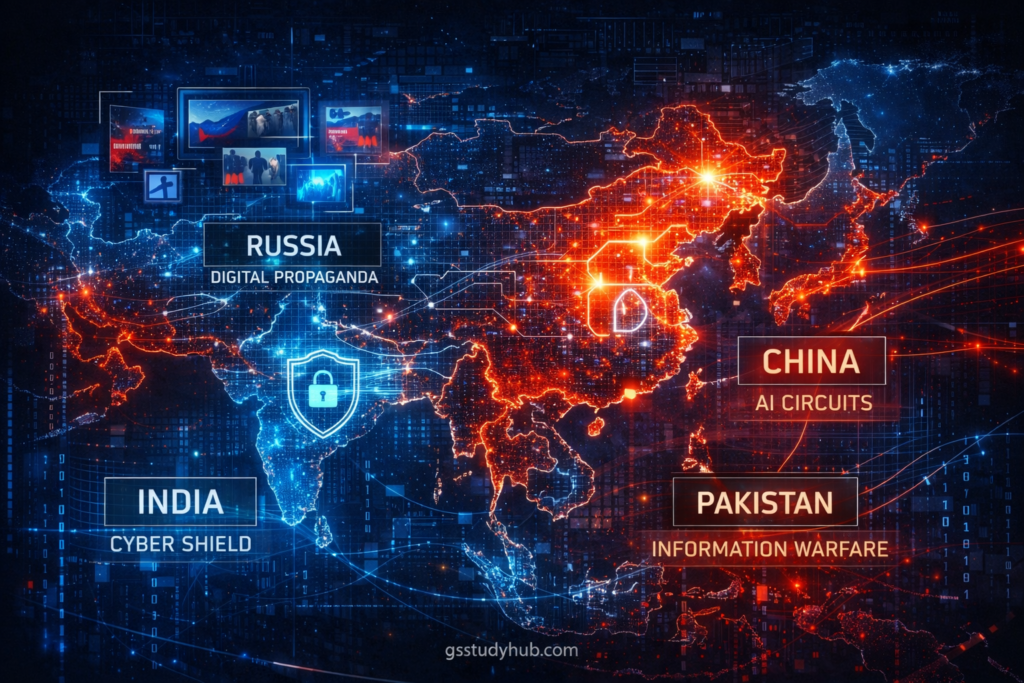
From a knowledge perspective, China has systematically integrated cyber and hybrid tools into its long-term geopolitical strategy. Digital dominance is viewed as essential for both regional and global influence.
Three Warfare Strategy
China’s Three Warfare Strategy includes psychological warfare, media warfare, and legal warfare. The objective is to shape international narratives, influence decision-making processes, and create strategic advantages without direct military confrontation.
Cyber Military Units
China has developed specialized cyber military units tasked with cyber espionage, digital surveillance, and offensive cyber capabilities. These units strengthen China’s position in cyber intelligence and technological competition.
By combining cyber operations with economic influence and strategic infrastructure projects, China demonstrates a comprehensive hybrid approach to modern power projection.
🇷🇺 Russia
Russia’s hybrid model emphasizes digital propaganda and information warfare. Through online campaigns, social media influence, and strategic narratives, Russia seeks to shape political outcomes and public perception.
This strategy highlights how control of information flows can serve as a powerful geopolitical instrument. Russia’s approach blends cyber operations with political messaging, creating ambiguity and strategic disruption.
🇮🇳 India
India has taken significant steps to strengthen its cyber security architecture. The establishment of CERT-In (Indian Computer Emergency Response Team) ensures monitoring and rapid response to cyber incidents at the national level.
Additionally, India has moved toward operationalizing a dedicated Cyber Command to integrate digital defense within its military structure.
India’s strategy reflects a balanced approach — combining digital security, technological development, and democratic resilience to protect national interests.
🇵🇰 Pakistan
Pakistan’s approach incorporates elements of information warfare and digital narrative shaping. Online platforms and media strategies are used to influence regional discourse and strategic perception.
This reflects a hybrid model where ideological positioning and digital influence operations complement traditional security measures.
The knowledge conclusion is clear: Cyber and hybrid strategies in Asia are reshaping regional power dynamics. Military capability alone no longer determines influence. Instead, the integration of cyber power, information dominance, economic leverage, and strategic coordination defines modern geopolitical competition.
Understanding hybrid warfare also requires examining geopolitical flashpoints around the world. For an in-depth look at how escalating regional tension can mirror hybrid conflict patterns, check out Taiwan Strait Crisis 2026 – Is the Next Ukraine? for strategic insight into this unfolding geopolitical challenge.
AI, Deepfake and the Future of Warfare
Artificial intelligence is rapidly redefining Cyber and Hybrid Warfare in 21st Century by accelerating decision-making, automation, and psychological operations.
Experience in modern strategic conflicts suggests that the future of warfare will not be defined solely by missiles, tanks, or naval fleets. Instead, it will increasingly be shaped by Artificial Intelligence, algorithmic decision-making, and digital manipulation technologies. The battlefield of tomorrow is being constructed in data centers, laboratories, and network infrastructures.
AI-driven systems are already transforming surveillance, drone operations, intelligence analysis, and cyber defense. As automation expands, the speed and complexity of conflict are increasing dramatically, creating a new era of technology-dominated warfare.
1️⃣ Artificial Intelligence–Based Attacks
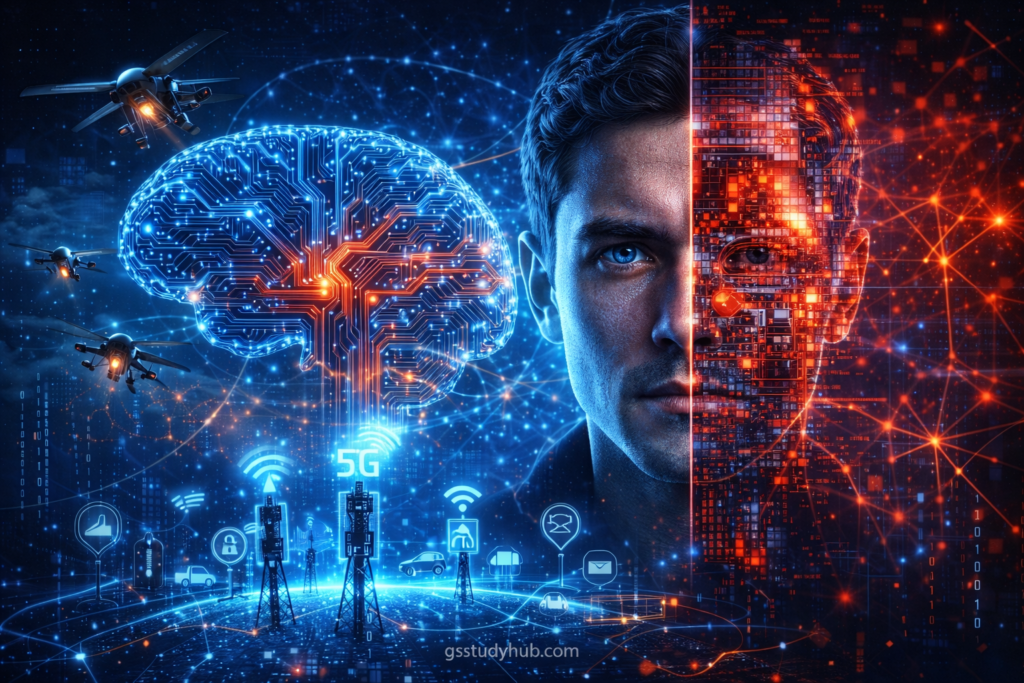
From a knowledge perspective, AI-based attacks involve the use of machine learning algorithms to identify vulnerabilities, analyze massive datasets, and execute cyber operations with minimal human intervention.
Unlike traditional cyber attacks, AI-powered systems can adapt in real time. They can scan networks, detect weak security points, and modify attack patterns instantly. This makes them significantly more dangerous and difficult to counter.
Autonomous drones and AI-controlled malware illustrate how automated warfare systems can operate without continuous human control. Such developments raise ethical and strategic concerns about accountability and escalation.
2️⃣ Deepfake Threats
Deepfake technology uses artificial intelligence to create highly realistic fake videos, audio recordings, and images. These manipulated media files can convincingly imitate political leaders, military officials, or public figures.
In future conflicts, deepfakes could be used to fabricate military orders, spread disinformation, destabilize governments, or incite public unrest. This represents a powerful extension of information warfare.
The most alarming aspect of deepfake technology is its ability to blur the boundary between truth and deception. When citizens can no longer distinguish authentic communication from manipulated content, trust in institutions and democratic systems weakens.
3️⃣ 5G and IoT Security
The expansion of 5G networks and the Internet of Things (IoT) is dramatically increasing global connectivity. Smart cities, autonomous vehicles, defense systems, and industrial networks rely on these technologies.
However, greater connectivity also means greater vulnerability. If hostile actors infiltrate 5G infrastructure or IoT devices, they could disrupt energy grids, transportation systems, healthcare networks, and military communications.
Future security strategies must therefore prioritize cyber resilience, encryption standards, and infrastructure protection. In an interconnected world, technological strength and digital defense are inseparable.
The knowledge conclusion is evident: Artificial Intelligence, deepfake technologies, and advanced connectivity systems will shape the future battlefield. Nations that lead in technological innovation, cybersecurity, and ethical governance will define the balance of power in the coming decades.
Modern hybrid strategies extend beyond cyber attacks to include economic and trade disruptions in key global regions. For example, disruptions in maritime corridors can have strategic ramifications that intersect with hybrid conflict mechanisms. For more on this, see our comprehensive analysis on Red Sea Crisis 2026 – Global Trade Impact , which explores how trade disruptions influence international strategic competition.
Comparative Analysis: Cyber Warfare vs Hybrid Warfare
Experience in modern strategic conflicts demonstrates that warfare has evolved beyond traditional military confrontation. Some conflicts are fought entirely in digital space, while others combine military, economic, informational, and cyber dimensions. This distinction highlights the difference between Cyber Warfare and Hybrid Warfare.
Although both strategies are central to 21st-century geopolitics, they differ significantly in their nature, cost structure, and overall impact.
📊 Comparative Framework
| Basis | Cyber Warfare | Hybrid Warfare |
|---|---|---|
| Nature | Digital | Multi-dimensional |
| Cost | Low | Moderate |
| Impact | Technical Disruption | Socio-Political Instability |
📘 Knowledge-Based Analysis
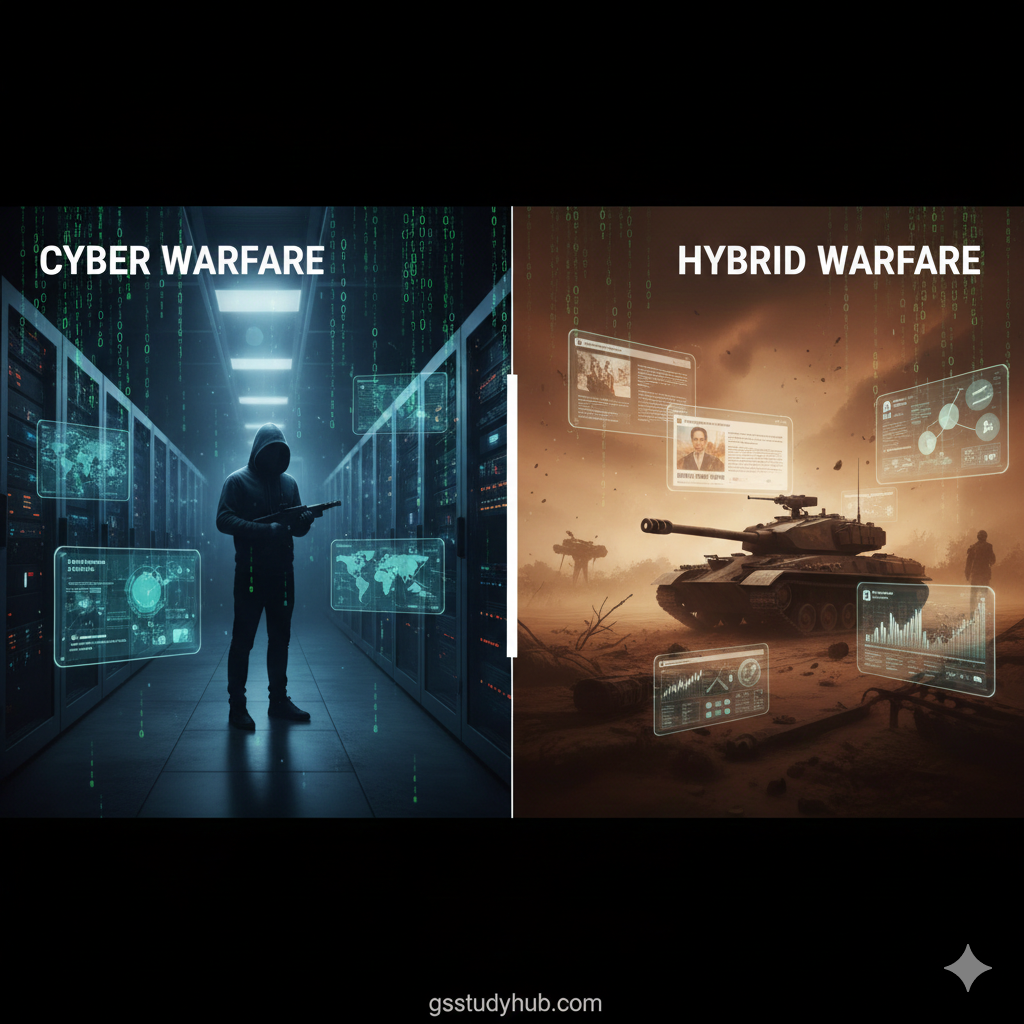
From a theoretical perspective, Cyber Warfare primarily targets digital infrastructure — including communication networks, banking systems, defense databases, and power grids. Its effects are immediate and technological in nature, often resulting in system failures and operational paralysis.
In contrast, Hybrid Warfare integrates cyber attacks with military maneuvers, economic sanctions, propaganda campaigns, and proxy actors. Its objective is not merely technical disruption, but the creation of broad socio-political instability.
Hybrid strategies operate in the “grey zone” between war and peace, making them strategically ambiguous and harder to counter through conventional defense mechanisms.
📌 Case Study Illustration
A direct cyber attack on a nation’s banking network represents a clear example of Cyber Warfare, where the primary objective is digital system disruption.
By contrast, events such as the 2014 Crimea crisis illustrate Hybrid Warfare, where military presence, cyber operations, information campaigns, and political strategy were combined to achieve geopolitical objectives.
The conclusion is clear: Both cyber warfare and hybrid warfare are essential instruments of modern power politics. However, while cyber warfare primarily disrupts digital infrastructure, hybrid warfare reshapes society, politics, and economic systems through coordinated multi-domain strategies.
The evolution of hybrid and cyber warfare is rooted in historical patterns of geopolitical competition. For a deeper understanding of how Cold War dynamics continue to shape modern strategic behavior, read our detailed analysis on Lessons from the Cold War for Today’s Geopolitics . This perspective provides valuable context for contemporary conflict models.
Theoretical Perspectives
Experience in global politics suggests that international events are not isolated incidents, but part of broader theoretical frameworks. To understand cyber warfare and hybrid strategies, we must interpret them through the major theories of International Relations.
Three dominant perspectives — Realism, Liberalism, and Constructivism — offer distinct explanations of power, security, cooperation, and identity in the modern world.
1️⃣ Realism
From a knowledge perspective, Realism argues that the international system is anarchic, meaning there is no central authority above states. As a result, states prioritize national interest and power maximization to ensure survival.
In this framework, cyber warfare becomes a strategic tool for enhancing state power. Digital attacks, intelligence gathering, and technological superiority are seen as modern extensions of traditional military competition.
For example, when a state disrupts another country’s digital infrastructure, its objective is to shift the balance of power in its favor.
2️⃣ Liberalism
Liberalism emphasizes cooperation, interdependence, and international institutions as mechanisms for reducing conflict.
According to this perspective, international organizations and rules-based systems can regulate cyber behavior and promote digital stability.
Cybersecurity agreements, shared norms, and global digital governance frameworks may help create collective security in cyberspace.
Liberalism also argues that economic interdependence makes prolonged hybrid conflict costly, thereby encouraging restraint and diplomatic engagement.
3️⃣ Constructivism
Constructivism suggests that international politics is shaped not only by material power, but also by ideas, identities, and social narratives.
In the context of hybrid and information warfare, identity formation and narrative control play a crucial role.
Deepfake technology, digital propaganda, and online influence campaigns demonstrate how states attempt to shape public perception and social meaning.
From this perspective, conflict is not only about physical resources or military strength, but also about competing interpretations of reality.
In conclusion, Realism explains the pursuit of power, Liberalism highlights cooperation and institutional regulation, and Constructivism emphasizes ideas and identity. Understanding cyber and hybrid warfare requires integrating insights from all three theoretical perspectives.
Economic conditions and inflation can also influence strategic decision-making in cyber and hybrid contexts. For an in-depth analysis of how inflation affects developing nations across the globe, see our detailed article Global Inflation and Its Impact on Developing Countries , which explores economic vulnerability and geopolitical risk.
Policy Recommendations for India
Experience in the 21st century demonstrates that national security is no longer confined to physical borders. Digital infrastructure, information networks, and cyber capabilities have become core pillars of national power. For a rising global actor like India, developing a forward-looking and comprehensive cyber strategy is essential.
With the growing intensity of cyber and hybrid threats, India must adopt a multi-dimensional and balanced strategic framework that integrates military preparedness, societal awareness, regulatory clarity, and international cooperation.
1️⃣ Strengthening the Cyber Command
From a knowledge perspective, India’s military cyber structure must be further consolidated and empowered. A fully integrated and operational Cyber Command can coordinate across the Army, Navy, and Air Force to respond effectively to digital threats.
Given the speed and complexity of cyber warfare, India must invest in real-time monitoring systems, AI-driven defense mechanisms, and calibrated offensive cyber capabilities. Such preparedness enhances deterrence and strategic credibility.
2️⃣ Promoting Digital Literacy
In the era of hybrid and information warfare, digital literacy has become a societal dimension of national security.
Citizens who can identify misinformation, deepfake content, and coordinated propaganda campaigns are less vulnerable to manipulation. Public resilience reduces the effectiveness of information warfare.
Educational institutions, civil society organizations, and media platforms should collaborate to implement cyber awareness and digital responsibility programs.
3️⃣ Social Media Regulation
Social media platforms have emerged as primary arenas of information warfare. Therefore, India requires a transparent and balanced regulatory framework to manage digital risks.
The objective should not be to suppress freedom of expression, but to counter disinformation, malicious influence operations, and coordinated propaganda.
Strengthening data protection laws and enhancing cooperation with technology companies will contribute to a secure and accountable digital ecosystem.
4️⃣ Advocating for an International Cyber Treaty
At the global level, India should actively support the development of international cyber norms and a comprehensive cyber treaty framework.
Such agreements can regulate state behavior in cyberspace, protect digital sovereignty, and encourage multilateral cooperation.
By taking a proactive role in global cyber governance, India can position itself as a responsible and leading digital power.
In conclusion, India’s response to cyber and hybrid threats must rest on four strategic pillars: military strengthening, societal awareness, regulatory balance, and international cooperation. In the evolving global order, digital preparedness will define true national security.
The strategic behavior of Western alliances like NATO has a significant impact on hybrid and cyber conflict dynamics around the world. For an in-depth look at NATO’s evolving strategy in Eastern Europe and its global implications, see our detailed analysis on NATO Strategy in Eastern Europe & Global Impact , which examines how alliance strategy shapes broader geopolitical competition.
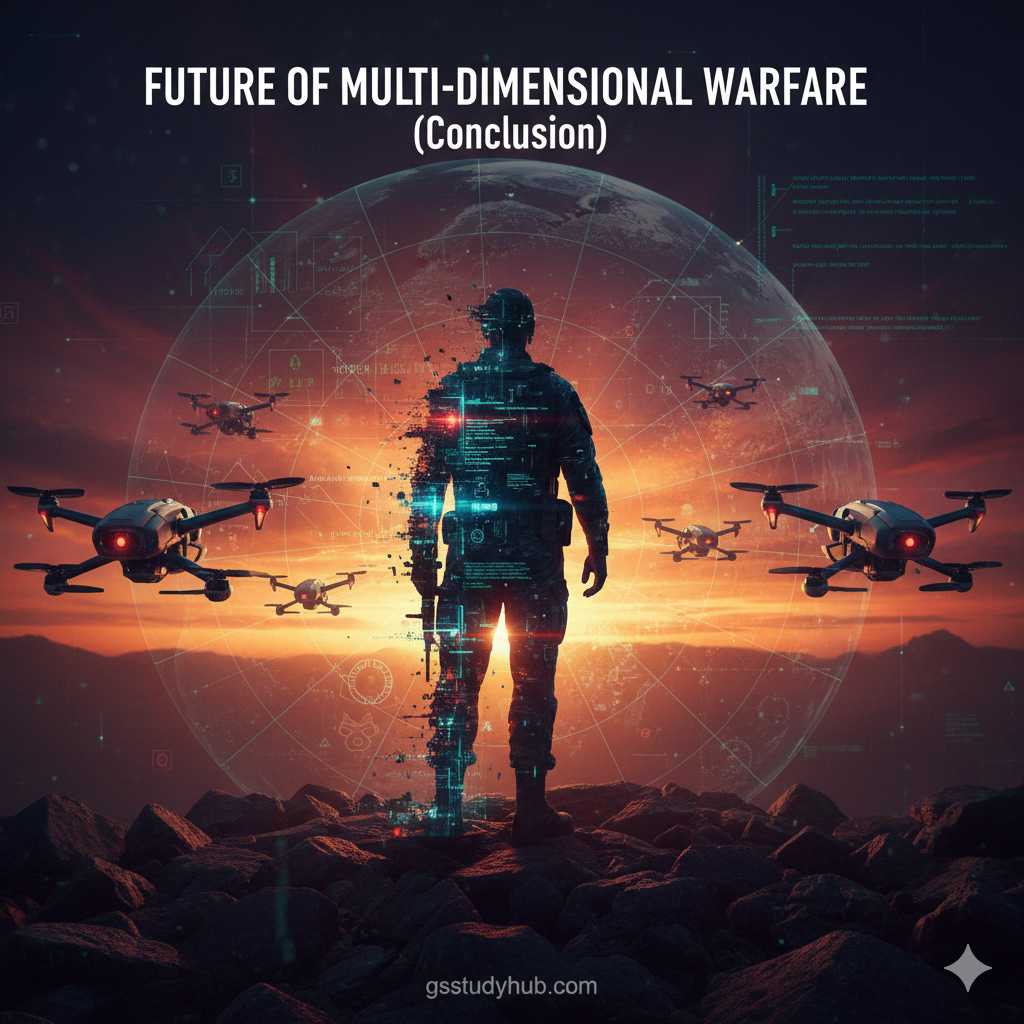
Conclusion
Ultimately, Cyber and Hybrid Warfare in 21st Century symbolizes a shift from conventional confrontation to invisible yet highly strategic global competition.
Experience in the 21st century clearly demonstrates that the traditional definition of power has fundamentally changed. Power is no longer measured solely by military strength, territorial control, or the number of weapons a state possesses. Today, data, digital infrastructure, technological innovation, and control over information have become the new indicators of global influence.
Cyber attacks, hybrid strategies, artificial intelligence systems, and deepfake technologies reveal that warfare has become invisible and multi-layered. Tanks and missiles still exist, but the first wave of modern conflict often begins in cyberspace — silently and strategically.
From a knowledge perspective, modern warfare is defined by three essential characteristics — speed, stealth, and expanded impact.
Where wars were once confined to specific geographic battlefields, today their consequences spread across global economies, societies, and political systems. Technical disruption can rapidly transform into socio-political instability.
The future of conflict will undoubtedly be multi-dimensional. Conventional military force, cyber capabilities, information warfare, economic leverage, and AI-driven systems will operate simultaneously.
Nations capable of integrating these dimensions into a coherent strategic framework will shape the global balance of power. Security is no longer limited to defending borders; it now includes protecting digital sovereignty and societal resilience.
Ultimately, war has transformed. It is no longer fought only on physical frontiers, but within data systems, narratives, and digital networks. The future of power will belong to those who understand and master this new strategic reality.
As global strategic competition evolves, new power blocs are reshaping geopolitical balance. For a deeper analysis of how BRICS expansion is influencing the changing world order and its strategic implications, read our comprehensive article BRICS Expansion and the Changing World Order Impact , which explores how emerging alliances affect global power dynamics.
FAQ – Cyber Warfare and Hybrid Strategy in the 21st Century
❓ 1. What is Cyber Warfare?
Experience shows that cyber warfare refers to conflicts conducted through digital networks, data systems, and information infrastructure. Government websites, banking networks, energy grids, and military databases may become targets. From a knowledge perspective, its primary objective is to create technical disruption and gain strategic advantage.
❓ 2. How is Hybrid Warfare different from Cyber Warfare?
Cyber warfare is primarily digital in nature, whereas hybrid warfare is a multi-dimensional strategy. Hybrid warfare combines conventional military force, cyber attacks, information warfare, and economic pressure simultaneously. As illustrated in case studies, the 2014 Crimea crisis is often cited as a classic example of hybrid warfare.
❓ 3. Is Cyber Warfare more dangerous than traditional warfare?
From an analytical standpoint, cyber warfare’s speed and stealth make it highly impactful. It can destabilize a nation’s economy and infrastructure without crossing physical borders. However, its effects are often invisible and complex, making detection and response more challenging.
❓ 4. What role will AI and Deepfake play in future conflicts?
Recent developments indicate that AI-driven attacks and deepfake technology can intensify information warfare. Fabricated videos and manipulated narratives may influence public opinion and create political instability. This significantly expands the scope of digital conflict.
❓ 5. How should India respond to Cyber and Hybrid threats?
India should focus on strengthening its Cyber Command, promoting digital literacy, enhancing social media regulation, and supporting international cyber cooperation. The strategic conclusion is that future security depends on digital preparedness.
Final Thought: In the 21st century, war is no longer fought only on physical borders. It is increasingly contested within digital networks, data systems, and information flows.
Economic pressure and resource competition are key elements of modern hybrid strategies. For a detailed analysis of how regional instability and oil price shifts affect global power dynamics, see our article Regional Instability and Oil Prices — Role of Powers , which explores how energy economics can influence strategic behavior among major actors.
References
Experience in academic research demonstrates that a strong references section enhances credibility, transparency, and intellectual integrity. In studies related to cyber warfare and hybrid strategy, it is essential to cite authoritative books, official documents, international institutions, and peer-reviewed journals.
From a knowledge perspective, a well-structured reference list reflects scholarly rigor and strengthens analytical arguments. Below is a recommended format.
A. Books
- Joseph Nye – Cyber Power
(Explores the concept of cyber power within global strategic competition.) - Frank Hoffman – Hybrid Warfare
(Analyzes the evolution and operational structure of hybrid conflict.)
B. Government Documents
- NATO Cyber Strategy
(Official policy framework outlining NATO’s approach to cyber defense and deterrence.) - US Cyber Command Reports
(Annual and strategic reports detailing operational cyber readiness and doctrine.)
C. International Institutions
- NATO
(Provides strategic doctrine and cooperative cyber defense initiatives.) - United Nations
(Engages in global discussions on cyber norms, digital governance, and international security frameworks.)
D. Academic Journals
- Journal of Strategic Studies
(Publishes peer-reviewed research on military strategy and security studies.) - International Security
(A leading journal focusing on global security, defense policy, and geopolitical analysis.)
Final Academic Note: A comprehensive references section not only supports your arguments but also demonstrates scholarly credibility, analytical depth, and research authenticity.
Strategic balance and security doctrines remain central to understanding modern conflict, especially when hybrid and cyber tactics intersect with traditional deterrence. For a comprehensive examination of how nuclear non-proliferation contributes to global strategic stability, see our analysis on Nuclear Non-Proliferation and Strategic Balance , which explores shifting defense paradigms and the role of arms control in an era of complex warfare.