

Cooperative Movement in India
Introduction
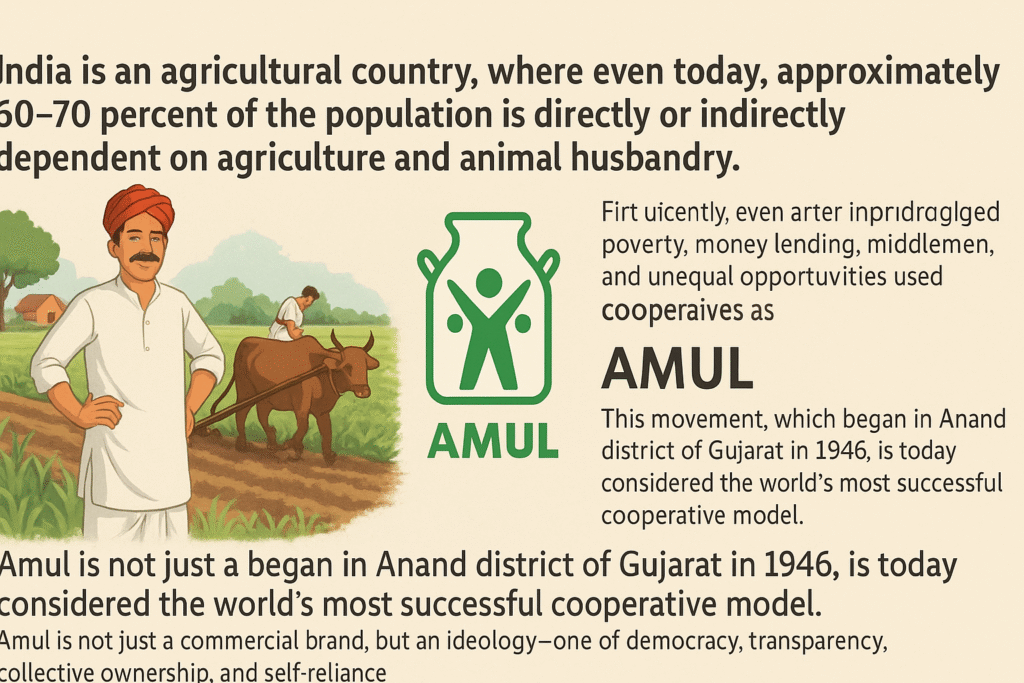
India is traditionally known as an agricultural country, where even today nearly 60–70% of the population is directly or indirectly dependent on agriculture and animal husbandry. Despite independence, the true producers of rural India — the farmers — continued to struggle with poverty, exploitation by moneylenders, and unequal opportunities.
At this crucial stage, an important economic and social question emerged: Can farmers protect their interests by struggling individually?
The solution came in the form of Cooperatives — organizations formed by members who collectively conduct economic activities for mutual benefit. The most successful example of this cooperative principle is Amul, which led India towards the historic White Revolution.
The movement began in 1946 in the Anand district of Gujarat, where milk producers united against unfair trade practices. Over time, this small initiative grew into the world’s most successful dairy cooperative model.
Amul is not merely a commercial brand — it represents an ideology of democracy, transparency, collective ownership, and self-reliance. It proved that when farmers become owners and decision-makers, economic transformation becomes possible.
This article aims to understand the journey, background, structural framework, and relevance of the cooperative model in today’s context of sustainable rural development and inclusive economic growth.
Introduction of The Cooperative System in India
The roots of the cooperative movement in India lie in the British colonial period. During the late 19th and early 20th centuries, rural India suffered from severe economic distress. Farmers were trapped in exploitation, heavy moneylender debt, and lacked organized credit and marketing facilities. There was no structured system to provide affordable loans or fair prices for agricultural produce.
To overcome this economic disorganization, the foundation of the cooperative system was laid, with the objective of collective self-help, democratic participation, and financial stability.
🔹 1904 — Cooperative Credit Societies Act
The British government enacted this law to free farmers from the clutches of moneylenders. Under this Act, small farmers could form credit societies and receive collective financial assistance at reasonable interest rates. This was the first formal step toward organized rural credit in India.
🔹 1912 — Cooperative Societies Act
This Act expanded the scope of cooperatives beyond credit societies. It allowed the formation of production, marketing, and consumer societies. It laid the structural foundation for rural self-organization and strengthened the cooperative framework across provinces.
🔹 New Role After Independence (Post-1947)
After independence, cooperatives were recognized as a pillar of India’s economic planning. India’s first Prime Minister emphasized their importance in nation-building and rural transformation.
The main objectives of cooperatives during this period were:
- Empowering farmers through collective strength
- Reducing dependency on moneylenders
- Establishing a democratic decision-making system
- Promoting rural development and self-reliance
🔹 Example: Anand’s Cooperative Experiment
In the 1940s, farmers in Gujarat formed village-level milk committees. They collected milk daily and sold it to a district union. The profits were distributed directly among farmers, eliminating middlemen. This grassroots model later evolved into the famous dairy cooperative known as “Amul.”
Thus, the cooperative system in India gradually transformed from a colonial credit mechanism into a powerful tool of rural development, economic democracy, and social empowerment.

Amazon Product
Click below to view full product details and the latest price on Amazon.
👉 View on Amazon*As an Amazon Associate, I earn from qualifying purchases.
Current Situation – Why Has The State Cooperative System Weakened?
Initially, cooperatives served as a powerful vehicle for empowering farmers and strengthening rural economies.
However, over time, many state-level cooperative institutions began to weaken due to structural, political,
and managerial challenges. The major reasons are outlined below:
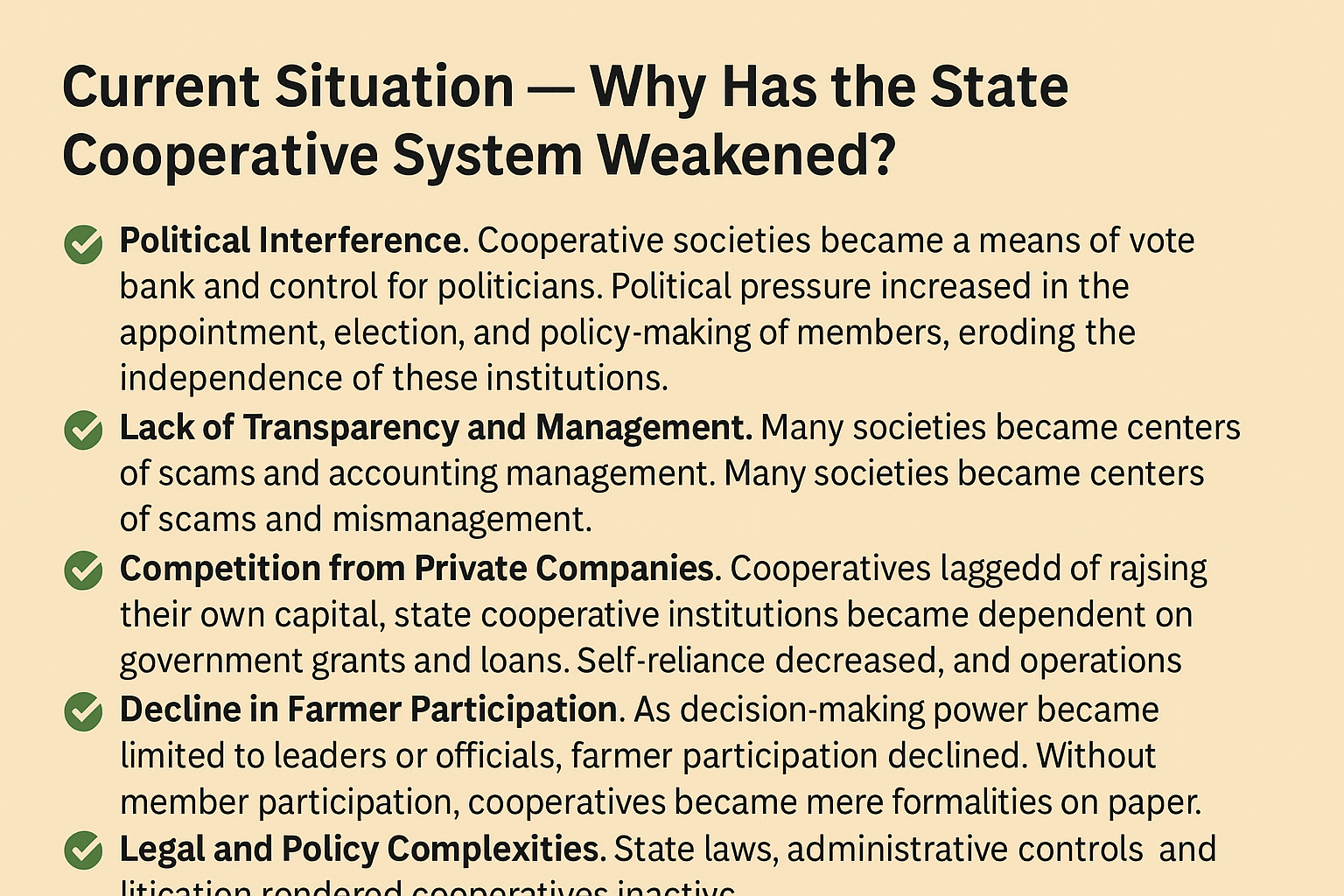
✅ 1. Political Interference
Cooperative societies gradually became instruments of vote bank politics.
Political influence increased in appointments, elections, and policy decisions.
This excessive interference weakened institutional autonomy and reduced democratic functioning.
✅ 2. Lack of Transparency and Poor Management
Weak financial oversight, irregular audits, and poor accounting practices eroded farmers’ trust.
In several cases, cooperative institutions became associated with scams, corruption, and mismanagement.
✅ 3. Competition from Private Companies
Private and corporate firms entered dairy and agricultural marketing sectors aggressively.
While private companies adopted modern technology, branding strategies, and efficient supply chains,
many cooperatives lagged behind in innovation and competitiveness.
✅ 4. Excessive Government Dependence
Instead of building their own capital base, many state cooperatives became dependent on government grants and loans.
This dependency reduced self-reliance, slowed operational efficiency, and limited financial sustainability.
✅ 5. Decline in Farmer Participation
As decision-making power concentrated in the hands of politicians or bureaucrats,
active participation of farmer-members declined. Without genuine member involvement,
cooperatives lost their original spirit and became formal institutions on paper.
✅ 6. Legal and Policy Complexities
Different state laws, administrative controls, regulatory hurdles, and prolonged litigation
made the functioning of cooperatives complicated and inefficient.
🔹 Result: In many regions, cooperatives gradually shifted from being vehicles of farmer empowerment
to becoming centers of politics and administrative control.
However, successful models such as Amul demonstrate that with proper management,
democratic participation, financial transparency, and professional leadership,
cooperatives can still serve as powerful instruments of inclusive economic development.
Political Interference – The Biggest Challenge for Cooperatives
The original spirit of the cooperative movement in India was “people’s empowerment through public participation.” However, over time, many cooperative societies came under political control. This deeply affected their transparency, independence, and democratic structure.
🔹 How Does Political Interference Occur?
1. Pressure and Recommendations in Elections
- Individuals affiliated with political parties are appointed as chairman, manager, or directors.
- Membership and voting processes are influenced for electoral advantage.
2. Misuse of Resources
- Committee funds are diverted toward political propaganda or personal interests.
- Budgets intended for farmer welfare, development, or production are manipulated.
3. Control Over Administrative Positions
- Individuals with little or no agricultural background are appointed to key posts.
- Decisions are taken for political gain rather than farmer interests.
4. Interference in Policies and Appointments
- Rules and bylaws are altered to benefit political supporters.
- Management committee officials are selected based on loyalty instead of merit.
🔹 What Are the Consequences?
- Farmers’ trust weakened significantly
- Financial instability and losses increased
- Youth and women’s participation declined
- Cooperatives became political platforms instead of people’s institutions
- Corruption, nepotism, and mismanagement expanded
- Actual members (farmers, dairy producers, artisans) were excluded from decision-making
🔹 What Could Be the Solutions?
- ✅ Establish an autonomous administrative structure
- ✅ Ensure direct and transparent elections by members
- ✅ Introduce term limits for political officials
- ✅ Implement digital voting and audit systems
- ✅ Limit government role to facilitative, not controlling
- ✅ Promote farmer-based representation in management
- ✅ Create an independent Election Commission–like authority for cooperatives
If cooperatives are to regain their original democratic character, they must return to their core principle: “By the members, for the members, and of the members.”

Amazon Product
Click below to view full product details and the latest price on Amazon.
👉 View on Amazon*As an Amazon Associate, I earn from qualifying purchases.
Lack of Transparency and Management
The success of cooperatives depends on honest, professional, and accountable governance. However, in many states, the biggest weakness has become the lack of transparency and poor management systems. Without strong internal controls and professional leadership, cooperatives struggle to maintain credibility and efficiency.
🔹 Why Is Transparency Important?
Cooperatives generally rely on the following sources of capital:
- ✔ Farmer members’ contributions
- ✔ Government support and subsidies
- ✔ Income from production and marketing activities
When these financial resources are not properly recorded or audited, both the organization’s purpose and public trust are compromised.
🔹 Manifestations of Management Weaknesses
1. Accounting Irregularities
- Records are not regularly updated
- Audits are irregular or delayed
- Loan and payment information remains unclear
2. Lack of Effective Leadership
- Absence of trained managers or financial experts
- Decisions based on emotional or political factors
- Members excluded from planning processes
3. Absence of Digital Systems
- Excessive cash transactions
- Lack of proper receipts and documentation
- Poor transparency in storage, marketing, and distribution
4. Arbitrary Withdrawals and Profit Distribution
- Dividends not paid on time
- Profit distribution not proportional
- Financial control concentrated among a few officials
5. Weak Reporting Systems
- Annual reports not prepared
- Meeting minutes not properly recorded
- Government and member oversight absent
🔹 Consequences
- Member confidence declined
- Financial losses increased
- Dependence on external debt rose
- Youth and women disengaged
- Many cooperatives became inactive or defunct
- Private businesses captured market opportunities
🔹 Measures to Improve Transparency and Management
- ✅ Implement digital accounting and ERP systems
- ✅ Conduct all financial transactions through banking channels
- ✅ Make annual audits mandatory and publicly accessible
- ✅ Provide members with online access to financial reports
- ✅ Include finance, marketing, and technical experts in management committees
- ✅ Strengthen RTI and registrar-level monitoring
- ✅ Ensure regular and properly recorded meetings
- ✅ Maintain timely and transparent dividend distribution
A transparent and professionally managed cooperative system can rebuild trust, attract youth participation, and restore cooperatives as strong pillars of rural economic development.
Competition From Private Companies
India’s cooperatives have long been the backbone of the rural economy — especially in dairy, agriculture, marketing, and rural finance. However, over the last two decades, the entry of private and corporate companies has significantly challenged their position in the market.
🔹 Why Have Private Companies Proven Stronger?
1. Modern Technology and Management
- Advanced machinery, cold chains, packaging, and distribution networks
- Use of data analytics, digital platforms, and market research
2. Capital and Investment Access
- Access to banking, investors, venture capital, and FDI
- Rapid expansion capability compared to capital-constrained cooperatives
3. Mastery of Branding and Marketing
- Strong presence on TV, social media, and FMCG channels
- Professional advertising and brand-building strategies
- Cooperatives often lack effective product promotion
4. Professional Staff and Training Systems
- Economically driven management decisions
- Skilled workforce with performance-based incentives
5. Focus on Customer Preferences
- Continuous improvement in quality, packaging, pricing, and delivery
- Product innovation aligned with consumer demand
- Cooperatives often operate in traditional structures
🔹 Impact on Cooperatives
- Market share gradually shifted to private companies
- Cooperative dairy, food processing, seed production, and marketing units weakened
- Farmers increasingly depended on private agents for sales
- Private companies ensured faster procurement and payment systems
- Corporate supply chains expanded into rural markets
🔹 How Can Cooperatives Survive the Competition?
✅ 1. Repurposing the Amul Model
- Multi-tiered structure (Village → District → State)
- Producers as owners and beneficiaries
✅ 2. Technological and Financial Upgradation
- Modern processing units, cold storage, digital payments
- Funding through NABARD, NCDC, and government schemes
✅ 3. Brand Building and Marketing Strategy
- National recognition for local cooperative brands
- Entry into e-commerce and retail platforms
✅ 4. Member-Based Profit Model
- Direct procurement and payment systems
- Profit share transferred directly to farmers’ accounts
✅ 5. Training and Professional Management
- Inclusion of managers, chartered accountants, and marketing experts
- Active involvement of youth and women members
✅ 6. Emphasis on Quality and Innovation
- Product diversification (Ghee, Paneer, Packaged Milk, Organic Food)
- Consumer-friendly and modern packaging
✅ 7. Policy and Institutional Support
- Support from the Government and Ministry of Cooperatives
- Policy protection, tax relief, and digital transformation
With modernization, transparency, professional management, and member participation, cooperatives can not only survive private competition but also reclaim their central role in India’s rural economic transformation.
Government Dependence – The Biggest Constraint on Autonomy
The original vision of cooperatives was to build institutions that are owned by the people, managed by the people, and run for the people. However, over time, many cooperatives became increasingly dependent on government grants, schemes, and administrative control. This excessive dependence weakened both self-reliance and innovation.
🔹 Major Forms of Government Dependence
1. Excessive Reliance on Financial Assistance
- Dependence on grants, subsidies, and government loans
- Weak internal capital formation and low reinvestment capacity
- Use of government schemes to cover operational deficits
2. Policy Control and Administrative Interference
- Registrar and ministry control over committee management
- Changing committee structures or delaying elections
- Appointments made under external pressure
3. Delays in Loans and Grants
- Production disrupted due to delayed funding
- Member payments postponed
- Loss of credibility in external markets
4. Slow Decision-Making Process
- Administrative restrictions on autonomous decisions
- Dependence on approvals, files, and licenses
- Inability to launch new projects on time
5. Reduced Competitive Capacity
- Private entities make faster market decisions
- Cooperatives remain trapped in bureaucratic processes
🔹 Adverse Effects of Government Dependence
- Self-capital formation weakened
- Decision-making autonomy reduced
- Member participation declined
- Administrative sluggishness and corruption increased
- Self-reliance replaced by a “grant-based survival model”
- Youth and skilled professionals disengaged from the sector
🔹 Solution: Towards Self-Reliant and Autonomous Cooperatives
✅ 1. Internal Capital Formation
- Increase member share capital
- Reinvest dividends into expansion
- Generate revenue from value-added products
✅ 2. Government as Facilitator, Not Controller
- Limit role to guidance, technical, and financial assistance
- Decision-making authority must remain with members
✅ 3. Direct Institutional Funding
- Access to NABARD, NCDC, and banking channels
- Utilization of Cooperative Infrastructure Funds
✅ 4. Digital and Professional Operations
- Adoption of e-management systems
- Online audit and reporting mechanisms
- Transparent accounting practices
✅ 5. Shift Towards Profit-Oriented Social Enterprises
- Revenue-driven production models instead of grant dependency
- Expansion into FMCG, dairy, agri-marketing, and handicrafts sectors
✅ 6. Constitutional Autonomy
- Implement the spirit of the 97th Constitutional Amendment
- Encourage multi-state cooperative structures
For cooperatives to regain their original strength, they must evolve into financially independent, professionally managed, and democratically governed institutions. Only then can they effectively compete in a modern market economy while safeguarding member interests.
Declining Farmer Participation – Weakening the Fundamentals of Cooperatives
The backbone of the cooperative movement has always been farmers, dairy producers, artisans, and rural entrepreneurs. However, as transparency, accountability, and genuine ownership declined within many cooperatives, farmers gradually withdrew from active participation. This erosion of member engagement has weakened the very foundation upon which cooperatives were built.
🔹 Why Has Farmer Participation Declined?
1. Loss of Decision-Making Power
- Officials and office-bearers began taking unilateral decisions
- Village-level committees’ voices were ignored
2. Delays or Discrimination in Payments
- Non-timely payments for produce
- Irregularities in profit and dividend distribution
3. External Political Influence in Elections
- Interference by outside politicians and contractors
- Manipulation of membership lists
4. Farmers Ignored in Management
- Limited involvement in technical and administrative decisions
- Lack of training and participation opportunities
5. Decline in Trust
- Corruption, mismanagement, and scams reduced confidence
- Shift toward private agents and companies increased
6. Lack of Incentives and Communication
- Village-level meetings became irregular or absent
- Grievance redressal and suggestion systems remained inactive
🔹 Consequences
- Committees became nominal or inactive
- Membership numbers declined
- Production, procurement, and marketing bases weakened
- Young farmers became reluctant to join
- Private companies filled the operational vacuum
- Cooperatives shifted from “people’s institutions” to mere management bodies
🔹 Measures to Increase Farmer Participation
✅ 1. Member-Based Decision-Making
- Real decision-making rights for every village committee
- Direct farmer participation in voting and policy formation
✅ 2. Guaranteed Benefits and Payments
- Prompt payments for produce procurement
- Transparent and timely dividend distribution
✅ 3. Regular Meetings and Dialogue Forums
- Monthly Gram Sabha-level discussions
- Active grievance and suggestion mechanisms
✅ 4. Improved Electoral System
- Digital membership databases
- Fair, transparent, and timely elections
✅ 5. Training and Incentive Models
- Workshops on agriculture, dairy, marketing, and finance
- Special programs for youth and women members
✅ 6. Restoring Farmer Ownership
- Producer representation on management boards
- Selection of office bearers based on contribution and production
✅ 7. Strengthening the Profit-Sharing Model
- Revive the principle: “Member = Owner”
- Participatory framework from village to district level
Rebuilding farmer participation is essential for restoring the democratic spirit and long-term sustainability of cooperatives. Without active member engagement, cooperatives risk losing their identity as grassroots economic institutions.
Legal and Policy Complexities – The Biggest Hurdle in the Way of Reform
The legal and policy framework governing cooperatives in India is complex, multi-layered, and sometimes contradictory. While laws were intended to regulate and protect cooperatives, excessive procedural control and overlapping regulations have often hindered efficiency, innovation, and autonomy.
🔹 Key Legal and Policy Challenges
1. Different Laws by State
- Each state operates under its own State Cooperative Act.
- Laws applicable in one state do not apply in another.
- Multi-state cooperatives are governed by separate central legislation.
2. Government Control and Approval Constraints
- Government dominance over elections, appointments, audits, and policy decisions.
- Administrative approvals required for schemes, expansions, or restructuring.
3. Limited Enforcement of the 97th Constitutional Amendment
- Though cooperatives received constitutional status, implementation varies across states.
- The spirit of autonomy and democratic functioning often remains limited in practice.
4. Complex Licensing and Registration Processes
- Delays in registration of new cooperative societies.
- Ambiguity in procedural rules and excessive paperwork.
- Occasional arbitrary actions by local registrars.
5. Court Cases and Legal Disputes
- Internal conflicts leading to litigation.
- Elections, financial decisions, and leadership appointments blocked.
- Long-term cases paralyzing institutional functioning.
6. Weak Audit and Inspection Mechanisms
- Lack of professional and digital audit systems in many states.
- Irregular or biased reporting practices.
7. Lack of Policy Coordination
- Poor coordination among the Ministry of Cooperation, Agriculture, Dairy, Panchayati Raj, and Rural Development departments.
- Benefits of schemes often fail to reach ground-level cooperatives.
🔹 Consequences of These Complexities
- Limited autonomy in decision-making
- Delays in elections and financial operations
- Innovation and expansion slowed
- Farmers and youth discouraged from participation
- Long-term legal disputes paralyze institutions
🔹 Practical Solutions
✅ 1. Toward a Uniform Cooperative Framework
- Harmonization between state and central cooperative laws.
- Recognition of cooperatives as socio-economic development units.
✅ 2. Digital and Simplified Registration System
- Online registration, licensing, and documentation.
- Time-bound approval mechanisms.
✅ 3. Independent Election and Governance Mechanism
- Creation of State Cooperative Election Authorities.
- Clear prohibition of political interference.
✅ 4. Transparent Audit and Reporting Model
- Online and real-time audit systems.
- Public access to annual financial reports.
✅ 5. Fast-Track Dispute Resolution System
- Establishment of Cooperative Tribunals or Lok Adalat models.
- Defined timelines for litigation resolution.
✅ 6. Policy Coordination and Institutional Support
- Coordination among the Ministry of Cooperation, NABARD, NCDC, and Agriculture departments.
- Creation of a single-window support system.
✅ 7. Professional Leadership Standards
- Appointment of experts in finance, management, and marketing.
- Minimum qualification standards for office bearers.
Reforming legal and policy complexities is essential to transform cooperatives into efficient, autonomous, and competitive socio-economic institutions. Without structural reforms, even the strongest cooperative models may struggle to achieve sustainable growth.
Solutions and The Path to a Stronger Cooperative Model
India’s cooperative system certainly has weaknesses, but it remains one of the most effective models for rural development, agricultural empowerment, and collective economic growth. What is needed is reform, restructuring, and modernization with a forward-looking approach.
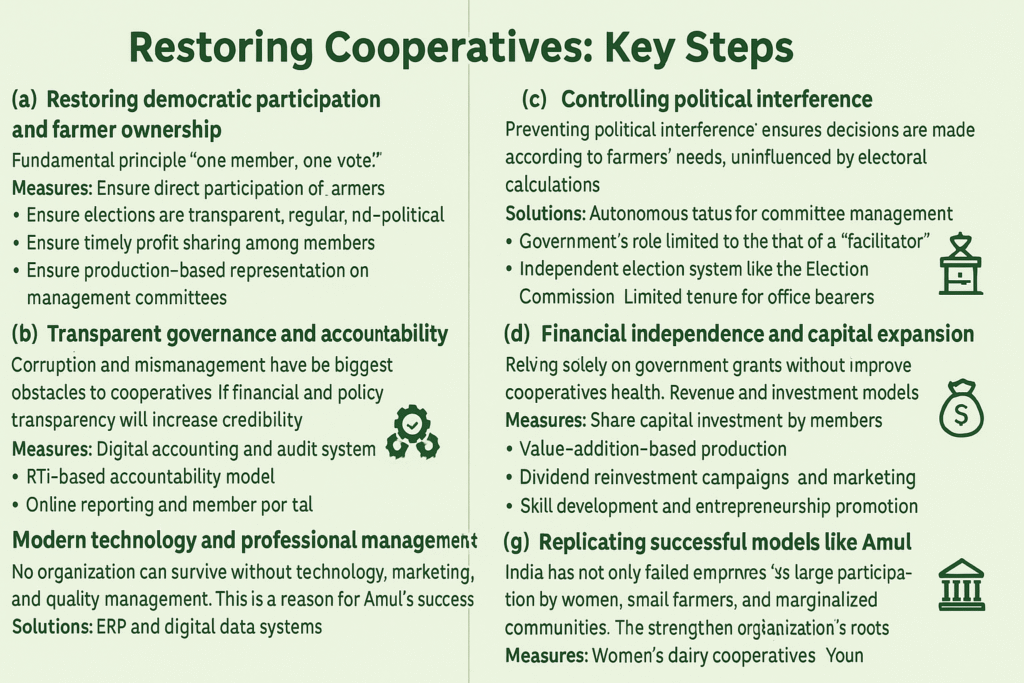
✅ (a) Restoring Democratic Participation and Farmer Ownership
The core principle of cooperatives is “One Member, One Vote.” Farmers must become decisive partners, not symbolic members.
- Ensure direct participation of farmers
- Transparent, regular, and non-political elections
- Timely profit distribution to members
- Production-based representation in management committees
✅ (b) Transparent Administration and Accountability
Credibility increases when financial and policy transparency is ensured.
- Digital accounting and audit systems
- RTI-based accountability framework
- Online reporting and member portals
- Timely accountability of board members
✅ (c) Controlling Political Interference
Decisions should reflect farmers’ needs, not electoral calculations.
- Autonomous status for committee management
- Government role limited to facilitation
- Independent electoral authority model
- Term limits for office bearers
✅ (d) Modern Technology and Professional Management
Technology, branding, and efficiency are essential for survival in today’s competitive environment.
- ERP and digital data systems
- Appointment of professional managers and experts
- Modernized production, processing, branding, and marketing
- E-commerce and app-based marketing adoption
✅ (e) Financial Independence and Capital Expansion
Revenue-driven models ensure sustainability and self-reliance.
- Member share capital investment
- Value-addition-based production
- Dividend reinvestment policies
- Utilization of bank-linked schemes and NABARD support
✅ (f) Ensuring Youth and Women’s Participation
Inclusive participation strengthens grassroots foundations.
- Women’s dairy cooperatives
- Youth leadership training
- Village-level cooperative education campaigns
- Skill development and entrepreneurship promotion
✅ (g) Replicating Successful Models
India has successful cooperative institutions that can serve as models for reform.
- Multi-level structure (Village → District → State)
- Member-based ownership
- Direct profit distribution
- Strong branding and enterprise-level governance
- Transparent decision-making systems
With democratic governance, transparency, financial independence, and professional management, cooperatives can once again become powerful engines of inclusive and sustainable development.
Restoring Democratic Participation and Farmer Ownership
The spirit of the cooperative movement lies in “democratic participation” and “member ownership.” When farmers actively participate in decision-making, cooperatives not only survive but become strong vehicles of rural development. However, over time, this democratic foundation has weakened, and many committees have become influenced by officials and external forces rather than members.
It is time to reconnect the cooperative model with its original grassroots roots.
🔹 Why is Democratic Participation Important?
- Cooperative societies are people-based institutions, not government departments.
- Decisions should be made from the bottom, not imposed from the top.
- Producers (farmers/milk producers) are the real owners.
- A sense of ownership makes farmers active and responsible.
- Economic benefits flow directly to members.
🔹 Reasons for the Current Decline
- Committee elections have become politicized.
- Member participation in meetings has decreased.
- Decision-making power is limited to a few individuals.
- Information about dividends and schemes does not reach members.
- Village-level committees have become inactive.
- Young farmers and women have been left out.
✅ Solution: Restore Democracy and Ownership
- Voting rights for active members only.
- Maintain a transparent membership list.
- Ensure digital and fair elections.
- Village participation before block or district decisions.
- Mandatory local meetings and Annual General Meetings (AGMs).
- Producer-based representation on boards and committees.
- Election of office bearers based on production or contribution.
- Special reservation or quota system.
- Integration of self-help groups into the cooperative structure.
- Information sharing through mobile apps and portals.
- Dividend, scheme, and payment details available online.
- Direct dividend transfer into bank accounts.
- Year-end profit share based on contribution percentage.
- Production-based bonus system.
- Village meetings, camps, and workshops for member empowerment.
- Cooperative leadership training programs.
🔹 Why is the Amul Model Inspiring?
Amul’s three-tier structure (Village Cooperative Society → District Union → State Union) continues to operate on strong democratic principles:
- ✔ Farmers are the owners
- ✔ Farmers are the decision-makers
- ✔ Profits flow directly to members
- ✔ Producer interests are prioritized over politics
Restoring democratic participation and farmer ownership is not just reform—it is a return to the foundational values that made cooperatives successful in the first place.
Transparent Governance and Accountability
The credibility and sustainability of cooperatives depend on how transparent, accountable, and member-centric their governance systems are. When societies function fairly, farmers, laborers, and small producers participate with confidence. But where transparency ends, corruption, favoritism, and economic decline begin.
Therefore, transparent governance and accountability are essential for the revival and long-term success of cooperatives.
🔹 Problems Caused by Lack of Transparency
- Misappropriation of funds
- Manipulation of accounts
- Delays in dividend payments
- Registers not updated regularly
- Superficial annual audits
- Lack of digital record systems
- Schemes, benefits, and policies not disclosed
- Meetings not reported on time
- Decisions limited to a few individuals
- Administrative or political pressure in decisions
- Farmer representatives not heard
- Officials not held responsible
- Complaints unresolved
✅ Solution: Establish Transparent and Accountable Administration
- ERP and online accounting systems
- Public annual audit reports
- Compliance with NABARD/NCDC standards
- Cashless payments
- Dividends directly deposited into member accounts
- Online data recording
- Updates through mobile apps, SMS, and websites
- Access to meeting records, dividend details, and procurement data
- Direct procurement from producers
- Elimination of intermediaries
- Public display of price lists
- Helpline number or digital complaint portal
- Time-bound grievance redressal system
- Annual performance review
- Term limits
- Removal provisions for poor performance
- Mandatory AGM and monthly meetings
- Written records of decisions
- Signatures of attending members
- External expert auditors
- Timely inspections
- Audit reports presented to members
🔹 Example: Success of Amul and IFFCO
- At Amul, all payments are digital
- Purchase, sales, and bonus records are maintained online
- Farmers receive updates through apps, SMS, and portals
- Audit and meeting records are publicly maintained
Transparent governance builds trust. Trust builds participation. And participation strengthens cooperatives into sustainable, people-driven economic institutions.

Amazon Product
Click below to view full product details and the latest price on Amazon.
👉 View on Amazon*As an Amazon Associate, I earn from qualifying purchases.
Control Over Political Interference
The greatest strength of the cooperative movement is its democratic organization. However, when political influence increases, the autonomy, transparency, and purpose of these institutions begin to weaken. Political interference has alienated many cooperatives from farmers and members. Therefore, these institutions must be repositioned not as “political platforms” but as “member-owned economic organizations.”
🔹 How Does Political Interference Harm?
- Officials selected on political influence rather than merit
- External pressure on membership lists and voting
- Committee earnings diverted to political propaganda or personal gain
- Development and welfare activities neglected
- The united voice of farmers and producers ignored
- Policies designed for political benefit rather than farmer welfare
- Appointments based on recommendations or connections
- Efficiency and accountability weakened
- Committees dependent on political or government dictates
- Independent business expansion reduced
✅ Solution: Practical Measures to Limit Political Control
- Committees operate under a “Members Council”
- Clear legal prohibition of political party interference
- Cooperative Election Commission or third-party monitoring
- Digital voting and member verification systems
- Production/membership-based eligibility criteria
- Maximum tenure and age limits
- “No political posts + no cooperative posts” policy
- Use of member capital and production income instead of grants
- Dividends directly transferred to members
- Regular and recorded meetings
- Farmer consultation before major decisions
- Amend cooperative constitutions to safeguard autonomy
- Disqualification provisions for political interference
- “No leaders, only member leadership” approach
- Decisions guided by production and economic priorities
🔹 Inspiring Examples
Farmer-based management and distance from political control helped cooperatives become a global model.
✅ IFFCOJoint governance by farmer representatives and professionals created a self-sustaining and profitable organization.
✅ Karnataka’s Nandini ModelRapid growth achieved through committee- and member-based decisions rather than excessive government control.
Limiting political interference restores autonomy, strengthens trust, and ensures that cooperatives truly serve their members.
Conclusion
India’s cooperative system is not merely an economic structure; it is the lifeline of social justice, collective ownership, and rural development. Successful models such as Amul have demonstrated that when farmers become owners, partners, and decision-makers, cooperatives evolve beyond institutions and transform into vehicles of economic and social revolution.
Cooperatives weakened when they became alienated from farmers and fell victim to politics, corruption, and mismanagement. Yet the solution lies within the system itself — re-centering farmers, embracing technology, strengthening transparency, and adapting cooperative frameworks to the demands of the modern market economy.
As India advances toward the vision of “Self-Reliant India,” rural employment expansion, agribusiness growth, and organized production, the role of cooperatives becomes more vital than ever. The creation of the Ministry of Cooperation and the vision of “Prosperity through Cooperation” signal a renewed phase of revival and transformation.
If democratic, transparent, and economically sustainable cooperative models—based on successful experiences like Amul—are replicated across states, they will not only enhance farmers’ incomes but also empower rural communities, promote self-reliance, and strengthen organized rural enterprise.
References / Sources
1. Government Documents and Policies
- Cooperative Societies Acts, 1904 and 1912
- National Cooperative Development Corporation (NCDC) Reports
- Ministry of Cooperation, Government of India – Policy Documents
- NABARD Annual Reports
- Provisions Related to Cooperatives in Five-Year Plans
2. Institutional Studies and Reports
- Official Website and Annual Reports of Amul (GCMMF)
- “White Revolution and Cooperative Movement” – Memoirs of Verghese Kurien
- Cooperative Policy and Organizational Model of IFFCO
- Publications of State Dairy Federations
3. Research and Academic Sources
- Research Papers of the Indian Council of Agricultural Research (ICAR)
- Tata Institute of Social Sciences (TISS) – Cooperative Studies
- Case Studies of the Indian Institute of Management Ahmedabad (IIM-A)
4. Statistics and Current Data Sources
- Ministry of Agriculture and Farmers Welfare Website
- National Statistical Office (NSO) Data
- Ministry of Rural Development MIS Reports
- Annual Status Report of the Dairy and Agricultural Marketing Board
5. News and Analysis Sources
- The Hindu Business Line
- Down to Earth
- Rural Development Magazine
- Indian Express – Articles on the Cooperative Movement
6. Local and Regional Examples
- Case Report of the Anand (Gujarat) Dairy Union
- Warana Cooperative Model (Maharashtra)
- Karnataka Milk Federation (Nandini) Report
- Kerala Dairy Movement