
A Detailed Introduction to World War II
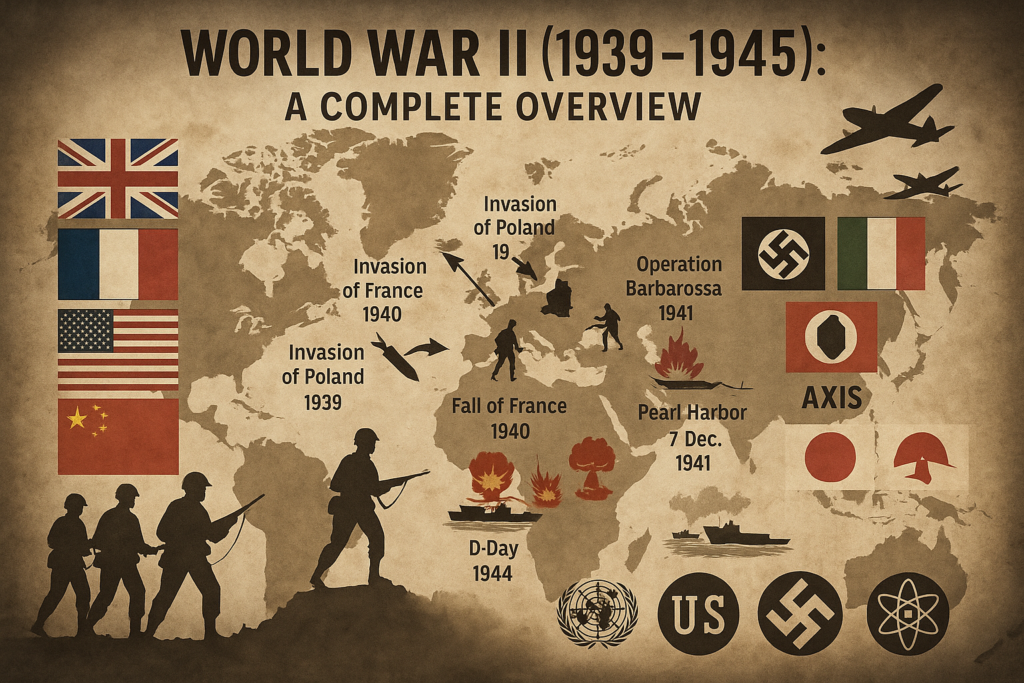
The Second World War (1939–1945) was one of the most destructive and widespread conflicts in human history. Almost all major nations took part in this war, divided into two main groups—the Allied Powers and the Axis Powers.
Major Causes of the War
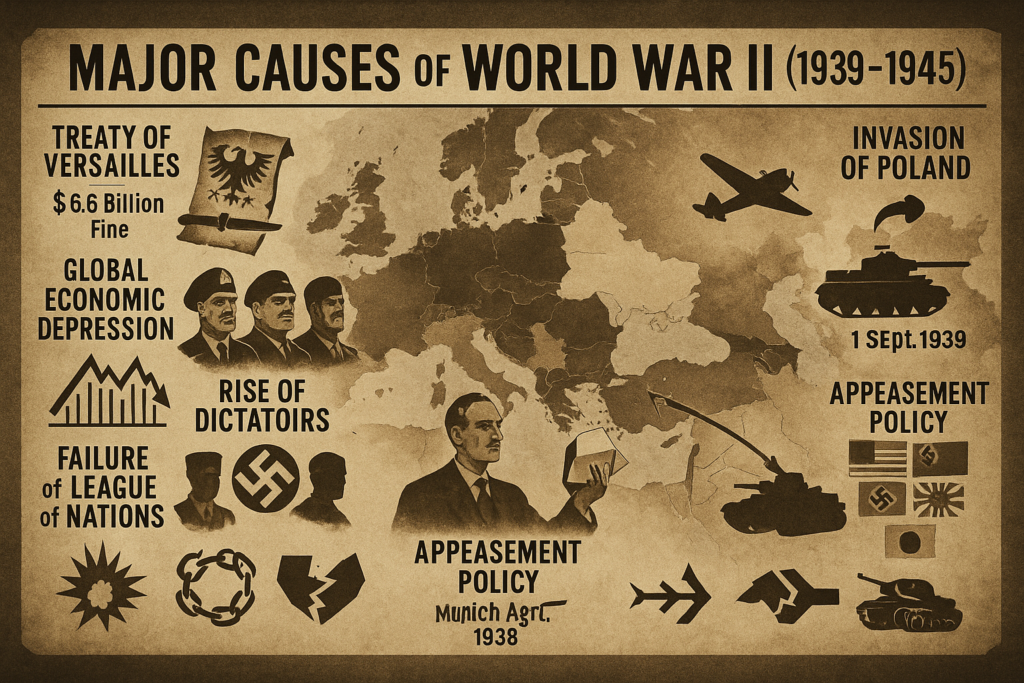
- Treaty of Versailles (1919): The treaty imposed harsh penalties on Germany, increasing resentment and instability.
- Rise of Dictatorship: Adolf Hitler in Germany, Benito Mussolini in Italy, and military governments in Japan adopted aggressive expansionist policies.
- Colonial Competition: Rivalries over land and resources in Europe and Asia increased tensions among major powers.
- Unbalanced Global Politics: The League of Nations failed to maintain peace due to its weak structure.
- Invasion of Poland (1939): Germany invaded Poland on 1 September 1939, leading Britain and France to declare war on Germany.
Countries and Their Factions Involved
✔ Easy to use for daily needs
✔ Great value for money
✔ Trusted choice on Amazon
1. Allied Powers
- Britain
- France
- Soviet Union (after 1941)
- United States (after 1941)
- China
2. Axis Powers
- Germany
- Italy
- Japan
Major Events of the War
- 1939: Germany attacks Poland – the beginning of World War II.
- 1940: German occupation of France; Germany takes control of Paris.
- 1941: Operation Barbarossa – Germany invades the Soviet Union.
- 7 December 1941: Japan attacks Pearl Harbor – the United States enters the war.
- 1942: Battle of Stalingrad – Soviet victory shifts the momentum of the war.
- 6 June 1944: D-Day (Normandy Landings) – Allied forces land in German-occupied France.
- 30 April 1945: Adolf Hitler commits suicide – Germany moves toward surrender.
- 8 May 1945: V-E Day (Victory in Europe Day) – Germany surrenders.
- 6 & 9 August 1945: Atomic bombs dropped on Hiroshima and Nagasaki – Japan surrenders.
- 2 September 1945: Japan formally surrenders – the war ends.
Results and Impact
- Establishment of the United Nations (UN): Formed on 24 October 1945 to promote world peace.
- Rise of Two Superpowers: The United States and the Soviet Union emerged as global superpowers, leading to the Cold War.
- Reorganization of Europe: Germany was divided, and new governments were formed across Europe.
- Beginning of the Atomic Age: Nuclear weapons changed the nature of future warfare.
- Massive Loss of Life and Economic Damage: Around 70 million people died, and the economies of many nations collapsed.
Conclusion
The Second World War had a profound impact on global politics, economy, and society. The world became divided into two major blocs—one led by the United States and the other by the Soviet Union. The war highlighted the need for strong international institutions, leading to the formation of the United Nations. As one of the biggest tragedies in human history, the war reminded the world of the importance of peace, cooperation, and diplomacy.
Major Causes of The War
Detailed Analysis of the Main Causes of World War II
The economic, political, and social causes behind the Second World War (1939–1945) were complex. The war was not the result of a single incident but the outcome of long-standing international conflicts and imbalances that had developed over decades.
1. Treaties of World War I and the Treaty of Versailles (1919)
After World War I (1914–1918), the defeated nations—especially Germany—were punished through extremely harsh treaties.
Harsh Provisions of the Treaty of Versailles
- Heavy Fine: Germany had to pay £6.6 billion, crippling its economy.
- Military Restrictions: The German army was limited to 100,000 soldiers.
- Territorial Losses: Germany lost Alsace-Lorraine to France and eastern regions to Poland.
- National Humiliation: Germany was blamed solely for starting the war.
Result
- Resentment and nationalism increased among Germans.
- Leaders like Hitler rose by exploiting public anger.
- Germany began military expansion seeking revenge.
2. Rise of Dictatorial Leaders and Expansionist Policies
(i) Germany – Adolf Hitler and Nazism
- Hitler rose to power in 1933, defying the Treaty of Versailles.
- Adopted the policy of Lebensraum (living space) to expand into Eastern Europe.
(ii) Italy – Benito Mussolini and Fascism
- Mussolini wanted to revive the Roman Empire.
- Invaded Ethiopia in 1935 and expanded military forces.
(iii) Japan – Militaristic Government and Expansion
- Occupied Manchuria in 1931.
- Launched full-scale war on China in 1937.
- Aimed to build a vast Asian empire.
3. Economic Depression and Global Crisis (Great Depression, 1929)
- The 1929 stock market crash collapsed the global economy.
- Unemployment and poverty rose across Europe and America.
- People began trusting aggressive leaders like Hitler and Mussolini.
- Germany pursued economic recovery through militarization.
4. Failure of the League of Nations
- The League failed to stop aggressive nations such as Germany, Italy, and Japan.
- No strong action was taken against Japan’s invasion of Manchuria (1931).
- No effective response to Italy’s attack on Ethiopia (1935).
- This emboldened dictators to continue expansion.
5. Military Alliances and Polarization
During the 1930s, the world was divided into two blocs:
Allied Powers
Britain, France, Soviet Union (later joined by the United States).
Axis Powers
Germany, Italy, Japan.
Hitler and Mussolini formed the Rome-Berlin Axis (1936), followed by the Tripartite Pact with Japan (1940), increasing global instability.
6. Appeasement Policy and Weak Responses
- Britain and France tried to appease Hitler instead of resisting him.
- Munich Agreement (1938) allowed Hitler to annex the Sudetenland from Czechoslovakia.
- This convinced Hitler he could expand without facing war.
7. Germany’s Attack on Poland (1 September 1939)
Nazi-Soviet Non-Aggression Pact (23 August 1939)
Germany and the Soviet Union secretly agreed to divide Poland and Eastern Europe.
Invasion
- Germany invaded Poland on 1 September 1939.
- Britain and France declared war on 3 September 1939.
Conclusion
World War II had both long-term and immediate causes. The harsh treaties after WWI, rising nationalism, aggressive dictators, global economic depression, weak international institutions, and appeasement collectively led to conflict. Germany’s invasion of Poland finally triggered the global war. World War II deeply transformed international politics, the economy, and relations between nations.
Treaties of World War I
A detailed explanation of the treaties that shaped post–World War I Europe and contributed to World War II.
1. Treaty of Versailles – 28 June 1919
This treaty was signed between Germany and the Allied powers: Britain, France, and the United States.
Key Terms
(i) Territorial Losses
- Alsace-Lorraine returned to France.
- Parts of western Poland granted to Poland.
- Rhineland declared demilitarized.
- Germany lost all overseas colonies.
(ii) Economic Penalties
- £6.6 billion compensation.
- Saar Basin placed under League control for 15 years.
✔ Easy to use and reliable
✔ Suitable for daily use
✔ Value for money choice
(iii) Military Restrictions
- Army limited to 100,000 soldiers.
- No submarines or air force allowed.
- Ban on production of heavy weapons.
(iv) War Guilt Clause
Germany was held responsible for starting World War I.
2. Treaty of Saint-Germain – 10 September 1919
Signed with Austria.
- The Austro-Hungarian Empire was dissolved.
- Austria’s army was limited to 30,000 soldiers.
- Austria was forbidden to unite with Germany.
3. Treaty of Trianon – 4 June 1920
Signed with Hungary.
- Hungary lost two-thirds of its territory.
- Army reduced to 35,000 soldiers.
4. Treaty of Neuilly – 27 November 1919
Signed with Bulgaria.
- Bulgaria lost parts of Thrace, Yugoslavia, and Romania.
- Army limited to 20,000 soldiers.
5. Treaty of Sèvres – 10 August 1920
Signed with the Ottoman Empire (Turkey).
- Partition of the empire among Britain, France, Greece, and Italy.
- Middle Eastern territories divided between Britain and France.
- Turkish army severely restricted.
Result
The harsh terms of these treaties caused political instability, economic suffering, and widespread resentment—creating conditions that fueled World War II.
The Rise of Dictatorship
Reasons Behind the Rise
- Post-war political instability.
- Great Depression (1929).
- Harsh treaties imposed after WWI.
- Rise of nationalism and militarism.
- Weak democratic governments.
Major Dictators
Adolf Hitler – Germany
- Rose to power in 1933.
- Aimed to expand German territory.
Benito Mussolini – Italy
- Established Fascist rule in 1922.
- Promoted imperial expansion.
Joseph Stalin – Soviet Union
- Strengthened communism.
- Implemented Five-Year Plans.
Francisco Franco – Spain
Rose to power in the Spanish Civil War (1936).
Japan – Military Rule
- Occupied Manchuria in 1931.
- Attacked Pearl Harbor in 1941.
Effects of Dictatorship
- Led to World War II.
- Decline of democracy in many nations.
- Mass killings under Hitler and Stalin.
- Post-war creation of the UN.
Colonial Competition
Introduction
Colonial competition refers to the rivalry between European powers to control colonies in Africa, Asia, and the Americas. This rivalry increased tensions and contributed to both World War I and World War II.
Major Reasons
(i) Industrial Revolution
European nations needed raw materials and new markets.
(ii) Control of Trade Routes
Countries competed for control of strategic sea routes such as the Suez Canal.
(iii) Nationalism and Imperial Ambitions
European powers wanted to expand their empires.
(iv) Military Importance
Colonies served as military bases and strategic points.
(v) Population Pressure
Growing European populations required new lands for settlement.
Effects of Colonial Rivalry
- Contributed to the outbreak of World War I.
- Led to nationalist movements in colonies.
- Caused exploitation and racial discrimination.
- Played a role in World War II, especially in Asia.
Unbalanced Global Politics
Introduction
Unbalanced global politics occur when power is distributed unequally among nations, causing conflicts, instability, and competition.
Major Reasons
- Unequal distribution of power.
- Colonial legacy.
- Influence of international organisations.
- Economic inequality.
- Nuclear weapons imbalance.
- Regional conflicts.
- Inequality of natural resources.
Effects
- Powerful countries dominate weaker ones.
- Increased military alliances and conflicts.
- Rise of terrorism.
- Environmental challenges.
Solutions
- Strengthening global balance of power.
- Reforming the UN and international institutions.
- Reducing global economic inequality.
- Limiting nuclear and military expansion.
- Cooperation to protect the environment.
German Invasion of Poland (1939)
Introduction
On 1 September 1939, Nazi Germany invaded Poland, initiating the Second World War. This attack marked the first major use of the Blitzkrieg strategy (“lightning war”).
Main Reasons for the Invasion
(i) Treaty of Versailles
Germany wanted to reclaim territories lost after WWI.
(ii) Lebensraum Policy
Hitler aimed to expand eastward for “living space”.
(iii) German-Soviet Pact (23 August 1939)
Germany and the Soviet Union secretly agreed to divide Poland.
(iv) Hitler’s Demands
Control of Danzig port and the Polish Corridor.
(v) Failed British–French Policies
Hitler’s earlier expansions were tolerated, encouraging further aggression.
The Invasion – 1 September 1939
Blitzkrieg Strategy
Germany used fast air attacks, tanks, and infantry to overwhelm Poland.
Initial Attack
- Luftwaffe bombed major Polish cities.
- Soviet Union invaded eastern Poland on 17 September.
- Warsaw surrendered on 27 September 1939.
Consequences
- Britain and France declared war on Germany.
- Poland was divided between Germany and the Soviet Union.
- Widespread persecution of Jews and Polish civilians.
- Temporary Germany–Soviet friendship ended with Operation Barbarossa (1941).
Conclusion
The invasion of Poland laid the foundation for the Second World War. Hitler’s expansionism and failed diplomatic efforts by Britain and France pushed the world into a devastating conflict.
Countries and Their Factions Involved in the War
Countries and Their Groups Involved in World War II
In World War II (1939–1945), two major factions fought against each other: the Allied Powers and the Axis Powers. The war affected more than 100 countries, making it the largest and most widespread conflict in global history.
1. Allied Powers
Key Countries and Their Roles
| Country | Date of Entry | Prominent Leaders | Role |
|---|---|---|---|
| Britain | 3 September 1939 | Winston Churchill (1940–1945) | First to declare war on Germany; key role in Dunkirk evacuation and D-Day. |
| France | 3 September 1939 | Charles de Gaulle (Exile Govt.) | Occupied by Germany in 1940; Free French Forces fought with the Allies. |
| Soviet Union (USSR) | 22 June 1941 | Joseph Stalin | Joined Allies after Germany attacked; major role in Stalingrad and Berlin capture. |
| United States of America (USA) | 7 December 1941 | F.D. Roosevelt, Harry S. Truman | Joined after Pearl Harbor; first nation to use atomic bombs. |
| China | 7 July 1937 | Chiang Kai-shek | Fought Japan on the Asian front; slowed Japanese expansion. |
| Canada | 10 September 1939 | Mackenzie King | Economic and military support; participated in Normandy landings. |
| Australia | 3 September 1939 | Robert Menzies | Fought in European and Pacific theatres. |
| New Zealand | 3 September 1939 | Michael Joseph Savage | Fought in the Pacific and the Italy campaign. |
| India (British India) | 3 September 1939 | Lord Linlithgow | Millions of Indian soldiers fought under British command. |
| Brazil | 1942 | Getulio Vargas | Sent troops for the Italian campaign. |
Objectives of the Allied Powers
- Defeat Nazi Germany, Fascist Italy, and Imperial Japan.
- Defend democracy and freedom in Europe and Asia.
2. Axis Powers
Key Countries and Their Roles
| Country | Date of Entry | Prominent Leaders | Role |
|---|---|---|---|
| Germany | 1 September 1939 | Adolf Hitler | Started the war by invading Poland; occupied most of Europe; responsible for the Holocaust. |
| Italy | 10 June 1940 | Benito Mussolini | Fought in North Africa and Europe; surrendered in 1943. |
| Japan | 7 December 1941 | Hideki Tojo | Attacked Pearl Harbor; expanded aggressively in Asia and the Pacific. |
| Hungary | 1940 | Miklos Horthy | Supported Germany; switched to Allies in 1944. |
| Romania | 1940 | Ion Antonescu | Fought beside Germany against USSR. |
| Bulgaria | 1941 | Boris III | Allied with Germany; later joined the Allies. |
Objectives of the Axis Powers
- Germany: Establish control over Europe and enforce Aryan supremacy.
- Japan: Create an empire across Asia and the Pacific.
- Italy: Revive the Roman Empire under Mussolini.
3. Other Partner Countries and Their Roles
| Country | Group | Role |
|---|---|---|
| Spain | Pro-Axis (Not Official) | Supported Hitler and Mussolini but did not formally enter the war. |
| Finland | Supported Axis | Fought USSR alongside Germany. |
| Sweden | Neutral | Provided industrial and economic support to Germany. |
| Switzerland | Neutral | Officially neutral, provided covert aid to the Allies. |
| Turkey | Joined Allies in 1945 | Neutral for most of the war, later supported Allies. |

4. Major Battlegrounds Between the Allies and Axis Powers
(i) European Theatre
- Germany vs Britain, France, USSR, USA
- Major battles: D-Day (Normandy), Battle of Stalingrad
(ii) Pacific Theatre
- Japan vs USA, China, Britain, Australia
- Major events: Pearl Harbor, Hiroshima–Nagasaki
(iii) North Africa & Mediterranean
- Germany & Italy vs Britain & USA
- Major battle: El Alamein, Occupation of Sicily
5. End of the War & Victory of the Allies
- 1943: Italy surrenders.
- April 1945: Hitler commits suicide.
- May 1945: Germany surrenders (V-E Day).
- August 1945: USA drops atomic bombs on Japan.
- 2 September 1945: Japan surrenders; WWII ends.
Conclusion
World War II ended with the victory of the Allied Powers and the defeat of the Axis Powers. The war reshaped global politics and led to the establishment of the United Nations (UN) to prevent such conflicts in the future.
Allied Powers
Detailed Description of Allied Powers
The Allied Powers fought against Nazi Germany, Fascist Italy, and Imperial Japan. The alliance grew over time and played a major role in ending the war in 1945.
1. Origin of the Allies
(i) Effects of World War I
- The Treaty of Versailles created resentment in Germany.
- The rise of fascism caused instability in Europe and Asia.
(ii) Expansionism of Germany, Italy, and Japan
- Germany occupied Austria (1938) and Czechoslovakia (1939).
- Italy invaded Ethiopia (1935).
- Japan occupied Manchuria (1931).
2. Major Countries of the Allies & Their Roles
(i) United Kingdom
- Declared war on Germany on 3 September 1939.
- Led by Winston Churchill from 1940.
(ii) France
- Occupied by Germany in 1940.
- Free French Forces led by Charles de Gaulle continued to fight.
(iii) Soviet Union (USSR)
- Joined Allies after Germany attacked in 1941.
- Played a decisive role in Stalingrad and Berlin.
(iv) United States (USA)
- Entered the war after the Pearl Harbor attack (1941).
- Used atomic bombs to force Japan’s surrender.
(v) China
- Fought Japan since 1937.
- Major front of the Asian theatre.
3. Other Allied Countries
- Canada, Australia, New Zealand, India.
- Brazil, South Africa.
4. Major Battles Won by the Allies
| Battle | Year | Participants | Result |
|---|---|---|---|
| Battle of Britain | 1940 | UK vs Germany | British victory |
| Battle of Stalingrad | 1942–43 | USSR vs Germany | Germany defeated |
| El Alamein | 1942 | UK vs Germany | Axis pushed from North Africa |
| D-Day (Normandy) | 1944 | USA, UK, Canada | France liberated |
5. Victory of the Allies
- Germany surrenders on 8 May 1945 (V-E Day).
- Japan surrenders on 2 September 1945 after atomic bombings.
Conclusion
The Allied Powers successfully defended democracy and freedom, and reshaped world politics after defeating the Axis Powers.
Axis Powers
Detailed Description of Axis Powers
1. Origin of the Axis Powers
(i) Effects of World War I
- Germany suffered harsh penalties under the Treaty of Versailles.
- Italy felt excluded from the benefits of WWI victory.
(ii) Expansionist Agenda
- Germany annexed Austria & Czechoslovakia.
- Italy invaded Ethiopia & Albania.
- Japan expanded into China and Asia.
(iii) Formal Formation
- Rome-Berlin Axis (1936)
- Anti-Comintern Pact (1936)
- Tripartite Pact (1940)
2. Major Axis Countries & Their Roles
Nazi Germany
- Led by Adolf Hitler.
- Started WWII by invading Poland.
Fascist Italy
- Led by Benito Mussolini.
- Dreamed of a New Roman Empire.
Imperial Japan
- Led by Hideki Tojo.
- Attacked Pearl Harbor and expanded across Asia.
3. Allies Supporting Axis Powers
- Hungary
- Romania
- Bulgaria
- Finland
4. Major Axis Battles
| Battle | Year | Result |
|---|---|---|
| Invasion of Poland | 1939 | Start of WWII |
| Operation Barbarossa | 1941 | Massive German offensive on USSR |
| Stalingrad | 1942 | Major German defeat |
| Hiroshima–Nagasaki | 1945 | Japan surrenders |
5. Defeat of the Axis Powers
- Italy surrenders (1943).
- Germany defeated (1945).
- Japan surrenders (September 1945).
Conclusion
The Axis Powers attempted global domination but were ultimately defeated by the combined strength of the Allied Powers. The war led to the formation of the United Nations to maintain global peace.
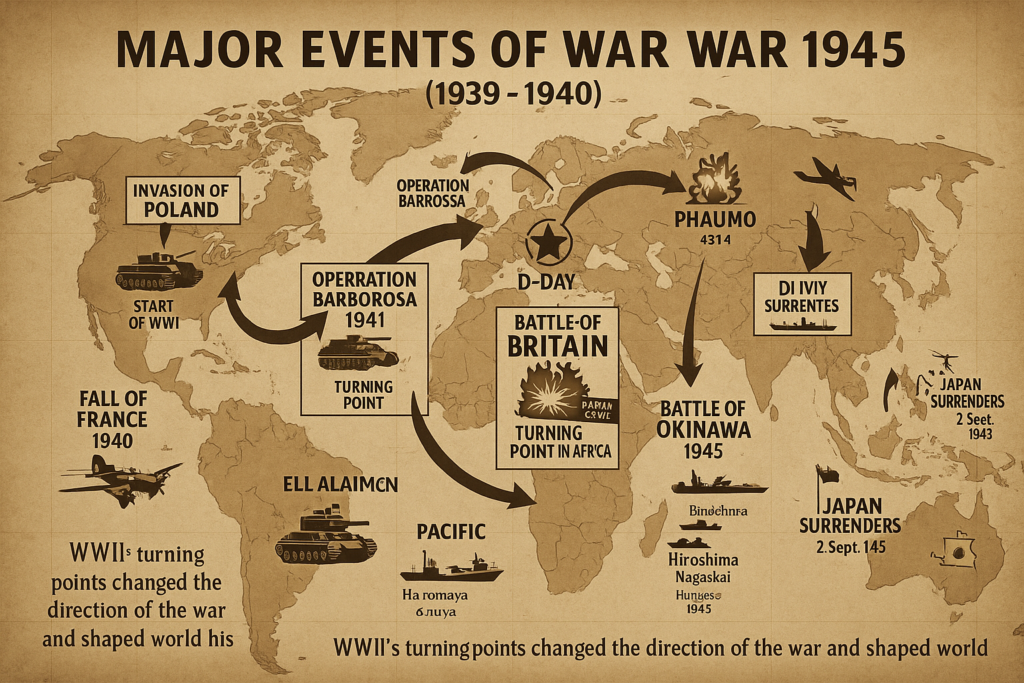
The Major Events of the War
Major Events of World War II
The Second World War (1939–1945) was the most destructive conflict in human history. Battles were fought across Europe, Africa, Asia, and the Pacific. The war witnessed several major turning points that shaped its direction and final outcome.
1. Beginning of the War (1939–1940)
(i) German Invasion of Poland – 1 September 1939
- Germany attacked Poland using the Blitzkrieg (lightning warfare) strategy.
- On 3 September 1939, Britain and France declared war on Germany.
- This marked the formal beginning of World War II.
(ii) Soviet Occupation of Eastern Poland – 17 September 1939
- Under the Molotov–Ribbentrop Pact, Germany and the Soviet Union divided Poland.
- The USSR also captured Finland, the Baltic states, and parts of Romania.
(iii) German Invasion of Western Europe – 1940
- April 1940: Germany attacked and occupied Denmark and Norway.
- May 1940: Germany captured the Netherlands, Belgium, and Luxembourg.
- 14 June 1940: Paris fell to Germany; France soon surrendered.

✔ Easy & convenient to use
✔ Great value for money
✔ Popular choice among buyers
(iv) Battle of Britain – July to October 1940
- Germany tried to weaken Britain through massive air attacks.
- Britain’s Royal Air Force (RAF) inflicted heavy losses on the Luftwaffe.
- This was Germany’s first major defeat and a crucial turning point.
2. Expansion of the War (1941–1942)
(i) Operation Barbarossa – 22 June 1941
- Germany launched a massive invasion of the Soviet Union.
- Despite early success, German forces were halted by Soviet resistance and winter.
- This became Germany’s biggest strategic mistake.
(ii) Attack on Pearl Harbor – 7 December 1941
- Japan attacked the U.S. naval base at Pearl Harbor, Hawaii.
- On 8 December 1941, the United States declared war on Japan.
- The U.S. officially entered World War II.
(iii) Japanese Expansion in the Pacific (1941–1942)
- Japan rapidly captured the Philippines, Malaya (Malaysia), Singapore, Indonesia, and Burma.
- Japan became the dominant power in the Pacific region.
3. Turning Points of the War (1942–1943)
(i) Battle of Midway – June 1942
- The U.S. Navy defeated Japan near Midway Island.
- This was a decisive turning point in the Pacific War.
(ii) Battle of Stalingrad – August 1942 to February 1943
- Germany tried to capture the Soviet city of Stalingrad.
- The Soviet Red Army encircled and defeated German forces.
- On 2 February 1943, Germany surrendered.
- This is considered the most important turning point of the war.
(iii) Battle of El Alamein – October 1942
- Britain defeated Germany and Italy in North Africa.
- This victory pushed Axis forces out of Africa.
4. The Allied Counteroffensive (1944–1945)
(i) D-Day – Normandy Landings – 6 June 1944
- U.S., British, and Canadian forces landed on the beaches of Normandy, France.
- This was the largest amphibious invasion in history.
- It marked the beginning of Germany’s downfall in Europe.
(ii) Battle of Leyte Gulf – October 1944
- The U.S. defeated Japan’s navy decisively.
- The Philippines were liberated.
(iii) Battle of the Bulge – December 1944 to January 1945
- Germany launched its last major offensive in the Ardennes region.
- The Allies eventually stopped the attack and pushed Germany back.
(iv) Soviet Capture of Berlin – April 1945
- The Soviet Red Army launched a massive assault on Berlin.
- On 30 April 1945, Adolf Hitler committed suicide.
- Germany surrendered on 8 May 1945 (V-E Day).
5. Collapse of Japan and End of the War (1945)
(i) Battle of Okinawa – April to June 1945
- The U.S. captured Okinawa, a vital island close to Japan.
(ii) Atomic Bombings – Hiroshima and Nagasaki (6 & 9 August 1945)
- The U.S. dropped atomic bombs on Hiroshima and Nagasaki.
- Hundreds of thousands of civilians were killed.
- Japan was left completely devastated.
(iii) Surrender of Japan – 2 September 1945
- Japan formally surrendered aboard the USS Missouri.
- This marked the official end of World War II.
Conclusion
The events of the Second World War transformed world history. The war led to the creation of the United Nations, the rise of the Cold War, and inspired independence movements across Asia and Africa. It proved that dictatorship and aggressive expansion lead only to destruction, while peace and cooperation are essential for global stability.
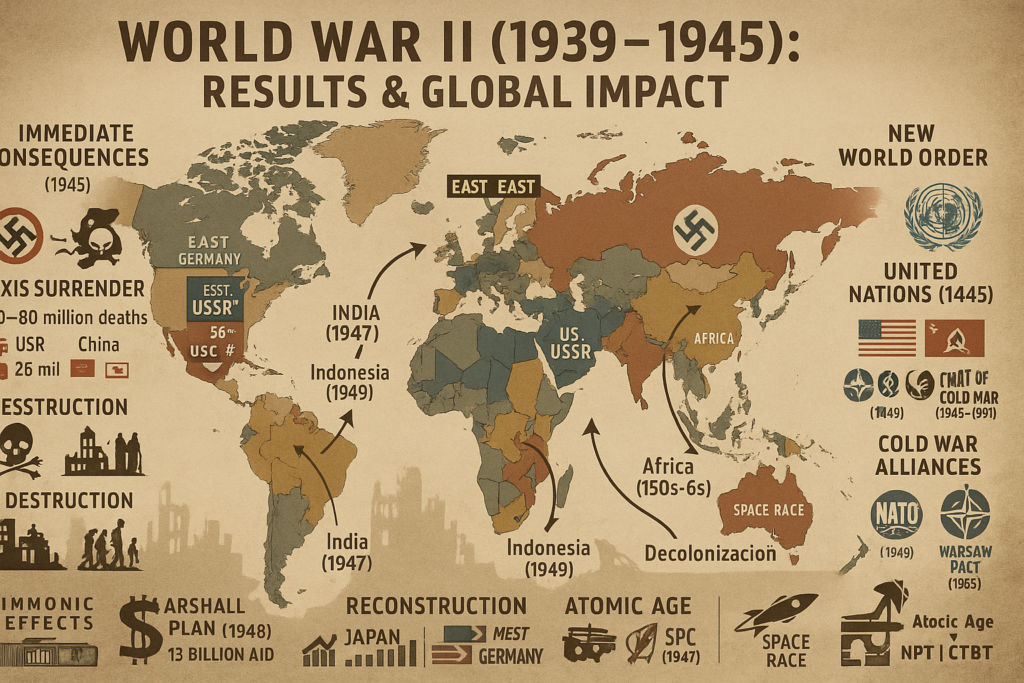
World War II Results and Effects
World War II (1939–1945) was the deadliest and most transformative war in human history. With an estimated 70–80 million deaths, this war brought profound changes to global politics, the economy, science, society, and the ideological balance of the world. The war reshaped entire continents, created new superpowers, accelerated technological progress, and laid the foundation for modern international relations. The major results and effects of this war are explained in detail below.
1. Immediate Consequences of the War
(i) Defeat and Surrender of the Axis Powers
- Germany surrendered in May 1945 after Adolf Hitler committed suicide in Berlin on 30 April 1945.
- Japan surrendered on 2 September 1945 following the atomic bombings of Hiroshima and Nagasaki by the United States.
- The surrender of both Germany and Japan marked the official end of World War II.
- With their surrender, Axis leadership collapsed, military expansion ended, and democratic governments began to take shape in these nations.
(ii) Huge Loss of Life and Destruction
- Approximately 70–80 million people were killed—nearly 3–4% of the global population at the time.
- The Soviet Union suffered the highest loss, with nearly 26 million deaths.
- China, Germany, Japan, Poland, and Yugoslavia also faced large-scale civilian and military casualties.
- Massive destruction took place:
- Cities were reduced to rubble.
- Industrial areas, hospitals, schools, and transport systems were devastated.
- Millions became refugees, homeless, and displaced.
(iii) Political Changes in Europe and Asia
- Germany was divided into East Germany (Soviet-controlled) and West Germany (controlled by the US, Britain, and France).
- Dictatorships ended in Italy, Germany, and Japan. Democratic reforms were introduced.
- In Asia and Africa, colonial empires weakened, leading to independence movements in India, Indonesia, Vietnam, and many African nations.
2. Impact on World Politics
(i) Establishment of the United Nations (1945)
- The UN was formally established on 24 October 1945 to prevent future wars.
- The UN Security Council was formed with five permanent members: the US, USSR (now Russia), Britain, France, and China.
- The UN became the world’s most important organization for peacekeeping, diplomacy, humanitarian aid, and human rights protection.
(ii) Emergence of the USA and USSR as Superpowers
- The war destroyed the economic and military strength of major European powers.
- The United States and the Soviet Union emerged as the two dominant powers with:
- the world’s largest armies
- nuclear capabilities
- advanced industries and technology
- This dual power structure created a bipolar world.
(iii) Beginning of the Cold War
- Ideological rivalry between:
- Capitalist USA
- Communist Soviet Union
- The Cold War lasted nearly 45 years (1945–1991).
- Military alliances formed:
- NATO (1949) – led by the US.
- Warsaw Pact (1955) – led by the USSR.
- The Cold War influenced global politics, proxy wars, espionage, and technological competition.
3. Economic Impact
(i) Collapse of Europe’s Economy
- Industrial production in Europe fell by 50–70%.
- Railways, bridges, ports, mines, and factories were destroyed.
- Millions faced unemployment, poverty, and famine.
(ii) Marshall Plan (1948)
- The United States launched the Marshall Plan to rebuild Europe.
- About $13 billion were provided as economic aid.
- This revived European industry, reduced hunger, and strengthened democratic governments.

✔ Easy & convenient for everyday use
✔ Great value for money
✔ Trusted choice by customers
(iii) Economic Rise of the USA
- The US emerged as the world’s largest economic power.
- American industries, technology, and agriculture expanded rapidly.
- The US dollar became the world’s leading currency.
(iv) Reconstruction of Japan and Germany
- The US assisted in rebuilding Japan and West Germany.
- Both countries adopted new constitutions and modern industries.
- By the 1960s, Japan and West Germany became major global economies.
4. Social and Cultural Impact
(i) Human Rights Focus and War Crimes Trials
- The Holocaust shocked the world—6 million Jews were murdered by the Nazis.
- Nuremberg Trials (1945–46) punished Nazi leaders for genocide and war crimes.
- Tokyo Trials (1946–48) prosecuted Japanese war criminals.
- These trials strengthened the global movement for human rights.
(ii) End of Colonialism
- The weakening of European powers led to widespread decolonization.
- India and Pakistan gained independence in 1947.
- Dozens of African and Asian countries became independent in the 1950s and 1960s.
(iii) Empowerment of Women
- Women played major roles in wartime industries, medical services, and administration.
- Post-war societies recognized women’s contributions.
- Many countries expanded women’s rights, education, and employment opportunities.
5. Scientific and Technological Impact
(i) Beginning of the Atomic Age
- The atomic bombings introduced nuclear weapons to the world.
- The nuclear arms race became central to global politics.
- The US and USSR invested heavily in nuclear research and weapons.
(ii) Rocket Technology and Space Race
- German rocket scientist Wernher von Braun influenced modern rocketry.
- This led to the US–USSR space race.
- By 1969, the US landed humans on the Moon.
(iii) Medical and Industrial Advances
- Penicillin and other antibiotics were mass-produced.
- Plastics, radar, radio communication, and aircraft technology improved.
- These innovations revolutionized civilian life.
6. Conclusion
World War II transformed the world in terms of political boundaries, economic systems, technological capabilities, and global institutions. It led to the formation of the United Nations, the rise of two superpowers, the onset of the Cold War, the end of colonialism, and the beginning of the nuclear age. The war’s unprecedented destruction also taught humanity that long-term peace, diplomacy, and cooperation are essential for global progress and stability.
Good
Good
Very good