
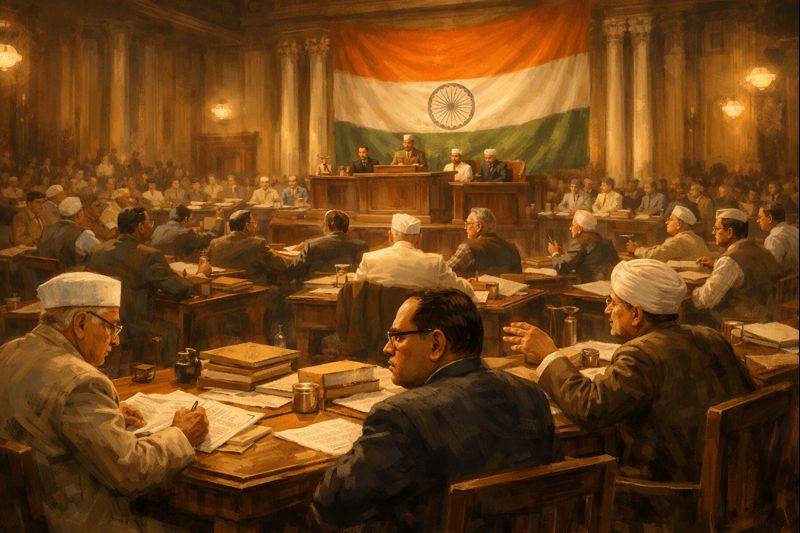
Introduction: The Beginning of India’s Constitutional Journey
When I first began to study the Committees of the Constituent Assembly in depth, I realized that India’s Constitution is not merely a collection of laws, but a living document shaped by the hopes, struggles, and aspirations of millions of people. It represents the vision of a nation that had just emerged from centuries of colonial rule and was determined to define its own destiny.
The Committees of the Constituent Assembly formed the backbone of this historic task. Through these committees, some of the finest minds of the country engaged in intense discussions and debates on every major issue that would shape independent India’s political, social, and economic future. Each committee contributed ideas that eventually became the pillars of our democratic framework.
This article presents the structure, objectives, key recommendations, and historical significance of the various committees of the Constituent Assembly in a simple, narrative style. It also highlights the lessons we can learn from their work today. Whether you are preparing for competitive examinations or seeking a deeper understanding of the Indian Constitution, this article aims to guide and inspire you.

Top Rated Amazon Product
Well-reviewed and trusted product on Amazon. Perfect for everyday use with reliable performance and quality.
- ✔ High customer satisfaction
- ✔ Durable & dependable
- ✔ Fast & secure delivery
Formation and Objectives of the Constituent Assembly
As India moved steadily towards independence, one of the greatest challenges before the nation was to create a Constitution that could unite a society rich in diversity. The idea of forming a Constituent Assembly emerged from this urgent need. The Constituent Assembly was not merely a political body; it was a historic platform entrusted with shaping the future of a new nation.
The Constituent Assembly was established under the Cabinet Mission Plan of 1946. Its primary objective was to frame a Constitution for an independent India that would reflect the ideals of sovereignty, democracy, secularism, and social justice. Representatives from different provinces, communities, and social groups were included to ensure that the Constitution would truly represent the will of the people.
The first meeting of the Constituent Assembly was held on 9 December 1946. Dr. Sachchidananda Sinha served as the temporary president, and later Dr. Rajendra Prasad was elected as the permanent President of the Assembly. This leadership symbolized the commitment to democratic principles throughout the constitution-making process.
The major objectives of the Constituent Assembly included:
- To draft a written and comprehensive Constitution for India.
- To guarantee Fundamental Rights to all citizens.
- To establish a strong and balanced federal structure.
- To incorporate the ideals of social, economic, and political justice.
- To promote unity while respecting the country’s diversity.
The Constituent Assembly worked continuously for nearly three years. During this period, intense debates, disagreements, and discussions took place, but members ultimately placed national interest above all else. As a result, India adopted one of the world’s longest and most inclusive Constitutions.
For me, the story of the Constituent Assembly teaches a powerful lesson: when people come together with a shared vision and a sense of responsibility, they can build institutions that stand the test of time. This spirit remains the true strength of Indian democracy.
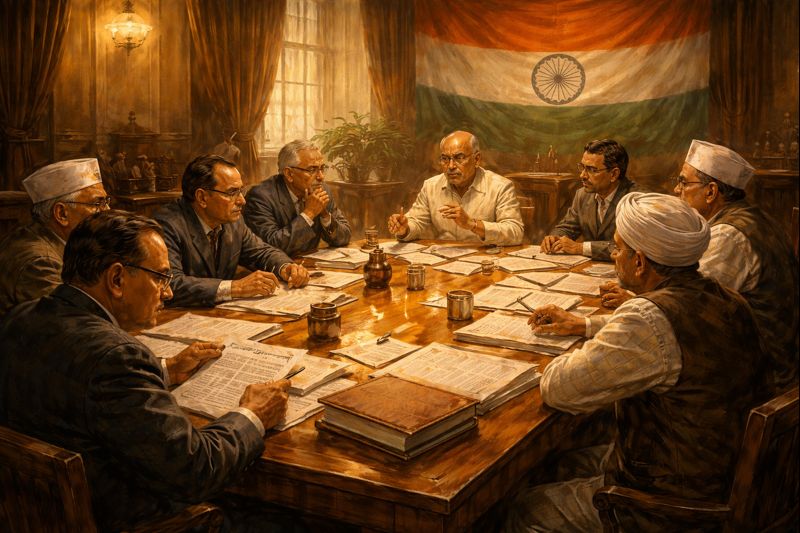
Why Were Committees Necessary?
When the Constituent Assembly began its work, it was immediately confronted with an enormous range of subjects. Issues such as the system of government, Fundamental Rights, federal structure, judiciary, minority protections, language policy, and social justice required deep and careful examination. It soon became clear that discussing all these complex matters in detail within the full Assembly would be neither practical nor efficient.
To address this challenge, various committees were established. Each committee was assigned a specific subject so that members with relevant expertise could study the issue thoroughly and present well-considered recommendations. This approach made the constitution-making process more systematic, organized, and effective.
The purpose of these committees was not merely to offer suggestions, but to bring together diverse viewpoints and craft balanced frameworks that reflected India’s pluralistic society. Debates within the committees were often intense and intellectually stimulating, yet they were guided by a shared commitment to building a strong and just nation.
For me, learning about the role of these committees was deeply inspiring. They demonstrate that even the most complex and monumental tasks can be accomplished by breaking them into manageable parts and addressing each with patience and dedication. This principle is not only relevant to constitution-making, but also to life itself.
Thus, the establishment of committees transformed the Constituent Assembly into a structured and purposeful forum, where ideas could be examined in depth and refined into the constitutional principles that continue to shape India’s democracy today.
Drafting Committee
Among all the committees of the Constituent Assembly, the Drafting Committee occupied the most crucial position. It was entrusted with the responsibility of transforming the recommendations of various committees into a coherent, clear, and workable constitutional document. In simple terms, the Drafting Committee represented the final stage of constitution-making, where ideas were given precise legal form.
The Drafting Committee was constituted on 29 August 1947, with Dr. B. R. Ambedkar as its Chairman. He is widely regarded as the chief architect of the Indian Constitution. Other distinguished members of the committee included N. Gopalaswami Ayyangar, K. M. Munshi, Alladi Krishnaswami Ayyar, Syed Mohammad Saadulla, B. L. Mitter, and D. P. Khaitan (later replaced by B. R. Das).
The primary function of the committee was to examine the reports of other committees, reconcile differences among them, and prepare the Draft Constitution. The Drafting Committee not only refined the legal language, but also ensured that each article of the Constitution was clear, logical, and capable of practical application.
Under the leadership of Dr. Ambedkar, the Drafting Committee demonstrated that a constitution must be more than a statement of ideals; it must also serve as a functional guide for governance. Core values such as individual liberty, equality, and social justice were firmly embedded at the heart of the Constitution.
For me, the story of the Drafting Committee conveys an enduring lesson: true leadership lies in the ability to convert vision into workable reality. This is why the Drafting Committee is often described as the soul of the constitution-making process.
Fundamental Rights Committee
The Fundamental Rights Committee of the Constituent Assembly was entrusted with the task of designing a framework of rights that would protect the dignity, liberty, and equality of every citizen of India. The committee worked on the belief that democracy can flourish only when people enjoy clearly defined and enforceable rights.
The committee was chaired by Sardar Vallabhbhai Patel. It included prominent leaders and thinkers who sought to ensure that rights would not remain mere declarations, but would have real meaning in the daily lives of citizens.
The Fundamental Rights Committee recommended that fundamental rights should be classified into different categories, such as the Right to Equality, Right to Freedom, Right against Exploitation, Right to Freedom of Religion, Cultural and Educational Rights, and the Right to Constitutional Remedies.
On the basis of these recommendations, Fundamental Rights were incorporated into Part III of the Indian Constitution. These provisions give citizens the confidence that even the powers of the State are subject to constitutional limits.
For me, the work of the Fundamental Rights Committee conveys a powerful lesson: freedom is not only about achieving independence, but also about continuously safeguarding the rights and dignity of every individual. This spirit is what makes the Indian Constitution a living and dynamic document.

Highly Rated Amazon Product
Trusted by Amazon buyers and well-reviewed for quality and performance. Great for everyday use with dependable reliability.
- ✔ Strong customer ratings
- ✔ Durable & reliable
- ✔ Fast & secure delivery
Union Powers Committee
The Union Powers Committee of the Constituent Assembly was created to determine the distribution of powers between the Union (Centre) and the States in independent India. This was one of the most sensitive and crucial issues before the Assembly, as the nation required a strong central authority while also respecting the autonomy of the States.
The committee was chaired by Pandit Jawaharlal Nehru. Under his leadership, the committee sought to design a federal structure that would strengthen national unity without undermining the country’s diversity.
The Union Powers Committee recommended that subjects of national importance such as defence, foreign affairs, communications, currency, and national security should fall under the authority of the Union Government. At the same time, it emphasized that States should enjoy adequate powers over areas like local administration, agriculture, health, and education.
Based on the committee’s recommendations, the Constitution introduced the system of the Union List, State List, and Concurrent List. This arrangement clearly defined the legislative powers of different levels of government and gave India its distinctive federal character.
For me, the work of the Union Powers Committee highlights an essential lesson: nation-building requires a careful balance between central authority and regional autonomy. This balance remains the cornerstone of Indian federalism.
Minorities Committee
The Minorities Committee of the Constituent Assembly was formed to ensure the protection of the rights and interests of minority communities in independent India. In a country as diverse as India, this was a highly sensitive and significant issue, as national unity could be sustained only when every community felt secure and respected.
The committee was chaired by Sardar Vallabhbhai Patel. It examined various safeguards that could guarantee minorities equal status as citizens and prevent any form of discrimination or marginalization.
The Minorities Committee placed special emphasis on freedom of religion, preservation of cultural identity, and the right to establish and administer educational institutions. The committee believed that protecting minority rights was essential not only for minorities themselves, but for the health and strength of Indian democracy as a whole.
The influence of this committee is clearly visible in the provisions related to Fundamental Rights and minority protections in the Constitution. These safeguards helped shape India into an inclusive and pluralistic nation.
For me, the work of the Minorities Committee teaches an important lesson: true democracy is measured by how well it protects its minorities. A nation becomes stronger when every community feels safe, valued, and equal.
Provincial Constitution Committee
The Provincial Constitution Committee was established to design an appropriate constitutional framework for the States in independent India. Its task was to determine the nature of provincial governance and the extent of autonomy that States should enjoy within the federal system.
The committee was chaired by Sardar Vallabhbhai Patel. Under his leadership, the committee worked to ensure that the governance of States would be democratic, responsible, and in harmony with the Union Government.
The Provincial Constitution Committee made important recommendations regarding the parliamentary system in the States, the role of the Governor, and the responsibility of the Council of Ministers to the elected legislature. These recommendations became the foundation of the constitutional structure of State governments.
The committee’s work strengthened India’s federal framework by providing States with sufficient authority to govern according to their local needs while remaining integrated within the Union.
For me, the Provincial Constitution Committee conveys a clear message: strong States are essential for building a strong nation. Balanced federalism is the key to India’s unity and stability.
Union Constitution Committee
The Union Constitution Committee of the Constituent Assembly was established to design the basic framework of India’s federal system. The committee was entrusted with deciding the nature of relations between the Union and the States and the principles on which Indian federalism would be based.
The committee was chaired by Pandit Jawaharlal Nehru. Under his leadership, the committee sought to create a federal structure with a strong Centre while also preserving the identity and autonomy of the States.
The Union Constitution Committee recommended a balanced and integrated federal system rather than a loose confederation. Its ideas played a crucial role in laying the foundations of the federal structure embodied in the Indian Constitution.
The work of this committee makes it clear that Indian federalism is not merely about the division of powers, but also about cooperation, coordination, and shared responsibility between different levels of government.
For me, the Union Constitution Committee conveys an important lesson: in a diverse nation, a well-designed federal system is essential for maintaining unity while respecting diversity.
Other Important Committees Besides the Drafting Committee
Although the Drafting Committee is often regarded as the soul of the constitution-making process, many other committees also made significant contributions to shaping the Indian Constitution.
Some of the most important among them included the Union Powers Committee, Fundamental Rights Committee, Minorities Committee, Provincial Constitution Committee, Union Constitution Committee, and the Advisory Committee.
Each of these committees carried out detailed studies in its respective area and submitted well-considered recommendations. The synthesis of their ideas made it possible to create a balanced, practical, and inclusive constitutional framework.
Their collective contribution demonstrates that the Constitution is not the work of a single individual, but the outcome of hundreds of minds working together with a shared vision.
For me, this collective effort highlights a timeless truth: democracy becomes stronger through dialogue, collaboration, and shared wisdom.
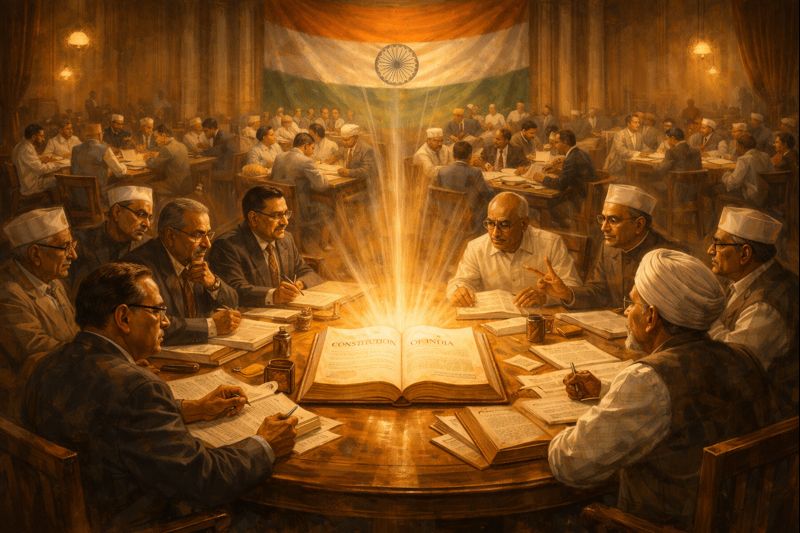
Overall Significance of the Committees of the Constituent Assembly
The committees of the Constituent Assembly formed the backbone of India’s constitution-making process. They not only made the task of drafting the Constitution manageable, but also ensured that the process was systematic, well-organized, and participatory. Each committee examined its assigned subject in depth and submitted recommendations that contributed to the creation of a strong and balanced constitutional framework.
The work of these committees ensured that the Constitution did not reflect the ideas of only a few individuals, but represented the collective wisdom of a diverse nation. Members from different backgrounds brought their experiences and perspectives into discussions, making the Constitution more inclusive and practical.
Another major significance of the committees lies in the democratic spirit they embodied. Despite sharp differences of opinion on many issues, members engaged in dialogue and ultimately arrived at consensus in the national interest. This culture of debate and compromise remains one of the greatest strengths of Indian democracy.
For me, the overall significance of these committees lies in the powerful lesson they offer: even the most complex nation-building tasks can be accomplished through cooperation, patience, and collective wisdom. This lesson continues to be relevant for India today.
Conclusion: From Constitution-Making to Nation-Building
The work of the committees of the Constituent Assembly reminds us that India’s Constitution is not merely a legal document, but the outcome of the hopes, struggles, and collective determination of millions of people. The dedication, patience, and vision shown by these committees laid the strong foundation of Indian democracy.
Through their functioning, it becomes clear that democracy grows through dialogue, consensus, and participation. Despite differing viewpoints, the members consistently placed national interest above all else and worked towards common solutions. This remains one of the greatest achievements of the constitution-making process.
For me, the committees of the Constituent Assembly are not just a chapter of history, but a source of lifelong lessons. They teach us that even the most ambitious goals can be achieved through small, consistent efforts and collective cooperation.
As we reflect on India’s democratic journey today, the legacy of these committees continues to inspire us to uphold the core values of the Constitution — liberty, equality, justice, and fraternity — in our daily lives.
Frequently Asked Questions (FAQ)
Which was the most important committee of the Constituent Assembly?
The Drafting Committee is considered the most important, as it prepared and finalized the Draft Constitution of India.
How many committees were there in the Constituent Assembly?
There were about 22 major committees and several sub-committees in the Constituent Assembly.
Who was the Chairman of the Drafting Committee?
Dr. B. R. Ambedkar was the Chairman of the Drafting Committee.
What was the main objective of the Fundamental Rights Committee?
The main objective was to design a framework of fundamental rights and ensure their protection.
What was the role of the Union Powers Committee?
The Union Powers Committee dealt with the distribution of powers between the Union and the States.
What lessons do we learn from the committees of the Constituent Assembly?
They teach us the importance of cooperation, dialogue, consensus, and democratic values.

Top Choice Amazon Product
Well-reviewed and trusted product on Amazon. Excellent performance and reliable quality — great everyday companion.
- ✔ High customer satisfaction
- ✔ Durable & dependable
- ✔ Fast & secure delivery
References
- Constitution of India (Official Government of India Publication)
- Granville Austin – The Indian Constitution: Cornerstone of a Nation
- D.D. Basu – Introduction to the Constitution of India
- Constituent Assembly Debates
- NCERT Political Science – Class XI and XII
- Government of India, Legislative Department (Official Website)