
Terrorism Of Rise in India: Causes, Major Incidents, Impacts and Responses
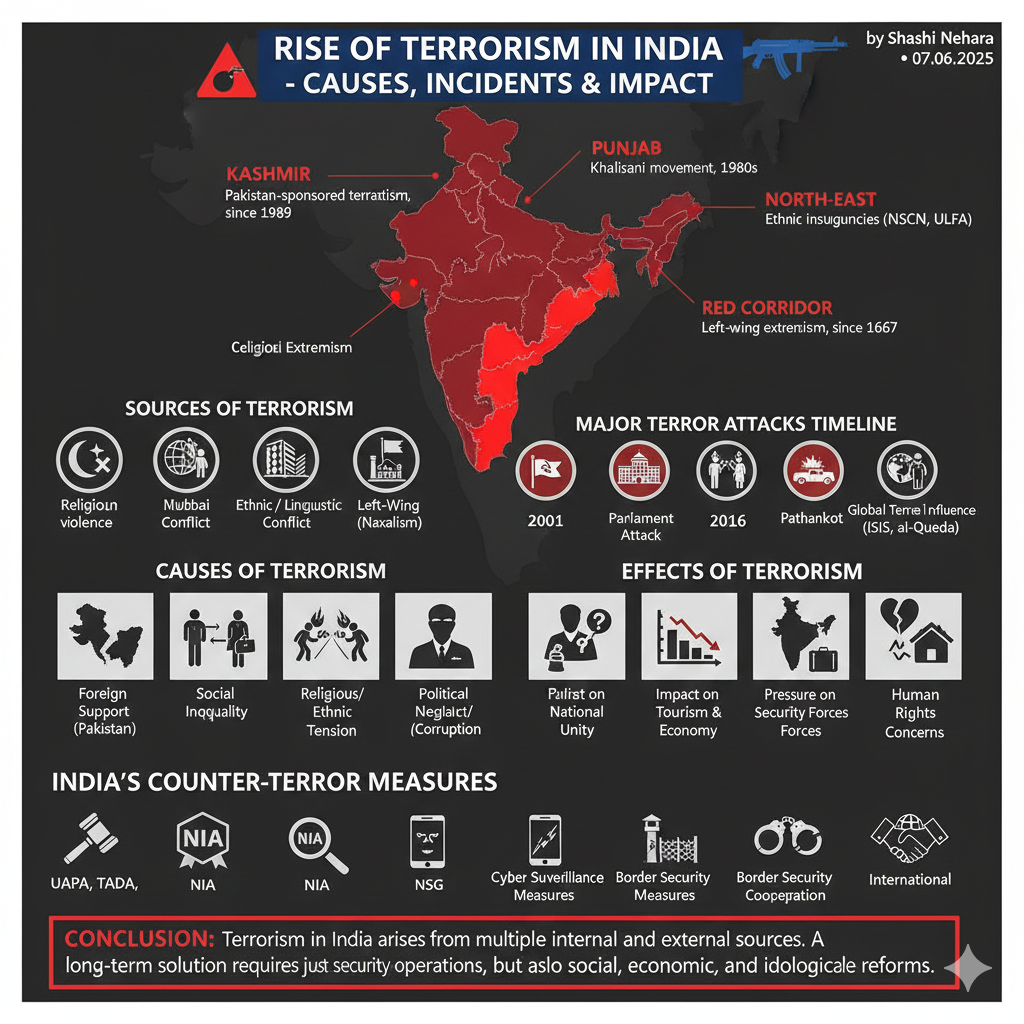
The Terrorism Of Rise in India has become one of the most serious internal security challenges in recent decades. This article explains the terrorism of rise phenomenon in India by examining its historical background, major incidents, regional variations, socio-economic consequences and long-term counter-terrorism strategies.
1. Introduction to Terrorism Of Rise in India
Terrorism of rise in India reflects a complex and multi-dimensional process influenced by political instability, social grievances, regional inequalities, religious extremism and cross-border interference. The terrorism of rise pattern has manifested differently in regions such as Jammu & Kashmir, the Northeast, Punjab during the Khalistan movement, and areas affected by Left-Wing Extremism (Naxalism).
2. Primary Sources Behind Terrorism Of Rise in India
Religious fanaticism and separatism
Religious extremism has significantly contributed to terrorism of rise in India.
- Jammu & Kashmir: Political grievances and cross-border radicalization have fueled insurgency.
- Punjab — Khalistani movement: The demand for a separate state intensified violence during the 1980s.
Ethnic and linguistic conflicts
Insurgencies in the Northeast emerged due to identity struggles and autonomy demands, contributing to the broader terrorism of rise trend in India.
Left-wing extremism (Naxalism)
Originating in 1967, Naxalism developed from socio-economic inequality and land disputes. It remains a core dimension of terrorism of rise in central India.
International extremist influence
Global radical networks and online propaganda have strengthened terrorism of rise by influencing vulnerable individuals and sleeper cells.
3. Major Incidents Related to Terrorism Of Rise
| Year | Event | Place |
|---|---|---|
| 1984 | Operation Blue Star related violence | Punjab |
| 1993 | Mumbai serial bombings | Mumbai |
| 2001 | Parliament attack | New Delhi |
| 2008 | 26/11 Mumbai attacks | Mumbai |
| 2016 | Pathankot attack | Punjab |
| 2019 | Pulwama attack | Jammu & Kashmir |
4. Root Causes Behind Terrorism Of Rise in India
- Cross-border support and external interference.
- Economic inequality and unemployment.
- Social alienation and perceived injustice.
- Governance gaps and corruption.
- Online radicalization and propaganda.
5. Effects of Terrorism Of Rise
- Loss of lives and destruction of property.
- Communal tensions and weakened social unity.
- Negative economic impact on tourism and investment.
- Increased burden on security forces.
6. Government Response to Terrorism Of Rise in India
- Strict legal framework including UAPA.
- Role of agencies such as NIA and NSG.
- Border security and intelligence strengthening.
- Development-focused and inclusive governance approach.
7. Conclusion
The Terrorism Of Rise in India represents a long-term national security concern shaped by multiple internal and external factors. Addressing terrorism of rise requires a balanced approach combining security measures, economic development, political dialogue and social integration to ensure lasting peace and stability.
1. Introduction to the Rise of Terrorism in India
The Rise of Terrorism in India is not only a serious internal security challenge but also a threat to social harmony, economic stability and national development. India, being a pluralistic democratic country with multiple religions, castes, languages and cultures, faces terrorism as a multi-dimensional problem that affects both governance and unity.
The rise of terrorism in India has not been uniform. It has appeared in different forms across various historical periods, geographical regions and ideological backgrounds—such as separatist movements in Kashmir, ethnic militancy in the North-East, religious extremism in Punjab and left-wing extremism in central India.
Sometimes the rise of terrorism in India emerges from socio-economic inequality, and sometimes from foreign-sponsored radicalization. It harms innocent citizens, weakens internal security, damages India’s international image and slows down development. Understanding the historical, political and social dimensions behind the rise of terrorism in India is essential to formulate effective and sustainable solutions.
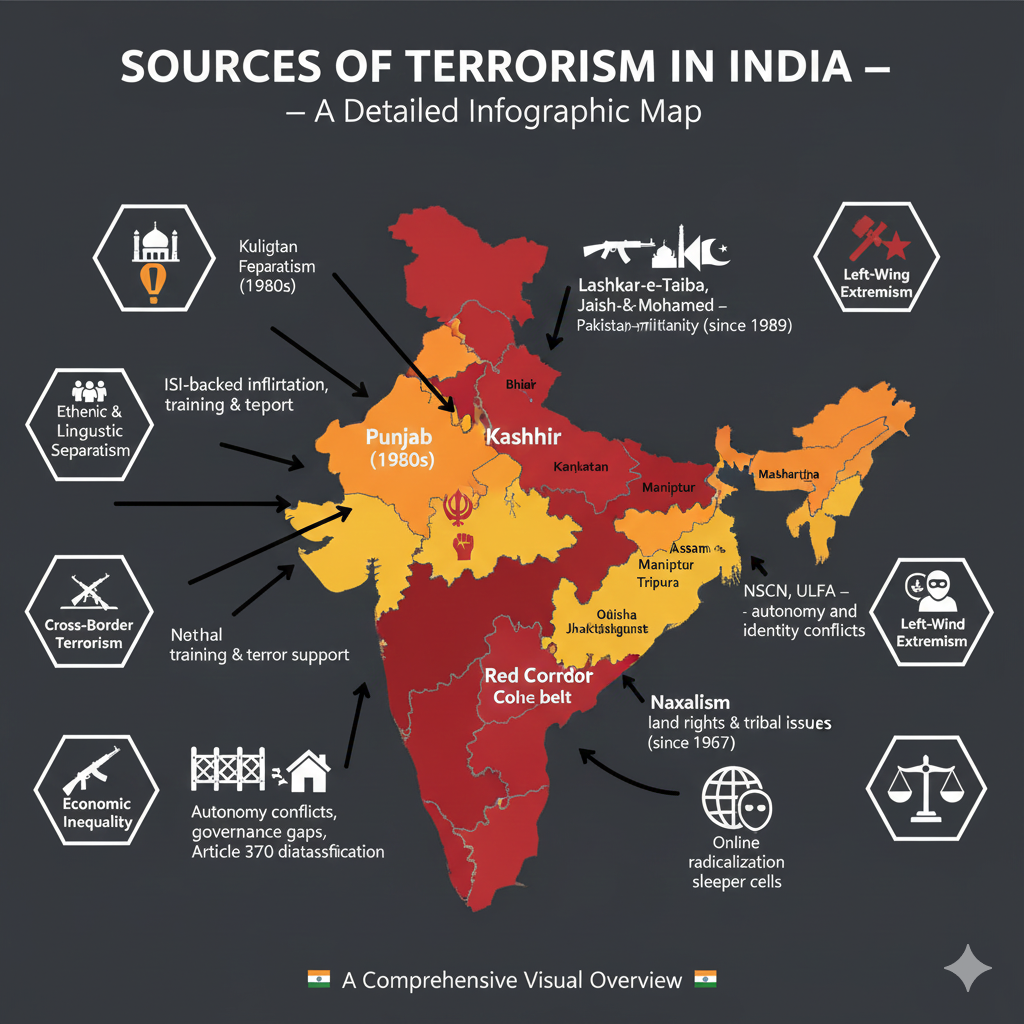
2. Major Sources Behind the Rise of Terrorism in India
The rise and spread of terrorism in India is linked to several religious, political, social, economic and international factors. Below is a structured analysis of the major sources contributing to the rise of terrorism in India:
1. Religious Fanaticism and Separatism
Extreme religious ideologies have significantly contributed to the rise of terrorism in India.
Kashmir (Islamic Terrorism Since 1989)
Pakistan-supported terrorist groups like Lashkar-e-Taiba and Jaish-e-Mohammed have used radical ideology to push separatism in Kashmir. Their objective has been to destabilize the region and challenge India’s sovereignty.
Khalistan Movement (1980s)
In Punjab, extremist Sikh factions demanded an independent Sikh nation called “Khalistan.” External ideological and financial support amplified this movement, leading to violence during the 1980s.
2. Ethnic and Linguistic Separatism
The North-East region, with its diverse tribes and linguistic communities, has experienced insurgencies driven by identity politics and autonomy demands. Groups such as NSCN in Nagaland and ULFA in Assam have played major roles in regional instability.
3. Left-Wing Extremism (Naxalism)
Beginning in 1967 in Naxalbari (West Bengal), this movement originally sought land reforms and tribal rights. Over time, it transformed into an armed rebellion. The rise of terrorism in India in central regions is closely linked to socio-economic injustice and governance gaps.
4. Cross-Border Terrorism
External interference has been a major driver in the rise of terrorism in India. Pakistan’s ISI has been accused of training, arming and financing militant groups responsible for attacks such as the 1993 Mumbai blasts, the 2001 Parliament attack and the 2008 Mumbai attacks.
5. Economic Inequality and Social Injustice
In backward and tribal areas, poverty, unemployment, corruption and exploitation create fertile ground for radicalization. Socioeconomic inequality remains one of the structural causes behind the rise of terrorism in India.
6. Influence of International Terrorist Organizations
Global organizations such as Al-Qaeda and ISIS attempt to spread extremist narratives through digital propaganda. Online radicalization has emerged as a modern dimension of the rise of terrorism in India.
7. Political Discontent and Exploitation
Political dissatisfaction and perceived marginalization sometimes push groups toward violent methods. Lack of political dialogue and trust deficits can indirectly contribute to the rise of terrorism in India.
Conclusion — Understanding the Rise of Terrorism in India
The Rise of Terrorism in India is shaped by both internal and external dynamics. Religious fanaticism, regional separatism, socio-economic inequality, political neglect and cross-border interference together intensify this challenge. Unless the root causes behind the rise of terrorism in India are addressed through balanced development, strong governance and inclusive policies, complete eradication will remain difficult.
References
- Self-written analytical content based on publicly known historical events and general knowledge.
- Information derived from commonly accepted public domain facts and historical timelines related to terrorism in India.
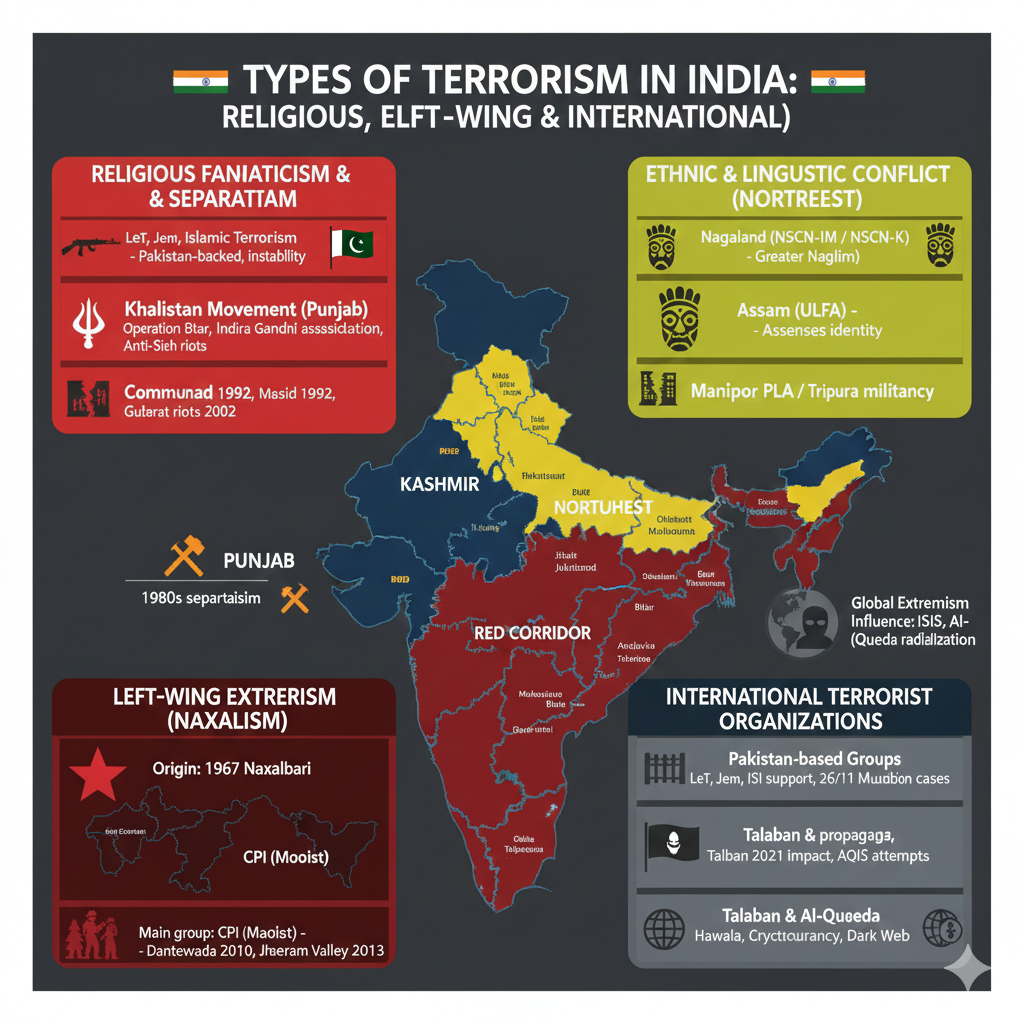
Religious Fanaticism and Separatism
Religious fanaticism and separatism have been among the chief sources of terrorism in India. When religion is used to achieve political objectives and extreme ideologies spread within society, movements often take violent forms. The exploitation of religious emotions becomes the first step toward separatist ideologies and terrorism.
In India, this has been observed most clearly in two regions:
1. Islamic Terrorism in Kashmir
Background
During the late 1980s, terrorism began in Jammu & Kashmir. Pakistan’s intelligence agency ISI provoked local youth, provided weapons and training, and pushed them toward militancy.
In 1989, militancy gained momentum when Pakistan-backed terrorist groups launched violent activities against the Indian state.
Major Terrorist Organizations
- Lashkar-e-Taiba
- Jaish-e-Mohammed
- Hizbul Mujahideen
- Ansar Ghazwat-ul-Hind
Objectives
- To separate Jammu & Kashmir from India
- To establish an Islamic state in the region
Effects
- Exodus of Kashmiri Pandits in 1990
- Fatalities among civilians, soldiers, and militants
- Long-term instability and developmental obstacles
2. Khalistani Insurgency in Punjab
Background
In the 1980s, extremist Sikh factions demanded a separate Sikh nation called “Khalistan.” This movement was rooted in religious identity and political dissatisfaction. Sikh extremist groups abroad also provided financial and ideological support.
Important Events
- Operation Blue Star (1984): Indian Army conducted an operation inside the Golden Temple to remove extremist leader Jarnail Singh Bhindranwale.
- Assassination of Indira Gandhi (1984): Killed by her Sikh bodyguards in retaliation for Operation Blue Star.
- Anti-Sikh riots: Violent riots occurred in Delhi and other cities after her assassination.
Effects
- A decade-long period of violence and instability
- Thousands of innocent lives lost
- Deepened social and communal divisions
3. Other Examples of Religious Conflicts
- Babri Masjid demolition (1992) and subsequent riots
- Godhra incident (2002) and Gujarat riots
These events deepened religious polarization and provided extremist groups an opportunity to spread fanaticism.
Conclusion — Religious Fanaticism
Religious fanaticism and separatism not only divide society but also pose grave dangers to national security. When people are instigated through religious emotions and pushed toward violence, innocent citizens suffer and the unity and integrity of the nation are threatened. Awareness, education, dialogue, and strong security measures are essential to counter such ideologies.
Ethnic and Linguistic Conflict
India is a multi-racial and multi-lingual country where diverse tribes, communities and linguistic groups coexist. These variations enrich the nation culturally, but when groups feel deprived of their identity, rights, or resources, such conflicts can evolve into terrorism or insurgency.
Ethnic and linguistic conflicts are most intense in the North-Eastern states, where many tribal communities have taken up arms demanding autonomy or independence.
1. Separatist Movements in North-East India
(a) Nagaland — NSCN
Naga groups assert that they maintain a distinct cultural and historical identity separate from India. NSCN-IM and NSCN-K demand a sovereign “Greater Nagalim.” A ceasefire between NSCN-IM and the Indian government has been in effect since 1997, with ongoing negotiations.
(b) Assam — ULFA
Founded in 1979, ULFA demanded an independent Assam, claiming that the Indian government exploited Assam’s resources and endangered Assamese identity. During the 1990s, ULFA carried out bombings and kidnappings. It later split into negotiation-friendly and extremist factions.
(c) Manipur, Mizoram & Tripura
Various tribal groups such as PLA (Manipur), HNLC (Meghalaya) and others took up arms seeking autonomy or independence, feeling neglected and marginalized.
2. Linguistic Conflict
Hindi vs Other Languages
Post-independence, efforts to adopt Hindi as a national language faced strong opposition, especially in Tamil Nadu. Although this did not transform into terrorism, it shows how linguistic identity can generate serious unrest.
3. Main Causes of Ethnic Conflict
- Ethnic and cultural identity crisis
- Political neglect and underrepresentation
- Economic backwardness and unemployment
- Fear of demographic imbalance due to migration
- Alleged human rights violations by security forces
4. Government Strategy
- Peace talks and agreements (e.g., Mizoram and Tripura accords)
- Autonomous councils and special provisions
- Security operations by Army and paramilitary forces
- Development projects and employment generation
Conclusion — Ethnic Conflict
Ethnic and linguistic conflicts are not merely law-and-order issues but involve concerns of social justice, cultural identity and political inclusion. Lasting peace requires understanding local aspirations and adopting inclusive policies.
Left-Wing Extremism (Naxalism)
Left-wing extremism is one of India’s longest-running internal security threats. It originates from economic inequality, social exploitation and distrust in the governmental system. It is largely active in rural and tribal areas known as the “Red Corridor.”
1. Origin of Naxalism
Naxalism began in 1967 in Naxalbari village, West Bengal, led by Charu Majumdar and Kanu Sanyal. The movement aimed to fight for the rights of poor farmers and landless labourers against exploitation.
2. Ideology and Objectives
Naxalism draws from Marxist, Leninist and Maoist ideologies.
- Armed revolution to overthrow the government
- End to capitalism and the “exploitative” system
- Establish an egalitarian society
3. Red Corridor
The movement is active in:
- Chhattisgarh
- Jharkhand
- Bihar
- Odisha
- West Bengal
- Maharashtra (Gadchiroli)
- Andhra Pradesh
- Telangana
4. Main Organization
CPI (Maoist): India’s most active left-wing extremist group, formed in 2004 after the merger of PWG and MCCI. It conducts guerrilla warfare from forested regions and frequently targets security forces.
5. Major Incidents
- Dantewada attack (2010) — 76 CRPF personnel killed
- Frequent attacks in Jharkhand and Gadchiroli
- 2013 Jheeram Valley attack — 27 Congress leaders killed
6. Reasons Behind Naxalism
- Extreme poverty, unemployment and resource exploitation
- Discrimination against Dalits and tribal populations
- Administrative failures and corruption
- Lack of education and awareness
- Political neglect and low development
7. Government Response
- Security operations such as Operation Green Hunt
- Development schemes for roads, healthcare and education
- Awareness programs for local communities
- Surrender and rehabilitation policies for militants
8. Challenges
- Dense forests providing safe havens
- Sympathy among local tribes
- Weak administration and police presence
- Corruption affecting development programs
Conclusion — Naxalism
Left-wing extremism is a serious threat to India’s internal security and democracy. Only a balanced approach—combining development, dialogue and justice—can ensure long-term peace.
International Terrorist Organizations and Their Impact on India
Apart from internal factors, international terrorist organizations significantly affect terrorism in India. They promote radical ideologies, support local extremist groups and threaten India’s national security and global standing.
1. Pakistan-Based Terrorist Organizations
(a) Lashkar-e-Taiba (LeT)
- Founded: 1987 (Pakistan)
- Close links with ISI
- Objectives: Jihad in India, especially in Kashmir
Major Attacks:
- 2001 Parliament attack
- 2008 Mumbai attacks (166 deaths)
(b) Jaish-e-Mohammed (JeM)
- Founded: 2000 by Masood Azhar
Major Attacks:
- 2001 Parliament attack
- 2016 Pathankot Air Base attack
- 2019 Pulwama suicide attack (40 CRPF personnel killed)
2. Afghanistan–Pakistan Region Groups
(a) Al-Qaeda
Though limited in India, its South Asian branch AQIS has attempted to spread jihadist ideology.
(b) Taliban
The Taliban’s resurgence in Afghanistan (2021) has strengthened Pakistan-based groups and raised India’s security concerns.
3. Islamic State (ISIS)
ISIS has limited ground presence in India, but has tried radicalizing youth via the internet. Cases have been reported from Kerala, Kashmir and Maharashtra, and NIA has dismantled several ISIS modules.
4. Global Terror Networks and Funding
- Use of Hawala networks and foreign funding
- Cryptocurrency transactions
- Dark Web communication
- Foreign NGOs indirectly supporting extremist groups
5. India’s Response
- Strengthened intelligence agencies — RAW, IB, NIA, NSG
- Diplomatic pressure through UN and FATF
- Counter-terror cooperation with the US, Russia, France, Israel
- Cyber monitoring against online radicalization
Conclusion — International Terrorism
International terrorist organizations pose severe external threats to India. They spread radicalism, support cross-border attacks and destabilize internal peace. India must combine security, diplomacy and ideological counter-narratives to combat these dangers effectively.
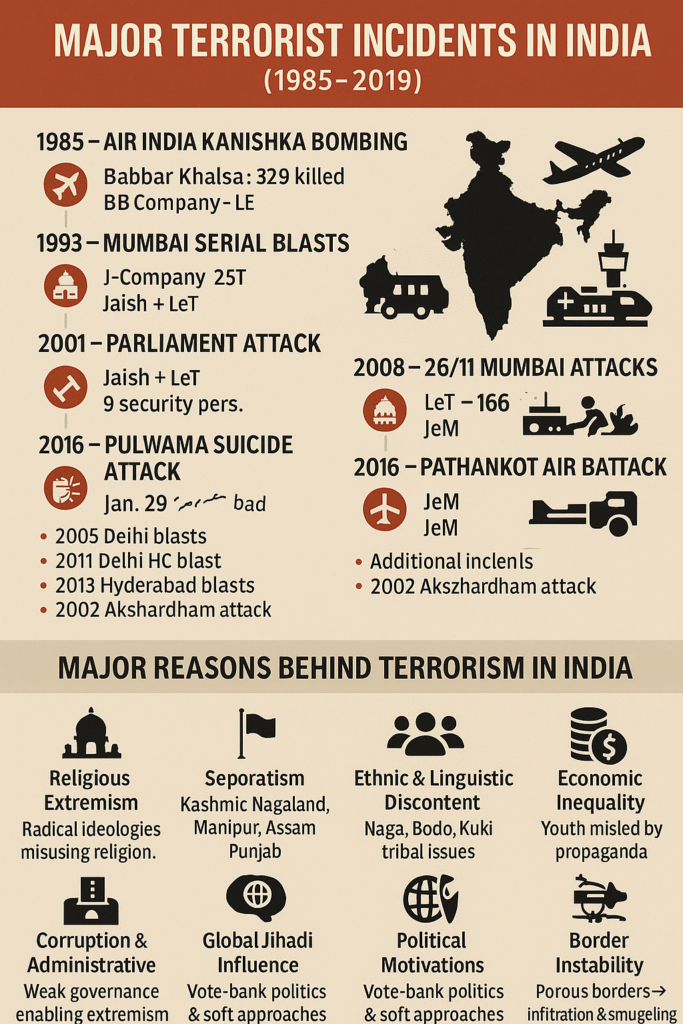
3. Major Terrorist Incidents in India
In the past few decades, India has witnessed several gruesome terrorist attacks. These incidents caused heavy loss of life and property, while deeply impacting national security, economic development and social harmony. Below are some of the major terrorist events recorded in India:
1. 1985 – Air India Kanishka Bombing
- Date: 23 June 1985
- Location: Atlantic Ocean (near Ireland)
- Incident: Bomb planted on Air India Flight 182 by Sikh separatists
- Deaths: 329 people
- Responsible Organization: Babbar Khalsa (Canada-based extremist faction)
2. 1993 – Mumbai Serial Bomb Blasts
- Date: 12 March 1993
- Location: Mumbai
- Incident: 12 coordinated blasts at stock exchange, hotels, buses etc.
- Deaths: 257
- Injured: 700+
- Responsible: D-Company under Dawood Ibrahim with ISI support
3. 2001 – Attack on Indian Parliament
- Date: 13 December 2001
- Location: New Delhi, Parliament House
- Incident: Suicide attackers attempted to storm Parliament
- Deaths: 9 security personnel + 5 terrorists
- Responsible: Jaish-e-Mohammed & Lashkar-e-Taiba
4. 2006 – Mumbai Local Train Blasts
- Date: 11 July 2006
- Location: Mumbai suburban railway
- Incident: 7 coordinated bomb blasts in local trains
- Deaths: 209
- Injured: 700+
- Responsible: SIMI and Pakistan-supported networks
5. 2008 – 26/11 Mumbai Terror Attacks
- Date: 26–29 November 2008
- Location: Mumbai (Taj Hotel, Oberoi, CST, Nariman House)
- Incident: 10 terrorists entered Mumbai by sea; 60-hour siege
- Deaths: 166
- Injured: 300+
- Responsible Organization: Lashkar-e-Taiba
- Special Note: Ajmal Kasab was captured alive
6. 2016 – Pathankot Air Base Attack
- Date: 2 January 2016
- Location: Pathankot, Punjab
- Incident: JeM terrorists attacked Air Force Base
- Deaths: 7 security personnel + 6 terrorists
7. 2019 – Pulwama Suicide Attack
- Date: 14 February 2019
- Location: Pulwama, Jammu & Kashmir
- Incident: Suicide bomber rammed explosive-laden vehicle into CRPF convoy
- Deaths: 40+ CRPF jawans
- Responsible Organization: Jaish-e-Mohammed
- Outcome: India conducted Balakot Airstrike on 26 February 2019
8. Other Major Terrorist Incidents
| Year | Place | Description |
|---|---|---|
| 2005 | Delhi | Sarojini Nagar & Paharganj blasts before Diwali (60 deaths) |
| 2011 | Delhi High Court | Bomb explosion outside the court gate (15 deaths) |
| 2013 | Hyderabad | Dilsukhnagar twin blasts (17 deaths) |
| 2002 | Akshardham Temple, Gujarat | Terrorists attacked temple premises (30+ deaths) |
Conclusion — Terrorist Incidents
These attacks deeply affected India’s security policies, foreign policy and social structure. Following these incidents, India strengthened its anti-terror laws, established the National Investigation Agency (NIA), and enhanced border and internal security. However, terrorism continues to remain a significant challenge, making constant vigilance essential.
4. Major Reasons Behind Terrorism in India
Terrorism in India is a complex issue that cannot be attributed to a single factor. Multiple internal and external forces—social, economic, political and ideological—fuel extremist activities. Below is a detailed analysis of the key reasons:
1. Religious Extremism
- Fanatic groups misuse religion to spread hate and violence.
- Organizations like Jaish-e-Mohammed and Lashkar-e-Taiba mislead youth in the name of jihad.
- Certain Sikh and Hindu extremist factions have also shown radical tendencies.
2. Separatism
- Demands for independence in Jammu & Kashmir, Nagaland, Manipur, Assam and Punjab.
- Many of these movements receive direct or indirect foreign support (Pakistan, China).
3. Ethnic and Linguistic Discontent
- Conflicts based on ethnic identity, language or tribal rights.
- North-East movements by Naga, Bodo, Kuki and other tribal groups.
4. Economic Inequality and Poverty
- Poverty, unemployment and exploitation create resentment.
- Naxalism emerged from socio-economic inequality in tribal and backward regions.
5. Lack of Education and Awareness
- Uneducated and unemployed youth easily fall prey to extremist propaganda.
- Misleading promises and religious hate messages drive radicalization.
6. Cross-Border Terrorism
- ISI in Pakistan trains, funds and shelters terrorists.
- Most major terrorist attacks in India have Pakistan links.
7. Corruption and Administrative Failures
- Weak law enforcement and negligence aid terrorist operations.
- Poor implementation of welfare schemes breeds resentment.
8. Spread of Global Jihadi Ideology
- ISIS and similar groups use social media to radicalize youth.
- Online videos, propaganda and fatwas influence vulnerable minds.
9. Political and Vote-Bank Motivations
- Some political leaders avoid action against extremists for vote-bank considerations.
- Soft approaches on sensitive issues indirectly support extremist confidence.
10. Border Instability
- Long and porous borders (LOC, India–Bangladesh) make monitoring difficult.
- Infiltration and arms smuggling boost terrorism.
Conclusion — Reasons for Terrorism
Terrorism in India stems from multiple layers—religious, social, economic, political and ideological. A lasting solution requires not only strong security forces but also development, education, justice, dialogue and efficient administration. Only coordinated efforts across all levels can eliminate this threat from its roots.
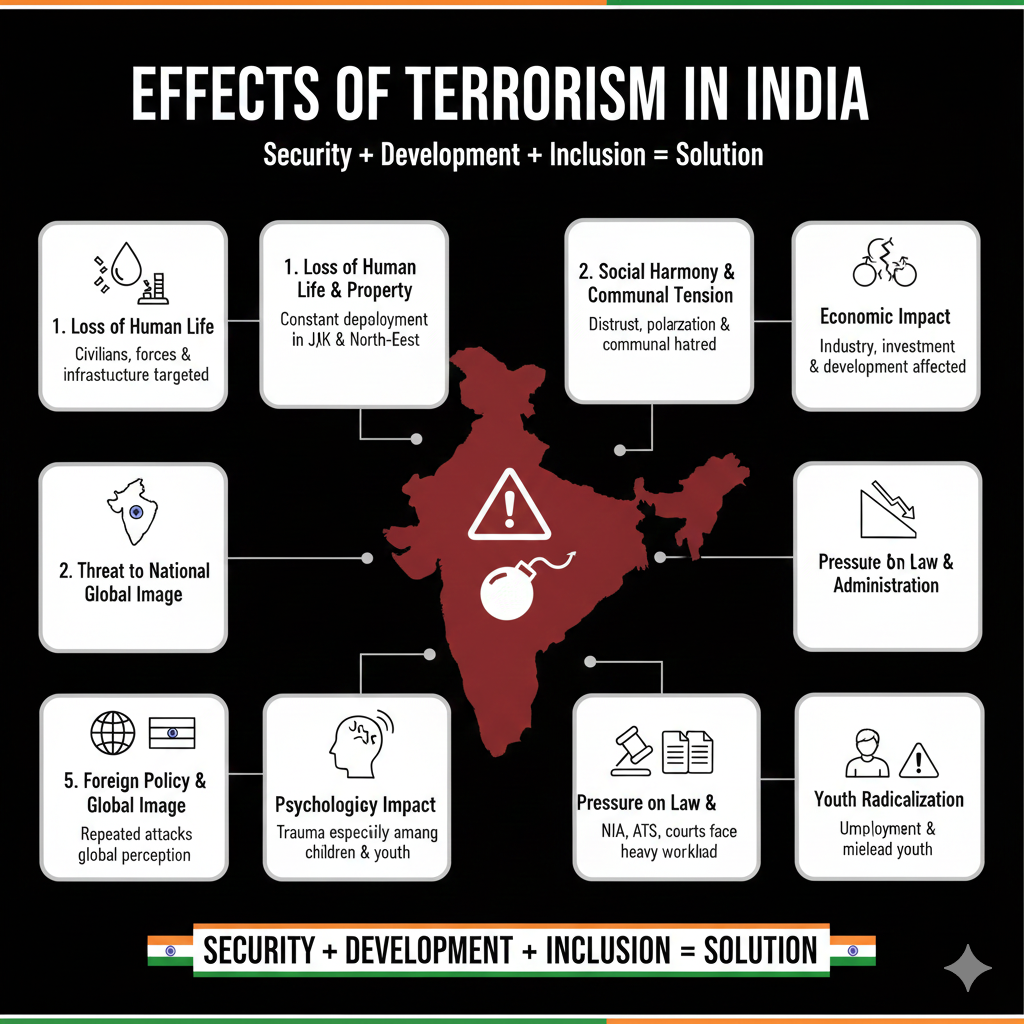
5. Effects of Terrorism Of Rise in India
The Terrorism Of Rise in India has deeply impacted the country at economic, social, political and psychological levels. Terrorism of rise is not limited to the loss of life and property; it also affects national integrity, development, democratic stability and citizens’ confidence. Below is a detailed examination of the major consequences associated with terrorism of rise in India:
1. Loss of Human Life and Property
- Hundreds of innocent civilians and security personnel lose their lives.
- Public places such as schools, hospitals and transport hubs become targets.
- Destruction of infrastructure results in heavy financial losses.
Example: 26/11 Mumbai attacks caused significant casualties and economic damage.
2. Threat to National Security Due to Terrorism Of Rise
- Continuous deployment of armed forces in sensitive regions.
- Large budget allocation toward defense and internal security.
3. Social Harmony and Communal Tension
- Increase in mistrust among communities.
- Spread of hatred and polarization.
- Weakening of social unity and democratic values.
4. Economic Impact of Terrorism Of Rise
- Decline in tourism and foreign investment.
- Slowdown in business and industrial growth.
- Increased government expenditure on security.
5. Foreign Policy and Global Image
- International perception challenges.
- Diplomatic pressure regarding cross-border terrorism.
- Enhanced global cooperation efforts.
6. Psychological Impact on Citizens
- Fear, anxiety and insecurity among the population.
- Emotional trauma, especially among youth and children.
7. Pressure on Legal and Administrative Systems
- Lengthy investigations and court procedures.
- Heavy workload on agencies like NIA and ATS.
8. Youth Radicalization
- Unemployment and frustration make youth vulnerable to extremist narratives.
- Online propaganda contributes to recruitment.
Conclusion — Effects of Terrorism Of Rise
The Terrorism Of Rise in India has long-term implications for national security, economic development and social cohesion. Addressing terrorism of rise requires a balanced approach combining strong security measures, inclusive governance, social reforms and educational awareness.
6. Measures to Counter Terrorism Of Rise in India
To control and reduce terrorism of rise, the Indian government has implemented coordinated efforts across security, policy, financial monitoring and social development sectors.
1. Strengthening Security and Intelligence Networks
- Modernization of agencies like RAW, IB, NIA and ATS.
- Improved border surveillance systems.
- Use of drones, satellite monitoring and cyber intelligence.
2. Strict Anti-Terror Legal Framework
- Strengthening of UAPA provisions.
- Fast-track courts for terror-related cases.
3. Strong Border Management
- Smart fencing and electronic surveillance.
- Community participation in border vigilance.
4. Disrupting Terror Financing
- Monitoring suspicious transactions.
- Crackdown on Hawala networks and illegal funding.
5. Social Development & Inclusion
- Focused development in backward regions.
- Improved education and employment opportunities.
6. Combating Cyber and Online Terrorism Of Rise
- Monitoring radical online content.
- Strengthening cyber-security infrastructure.
7. International Cooperation
- Intelligence sharing with global partners.
- Participation in UN anti-terror initiatives.
8. Emergency Response & Rehabilitation
- Immediate relief for victims.
- Psychological support and rehabilitation programs.
9. Public Awareness Campaigns
- Encouraging vigilance and reporting suspicious activities.
- Awareness programs in schools and communities.
Conclusion — Countering Terrorism Of Rise
India’s strategy against Terrorism Of Rise combines security enforcement, legal reforms, social development and international cooperation. Only a comprehensive, multi-dimensional and sustained effort can effectively control terrorism of rise and ensure long-term national stability.
7. Final Conclusion on Terrorism Of Rise in India
The Terrorism Of Rise in India remains a complex challenge influenced by ideological, socio-economic and geopolitical factors. While significant progress has been made in counter-terror strategies, continued vigilance, development-oriented policies and social harmony are essential to ensure a peaceful and secure future for the nation.
References
- Self-written analytical content based on general knowledge, historical events and publicly available information.
- No single external source used; data compiled from commonly known facts about terrorism in India.
- Events and incidents referenced from publicly recorded historical timelines.