Chandragupta Maurya and the Maurya Empire: History, Struggle, and Life Lessons

Introduction: A Story from History That Still Teaches Life

History is not merely a collection of dates, wars, and rulers. It is a living record of human struggle, vision, failure, and transformation. Whenever I faced uncertainty or self-doubt in my own life, I found that certain stories from history spoke to me more powerfully than any modern motivational advice ever could.

The journey of Chandragupta Maurya is one such story. To me, it is not just the biography of an ancient emperor, but the story of an ordinary individual who rose from obscurity to create one of the greatest empires in the history of the Indian subcontinent.

He was not born into royalty, nor did he inherit power or privilege. What he possessed was resilience, the courage to challenge injustice, and the wisdom to seek guidance when the path was unclear.

The foundation of the Maurya Empire was not built solely on warfare, but on strategy, discipline, vision, and the timeless bond between a mentor and his disciple. These are the same principles that continue to shape success in personal life, leadership, governance, and nation-building even today.

Through this article, I aim to explore not only the historical rise of Chandragupta Maurya and the Maurya Empire, but also the personal life lessons I have drawn from this remarkable journey— lessons that remain deeply relevant in the modern world.

This is a story for readers who believe that history is not meant to be memorized, but understood, reflected upon, and applied to build a stronger present and a wiser future.

⭐ Top Study Product Best Choice
Study Product
Premium Study Guide for Competitive Exams
★★★★☆ 4.5/5 Rating
  • Latest exam-oriented content
  • Clear and easy explanations
  • Trusted by thousands of students
  • Perfect for UPSC & competitive exams
Check Price on Amazon

The Condition of India Before the Maurya Empire

Before the rise of Chandragupta Maurya, India was passing through a period of deep political uncertainty and fragmentation. The idea of India as a single, unified nation did not yet exist. Instead, the subcontinent was divided into numerous independent kingdoms, each driven by its own ambitions, fears, and limitations.

Rivalries among rulers, constant warfare, and the absence of a central authority had weakened the political foundation of the region. This internal weakness not only disrupted governance and public life but also opened the door for foreign invasions, making the need for unification more urgent than ever.

India Divided into Numerous Small Kingdoms

In the centuries preceding the Maurya Empire, India was politically fragmented into many powerful and semi-powerful states such as Magadha, Avanti, Kosala, Gandhara, and others. Each kingdom focused primarily on protecting its own territory and expanding its influence over neighboring regions.

These rulers rarely thought beyond their immediate borders. Long-term national stability, collective security, and the welfare of the broader population were often sacrificed for short-term political gains. As a result, alliances were fragile, and conflicts between states became a recurring reality.

For ordinary people, this fragmentation meant instability. Frequent wars, heavy taxation, and inconsistent administration created an atmosphere of fear and uncertainty. Trade suffered, agriculture was disrupted, and social development slowed under the burden of constant conflict.

When I reflect on this period, it reminds me of moments in life when efforts are scattered in too many directions. Without unity and a shared vision, even great potential fails to produce lasting results. History makes it clear that strength without coordination cannot sustain progress for long.

Greek Invasions and Political Instability

The internal divisions of India became especially evident during the Greek invasions led by :contentReference[oaicite:0]{index=0}. His campaign into the northwestern regions of the subcontinent was not merely a military event, but a powerful signal of India’s political vulnerability.

Although Alexander did not remain in India for an extended period, his advance exposed the lack of coordination among Indian rulers. Many local kings chose submission or neutrality rather than forming a united resistance against the invader.

This absence of collective strategy made foreign intervention easier and revealed the urgent need for strong, centralized leadership. The political instability of the time was not caused by a lack of courage, but by the absence of unity and long-term vision.

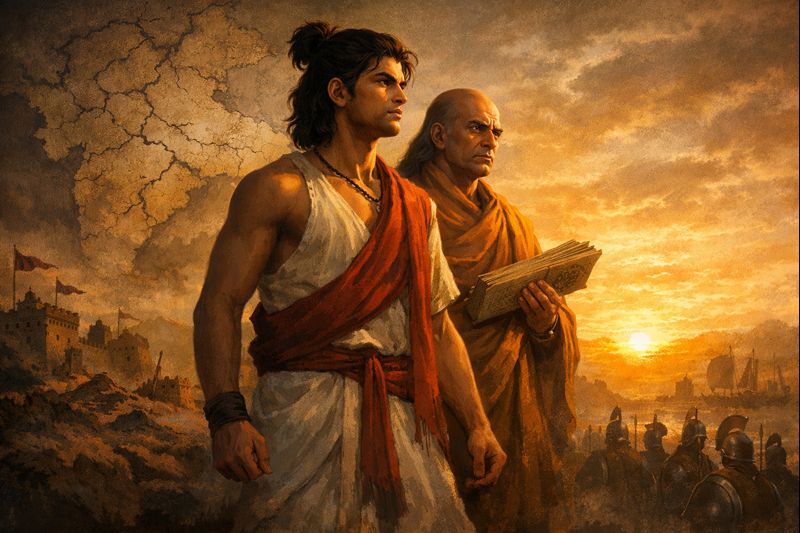
It was within this environment of disorder, division, and external threat that the foundations for a new political order were laid. The rise of Chandragupta Maurya and his mentor Chanakya was not accidental, but a historical response to the crisis facing the Indian subcontinent.

Chandragupta Maurya: From an Ordinary Boy to an Emperor

The life journey of :contentReference[oaicite:0]{index=0} stands as one of the most powerful narratives in history. It proves that greatness is not inherited by birth, but earned through resilience, vision, and relentless struggle.

The man who would later establish the first great empire of India did not begin his life surrounded by power, privilege, or security. His early years were shaped by uncertainty, hardship, and a social environment that offered him very little hope.

Birth and Social Background

Historical sources suggest that Chandragupta Maurya was not born into a royal or elite family. There remains scholarly debate regarding his exact origins, but it is widely accepted that he belonged to a modest and socially marginalized background.

In ancient Indian society, social identity was largely determined by birth. Opportunities, respect, and authority were reserved for those who belonged to established lineages. For a boy from a humble background, even dreaming of leadership was considered unrealistic.

Yet, within Chandragupta existed a sense of purpose that could not be confined by social labels. He carried within himself an ambition that extended far beyond personal success— an ambition to change the fate of a fragmented land.

Humiliation, Rejection, and Inner Struggle

Chandragupta’s early life was marked by repeated rejection. He was underestimated, dismissed, and often ridiculed. His lack of status made him an easy target for those who believed power belonged only to the privileged.

However, these humiliations did not weaken him. Instead, they became the fuel that strengthened his resolve. Rather than accepting defeat, he chose self-discipline, learning, and preparation.

His struggle was not limited to external obstacles. It was also an internal battle against fear, doubt, and the temptation to abandon his aspirations. Each failure refined his character and prepared him for the responsibilities that awaited him.

When Society Sees You as Weak

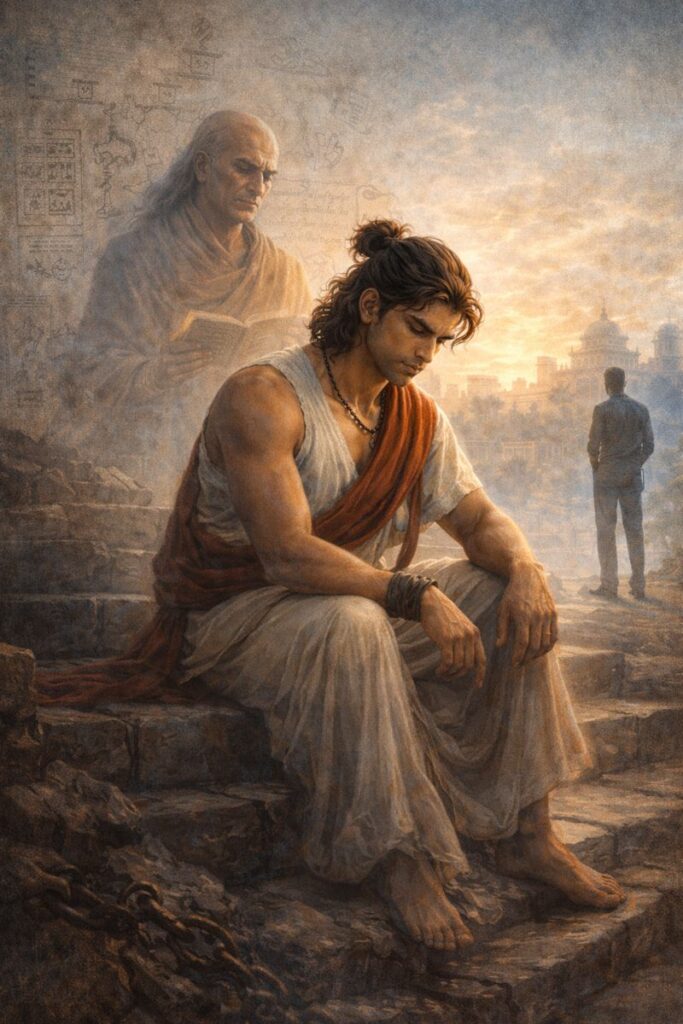
There are moments in life when society defines our limits for us— when people assume that we cannot rise beyond our current circumstances. I, too, have experienced such moments, when expectations imposed by others felt heavier than the challenges themselves.

The story of Chandragupta Maurya teaches a timeless lesson: society judges based on present conditions, not on hidden potential. True strength often grows in silence, far from recognition or approval.

By choosing perseverance over resentment and preparation over complaint, Chandragupta transformed perceived weakness into the foundation of extraordinary power. This inner strength would eventually lead him from obscurity to the throne of history.

Chanakya and Chandragupta: A Historic Mentor–Disciple Partnership

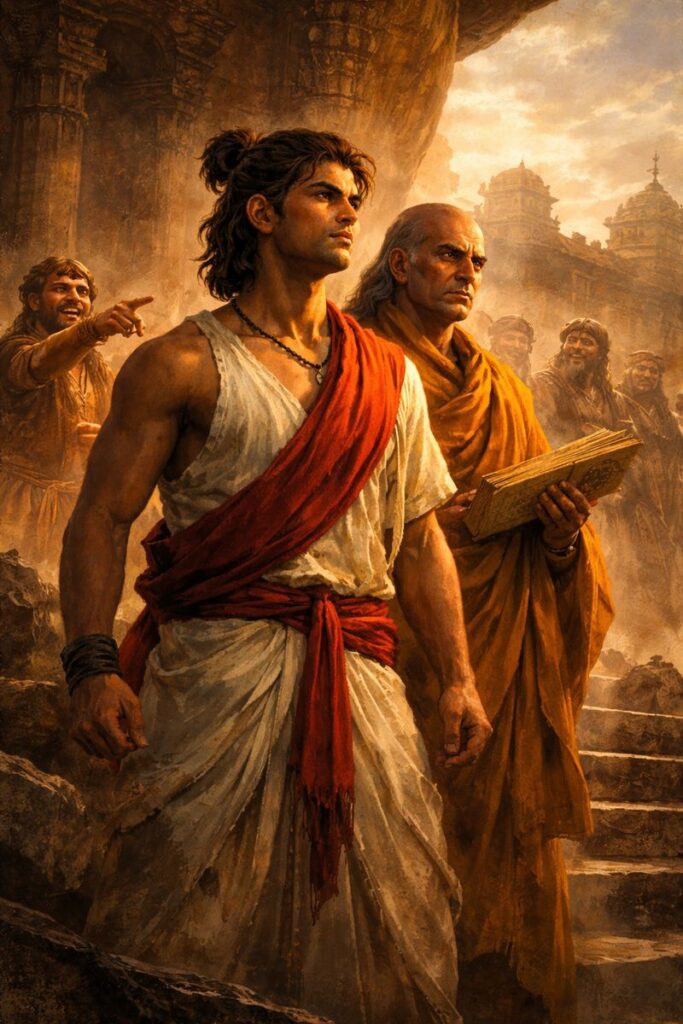
In the history of India, few relationships have shaped the destiny of a nation as profoundly as the bond between :contentReference[oaicite:0]{index=0} and :contentReference[oaicite:1]{index=1}. This partnership was not merely political in nature; it was an extraordinary union of wisdom and action, vision and execution, philosophy and power.

While Chandragupta brought courage, ambition, and youthful determination, Chanakya contributed experience, intellectual depth, and a clear understanding of statecraft. Together, they did not just overthrow a ruler— they redefined the very idea of governance in ancient India.

Chanakya’s Humiliation and His Oath

Chanakya was a respected scholar and teacher, renowned for his mastery of politics, economics, and philosophy. However, a single moment of humiliation in the court of King Dhana Nanda became the turning point of his life.

The arrogance of power and the insult directed at a learned mind ignited a fire within Chanakya. What might have broken an ordinary person instead strengthened his resolve. In that moment, Chanakya took a solemn oath— to uproot tyranny and establish a just and disciplined rule.

This vow was not driven by personal revenge alone, but by a larger vision for the nation. Chanakya understood that removing a corrupt ruler was meaningless without preparing a capable and ethical leader to replace him.

It was during this search for the right instrument of change that Chanakya recognized extraordinary potential in a young and unpolished Chandragupta.

Strategy, Ethics, and Diplomacy

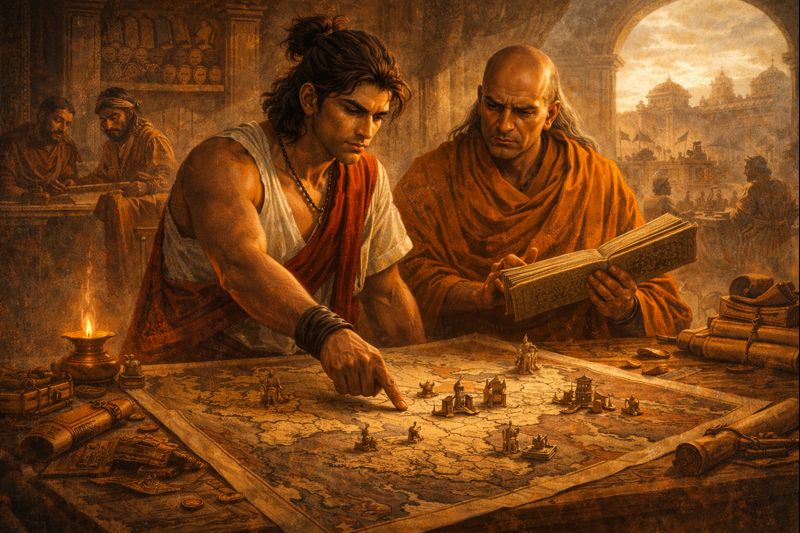
Chanakya’s guidance extended far beyond military planning. He trained Chandragupta in administration, economic management, intelligence systems, and the delicate art of diplomacy.

According to Chanakya, the true strength of a state lay not only in its army, but in efficient governance, a stable economy, and the trust of its people. These principles later became the foundation of the Maurya Empire’s success.

Patience in warfare, calculation in politics, and discipline in governance— these qualities were carefully cultivated in Chandragupta under Chanakya’s mentorship. Every decision was evaluated not for short-term gain, but for long-term national stability.

This mentor–disciple relationship was guided by reason rather than emotion, where personal ambition was always secondary to the greater interest of the state.

A True Mentor Can Change the Direction of Life

Finding the right mentor in life is often the defining moment of personal transformation. A true mentor does more than impart knowledge; they recognize hidden potential and provide direction when clarity is missing.

⭐ Top Study Product Bestseller
Study Book
Recommended Study Book for Competitive Exams
★★★★☆ 4.4/5 Rating
  • Exam-focused content
  • Clear and simple explanations
  • Trusted by thousands of students
  • Ideal for UPSC & competitive exams
Check Price on Amazon

Just as Chanakya saw greatness in Chandragupta when society saw only an ordinary youth, every individual needs guidance that focuses on possibilities rather than limitations.

From my own experience, timely guidance has the power to end years of confusion and hesitation. The story of Chanakya and Chandragupta reminds us that talent alone is not enough— it is the right mentor who turns potential into history.
Foundation of the Maurya Empire: Built on Strategy, Not Just the Sword

The establishment of the Maurya Empire cannot be understood as a simple tale of battlefield victories. It was the result of calculated planning, political insight, patient preparation, and a deep understanding of power. The rise of the Mauryas marked a shift in Indian history— from fragmented rule to centralized governance.

Under the leadership of :contentReference[oaicite:0]{index=0} and the strategic vision of his mentor, power was pursued not through reckless aggression, but through long-term thinking and institutional strength. This approach set the Maurya Empire apart from all its contemporaries.

The Fall of Dhana Nanda

The throne of Magadha was occupied by :contentReference[oaicite:1]{index=1}, a ruler known for immense wealth and military resources, but also for oppression, heavy taxation, and growing distance from public sentiment.

Dhana Nanda’s greatest weakness was not a lack of power, but an excess of arrogance. Confident in his armies and riches, he underestimated the strength of organized resistance and the impact of public dissatisfaction.

Rather than engaging in direct confrontation at the outset, Chanakya and Chandragupta chose a methodical approach. They weakened the Nanda administration from within, built alliances, gained popular support, and carefully identified the vulnerabilities of the ruling system.

When the final confrontation arrived, the foundations of Nanda rule were already unstable. The fall of Dhana Nanda was therefore not sudden, but inevitable— a symbolic end to tyranny and misrule, and the beginning of a new political order.

Territorial Expansion and Administration

After securing power, Chandragupta Maurya did not treat victory as the final goal. He understood that conquest without governance leads only to temporary dominance. His true focus was the creation of a stable, well-administered, and enduring empire.

Territorial expansion was carried out in a planned manner. Border regions were secured first, followed by the establishment of administrative units to ensure law, order, and economic stability in newly acquired territories.

The Maurya administration was characterized by centralized authority, clear chains of responsibility, an organized taxation system, and a highly effective intelligence network. These institutions transformed conquered lands into integrated parts of a unified empire.

The success of the Maurya Empire lay not merely in the size of its territory, but in the quality of its governance. It demonstrated that true power is sustained not by fear, but by order, efficiency, and public trust.

For me, this phase of Maurya history offers a timeless lesson: achieving a goal is important, but building systems that can sustain success is what defines lasting leadership.

⭐ Top Study Product Best Choice
Premium Quality Amazon Product
★★★★☆ 4.4/5 Rating
  • Smart, compact design
  • Reliable everyday performance
  • Highly rated by users
  • Great value for money
Check Price on Amazon

Administrative System of the Maurya Empire

The true strength of the Maurya Empire did not lie merely in its vast territory or powerful army, but in its highly organized and disciplined administrative system. Chandragupta Maurya, guided by Chanakya, understood that lasting rule depends on efficient governance, clear accountability, and institutional stability.

The Mauryan administration was centralized in nature, with well-defined roles assigned to officials at every level. The primary objective of governance was not only revenue collection, but also public welfare, internal security, economic stability, and social order. This approach made the Maurya Empire one of the most advanced states of the ancient world.

Arthashastra and Economic Policy

The economic foundation of the Maurya Empire was deeply influenced by :contentReference[oaicite:0]{index=0}, authored by Chanakya. This work was far more than a manual on wealth or taxation; it provided a comprehensive blueprint for governance, administration, and economic management.

Agriculture, trade, and industry were treated as the three pillars of the state economy. Farmers were protected through regulated taxation, ensuring that revenue collection did not destroy productivity. The state actively supported irrigation, land management, and agricultural expansion.

Trade routes were secured, standardized weights and measures were enforced, and key industries such as mining and manufacturing were placed under state supervision. These policies created economic self-reliance and ensured a steady flow of resources to the treasury.

For me, this economic system offers a timeless lesson: without financial discipline and long-term planning, no organization or system can sustain success.

Intelligence Network and Internal Security

One of the most remarkable features of the Maurya Empire was its extensive and well-organized intelligence network. Chanakya believed that the security of the state depended not only on military strength, but on constant vigilance and accurate information.

Spies operated across the empire in various disguises— as monks, merchants, servants, and common citizens. Their role was to gather information about internal dissent, administrative corruption, and external threats before they could escalate.

This intelligence system also functioned as a tool of administrative discipline. Officials were aware that misconduct would not go unnoticed, which encouraged honesty and efficiency in governance.

In a broader sense, the Maurya intelligence network demonstrates that strong security systems are built not merely through force, but through awareness, coordination, and timely decision-making.

Life Lessons I Learned from Chandragupta Maurya

The true purpose of studying history is not simply to remember events, but to reflect on experiences and apply their wisdom to our own lives. The journey of Chandragupta Maurya has repeatedly reminded me that difficult circumstances do not define our limits— our response to them does.

His life serves as a mirror, in which I have seen my own struggles, moments of doubt, and the critical decisions that shaped my path. From his story, I have drawn lessons that remain deeply relevant in every stage of life.

Never Be Afraid of Struggle

The entire life of Chandragupta Maurya was shaped by struggle. From social neglect in his early years to the immense challenges of confronting powerful rulers, every phase of his journey demanded resilience.

He demonstrated that struggle is not a sign of weakness, but a process of preparation. Every hardship either breaks a person or strengthens their character and clarity of purpose.

⭐ Top Study Product Best Choice
Premium Quality Amazon Product
★★★★☆ 4.3/5 Rating
  • Compact and practical design
  • Reliable everyday performance
  • Well-reviewed by customers
  • Suitable for daily use
Check Price on Amazon

In my own life, there were moments when circumstances felt overwhelming. During those times, I realized that avoiding struggle only delays growth. Facing it with courage is what transforms adversity into strength.

Making the Right Decision at the Right Time

One of the most striking qualities of Chandragupta Maurya was his ability to make thoughtful decisions. He knew when to advance, when to wait, and when to withdraw in order to prepare better.

He never confused impulsive action with bravery. Often, patience, observation, and timing proved far more powerful than immediate reaction.

I have learned from my own experiences that hurried decisions often lead to regret, while well-timed choices open new possibilities. Chandragupta’s life teaches us that the right decision matters most when it is taken at the right moment.

The Importance of Team and Mentorship

If Chandragupta Maurya had walked his path alone, history might have remembered him as a rebel rather than an emperor. It was the guidance of Chanakya and the support of a committed team that transformed his potential into reality.

This reminds us that no individual rises to greatness alone. A trustworthy team, shared vision, and timely guidance form the foundation of lasting success.

In my own journey, progress accelerated whenever I received the right guidance and worked alongside people who believed in a common purpose. From Chandragupta Maurya, I learned that choosing the right companions is just as important as choosing the right direction.

His story continually reinforces a powerful truth: struggle, wise decision-making, and meaningful collaboration together can transform an ordinary individual into an extraordinary force.

Relevance of the Maurya Period in Contemporary India

History becomes truly meaningful when it speaks to the present. The Maurya period was not merely a chapter of ancient Indian politics; it was a comprehensive model of governance, administration, and nation-building whose relevance remains strikingly visible in modern India.

Contemporary India faces complex challenges— social diversity, economic transformation, geopolitical pressures, and internal security concerns. In such a context, the unity, centralized administration, and long-term vision of the Maurya Empire offer valuable insights for today’s political and administrative systems.

Chandragupta Maurya and Chanakya clearly understood that a strong nation is not built on emotion alone, but on clear policies, effective institutions, and disciplined implementation. These principles remain equally essential in modern democratic governance.

One of the most important lessons from the Maurya period is the relationship between the state and its citizens. Governance was viewed as a responsibility, not merely a privilege of power. The welfare, security, and stability of the people were central to the legitimacy of rule.

As modern India emphasizes good governance, transparency, and accountability, the Mauryan administrative philosophy reminds us that public trust is the true foundation of political authority. Power endures only when it is exercised with responsibility.

The Maurya period also highlights the importance of strategy in politics. Short-term gains were never prioritized over long-term national interest. Whether in diplomacy, economic planning, or internal security, strategic patience proved to be a decisive strength.

For me, the relevance of the Maurya era extends beyond politics. It carries a moral dimension— the idea that leadership means owning the consequences of decisions, not merely exercising authority. This lesson is as vital for modern leaders as it is for responsible citizens.

If contemporary India seeks to strengthen its future, it must combine modern technology and democratic values with the timeless wisdom of the Maurya period— vision, discipline, and an unwavering commitment to national interest.

Conclusion: Learning from History, Moving Toward the Future

The story of Chandragupta Maurya is not merely the account of an empire’s rise, but the journey of an ordinary individual who achieved extraordinary greatness. It reminds us that circumstances do not determine destiny— clarity of purpose and strength of character do.

The emergence of the Maurya Empire proves that true power does not lie only in military strength, but in strategy, discipline, wise mentorship, and public trust. The partnership between Chandragupta and Chanakya stands as a timeless example of how guidance and vision can transform potential into lasting impact.

For me, the life of Chandragupta Maurya is not just history, but a living guide for the present. His journey teaches us to face struggle without fear, to make thoughtful decisions at the right moment, and to recognize the value of collaboration and mentorship. These lessons remain as relevant today as they were centuries ago.

In modern India and in our personal lives, where challenges are complex and expectations are high, the principles of the Maurya period— vision, discipline, and responsibility— offer balance and direction. History exists not to bind us to the past, but to inspire wiser choices for the future.

If we can internalize these values from Chandragupta Maurya’s journey, we not only improve our own lives, but also contribute to building a more responsible, resilient, and forward-looking society. This is the true legacy of history, and the most meaningful way to honor it.

Frequently Asked Questions (FAQ)

Who was Chandragupta Maurya?

Chandragupta Maurya was the founder of the Maurya Empire and the first ruler to unify a large part of the Indian subcontinent under a centralized authority. He is regarded as one of the greatest emperors in ancient Indian history.

What was the significance of the Maurya Empire?

The Maurya Empire marked the beginning of large-scale political unity in India. It introduced efficient administration, economic planning, internal security, and laid the foundation for strong governance and nation-building.

What role did Chanakya play in Chandragupta Maurya’s rise?

Chanakya was the mentor, strategist, and political guide of Chandragupta Maurya. His teachings on administration, diplomacy, and economics helped shape Chandragupta into a capable ruler and enabled the successful establishment of the Maurya Empire.

Why is the Maurya administration considered advanced?

The Maurya administration was highly centralized and well-organized. It included systematic taxation, a strong intelligence network, regulated trade, agricultural support, and public welfare policies, making it one of the most advanced governance systems of the ancient world.

What life lessons can be learned from Chandragupta Maurya?

Chandragupta Maurya’s life teaches us to embrace struggle, make thoughtful decisions at the right time, value mentorship and teamwork, and remain disciplined in pursuit of long-term goals.

Why is the Maurya period relevant in modern India?

The Maurya period remains relevant today because it emphasizes unity, strategic governance, accountability, and public trust— principles that are essential for modern democratic institutions and responsible political leadership.

References

  • Thapar, Romila. Aśoka and the Decline of the Mauryas. Oxford University Press.
  • Radhakrishnan, S. (Editor). The Arthashastra of Kautilya. Penguin Classics.
  • Upinder Singh. A History of Ancient and Early Medieval India. Pearson Education.
  • Sastri, K.A. Nilakanta. Age of the Nandas and Mauryas. Motilal Banarsidass.
  • Mookerji, Radhakumud. Chandragupta Maurya and His Times. Motilal Banarsidass.
  • Megasthenes. Indica (Fragments and Accounts), as cited in classical Greek historical records.
  • Ministry of Culture, Government of India. Ancient Indian History Resources.

Leave a Comment

Your email address will not be published. Required fields are marked *

Scroll to Top