
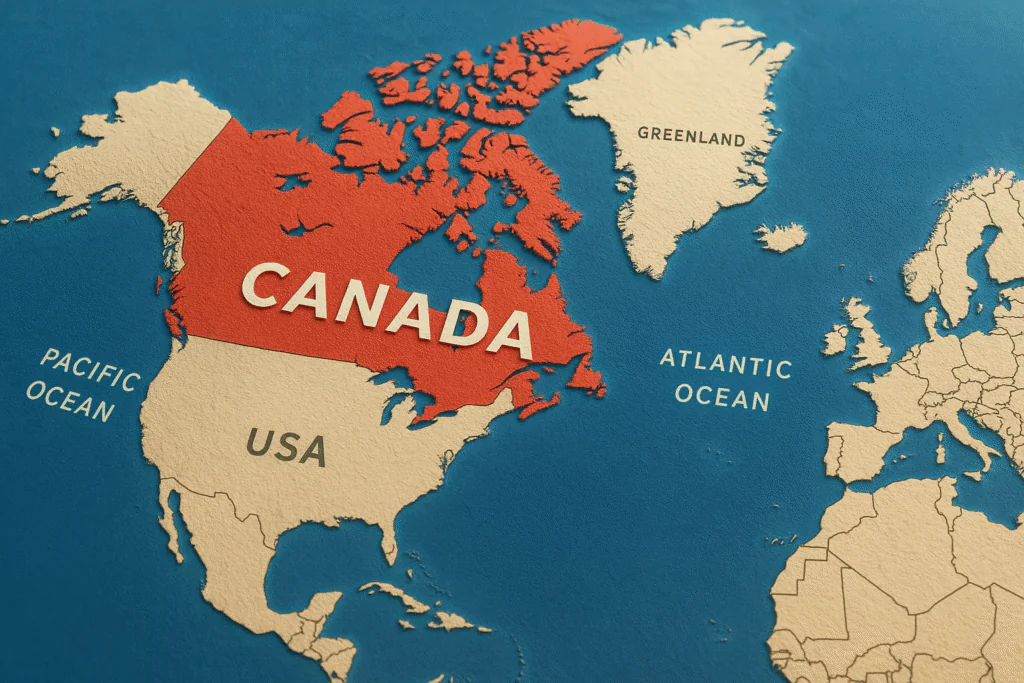
Canada Complete Guide
Canada is a vast and developed country located in North America. It is the second largest nation in the world and is known for its natural beauty, multicultural society, high standard of living and economic stability. The country is globally respected for peace, education, healthcare and employment opportunities.
Geographical Overview
Location and Border
This North American nation shares its southern border with the United States of America (USA). The Arctic Ocean lies to the north, the Atlantic Ocean to the east and the Pacific Ocean to the west.
Major Rivers and Lakes
- St. Lawrence River
- Fraser River
- Great Lakes
Climate
The climate varies significantly across regions. Arctic conditions dominate the north, while temperate weather is experienced in the southern provinces.
Historical Background
Early History
The original inhabitants were the Inuit and First Nations communities, who developed rich indigenous cultures long before European arrival.
Colonial Period
French and British powers established colonies during the 16th century. The nation received Dominion status in 1867 and gradually evolved into a fully independent state.
Political System and Administration
Government Structure
- A constitutional monarchy with a parliamentary democracy.
- The political system is influenced by British traditions.
- King Charles III serves as the formal head of state.
Major Political Institutions
- Prime Minister
- Parliament
- Provincial Governments
Economic Structure
Major Industries
- Natural Resources (Oil, Gas, Minerals)
- Agriculture and Forestry
- IT and Service Sector
- Tourism
Trade and Cooperation
The country is a member of G7, G20, and WTO. It maintains strong trade relations with the United States, China, and the European Union.
Society and Cultural Life
Multicultural Society
The nation has one of the highest immigration rates in the world. Different religions, languages and traditions coexist peacefully.
Official Languages
- English
- French
Education and Health
The education and healthcare systems are considered among the best globally, contributing to a high quality of life.
Major Tourist Destinations
Main Attractions
- Niagara Falls
- Rocky Mountains
- Banff National Park
- Historic sites of Ottawa and Toronto
Travel Guide Book
Click below to view full product details and the latest price on Amazon.
👉 View on Amazon*As an Amazon Associate, I earn from qualifying purchases.
Conclusion
Canada is geographically vast and economically strong. Its education system, healthcare facilities, multicultural society and natural landscapes make it one of the most developed and peaceful countries in the world. The nation continues to represent stability, opportunity and sustainable growth.
Introduction to the Country
This North American state is widely admired for its clean environment, high living standards and social harmony. It ranks among the safest and most attractive destinations globally due to economic progress and inclusive policies.
Detailed Geographical Features
The total area is approximately 9.98 million square kilometers. The landscape includes mountains, plains, plateaus, rivers, lakes and extensive coastal regions, supporting diverse ecological systems and economic activities.
Location and Extent
- Spread between 41° North to 83° North latitude.
- Shares the world’s longest demilitarized border with the USA.
- Surrounded by the Arctic, Atlantic and Pacific Oceans.
- Possesses one of the longest coastlines globally.
Water Resources
The region is rich in freshwater resources, supporting trade, irrigation and hydroelectric power.
- St. Lawrence River – Major trade route.
- Fraser River – Important for fisheries and hydropower.
- Great Lakes – Largest freshwater lake system in the world.
Climate Patterns
Arctic climate dominates the northern territories, while moderate summers and cold winters are experienced in central and southern areas. Coastal regions experience marine climatic influence.
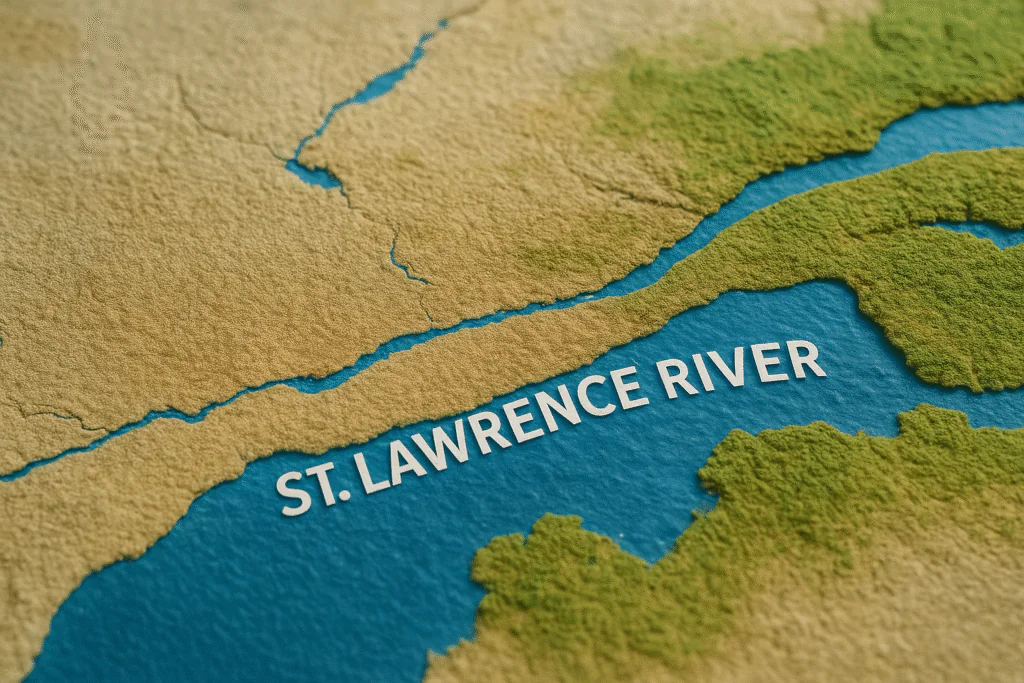
Major Rivers and Lakes of Canada
Canada is among the richest nations in the world in terms of freshwater resources. Its vast network of rivers and lakes enhances natural beauty and plays a vital role in transportation, irrigation, hydroelectric power generation and fisheries.
Major Rivers
St. Lawrence River
St. Lawrence River connects the Great Lakes to the Atlantic Ocean and serves as a major trade and transportation corridor.
Fraser River
Fraser River, flowing through British Columbia, is well known for hydroelectricity production and salmon fisheries.
Mackenzie River
Mackenzie River is the longest river in the country. It flows through the Northwest Territories and drains into the Arctic Ocean.
Yukon River
Yukon River flows through Yukon and Alaska and became famous during the historic Gold Rush period.
Major Lakes
Great Lakes
Great Lakes (Superior, Michigan, Huron, Erie and Ontario) form the largest freshwater lake system in the world.
Great Bear Lake
Great Bear Lake is the largest lake located entirely within national territory.
Great Slave Lake
Great Slave Lake lies in the Northwest Territories and plays an important role in regional transport.
Lake Winnipeg
Lake Winnipeg, situated in Manitoba, is well known for fish production.
👉 These rivers and lakes have shaped the geographical identity, economic development and cultural evolution of the nation.
St. Lawrence River – Detailed Overview
The St. Lawrence River is one of the most important waterways in North America. It holds great economic, commercial and cultural significance.
Geographical Location
- Originates from the Great Lakes.
- Travels approximately 1,197 kilometers.
- Empties into the Atlantic Ocean.
- Flows mainly through Quebec and forms part of the border with the United States.
Key Features
- Provides a major international trade route.
- The St. Lawrence Seaway allows large ships to travel inland.
- Montreal and Quebec City are key urban centers along its banks.
Economic and Cultural Importance
- Trade: Backbone of import-export activities.
- Hydropower: Supports major energy projects.
- Tourism: Attracts visitors due to scenic and historic value.
👉 This river remains central to national economic strength and global trade connectivity.
Fraser River – Key River of British Columbia
The Fraser River is the longest river in British Columbia and is famous for natural scenery, hydroelectric potential and salmon fisheries.
Geographical Location
- Approximately 1,375 kilometers long.
- Originates in the Rocky Mountains.
- Flows southwest before entering the Pacific Ocean.
Key Features
- Vancouver is located near its mouth.
- The Fraser Valley is highly fertile.
- Renowned globally for salmon fish.
Economic and Cultural Importance
- Fisheries: Major salmon source.
- Hydropower: Supports energy production.
- Agriculture: Fertile valley aids farming.
- Tourism: Scenic landscapes attract visitors.
Travel Guide Book
Click below to view full product details and the latest price on Amazon.
👉 View on Amazon*As an Amazon Associate, I earn from qualifying purchases.
👉 The Fraser River remains a vital economic and ecological asset of western Canada.
Great Lakes System
The Great Lakes are shared between the United States and Canada and represent the largest freshwater system on Earth.
List of Great Lakes
- Lake Superior – Largest freshwater lake by area.
- Lake Michigan – Entirely within the United States.
- Lake Huron – Known for islands and long coastline.
- Lake Erie – Productive fishing region.
- Lake Ontario – Connected to the Atlantic via the St. Lawrence River.
Key Features
- Provide nearly 20% of global surface freshwater.
- Cover approximately 244,000 square kilometers.
- Support the St. Lawrence Seaway trade route.
Economic and Cultural Importance
- Shipping: Heavy trade movement.
- Fisheries: Major fish production zone.
- Water supply: Supports agriculture and cities.
- Tourism: Popular for beaches and water sports.
👉 The Great Lakes remain central to regional economic activity and freshwater sustainability.
Climate Zones
Due to its vast geographical extent, climate patterns vary widely across the country. Northern areas experience extreme cold, while southern regions have more moderate conditions.
Arctic Climate
- Located within the Arctic Circle.
- Snow and ice dominate most of the year.
- Very low temperatures.
Prairie Climate
- Vast plains region.
- Warm summers and long cold winters.
- Major agricultural zone.
Temperate Climate
- Found in Ontario and Quebec.
- Moderate summers and cold winters.
Maritime Climate
- Common in coastal British Columbia.
- Mild temperatures and higher rainfall.
👉 Overall, climate diversity reflects the country's size and proximity to three oceans.
History of Canada
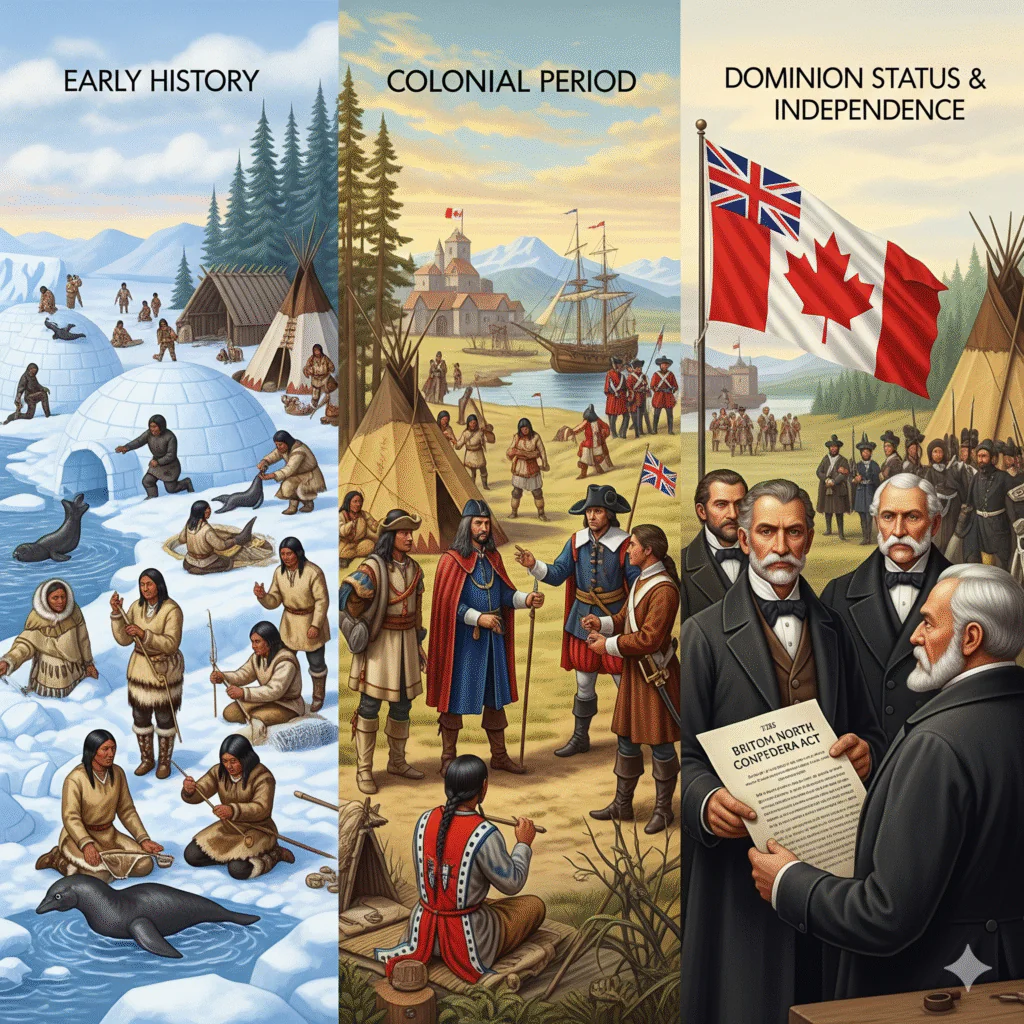
The history of Canada is rich and diverse, reflecting a long journey from Indigenous civilizations to colonial rule and finally the emergence of a modern democratic nation.
Early History
- The first inhabitants were the Inuit, First Nations and Métis communities.
- They depended on hunting, fishing and gathering.
- Each group developed distinct languages, traditions and governance systems.
European Arrival and Exploration (15th–16th Century)
- In 1497, John Cabot reached Newfoundland.
- In 1534, Jacques Cartier explored the St. Lawrence River.
- European traders later expanded the fur trade network.
Colonial Period
- In the 17th century, France established “New France”.
- The Treaty of Paris (1763) transferred control to Britain.
- British governance strengthened parliamentary traditions and English influence.
Confederation (1867)
- On 1 July 1867, the Dominion was formed under the British North America Act.
- Initially included Ontario, Quebec, Nova Scotia and New Brunswick.
- Later expanded to 10 provinces and 3 territories.
Journey Towards Independence
- The Statute of Westminster (1931) granted legislative autonomy.
- The Constitution Act (1982) ensured full constitutional independence.
Modern Era
- Today it operates as a constitutional monarchy and parliamentary democracy.
- Known globally for human rights, peace and multicultural society.
👉 This historical journey reflects the transformation from Indigenous foundations to a sovereign democratic state.
Indigenous Foundations
Long before European arrival, diverse Indigenous communities lived across the region with rich cultural traditions.
Major Indigenous Groups
- Inuit – Inhabited Arctic regions.
- First Nations – Spread across forests and plains.
- Métis – Communities of mixed Indigenous and European heritage.
Lifestyle and Culture
- Close relationship with nature.
- Economy based on hunting, fishing and gathering.
- Developed art, spirituality and governance systems.
Trade Networks
- Established trade routes across territories.
- Exchanged fur, copper and natural resources.
👉 Indigenous heritage remains central to national identity today.
Colonial Era
The colonial era began with European exploration and settlement, shaping political and cultural development.
French Colonies (New France)
- Jacques Cartier claimed territory for France (1534).
- Samuel de Champlain founded Quebec City (1608).
- Economy centered on fur trade.
British Colonies
- British settlers expanded influence in the 17th century.
- Treaty of Paris (1763) marked British dominance.
- Parliamentary system and common law traditions strengthened.
Conflict and Cultural Tensions
- Rivalries between French and British settlements.
- Religious and linguistic tensions.
- French language and culture remained strong in Quebec.
History Book
Click below to view full product details and latest price.
👉 View on Amazon*As an Amazon Associate, I earn from qualifying purchases.
👉 The colonial period laid the foundation of bilingualism and parliamentary governance.
Political and Administrative System
The country follows a constitutional monarchy and federal parliamentary democracy.
Constitutional Framework
- The British monarch serves as formal head of state.
- Represented by the Governor General.
- Executive authority lies with the elected Prime Minister and cabinet.
Parliament
- House of Commons – Elected representatives.
- Senate – Appointed members reviewing legislation.
Federal Structure
- 10 provinces and 3 territories.
- Federal government handles defence and foreign affairs.
- Provinces manage education, health and natural resources.
Judiciary
- Supreme Court is the highest authority.
- Protects constitutional rights and resolves disputes.
Major Political Parties
- Liberal Party
- Conservative Party
- New Democratic Party
- Bloc Québécois
- Green Party
👉 The system blends British parliamentary tradition with federal principles, ensuring democratic governance and multicultural representation.

Amazon Product
Click below to view full product details and the latest price on Amazon.
👉 View on Amazon*As an Amazon Associate, I earn from qualifying purchases.
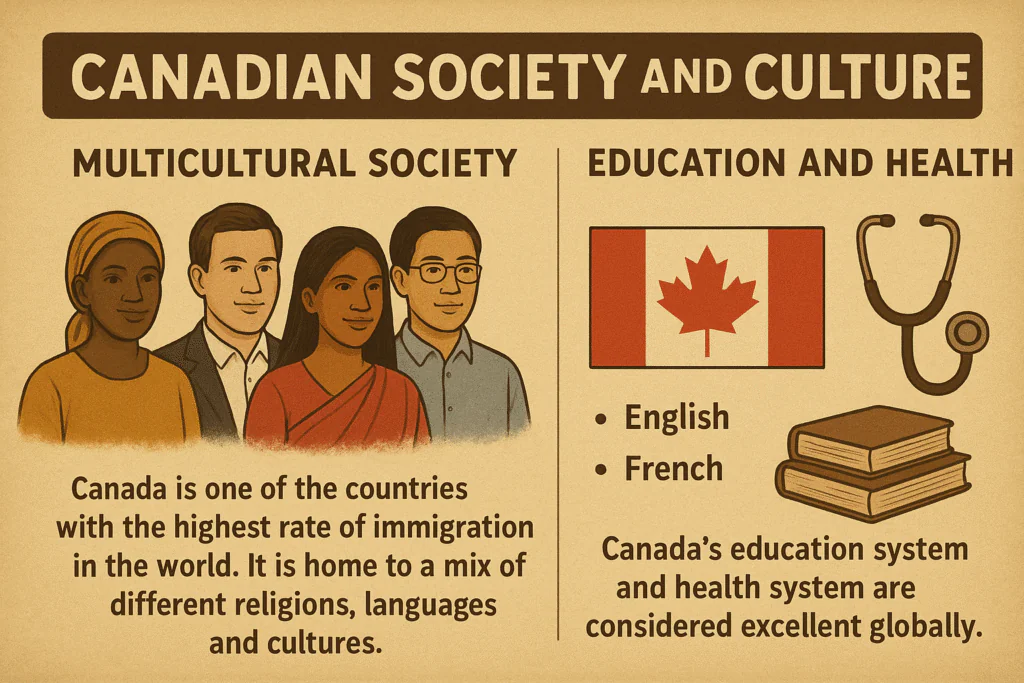
Society and Culture of Canada
Canada is globally recognized for its multicultural identity, social harmony and cultural diversity. Different religions, languages and traditions coexist peacefully, making the nation one of the most progressive societies in the world.
Multicultural Society
- Often called the “Immigrants’ Nation”.
- Communities from Asia, Europe, Africa and the Middle East live together.
- Equal rights and opportunities are guaranteed for all citizens.
Official Languages
- English and French are the two official languages.
- French is dominant in Quebec, while English is widely spoken elsewhere.
Religion and Belief
- Christianity is the largest religion.
- Hinduism, Islam, Sikhism, Buddhism and Judaism are also practiced.
- Religious freedom is protected by law.
Education & Healthcare
Education
- The education system ranks among the best globally.
- Institutions such as the University of Toronto, McGill University and the University of British Columbia are internationally respected.
Healthcare
- Public-funded healthcare ensures accessible medical services.
Festivals & Traditions
- Canada Day – Celebrated on July 1.
- Thanksgiving – Harvest celebration.
- Christmas and Easter.
- Diwali, Eid and Chinese New Year are also widely celebrated.
Arts & Sports
- Strong contributions in literature, music and cinema.
- Ice Hockey – National winter sport.
- Lacrosse – Official summer sport.
Culture Book
Click below to view full product details and latest price.
👉 View on Amazon*As an Amazon Associate, I earn from qualifying purchases.
👉 Overall, society is built on diversity, tolerance and equality.
Impact of Immigration
- Welcomes millions of immigrants annually.
- Immigration strengthens economic growth and diversity.
Equality & Tolerance
- Equal rights guaranteed by law.
- Discrimination based on race, religion or gender is prohibited.
Linguistic Diversity
- English and French are official.
- Punjabi, Hindi, Chinese, Arabic and Spanish are widely spoken.
Education System
Public Education
- Primary and secondary education are publicly funded.
- High standards maintained nationwide.
Higher Education
- Universities rank among the world’s best.
- Strong focus on research and innovation.
Healthcare System
Public Healthcare
- Government-funded medical services.
- Essential healthcare available at minimal cost.
Provincial Administration
- Each province manages its own health system.
Key Highlights
- High quality of life.
- Strong welfare system.
- Equal access to education and healthcare.
👉 The cultural framework reflects bilingualism, multiculturalism and social equality.
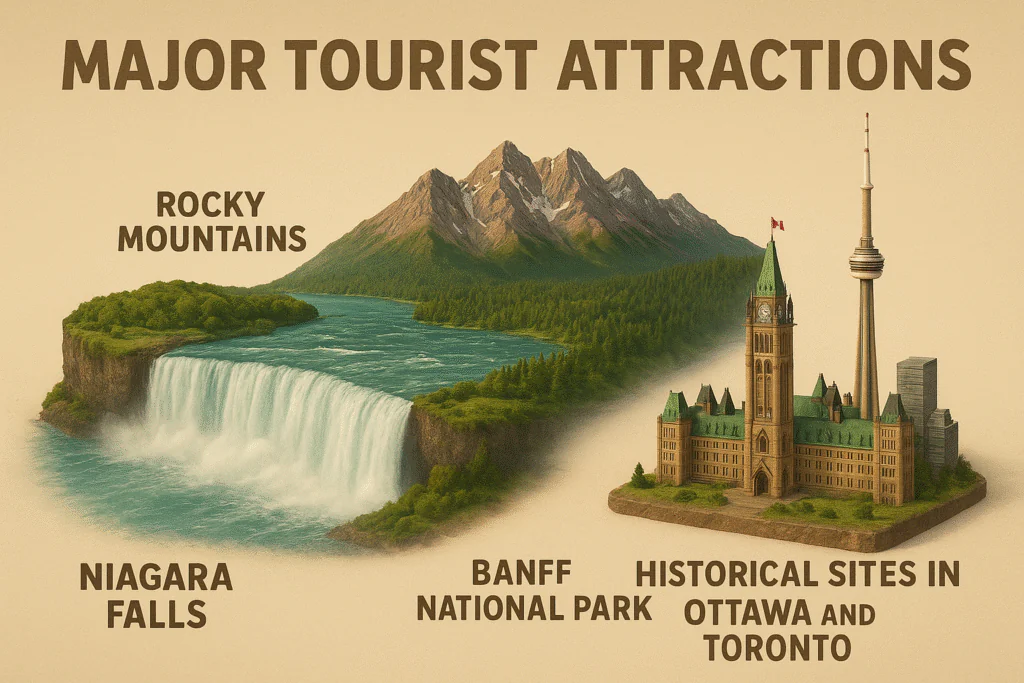
Tourist Places in Canada
Canada is famous all over the world for its natural beauty, historical heritage and modern cities. Its magnificent lakes, mountains, national parks and multicultural cities attract tourists.
Major Tourist Destinations in Canada
Niagara Falls (Ontario)
- One of the most famous waterfalls in the world.
- Tourists can go near the waterfall by boat (Maid of the Mist).
Banff National Park (Alberta)
- The oldest national park in Canada.
- Famous for lakes, snowy peaks and wildlife.
Toronto (Ontario)
- The largest city in Canada.
- CN Tower and Toronto Islands are major attractions.
Vancouver (British Columbia)
- A beautiful blend of nature and modernity.
- Stanley Park and Capilano Suspension Bridge are famous.
Québec City (Quebec)
- A UNESCO World Heritage Site.
- Known for European-style buildings and Château Frontenac.
Ottawa (Ontario)
- Capital of Canada.
- Parliament Hill, Rideau Canal and National Museum are major attractions.
Jasper National Park (Alberta)
- Part of the Rocky Mountains.
- Best for trekking, camping and wildlife viewing.
Prince Edward Island
- Famous for beaches and natural beauty.
- Known as the setting of the novel “Anne of Green Gables”.
Whistler (British Columbia)
- World-famous ski resort.
- Host of the 2010 Winter Olympics.
Churchill (Manitoba)
- Known as the “Polar Bear Capital of the World”.
- Famous for viewing polar bears and Northern Lights (Aurora Borealis).
Niagara Falls
Niagara Falls is a world-famous waterfall located on the border of Canada and the USA. It is situated on the Niagara River flowing between Ontario (Canada) and New York State (USA).
Main Features
- The waterfall has three parts:
- Horseshoe Falls – Canadian side.
- American Falls – US side.
- Bridal Veil Falls – US side.
- Horseshoe Falls is the largest and most attractive.
- About 3,000 tons of water falls every second.
Tourist Attractions
- Maid of the Mist Boat Tour – Takes visitors close to the waterfall.
- Niagara Parks – Beautiful green parks.
- Illumination Show – Waterfalls lit up with colorful lights at night.
- Niagara SkyWheel – Panoramic aerial view.

81-Key Electronic Cash Register / POS System
Ideal for small businesses, shops and retail checkout — supports multiple sales functions, numeric keypad, and clear display. :contentReference[oaicite:1]{index=1}
👉 View on Amazon*As an Amazon Associate, I earn from qualifying purchases.
Best Time to Visit
- May to September – Peak tourist season.
- Winter gives a partially frozen and unique view.
Special Significance
- One of the natural wonders of the world.
- Major contributor to Canada’s tourism economy.
- A popular honeymoon destination.
Rocky Mountains
The Rocky Mountains, also called “The Rockies,” are one of the most magnificent mountain ranges in North America. In Canada, they lie across Alberta and British Columbia.
Key Features
- Length: About 4,800 km.
- Elevation: Peaks rise up to 3,900 meters.
- Geography: Glaciers, lakes, valleys, and snow-capped mountains.
- Wildlife: Bears, deer, wolves, foxes and many birds.
Tourist Attractions
Banff National Park
- The most famous park in the Rockies.
- Known for lakes, glaciers and scenic hiking trails.
Jasper National Park
- Second major national park of the Rockies.
- Ideal for camping, trekking and wildlife spotting.
Lake Louise & Moraine Lake
- Beautiful blue lakes with breathtaking mountain views.
- Canoeing, photography and hiking available.
Winter Sports
- Whistler and Banff are world-famous for skiing and snowboarding.
Best Time to Visit
- Summer (June–September): Best for hiking and lake trips.
- Winter (December–March): Best for skiing and snow activities.
Special Significance
- Important part of Canada's natural heritage.
- Major contributor to adventure tourism and eco-tourism.
Conclusion of the Article on Canada
Canada is not only geographically vast and diverse, but also extremely rich socially, culturally and economically. Its major highlights include:
- Geographical diversity: From Arctic lands to temperate regions with rivers, lakes and wildlife.
- History and politics: A mix of Indigenous heritage, French and British colonial past, now a federal democratic nation.
- Economy: Strong industries in natural resources, agriculture, IT, manufacturing and tourism.
- Society and culture: Multiculturalism, bilingualism and high living standards.
- Education and health: World-class systems offering security and prosperity.
- Tourism: Iconic sites like Niagara Falls, Rockies, Banff and Jasper attract global travelers.
👉 In short, Canada represents peace, natural beauty, diversity and development. Its strong policies and rich culture will keep it an ideal nation globally.
References
- Government of Canada – Official Website
- Statistics Canada – Population, language, employment and economy
- Canada Tourism – Official travel guide
- University of Toronto, McGill University – Research sources
- Canadian Encyclopedia – thecanadianencyclopedia.ca
- World Bank – Canada overview
- UNESCO – World Heritage Sites in Canada
- Lonely Planet – Canada travel guide
- National Geographic – Canada nature and travel
- CIA World Factbook – Canada
- IMF Country Reports – Canada economy