
Cabinet Mission Plan 1946: History, Proposals, Failure and Key Learnings

Historical Background: India Before 1946

To properly understand the significance of the Cabinet Mission Plan 1946, it is essential to examine the political, economic and social conditions prevailing in India in the immediate post-World War II period. By the mid-1940s, British authority in India had considerably weakened, while nationalist aspirations had reached their peak. The growing demand for independence, combined with rising communal tensions between major political groups, created an urgent need for a constitutional settlement. It was in this complex and highly charged environment that the British government decided to send the Cabinet Mission to India in 1946.

Post-World War II Situation

The end of World War II significantly changed the political and economic position of Britain. The war had severely weakened the British economy, exhausted its military resources and reduced its capacity to maintain control over distant colonies like India. At the same time, nationalist movements in India had become more organised and assertive. In this context, the Cabinet Mission Plan 1946 emerged as a major British effort to find a constitutional solution for the transfer of power.

Britain’s Weakness and Its Impact on India

By 1945–46, Britain was facing serious financial stress, rising international pressure and growing resistance within India. The Royal Indian Navy mutiny of 1946, widespread labour unrest and the strong mass base of the Indian National Congress made it clear that British rule could not continue for long. British policymakers increasingly realised that a negotiated settlement with Indian leaders was necessary. This situation directly paved the way for the Cabinet Mission, which aimed to create a constitutional framework acceptable to major political groups.

Congress, Muslim League, and the Demand for Independence

By the mid-1940s, the two major political forces in India — the Indian National Congress and the All-India Muslim League — had developed sharply different visions for the future political structure of the country. While the Congress largely supported a united India with a strong central government, the Muslim League under Muhammad Ali Jinnah increasingly pressed for the creation of Pakistan to safeguard Muslim political interests.

Hope for Unity and Fear of Partition

Despite deep disagreements, there was still some hope among British officials and Indian leaders that a constitutional compromise could preserve Indian unity. However, growing mistrust, communal tensions and political rigidity gradually strengthened the possibility of Partition. This tense atmosphere formed the immediate background in which the Cabinet Mission arrived in India in 1946 to negotiate a peaceful transfer of power.

Amazon Product Image

Example Product Title

👉 Buy on Amazon

Disclosure: As an Amazon Associate, I earn from qualifying purchases.
What Was the Cabinet Mission Plan 1946? Explained in Simple Language

The Cabinet Mission Plan 1946 was a major constitutional proposal sent by the British Government to India during the final phase of colonial rule. Its primary aim was to design a peaceful mechanism for the transfer of power while attempting to keep India politically united. The plan tried to balance the competing demands of the Indian National Congress and the Muslim League, making it one of the most significant turning points in India’s freedom struggle.

Who Were the Members of the Cabinet Mission?

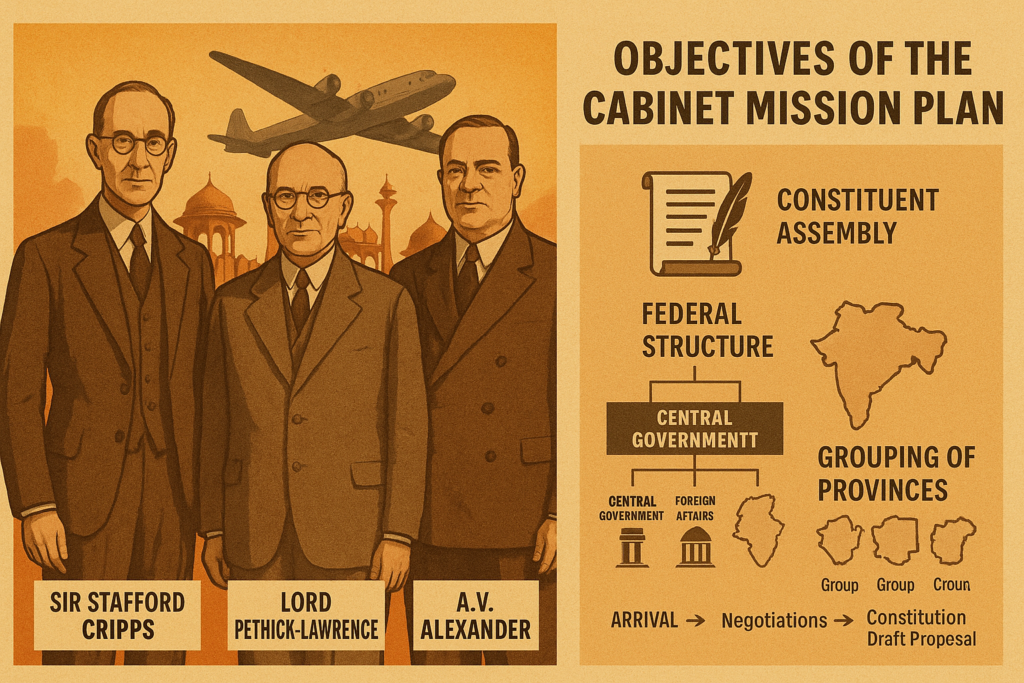
The Cabinet Mission was a special delegation sent by the British Government to India in 1946 to decide the future political structure of the country. It consisted of three senior British ministers who were selected due to their political experience, administrative knowledge, and involvement in British wartime governance.

The British Team That Arrived in India

The mission included:
Sir Stafford Cripps – Known for the earlier Cripps Mission and known for his liberal views on Indian self-governance.
Lord Pethick-Lawrence – The Secretary of State for India, who had significant influence over British policies in India.
A.V. Alexander – The First Lord of the Admiralty, who provided strategic and administrative expertise.

These three ministers arrived in India with the intention of holding discussions with Indian leaders, including representatives of the Indian National Congress, the Muslim League, and other regional political groups. Their key goal was to find a peaceful and acceptable way to transfer power from British rule to Indian hands while preventing civil conflict and maintaining stability under the proposed Cabinet Mission Plan 1946.

Main Objectives of the Mission

The mission had several important objectives that aimed to decide India’s constitutional future. It was designed to give Indians a platform to create a new government structure that would represent the entire country.

Providing a Roadmap for the Transfer of Power to India

One of the mission’s most significant goals was to create a clear roadmap for the transfer of power. This included:
• Setting up a Constituent Assembly responsible for drafting India’s new constitution.
• Establishing a federal structure where the central government would manage key subjects like defense, foreign affairs, and communications.
• Creating a system of groupings of provinces so that regions with similar political or religious interests could work together.

The British government hoped that if Indian leaders accepted the plan, power could be transferred peacefully, and India could remain united as a single nation instead of breaking into smaller countries. However, disagreements between the Congress and the Muslim League eventually made the plan difficult to implement, shaping the future course of India’s independence movement.

Reaction to the Cabinet Mission Plan: Hope, Doubt, and Conflict

The announcement of the Cabinet Mission Plan 1946 generated a mixed response across India. While many leaders initially saw it as a possible path toward a peaceful transfer of power, deep political differences soon surfaced. The reactions of the Congress, the Muslim League and ordinary Indians reflected a complex blend of hope, suspicion and strategic calculation.

Congress's Perspective

Desire for Unity, but Questions on Conditions

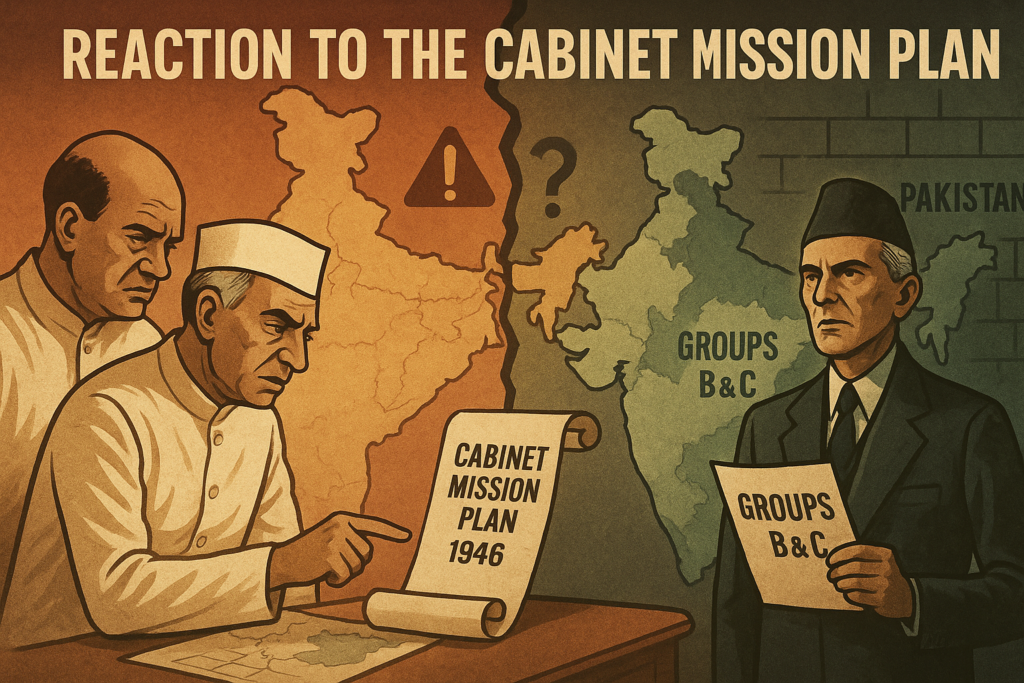
The Indian National Congress broadly supported the idea of a united India and welcomed any step that could lead to independence. However, its leaders raised serious questions about some of the conditions in the Cabinet Mission Plan. Congress was willing to accept the formation of a Constituent Assembly and the transfer of power, but it was not fully satisfied with the proposed grouping of provinces and the limited powers of the central government.

Congress feared that the compulsory grouping of provinces could weaken the unity of India in the long run and create semi-autonomous blocks that might function like “states within a state.” Leaders like Jawaharlal Nehru and Sardar Patel were particularly concerned that such arrangements could make governance complicated and unstable. Although Congress did accept parts of the plan for the sake of progress, it remained cautious and critical about the provisions that could encourage communal or regional division.
Amazon Product Image

Example Product Title

👉 Buy on Amazon

Disclosure: As an Amazon Associate, I earn from qualifying purchases.

Muslim League's Perspective

Demand for Pakistan and the Wall of Distrust

The All-India Muslim League, under the leadership of Muhammad Ali Jinnah, viewed the Cabinet Mission Plan 1946 through the lens of its long-standing demand for Pakistan. At first, the League showed some willingness to consider the plan because the grouping of provinces (especially Muslim-majority provinces in Groups B and C) appeared to give it significant political influence.

However, deep mistrust between the Congress and the Muslim League soon resurfaced. The League feared that in a united India, Muslims would remain politically and socially insecure under a Hindu-majority central government. When Congress made statements that were interpreted as attempts to weaken or reinterpret the grouping provisions, the League felt betrayed and hardened its stance.

This growing distrust eventually led the Muslim League to announce the Direct Action Day in August 1946, which resulted in communal violence and further damaged the chances of a peaceful settlement based on the Cabinet Mission Plan. Instead of building a bridge between communities, the political climate began to move rapidly towards confrontation and division.

The Condition of Ordinary Indians

People’s Hopes and Leaders’ Strategies

While top leaders of Congress and the Muslim League were engaged in intense negotiations and strategic calculations, ordinary Indians were mostly hoping for freedom, peace, and stability. Many people did not fully understand the complex details of the plan, but they deeply felt the impact of political tension, communal speeches, and rumours spreading in society.

For common citizens, the dream of independence was mixed with fear of violence and uncertainty about the future. They wanted an end to colonial rule, but they were also anxious about what kind of India would emerge—united or divided, peaceful or full of conflict. In many places, people’s lives were directly affected by protests, strikes, and riots triggered by political decisions taken at the top.

From a personal learning point of view, this phase of history teaches a powerful lesson: when two sides start seeing each other as enemies instead of partners in dialogue, even the best-designed plan can become a source of conflict. The same mistake is often repeated in modern politics, workplaces, families, and society—when trust collapses, understanding dies, and division becomes the easiest path.

How the Cabinet Mission Plan Failed and Its Far-Reaching Consequences

The failure of the Cabinet Mission Plan 1946 marked a decisive turning point in India’s journey toward independence. Although the plan initially appeared to offer a workable compromise between competing political demands, deep mistrust, rigid positions and rapidly deteriorating communal relations prevented its successful implementation. The collapse of this plan ultimately pushed the subcontinent closer to Partition.

Lack of Trust and Political Stubbornness

What If Dialogue Had Continued?

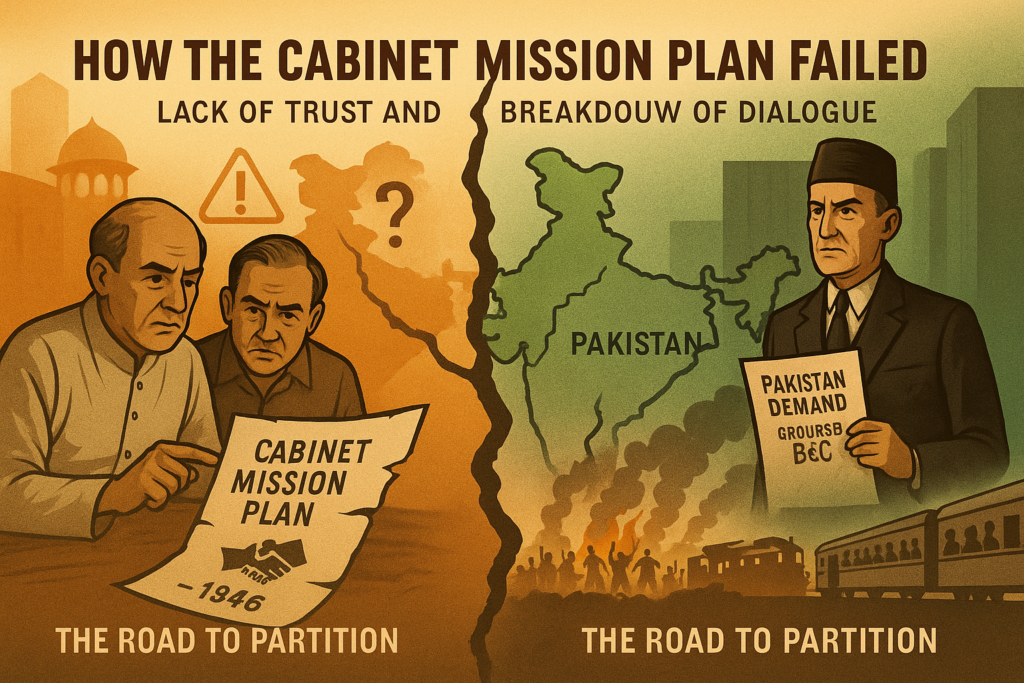
On paper, the Cabinet Mission Plan appeared to be a balanced and practical solution for India’s political future. However, the reality on the ground was very different. The long-standing mistrust between the Indian National Congress and the Muslim League deepened further during the negotiation process. Instead of viewing each other’s arguments with an open mind, both sides interpreted every statement with suspicion.

Congress feared that the proposed grouping of provinces could eventually weaken national unity and lead to semi-autonomous regional blocks. On the other hand, the Muslim League believed that Congress would dominate the central government and undermine the political influence of Muslim-majority provinces. Due to these conflicting interpretations, no shared understanding could be achieved under the Cabinet Mission Plan 1946.

If both sides had stepped back from their rigid political positions and focused solely on India’s long-term future, the plan might have created a stable framework for the Constituent Assembly and a peaceful transfer of power. History teaches us that when dialogue breaks down, conflict becomes inevitable.

Amazon Product Image

Example Product Title

👉 Buy on Amazon

Disclosure: As an Amazon Associate, I earn from qualifying purchases.

The Road to Partition

The Painful Journey from the Plan to the Division

The failure of the Cabinet Mission Plan directly accelerated the path toward the Partition of India. When Congress and the Muslim League could not agree on a common approach, the British government also began to lose hope in the possibility of a united India. As tensions rose, the Muslim League strengthened its demand for Pakistan, and Congress eventually accepted the idea of partition as an unavoidable reality.

The situation worsened after the announcement of Direct Action Day in August 1946, which triggered widespread communal riots and deepened the divide between the two major communities. What had started as an attempt to keep India united slowly turned into a political dead-end, from which the only remaining solution appeared to be the division of the country.

By 1947, communal tensions, political mistrust, and violent incidents had made the possibility of a peaceful and united India extremely difficult. Millions of people were displaced, countless families were separated, and the human cost of Partition became one of the most tragic chapters in the subcontinent’s history.

From a personal perspective, this period teaches a powerful lesson: When mistrust replaces dialogue, decisions are driven not by wisdom but by fear and hostility. History repeatedly reminds us that the beginning of conflict lies in the end of communication.
Lessons for Today's India from the Cabinet Mission Plan

The experience of the Cabinet Mission Plan 1946 offers valuable lessons for contemporary India. Although the plan belonged to a different historical context, the issues it highlighted—political mistrust, lack of dialogue and competing national visions—remain relevant even today. By revisiting these lessons, modern India can better navigate its democratic and developmental challenges.

Why It Is Important to Remember History While Making Decisions

Learning from Mistakes Is Better Than Repeating Them

The study of the Cabinet Mission Plan is not just an academic exercise—it is a reminder of how crucial dialogue, trust, and collective decision-making are in shaping a nation’s future. Modern India still faces many of the challenges that existed during 1946: political divisions, miscommunication, and rising mistrust among different groups. History teaches us that when nations ignore past experiences, they often repeat the same mistakes, leading to unnecessary conflict and instability.

Remembering history while making decisions gives us a broader understanding of what worked, what failed, and why. It allows individuals and leaders to choose wisely, based on lessons learned through struggle and sacrifice. The failure of the Cabinet Mission Plan 1946 strongly reminds us that great decisions require patience, clarity, and a commitment to the greater good—not just emotional reactions or political pressure.

The Importance of Constitution, Democracy, and Unity

My Responsibility as a Student and Young Citizen

Today’s India stands on three powerful pillars: the Constitution, democracy, and national unity. The political turmoil of 1946 showed us that a nation’s strength does not come only from its borders, but from understanding, cooperation, and the willingness to build a shared future. Had there been more trust and willingness to compromise in 1946, the journey toward independence might have been less painful and far more harmonious.

As a student and a young citizen, it is my responsibility to uphold these values—not just in theory, but in my everyday actions. Democracy thrives when citizens think responsibly, ask meaningful questions, and participate constructively in society. This part of history reminds us that unity is built through our attitudes, words, and actions, and it requires active contribution from each one of us.

Ultimately, the most powerful lesson we draw from this episode is that dialogue, trust, and collective responsibility are the foundation of nation-building. If we strengthen these values today, India can move toward a future that is more prosperous, balanced, and filled with harmony.

Conclusion: Cabinet Mission Plan 1946 – Priceless Lessons from an Unsuccessful Attempt

The story of the Cabinet Mission Plan 1946 remains one of the most instructive episodes in India’s freedom struggle. Although the plan ultimately failed to achieve its objective of maintaining a united political framework, it left behind powerful lessons about negotiation, compromise and the consequences of deep political mistrust. Its legacy continues to shape how historians and students understand the final phase of British rule in India.

Strengths and Weaknesses of the Plan

If It Had Succeeded, Then Perhaps...

The Cabinet Mission Plan of 1946 was a crucial turning point in India’s political journey. Its greatest strength was its attempt to preserve a united India at a time when communal tensions and political disagreements were steadily rising. The plan offered a balanced structure—limited central authority, provincial autonomy, and the formation of a Constituent Assembly—ideas that could have laid the foundation for a democratic and inclusive nation.

However, the plan also had clear weaknesses: the ambiguity of the grouping system, the absence of trust between Congress and the Muslim League, and the British government’s limited willingness to mediate deeply. Had the Cabinet Mission Plan 1946 succeeded, India might have experienced a smoother transition to independence, possibly avoiding the large-scale human suffering caused by Partition. Millions of people could have been spared displacement, tragedy, and communal violence.

My Personal Journey: From Information to Awareness

The Journey from Reading History to Transforming My Thinking

Studying the Cabinet Mission Plan has been more than a historical exercise for me—it has become a journey of understanding and self-awareness. As I explored the reasons behind its success and failure, I realized that politics is not only about structures or power, but also about trust, communication, and collective responsibility.

While reading this chapter of history, I understood that whether it is a nation, a community, or a family— conflict begins where communication ends. The failure of the Cabinet Mission Plan has taught me that as responsible individuals, we must look at issues not through the lens of division but through the lens of solutions.

In the end, this journey has shown me that history is not merely a collection of past events— it is a guidebook for the future. Though the Cabinet Mission Plan did not succeed, the lessons it offers today are still deeply relevant: unity, understanding, and dialogue are the true pillars of nation-building.

Frequently Asked Questions (FAQ)

The following frequently asked questions help students quickly revise the key aspects of the Cabinet Mission Plan 1946 for exams and conceptual clarity.

What was the Cabinet Mission Plan of 1946?

The Cabinet Mission Plan 1946 was a political proposal sent by the British government in 1946 to decide the future governance of India and to outline the process of transferring power from British rule to Indian leaders.

Who were the members of the Cabinet Mission?

The mission consisted of three British ministers: Sir Stafford Cripps, Lord Pethick-Lawrence, and A.V. Alexander.

What was the main weakness of the Cabinet Mission Plan?

The biggest weakness of the plan was the deep mistrust between the Indian National Congress and the Muslim League, especially regarding the grouping of provinces.

Could the Cabinet Mission Plan have succeeded?

Yes, the plan had the potential to succeed if both major political parties had shown more willingness to compromise and engage in open dialogue. Its failure was largely due to political rigidity and differing interpretations.

How is the Cabinet Mission Plan connected to the Partition of India?

The failure of the Cabinet Mission Plan intensified political tensions in India and directly accelerated the events that eventually led to the Partition in 1947.

Amazon Product Image

Example Product Title

👉 Buy on Amazon

Disclosure: As an Amazon Associate, I earn from qualifying purchases.

References

  • Bipan Chandra – *Modern Indian History*
  • Government of India – Official Archives on the Indian Independence Movement
  • National Archives of India – Documents on the Cabinet Mission Plan 1946
  • India Office Records, London – Papers Related to the Partition of India
  • Research papers and historical sources on the Cabinet Mission Plan (1946)

Leave a Comment

Your email address will not be published. Required fields are marked *

Scroll to Top