
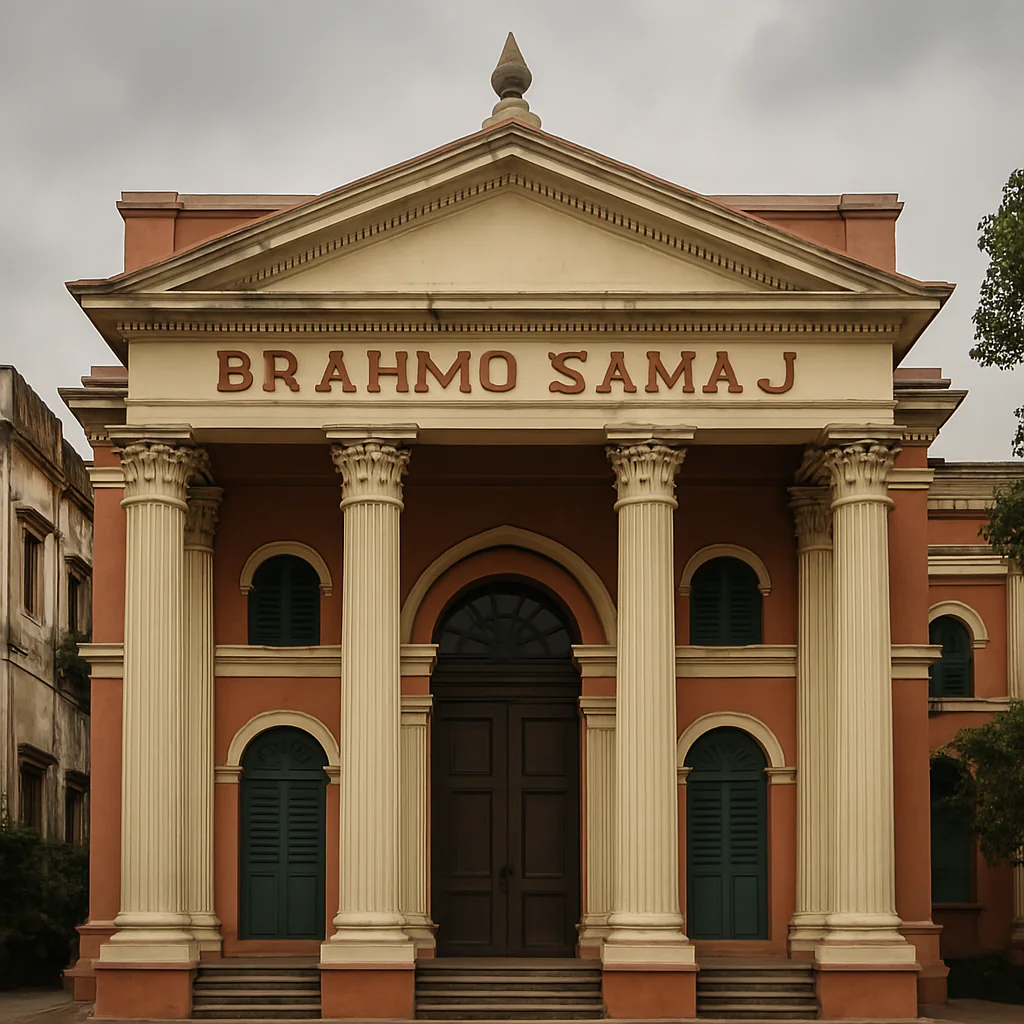
Brahma Society: History, Ideology, Objectives and Impact
The Brahma Society was one of the most significant social and religious reform movements of India. It emerged during the early 19th-century Renaissance period and played a crucial role in reshaping Indian society. Below is an inspiring and informative overview that explains its foundation, principles, contributors, and long-lasting impact.
Establishment of the Brahma Society
Founding Details
- Founder: Raja Rammohan Roy
- Year: 1828
- Location: Calcutta (now Kolkata)
- Original Name: Brahma Sabha (1828), later renamed the “Brahma Society” in 1830
The Brahma Society was formed with the intent to reform the religious and social practices prevailing in India and to revive belief in one formless, supreme God.
Objectives of Establishment
Core Social & Religious Goals
- To eliminate superstition, idol worship, and harmful religious practices.
- To promote monotheism (belief in one God).
- To oppose social evils such as the Sati system, child marriage, and caste-based discrimination.
- To improve the status of women by supporting widow remarriage and female education.
Main Ideological Principles
Vision of the Brahma Society
- Monotheism: Belief in one supreme, formless God.
- Opposition to Idolatry: The society disagreed with idol worship and ritualistic practices.
- Rational Religion: Religion should be based on logic, ethics, and reasoning.
Major Contributors
Key Reformers and Their Roles
- Raja Rammohan Roy: Founder, a pioneer of modern India, and the strongest opponent of the Sati custom.
- Debendranath Tagore: Joined the society in 1843 and merged it with the “Tattvabodhini Sabha.”
- Keshav Chandra Sen: Expanded the reach of the Brahma Society across India; later led a separate branch due to differences.
- Shibnath Shastri: Promoted progressive and reformist ideas.
Branches of the Brahma Society
Main Divisions
- Adi Brahma Samaj: Led by Debendranath Tagore
- Bharatvarshiya Brahma Samaj: Led by Keshav Chandra Sen
- Sadharan Brahma Samaj: Formed in 1878 with liberal ideology
Impact of the Brahma Society
Long-Term Social & Religious Influence
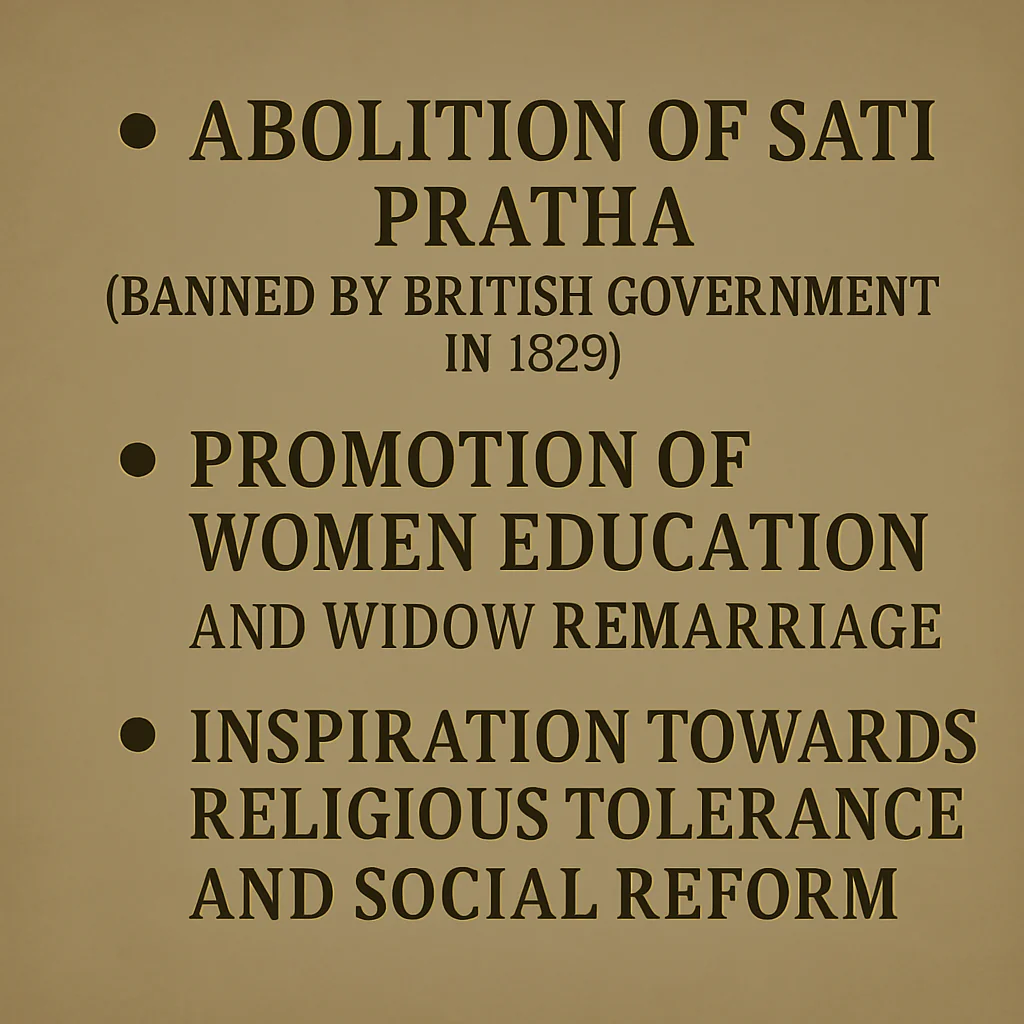
- The Sati system was abolished in 1829 with support from the movement.
- Encouraged women’s education and widow remarriage.
- Promoted religious tolerance, scientific temper, and social reform.
- Inspired India’s journey toward modernity, rationalism, and humanism.
Conclusion
The Brahma Society sparked a new wave of reform and consciousness in Indian society. It stands today as a remarkable example of the fusion of religious renaissance and social transformation. Raja Rammohan Roy’s vision laid the foundation for a modern, progressive, and rational India.
Brahma Society: A Detailed Overview
The Brahma Society was established in 1828 by Raja Rammohan Roy in Kolkata. It was the first organized religious and social reform movement in India. Its mission was to remove harmful practices within Hindu society and to rebuild religion on the principles of monotheism, logic, and morality.
Essential Facts of Establishment
- Founder: Raja Rammohan Roy
- Place: Kolkata (formerly Calcutta)
- Year: 1828
- Main Objective: To abolish idolatry, Sati, casteism, and superstition, and to promote rational, monotheistic religion.
- Core Ideas: Formless God, religious tolerance, equality, and social upliftment.
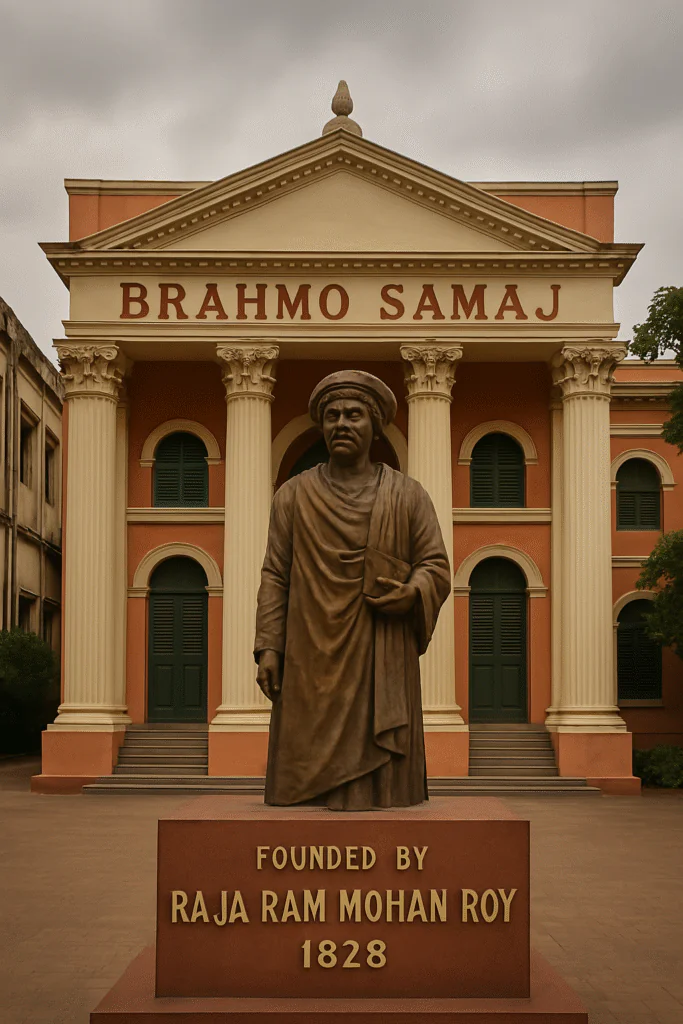
Objectives of the Brahma Society
When Raja Rammohan Roy established the Brahma Society in 1828, his primary aim was to eliminate the social and religious evils spreading across Indian society and to establish a true, logical, and moral form of religion. The major objectives are explained below:
1. Promotion of Monotheism
- During that period, polytheism and idol worship were widely practiced.
- The Brahma Society encouraged belief in one formless, omnipotent God.
2. Opposition to Idolatry and Religious Pomposity
- The society opposed meaningless rituals, superstitions, and religious hypocrisy.
- It emphasized connecting religion with logic, reasoning, and ethics.
3. Elimination of Social Evils
- Opposed practices such as Sati, child marriage, the caste system, and widow persecution.
- Encouraged widow remarriage, women’s education, and women’s dignity.
4. Bringing Social and Religious Reform
- Presented Hindu religion in a moral, modern, and rational form.
- Worked to eradicate caste-based discrimination.
5. Giving Space to Personal Reasoning and Logic in Religion
- The Brahma Society believed that religion should not be based on blind imitation.
- It taught that faith must be grounded in personal discretion and logical understanding.
6. Emphasis on Humanity and Ethics
- Promoted the belief that all humans are equal.
- Encouraged social unity, harmony, and fraternity.
✔ Summary
The primary objectives of the Brahma Society were: belief in one God, rejection of religious hypocrisy, elimination of social evils, upliftment of women, and the establishment of a modern society based on logic, ethics, and rationality.
Main Thinking of the Brahma Society
The ideology of the Brahma Society, shaped by Raja Rammohan Roy, was based on monotheism, logic, ethics, and social reform. Its purpose was to modernize Indian society and religion through a scientific, rational, and humanistic approach.
Key Ideologies
1. Monotheism
- The Brahma Society believed in one formless, omnipotent God.
- Worship should be free from idols, rituals, and sacrifices.
2. Opposition to Idolatry and Ritualism
- Idolatry was considered a source of superstition and religious hypocrisy.
- The society encouraged a direct relationship with God without priests or intermediaries.
3. Religion Based on Logic and Reasoning
- Religion should be rooted in logic, reasoning, and ethics—rather than superstition or blind tradition.
- Religious texts should be understood with wisdom and applied with rational thinking.
4. Social Reform
- Opposed social evils like Sati, child marriage, casteism, and widow persecution.
- Supported widow remarriage, women’s education, and women's rights.
5. Humanism and Equality
- All humans are equal in the eyes of God.
- Discrimination based on caste, religion, class, or gender is unjust.
- Encouraged the spread of equality, unity, and humanitarian values.
6. Interfaith Tolerance
- The society acknowledged truth and moral values present in all religions.
- Promoted religious tolerance, dialogue, and harmony among communities.
Conclusion
The main thinking of the Brahma Society formed the foundation of India’s social and religious renaissance. It emphasized religious purity, social justice, rational thinking, and human values. This ideology inspired Indian society toward scientific thinking and moral upliftment.
Monotheism in the Brahma Society
Monotheism means “belief in one God.” It teaches that one supreme, omnipresent, and formless God is the creator, protector, and controller of the universe.
Role of Monotheism in the Brahma Society
Raja Rammohan Roy established the Brahma Society on the principle of monotheism. He stated:
“God is one—formless, omniscient, omnipotent, and compassionate. He can be worshipped without images, rituals, or sacrifices.”
Main Elements of Monotheism
1. Belief in One Supreme God
- The Brahma Society rejected polytheism and idolatry.
- God was seen as formless (nirakara), without attributes (nirguna), and infinite (Brahman).
2. Direct Worship Without Mediation
- No priest, mediator, or ritual was necessary to reach God.
- Individuals could connect with God through meditation, prayer, and moral living.
3. God is Just and Omnipresent
- God is present everywhere and treats all beings with justice.
- His essence is beyond name, form, or language.
4. Foundation of Religious Tolerance
- Since God is one, all religions should be viewed with equality.
- This idea promotes unity, harmony, and interfaith respect.
Conclusion
Monotheism was the cornerstone of the Brahma Society. It not only guided religious reform but also encouraged social equality, rationality, and ethical living. This belief laid the foundation for a modern, progressive, and enlightened Indian society.
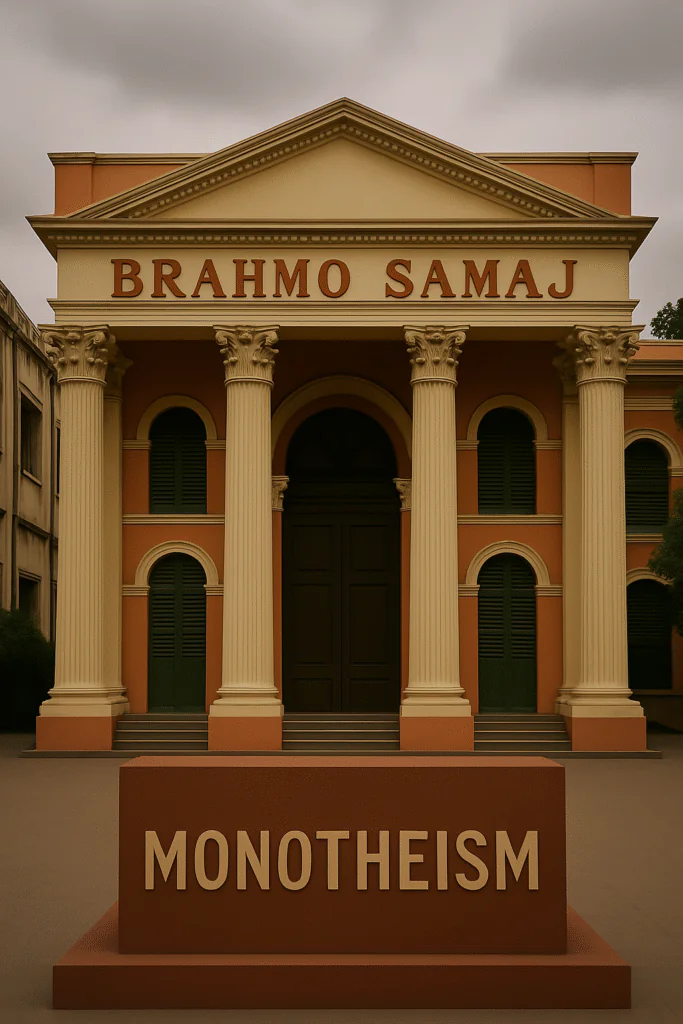
Opposition to Idolatry – Brahma Society's Approach
Buy Now on AmazonRaja Rammohan Roy, the founder of the Brahma Society, believed that widespread idol worship in Indian society had led people away from the true essence of religion. He opposed idolatry on the basis of logic, rationality, and the teachings of the Vedas.
Main Reasons for Opposing Idolatry
1. Principle of a Formless God
- The Brahma Society believed that God is formless, eternal, and infinite.
- Therefore, imagining God in any physical object or statue was considered incorrect.
2. Source of Religious Hypocrisy
- Idolatry was associated with superstition and blind rituals.
- The society observed that worship became limited to rituals, ignoring ethics and spiritual wisdom.
3. Diverts People from True Spirituality
- According to Rammohan Roy, idol worship distracts people from true spiritual knowledge.
- External display replaces internal growth and hinders a genuine relationship with God.
4. Supported by Vedas and Upanishads
- Rammohan Roy proved through Vedic and Upanishadic teachings that ancient Indian religion did not support idolatry.
- The Upanishads state: “Ekam Brahma, Dvitīya Nasti” — Brahma is one, there is no second.
5. Foundation for Religious Unity
- Idolatry leads to division based on different gods and forms.
- The Brahma Society promoted unity through belief in one formless God.
Conclusion
Opposition to idolatry was a central pillar of the Brahma Society’s religious reform movement. Using logic, Vedic knowledge, and ethical reasoning, Raja Rammohan Roy rejected idol worship as an external tradition and emphasized true spiritual devotion and moral life.
Religion and Logic – Brahma Society's Approach
One of the most remarkable features of the Brahma Society was its attempt to connect religion with logic and reasoning. Raja Rammohan Roy believed that religion should not rely on blind tradition or outward rituals, but on morality, rationality, and human welfare.
Relationship Between Religion and Logic – Brahma Society’s View
1. Need for Rational Religion
- The Brahma Society believed that a religious belief is acceptable only when it passes the test of logic and reason.
- Superstitions, miracles, idol worship, and rituals were rejected because they lacked rational foundation.
2. True Purpose of Religion – Moral Regeneration
- The aim of religion is not just worship or prayer, but the cultivation of moral values, truth, compassion, and social service.
- Any religious practice that contradicts justice, humanity, or truth cannot be considered true religion.
3. Logical Interpretation of Vedas and Upanishads
- Rammohan Roy interpreted Vedic and Upanishadic teachings with a rational and scientific perspective.
- He attempted to uncover the deeper knowledge hidden in scriptures through logic and critical analysis.
4. Freedom of Personal Reasoning
- The Brahma Society emphasized that every individual should have the freedom to choose, understand, and follow religion independently.
- No one should be forced to accept traditions or beliefs without personal understanding.
5. Harmony Between Religion and Science
- The Brahma Society believed that religion and science are not contradictory but complementary.
- A logic-based religion can guide society toward progress, ethics, and enlightenment.
Conclusion
The Brahma Society initiated the practice of viewing religion through the lens of logic and rationality. This approach sparked scientific thinking, social reform, and spiritual upliftment during the Indian Renaissance. Raja Rammohan Roy’s rational perspective profoundly influenced India’s intellectual and cultural awakening.
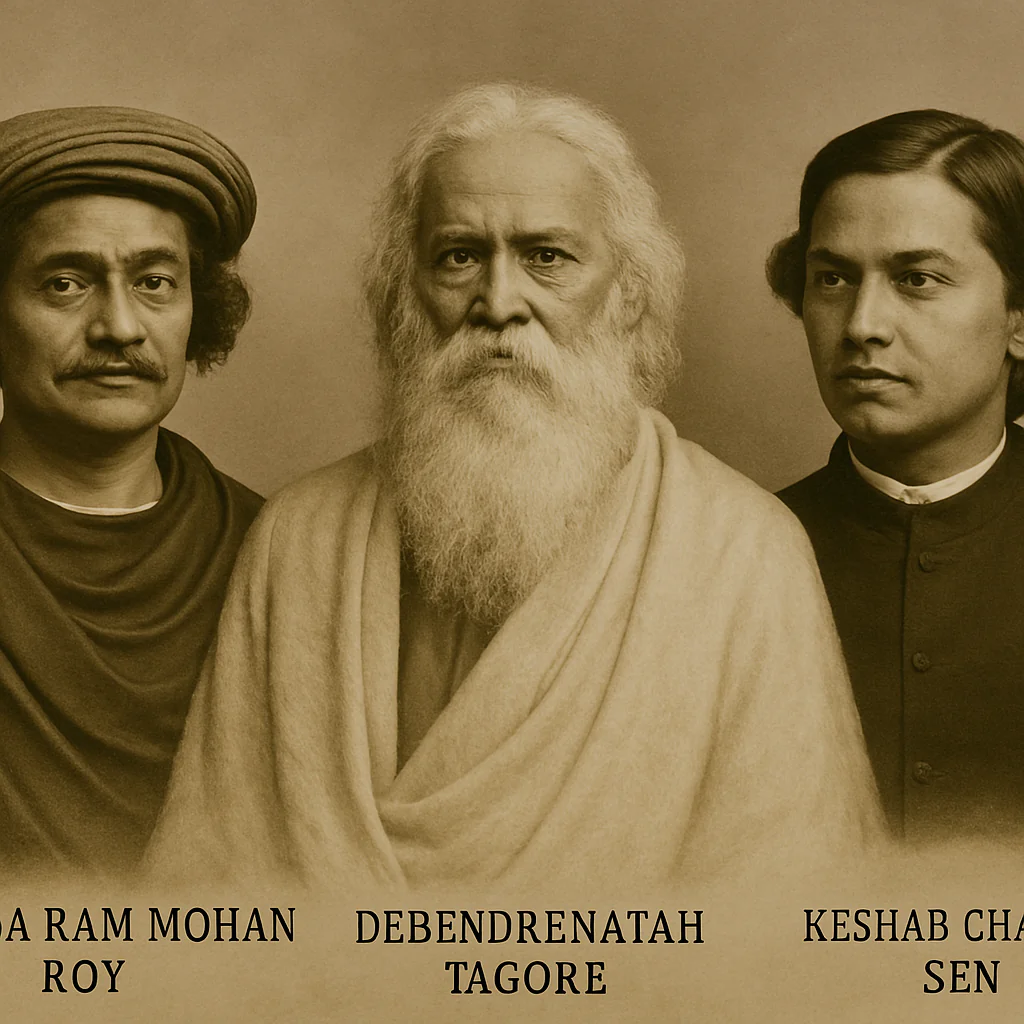
Chief Contributors of the Brahma Society
The Brahma Society was not just a religious institution but a powerful social and intellectual revolution. Its growth and spread were made possible by several visionary leaders and thinkers. Here is a detailed overview of their contributions:
1. Raja Rammohan Roy (1772–1833) – Founder
- Establishment: Founded the Brahma Sabha in 1828 in Kolkata, which later became the Brahma Society.
- Major Contributions:
- Played a crucial role in the abolition of the Sati system.
- Advocated monotheism, rationalism, and social reforms.
- Promoted women’s education, widow remarriage, and press freedom.
- Widely regarded as the “Father of the Indian Renaissance.”
2. Devendranath Tagore (1817–1905)
- Father of Rabindranath Tagore.
- Joined the Brahma Society in 1843.
- Integrated the Tattvabodhini Sabha into the Brahma Society, giving it a new philosophical and Vedic direction.
- Strengthened the society with emphasis on Upanishadic teachings.
3. Keshav Chandra Sen (1838–1884)
- Joined the Brahma Society in 1858.
- A brilliant speaker and dynamic reformer.
- Expanded the Brahma movement throughout India.
- Worked for women's rights, against child marriage, and supported interfaith marriage.
- Due to ideological differences, he later founded the “Bharatvarshiya Brahma Samaj” in 1866.
4. Shivnath Shastri (1847–1919)
- A renowned historian, writer, and social reformer.
- Played an essential role in the formation of the “Sadharan Brahma Samaj” in 1878.
- Promoted religious tolerance, moral education, and equality.
5. Other Key Associates
- Ashish Kumar Dutt
- Anandachandra Maitra
- Sushil Kumar Majumdar
- These individuals spread the teachings of the Brahma Society through education, journalism, and literature.
Conclusion
The expansion and influence of the Brahma Society were not limited to Raja Rammohan Roy alone. Devendranath Tagore, Keshav Chandra Sen, and several others transformed it into a comprehensive religious and social reform movement. Their combined efforts laid the foundation of modernity, equality, and ethics in India.
Raja Rammohan Roy – Father of the Indian Renaissance
Raja Rammohan Roy (1772–1833) was one of the greatest social reformers in modern Indian history. He not only founded the Brahma Society but also fought against many social evils that were deeply rooted in Indian society. He is widely acknowledged as the precursor of India’s religious, social, and intellectual revolution.
Brief Life Sketch
| Subject | Description |
|---|---|
| Birth | 22 May 1772, Radhanagar (Bengal) |
| Death | 27 September 1833, Bristol (England) |
| Education | Sanskrit, Persian, Arabic, English, Bengali |
| Languages | Hindi, English, Bengali, Arabic, Sanskrit, Persian |
| Title | “Raja” title given by Mughal Emperor Akbar II (1831) |
Major Contributions
1. Establishment of the Brahma Society (1828)
- Promoted monotheism, opposed idolatry, and emphasized logic in religion.
- Laid the foundation for social and religious reform in modern India.
2. Opposition to the Sati System
- Condemned the Sati practice as inhuman and unjust.
- Worked with Lord William Bentinck to legally ban Sati in 1829.
3. Advocacy for Women's Rights
- Supported widow marriage and women's education.
- Encouraged women’s freedom and equal rights.
4. Contribution to Modern Education
- Promoted modern and Western education in India.
- Helped establish the Hindu College (later Presidency College) in 1825.
- Encouraged the study of English, science, mathematics, and logic.
5. Champion of Press Freedom
- Published journals like Sambad Kaumudi (Bengali) and Mirat-ul-Akhbar (Persian).
- Fought for freedom of expression and independent journalism.
6. Religious Tolerance
- Promoted the original teachings of the Vedas and Upanishads.
- Believed that all religions contain elements of truth.
Foreign Travel and Recognition
- Traveled to England in 1830 to present Indian social and religious ideas.
- Passed away in Bristol, where he is buried.
- Honored with the title “Raja” by the British and respected internationally.
Awards and Titles
- “Forerunner of the Indian Renaissance”
- “Father of Modern India”
- “Mentor of the Indian Reform Movement”
Conclusion
Raja Rammohan Roy carried out revolutionary work in the fields of religious reform, social justice, and modern education. He was one of India's first modern thinkers and humanist reformers. His life continues to inspire generations.
Devendranath Tagore (Debendranath Tagore) – Revivalist of the Brahma Society
Devendranath Tagore (1817–1905) was a major reformer and leader of the Brahma Society. He was the father of the renowned poet Rabindranath Tagore and a strong supporter of Raja Rammohan Roy’s reformist ideas. He gave the Brahma movement philosophical depth and religious discipline and ensured its stability and continuity.
Concise Life Introduction
| Subject | Description |
|---|---|
| Birth | 15 May 1817, Kolkata (West Bengal) |
| Death | 19 January 1905, Kolkata |
| Education | Sanskrit, Persian, English, Vedic and Upanishadic scholarship |
| Chief Role | Leader of the Tattvabodhini Sabha; reorganizer of the Brahma Society |
Main Contributions
1. Leadership of the Tattvabodhini Sabha (1839)
- Founded in 1839 to promote religious and moral education.
- The Sabha merged with the Brahma Society in 1843 under his leadership.
2. Reviving the Brahma Society
- After Raja Rammohan Roy left for England, the Brahma Society became inactive.
- Devendranath revived the movement in 1843 and strengthened its structure.
- Established the society firmly on the principles of formless God, Vedic philosophy, and moral purity.
3. Promotion of Vedas and Upanishads
- Presented Vedantic teachings in simple language for common people.
- Authored the book “Brahma Dharma”, summarizing the principles of the Brahma religion.
4. Religious and Moral Reforms
- Opposed idolatry, casteism, and hypocrisy.
- Emphasized logic, ethics, and self-purification in religious life.
5. Contribution to Education
- Associated with Hindu College (later Presidency College) and other cultural institutions.
- Raised his son Rabindranath in a spiritual, disciplined, and literary environment.
Devendranath Tagore and the Growth of the Brahma Society
| Aspect | Contribution |
|---|---|
| Vision | Spread of Vedanta-based Brahma religion |
| Organization | Gave the Brahma Society an organized and systematic structure |
| Ethics | Promoted moral conduct and discipline in religious life |
| Ideas | Religious tolerance, self-discipline, monotheism |
Titles and Recognition
- Honored with the title “Maharshi” for his spiritual and scholarly contributions.
- Considered a major pillar of the Bengal Renaissance.
Conclusion
Devendranath Tagore gave the Brahma Society philosophical depth, spiritual discipline, and strong organizational foundations. He advanced the unfinished work of Raja Rammohan Roy, giving the movement longevity and direction. His contributions are invaluable in India’s religious and intellectual history.
Keshavchandra Sen – Great Campaigner of the Brahma Society
Keshavchandra Sen (1838–1884) was a prominent 19th-century social reformer, thinker, and one of the most influential leaders of the Brahma Society. He infused new energy and direction into the movement and helped spread it across India. His powerful speeches and intense spiritual approach made him widely popular.
Concise Life Introduction
| Subject | Description |
|---|---|
| Birth | 19 November 1838, Kolkata (West Bengal) |
| Death | 8 January 1884, Kolkata |
| Education | Hindu College, Kolkata |
| Religion | Brahma Dharma (Brahmo Religion) |
| Fame | Dynamic leader of the Brahma Samaj and a passionate social reformer |
Main Contributions
1. Active Involvement in the Brahma Society (1858)
- Joined under the leadership of Devendranath Tagore.
- Quickly became a charismatic speaker and leading campaigner.
2. Establishment of the Indian Brahma Society (1866)
- Separated due to ideological differences with Devendranath Tagore.
- Founded the “Bharatvarshiya Brahma Samaj” (Indian Brahma Society).
- This branch promoted liberal ideas and strongly supported women’s rights.
3. Advocate of Women's Rights and Education
- Opposed child marriage and supported widow remarriage.
- Promoted women's education and empowerment.
- Encouraged interfaith and inter-caste marriages.
4. Interfaith Dialogue and Universal Religion
- Influenced by Christianity, he advocated religious unity and global humanism.
- Believed all religions contained elements of truth.
5. The 1878 Marriage Controversy
- Married his underage daughter to the Maharaja of Cooch Behar.
- This contradicted his own principles and led to widespread criticism.
- The Brahma movement split into two branches:
- Indian Brahma Society
- Sadharan Brahma Society (formed in 1878)
Main Ideas
| Idea | Description |
|---|---|
| Monotheism | Belief in one formless God |
| Ethics | Religion based on morality, love, and service |
| Religious Unity | Accepting goodness in all religions |
| Social Reform | Opposition to casteism, child marriage, and idolatry; support for women's rights |
Titles and Recognition
- Known as a “Religious Revolutionary of India.”
- Major contributor to the expansion of the Brahma Society and social reform movement.
Conclusion
Keshavchandra Sen transformed the Brahma Society into a vibrant social movement. He blended religion, ethics, and social improvement in a unique way. Although his life saw controversies, his contribution to the Indian Renaissance remains highly significant.
Shivnath Shastri (Shivanath Shastri) – Social Reformer and Historian
Shivnath Shastri (1847–1919) was a distinguished social reformer, writer, teacher, and historian of Bengal. He was an active member of the Brahma Society and later became a founder of the Sadharan Brahma Society. His work in Indian history, culture, and social reform is widely respected.
Concise Life Introduction
| Subject | Description |
|---|---|
| Birth | 1847, Kolkata (West Bengal) |
| Death | 1919 |
| Profession | Teacher, writer, social reformer |
| Education | Sanskrit, Bengali, and English literature |
Main Contributions
1. Establishment of the Sadharan Brahma Society (1878)
- Formed after differences with Keshab Chandra Sen’s leadership.
- This branch focused on liberal ideas and social reforms.
2. Social Reform and Education
- Opposed casteism, idolatry, and superstition.
- Promoted equality, ethics, and modern education.
- Supported widow remarriage and women’s education.
3. Promotion of Indian History and Culture
- Authored several books on Indian history, culture, and Vedic knowledge.
- Worked to revive cultural pride and awareness among people.
4. Contributions to Writing and Teaching
- Major contributor to Bengali literature.
- Worked through education to awaken social and religious consciousness.
Main Ideas
| Idea | Description |
|---|---|
| Social Reform | Opposition to casteism, idolatry, and social evils |
| Education | Support for modern and religious education |
| Religion | Logic-based monotheism and religious tolerance |
| Culture | Preservation and promotion of Indian history and culture |
Conclusion
Shivnath Shastri strengthened the social reform activities of the Brahma Society and played an important role in the promotion of Indian history and culture. He was an influential teacher and reformer whose efforts significantly shaped social and religious awakening in India.
Branches of the Brahma Society
With the growth of the Brahma Society, various ideological differences and organizational challenges led to the formation of multiple branches. These branches continued the core principles of the movement and introduced new social–religious ideas.
Main Branches
| Branch Name | Establishment Year | Chief Leader / Founder | Features & Ideology |
|---|---|---|---|
| Brahma Society of Devendranath Tagore | 1843 | Devendranath Tagore | Reorganization of the Brahma Society, emphasis on Vedic teachings, religious discipline, spread of Vedanta. |
| Indian Brahma Society | 1866 | Keshavchandra Sen | More active in social reforms, supporter of women’s rights, promoted religious liberalism. |
| Sadharan (Ordinary) Brahma Society | 1878 | Shivnath Shastri, Anandachandra Basu, Prabhatchandra Majumdar | More democratic branch, strong opposition to idolatry, focus on social reforms, simplicity in worship. |
Reasons for Branch Formation
- Ideological Differences: Conflicts between Devendranath Tagore and Keshavchandra Sen on religious and social reforms.
- Approach to Social Reform: Some branches focused more on widow remarriage, women’s rights, and caste reform.
- Organizational Differences: Growth of the movement brought differing administrative approaches.
Conclusion
The branches of the Brahma Society reflect its diversity of thought and evolving reformist approach. These branches played an important role in strengthening religious reform, social awareness, and the spread of modern ideas across India.
Adi Brahmo Samaj (Etcetera Brahma Society)
The Adi Brahmo Samaj was the first and original branch of the Brahma Society, founded by Raja Rammohan Roy in 1828. It marked the beginning of the Brahmo movement in India.
Introduction
- Founded: 1828 by Raja Rammohan Roy
- Location: Kolkata (then Calcutta)
- Objectives: Abolition of idolatry, promotion of monotheism, opposition to religious evils
- Main Ideas: Worship of a formless God, social reform, rational religion
Key Features
| Subject | Description |
|---|---|
| Religious Ideas | Monotheism, opposition to idolatry |
| Social Reform | Opposed Sati, encouraged widow remarriage and women's education |
| Rational Religion | Promoted logic, justice, and opposed superstition |
| Education | Supported modern and Western education |
| Publication | Brahmanmat magazine |
Important Events
- Rammohan Roy played a major role in the abolition of Sati (1829).
- During his visit to England (1830), he promoted Indian religious and social reforms internationally.
- The Adi Brahmo Samaj began a new wave of religious and social awakening in India.
Conclusion
The Adi Brahmo Samaj initiated religious reform in India and worked to liberate society from harmful traditions and superstitions. Under Rammohan Roy’s leadership, it became a forerunner of the Indian Renaissance.
Indian Brahma Society (Bharatiya Brahmo Samaj)
The Indian Brahma Society was one of the major branches of the Brahmo movement. It was founded by Keshavchandra Sen in 1866 and focused heavily on social activism along with religious reform.
Introduction
- Founded: 1866 by Keshavchandra Sen
- Inspired By: Principles of the original Brahma Society with a focus on social activism and liberal religion
- Objectives: Promote monotheism, support women's education, widow remarriage, oppose casteism
Key Features
| Subject | Description |
|---|---|
| Religious Ideas | Monotheism, rejection of rituals and idol worship |
| Social Reform | Opposition to child marriage; support for widow remarriage and women’s education |
| Religious Liberalism | Accepted moral values from all religions |
| Global Approach | Promoted interfaith harmony, influenced by Christianity |
| Famous Event | Keshavchandra Sen’s daughter’s marriage to the King of Cooch Behar (1878), causing controversy |
Chief Leader
- Keshavchandra Sen – Founder and principal leader
Conclusion
The Indian Brahma Society combined religious reform with strong social activism. It championed women’s rights, education, and equality. Despite controversies, its contribution to India’s social reform movement remained significant.
Ordinary Brahma Society (Sadharan Brahmo Samaj)
The Sadharan Brahmo Samaj was formed in 1878 due to ideological and social differences with Keshavchandra Sen’s branch. It became a democratic and socially active branch of the Brahma movement.
Introduction
- Founded: 1878, Kolkata
- Reason: Opposition to Keshavchandra Sen’s controversial child marriage decision and ideological differences
- Chief Founders: Shivnath Shastri, Anandachandra Basu, Prabhatchandra Majumdar
Key Features
| Subject | Description |
|---|---|
| Religious Ideals | Strict monotheism, complete rejection of idolatry |
| Social Reform | Opposed child marriage, casteism, and supported widow remarriage and women's education |
| Organization | Democratic and transparent structure |
| Religious Practice | Simple and rational worship methods |
| Propagation | Active in Bengal and other Indian states |
Conclusion
The Sadharan Brahmo Samaj pushed the Brahma movement toward rational, ethical, and socially reformist principles. It significantly influenced the fight for social justice and equality in Indian society.
Influence of the Brahmo Samaj
The Brahma Society had a profound impact on the religious, social, and cultural life of 19th and 20th century India. It played a key role in initiating modernity, reform, and renaissance in Indian society.
Main Influences
1. Religious Reform
- Opposed idolatry, Sati, casteism, superstition, and meaningless rituals.
- Promoted monotheism and rational thinking in religion.
- Encouraged religious tolerance and respect for all faiths.
2. Social Reform
- Helped abolish the Sati system.
- Encouraged widow remarriage and women’s education.
- Opposed child marriage and untouchability.
- Promoted equality and human rights.
3. Education and Knowledge
- Encouraged Western education and scientific reasoning.
- Inspired awareness and intellectual development among youth.
- Opened opportunities for women's education.
4. National Awakening
- Promoted self-respect, unity, and social justice.
- Played an important role in the Indian Renaissance.
5. Literature and Culture
- Encouraged new themes in literature, music, and art.
- Contributed to cultural revival and intellectual growth.
Conclusion
The Brahma Society challenged social evils and religious fanaticism and laid the foundation for modern Indian society. Its ideals continue to shape moral, educational, and religious values today.
Conclusion – Legacy of the Brahma Society
The Brahma Society ushered in a new wave of modernity and reform in 19th-century India. It opposed harmful traditions like Sati, idolatry, casteism, and superstition with great resolve. Under the leadership of Raja Rammohan Roy and later reformers, the movement promoted rational religion, social equality, and education, becoming a pillar of the Indian Renaissance.
The Brahma Society was not only a religious reform movement but a revolutionary step toward justice, humanity, and modern values. Its ideas continue to inspire India’s social and religious landscape even today.
Your work is very nice