
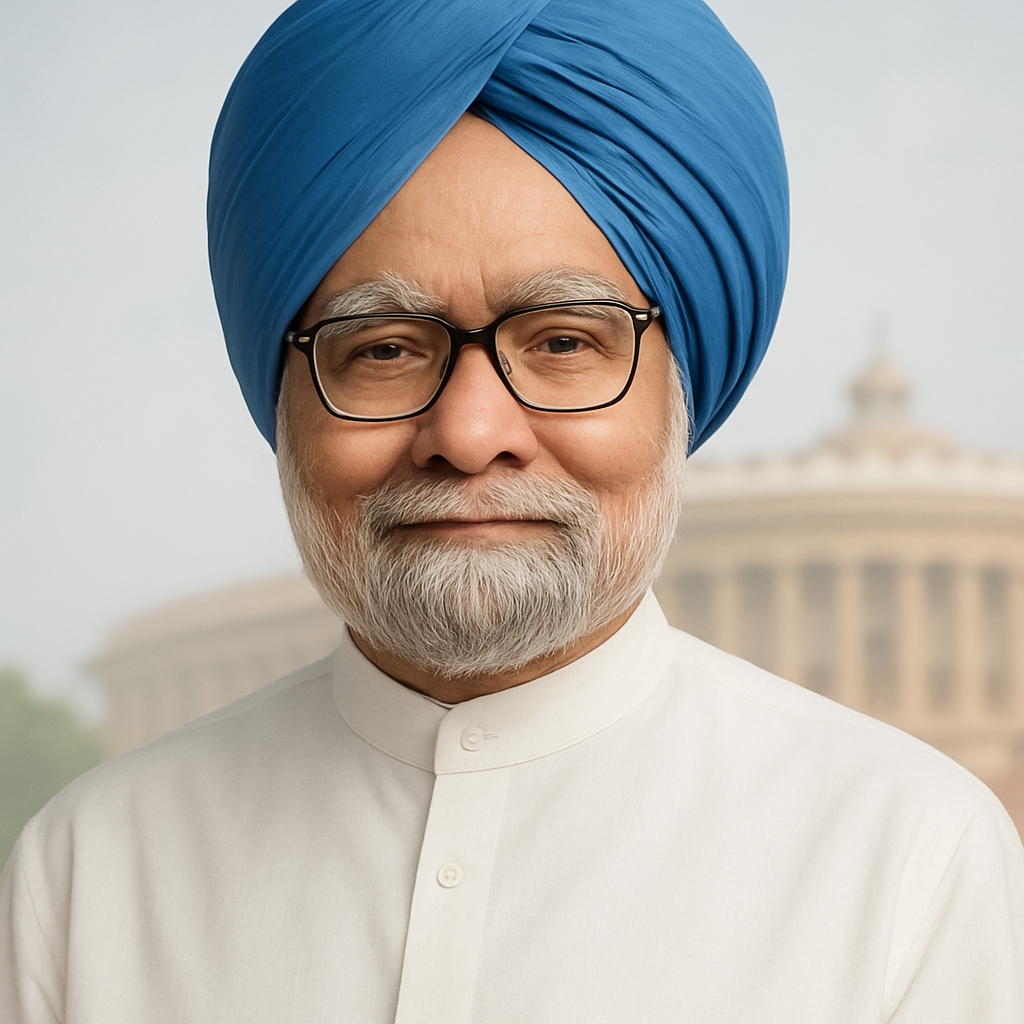
Biography of Dr. Manmohan Singh
Introduction
Dr. Manmohan Singh is one of India’s most respected economists and political leaders. Known globally for his honesty, simplicity, and scholarly excellence, he served as the 13th Prime Minister of India from 2004 to 2014. His leadership reshaped India’s economic roadmap and strengthened its global identity.
Personal Details
- Name: Dr. Manmohan Singh
- Born: 26 September 1932
- Birthplace: Gah (now in Pakistan’s Punjab province)
- Occupation: Economist, Politician
- Fame: 13th Prime Minister of India (2004–2014)
- Party: Indian National Congress
- Religion: Sikh
Early Life and Education
Childhood and Background
Dr. Manmohan Singh was born in Gah village in present-day Pakistan before the partition of India. After 1947, his family migrated to India. Despite hardships during the partition, he continued his education with dedication.
Elementary Education
- Completed early education from Chakwal and Punjab University (Lahore).
- After partition, continued studies in Punjab University, Chandigarh.
- Earned a Bachelor’s (B.A.) and Master’s (M.A.) degree in Economics with outstanding performance.
Higher Education
- Went to the United Kingdom for higher studies.
- Completed his first postgraduate degree (Economics) from the University of Cambridge (St. John’s College).
- Influenced by the teachings of great economist John Maynard Keynes.
- Completed his D.Phil. (Doctorate) from the University of Oxford, focusing on “Trade, Monetary and Public Finance of India.”
Other Academic Highlights
Dr. Manmohan Singh was recognized as one of the brightest students of his time. His discipline, hard work, and intellectual depth laid the foundation for his future contributions as an economist and policymaker.
Summary of Early Life
His early life symbolizes determination and perseverance. Despite limited resources, Dr. Singh achieved excellence in academics, which later became the cornerstone of his economic and political achievements.
Professional Life

Amazon Popular Pick
Trusted and well-reviewed product with great user feedback. Check the latest price, deals & availability on Amazon.
👉 View on AmazonEconomic Expertise
Dr. Manmohan Singh began his professional journey as an economist, holding several prestigious positions:
- Governor of the Reserve Bank of India (1982–1985)
- Deputy Chairman, Planning Commission
- Finance Secretary, Government of India
- Economic Advisor, United Nations
His expertise lies in developing economies, economic reforms, and public finance.
As Finance Minister (1991)
In 1991, India faced a severe economic crisis. At this crucial moment, Prime Minister P.V. Narasimha Rao appointed Dr. Manmohan Singh as the Finance Minister. Under his leadership, India began its transformative economic liberalization journey.
Key Reforms Introduced
- Reduction of the Licence Raj
- Promotion of privatisation
- Policies to attract foreign investment
- Strengthening business and industrial growth
His historic 1991 Budget Speech is still considered a watershed moment in India’s economic history.
As Prime Minister of India
Dr. Manmohan Singh became the Prime Minister in 2004 after the UPA’s electoral victory. He was re-elected in 2009, serving until 2014.
Major Achievements
- Launch of MNREGA (Rural Employment Guarantee)
- Implementation of the Right to Information Act (RTI)
- Indo-US Nuclear Deal (2008)
- Reforms in education and healthcare
- Significant increase in economic growth
Challenges During His Tenure
Some major controversies (such as the 2G spectrum case and Commonwealth Games scam) affected the government's image, although Dr. Singh’s personal integrity remained widely respected.
Personal Life
Dr. Manmohan Singh is married to Gursharan Kaur, and they have three daughters. He is known for his calm, humble, and scholarly personality. He enjoys reading and intellectual discussions. His simplicity and honesty continue to inspire millions.
Major Awards and Honours
- Padma Vibhushan (1987)
- World Statesman Award (2010)
- Honorary degrees from various international universities
- Several national and global honors
Conclusion
Dr. Manmohan Singh is a leader who not only transformed India’s economic direction but also elevated India’s global reputation. His honesty, scholarship, and dedication make him a unique and respected figure in Indian politics. His life teaches us that great changes can be achieved through knowledge, patience, and humility.
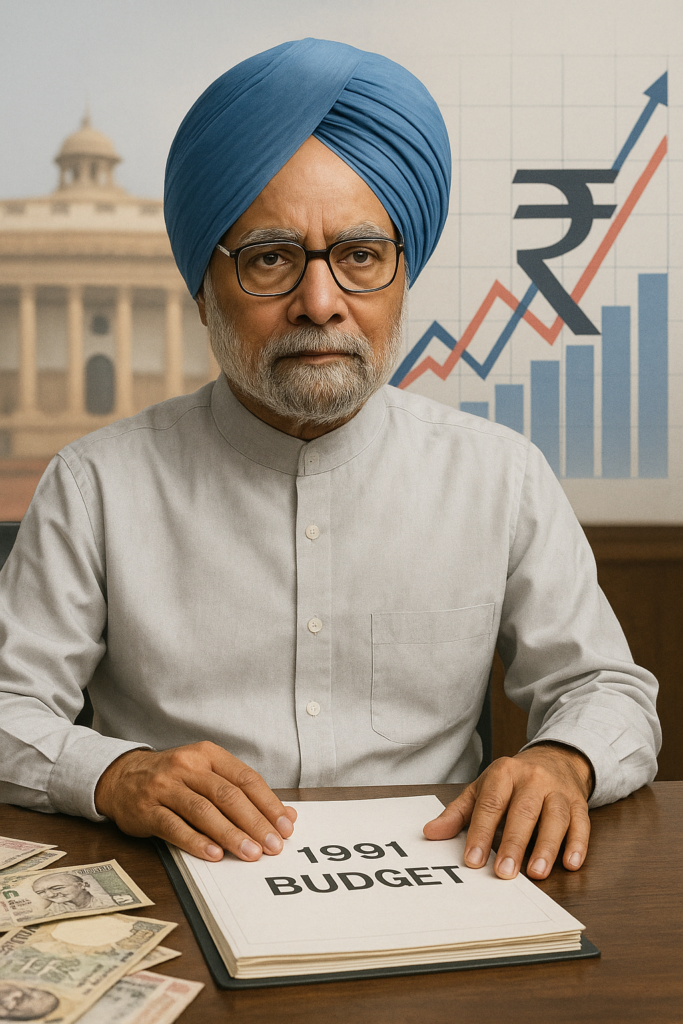
Professional Life: Economic Expertise
Dr. Manmohan Singh’s professional life has been extremely influential in the fields of economics and policy reforms. He is one of the few experts in India whose knowledge and foresight transformed the country’s economic direction.
Early Career
- Started his career as a teacher at Punjab University.
- Later became a Financial Advisor at the United Nations (UN).
- Played an important role as an economist in several international organizations.
Contribution to the Government of India
Dr. Singh held many significant positions in the Government of India, where he showcased his expertise in economic policy and reforms. Some of his major roles include:
- Economic Advisor, Ministry of Commerce
- Finance Secretary, Ministry of Finance
- Governor, Reserve Bank of India (1982–1985)
- Deputy Chairman, Planning Commission
- Secretary of Foreign Trade
- Economic Adviser to the Prime Minister
Popular Amazon Product
Trusted and well-reviewed product loved by customers. Click below to check the latest price & availability on Amazon.
👉 View on AmazonFather of Economic Liberalisation
In 1991, when India was facing a severe economic crisis and foreign exchange reserves were nearly depleted, Prime Minister P.V. Narasimha Rao appointed Dr. Manmohan Singh as the Finance Minister.
Major Decisions Taken as Finance Minister
- Ending the Licence Raj
- Encouraging Foreign Direct Investment (FDI)
- Simplifying import-export trade
- Reforming public sector undertakings and promoting privatization
- Devaluing the Indian Rupee to boost exports
In his first budget speech in 1991, Dr. Singh warned:
“No power can save this country from disaster if we do not implement reforms now.”
These reforms marked the beginning of a new economic era in India and prepared the nation to compete globally.
Global Honors
Dr. Manmohan Singh earned global recognition as an efficient policymaker and visionary economist. His policies helped India emerge from an economic crisis and become one of the world’s fastest-growing economies.
Brief Conclusion
Throughout his professional life, Dr. Manmohan Singh played a crucial role as an outstanding economist who rescued India from economic instability and set it on a path of sustained development. His honesty, transparency, and farsightedness make him one of India’s most respected economic reformers.
Dr. Manmohan Singh as Finance Minister
The period between 1991 and 1996—when Dr. Manmohan Singh served as Finance Minister—is considered a turning point in modern India’s economic history. During this time, he introduced bold reforms that transformed India’s economy.
Background: A Time of Crisis
In 1991, India was trapped in a severe economic crisis:
- Foreign exchange reserves were enough for only a few weeks of imports.
- Inflation was rising sharply.
- Fiscal deficit was at a dangerous high.
- Industrial growth had slowed down.
- India’s global credibility was weakening.
Amidst this crisis, Prime Minister P.V. Narasimha Rao entrusted Dr. Manmohan Singh with the responsibility of Finance Minister.
Major Reforms and Decisions
1. New Economic Policy (1991)
The New Economic Policy introduced by Dr. Singh had three key pillars:
- Liberalization: Reducing government control and ending the Licence Raj.
- Privatization: Opening government industries to private investment.
- Globalization: Integrating the Indian economy with the global market.
2. Devaluation of the Rupee
To boost exports and strengthen foreign exchange reserves, the Indian Rupee was strategically devalued.
3. Promotion of Foreign Investment
- Simplified policies for foreign investors.
- FDI allowed in sectors such as insurance, banking, and telecom.
4. Industrial Policy Reforms
- Abolished the need for industrial licensing.
- Provided operational freedom to industries by reducing government interference.
5. Tax System Reforms
- Rationalized income tax and corporate tax rates.
- Made the tax collection process simpler and more transparent.
Memorable Words from Dr. Singh
During the 1991 budget speech, he said:
“Future history will judge how we overcome this crisis. We have no time to lose now.”
Results of the Reforms
- The economy regained momentum.
- Foreign exchange reserves increased significantly.
- Investment and employment opportunities grew.
- India emerged as an important global economic player.
Although the reforms initially faced criticism, especially from the poor and working class, the long-term impact was overwhelmingly positive, making India economically stronger.
Conclusion
The economic reforms initiated by Dr. Manmohan Singh as Finance Minister became the foundation of modern India’s economic rise. His bold vision, transparency in policymaking, and calm leadership transformed India during one of its most challenging periods. Today, he is honored as the “architect of India’s economic renaissance.”
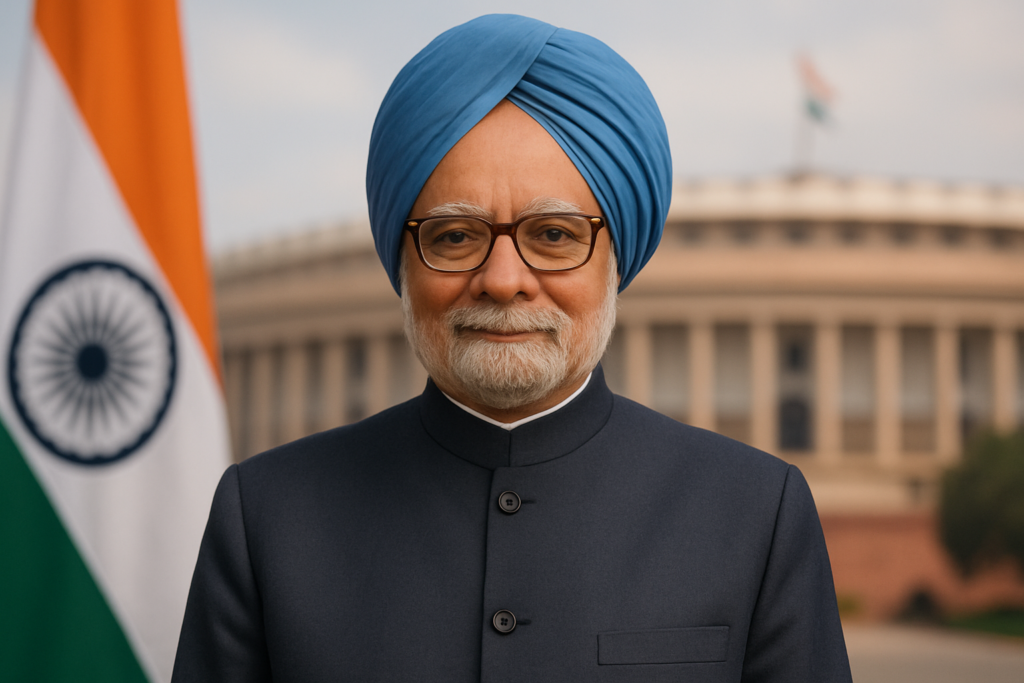
Dr. Manmohan Singh as Prime Minister
Dr. Manmohan Singh served as the 13th Prime Minister of India and completed two full terms (2004–2009 and 2009–2014). He became the first Sikh Prime Minister of independent India. His tenure is remembered for peace initiatives, economic growth, and major social welfare reforms.
Background to Becoming Prime Minister
In the 2004 general elections, the Indian National Congress led the United Progressive Alliance (UPA) to victory. Congress President Sonia Gandhi declined the position of Prime Minister and proposed the name of Dr. Manmohan Singh. Considering his clean image, administrative experience, and economic expertise, he was chosen as the Prime Minister.
Major Achievements
1. Economic Development
- India achieved an average annual economic growth rate of 8–9% during his tenure.
- The service sector and IT industry expanded at an unprecedented rate.
- India maintained relative stability despite the global financial crisis of 2008.
2. India–US Nuclear Deal (2008)
- A historic civil nuclear agreement was signed between India and the United States.
- The deal provided India access to global nuclear technology despite being a non-signatory to the Nuclear Non-Proliferation Treaty (NPT).
- He faced significant political pressure and even had to win a vote of confidence in Parliament.
3. Social Welfare Schemes
- MNREGA: Guaranteed a minimum of 100 days of employment in rural areas.
- Right to Information Act (RTI), 2005: Ensured transparency and accountability in governance.
- Right to Education Act (RTE), 2009: Guaranteed free and compulsory education for children aged 6 to 14.
4. Improvements in Health and Education
- Launched the National Rural Health Mission (NRHM).
- Opened new higher education institutions including IITs and IIMs.
5. Internal and External Policies
- Took initiatives to improve relations with Pakistan and China.
- Strengthened India’s security infrastructure, especially after the 26/11 Mumbai attacks.
Challenges and Criticisms
Despite being respected as an honest and capable leader, several major scandals emerged during his tenure:
- 2G Spectrum Scam
- Commonwealth Games Scam
- Coal Block Allocation Scam
These controversies damaged the government’s public image. Dr. Singh was also criticized for his “silence” and “lack of assertiveness” in dealing with political issues. He was often called the “Silent Prime Minister,” although his personal integrity remained unquestioned.

Amazon Choice Product
Top-rated and well-loved product with great customer feedback. Check the latest price, deals & availability on Amazon.
👉 View on AmazonLeadership Style
Dr. Manmohan Singh’s leadership style was calm, thoughtful, and consensus-oriented. He avoided direct confrontation, preferring behind-the-scenes negotiation. His academic background and administrative expertise were visible in his decision-making approach.
Conclusion
Dr. Manmohan Singh’s tenure as Prime Minister marked an era of economic reforms, welfare schemes, and India’s rising global stature. Although his government faced criticism due to administrative shortcomings and scandals, his integrity, scholarship, and contributions to India’s development are remembered with deep respect. He is regarded as a leader who believed more in “actions than words.”
Challenges Before Dr. Manmohan Singh
Dr. Manmohan Singh achieved many historic milestones as Prime Minister, but he also faced several serious challenges. These challenges spanned economic, political, social, and international spheres.
1. Corruption Allegations and Scandals
- 2G Spectrum Scam (2010): Irregularities in telecom licence allocation caused widespread criticism.
- Commonwealth Games Scam (2010): Financial mismanagement during the Delhi Commonwealth Games damaged the government’s reputation.
- Coal Block Allocation Scam (2012): Alleged non-transparent allocation of coal mines raised accusations of favoritism and corruption.
These scandals weakened the government’s image, although Dr. Singh’s personal honesty was never questioned.
2. Policy Paralysis
After the scandals, the government was accused of being slow and indecisive. Investors and industries felt that major economic decisions were delayed, leading to reduced investor confidence and slower growth.
3. Internal Security Challenges
- 26/11 Mumbai Terrorist Attacks (2008): The attack by Pakistan-based terrorists exposed gaps in India’s security systems.
- Naxalism and internal insurgency remained major issues.
4. Inflation and Financial Pressure
- Sharp rise in prices of essential commodities and petroleum products.
- Public dissatisfaction increased due to inflation.
- The global financial crisis of 2008 also impacted India, although India recovered relatively quickly.
5. Political Pressure and Coalition Constraints
Dr. Singh headed a coalition government (UPA), where different partners had varied demands and priorities. Sometimes the government had to compromise on decisions due to coalition pressures, limiting his ability to take independent decisions.
6. Foreign Policy Challenges
- Relations with Pakistan deteriorated after the 26/11 attacks.
- Border tensions with China persisted.
- Despite the civil nuclear deal with the US, some diplomatic challenges continued at the global level.
Conclusion
The challenges before Dr. Manmohan Singh were complex and multifaceted. His greatest strength was his patience and dignity, with which he led the country through difficult times. Although political constraints sometimes restricted his leadership, his honesty, humility, and commitment to national interest remained unquestionable. History remembers him as a scholarly Prime Minister and a true patriot.
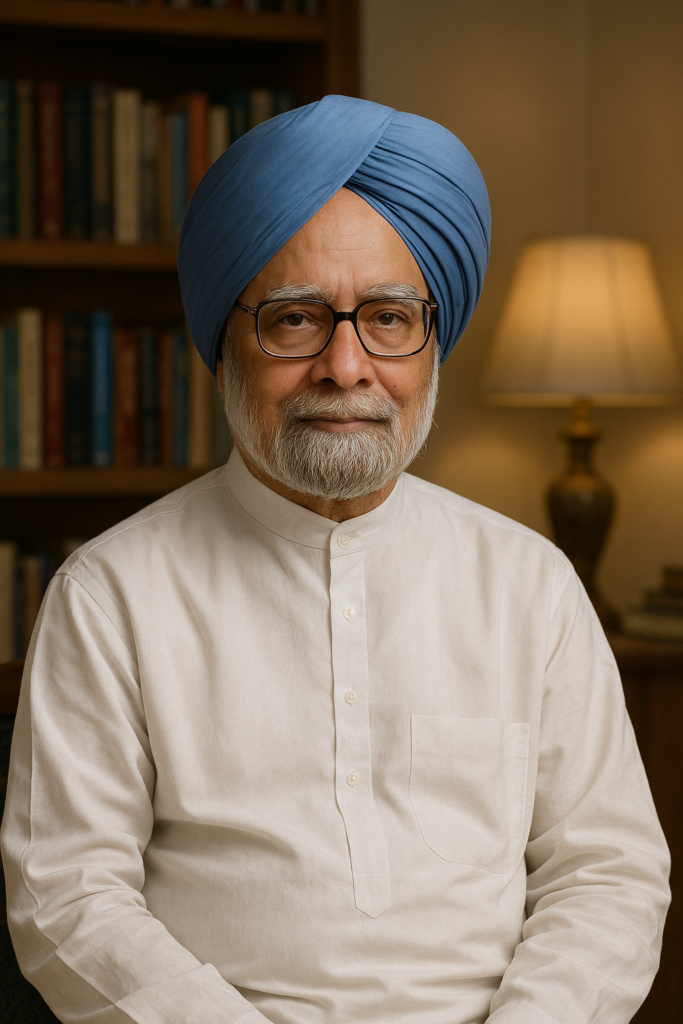
Dr. Manmohan Singh’s Personal Life
Dr. Manmohan Singh is known for his calm, modest, and simple way of living. His personal life reflects the same values seen in his public life—honesty, discipline, and dedication.
Early Life and Family
- Born on 26 September 1932 in Gah village, Punjab province (now in Pakistan).
- After the partition of India in 1947, his family migrated and settled in India.
- He came from a simple Sikh family and was academically brilliant from childhood.
Marriage and Family
Dr. Manmohan Singh married Gursharan Kaur, an educated woman with strong literary interests. She has written poems on various occasions.
The couple has three daughters:
- Upinder Singh – Historian and Professor at Delhi University
- Daman Singh – Writer
- Amrit Singh – Human rights lawyer
Their family life has always remained simple and free from controversies. Dr. Singh is considered an ideal family man.
Lifestyle
- Dr. Singh lives a highly disciplined life.
- His attire is simple—usually a blue turban and white kurta-pyjama.
- He avoids show-off and believes in simplicity.
- Loves reading books, especially on economics, politics, and history.
Religious and Moral Values
- He follows Sikhism and has deep faith in its teachings.
- The principles of service, honesty, and hard work strongly influence his life.
- He is considered a symbol of morality, integrity, and humility.
Health Information
Dr. Singh has faced several health challenges, including heart problems for which he underwent multiple bypass surgeries. Despite these difficulties, he fulfilled his responsibilities with utmost dedication.
Conclusion
Dr. Manmohan Singh’s personal life is an inspiring example of how simplicity, honesty, and education can take a person to the highest positions in a country. His personal life reflects the same purity and dignity that defined his public life. He remains one of the rare leaders who upheld honesty in both personal and political spheres.
Major Awards and Honours of Dr. Manmohan Singh
Dr. Manmohan Singh dedicated his life to education, public service, and nation-building. His extraordinary contribution has earned him several national and international awards.
National Honours
1. Padma Vibhushan (1987)
The Government of India awarded Dr. Singh the country’s second-highest civilian honour, the Padma Vibhushan, for his exceptional contribution in economics and public service.
2. Recognition for Outstanding Contribution as Finance Minister (1993–1994)
He received the “Finance Minister of the Year for Asia” award from the prestigious magazine Euromoney for his landmark economic reforms.
3. Finance Minister of the Year (World)
Dr. Singh was also ranked globally as the best Finance Minister by Euromoney and AsiaMoney for his financial reforms.
Academic Honors
4. Honorary Doctorate Degrees
He received honorary doctorates from several distinguished universities, including:
- University of Oxford (Doctor of Civil Law, 2005)
- University of Cambridge
- Delhi University
- Punjab University
- Banaras Hindu University (BHU)
International Honours
5. Greatest Global Indian Award (2012)
CNN-IBN honoured him with the “Greatest Global Indian” award for elevating India’s global reputation.
6. World Statesman Award (2010)
The Appeal of Conscience Foundation (USA) awarded him for his efforts in promoting peace, tolerance, and human dignity worldwide.
7. Jawaharlal Nehru Birth Centenary Award
Presented by the Indian Science Congress, this award recognized his contribution to the field of science and national development.

Popular Amazon Choice
Well-reviewed and trusted product with high user ratings. Check the latest price, offers & availability on Amazon.
👉 View on AmazonOther Recognitions
- Featured multiple times in TIME, Forbes, and Newsweek lists of the world’s most influential leaders.
- Often described as the “Architect of New India” for his economic reforms.
- Credited with establishing India as a strong global economic power.
Conclusion
The awards and honours received by Dr. Manmohan Singh reflect his exceptional leadership, honesty, and service to the nation. His scholarship and farsighted vision earned him immense respect in India and across the world. He remains one of the rare leaders whose contributions are appreciated even more with time.
Conclusion
Dr. Manmohan Singh is an inspiring and extraordinary figure in India’s political and economic history. His life represents simplicity, scholarship, honesty, and selfless service. Rising from a middle-class family to being educated in some of the world’s most prestigious institutions—and then shaping India’s economic destiny—reflects his remarkable journey.
As Prime Minister, he led India toward economic strength, global recognition, and social development. Although his tenure faced allegations of corruption and the challenges of coalition politics, his personal integrity and academic brilliance were never questioned.
He is respected worldwide for his calm nature, deep thinking, and tireless work ethic. Dr. Manmohan Singh’s life teaches us that knowledge, integrity, and perseverance can create success even in difficult circumstances. He embodies the democratic values of transparency, service, and accountability.
Today, his achievements and contributions continue to inspire not only the people of India but future leaders across the world.