
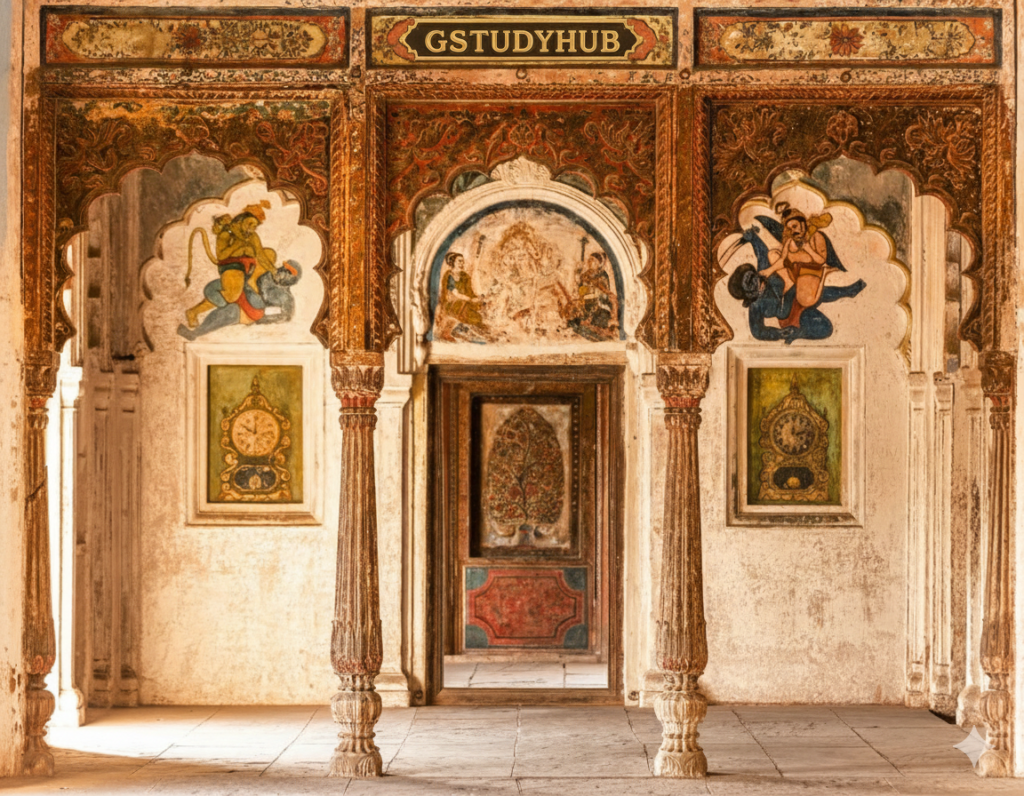
Introduction: The Inner Story of a King
The story of Ashoka and His Dharma reveals the extraordinary transformation of a ruthless conqueror into a messenger of peace, compassion, and moral governance.
Some stories remain only inside history books, while others continue to live inside human hearts. The story of Emperor Ashoka belongs to the second kind. It is not merely the tale of a powerful ruler, but the journey of a human soul that moved from darkness toward light.
Whenever I reflect on Ashoka’s life, I do not see only a king seated on a golden throne. I see a man struggling with his conscience, fighting battles not only on the battlefield, but also within himself.
This article is not simply about wars, dates, or empires. It explores transformation, self-realization, and the enduring influence of his moral vision.
My First Encounter with the Story of Ashoka
My first encounter with the story of Ashoka came through a school history textbook. At that time, he appeared to be just another mighty emperor, a ruler who expanded his empire through strength and strategy.
As I grew older and understood his journey more deeply, I realized that his greatness did not lie in the lands he conquered, but in the self he ultimately conquered.
The image of a ruler who witnessed unimaginable suffering and allowed that experience to reshape his worldview left a lasting impression on me.
History Is Not Just Dates, It Is a Lesson
We often treat history as a collection of timelines and events. Yet true history acts as a teacher. It reveals what human beings are capable of becoming.
His life reminds us that making mistakes is human, but acknowledging them and choosing a better path requires courage.
If a warrior driven by conquest can awaken compassion within himself, then every individual carries the same possibility of change. That is why his story continues to resonate even today.
This narrative is not only about a historic emperor. It is also about us — our struggles, our decisions, and our potential to grow into better human beings.
The deeper meaning of Ashoka and His Dharma lies in the transformation of power into compassion.
Early Life of Emperor Ashoka
The early life of Emperor Ashoka was far from ordinary. He grew up within the grandeur of royal palaces, surrounded by politics, power, and the expectations of future leadership. From a very young age, he was being prepared for the responsibilities of rule.
Even as a child, he displayed courage, intelligence, and determination. Among his brothers, he often stood out because of his fearless personality and strong sense of authority.
Within his young heart, a powerful ambition slowly took shape — the desire to rule and command.
Upbringing and Education of the Prince
The young prince was raised under strict discipline. He received extensive training in warfare, administration, politics, and statecraft. His teachers ensured that he developed both physical strength and intellectual depth.
He studied history, geography, economics, and military strategy, learning how great empires were built and sustained.
The palace environment reinforced the idea that power was supreme. At this stage, strength and dominance appeared to be the ultimate measures of success.
Desire for Power from Childhood
From an early age, the dream of occupying the throne filled his imagination. He envisioned himself as a mighty emperor before whom kingdoms would bow.
Victory fascinated him. Conquest excited him. He longed to be remembered as an invincible ruler.
This hunger for authority gradually became central to his identity.
Ambition in Youth
As he entered youth, his ambitions intensified. He no longer wished to be merely a king — he aspired to become the greatest emperor of his era.
His vision was of a vast empire stretching across the subcontinent, governed by absolute authority.
For this dream, he was prepared to make any sacrifice.
The Portrait of a Hard-Hearted Ruler
During this phase, he was more familiar with cruelty than compassion. His thoughts revolved around war, not peace.
People admired his bravery and strength, yet few recognized the darkness slowly taking root within him.
This inner hardness would eventually guide him toward the tragic events of the Kalinga War — the decisive turning point of his life.
The journey of Ashoka and His Dharma began long before his spiritual awakening.

Thirst for Power and Obsession with Victory
As he moved further into youth, his hunger for power intensified. He no longer dreamed of becoming merely a king; he aspired to be an emperor whose name would resonate across the world.
Power was no longer just a tool of governance. It had become central to his identity. Standing at the very summit of authority became his ultimate ambition.
Policy of Imperial Expansion
He believed that true greatness lay in constant expansion. Territorial growth appeared to him as the clearest symbol of strength and supremacy.
He resolved that any kingdom standing in his path would eventually bow before his authority.
War, in his view, was not merely a political strategy; it seemed the quickest route to fulfill his ambition.
War as the Solution to Every Problem
Whenever a kingdom resisted submission, the response was firm — war.
Fear was regarded as the strongest weapon. A ruler who inspired fear, he believed, commanded unquestioned authority.
This mindset gradually distanced him from compassion and drew him closer to cruelty.
Blind Attachment to Victory
Victory soon became more than success. It turned into a source of pride and personal satisfaction.
Each conquered territory intensified the desire for more. The thirst for domination remained unfulfilled.
In the intoxication of triumph, the reality was ignored — that behind every victory lay countless tears, broken families, and ruined lives.
The Image of an Emperor Who Never Stops
At this stage, he was an emperor who never felt content.
His gaze remained fixed on the next conquest, and his heart burned with relentless ambition.
This very fire would soon guide him toward the defining turning point of his life — the Kalinga War.
The Kalinga War: Land of Blood and Destruction
The Kalinga War became the defining turning point in the life of the Mauryan ruler. It was the moment that transformed a relentless conqueror into a man forced to confront his own conscience.
Kalinga was a prosperous and independent kingdom, known for the courage and dignity of its people. When it refused to submit to his expanding empire, conflict became inevitable.
The Horrifying Scene of War
As the battle began, the land seemed to darken with violence. The clash of swords, the thunder of advancing armies, and the cries of the wounded echoed across the battlefield.
Thousands stood face to face in fierce combat, and everywhere there was devastation.
The once peaceful land of Kalinga turned into a field of unimaginable destruction.
A Battlefield Covered with Bodies
The silence after the battle was even more haunting.
Countless bodies lay scattered across the land. Mothers searched desperately for their sons, wives looked for their husbands, and children wept for their fathers.
Grief hung heavily in the air, and the cost of victory became painfully visible.
Silence After Victory
The emperor had won the war, yet triumph brought no joy.
He stood victorious, but inside felt an unfamiliar emptiness.
As he looked at the devastation surrounding him, something within began to break.
The First Wound on the Soul
Standing amid the ruins of battle, he began to question his own decisions.
For the first time, he understood that the victory once glorified had been built upon immeasurable human suffering.
In that silent moment, a seed of transformation was planted — one that would alter the course of his life forever.
The tragedy of Kalinga ultimately became the foundation of Ashoka and His Dharma.
The devastation of Kalinga marked the emotional birth of Ashoka and His Dharma.
Repentance: When the Emperor Broke from Within
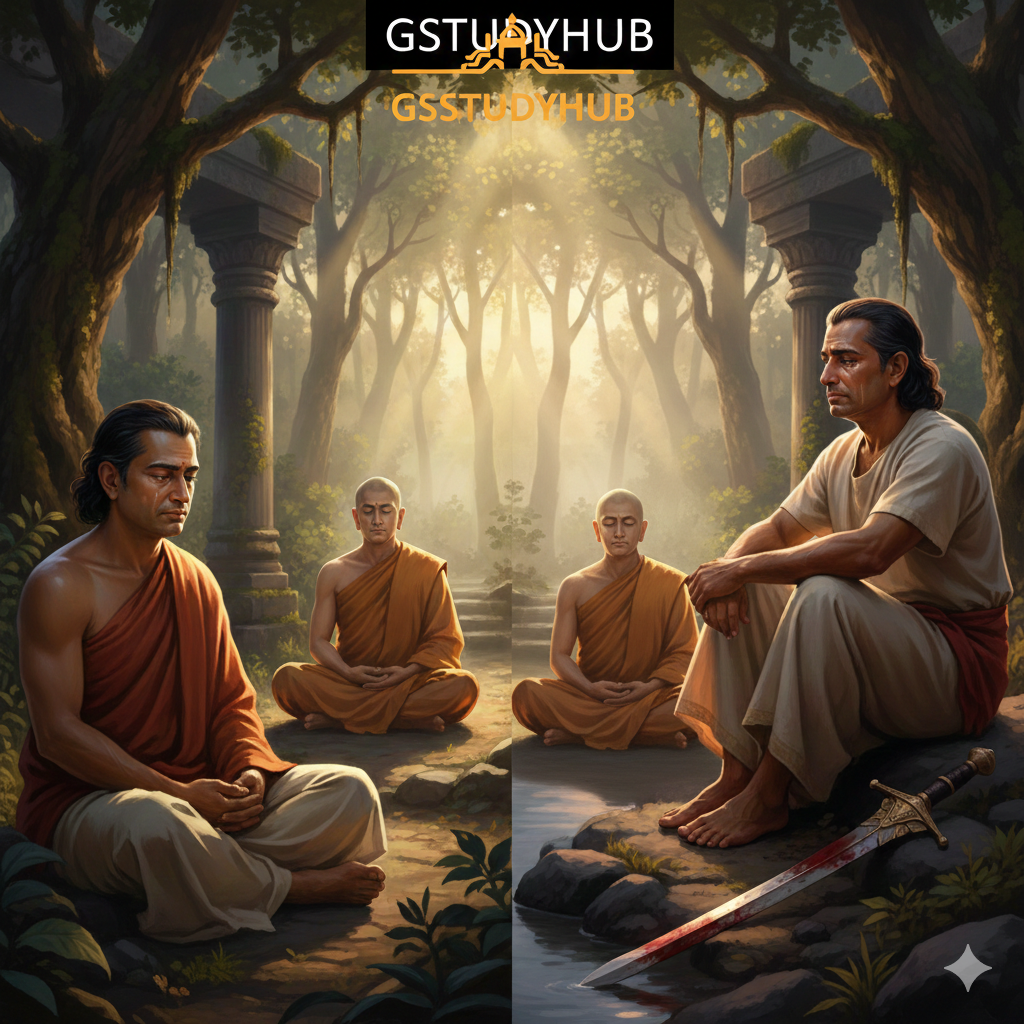
The aftermath of the Kalinga War created a storm inside the Mauryan ruler that he could neither silence nor escape. Outwardly, he remained victorious, but inwardly, he felt deeply fractured.
For the first time in his life, he realized that power and conquest could never bring peace to the human soul. Guilt and sorrow followed him like shadows.
The Voice of Conscience
Sleep deserted him. Whenever he closed his eyes, the battlefield returned — crying children, mourning women, and wounded soldiers struggling for life.
These memories tormented his conscience. Every silent image seemed to ask, “Is this victory?” “Is this greatness?”
The Birth of Guilt
Gradually, he accepted responsibility for the suffering that had unfolded.
He understood that countless innocent lives had paid the price for ambition.
That realization slowly created space within his heart for compassion.
Hatred Toward Violence
The sword once admired now felt unbearably heavy.
He came to understand that violence produces destruction, never lasting solutions.
In quiet reflection, he resolved never again to walk the path of needless war.
The Resolve to Transform
A solemn promise was formed within him — to become a ruler who governed through trust, not fear.
This inner awakening would soon guide him toward the path of Dhamma.
This inner awakening marked the beginning of Ashoka and His Dharma as a guiding force in his life.
Through deep reflection, Ashoka and His Dharma started redefining the meaning of power.
Ashoka and His Relationship with Buddhism
After being overwhelmed by repentance, the Mauryan emperor began searching for a path that could calm his restless mind. His heart was burdened, his thoughts unsettled, and his spirit longed for peace.
This inner journey gradually led him toward Buddhism — a philosophy grounded in compassion, non-violence, and self-awareness.
Meeting with a Buddhist Monk
According to historical traditions, he encountered a Buddhist monk whose calm presence left a profound impression. The monk’s serene expression reflected a peace he had never experienced before.
He questioned the monk about life, suffering, and freedom. The reply was simple — suffering arises from uncontrolled desire, and liberation is achieved through compassion and discipline.
The First Experience of Peace
As he listened, the turmoil within began to subside.
For the first time in years, there was a moment free from anger, free from ambition, and free from fear.
The Decision to Embrace Buddhism
This realization altered the direction of his life.
He understood that true victory does not lie in defeating others, but in mastering oneself.
The emperor chose to embrace Buddhism and committed himself to the principles of non-violence and compassion.
The Beginning of a New Life Path
From that point onward, he was not merely a sovereign ruler. He became a follower and protector of Dhamma.
His ambition shifted — from territorial expansion to the upliftment of humanity.
Thus emerged a transformed ruler, remembered in history as a symbol of peace and moral leadership.
Through this spiritual journey, Ashoka and His Dharma became inseparable from his identity as a ruler.
Buddhism became the foundation upon which Ashoka and His Dharma were firmly established.
Ashoka’s Dhamma: The Art of Living
After embracing Buddhism, the Mauryan emperor’s life underwent a profound transformation. His purpose was no longer limited to personal salvation; it expanded toward the welfare of society as a whole.
To realize this vision, he articulated the concept of “Dhamma” — not as a narrow religious creed, but as a universal ethical code grounded in compassion, humanity, and moral responsibility.
Meaning of Dhamma
For the emperor, Dhamma did not signify rituals or blind devotion.
It meant speaking the truth, practicing non-violence, showing kindness to all living beings, and fulfilling one’s duties with sincerity.
In essence, it was a path of inner discipline and moral purification.
Compassion, Mercy, and Non-Violence
Compassion formed the foundation of this ethical vision.
He believed that a person who understands and respects the suffering of others demonstrates true humanity.
Non-violence, in this understanding, was not merely the absence of physical harm, but the avoidance of injury in thought, word, and action.
Core Principles of Dhamma
These principles were expressed in simple yet powerful teachings:
- Truthfulness and integrity
- Respect for elders
- Care and service toward parents
- Tolerance toward all religions
- Charity and public service
Truth, Equality, and Service
The aim of this philosophy was to cultivate equality within society.
He maintained that whether ruler or common citizen, all individuals possess equal moral worth.
Service became central to governance. For him, the highest responsibility of leadership was to serve and uplift the people.
The principles of Ashoka and His Dharma emphasized moral responsibility over political dominance.
The ethical framework of Ashoka and His Dharma emphasized responsibility toward all beings.
Transformation in Governance: The Age of Welfare
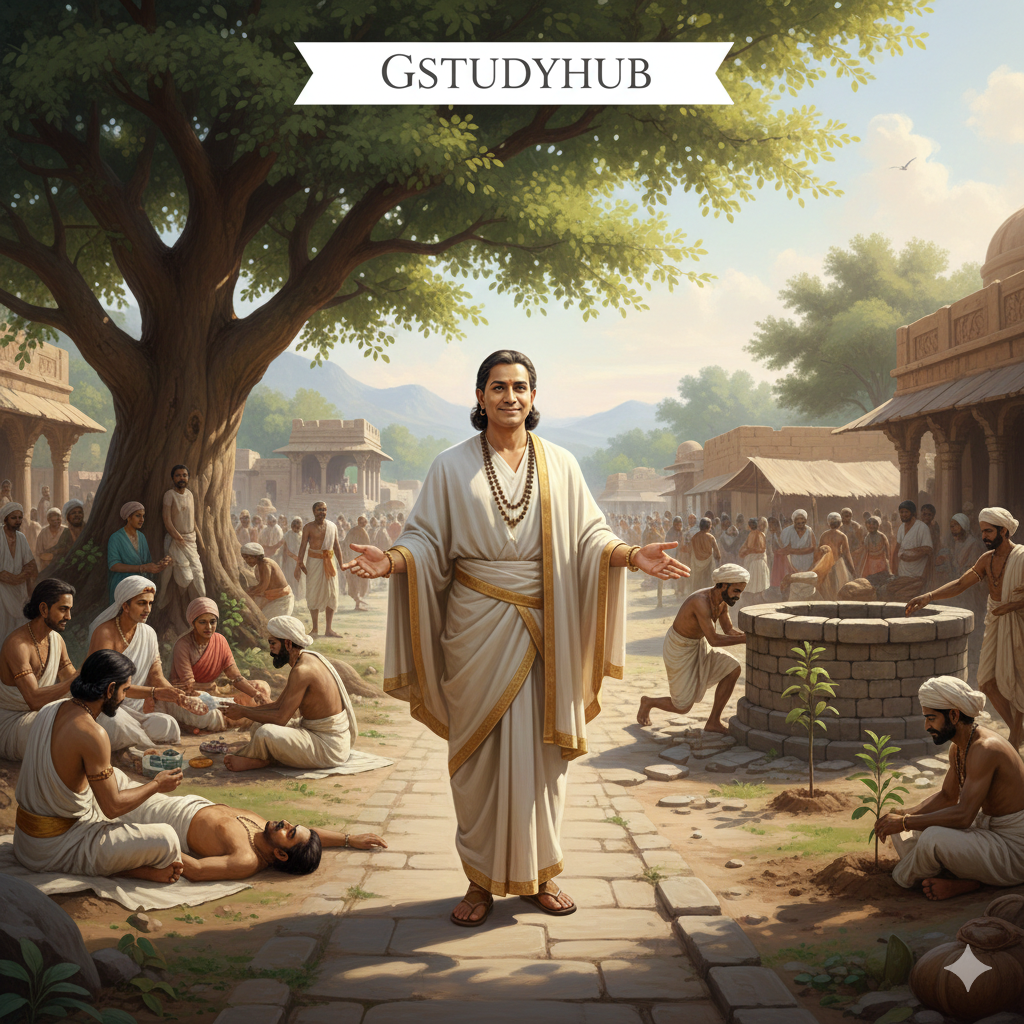
After embracing the path of Dhamma, the Mauryan ruler’s approach to governance changed fundamentally. The leader who once measured greatness through conquest now measured it through the well-being of his people.
Expansion of territory was no longer a priority. The true purpose of administration became social welfare and moral responsibility.
Welfare-Oriented Policies
Numerous reforms were introduced to improve the daily lives of the subjects. The administration focused on practical measures that ensured public comfort and stability.
- Establishment of hospitals
- Construction of roads and bridges
- Digging of wells and reservoirs
- Rest houses for travelers
- Plantation of trees and development of gardens
Hospitals, Roads, and Wells
Medical facilities were constructed for both humans and animals, reflecting a commitment to universal compassion.
Along major routes, wells were dug and trees planted to provide shade and water for travelers.
Such initiatives ensured that essential services reached even distant regions of the empire.
Governance Based on Justice and Compassion
He believed that true governance must combine justice with empathy.
Officials were instructed to administer laws with fairness and treat citizens with dignity rather than severity.
From King to Servant
Gradually, he began to see himself not merely as a sovereign, but as a servant of the people.
The highest responsibility of leadership was considered to be public service.
This transformation explains why that reign is remembered as an age of welfare and moral leadership.
The welfare reforms introduced during his reign reflected the practical application of Ashoka and His Dharma.
The reforms he introduced reflected the practical implementation of Ashoka and His Dharma.
Spread of Buddhism Across the World
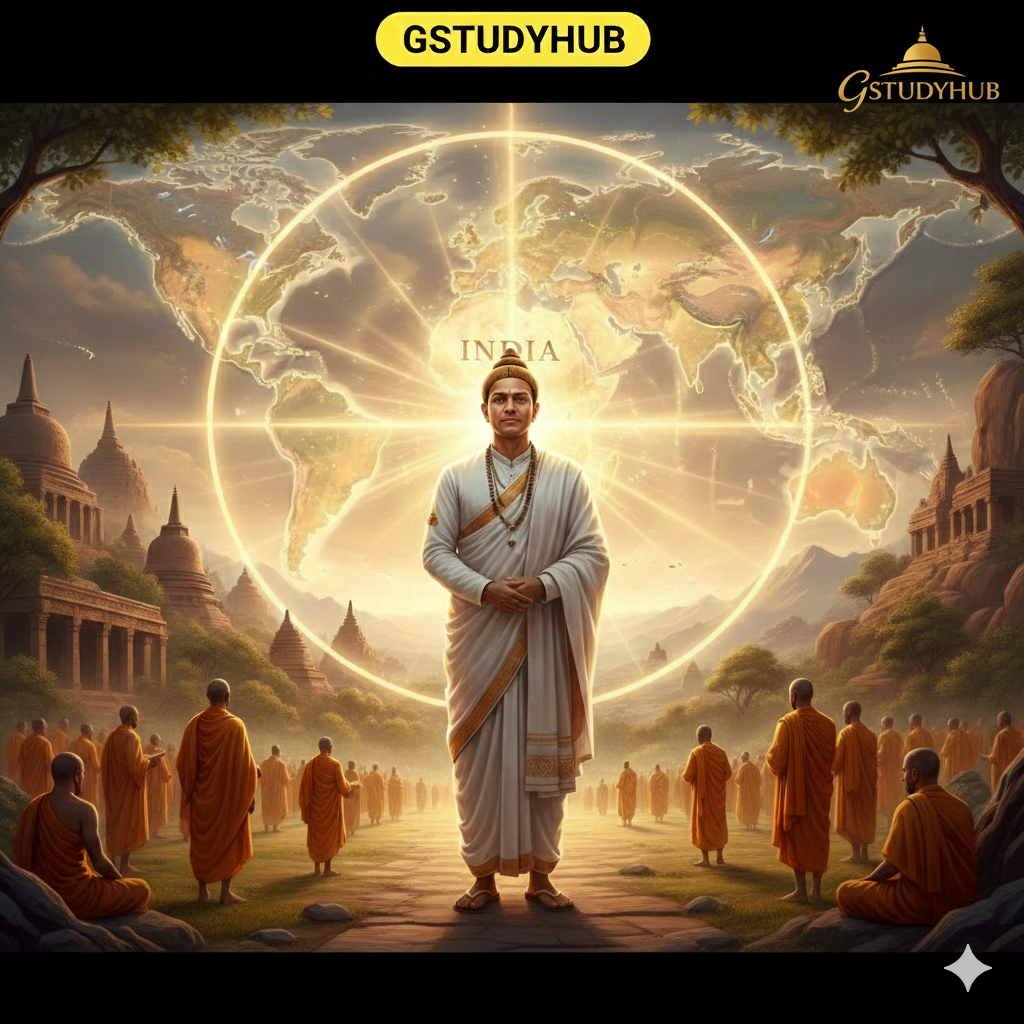
The Mauryan emperor did not keep Buddhism limited to his personal transformation. He turned it into a message meant for the welfare of all humanity.
He believed that the values of compassion, non-violence, and peace should not be confined by political boundaries.
Journeys of the Missionaries
Missionaries were sent to different regions to share the teachings of the Buddha.
They traveled not only across the Indian subcontinent, but also to Sri Lanka, Myanmar, Thailand, Nepal, and parts of Central Asia.
Message of Peace Reaching Asia
Wherever these envoys went, they carried a message of peace, tolerance, and moral discipline.
Gradually, the Buddhist tradition began to take root in many parts of Asia.
Construction of Stupas and Monasteries
Numerous stupas and monasteries were commissioned to strengthen and support the growing spiritual movement.
These institutions became important centers of learning and spiritual practice.
Buddhism as a Global Path
Through these sustained efforts, the tradition gradually evolved into a global spiritual movement.
Even today, its influence can be observed across many regions of the world.
Through global missions, Ashoka and His Dharma extended beyond imperial boundaries.
Lessons from His Life
While reflecting on the life of the Mauryan emperor, I came to understand that this story is not merely the journey of a king. It serves as a mirror for every human being.
His transformation reminds us that no matter how far a person may drift from the right path, the possibility of change always remains.
Transformation Is Possible
He evolved from a ruthless conqueror into a compassionate and morally guided ruler.
This journey proves that transformation is not weakness; it is strength.
Our past actions may shape us, but they do not imprison our future.
No Matter How Great the Mistake
After witnessing immense suffering, repentance was chosen over pride and reform over denial.
This teaches us that no error is beyond correction when there is courage and humility.
Compassion Is Greater Than Power
Ultimately, it became clear that power achieved through violence is temporary, while moral authority earned through compassion endures.
True greatness does not lie in defeating others, but in uplifting them.
The Meaning of True Victory
When we conquer anger, ego, and hatred within ourselves, we achieve the highest form of victory.
This remains the enduring message of that remarkable life and legacy.
Ashoka and His Dharma in the Modern World
The modern world is shaped by technology, ambition, and intense competition. Nations, institutions, and individuals are constantly striving to move ahead.
In such a fast-paced and often divided global environment, the teachings of the Mauryan emperor and his concept of Dhamma appear more relevant than ever.
The Message of Non-Violence in a Turbulent World
Even today, many regions across the globe continue to experience conflict, extremism, and unrest.
His transformation demonstrates that violence rarely resolves problems; instead, it often deepens them.
The path of non-violence may demand patience and courage, but it remains the most sustainable route to lasting peace.
The Path of Peace
When individuals, communities, and nations choose dialogue over destruction, cooperation replaces hostility.
This principle lies at the heart of that ethical vision — peace built upon understanding and empathy.
The Importance of Morality and Compassion
In the contemporary age, success is often measured in material wealth and political power.
That legacy reminds us that true success is defined by the positive impact we create in the lives of others.
Humanity as the Highest Ideal
This philosophy was never confined to a single faith.
It elevated humanity itself as the highest moral principle.
Such timeless guidance continues to inspire the building of a more compassionate and harmonious world.
Even in contemporary society, Ashoka and His Dharma offer valuable lessons for ethical leadership.
Even today, Ashoka and His Dharma inspire conversations about ethical leadership.
Conclusion: The Greatness of a King
The life of the Mauryan emperor reminds us that true greatness is not measured by the sharpness of the sword, but by the depth of the heart.
The ruler who once believed that war defined success ultimately became a timeless symbol of peace, compassion, and moral courage.
This Is the Story of Us All
That remarkable journey is more than a chapter in history. It reflects the potential within every human being.
Within each of us lives a struggle — a conflict between anger and understanding, ego and humility, violence and compassion.
Such a life teaches us that the path we choose defines the legacy we leave behind.
The Beginning of Change Lies Within
This story reminds us that lasting change does not begin in kingdoms or governments, but within the human mind.
When thoughts transform, actions transform — and gradually, the world around us changes as well.
The Legacy
The greatest legacy of that reign was not the vastness of an empire, but the principles upheld.
A philosophy rooted in compassion, non-violence, tolerance, and truth.
An Eternal Message
Empires may rise and fall, but moral ideals endure.
The message continues to echo through centuries — the world is not truly conquered by force, but by compassion.
The enduring relevance of Ashoka and His Dharma reminds humanity that compassion is stronger than conquest.
The legacy of Ashoka and His Dharma continues to guide humanity toward compassion.
Frequently Asked Questions (FAQ)
Why did Emperor Ashoka adopt Buddhism?
After witnessing the massive bloodshed and destruction of the Kalinga War, Emperor Ashoka experienced deep remorse. This inner transformation led him to adopt Buddhism, a path based on compassion, non-violence, and peace.
What was Ashoka’s Dhamma?
Ashoka’s Dhamma was not a narrow religious doctrine, but a moral way of life. It emphasized truth, non-violence, compassion, service, tolerance, and humanity.
Did Ashoka truly give up violence?
Yes, after the Kalinga War, Ashoka renounced the path of war and violence and adopted peace, dialogue, and welfare-based governance.
What did Ashoka do to spread Buddhism?
Ashoka sent Buddhist missionaries to different regions, constructed stupas and monasteries, and promoted Buddhist teachings through inscriptions.
Why are Ashoka’s teachings important today?
In a world facing violence, conflict, and intolerance, Ashoka’s teachings of non-violence, compassion, and humanity offer a path toward peace and coexistence.
References
- Thapar, Romila. Ashoka and the Decline of the Mauryas. Oxford University Press.
- Strong, John S. The Legend of King Ashoka: A Study and Translation of the Ashokavadana. Princeton University Press.
- Strong and durable build quality
- Reliable performance for daily use
- Excellent value for money
- Highly rated by customers
- Keay, John. India: A History. Grove Press.
- Encyclopedia Britannica – Emperor Ashoka https://www.britannica.com/biography/Ashoka
- National Council of Educational Research and Training (NCERT), History Textbooks – Ancient India.
- World History Encyclopedia – Ashoka the Great https://www.worldhistory.org/Ashoka/
