
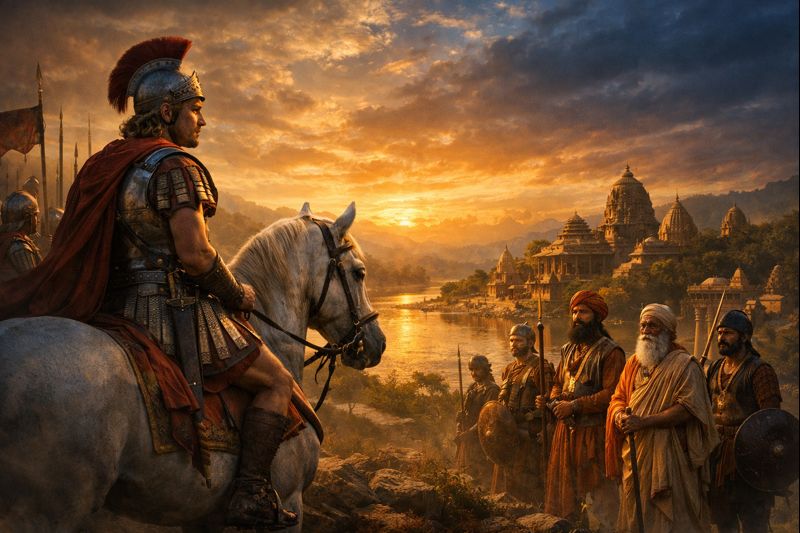
Alexander’s Invasion of India: When a World Conqueror Met an Ancient Civilization
History is not merely a collection of dates and battles; it is the living story of human courage, ambition, and resilience. Alexander’s Invasion of India represents one such remarkable chapter where a world conqueror encountered an ancient civilization rooted in wisdom, culture, and dignity.
Alexander the Great, who had already conquered vast regions of Europe, Asia, and Africa, believed that no land was beyond his reach. However, when he stepped onto Indian soil during Alexander’s Invasion of India, he realized that this was not just another territory to be claimed, but a civilization protected by centuries of tradition, philosophy, and inner strength.
This article is not only a historical narration of this historic campaign, but also a story of confrontation between power and principles, conquest and culture, ambition and restraint. It reminds us that true victory is not achieved by defeating armies alone, but by earning the respect of a civilization.
Through this journey, we will explore Alexander’s arrival in India, his battles, his limitations, and the unbreakable spirit of the subcontinent, presented in a storytelling manner so that history is not just read, but deeply felt.

Premium Study Material for Competitive Exams
- ✔ Structured & easy-to-understand content
- ✔ Clear explanations for better revision
- ✔ Trusted by many aspirants
- ✔ Ideal for academic & competitive exams
Who Was Alexander the Great?
Alexander the Great, born in 356 BCE, was the king of Macedonia and one of the most ambitious rulers in world history. At a very young age, he inherited the throne from his father, King Philip II, and soon began transforming his small kingdom into a vast empire that stretched across three continents.
Alexander was not only a warrior but also a thinker and strategist. He was educated by the great philosopher Aristotle, who shaped his understanding of leadership, culture, and knowledge. This education made Alexander different from many other conquerors of his time — he wanted not only to rule lands, but also to understand the civilizations he encountered.
His life reflects the power of youthful determination, yet it also reveals how limitless ambition can eventually lead a person to confront his own boundaries — a truth clearly visible during Alexander’s Invasion of India.
The Dream That Led to Alexander’s Invasion of India
Alexander’s greatest dream was to conquer the entire known world. He believed that no kingdom was too powerful and no land was beyond his reach. With every victory, his confidence grew stronger, and his desire for universal conquest became deeper.
He defeated the Persian Empire, captured Egypt, and expanded his rule across Mesopotamia and Central Asia. For Alexander, conquest was not just about territory — it was about proving his destiny as a world ruler.
However, this dream slowly turned into a test of his own limits, especially as he marched toward the Indian subcontinent, setting the stage for Alexander’s Invasion of India.
Building an Empire in Youth
At just twenty years of age, Alexander ascended the throne of Macedonia and soon created one of the largest empires in history. His army was disciplined, loyal, and strategically superior. His leadership proved that age is not a barrier to greatness.
Yet, the rapid success of his youth also gave him a sense of invincibility. This belief eventually guided him toward India, where for the first time he realized that not every land could be conquered by the sword alone.
Alexander’s early achievements teach us that true greatness is not only measured by victories, but by the wisdom to recognize one’s own limitations.
Causes Behind Alexander’s Invasion of India
In Alexander’s imagination, India was portrayed as a land of gold and endless wealth. Greek travelers and traders had described India as a region rich in precious metals, fertile lands, and prosperous kingdoms. These stories shaped Alexander’s perception of India as a “golden land” waiting to be conquered.
However, India attracted Alexander not only because of its wealth, but also because of its ancient and highly developed civilization. India was known for its deep traditions in philosophy, science, mathematics, medicine, and spirituality. Alexander wished to witness and understand the power of a civilization that had survived and flourished for thousands of years.
Yet, above all these reasons stood one powerful force — his desire for world conquest. Alexander believed himself to be destined to rule the entire known world. For him, India represented the final frontier of his legendary campaign.
This chapter of history teaches me a personal lesson as well. It reminds me that when ambition crosses its natural limits, decline quietly begins. Alexander’s march toward India was not only a military expedition, but also the moment when his limitless ambition began to confront its own boundaries.
The Beginning of Alexander’s Invasion of India
After years of continuous victories, Alexander finally reached the borders of India, marking the decisive phase of Alexander’s Invasion of India. Before him stood not just a new land, but one of the world’s oldest and richest civilizations. India was the land he had heard about in countless stories — a land of wisdom, wealth, and deep cultural roots.
For Alexander, entering India was not merely a military move; it marked the beginning of the greatest test of his life. The air, the soil, and even the silence of this land carried a spirit that was unfamiliar to him.
Crossing the Indus River
The first major milestone of Alexander’s Indian campaign was crossing the mighty Indus River. This river was not just a geographical boundary, but a symbolic line between two ancient civilizations during Alexander’s Invasion of India.
As Alexander and his army crossed the Indus, they felt they were stepping into an entirely different world. Pride from past victories mixed with a quiet sense of uncertainty, as if history itself was watching their steps.
The First Indian Encounter
After crossing the Indus, Alexander encountered Indian soldiers and local rulers for the first time. These warriors were not driven only by weapons, but by a deep sense of honor and loyalty to their land.
This first encounter surprised Alexander. He saw fighters who were not afraid of defeat, but who valued dignity above life itself. At that moment, he realized that conquering India would be far more difficult than he had ever imagined.
This initial experience made one truth clear — India could not be conquered by the sword alone, because its true strength lived in its spirit.

High-Quality Study Material for Exams
- ✔ Structured & easy-to-follow content
- ✔ Clear explanations for quick revision
- ✔ Trusted by exam aspirants
- ✔ Ideal for competitive & academic exams
The Historic Battle Between King Porus and Alexander
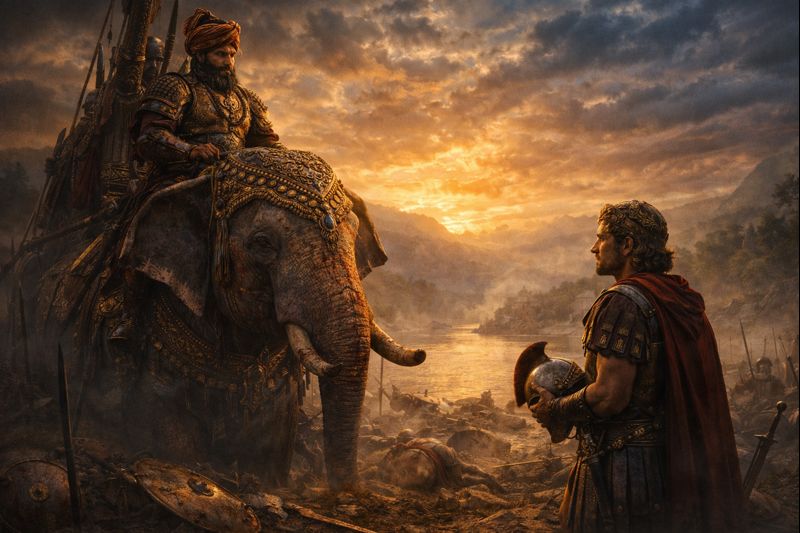
This chapter of Indian history is not merely a record of war, but an immortal story of courage, dignity, and self-respect. The historic battle between King Porus and Alexander, fought on the banks of the Hydaspes River (Jhelum), became one of the most decisive moments of Alexander’s Invasion of India, where the so-called invincible world conqueror faced the unbreakable spirit of India.
King Porus stood fearlessly before Alexander’s massive and well-trained army. He was not driven by the desire for power alone, but by deep loyalty to his land and people. For Porus, this war was not about conquest — it was about honor.
The battlefield witnessed intense fighting. War elephants, horses, chariots, and soldiers clashed with full force. Even after being seriously wounded, King Porus continued to fight with unmatched bravery. His courage astonished Alexander and his commanders during Alexander’s Invasion of India.
When Porus was finally captured, his body was wounded, but his spirit remained unbroken. Alexander asked him how he wished to be treated. Porus replied with calm pride, “Like a king.” These words echoed through history.
Alexander was deeply moved by this response. He not only spared Porus, but restored his kingdom and honored him as a ruler. This moment proved that true victory is not achieved by crushing an enemy, but by recognizing greatness in them.
The battle between King Porus and Alexander teaches us that defeat can touch the body, but never the soul. And this unyielding spirit has always been the true strength of India.
The Defeat of Alexander That History Calls a Victory
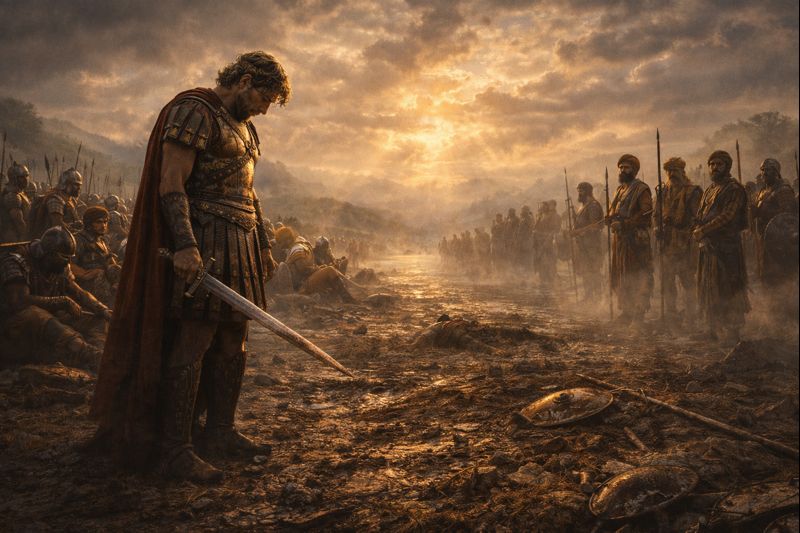
Alexander is remembered in history as a great conqueror, yet on Indian soil he experienced something he had never faced before. After the battle with King Porus, Alexander realized that although he may have won a battlefield during Alexander’s Invasion of India, he had not conquered the spirit of the land.
His army was exhausted, his soldiers refused to march further, and for the first time doubt entered Alexander’s own mind. This was the moment when the image of an invincible conqueror began to crack. This silent realization became his true defeat — a defeat written not in swords, but in conscience.
Alexander was forced to accept that not every victory is achieved through force, and not every land can be bent by power alone. The events of Alexander’s Invasion of India taught him that the strength of the soul is greater than the strength of weapons.
From this moment, I learned a powerful lesson: sometimes defeat itself becomes the greatest victory. Because defeat teaches us humility, reveals our limitations, and guides us toward true wisdom.
Thus, his retreat from India was not merely a military withdrawal, but a transformation — a lesson that continues to inspire even today.

High-Quality Study Material for Better Learning
- ✔ Easy-to-follow structured content
- ✔ Clear explanations & quick revision
- ✔ Trusted by many aspirants
- ✔ Ideal for competitive & academic exams
The Morale of Indian Soldiers
Indian soldiers may have been fewer in number compared to Alexander’s vast and disciplined army, but their morale stood higher than any mountain. They were not fighting merely under orders, but for their motherland, culture, and self-respect.
For them, this war was not just a struggle for power; it was a battle for identity and existence. They carried within themselves an unshakable belief that even if the body grew tired, the spirit must never bow.
Exhausted Yet Unbreakable
Despite continuous battles, wounds, hunger, and extreme fatigue, the courage of Indian soldiers never weakened. Their faces reflected exhaustion, but their eyes showed no sign of surrender.
They knew that this war was not only about the present, but about the honor of future generations. With every blow, they stood even more firmly on the battlefield.
This sight deeply surprised Alexander himself. For the first time, he witnessed warriors who were driven not by fear of defeat, but by loyalty to their duty.
The morale of Indian soldiers still teaches us today that true strength does not live in weapons, but in unwavering determination and self-respect.
The Final Phase of Alexander’s Invasion of India: His Return
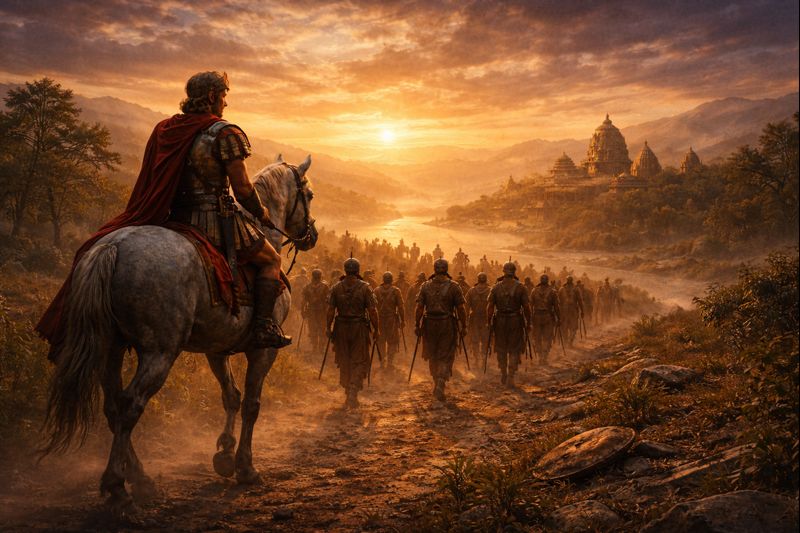
After his campaign in India, Alexander was forced to accept for the first time that his journey of conquest could not continue further. His army was exhausted, the soldiers were worn out by endless battles, and a strong desire to return home had begun to rise among them.
Alexander made several attempts to persuade his troops, but they refused to march ahead. This turning point marked the final phase of Alexander’s Invasion of India, when a great conqueror had to bow before the emotions and limits of his own soldiers. It was not a sign of weakness, but a true test of leadership.
As Alexander turned back from India, his heart was filled not with anger, but with deep reflection. He had realized that India could not be conquered, because it was not merely a land, but a living soul.
His return was not an ordinary retreat; it was the return of a man who was no longer the same as before. India had given him not defeat, but self-awareness.
Alexander’s return stands in history as proof that sometimes the greatest journeys are those that lead us not across lands, but into our own inner world.

Premium Study Material for Competitive Exams
- ✔ Well-structured & exam-ready content
- ✔ Easy-to-understand explanations
- ✔ Trusted by aspirants nationwide
- ✔ Ideal for long study sessions
What I Learned from This Story
The story of Alexander’s invasion of India was not just a historical narrative for me, but a deep moment of self-reflection. It taught me that not every victory lasts forever, and not every defeat is meaningless.
I learned that true greatness does not lie only in conquering others, but in understanding one’s own limitations. Alexander had conquered half the world, yet in India he realized that the human spirit cannot be defeated by the sword.
This story also taught me that when ambition becomes the only goal, a person slowly loses inner peace. But when one accepts boundaries with humility, true wisdom begins to grow.
I realized that history is not only about the past; it is a guide for the present and the future. Alexander’s journey reminds us that power is temporary, but self-respect, humility, and character are eternal.
From this story, I finally learned that the greatest victory in life is the one that transforms us into a better human being.
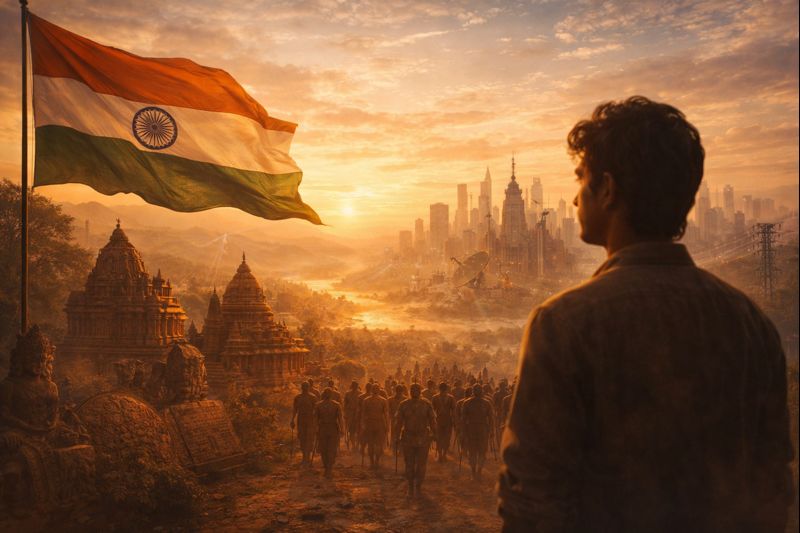
Message for Modern India
Alexander’s journey into India is not merely a historical episode, but a powerful message for modern India. It reminds us that the true strength of a nation does not lie only in military power or economic growth, but in its culture, values, and self-respect.
In today’s globalized world, India is emerging as an influential voice on the world stage. At such a time, Alexander’s story teaches us to move forward with modern vision while remaining deeply rooted in our ancient heritage.
This story also reminds us that internal unity is more important than external challenges. If we preserve our moral values, social harmony, and confidence, no force can weaken the soul of India.
Alexander’s invasion conveys that power finds its true meaning in service, cooperation, and respect, not merely in domination and conquest.
For modern India, this story is a source of inspiration — to learn from history and build a future that is strong, just, and humane.
Conclusion
Alexander’s Invasion of India was not merely a historical event, but a meeting of two civilizations, two ideologies, and two visions of power. On one side stood the strength of the sword, and on the other stood the resilience of the soul. In this encounter, India proved that true victory does not lie in conquering land, but in preserving values.
The courage of King Porus, the morale of Indian soldiers, and the unbreakable spirit of the land transform this story from history into inspiration. Alexander may be remembered as a world conqueror, but India taught him that every power has its limits.
This journey teaches us that ambition is necessary, but only when it is guided by wisdom and humility does it lead to creation and progress. Otherwise, the same ambition becomes the path toward decline.
Alexander’s return from India stands as proof that sometimes stepping back is the greatest act of understanding, and sometimes defeat gives us the knowledge that no victory can offer.
Ultimately, Alexander’s Invasion of India reminds us that the subcontinent is not merely a nation, but a living civilization — one that remains unconquered in spirit despite time, conflict, and countless challenges.
Frequently Asked Questions about Alexander’s Invasion of India
Did Alexander completely conquer India?
No, Alexander did not completely conquer India. After the battle with King Porus during Alexander’s Invasion of India, his exhausted army refused to march further, forcing him to return from Indian territory.
Who was King Porus?
King Porus was a powerful Indian ruler who fought Alexander on the banks of the Hydaspes River (Jhelum). He is remembered for his courage, dignity, and fearless leadership.
Why did Alexander invade India?
Alexander invaded India because of its reputation as a wealthy land, its ancient civilization, and his strong desire for world conquest.
Why did Alexander return from India?
Alexander returned because his army was exhausted and unwilling to continue. He also realized that India could not be conquered by military power alone.
What is the historical significance of Alexander’s Invasion of India?
Alexander’s Invasion of India highlights the strength of Indian civilization, showing that cultural and moral resilience can be stronger than military force.
What lesson do we learn from this story?
This story teaches us that sometimes defeat becomes the greatest victory, and true success lies in humility, wisdom, and self-realization.
References
- Arrian – Anabasis of Alexander, translated editions.
- Plutarch – Life of Alexander, classical historical biography.
- Quintus Curtius Rufus – Histories of Alexander the Great.
- R. C. Majumdar – Ancient India, Motilal Banarsidass Publishers.
- Upinder Singh – A History of Ancient and Early Medieval India, Pearson Education.
- Romila Thapar – Early India: From the Origins to AD 1300.
- Indian Council of Historical Research (ICHR) – Research publications and archives.
- National Archives of India – Ancient Indian historical records.
- World history museums and academically verified historical sources.