
Ajatashatru and Bimbisara: A Tragic Story of Power and Repentance
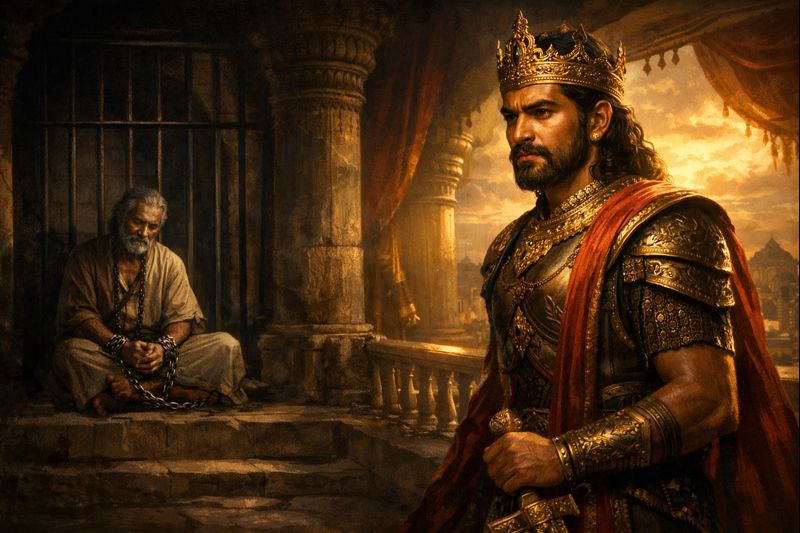
Ajatashatru and Bimbisara represent one of the most tragic and powerful father–son stories in ancient Indian history. History is not only a record of kings and wars, but also a reflection of human emotions, decisions, and regrets. The story of King Bimbisara of Magadha and his son Ajatashatru connects power, love, betrayal, and realization in a deeply emotional way.
This father–son conflict shows how ambition can overpower relationships and lead to irreversible consequences. Ajatashatru’s rise to the throne was not only a political victory, but also a lifelong burden of guilt and repentance.
Through this article, we will explore not just historical events, but also the moral and emotional lessons hidden within this story, so that history becomes a guide for life, not merely a chapter of the past.

Top Amazon Product Choice
Premium quality, modern design and strong performance make this product an excellent choice for everyday use or gifting.
👉 Buy on AmazonIntroduction to the Magadha Empire
The Magadha Empire holds a glorious and influential place in the history of ancient India. Located in the fertile Gangetic plains, Magadha emerged as a powerful political, cultural, and economic center. Its strategic geography played a key role in shaping the future of Indian civilization.
Covering parts of present-day Bihar and Jharkhand, Magadha benefited from rich agricultural land, river trade routes, and strong natural defenses. These advantages helped it grow into the most dominant kingdom of its time.
Great rulers such as Bimbisara, Ajatashatru, Mahapadma Nanda, and Chandragupta Maurya rose from this land, turning Magadha into the foundation of India’s first major empires. Thus, Magadha was not merely a kingdom, but a symbol of political unity and civilizational strength.
Reign and Administration of King Bimbisara
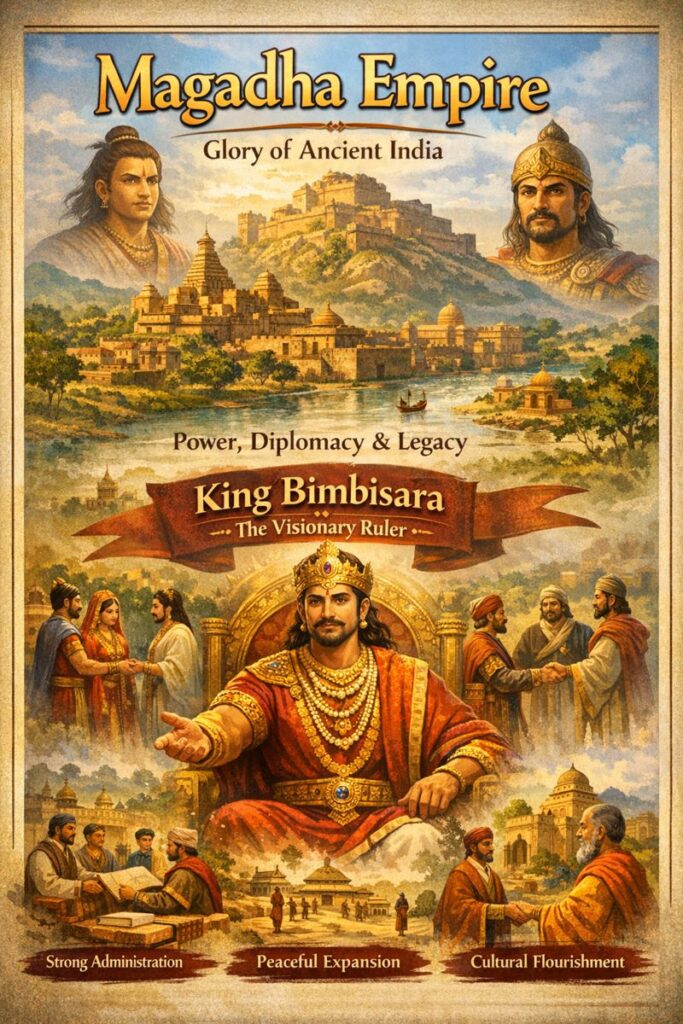
King Bimbisara is remembered as one of the most visionary and efficient rulers of ancient India. He ascended the throne of Magadha around 544 BCE and transformed the kingdom into a stable and well-organized state. His reign marked the beginning of Magadha’s rise as a dominant political power.
Bimbisara strengthened the administrative system by appointing capable officials, organizing a systematic tax structure, and ensuring a fair justice system. He maintained direct contact with his subjects, which helped build trust between the ruler and the people.
Politically, Bimbisara preferred diplomacy over continuous warfare. Through strategic marriage alliances and friendly treaties, he secured Magadha’s borders and expanded its influence peacefully. This policy allowed Magadha to grow without unnecessary bloodshed.
His administration was not limited to governance alone; it also promoted social harmony, religious tolerance, and cultural development. For these qualities, King Bimbisara is regarded as an ideal and enlightened ruler in Indian history.
Reign and Administration of King Bimbisara
King Bimbisara is remembered as one of the most visionary and efficient rulers of ancient India. He ascended the throne of Magadha around 544 BCE and transformed the kingdom into a stable and well-organized state. His reign marked the beginning of Magadha’s rise as a dominant political power.
Bimbisara strengthened the administrative system by appointing capable officials, organizing a systematic tax structure, and ensuring a fair justice system. He maintained direct contact with his subjects, which helped build trust between the ruler and the people.
Politically, Bimbisara preferred diplomacy over continuous warfare. Through strategic marriage alliances and friendly treaties, he secured Magadha’s borders and expanded its influence peacefully. This policy allowed Magadha to grow without unnecessary bloodshed.
His administration was not limited to governance alone; it also promoted social harmony, religious tolerance, and cultural development. For these qualities, King Bimbisara is regarded as an ideal and enlightened ruler in Indian history.
Birth and Personality of Ajatashatru
Ajatashatru was born as the son of King Bimbisara of Magadha, but from the very beginning his life was surrounded by predictions of future conflict. According to legends, astrologers foretold that this child would one day become an enemy to his own father, and therefore he was named “Ajatashatru,” meaning “one who is an enemy from birth.”
In his childhood, Ajatashatru was intelligent, brave, and highly ambitious. He possessed natural leadership qualities, yet deep within him grew a strong desire for power. He did not merely wish to inherit the throne in time; he wanted to claim it as soon as possible.
His personality reflected a blend of opposite traits. On one hand, he was bold, decisive, and capable, while on the other hand, he was suspicious, impatient, and emotionally restless. This inner conflict later shaped the most tragic decisions of his life.
Ajatashatru’s character teaches us that talent without self-control and wisdom can become a path not only to success, but also to destruction. His life stands as a living example of human psychology in ancient history.

Top Value Amazon Product
Premium build quality, sleek design and excellent performance make this a reliable choice for daily use or gifting.
👉 Buy on AmazonPower Struggle Between Father and Son
The relationship between Bimbisara and Ajatashatru initially reflected a normal bond of father and son. However, with time, ambition for power slowly poisoned this sacred relationship. Ajatashatru began to believe that as long as his father lived, he could never truly become the king.
Court conspiracies and misleading advice further strengthened this belief. Selfish ministers and negative influences convinced Ajatashatru that Bimbisara was the greatest obstacle in his path to the throne. Thus, a wall of distrust rose between father and son.
The desire for power blinded Ajatashatru to his father’s love, sacrifice, and guidance. The royal throne became more valuable to him than family bonds and moral duty.
This conflict was not only between two individuals, but also a symbol of the inner battle between ambition and responsibility. It eventually led to one of the most tragic chapters in the history of Magadha.
Imprisonment and Death of King Bimbisara
At the peak of the power struggle, Ajatashatru made a decision that changed the course of Magadha’s history forever. Imprisoning his own father, King Bimbisara, was the most cruel and inhuman act of his life.
During his imprisonment, Bimbisara was deprived of food and basic comforts. According to legends, the queen secretly tried to send him food, but when this was discovered, he was placed in complete isolation.
Slowly, physical suffering combined with mental agony began to break him. The great king who had once strengthened Magadha now struggled alone between life and death inside his own kingdom’s prison.
Eventually, hunger, pain, and humiliation ended the life of King Bimbisara. His death was not merely the death of a ruler, but a tragic symbol of the defeat of justice, compassion, and human values.
Repentance and Self-Realization of Ajatashatru
After the death of Bimbisara, Ajatashatru finally gained the throne for which he had sacrificed everything. Yet, peace did not follow power. Sitting on the royal throne, he felt empty and restless from within.
Slowly, he began to realize that although he had won a kingdom, he had lost his father’s love, blessings, and trust forever. Sleep left his nights, and joy disappeared from his days.
This inner pain became his greatest punishment. He understood that no empire could compensate for the crime he had committed against his own father.
From this moment, Ajatashatru’s journey of self-realization began. He looked within himself and accepted his guilt for the first time. This acceptance led him toward repentance, and repentance became the foundation of his spiritual transformation.
Ajatashatru’s Meeting with Lord Buddha
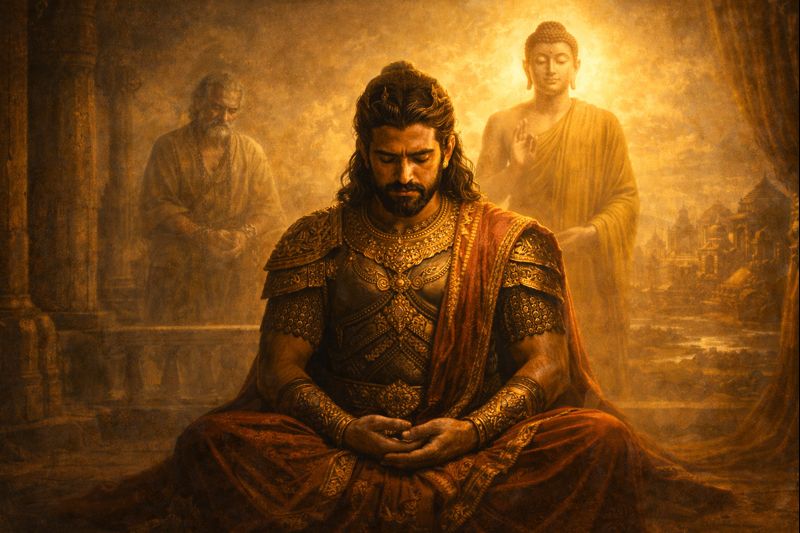
The fire of repentance was burning within Ajatashatru, yet he could not find a path toward peace. At this crucial moment, he decided to meet Lord Buddha, whose compassion and wisdom were renowned across the land.
Standing before Buddha, Ajatashatru confessed his sins. He expressed the heavy burden of guilt he carried in his heart for the injustice he had done to his own father. Buddha did not respond with condemnation, but with compassion and understanding.
Buddha explained that repentance itself is the first step toward inner purification. When a person accepts his mistakes with honesty, true transformation of the heart becomes possible.
After this meeting, a deep change occurred in Ajatashatru’s life. For the first time, he realized that true victory is not over others, but over the darkness within oneself.
Life Lessons from This Story
The historical story of Ajatashatru and Bimbisara is not only a tale of power and conflict, but also a source of deep and timeless lessons for human life. The experiences hidden in this story remain equally relevant in the modern world.
- Ambition must be guided by wisdom: When ambition overpowers conscience, it damages both relationships and inner peace.
- Relationships are greater than power: Kingdoms and thrones are temporary, but emotional bonds give lasting meaning to life.
- Repentance opens the door to purification: Accepting one’s mistakes is the first step toward true greatness.
- Compassion has the power to transform: Lord Buddha’s kindness changed the direction of Ajatashatru’s life.
- True victory is self-conquest: Defeating others is easy, but conquering one’s own weaknesses is the greatest achievement.
Thus, this story teaches us that history is not merely about the past, but a guiding light for our present and future as well.
Frequently Asked Questions About Ajatashatru and Bimbisara
Who was Ajatashatru?
Ajatashatru was the son of King Bimbisara and the ruler of the Magadha Empire, who imprisoned his own father to seize the throne in the tragic story of Ajatashatru and Bimbisara.
How did King Bimbisara die?
King Bimbisara died in prison due to starvation, suffering, and mental agony, making his death one of the most tragic events in the history of Ajatashatru and Bimbisara.
Why did Ajatashatru act against his father?
Extreme ambition for power, court conspiracies, and misleading advice pushed Ajatashatru to turn against his own father.
What is the importance of Ajatashatru’s meeting with Lord Buddha?
This meeting marked the beginning of Ajatashatru’s repentance and spiritual transformation, guided by Buddha’s compassion and wisdom.
What lessons does the story of Ajatashatru and Bimbisara teach us?
The story teaches that relationships are greater than power, and repentance leads to inner purification and growth.
Was Ajatashatru a good ruler?
Politically, Ajatashatru was a capable ruler, but morally his life remained deeply conflicted due to his actions against his father.
Conclusion: The Eternal Lesson of Ajatashatru and Bimbisara
The story of Ajatashatru and Bimbisara is not merely a chapter of ancient history, but a powerful reflection of human ambition, weakness, and transformation. The relationship between Ajatashatru and Bimbisara shows how unchecked desire for power can destroy relationships and inner peace.
Bimbisara represents patience, wisdom, and compassion, while Ajatashatru’s life teaches us that success gained through wrong choices never brings lasting happiness. Yet his repentance and self-realization prove that change is always possible.
The compassion of Lord Buddha delivers a timeless message — understanding and forgiveness are more powerful than punishment. It was this compassion that guided Ajatashatru toward inner awakening.
Ultimately, the story of Ajatashatru and Bimbisara reminds us that true victory is not achieved in external battles, but in conquering ego, anger, and ignorance within ourselves. This is the eternal lesson of this unforgettable historical tale.
References
- Thapar, Romila — Early India: From the Origins to AD 1300
- Majumdar, R. C. — The History and Culture of the Indian People
- Singh, Upinder — A History of Ancient and Early Medieval India
- Buddhist Texts — Digha Nikaya and Mahavamsa
- Archaeological Survey of India (ASI) Publications
- NCERT History Textbooks (Classes 6–12)
- Encyclopaedia Britannica — Ancient India Section
- World History Encyclopedia — Magadha Empire
These references were used to ensure historical accuracy, authenticity, and academic reliability in this article. They provide valuable insights into the political, cultural, and religious history of ancient India.