
Introduction: AI in Politics 2026
In 2026, politics is undergoing a major transformation, and at the center of this change is Artificial Intelligence (AI). Earlier, political strategies were built using traditional methods, but today AI-powered data analysis and digital tools have completely reshaped the political landscape. AI in Politics 2026 is no longer just a technological trend; it has become a powerful force influencing democratic processes and decision-making.
Political parties and governments are now using AI to understand voter behavior, preferences, and opinions more accurately than ever before. This has made election campaigns more targeted, efficient, and data-driven. As a result, understanding AI in Politics 2026 has become essential for both citizens and policymakers.
Stay updated with the most recent national and international developments. Read now → Current Affairs – 27 March 2026
The Growing Influence of AI in Politics
Over the past few years, the use of AI in politics has increased rapidly. Political organizations are collecting and analyzing large amounts of data to gain insights into voter behavior and trends. AI algorithms help determine which messages will be most effective in specific regions and among different demographic groups.
In AI in Politics 2026, social media platforms play a crucial role. AI decides what content is shown to which users, ensuring that political messages reach the right audience. This has made political communication highly personalized and more impactful than ever before.
Why This Issue is Important in 2026
In 2026, the use of AI in politics is not just an option—it has become a necessity. With growing populations, complex social issues, and rapid technological advancements, traditional political methods are no longer sufficient. AI provides solutions to these challenges by enabling faster and more accurate decision-making.
However, AI in Politics 2026 also raises serious concerns such as data privacy, misinformation, and the misuse of deepfake technology. If not properly regulated, these risks could threaten the foundations of democracy. Therefore, it is crucial to understand both the benefits and challenges associated with AI in modern politics.
What is AI in Politics 2026?
AI in Politics 2026 refers to the use of Artificial Intelligence in political processes, decision-making, and election strategies. This technology enables machines and software systems to analyze data, recognize patterns, and make predictions similar to human thinking. Today, AI is not just a technical tool—it has become a powerful force shaping modern political systems.
With the help of AI, political parties and governments can process large amounts of data quickly and efficiently. This allows them to better understand voter behavior, public opinion, and emerging trends. AI in Politics 2026 is playing a key role in making politics more data-driven, strategic, and impactful.
Basic Concept of AI
Artificial Intelligence (AI) is a technology that enables computer systems to learn, think, and make decisions like humans. It mainly involves machine learning, data analysis, and advanced algorithms. These systems are trained using large datasets to identify patterns and generate predictions.
This capability makes AI extremely valuable in politics, where understanding complex data and making accurate decisions is essential. AI in Politics 2026 is built on these core concepts, allowing political leaders to act more strategically and efficiently.
How AI is Used in Politics
AI is used in various aspects of politics, especially in election campaigns and voter analysis. It helps political parties identify key issues, target specific voter groups, and create personalized campaign messages. This makes political communication more effective and impactful.
In addition, AI is widely used for social media monitoring, public opinion analysis, and digital advertising. AI tools can determine which type of content should be shown to different audiences, making campaigns highly targeted. AI in Politics 2026 has transformed politics into a smarter, faster, and more data-driven system.
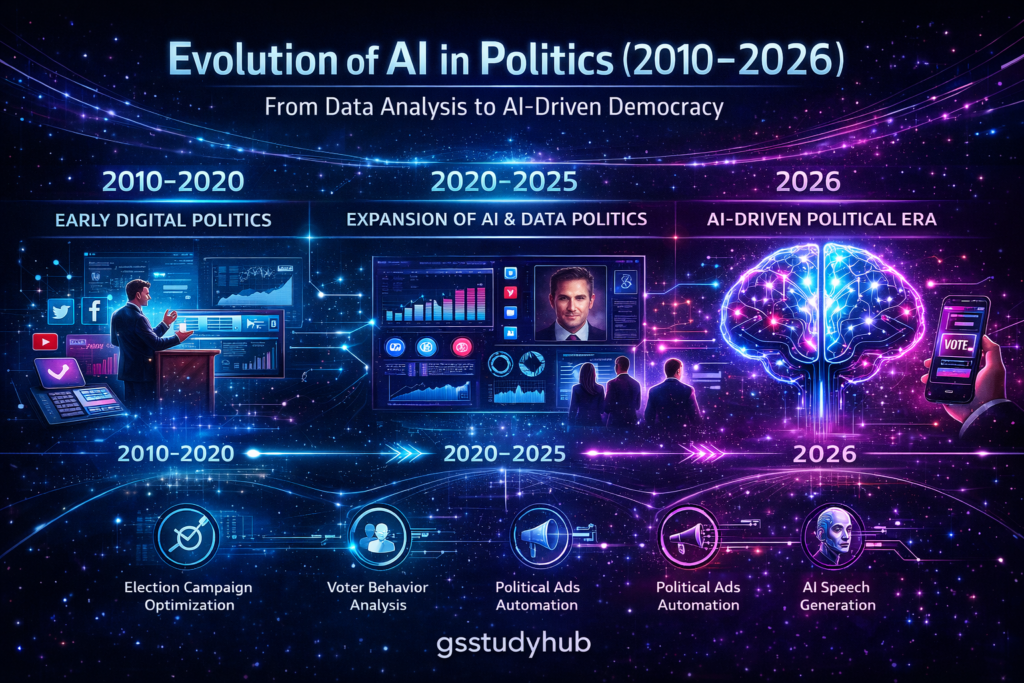
History and Evolution of AI in Politics 2026
To understand AI in Politics 2026, it is important to explore its history and evolution. The use of Artificial Intelligence in politics did not emerge overnight; it is the result of years of technological advancement and digital transformation. Over time, the growth of data, the internet, and machine learning has significantly reshaped political systems.
Today, AI in Politics 2026 has reached a stage where election strategies, policy decisions, and public opinion formation are all influenced by AI technologies. This transformation has occurred in different phases, each contributing to the current AI-driven political landscape.
2010–2020: The Early Phase
Between 2010 and 2020, the use of AI in politics was in its early stage. During this period, data analysis and digital campaigning began to gain importance. Political parties started using social media platforms to connect with voters and expand their outreach.
Although AI was not fully developed at that time, the foundation of machine learning and large-scale data collection was established. AI in Politics 2026 can trace its roots back to this phase, when political organizations first began using data to influence election strategies.
2020–2025: Expansion of Digital Politics
From 2020 to 2025, digital technologies rapidly expanded in the political sphere. AI tools became more advanced, allowing political parties to analyze voter behavior in greater detail. This period marked a significant shift toward data-driven political decision-making.
The combination of social media, big data, and AI algorithms transformed election campaigns. Political messages became more personalized, reaching individuals based on their interests and preferences. This phase laid a strong foundation for AI in Politics 2026.
2026: The Era of AI-Driven Politics
By 2026, politics has become fully AI-driven. AI is now used in election strategy planning, political advertising, public opinion analysis, and even speech generation. Advanced AI systems can predict which issues will influence voters and what strategies will be most effective.
AI in Politics 2026 has made political systems more data-driven, faster, and more precise. However, it also brings new challenges such as data privacy concerns, algorithmic bias, and the spread of misinformation. Therefore, balancing innovation with ethical regulation is essential in this new era.
Main Uses of AI in Politics 2026
AI in Politics 2026 has transformed many key areas of modern political systems. Today, Artificial Intelligence is being used in everything from election strategies to voter analysis and campaign management. This has made political processes faster, more accurate, and highly efficient.
Political parties and governments are leveraging AI to analyze large volumes of data and make better decisions. One of the biggest advantages of AI in Politics 2026 is its ability to simplify complex information and turn it into actionable strategies.
Election Campaign Optimization
AI is widely used to optimize election campaigns by making them more targeted and effective. It analyzes which issues matter most in specific regions and what type of messaging will influence voters the most.
AI tools continuously monitor campaign performance and suggest real-time improvements. This allows political teams to adjust their strategies quickly and efficiently. AI in Politics 2026 has made campaigning more intelligent and data-driven.
Voter Behavior Analysis
One of the most important uses of AI is analyzing voter behavior. AI helps understand people's preferences, opinions, and voting patterns in detail.
By processing large datasets, AI systems can predict how different groups of voters will respond to specific issues. This enables political parties to craft more precise and impactful messages. AI in Politics 2026 has made voter analysis a key strategic advantage.
Political Advertising Automation
AI is also used to automate political advertising. It determines which type of advertisement should be shown to which audience, making campaigns more efficient and targeted.
AI tracks the performance of ads and adjusts strategies accordingly, saving both time and resources. AI in Politics 2026 has significantly improved the effectiveness of digital political advertising.
Speech & Content Generation
AI is now being used to generate political speeches and content. It analyzes trends, data, and public sentiment to create messages that resonate with audiences.
AI tools help leaders craft speeches that connect with public concerns and emotions. This makes communication more relevant and impactful. AI in Politics 2026 has elevated political communication to a new level.
AI and Election Campaigns
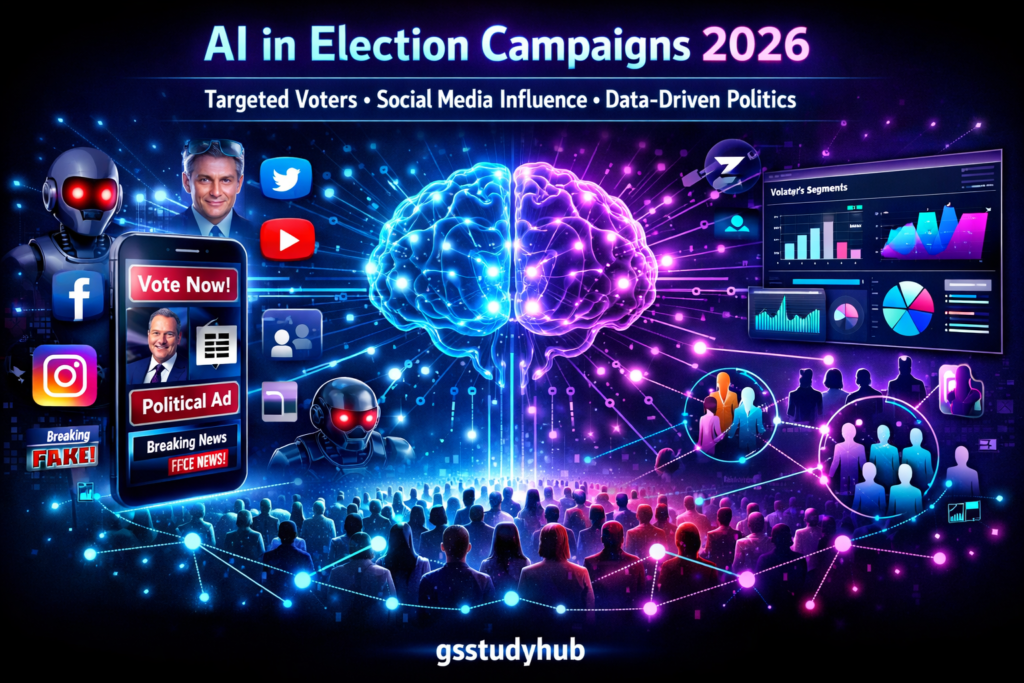
AI in Politics 2026 has completely transformed the way election campaigns are designed and executed. Earlier, political campaigns were broad and generalized, but now AI enables highly targeted and data-driven strategies. By analyzing large volumes of voter data, Artificial Intelligence helps political parties understand what type of message will resonate with specific groups of voters.
Today, political teams use AI tools to adjust their strategies in real time, making campaigns more precise and result-oriented. AI in Politics 2026 has made election campaigning smarter, faster, and more efficient than ever before.
How Targeted Campaigns Work
Targeted campaigns are one of the most powerful applications of AI in modern politics. AI analyzes voter data such as age, location, interests, and behavior to segment audiences into different groups. Based on this analysis, customized messages are created for each group.
AI determines which issues are most important in specific regions and tailors campaign content accordingly. This increases the effectiveness of political messaging and improves voter engagement. In AI in Politics 2026, targeted campaigning has become a key strategy for success.
Impact of AI on Social Media
AI has significantly influenced how political content is distributed on social media platforms. Algorithms decide what type of content is shown to each user, making political communication more personalized and impactful.
By tracking user behavior, AI systems identify which posts, videos, or ads perform best. Campaigns are then optimized based on these insights. AI in Politics 2026 has turned social media into one of the most powerful tools for political outreach.
Micro-Targeting Strategies
Micro-targeting is an advanced strategy where campaigns focus on very specific groups or even individual voters. AI makes this possible by analyzing detailed behavioral and demographic data.
Through micro-targeting, personalized messages are delivered to each voter based on their interests and concerns. This increases the chances of influencing voter decisions. In AI in Politics 2026, micro-targeting has emerged as one of the most effective and influential campaign strategies.
AI in Politics 2026 and Social Media
In AI in Politics 2026, social media plays a crucial role in shaping political communication and public opinion. Platforms like Facebook, X (formerly Twitter), and YouTube have become powerful tools for political campaigns. Artificial Intelligence is used to control, analyze, and distribute content across these platforms.
Political parties and governments use AI to understand what type of content will influence different audiences. This makes campaigns more targeted and effective. AI in Politics 2026 has turned social media into a powerful yet complex tool in modern democracy.
Use of AI on Facebook, X, and YouTube
Platforms such as Facebook, X, and YouTube use AI algorithms to decide which content is shown to each user. These systems analyze user behavior, interests, and activity to deliver personalized content.
Political campaigns leverage these AI systems to deliver targeted advertisements and messages to specific audiences. This significantly increases the impact of political communication. AI in Politics 2026 has made social media platforms central to election strategies.
Algorithm-Driven Politics
In modern politics, algorithms play an increasingly important role. AI algorithms determine which political content, news, and viewpoints are shown to users, influencing public opinion.
Algorithm-driven politics can create an "echo chamber" effect, where people are exposed only to information that aligns with their existing beliefs. This limits diverse perspectives and can shape political attitudes in a controlled way. AI in Politics 2026 has made this a significant challenge.
Digital Influence and Manipulation
AI has also increased the potential for digital influence and manipulation in politics. Political actors can use AI to influence public emotions and opinions more effectively than ever before.
The spread of fake news, the use of bots, and deepfake technology have made it easier to manipulate information. These practices can negatively impact democratic systems. In AI in Politics 2026, managing digital manipulation has become a critical issue that requires strong regulation and awareness.
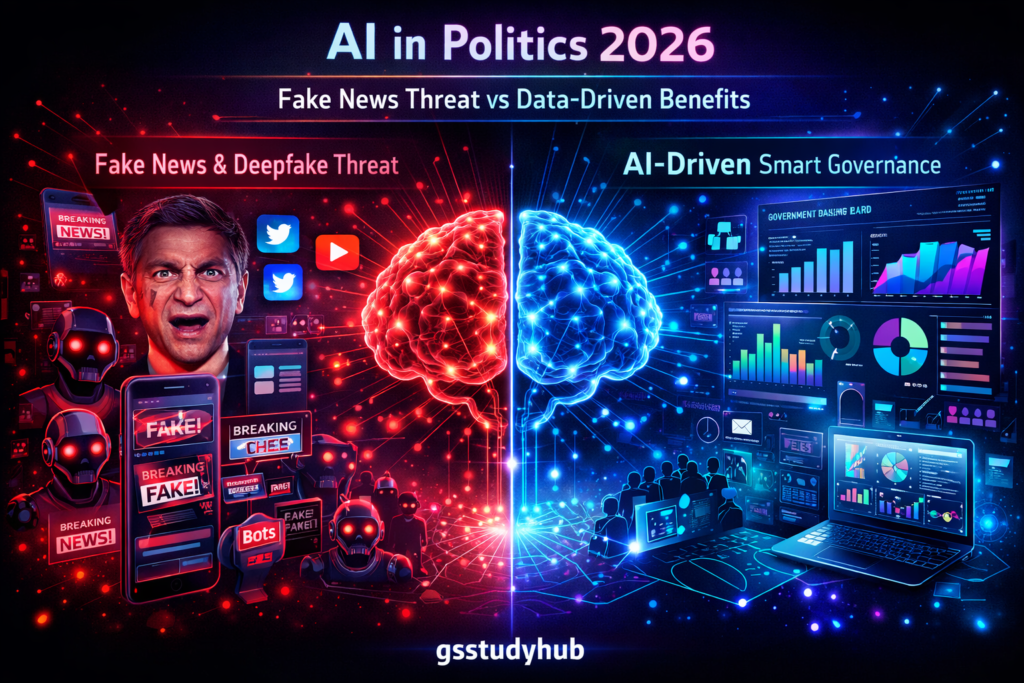
AI and the Threat of Fake News
With the rapid growth of AI in Politics 2026, the threat of fake news has also increased significantly. While Artificial Intelligence has made political systems more efficient and data-driven, it has also made it easier to create and spread misleading information. Today, false or manipulated content can go viral within minutes across digital platforms.
Fake news is often used to influence public opinion, mislead voters, and gain political advantage. In AI in Politics 2026, this has become a serious challenge that cannot be ignored.
What is Deepfake Technology?
Deepfake technology uses AI to create highly realistic fake videos or audio clips of individuals. These videos can make it appear as if a person is saying or doing something they never actually did.
In politics, deepfakes can be used to spread false statements by leaders or manipulate public perception. In AI in Politics 2026, deepfake technology has emerged as a major risk to truthful communication.
How Fake News Spreads
Fake news spreads mainly through social media platforms. AI algorithms prioritize content that generates high engagement, which can unintentionally amplify misleading or sensational information.
Bots and automated accounts also play a major role in spreading fake news. These accounts repeatedly share the same content, making it appear more credible and trending. In AI in Politics 2026, this process has become faster and more powerful.
Impact on Democracy
Fake news and deepfake technology can have serious consequences for democracy. They can weaken public trust and lead people to make decisions based on false information.
If voters rely on misinformation instead of facts, election outcomes can be affected. In AI in Politics 2026, this challenge poses a significant threat to transparency and the integrity of democratic systems. Addressing this issue and raising public awareness is essential.
Benefits of AI in Politics 2026
AI in Politics 2026 has made political systems more modern, efficient, and data-driven. With the help of Artificial Intelligence, political decision-making has become faster and more accurate than ever before. This technology plays a crucial role in understanding complex issues and providing effective solutions.
Political parties and governments are now using AI to better understand public needs, opinions, and challenges. This allows them to design more effective policies and strategies. AI in Politics 2026 is also contributing to strengthening democratic systems.
Improved Decision-Making
One of the biggest advantages of AI is its ability to analyze large amounts of data quickly. This provides leaders and policymakers with accurate insights, enabling them to make better decisions.
AI can also predict possible outcomes, reducing the chances of poor decision-making. In AI in Politics 2026, this capability has become extremely valuable.
Data-Driven Strategy
AI enables political strategies to be fully data-driven. It analyzes voter behavior, preferences, and trends to help create more effective campaign strategies.
This makes election campaigns more targeted and impactful. AI in Politics 2026 has replaced traditional methods with smarter and more precise approaches.
Improved Transparency
AI also helps improve transparency in governance. Through accurate data analysis and monitoring, it becomes easier to reduce corruption and avoid inefficient decisions.
AI systems make government processes more accountable and transparent, increasing public trust. In AI in Politics 2026, transparency plays a key role in strengthening democracy.
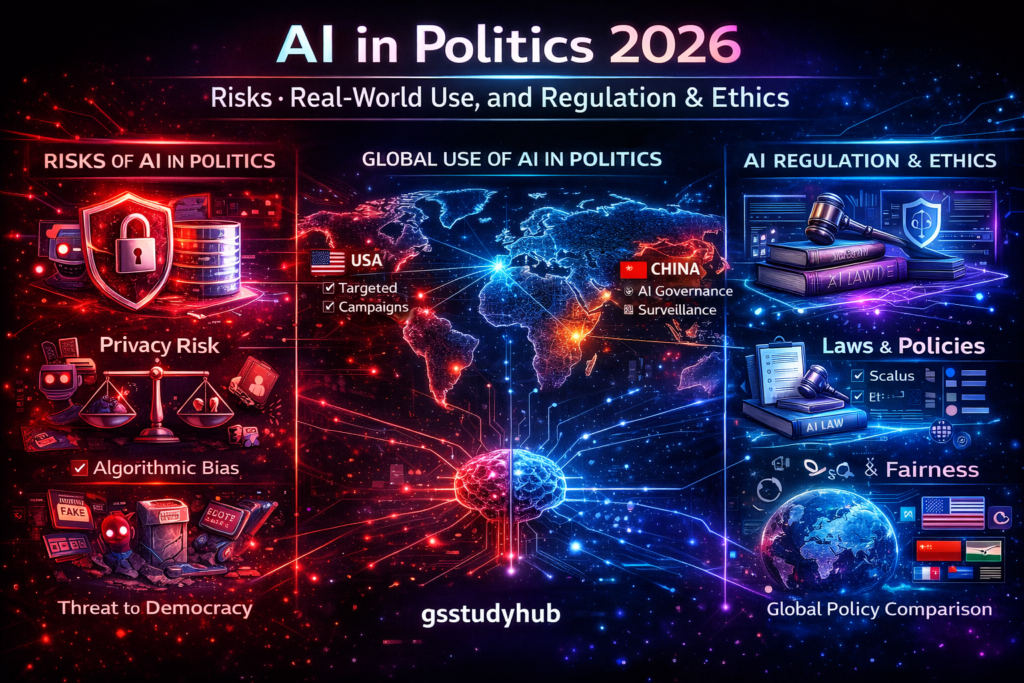
Disadvantages of AI in Politics 2026
While AI in Politics 2026 offers many benefits, it also comes with serious risks that cannot be ignored. The misuse of Artificial Intelligence can pose significant threats to political systems and democratic values. Key concerns include data misuse, algorithmic bias, and risks to individual privacy.
If AI is used without proper regulation and ethical guidelines, it can create misinformation, inequality, and manipulation. Understanding the negative aspects of AI in Politics 2026 is just as important as recognizing its advantages.
Privacy Risk
The use of AI involves collecting large amounts of personal data, including user behavior, preferences, and online activity. If this data is not properly protected, it can be misused.
Political organizations may use this data to influence voters, raising serious concerns about privacy and data security. In AI in Politics 2026, data privacy has become a major issue.
Bias and Algorithmic Control
AI algorithms are not always neutral. They are trained on existing data, which may contain biases. As a result, AI systems can produce biased outcomes.
Algorithmic control can also limit the diversity of information people see, exposing them only to content that aligns with certain viewpoints. In AI in Politics 2026, this can disrupt democratic balance and fairness.
Threat to Democracy
The misuse of AI can pose a serious threat to democracy. Through fake news, deepfakes, and data manipulation, public opinion can be influenced in misleading ways.
If voters make decisions based on false or manipulated information, election outcomes may be affected. In AI in Politics 2026, this represents a critical challenge that requires strong regulation and public awareness.
Real-World Examples of AI in Politics 2026
AI in Politics 2026 is not just a theoretical concept—it is already being applied in real-world political systems across different countries. Governments and political organizations are using Artificial Intelligence to improve election strategies, analyze public opinion, and enhance governance. These examples highlight how AI is actively transforming modern politics.
Different countries are adopting AI based on their political structures and needs. These real-world cases of AI in Politics 2026 help us understand both its impact and its future potential.
Stay updated with the most recent national and international developments. Read now → Current Affairs – 26 March 2026
USA Elections
In the United States, the use of AI in election campaigns has grown rapidly. Political parties use AI to analyze voter behavior, preferences, and trends. This enables highly effective targeted campaigning and micro-targeting strategies.
AI is also used on social media and digital platforms to deliver personalized advertisements and messages to specific voter groups. In AI in Politics 2026, the USA stands as a leading example of how technology can influence electoral processes.
India Elections
In India, the use of AI in politics is expanding quickly. Political parties are using AI to analyze large-scale voter data and understand public preferences more effectively.
Through social media campaigns, digital outreach, and data analytics, election strategies are becoming more advanced and targeted. AI in Politics 2026 in India demonstrates a unique blend of technology and democratic participation.
China and the AI Governance Model
In China, AI is not limited to elections but is widely used in governance. The government uses AI for monitoring public activity, analyzing data, and implementing policies more efficiently.
China’s AI governance model represents a different approach, where technology is used for control and efficiency at a large scale. In AI in Politics 2026, this model has become a major topic of global discussion.
AI Regulation and Government Policies
With the growing impact of AI in Politics 2026, one of the biggest challenges for governments and global organizations is how to regulate this powerful technology. Establishing clear rules and policies is essential to prevent misuse and ensure that AI is used responsibly within democratic systems.
Different countries have introduced various laws and frameworks to control the use of AI in political and governance processes. In AI in Politics 2026, regulation has become increasingly important because AI directly influences elections, public opinion, and policy decisions.
AI Laws and Regulations
Many countries have developed specific laws and regulations for AI usage. These laws focus on ensuring data protection, privacy, and transparency. Governments aim to ensure that AI systems are used in an ethical and accountable manner.
Guidelines are also being created to maintain fairness in election processes and political activities. In AI in Politics 2026, strong legal frameworks are essential to maintain trust and integrity in democratic systems.
Ethical Concerns
The use of AI raises several ethical concerns, including data privacy, algorithmic fairness, and transparency. These issues are critical because AI systems can influence decisions that affect millions of people.
If not properly managed, AI can increase inequality, bias, and discrimination. In AI in Politics 2026, addressing ethical concerns is crucial to ensure that technology benefits society as a whole.
Global Policies Comparison
AI policies vary significantly across different countries. Some nations enforce strict regulations, while others adopt a more flexible approach to encourage innovation.
This variation highlights that there is no single global model for AI regulation. In AI in Politics 2026, there is a growing need for balanced and coordinated international policies to ensure responsible use of AI worldwide.
AI in Politics 2026: Future Trends
AI in Politics 2026 is not just shaping the present—it is defining the future of political systems. As Artificial Intelligence continues to evolve, politics will become increasingly data-driven, automated, and technology-focused. These changes will deeply influence elections, governance, and citizen participation.
In the coming years, AI will move beyond supporting roles and become a core part of decision-making, policy development, and democratic processes. AI in Politics 2026 is laying the foundation for this transformation.
AI-Driven Elections
In the future, elections may become fully AI-driven. AI systems can analyze voter behavior and predict which issues will have the greatest impact on election outcomes. This allows political parties to design highly effective strategies.
Campaigns will become more automated and data-focused, potentially improving both efficiency and transparency. In AI in Politics 2026, this trend is already gaining momentum.
Smart Governance
AI has the potential to make governance smarter and more efficient. It can help governments analyze large datasets, improve decision-making, and implement policies more effectively.
Through smart governance, governments can better understand citizen needs and deliver faster, more responsive public services. AI in Politics 2026 highlights this as a key future development.
Digital Democracy
The growth of AI is also driving the expansion of digital democracy. Citizens can participate more directly in political processes through online platforms and digital tools.
AI helps analyze public opinion and incorporate it into policymaking. In AI in Politics 2026, digital democracy has the potential to make political systems more inclusive, transparent, and participatory.
Will AI Strengthen Democracy?
In the context of AI in Politics 2026, an important question arises: will Artificial Intelligence strengthen democracy or weaken it? AI can be seen as a double-edged sword, and its impact depends on how it is used.
If AI is applied responsibly and ethically, it has the potential to make democratic systems more transparent, efficient, and inclusive. However, if misused, it can pose serious risks to democratic values and institutions.
Positive Scenario
In a positive scenario, AI can significantly strengthen democracy. It enables governments to make better decisions based on data and helps them understand the needs and concerns of citizens more accurately.
AI can improve transparency, reduce corruption, and make policies more effective. In AI in Politics 2026, there is strong potential for creating a more participatory and accountable democratic system.
Negative Scenario
In a negative scenario, AI can be misused in ways that weaken democracy. Tools like fake news, deepfakes, and data manipulation can influence public opinion in misleading ways.
If AI algorithms are biased or promote a single perspective, they can distort democratic balance and limit fair access to information. In AI in Politics 2026, these risks are real and must be carefully managed.
Conclusion: Final Analysis of AI in Politics 2026
AI in Politics 2026 clearly shows that Artificial Intelligence is no longer just a technological innovation—it has become an integral part of modern political systems. This technology is transforming election strategies, public opinion analysis, and governance processes.
With the help of AI, politics has become more data-driven, efficient, and responsive. Governments can make better decisions and understand citizen needs more effectively. AI in Politics 2026 also has the potential to make democracy more transparent and participatory.
Stay updated with the most recent national and international developments. Read now → Daily Current Affairs – 25 March 2026
However, this transformation also brings serious challenges such as data privacy concerns, fake news, deepfake technology, and algorithmic bias. If these issues are not properly managed, they could pose significant risks to democratic systems.
Therefore, it is essential to use AI in a balanced, ethical, and responsible manner. The future of AI in Politics 2026 depends on how this technology is guided—whether it is used for positive development or for control and manipulation.
Ultimately, AI is a powerful tool that can either strengthen or weaken democracy. With proper regulations, awareness, and ethical practices, it has the potential to create a more transparent, efficient, and inclusive political future.
FAQs (Frequently Asked Questions)
What is AI in Politics 2026?
AI in Politics 2026 refers to the use of Artificial Intelligence in political processes such as data analysis, election strategy, voter behavior analysis, and digital campaigning. It helps make politics more data-driven and efficient.
Does AI influence elections?
Yes, AI can significantly influence elections. It analyzes voter behavior and enables targeted campaigns, which can impact voter decisions and election outcomes.
What are the risks of AI in politics?
The major risks of AI include data privacy issues, the spread of fake news, misuse of deepfake technology, and algorithmic bias. If not properly regulated, these risks can harm democratic systems.
What will be the future role of AI in politics?
In the future, AI will play a major role in elections, policymaking, and governance. It will make political systems smarter, faster, and more transparent. AI in Politics 2026 is laying the foundation for this transformation.
References
- Research papers and articles on Artificial Intelligence and politics
- Government policies and official documents related to AI
- Studies on digital media and election strategies
- Reports published by international organizations on AI and democracy
- Information collected from trusted news websites and credible online sources
This article is based on various reliable sources, research studies, and analysis of current trends. The topic of AI in Politics 2026 has been explained in a clear and simplified manner for better understanding.