
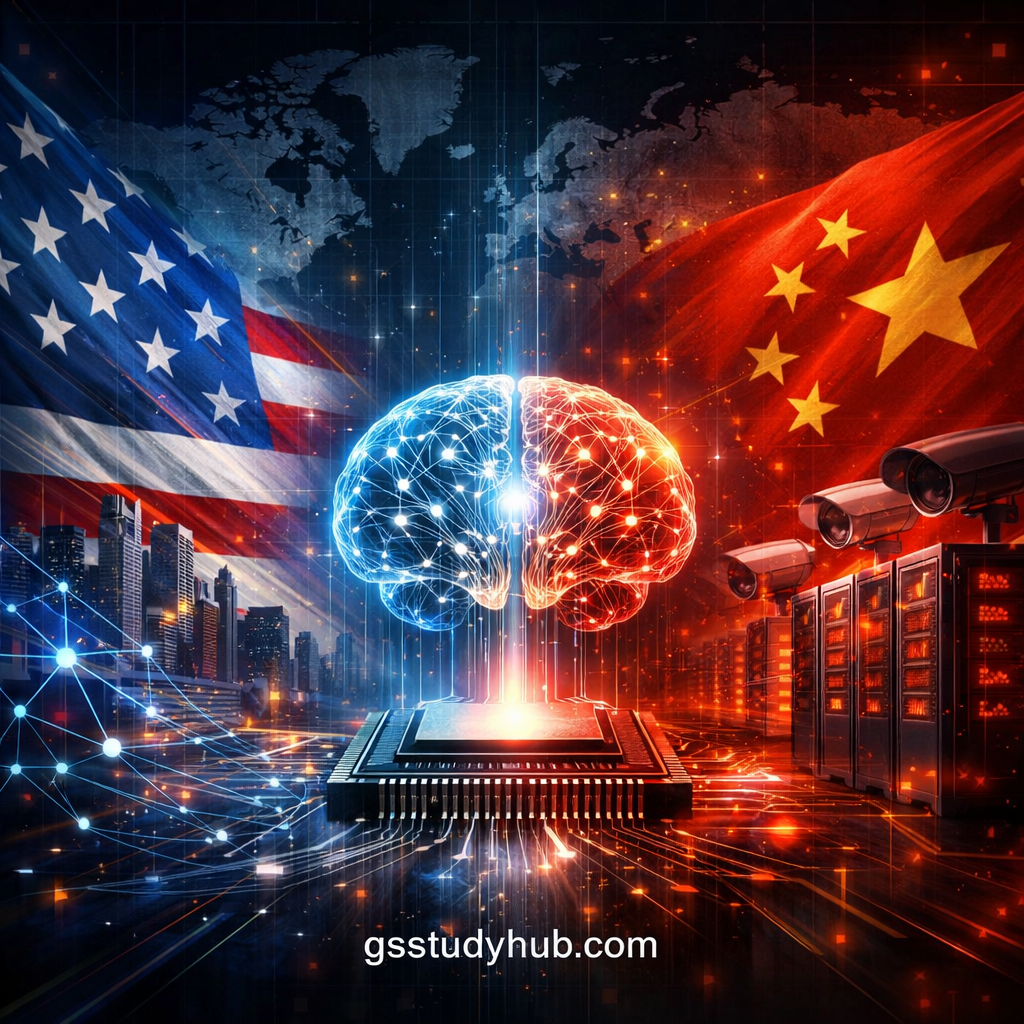
Introduction: Why the AI Arms Race Matters Today
The AI Arms Race US-China Tech War and Global Power Shift has emerged as the defining geopolitical struggle of the 21st century. This is not merely a competition over technology; it is a contest over global dominance, military superiority, economic influence, and digital sovereignty. As artificial intelligence becomes central to national strategy, the rivalry between the United States and China is reshaping the foundations of global power.
Artificial intelligence now drives defense systems, cybersecurity infrastructure, financial markets, surveillance networks, and advanced manufacturing. The AI Arms Race US-China Tech War and Global Power Shift therefore represents a structural transformation in how nations compete and project influence. Understanding this shift is essential to understanding the future world order.
From Cold War to Code War
The Cold War of the 20th century revolved around nuclear weapons, ideological rivalry, and military alliances. In contrast, today’s strategic competition can be described as a “Code War.” Instead of stockpiling missiles, nations are investing in algorithms, data supremacy, supercomputing power, and semiconductor innovation.
Power is no longer measured solely by the number of warheads a country possesses. It is increasingly defined by AI capabilities, access to high-performance chips, control over data flows, and technological ecosystems. This transformation makes the AI Arms Race US-China Tech War and Global Power Shift fundamentally different from previous geopolitical confrontations — and potentially more disruptive.
Historical Roots of the US-China Tech War
The US-China tech war did not emerge overnight. Its roots can be traced back to the early 2000s, when China began transitioning from a low-cost manufacturing hub to a technology-driven economy. At the same time, the United States had already established itself as the global leader in innovation, digital infrastructure, and advanced research.
As technologies such as artificial intelligence, semiconductors, 5G networks, and quantum computing became central to national power, competition intensified. What initially appeared to be economic rivalry gradually evolved into a strategic confrontation. This transformation laid the foundation for what is now widely recognized as the AI Arms Race US-China Tech War and Global Power Shift.
China’s Rise in Artificial Intelligence
Over the past decade, China has made remarkable progress in artificial intelligence. Its vast population, large-scale digital platforms, and extensive data collection capabilities created a powerful ecosystem for AI development. Chinese technology firms rapidly advanced in facial recognition, fintech innovation, smart surveillance systems, and AI-driven e-commerce platforms.
Strong state support, long-term policy planning, and substantial investment in research and development accelerated this growth. China viewed artificial intelligence not only as an economic opportunity but also as a strategic instrument of national security and geopolitical influence. As a result, AI integration expanded across both civilian industries and military modernization programs.
Made in China 2025 Strategy
The “Made in China 2025” initiative marked a turning point in China’s industrial strategy. Designed to reduce dependence on foreign technology, the policy prioritized high-tech sectors such as robotics, aerospace, semiconductors, and artificial intelligence.
A key objective of the strategy was to strengthen domestic innovation and move China up the global value chain. Semiconductor self-sufficiency became particularly critical, as advanced chips are the backbone of AI systems and high-performance computing.
Through targeted subsidies, state-backed investment funds, and coordinated industrial planning, China signaled its ambition to compete directly with Western technological dominance. This strategic shift significantly intensified tensions with the United States and deepened the structural rivalry shaping the AI Arms Race US-China Tech War and Global Power Shift.
America’s Technological Dominance and Response
For decades, the United States has maintained technological leadership through its innovation ecosystem, world-class universities, venture capital networks, and private-sector dynamism. Silicon Valley became synonymous with digital transformation, and American firms led breakthroughs in artificial intelligence, cloud computing, and semiconductor design.
However, as China’s capabilities expanded rapidly, Washington increasingly viewed Beijing’s rise as a direct strategic challenge. In response, the United States implemented export controls on advanced semiconductor technologies, restricted Chinese access to high-performance chips, and strengthened alliances with key partners in Asia and Europe.
These measures were not merely economic tools but components of a broader national security strategy. Within the framework of the AI Arms Race US-China Tech War and Global Power Shift, the United States aims to preserve its technological edge while preventing strategic technologies from enhancing China’s military and geopolitical influence.

Semiconductor War: The Hidden Battlefield
Semiconductors are the backbone of the modern digital economy and the foundation of advanced artificial intelligence systems. In the context of the AI Arms Race US-China Tech War and Global Power Shift, control over semiconductor design, manufacturing, and supply chains has become a decisive strategic advantage. AI models, supercomputers, autonomous weapons, cybersecurity systems, and advanced communications networks all depend on high-performance chips.
Unlike visible military assets such as aircraft carriers or missile systems, semiconductors represent a silent yet critical dimension of power. The nation that dominates advanced chip production holds leverage over technological innovation, defense modernization, and economic competitiveness. For this reason, semiconductor supremacy has emerged as the true hidden battlefield of the AI Arms Race US-China Tech War and Global Power Shift.
The global semiconductor ecosystem is deeply interconnected. Chip design is often led by American firms, fabrication is concentrated in Taiwan and South Korea, and essential raw materials and equipment are sourced from multiple countries. This complex interdependence makes the tech war not only strategic but also highly fragile.
Chip Sanctions and Supply Chain Disruption
In response to China’s rapid technological rise, the United States imposed export controls on advanced semiconductor technologies and chip-making equipment. These restrictions aim to limit China’s access to high-performance processors used in artificial intelligence training, military systems, and supercomputing applications.
The impact of these measures has extended far beyond bilateral trade tensions. Global supply chains have been disrupted as companies reassess risk exposure and diversify production locations. Nations are increasingly investing in domestic semiconductor manufacturing to reduce strategic vulnerabilities.
Within the broader framework of the AI Arms Race US-China Tech War and Global Power Shift, semiconductor restrictions function as instruments of strategic containment. Rather than direct military confrontation, technological denial has become a tool of geopolitical influence.
As a result, the semiconductor war demonstrates how economic policy, industrial strategy, and national security have become inseparably linked in the evolving global power structure.
AI in Military Strategy and Defense
Artificial intelligence is no longer confined to commercial innovation or civilian applications. It has become a central pillar of modern military strategy. Within the broader context of the AI Arms Race US-China Tech War and Global Power Shift, AI integration into defense systems is redefining how power is projected and conflicts are conducted.
AI-driven technologies are now embedded in drone operations, missile defense systems, battlefield intelligence analysis, logistics optimization, and real-time decision support platforms. These systems enhance speed, precision, and predictive capability, fundamentally transforming the character of warfare.
For both the United States and China, AI-enabled military modernization is not optional — it is strategic necessity. The ability to process vast volumes of data faster than an adversary can determine superiority in future conflicts.
Autonomous Weapons and Ethical Dilemmas
Autonomous Weapons Systems (AWS) represent one of the most controversial dimensions of AI integration in defense. These systems are capable of identifying, tracking, and engaging targets with minimal or no direct human intervention. Machine learning algorithms and computer vision technologies allow such systems to operate at speeds beyond human reaction time.
While autonomous weapons may offer operational advantages, they also introduce profound ethical and legal concerns. Questions of accountability remain unresolved: if an AI system makes a lethal mistake, who bears responsibility — the programmer, the military commander, or the state?
In the evolving landscape of the AI Arms Race US-China Tech War and Global Power Shift, the rapid development of autonomous weapons risks outpacing international norms and regulatory frameworks. Without coordinated global governance, technological acceleration could generate instability rather than security.
Cyber Warfare and AI Surveillance
AI has significantly expanded the scope and sophistication of cyber warfare. Advanced algorithms can identify system vulnerabilities, automate intrusion attempts, detect threats in real time, and generate adaptive responses. This increases both offensive and defensive cyber capabilities.
At the same time, AI-powered surveillance systems enable large-scale data analysis, facial recognition, behavioral monitoring, and predictive analytics. Governments can leverage these tools to enhance national security, but they also raise serious concerns regarding privacy, civil liberties, and digital control.
As a result, the military application of AI extends beyond traditional battlefields. It encompasses cyberspace, information warfare, and domestic security infrastructures. Within the broader AI Arms Race US-China Tech War and Global Power Shift, the fusion of AI with defense strategy marks a structural transformation in global security dynamics.
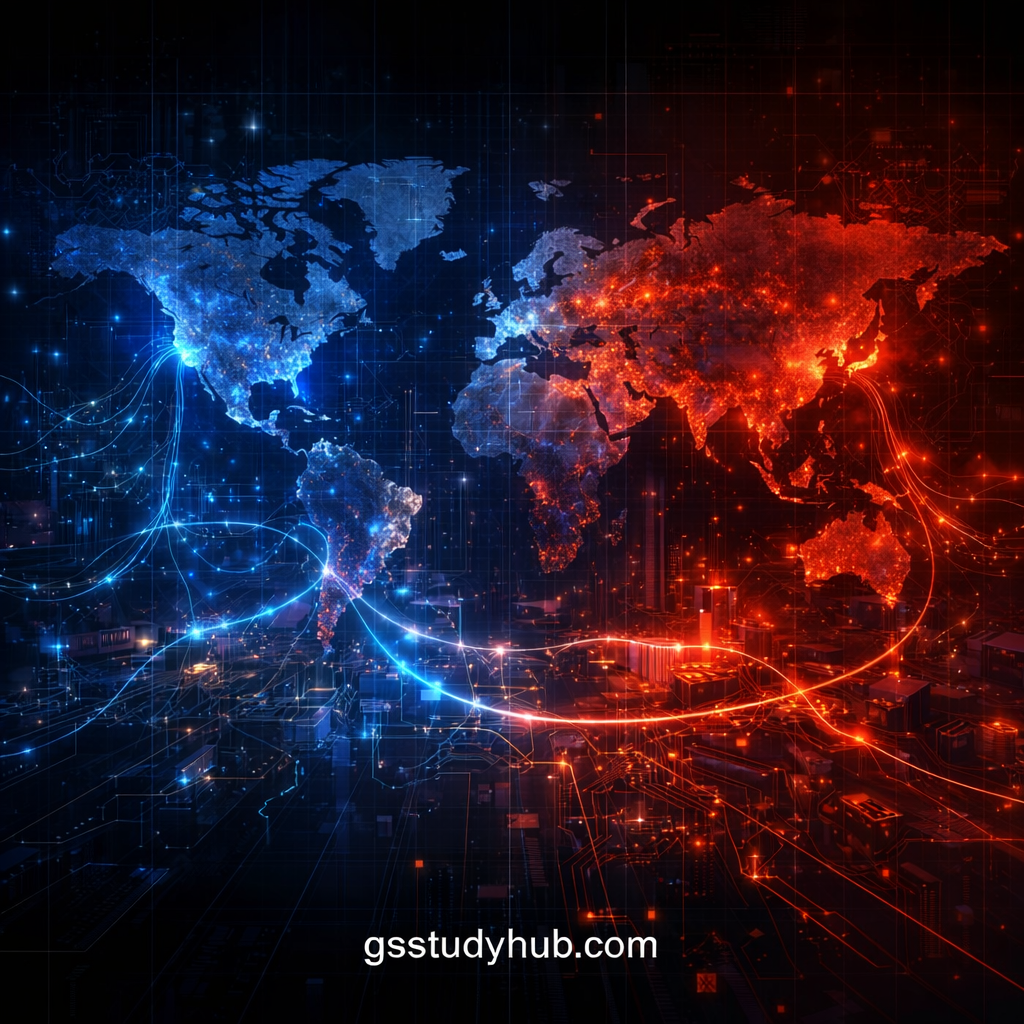
Economic Impact of the AI Arms Race
The AI Arms Race US-China Tech War and Global Power Shift is not limited to technological rivalry or military modernization. It is fundamentally reshaping the global economic order. Artificial intelligence, advanced semiconductors, cloud infrastructure, and data ecosystems have become strategic economic assets that determine competitiveness in the digital age.
Technological leadership now directly translates into economic leverage. Nations that dominate AI innovation and chip manufacturing gain influence over supply chains, financial systems, digital platforms, and emerging industries. As a result, economic policy is increasingly intertwined with national security strategy.
This transformation has accelerated state-led industrial policies, investment screening mechanisms, and strategic subsidies aimed at strengthening domestic technological capacity. The economic dimension of the AI Arms Race US-China Tech War and Global Power Shift is therefore as consequential as its military implications.
Global Trade Realignment
Export controls, technology bans, and strategic restrictions between the United States and China have triggered a significant realignment of global trade networks. Companies are reassessing supply chain dependencies and seeking diversification to reduce geopolitical risk exposure.
Critical sectors such as semiconductor fabrication, rare earth processing, battery technology, and advanced manufacturing are being restructured. Concepts like “friend-shoring” and “re-shoring” have gained prominence, as countries prioritize trade relationships with politically aligned partners.
Within the broader AI Arms Race US-China Tech War and Global Power Shift, this realignment signals a shift away from hyper-globalization toward strategically managed interdependence. The fragmentation of technological ecosystems may result in parallel innovation systems operating under different regulatory and political frameworks.
Impact on Developing Nations
For developing nations, the AI-driven transformation presents both opportunity and risk. On one hand, supply chain diversification opens space for new manufacturing hubs and foreign investment flows. Countries positioned strategically between major powers may attract technology partnerships and infrastructure development.
On the other hand, automation powered by artificial intelligence threatens labor-intensive industries that many developing economies depend on. If AI adoption accelerates unevenly, the global digital divide may widen, concentrating technological wealth and influence among advanced economies.
Moreover, limited access to high-performance chips and advanced digital infrastructure could constrain technological progress in emerging markets. In this sense, the AI Arms Race US-China Tech War and Global Power Shift has the potential to reshape not only great power competition but also the developmental trajectories of smaller states.
Global Power Shift: Is the World Becoming Bipolar Again?
The AI Arms Race US-China Tech War and Global Power Shift is accelerating a structural transformation in the international system. As artificial intelligence, semiconductor dominance, and digital infrastructure become central pillars of national power, the global order is increasingly shaped by technological capability rather than traditional military metrics alone.
In the post-Cold War era, the world operated under a largely unipolar structure dominated by the United States. However, China’s rapid technological and economic rise has challenged that configuration. Today, strategic influence is measured not only by defense spending, but also by AI innovation, control over data ecosystems, and leadership in advanced chip manufacturing.
Within the framework of the AI Arms Race US-China Tech War and Global Power Shift, emerging technological blocs appear to be forming. One is led by the United States and its network of democratic allies, while the other centers around China’s expanding economic and technological partnerships. Unlike the ideological divide of the Cold War, this competition is rooted in technological standards, digital governance models, and supply chain control.
Alliances: NATO, Quad and Indo-Pacific Strategy
Alliances have become central instruments in managing this evolving power competition. NATO, traditionally a military alliance, has expanded its focus to include cybersecurity, AI defense coordination, and the protection of critical digital infrastructure. Technology resilience is increasingly treated as a component of collective security.
The Quad — comprising the United States, India, Japan, and Australia — has also emphasized secure supply chains, emerging technology cooperation, and Indo-Pacific stability. The Indo-Pacific strategy extends beyond maritime security; it reflects a broader effort to balance technological influence and prevent strategic dependency on a single power.
In the broader context of the AI Arms Race US-China Tech War and Global Power Shift, these alliances are evolving into platforms for technological coordination, regulatory alignment, and strategic containment. Power competition is no longer confined to military deployments; it now includes standards-setting, semiconductor partnerships, and AI governance frameworks.
Whether the world is moving toward a renewed bipolar structure or a more complex multipolar system remains uncertain. What is clear, however, is that technological rivalry has become a defining force in shaping the next phase of global order.
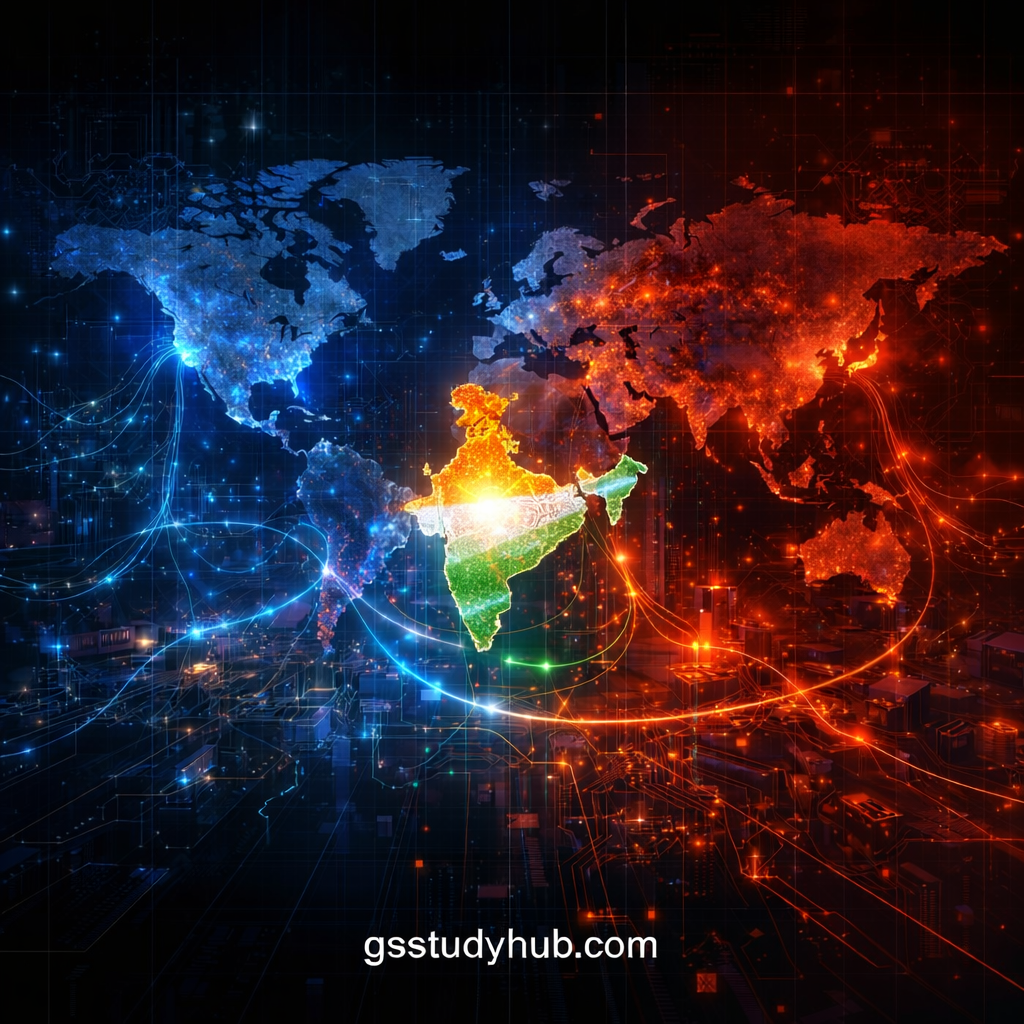
India’s Position in the AI Arms Race
Within the evolving landscape of the AI Arms Race US-China Tech War and Global Power Shift, India occupies a uniquely strategic position. As a rapidly growing digital economy with a strong IT services sector and a vast pool of engineering talent, India has the potential to emerge as a significant AI stakeholder. At the same time, intensifying technological rivalry between major powers creates complex strategic pressures.
India’s expanding digital public infrastructure, growing startup ecosystem, and large data economy provide a strong foundation for AI innovation. Government initiatives promoting digital governance, fintech expansion, and research collaboration further strengthen its technological base.
However, limitations in advanced semiconductor manufacturing, high-performance computing infrastructure, and deep-tech research capacity create vulnerabilities. Dependence on external supply chains for critical components places India within the broader dynamics of the AI Arms Race US-China Tech War and Global Power Shift, where technological autonomy increasingly defines national resilience.
Read more about India–China diplomatic strategy and bilateral relations here.
Opportunity or Strategic Pressure?
The restructuring of global supply chains presents a significant opportunity for India. As companies seek diversification away from concentrated manufacturing hubs, India could attract investment in electronics production, semiconductor assembly, and emerging technology partnerships. “Friend-shoring” strategies by Western economies may further enhance India’s role in trusted supply networks.
At the same time, deepening polarization between the United States and China may generate strategic pressure. India has historically pursued a policy of strategic autonomy, balancing relations with multiple global actors. In a technologically divided world, maintaining that balance may become increasingly challenging.
If India prioritizes sustained investment in AI research, semiconductor capabilities, cybersecurity infrastructure, and innovation-driven industrial policy, it can position itself not merely as a participant but as a shaping force within the AI Arms Race US-China Tech War and Global Power Shift.
Ultimately, India’s trajectory will depend on its ability to combine technological self-reliance with strategic partnerships while preserving policy flexibility in a rapidly transforming global order.
Conclusion: Humanity and the Ethical Future
The AI Arms Race US-China Tech War and Global Power Shift is not merely a contest between two great powers. It represents a transformative moment in human history. Artificial intelligence is reshaping economic systems, military strategy, governance models, and even the nature of individual freedom. The trajectory of this technological rivalry will influence not only geopolitical balances but also the moral foundations of the global order.
The central question is not simply which nation will lead in artificial intelligence, but what values will guide that leadership. If innovation advances without ethical oversight, transparency, and accountability, technological progress may deepen inequality, undermine civil liberties, and intensify global instability.
In the evolving landscape of the AI Arms Race US-China Tech War and Global Power Shift, international cooperation and rule-based governance are becoming increasingly essential. Issues such as autonomous weapons, data privacy, algorithmic bias, and cyber security demand coordinated global frameworks rather than unilateral technological escalation.
A human-centered approach to AI development offers a constructive path forward. By prioritizing ethical research, inclusive digital access, regulatory clarity, and responsible innovation, nations can ensure that artificial intelligence becomes a tool for shared prosperity rather than unchecked dominance.
Ultimately, the outcome of the AI Arms Race US-China Tech War and Global Power Shift will not be determined solely by computational power or semiconductor capacity. It will depend on whether global actors can balance competition with cooperation and power with responsibility. The future of AI will reflect the choices humanity makes today.
📚 Recommended Books on the AI Arms Race & US–China Tech War
To understand the growing AI arms race between the United States and China — including semiconductor geopolitics, military AI, and the global power shift — the following books offer strategic, economic, and technological insights.
These expert-recommended titles examine artificial intelligence competition, chip dominance, national security implications, and the future of global technological power.
| Book | Cover | Focus Area | Rating | Check Price |
|---|---|---|---|---|
| AI Superpowers – Kai-Fu Lee |  | US–China AI Competition & Economic Strategy | 4.3/5 ⭐⭐⭐⭐☆ | Check Price on Amazon |
| Chip War – Chris Miller ⭐ Editor’s Choice |  | Semiconductor Geopolitics & Global Tech Power | 4.7/5 ⭐⭐⭐⭐⭐ | Check Price on Amazon |
| The Kill Chain – Christian Brose |  | Military AI & Defense Modernization | 4.5/5 ⭐⭐⭐⭐⭐ | Check Price on Amazon |
| The New Map – Daniel Yergin |  | Energy Politics & China’s Global Strategy | 4.3/5 ⭐⭐⭐⭐☆ | Check Price on Amazon |
| The Future Is Faster Than You Think – Peter H. Diamandis |  | AI Disruption & Future Global Power Shift | 4.6/5 ⭐⭐⭐⭐⭐ | Check Price on Amazon |
If you want a deep strategic understanding of how semiconductor dominance shapes the US–China tech war and the global AI power balance, Chip War by Chris Miller provides the most comprehensive geopolitical analysis.
Check Price on AmazonFrequently Asked Questions (FAQ)
What is the AI Arms Race US-China Tech War and Global Power Shift?
The AI Arms Race US-China Tech War and Global Power Shift refers to the growing strategic rivalry between the United States and China in artificial intelligence, semiconductor technology, cybersecurity, and digital infrastructure. It represents a broader transformation in global power dynamics driven by technological competition.
Why are semiconductors so important in this rivalry?
Semiconductors are the foundation of advanced AI systems, high-performance computing, military equipment, and digital communication networks. Control over chip design and manufacturing directly influences technological superiority and national security capabilities.
Is this technological rivalry similar to the Cold War?
While there are parallels in terms of strategic competition between major powers, the current rivalry is primarily centered on technology, innovation ecosystems, and economic influence rather than ideological confrontation alone. It is often described as a “technology-driven” strategic competition.
How does the AI Arms Race US-China Tech War and Global Power Shift affect developing countries?
Developing nations may benefit from supply chain diversification and new investment flows. However, rapid AI-driven automation and unequal access to advanced technologies could widen the global digital divide and create economic vulnerabilities.
What role does India play in the AI competition?
India holds strategic importance due to its growing digital economy, strong IT sector, and large talent base. With sustained investment in AI research, semiconductor development, and cybersecurity, India could become a significant actor in the evolving technological landscape.
Can global cooperation reduce the risks of AI escalation?
Yes. International cooperation on AI governance, data protection standards, autonomous weapons regulation, and cybersecurity frameworks could help balance competition with stability. Human-centered AI development is widely viewed as essential for long-term global security.
References
- World Economic Forum – Reports on Artificial Intelligence and the Global Economy
- Brookings Institution – Analysis on US-China Technological Competition
- Center for Strategic and International Studies (CSIS) – Semiconductor Policy and National Security Research
- International Monetary Fund (IMF) – Digital Economy and Global Development Outlook
- OECD – AI Governance Principles and Digital Policy Standards