

Introduction: The Soul of Indian Democracy
Adoption of the Indian Constitution 26 November 1949 was not merely a historical event; it was a defining moment that shaped the destiny of modern India. The history of India is not only a record of kings, wars, and political events, but also a powerful journey of ideas, values, and collective aspirations. On that historic day, India formally adopted its Constitution, laying the foundation for a sovereign, democratic, and republic nation.
When I first read the Preamble of the Constitution, I realized that it is much more than a legal document written in complex language. It is, in fact, the soul of India. The opening words, “We, the People of India,” made me reflect deeply on my own identity as a citizen. They reminded me that power in a democracy does not belong to a few, but to every individual who calls this country home.
Even today, the importance of the Adoption of the Indian Constitution 26 November 1949 continues to guide India’s democratic institutions and public life.The adoption of the Indian Constitution on 26 November 1949 was the result of years of debate, discussion, and dedication by the members of the Constituent Assembly. Their vision was to create a framework that could unite a diverse population while protecting justice, liberty, equality, and fraternity for all.
Through this article, I invite you to walk with me on a journey that moves from history to the present, from facts to lived experiences, and from knowledge to inspiration. By understanding the significance of 26 November 1949, we can better appreciate the strength of Indian democracy and recognize our role in preserving and strengthening it for future generations.
Historical Background of the Indian Constitution
The significance of the Adoption of the Indian Constitution 26 November 1949 cannot be understood without examining the years of preparation that preceded it.The story of the Indian Constitution did not begin in 1947, but evolved gradually through decades of political struggle, reform, and national awakening. The journey that eventually led to the Adoption of the Indian Constitution 26 November 1949 was shaped by years of debate, resistance, and visionary leadership.
Early legislative measures such as the Indian Councils Act of 1909, the Government of India Act of 1919, and most importantly the Government of India Act of 1935 provided Indians with a partial role in governance. Many administrative and federal features of the present Constitution can be traced back to these Acts, though they were later expanded and democratized.
As the freedom movement gained momentum, the demand for complete independence was accompanied by the demand for a Constitution that would reflect the will of the Indian people. Indians wanted not just political freedom, but a system of governance based on justice, equality, and popular sovereignty.
In response to this aspiration, the Constituent Assembly was formed in 1946. It represented a wide range of regions, communities, and ideological perspectives. The Assembly became a platform where the vision of a new India was debated, refined, and shaped through thoughtful discussion.
Over nearly three years, the Constituent Assembly held numerous sessions and committee meetings. Key issues such as fundamental rights, social justice, federal structure, minority protection, and separation of powers were carefully examined. Every provision was debated in depth to ensure that the Constitution would serve both present and future generations.
Throughout this process, there was a shared understanding that the Constitution would be more than a legal document. It would be a moral and philosophical guide for the nation, reflecting the ideals of liberty, equality, justice, and fraternity.
This long and deliberate journey finally culminated in the Adoption of the Indian Constitution on 26 November 1949, when the Constitution of India was formally accepted, marking the birth of a new democratic republic.
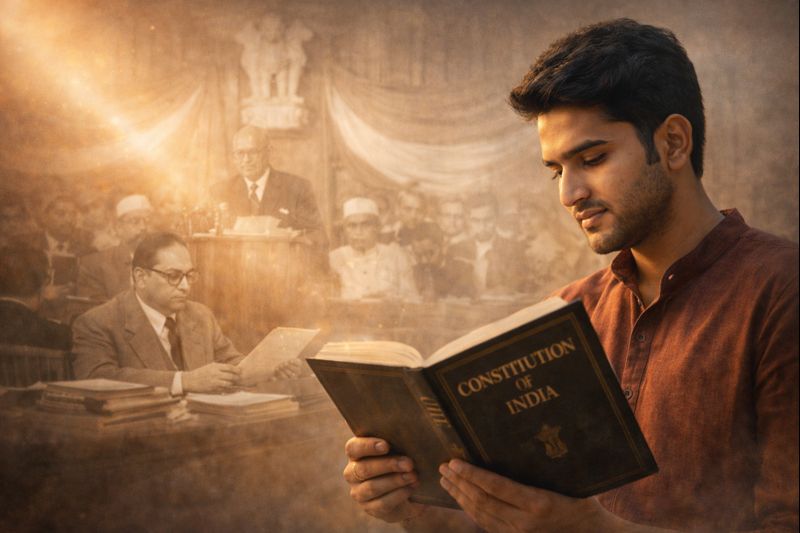
My Personal Journey: Discovering the Constitution as a Citizen
For a long time, the Constitution was just another thick book to me, something I studied only for exams. I memorized articles, definitions, and key terms without truly understanding their deeper meaning. At that stage of my life, I saw the Constitution as a subject, not as a living document that shapes my everyday existence.
Everything began to change when I decided to read the Preamble carefully, not as a student, but as a citizen. The words “We, the People of India” struck me with unexpected force. They made me realize that the Constitution does not belong only to lawmakers or institutions—it belongs to every Indian, including me. In that moment, I felt a new sense of responsibility toward my country.
As I reflected on the Adoption of the Indian Constitution 26 November 1949, I began to understand that this historic moment was not just about legal formalities. It represented the collective hopes and sacrifices of millions who dreamed of a democratic and just India. Realizing this deepened my connection with the values enshrined in the Constitution.
As I started exploring the chapters on Fundamental Rights, I understood that freedom is not merely the absence of restrictions. It is the presence of dignity, equality, and opportunity. The right to speak freely also carries the duty to speak responsibly. The right to protest exists alongside the duty to respect the democratic process.
Reading about Fundamental Duties was a turning point in my journey. I realized that democracy cannot survive on rights alone. If citizens focus only on what they can demand and ignore what they must contribute, the entire system becomes fragile. The Constitution taught me that a true citizen balances freedom with discipline and rights with responsibility.
Another powerful realization was that the Constitution is not a rigid or lifeless document. It evolves through amendments, judicial interpretations, and changing social realities. This flexibility shows the wisdom of its makers, who understood that a nation is always growing and transforming.
Today, when I look back, I see how understanding the significance of 26 November 1949 has shaped my thinking. It has made me more aware, more empathetic, and more conscious of my role in society. I no longer view democracy as something distant or abstract. I see it as a living relationship between the state and its citizens—one in which I am an active participant.
Role of the Constituent Assembly
The Constituent Assembly played a central and historic role in the making of the Indian Constitution. It was not merely a legislative body, but a visionary forum entrusted with the responsibility of shaping the political, social, and moral foundation of a newly independent nation. Formed in 1946, the Assembly began its work at a time when India was preparing to transition from colonial rule to self-governance.
The Assembly was composed of representatives from different provinces, communities, religions, languages, and social backgrounds. This broad and inclusive representation ensured that the Constitution would reflect the diverse realities of Indian society and not the interests of a single group or ideology.
Members of the Constituent Assembly engaged in extensive debates and discussions on every major aspect of governance. Issues such as Fundamental Rights, federal structure, separation of powers, independence of the judiciary, minority protection, and social justice were examined in depth. Many sessions lasted for hours, and every clause was carefully scrutinized before being accepted.
This rigorous process ultimately led to the Adoption of the Indian Constitution 26 November 1949, a historic milestone that marked the successful completion of the Assembly’s monumental task.
To facilitate systematic work, the Assembly established several committees, among which the Drafting Committee was the most significant. Dr. B.R. Ambedkar served as its Chairman and played a decisive role in shaping the final text of the Constitution. Reports and recommendations from various committees were presented to the Assembly and debated thoroughly.
After nearly three years of continuous effort, the Constituent Assembly completed its historic responsibility. The adoption of the Constitution on 26 November 1949 became a symbol of collective wisdom, patience, and dedication to democratic ideals that continue to guide India’s journey today.
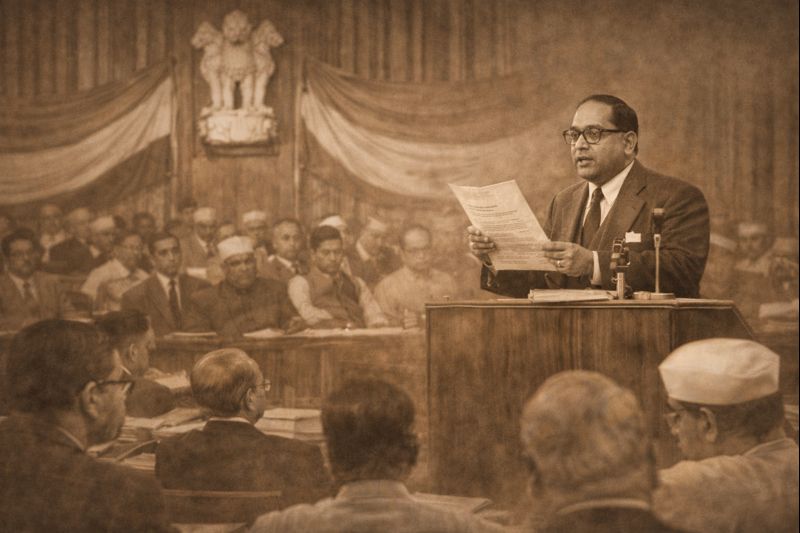
Dr. B.R. Ambedkar’s Contribution
Dr. Bhimrao Ramji Ambedkar occupies a central and historic place in the making of the Indian Constitution. He is widely regarded as the chief architect of the Constitution, not only because he served as the Chairman of the Drafting Committee, but also because of the depth of vision and moral clarity he brought to the entire constitutional process that ultimately led to the Adoption of the Indian Constitution 26 November 1949.
Dr. Ambedkar firmly believed that political freedom would remain incomplete without social and economic justice. For him, independence had little meaning if large sections of society continued to suffer from discrimination and inequality. This conviction guided his efforts to ensure that the Constitution placed strong emphasis on equality, liberty, and human dignity.
One of his most significant contributions was securing a comprehensive set of Fundamental Rights for Indian citizens. These rights guarantee equality before the law, freedom of speech and expression, freedom of religion, and protection against exploitation. Through these provisions, Dr. Ambedkar sought to transform India into a society where every individual could live with self-respect.
Dr. Ambedkar was also deeply committed to the upliftment of historically marginalized communities. His lifelong struggle against untouchability and social exclusion found constitutional expression in provisions aimed at protecting Scheduled Castes, Scheduled Tribes, and other disadvantaged groups. These measures strengthened the democratic spirit that was formally affirmed on 26 November 1949.
In matters of governance, Dr. Ambedkar supported a strong yet balanced federal structure. He advocated a clear division of powers between the Union and the States to maintain national unity while allowing regional autonomy. At the same time, he emphasized the necessity of a powerful and independent judiciary to safeguard constitutional values.
Beyond his role in drafting the Constitution, Dr. Ambedkar left a lasting intellectual legacy. His famous call to “educate, organize, and agitate” continues to inspire generations to work toward social transformation. Today, when we reflect on the significance of the Constitution’s adoption, we can clearly see Dr. Ambedkar’s vision of a just, equal, and democratic India reflected in its principles.
26 November 1949: The Historic Day of Adoption of the Constitution
Adoption of the Indian Constitution 26 November 1949 stands as one of the most unforgettable milestones in the history of India. On this day, the Constitution of India was formally adopted by the Constituent Assembly, marking a decisive step toward establishing the country as a sovereign, democratic republic. It was not merely a legal event, but the culmination of years of struggle, sacrifice, and collective vision.
After nearly three years of continuous debates, discussions, and revisions, the members of the Constituent Assembly approved the final draft of the Constitution. This moment symbolized the successful completion of a historic mission—to provide India with a comprehensive framework for governance based on justice, liberty, equality, and fraternity.
On this occasion, Dr. B.R. Ambedkar addressed the Assembly and highlighted the spirit and purpose of the Constitution. He emphasized that democracy should not be limited to political structures alone, but must become a way of life rooted in social and economic equality.
The adoption of the Constitution also affirmed the principle that ultimate authority rests with the people. The powerful words “We, the People of India” clearly declared that sovereignty belongs to the citizens, and that the government exists to serve them.
Although the Constitution was adopted on 26 November 1949, it came into force on 26 January 1950. This is why 26 January is celebrated as Republic Day in India, while 26 November is observed as Constitution Day to honor the making of the Constitution and to promote constitutional awareness.
The historic significance of 26 November 1949 lies not only in what happened on that day, but also in what it continues to represent. It reminds every generation of Indians that democracy must be nurtured, protected, and strengthened through active and responsible citizenship.

top study essential for competitive exams
⭐⭐⭐⭐☆ 4.4 out of 5 (1,000+ reviews)
- Ideal for UPSC, SSC, Banking & State exams
- Durable and student-friendly design
- Comfortable for long study sessions
- Highly rated by exam aspirants
Relevance of the Constitution in Today’s India
The legacy of the Adoption of the Indian Constitution 26 November 1949 continues to shape modern governance in India.The Indian Constitution is not merely a document of the past; it is a living and dynamic guide that continues to shape the present and future of the nation. The historic Adoption of the Indian Constitution 26 November 1949 laid the foundation for a system that remains relevant even in an era of rapid technological advancement, economic transformation, and social change.
Even today, the importance of the Adoption of the Indian Constitution 26 November 1949 continues to guide India’s democratic institutions and public life.
As India grows as a global power, the Constitution ensures that development is rooted in democratic values. The principle of the rule of law remains the cornerstone of governance, guaranteeing that no individual or institution is above the law.
The Constitution empowers citizens by safeguarding their fundamental rights, such as equality, freedom of expression, and the right to information. At the same time, it reminds citizens that these rights are inseparable from their fundamental duties.
In a society facing challenges like inequality, discrimination, and polarization, the Constitution calls upon us to uphold justice, fraternity, and social harmony. It encourages respect for diversity while reinforcing the idea of national unity.
The constitutional balance between the legislature, executive, and judiciary continues to prevent the concentration of power. This system of checks and balances protects democracy and ensures accountability.
Even decades after 26 November 1949, the spirit behind the adoption of the Constitution continues to inspire responsible citizenship. It reminds us that democracy thrives not only through institutions, but through the daily actions and choices of its people.

Message for Youth, Students, and Citizens
The future of India rests in the hands of its youth. Young people are not only the leaders of tomorrow, but also the builders of today’s nation. The historic Adoption of the Indian Constitution 26 November 1949 reminds us that the responsibility of preserving democracy now lies with every generation. Therefore, understanding the Constitution and living by its values is one of the greatest responsibilities of youth, students, and every citizen.
The Constitution teaches us that true patriotism is not limited to slogans or symbols, but is expressed through honest actions and responsible behavior. Whether you are a student, teacher, farmer, entrepreneur, or employee, your daily conduct contributes to the strength of democracy.
Young citizens must be aware not only of their rights, but also of their duties. Respecting the law, protecting public property, maintaining cleanliness, and showing respect for others’ rights may appear small, but together they create a powerful foundation for national progress.
For students, the study of the Constitution should go beyond examination preparation. It helps develop critical thinking, ethical reasoning, and a deeper understanding of justice and equality. This knowledge shapes them into informed and responsible citizens.
As citizens, we must remember that democracy thrives when people are aware, engaged, and active. The spirit established on 26 November 1949 continues to guide us toward responsible participation in public life.
This message is not merely to be read, but to be practiced. When we incorporate constitutional values into our everyday lives, we truly become partners in building a stronger, more just, and more democratic India.
Conclusion
The Adoption of the Indian Constitution 26 November 1949 remains a timeless reminder of India’s commitment to justice, liberty, equality, and fraternity.
The Adoption of the Indian Constitution 26 November 1949 is not merely a date in history; it is the symbol of a defining moment when India chose its own path toward democracy, justice, and equality. On this historic day, the nation adopted a Constitution that continues to guide its political, social, and moral life.
Through this article, we have explored the historical background of the Indian Constitution, the vital role of the Constituent Assembly, the extraordinary contribution of Dr. B.R. Ambedkar, and the enduring lessons that the Constitution offers to every generation. We have also reflected on its relevance in today’s India and the responsibility it places upon citizens.
The Constitution does not only grant rights; it also inspires responsibility. It reminds us that democracy is not sustained by institutions alone, but by the character and conduct of the people.
If we truly adopt the values of liberty, equality, justice, and fraternity in our daily lives, we can build a stronger and more inclusive nation for ourselves and for future generations.
Ultimately, respecting and protecting the Constitution is the highest form of patriotism. The spirit of 26 November 1949 continues to remind us that democracy must be preserved through awareness, participation, and integrity.
Frequently Asked Questions (FAQ)
When was the Constitution of India adopted?
The Constitution of India was adopted on 26 November 1949.
When did the Constitution of India come into force?
The Constitution of India came into force on 26 January 1950.
Why is the Adoption of the Indian Constitution 26 November 1949 important?
The Adoption of the Indian Constitution 26 November 1949 marked the formal establishment of India’s democratic framework and laid the foundation of the Republic of India.
Who is known as the architect of the Indian Constitution?
Dr. B.R. Ambedkar is widely regarded as the architect of the Indian Constitution.
When was the Constituent Assembly formed?
The Constituent Assembly was formed in the year 1946.
Why is 26 November celebrated as Constitution Day?
26 November is celebrated as Constitution Day because on this day in 1949, the Constitution of India was formally adopted.
What is the significance of the Preamble of the Constitution?
The Preamble expresses the core values of the Constitution, including justice, liberty, equality, and fraternity, and reflects the philosophy of the Indian state.
Why is the Indian Constitution considered one of the longest written constitutions in the world?
It contains detailed provisions, numerous articles, and schedules that comprehensively cover the structure and functioning of governance.
Even today, the importance of the Adoption of the Indian Constitution 26 November 1949 continues to guide India’s democratic institutions and public life.
References

Top-Rated Study Essential
- Ideal for UPSC, SSC, Banking & State exams
- Student-friendly and durable design
- Helps in long focused study sessions
- Highly trusted by competitive exam aspirants
- The Constitution of India – Official Government of India Publication
- Constituent Assembly Debates – Lok Sabha Secretariat
- Speeches and Writings of Dr. B.R. Ambedkar
- The Gazette of India
- National Archives of India
- Standard Books on Indian History and Polity