
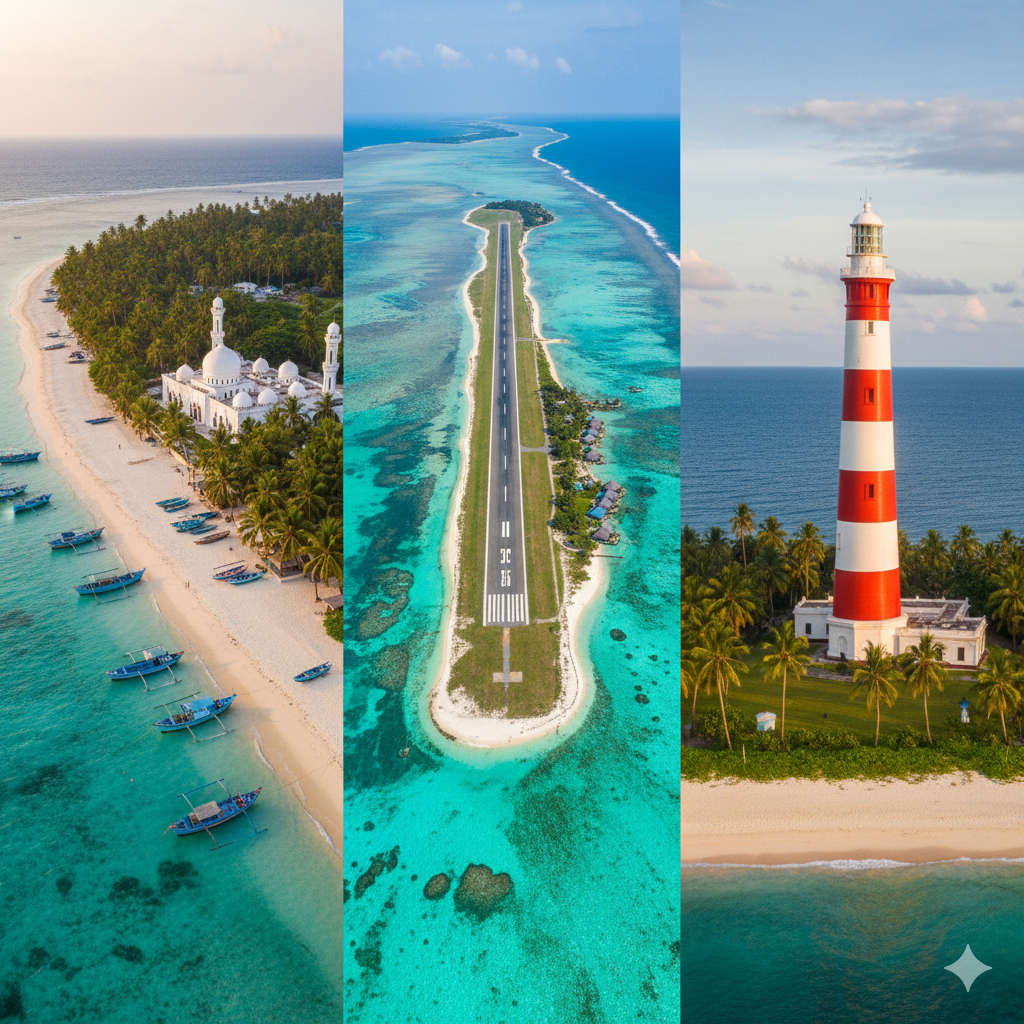
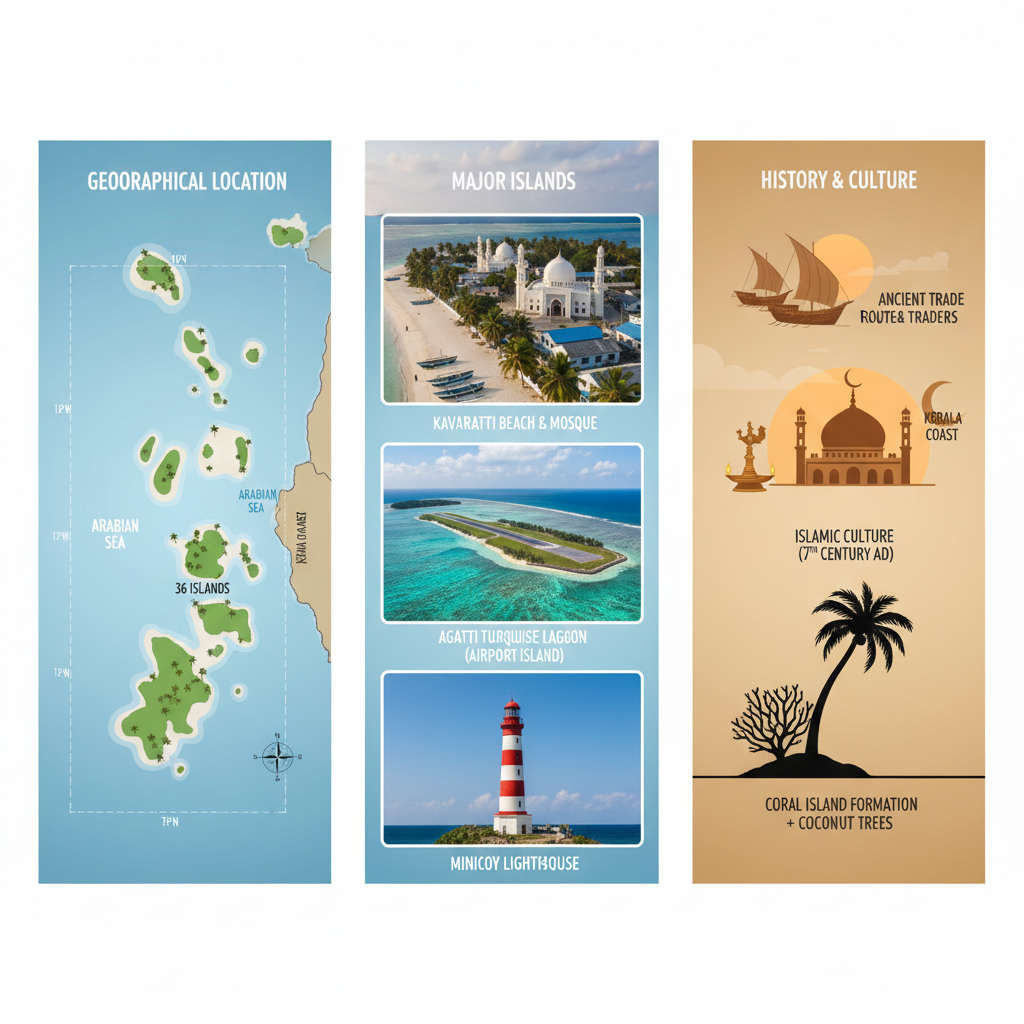
Geographical Location of Lakshadweep
Detailed Description of the Geographical Location
Lakshadweep is the smallest Union Territory of India, located off the west coast of Kerala in the Arabian Sea. Isolated from the mainland, the archipelago is known for its distinct geographical features, natural beauty, and marine ecosystem.
Geographical Location
Place
- Lakshadweep lies between 8°N to 12°N latitude and 71°E to 74°E longitude.
- It is situated at a sea distance of 200–440 km from Kerala.
- Located in the middle of the Arabian Sea, it forms an important part of the Indian Ocean region.
Area and Size
- Total geographical area: 32 sq. km.
- Comprises 36 islands, including atolls, lagoons, and coral reefs.
- The islands collectively stretch across about 2000 km of ocean area.
Major Islands
Out of the 36 islands, only 10 are inhabited. These include:
- Kavaratti (Capital)
- Agatti
- Minicoy
- Androth
- Amini
- Kalpeni
- Kadamat
- Chetlat
- Bitra
- Kiltan
Climate
- Lakshadweep has a tropical marine climate.
- Average temperature ranges between 25°C to 35°C throughout the year.
- The South-West monsoon brings heavy rainfall from June to September.
- During monsoon, the sea becomes rough and transportation is restricted.
Physical Structure
- Atolls: 12 naturally formed coral atolls.
- Lagoons: Clear-water lagoons around the islands, rich in marine biodiversity.
- Coral Reefs: A vital component of India’s marine ecosystem, protecting coastlines and supporting sea life.
Neighbouring Areas
- East: Malabar Coast of Kerala.
- West & South: Deep Arabian Sea.
- Part of the maritime route between India and Maldives.
Geographical Importance
Natural resources
- Rich marine life including corals, fish, turtles, and lagoon species.
- Coconut trees and marine fisheries significantly support the local economy.
Marine Biodiversity
The coral reefs and lagoons are home to diverse marine species. Coral reefs maintain oceanic balance, protect coasts from erosion, and support ecological stability.
Environmental Sensitivity
Lakshadweep’s small landmass and oceanic surroundings make it highly vulnerable to environmental changes like global warming and sea-level rise.
Strategic Position
Lakshadweep’s location on India’s western maritime border makes it strategically important for:
- India’s maritime security
- Trade routes connecting India to the Middle East
- Monitoring naval movement across the Arabian Sea
Geographical Structure and Challenges
1. Coral Reefs and Their Importance
Coral reefs act as natural barriers against coastal erosion. Their degradation can threaten the entire marine ecosystem and the livelihood of island communities.
2. Threat of Natural Disasters
Due to its oceanic location, Lakshadweep is vulnerable to cyclones, storms, and rising sea levels, risking the submergence of smaller islands.
3. Limited Land Area
With a total area of only 32 sq. km, land scarcity poses challenges for development, infrastructure, and growing population needs.
⭐ Recommended Study Resource
Explore a highly rated educational resource selected to support learning, revision, and exam preparation with trusted content and positive reader feedback.
Contribution of Geographical Location to Tourism
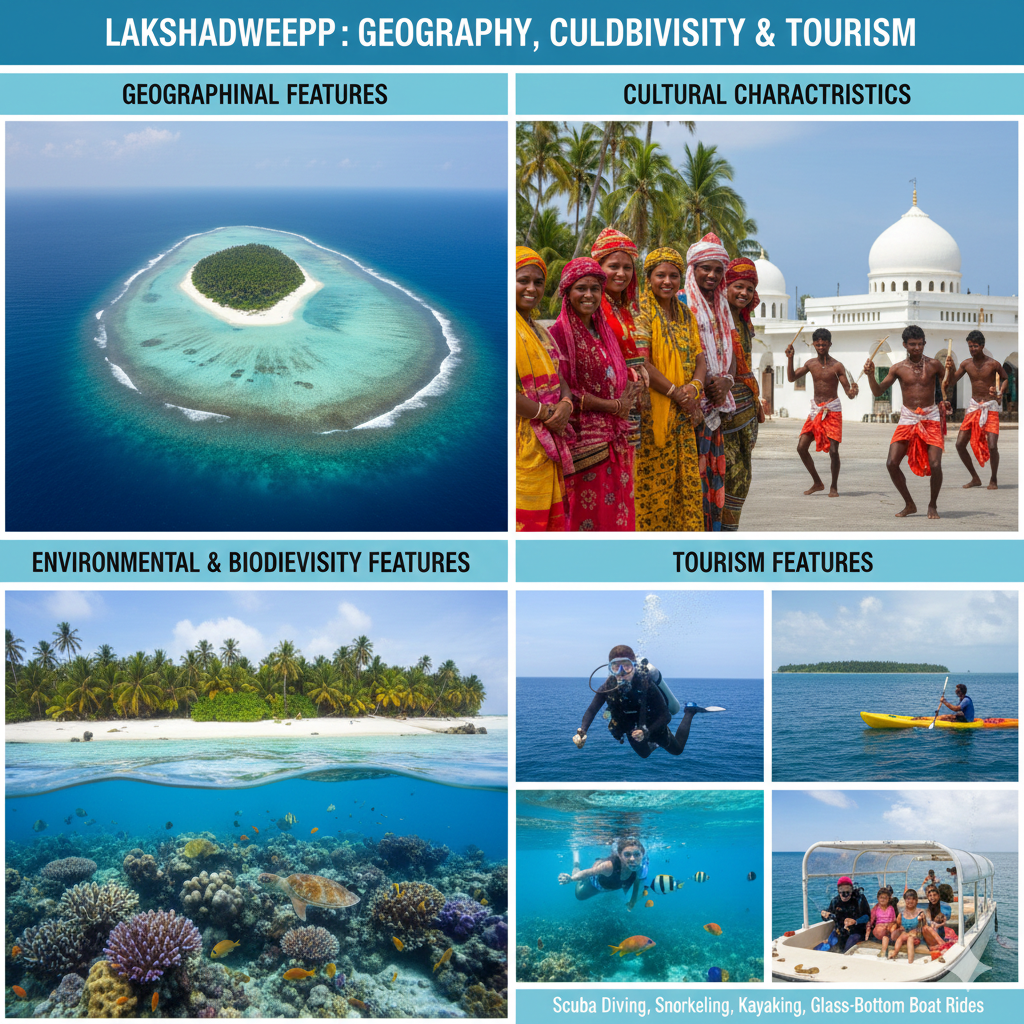
- Calm and clean beaches: White sand and turquoise water attract tourists from around the world.
- Sea sports: Scuba diving, snorkeling, and kayaking are popular due to clear water and rich marine life.
- Natural lagoons: Transparent water and vibrant underwater life make the lagoons a major attraction.
The geographical location of Lakshadweep not only defines its natural beauty but also highlights its environmental and strategic importance at regional and global levels.
History of Lakshadweep
The history of Lakshadweep spans centuries and reflects its role in ancient maritime trade, cultural exchange, and religious evolution. Influenced by multiple civilizations, its history holds political, cultural, and religious significance.
Ancient History
Origin of the Islands
- Lakshadweep was formed through the natural growth of coral reefs.
- Geologically, the islands took millions of years to develop into their current form.
Human Settlement
- Believed to have been settled by Malayali sailors and fishermen in ancient times.
- Sangham literature mentions these islands.
- Traded with mainland India, especially Kerala.
Part of Ancient Trade Routes
The region was a vital part of maritime trade between South India, Arabia, and Africa, dealing in spices and other goods.
Religious History
Influence of Hinduism
Initially, Hinduism had a cultural presence, proved by remnants of temples and idols found on some islands.
Advent of Islam
Islam reached Lakshadweep in the 7th century through Arab traders. As per legend, the saint Ubaidullah spread Islam across the region. Today, 97% of Lakshadweep’s population follows Islam.
Religious Tolerance
Despite cultural influences, the islands have maintained religious harmony and social unity.
Medieval History
Local Rulers
Initially controlled by local chiefs and communities, later influenced by the Chera dynasty of Kerala.
Arab Traders
Arab traders maintained strong dominance over trade and cultural activities.
Malik Deenar and Islamic Culture
In the 12th century, Islamic scholars like Malik Deenar strengthened Islamic practices and traditions.
Colonial Period
Portuguese Control
In the 16th century, Portuguese traders attempted to control Arabian Sea trade. Although they captured parts of Lakshadweep, local resistance weakened their influence.
Arakkal Dynasty (Kerala)
In the 17th century, the Arakkal dynasty established rule over Lakshadweep, further promoting Islamic culture.
British Rule
The British East India Company took control in the late 18th century. The islands were administered under the Madras Presidency. The British promoted coconut and fish trade.
Modern History
Republic of India
After independence in 1947, Lakshadweep became part of India and was declared a Union Territory in 1956.
Administrative Reforms
- Earlier known as “Lakshadweep, Minicoy and Aminidivi.”
- Renamed simply “Lakshadweep.”
- Kavaratti designated as the capital.
Environmental Protection
Special laws were enacted to preserve coral reefs, lagoons, and marine ecosystems.
Impact on Culture and Heritage
- Islamic traditions influence festivals, social life, and cultural practices.
- Malayali culture has a strong presence due to proximity to Kerala.
- Marine life and fishing have been part of their lifestyle for centuries.
Importance of History in Present Times
- Lakshadweep’s history shapes its cultural identity.
- It symbolizes India’s cultural diversity and religious harmony.
- The region teaches environmental conservation and coexistence with nature.
The history of Lakshadweep remains a source of pride and inspiration for both the local people and the nation.
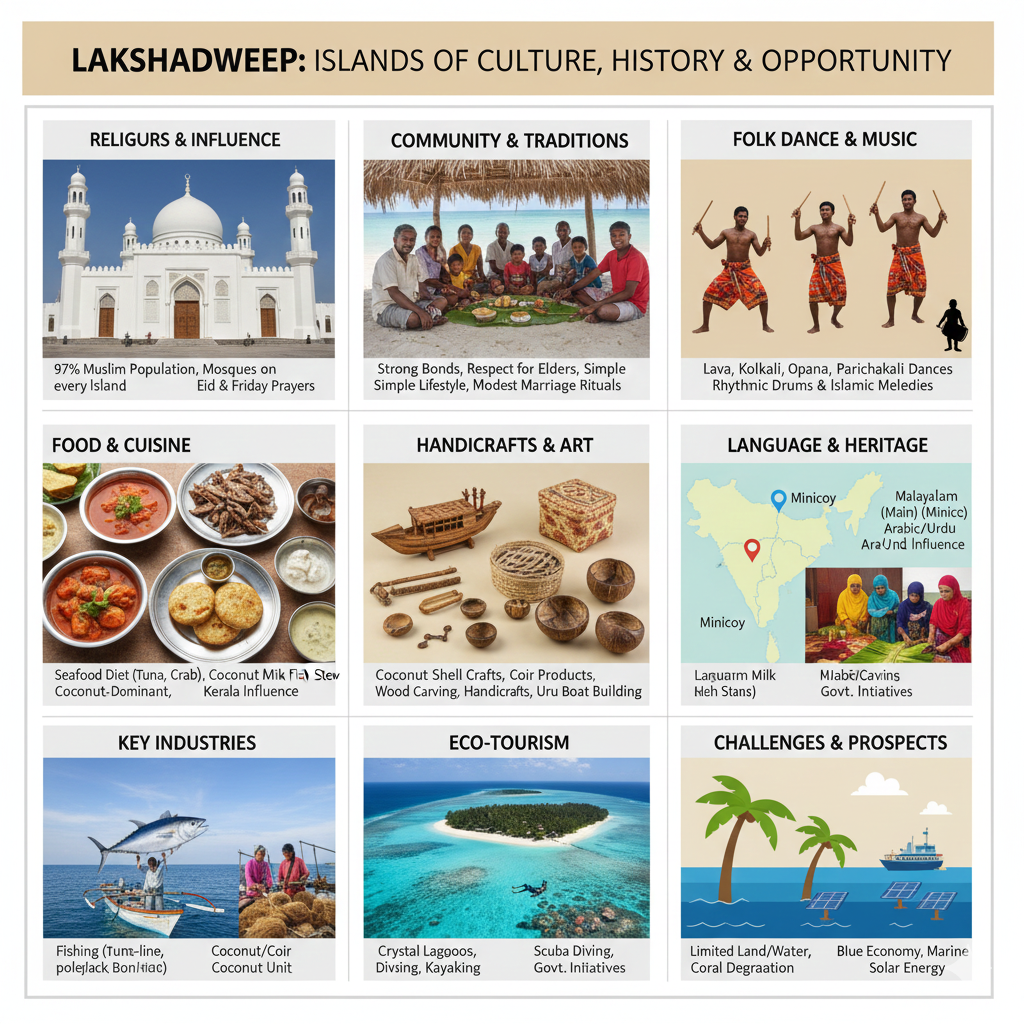
Culture and Language of Lakshadweep
The culture and language of Lakshadweep reflect a harmonious blend of the region’s geographical uniqueness, religious influences, and maritime trading history. The archipelago showcases a rich cultural heritage and a multilingual society.
Culture of Lakshadweep
1. Religious Influence
- Islam deeply influences Lakshadweep’s culture, with 97% of the population being Muslim.
- Social and religious traditions follow Islamic values.
- Mosques: Each island has beautiful and ancient mosques reflecting Islamic architecture.
- Festivals like Eid-ul-Fitr and Eid-ul-Adha are celebrated with great enthusiasm.
2. Social Life and Traditions
- Community cooperation and social harmony are major features of Lakshadweep society.
- Wedding ceremonies are simple and follow Islamic customs.
- Women play an important role in family care and handicraft work.
3. Folk Dance and Music
The people of Lakshadweep preserve their cultural heritage through traditional dances and music.
- Festival Dances: Performed during festivals and social gatherings.
- Sound-Based Dance: Group dances performed with drums and traditional instruments.
- Traditional music blends Islamic and local melodies.
4. Food and Cuisine
The cuisine of Lakshadweep is influenced by local resources and maritime lifestyle.
- Seafood: Tuna, fish, crabs, and shrimp.
- Coconut-based dishes: Coconut is a primary ingredient.
Main dishes:
- Fish Curry
- Coconut Chutney
- Appam and Stew (influenced by Malayali cuisine)
5. Handicrafts and Art
- Handicrafts made from coconut shells and wood are popular.
- Traditional boat building (Uru) is a significant art practiced for generations.
Language of Lakshadweep
1. Malayalam
The primary language of Lakshadweep is Malayalam, reflecting cultural influence from Kerala.
2. Mahl
Mahl (Mahal) is spoken on Minicoy Island. It is closely related to the Dhivehi language of the Maldives.
3. Arabic and Urdu Influence
- Islamic education contributes to the use of Arabic and Urdu vocabulary.
- Arabic is used in religious texts and mosque inscriptions.
4. Hindi and English
- Used for official, academic, and administrative purposes.
- English is increasingly important due to tourism and governance.
Festivals and Events
Religious Festivals
- Eid-ul-Fitr and Eid-ul-Adha are celebrated with great zeal.
- During Ramadan, people gather in mosques for collective prayers and Iftar.
Community Events
- Special community feasts mark the beginning and end of the fishing season.
- Cultural programmes include traditional dances and musical events.
Clothing and Lifestyle
⭐ Recommended Study Resource
Explore a highly rated educational resource selected to support learning, revision, and exam preparation with trusted content and positive reader feedback.
Traditional Attire
- Men: Lungi and kurta.
- Women: Hijab and long gown.
Lifestyle
The people of Lakshadweep follow a simple lifestyle close to nature, depending on coconut farming, fishing, and handicrafts.
Mainland Influence on Culture
Due to proximity to Kerala, Lakshadweep’s culture is influenced by Malayali traditions, especially in cuisine, clothing, and language.
Preservation and Importance of Culture
- Conservation Efforts: Government and local bodies undertake schemes to preserve cultural and environmental heritage.
- Tourism: Music, dance, food, and lifestyle attract tourists, strengthening cultural identity.
The culture and language of Lakshadweep form its unique identity and highlight India’s cultural diversity and religious harmony.
Economy of Lakshadweep
The economy of Lakshadweep is based on Natural resources, traditional occupations, and strong community involvement. Despite its small geographical size, the islands have a sustainable and resource-based economy. In recent years, tourism and government initiatives have played a key role in development.
1. Agriculture
Agriculture is limited due to low soil fertility and small land area, but it remains important.
Coconut
- The main cash crop of Lakshadweep.
- Coconut products such as oil, coir, ropes, and handicrafts contribute significantly to the economy.
- Coconut is exported to national and international markets.
Fruits and Vegetables
- Bananas, papayas, and seasonal vegetables are cultivated.
- Limited land restricts large-scale farming.
2. Fishing (Fisheries)
Fishing is the backbone of Lakshadweep’s economy.
Major Fishes
- Tuna and Bonito are the most commonly caught species.
- Export of tuna contributes significantly to revenue.
Fish Processing
- Processing, drying, and packing industries have expanded in recent years.
- Processed fish is exported globally.
Community Involvement
Fishing is both an economic activity and part of the traditional lifestyle of the islanders.
Government Schemes
Subsidies, modern boats, and equipment are provided by the Government of India to support fisheries.
3. Handicrafts and Cottage Industries
Products from Coconut
- Local artisans produce ropes, baskets, toys, and decorative items.
- Coconut-fibre-based products are exported.
Boat Building
Traditional wooden boat building (Uru) is a vital cottage industry carried forward for generations.
Handmade Decorative Items
Locally made artefacts use materials like sea shells, snails, and coconut wood.
4. Tourism
Natural Beauty
- White sand beaches, coral reefs, and lagoons attract tourists.
- The peaceful and clean environment enhances visitor experience.
Tourism Activities
- Scuba diving
- Snorkeling
- Kayaking
- Marine life exploration
Popular Tourist Spots
- Minicoy
- Kavaratti
- Agatti
Government Support
- Eco-sensitive tourism promoted through LTDC (Lakshadweep Tourism Development Corporation).
- Environmental protection is prioritized alongside tourism development.
5. Government Schemes and Assistance
- Subsidies and loans for agriculture, fisheries, handicrafts, and skill development.
- Infrastructure improvement in ports, transport, and communication.
- Training programmes for youth in fishing and tourism sectors.
6. Other Economic Activities
Water Transport
Water transport connects the islands and supports both passenger movement and cargo operations.
Exports
Major exports include coconut products, fish, and handicraft items.
Local Markets
Daily necessities and local goods are traded in small markets, supporting the internal economy.
7. Challenges
- Geographical isolation limits growth opportunities.
- Transport and communication gaps affect trade and tourism.
- Natural disasters such as cyclones and sea-level rise pose risks.
- Coral depletion and overuse of natural resources threaten sustainability.
8. Development Prospects
- Tourism Expansion: Scope for eco-friendly tourism.
- Blue Economy: Sustainable marine resource usage.
- Renewable Energy: Solar and wind energy potential.
- Eco-friendly Industries: Promotion of industries that do not harm the environment.
Conclusion
The economy of Lakshadweep is rooted in natural resources, traditional skills, and community support. With sustainable development, improved tourism, and modern economic initiatives, the region has the potential to become economically strong and self-reliant.
Tourist Places in Lakshadweep
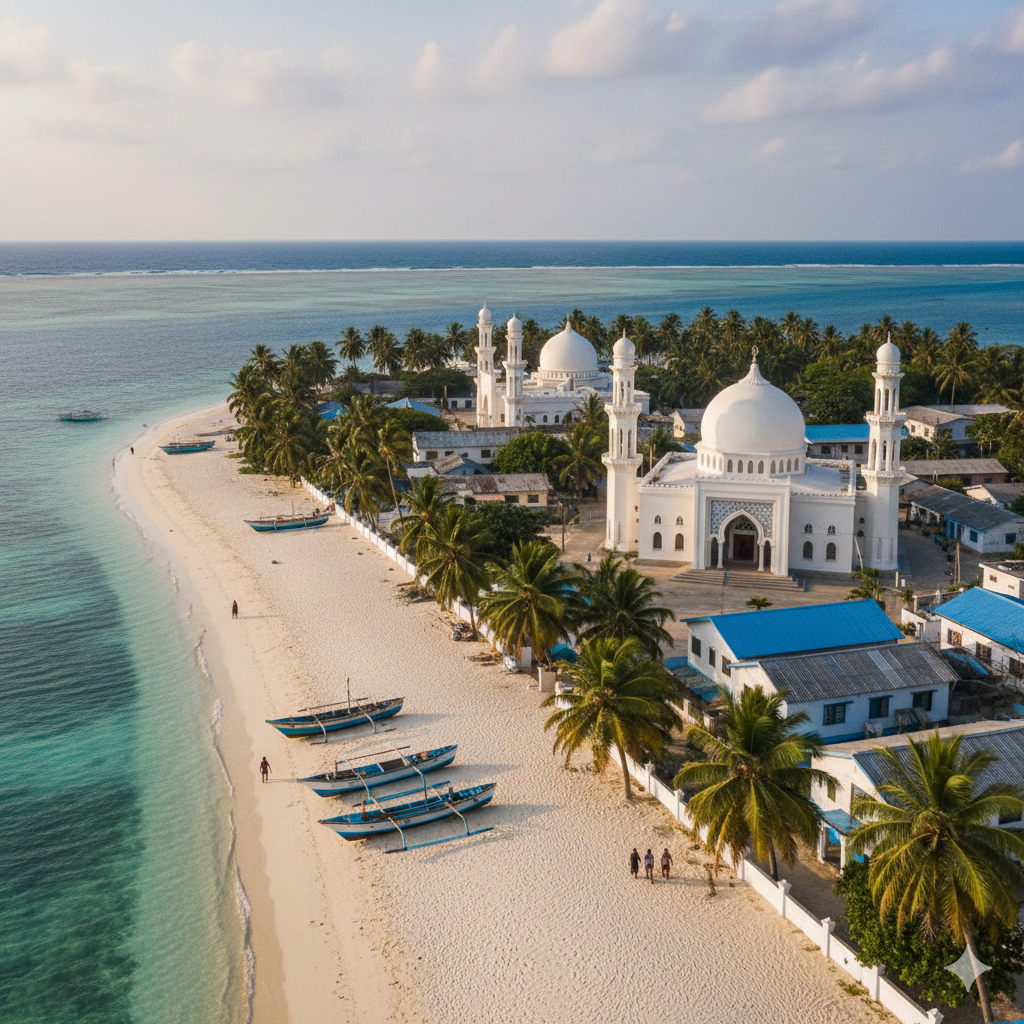
Lakshadweep, the smallest Union Territory of India, is known for its unique natural beauty, serene atmosphere, and rich marine life. The archipelago is an ideal tourist destination, famous for coral reefs, white-sand beaches, and various water sports. Each island has its own speciality, making Lakshadweep a heavenly travel destination.
Major Tourist Places
1. Kavaratti Island
Features
- Capital and the most developed island of Lakshadweep.
- Clean and calm beaches attract tourists.
- Beautiful coral reefs and clear blue waters.
Main Attractions
- Kavaratti Lagoon: Ideal for swimming, snorkelling, and boating.
- Ujra Mosque: A 17th-century mosque known for its architecture.
- Marine Museum: Showcases information about marine life and coral reefs.
2. Agatti Island
Features
- Gateway to Lakshadweep with its own airport.
- Known for lush palm trees and sparkling turquoise waters.
Main Attractions
- Scuba Diving & Snorkeling: Experience coral reefs and marine life.
- Kayaking & Boating: Calm lagoon waters are perfect for boating.
- Golden Beaches: Ideal for sunbathing and relaxation.
3. Minicoy Island
Features
- Southernmost island of Lakshadweep.
- Language “Mahl” and cultural similarities with Maldives.
- Also called the “Brother of Maldives.”
Main Attractions
- Minicoy Lighthouse: Built in 1885, offers panoramic views.
- Largest Lagoon: Ideal for swimming and water sports.
- Thekke Beach: Famous for stunning sunsets.
4. Kalpeni Island
Features
- Known for coral reefs and scenic lagoons.
- Provides a calm and nature-rich atmosphere.
Main Attractions
- Scuba diving and snorkelling.
- Lagoon boating and sailing.
- Beach camping.
5. Bangaram Island
Features
- Uninhabited and extremely peaceful.
- Perfect for honeymooners and retreat seekers.
Main Attractions
- Scuba diving with sightings of turtles, dolphins, and colorful fish.
- Camping and picnics.
- Photography: Every scene is picture-perfect.
6. Amini Island
Features
- Known for traditional handicrafts and cultural heritage.
Main Attractions
- Handicrafts made from stone and coconut shells.
- Clean and calm beaches.
7. Kadmat Island
Features
- Famous for coral reefs and adventure sea sports.
- Lagoon and beaches ideal for diving.
⭐ Recommended Study Resource
Explore a highly rated educational resource selected to support learning, revision, and exam preparation with trusted content and positive reader feedback.
Main Attractions
- Diving center offering professional scuba diving experiences.
- Marine life including corals, fish, and turtles.
- Sunbathing and snorkelling.
8. Chetlat Island
Features
- Rich cultural heritage and simple lifestyle.
Main Attractions
- Coral reefs and fisheries.
- Handicrafts made from coconut products.
Main Tourist Activities
- Water Sports: Scuba diving, snorkelling, kayaking, windsurfing.
- Marine Exploration: Coral reefs, sea turtles, dolphins, and colorful fish.
- Boat Tours: Enjoy lagoon and sea rides.
- Photography: A paradise for photographers.
Special Information for Tourists
Environmental Protection
Lakshadweep tourism is environmentally sensitive. Coral reefs and marine life are protected under strict guidelines.
Tourism Permit
- A special permit is required to visit Lakshadweep.
- Indian tourists get permits easily.
- Foreign tourists are restricted to selected islands.
Best Time to Visit
- The best time is from October to March.
- Weather remains pleasant and suitable for water sports.
Conclusion
Lakshadweep’s natural beauty, peaceful atmosphere, and adventure water sports make it a unique and unforgettable tourist destination. Each island has its own charm, adding to the region’s tourism potential while emphasizing environmental balance.
Transportation in Lakshadweep
Transportation in Lakshadweep is vital due to its remote oceanic location. It supports daily needs, tourism, trade, and administration.
1. Water Transport
Sea routes are the primary mode of transportation in Lakshadweep.
a. Ship Services
- Operated by the Shipping Corporation of India.
- Connect Lakshadweep islands with each other and with Kochi.
Major Ships: MV Kavaratti, MV Minicoy, MV Amindivi, MV Arabian Sea, MV Lakshadweep Sea.
- Passenger ships include AC and non-AC cabins, dormitories, and general seating.
- Essential goods like food, fuel, and building materials are transported.
- Travel time from Kochi: 14 to 20 hours.
b. Ferry Services
- Local ferries operate between nearby islands.
- Affordable and easily accessible for residents.
c. Cruise Services for Tourists
Special cruise services offer comfortable travel with entertainment and dining facilities.
2. Air Transport
a. Agatti Airport
- The only operational airport in Lakshadweep.
- Regular flights to Kochi (operated mainly by Air India).
- Suitable for small aircraft (ATR-72).
b. Helicopter Services
- Used for emergencies and medical transport.
- Available for inter-island and mainland connectivity.
c. Importance of Air Transport
- Crucial for emergency situations.
- Fastest and most convenient mode of travel.
3. Land Transport
a. Roads and Vehicles
- Each island has small roads connecting villages and beaches.
- Motorcycles, bicycles, and small vehicles are commonly used.
- Auto-rickshaws are available on some islands.
b. Eco-friendly Transportation
Bicycles and small electric vehicles are encouraged to preserve the environment.
4. Tourist Transportation
- Cruise ships designed for tourist comfort.
- Speed boats and catamarans for faster inter-island travel.
- Special boats for scuba diving and snorkelling activities.
5. Transportation Challenges
- Geographical isolation increases transport costs.
- Weather conditions like monsoons disrupt sea and air travel.
- Limited infrastructure for large ships and aircraft.
- Environmental concerns, including coral reef impact.
6. Development Prospects
- Modernizing ships, ferries, and airports.
- Promoting solar-powered and eco-friendly transport.
- Expanding tourist cruise and catamaran services.
- Generating local employment in transportation services.
Conclusion
Transportation is the lifeline of Lakshadweep, enabling tourism, trade, and daily life. Despite challenges, modern infrastructure and eco-friendly planning can further strengthen the region’s connectivity and growth.
⭐ Recommended Study Resource
Explore a highly rated educational resource selected to support learning, revision, and exam preparation with trusted content and positive reader feedback.
References
- Government of India – Ministry of Home Affairs, Lakshadweep Administration Official Website
- Census of India – Lakshadweep Demographic Data
- Incredible India – Official Tourism Information on Lakshadweep
- National Institute of Oceanography – Studies on Coral Reefs and Marine biodiversity
- Geographical and Environmental Science Academic Publications
- Official Reports and Documents Released by Lakshadweep Local Administration