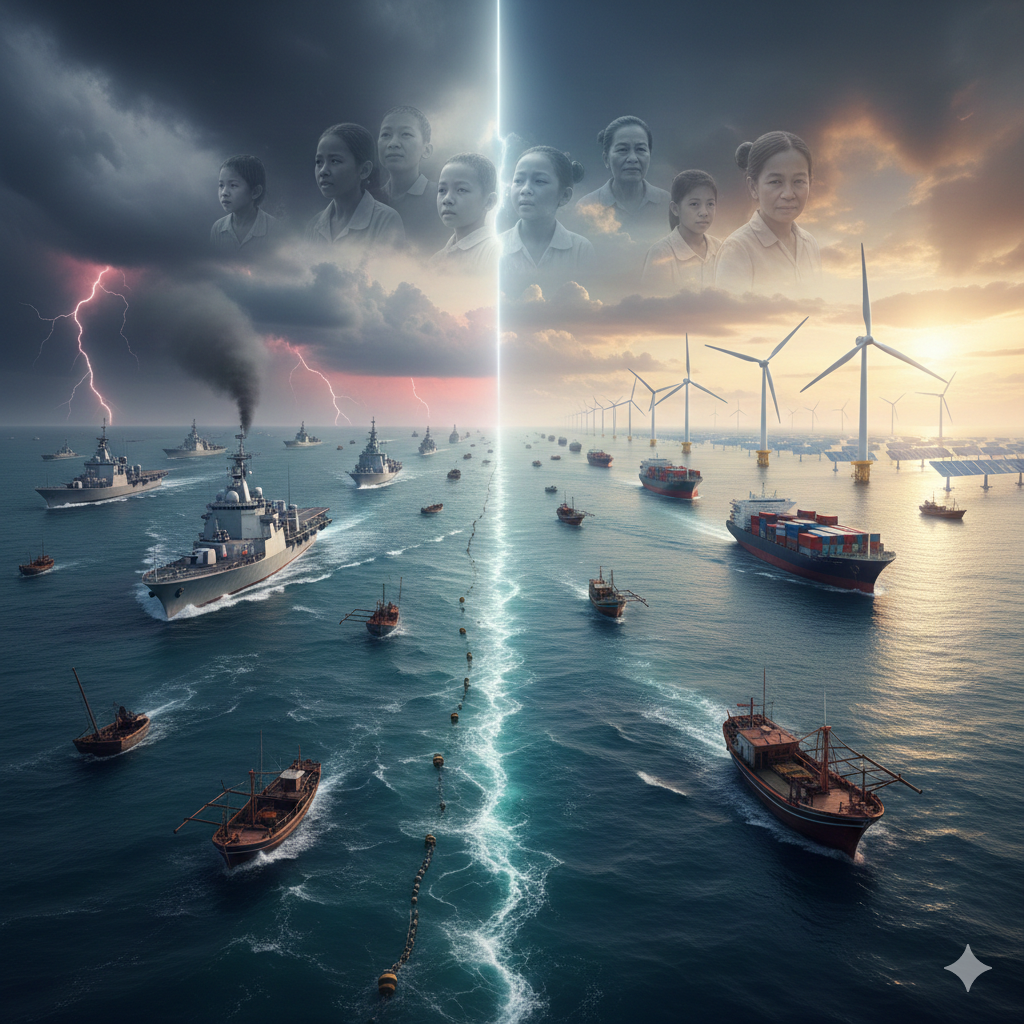
South China Sea Dispute: A Rising Conflict and My Personal Learning
When I first read about the South China Sea dispute, it felt like just another political headline in a crowded news feed. At that moment, I believed it was only a routine diplomatic issue, far removed from the everyday concerns of ordinary people.
However, as I slowly explored its history, maps, territorial claims, and international laws, the topic transformed into a powerful story. It was no longer only about water and boundaries, but about power, resources, identity, diplomacy, and the future of humanity.
Premium Study Material for Competitive Exams
- ✔ Structured & syllabus-focused content
- ✔ Clear explanations & smart revision
- ✔ Trusted by serious aspirants
- ✔ Ideal for long study sessions
I realized that the South China Sea is not merely a geographical region. It is a lifeline of global trade, a reservoir of energy resources, and a strategic heart of Asia, where the interests of multiple nations collide and reshape international politics.
While understanding this dispute, I also learned that global politics is not governed only by weapons and armies. It is equally shaped by patience, negotiation, perception, and long-term strategy. In this silent struggle, peace often becomes the most fragile victim.
This article is not just an analysis of the South China Sea dispute. It is the story of my intellectual journey — from reading a simple news article to understanding a global conflict through a human lens.
Through this narrative, I invite you to walk along the same path, to see how lines drawn on the sea can influence civilizations, economies, and the collective future of the world.
What Is the South China Sea and Why Is It Important?
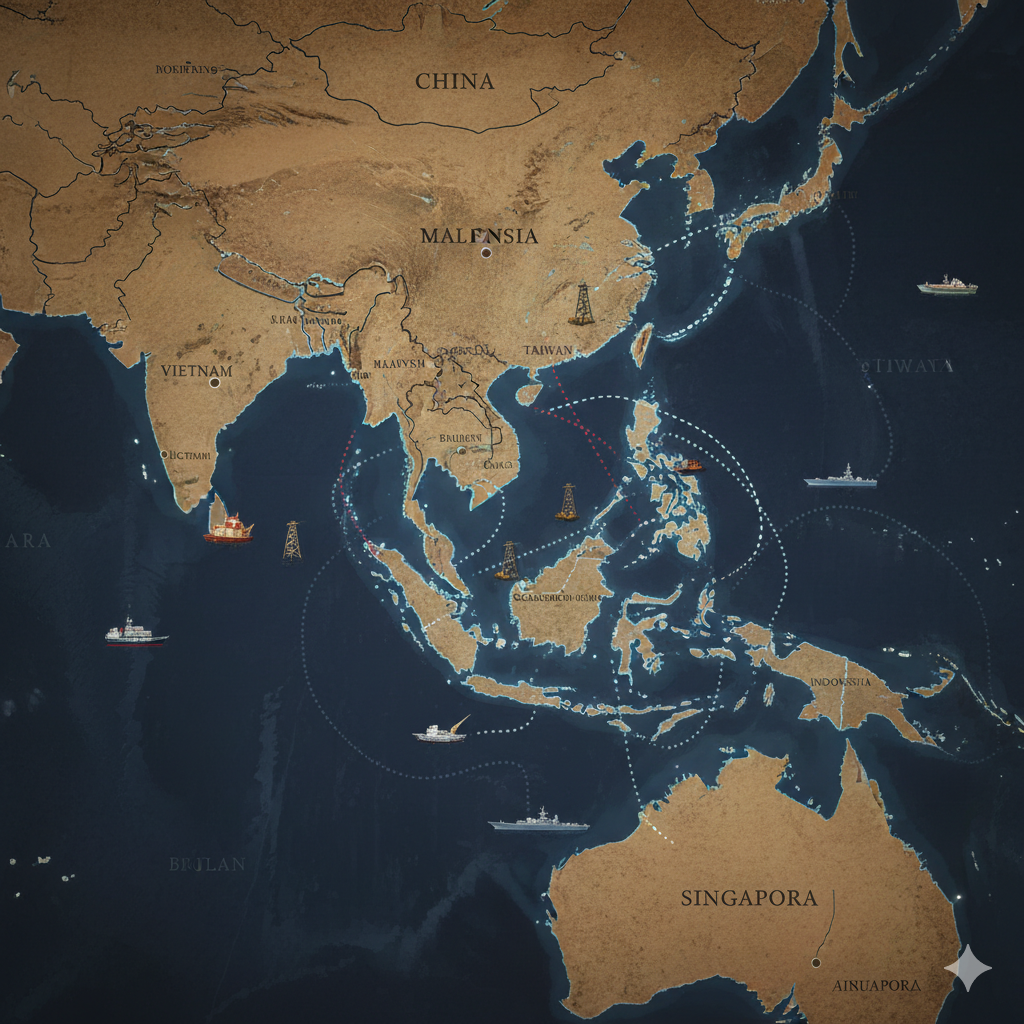
The South China Sea is not just a body of water on the world map. It is one of the most strategically significant maritime regions, serving as a crossroads of global trade, energy resources, and geopolitical power. This sea connects East Asia with Southeast Asia and acts as a bridge between the Pacific and Indian Oceans.
Every year, trillions of dollars worth of goods pass through this region. Oil, natural gas, consumer products, raw materials, and food supplies move across these waters, making the South China Sea a vital artery of the global economy.
Geographical Location
The South China Sea is surrounded by China, Taiwan, the Philippines, Vietnam, Malaysia, Brunei, and Indonesia. Its geographical position gives it exceptional strategic importance, as it links major shipping lanes and regional markets.
High-Quality Study Material for Competitive Exams
- ✔ Structured & syllabus-aligned content
- ✔ Clear explanations & quick revision
- ✔ Trusted by aspirants nationwide
- ✔ Ideal for long study sessions
The sea contains numerous small islands, reefs, and shoals, many of which are claimed by different countries. Control over these features is not only about land, but also about maritime boundaries, exclusive economic zones, and national security.
Economic Importance
Beneath the waters of the South China Sea lie significant reserves of oil and natural gas, making it a critical region for future energy security. In addition, the sea is one of the richest fishing grounds in the world, supporting the livelihoods of millions of people across coastal nations.
The South China Sea is also a central route for international shipping. Nearly one-third of global maritime trade passes through this region. Any instability here has the potential to disrupt global supply chains and economic stability.
For these reasons, the South China Sea is not merely a geographical space, but a symbol of economic power, political influence, and strategic competition in the modern world.
History of the South China Sea Dispute
The history of the South China Sea dispute stretches far beyond modern geopolitics. It is deeply rooted in centuries of maritime trade, imperial expansion, and regional influence. For ancient civilizations, this sea was not only a route for commerce but also a bridge for cultural exchange. Over time, these historical connections gradually transformed into political claims, which today shape one of the most complex territorial disputes in the world.
Understanding this history is essential, because the present conflict cannot be separated from the past. Every claim, counter-claim, and diplomatic stance is supported by interpretations of history, maps, and ancient records.
Ancient Claims
China, Vietnam, and the Philippines all trace their connections to the South China Sea back to ancient times. Chinese dynasties recorded the presence of islands and reefs in imperial documents and navigation charts. These records are often presented by China as evidence of long-standing sovereignty over the region.
Vietnamese historical archives, on the other hand, describe royal expeditions and administrative control over several island groups. Vietnam argues that its ancestors exercised continuous authority through taxation, settlement, and maritime patrols.
For the Philippines, proximity plays a central role. Local communities depended on these waters for fishing and trade, and Spanish-era records also mention the use of nearby islands. Thus, each nation views history through its own national lens, making reconciliation of claims extremely difficult.
Situation After the Second World War
The end of the Second World War marked a turning point in the South China Sea. Japan, which had occupied many islands during the war, withdrew from the region. This sudden power vacuum created uncertainty over ownership and control.
As colonial powers left Asia, newly independent nations began defining their maritime boundaries. At the same time, China introduced the famous "Nine-Dash Line," claiming a vast portion of the South China Sea. This line, drawn on Chinese maps, became the foundation of China’s modern territorial claims.
Meanwhile, Vietnam, the Philippines, Malaysia, and Brunei asserted their rights based on geographic proximity and international maritime principles. These overlapping claims turned the South China Sea into a zone of diplomatic tension and strategic competition.
UNCLOS and International Law
The United Nations Convention on the Law of the Sea (UNCLOS) was established to bring clarity and fairness to maritime boundaries. Under UNCLOS, countries are entitled to a 200-nautical-mile Exclusive Economic Zone (EEZ), granting them rights over marine resources.
UNCLOS aimed to reduce conflicts by creating a uniform legal framework. However, in the South China Sea, interpretations of this law differ sharply. China argues that historical rights should be respected alongside UNCLOS, while other countries insist that international law must take priority.
In 2016, an international tribunal ruled in favor of the Philippines, stating that China’s Nine-Dash Line had no legal basis under UNCLOS. Despite this, China rejected the ruling, highlighting the limitations of international law when major powers refuse to comply.
This situation reveals a harsh reality: international law can guide nations, but it cannot always enforce peace. As a result, the South China Sea remains a symbol of the ongoing struggle between legal principles and geopolitical power.
China’s Nine-Dash Line Theory
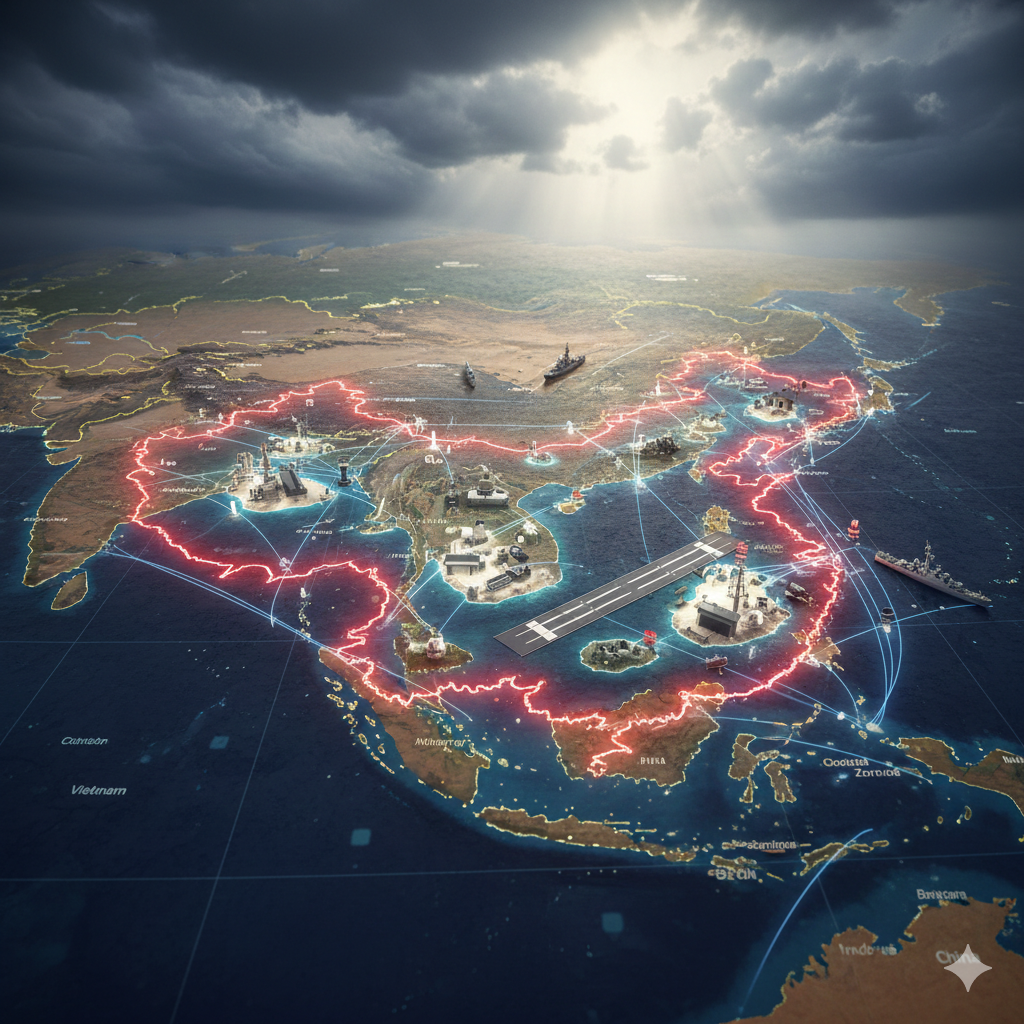
China’s “Nine-Dash Line” is not merely a line drawn on a map. It represents China’s national identity, historical narrative, and growing geopolitical ambition. First appearing on a Chinese map in 1947, this line outlines a vast portion of the South China Sea as part of China’s claimed maritime territory.
Over time, the Nine-Dash Line has become a central pillar of China’s foreign and security policy. China argues that its ancient sailors, fishermen, and traders used these waters for centuries, and therefore the region belongs to China based on historical rights and traditional usage.
However, this theory directly conflicts with modern international maritime law. The Nine-Dash Line covers nearly 90 percent of the South China Sea, overlapping with the Exclusive Economic Zones (EEZs) of the Philippines, Vietnam, Malaysia, Brunei, and Indonesia. This overlap is the primary reason why the dispute has become so intense and complex.
China views this line not only as a territorial claim, but as a strategic shield for its energy security, trade routes, and military influence. To strengthen its position, China has constructed artificial islands, established military facilities, and increased naval patrols within the claimed region.
Premium Study Material for Competitive Exams
- ✔ Structured & syllabus-aligned content
- ✔ Clear explanations & smart revision
- ✔ Trusted by competitive aspirants
- ✔ Ideal for long study sessions
From the perspective of other nations and international institutions, the Nine-Dash Line lacks legal clarity and legitimacy. In 2016, an international arbitration tribunal ruled that China’s historical claims under the Nine-Dash Line had no legal basis under UNCLOS. Despite this, China rejected the ruling, emphasizing its preference for bilateral negotiations over international judgments.
As a result, the Nine-Dash Line has become more than a maritime boundary. It now symbolizes the clash between historical narratives and modern international law, between rising power and regional stability, and between national pride and global responsibility.

Reaction of Southeast Asian Countries
The response of Southeast Asian nations to the South China Sea dispute has been cautious, strategic, and deeply influenced by their national interests. For these countries, the dispute is not only about maritime boundaries, but also about sovereignty, economic survival, and regional stability. Each nation has chosen a different path to protect its rights while avoiding a full-scale confrontation with China.
Philippines
The Philippines has taken one of the strongest legal stands in the dispute. In 2013, it approached the international arbitration tribunal under UNCLOS to challenge China’s claims. In 2016, the tribunal ruled in favor of the Philippines, declaring that China’s Nine-Dash Line had no legal basis.
This judgment was a major diplomatic victory for the Philippines and a symbolic moment for smaller nations relying on international law. Although China rejected the ruling, the Philippines demonstrated that legal mechanisms can still play an important role in global disputes.
Vietnam
Vietnam’s response is shaped by both history and political reality. It bases its claims on ancient administrative records, continuous occupation, and maritime traditions. For Vietnam, the South China Sea is closely linked to national identity and historical memory.
At the same time, Vietnam avoids direct military confrontation with China. Instead, it focuses on diplomacy, international partnerships, and regional cooperation to safeguard its interests. This balanced approach reflects Vietnam’s effort to protect sovereignty while maintaining political stability.
Malaysia and Brunei
Malaysia and Brunei have adopted a comparatively calm and pragmatic approach. Both countries rely primarily on international maritime law to justify their claims and prefer quiet diplomacy over public confrontation.
They emphasize economic cooperation, regional dialogue, and peaceful negotiation. Although their voices are softer in global debates, their legal and strategic positions contribute significantly to shaping the overall regional response.
Together, the reactions of Southeast Asian countries highlight that the South China Sea dispute is not merely a contest of power, but also a struggle for dignity, survival, and lawful coexistence in a complex geopolitical environment.
United States and Global Powers
The South China Sea dispute is no longer confined to Asia. It has evolved into a central issue of global power balance, attracting the attention of major world powers. Every strategic move in this region influences international politics, economic stability, and future security arrangements.
The United States plays a leading role in this dispute by positioning itself as a defender of international law and freedom of navigation. Washington argues that the South China Sea is an international waterway and must remain open to all nations. For this reason, the U.S. regularly conducts Freedom of Navigation Operations to challenge what it sees as excessive maritime claims.
From the American perspective, China’s growing military presence in the region threatens regional stability and global trade routes. Therefore, the U.S. considers its involvement not as interference, but as a responsibility toward maintaining a rules-based international order.
China, however, views American actions as strategic containment. It believes that the United States is using the South China Sea dispute to limit China’s rise as a global power. This clash of perceptions has significantly increased tensions between the two nations.
Japan and Australia strongly support the U.S. position. For Japan, the South China Sea is vital for energy imports and economic survival. Australia sees the region as a cornerstone of Indo-Pacific stability and maritime security.
European countries, although geographically distant, also express concern over the dispute. They emphasize respect for international law, peaceful resolution, and uninterrupted global trade. Their involvement reflects the global nature of the South China Sea issue.
India approaches the dispute from a strategic and economic perspective. It supports freedom of navigation and international law while strengthening cooperation with ASEAN nations. For India, stability in the South China Sea is essential for the broader Indo-Pacific balance.
Thus, the South China Sea dispute is not merely about maritime boundaries. It represents a global contest of influence, leadership, and vision for the future world order.
In this interconnected world, instability in one sea has the power to reshape global politics, economies, and alliances.
My Personal Reflection
While reading, researching, and reflecting on the South China Sea dispute, I gradually realized that borders do not exist only on land or sea. They also exist in our minds, in our policies, and in the way we perceive the world. Nations often defend these invisible borders with more intensity than physical ones, making compromise emotionally and politically difficult.
This dispute taught me that power is not limited to military strength. True power also lies in dialogue, patience, and long-term vision. Countries that rely only on force may achieve temporary control, but they rarely succeed in building lasting peace.
I also learned that international law, although essential, has its own limitations. Laws can guide nations, but they cannot always control them. When legal principles confront political power, the outcome often depends more on influence than on justice. This realization changed my understanding of how the global system truly works.
Another important lesson was the impact of such disputes on ordinary people. Citizens living far away from the South China Sea still feel its consequences through rising prices, energy insecurity, and economic uncertainty. Global conflicts are never distant stories; they silently enter our daily lives.
On a personal level, this topic taught me to view global issues not only from a national or political perspective, but from a human perspective. When we look at conflicts through the lens of humanity, we begin to understand the real cost of power struggles.
Ultimately, the South China Sea dispute reminded me that peace is not a natural condition. It is a continuous effort built on understanding, respect, and shared responsibility. Perhaps this is the most meaningful lesson I gained from studying this complex and ongoing conflict.
What Does the South China Sea Dispute Teach the Modern World?
The South China Sea dispute is not merely a regional conflict; it is a powerful lesson for the modern world. It reveals how global politics, national interests, international law, and human aspirations intersect in complex and often challenging ways. From this dispute, the world can draw several meaningful and lasting lessons.
- The Cost of Peace
Peace is never free or automatic. It demands patience, compromise, and mutual respect. The South China Sea dispute shows that when nations prioritize dominance over dialogue, peace becomes fragile and uncertain. True victory lies not in control, but in avoiding conflict.
- The Importance of Diplomacy
Diplomacy remains the most effective tool for resolving long-term conflicts. Despite deep disagreements, countries in the South China Sea region continue to rely on negotiations, regional forums, and international dialogue. This teaches the modern world that conversation, even when difficult, is stronger than confrontation.
- The Limitations of International Law
International laws such as UNCLOS provide structure and guidance, but their strength depends on the willingness of nations to respect them. When powerful states ignore legal rulings, the authority of law weakens. This dispute highlights the urgent need for stronger global commitment to legal principles.
- The Politics of Resources
Oil, natural gas, fisheries, and shipping routes lie at the heart of this conflict. The dispute demonstrates that resources are not only economic assets, but also instruments of political power and strategic security. In the modern world, control over resources often shapes the future of nations.
Taken together, these lessons show that the South China Sea dispute is both a warning and a guide. It reminds humanity that sustainable peace and stability can only be achieved when cooperation is valued more than competition, and understanding more than dominance.
Future Possibilities
The future of the South China Sea dispute remains uncertain. The direction it takes will shape not only Asian geopolitics but also global economic and security dynamics. This region stands at a crossroads, where it can either become a permanent zone of tension or a model of international cooperation.
Conflict
If a balanced and peaceful solution is not achieved, the South China Sea may gradually transform into a long-term conflict zone. Increasing military activities, naval confrontations, and aggressive political narratives could escalate tensions into open hostilities.
Such a scenario would severely disrupt global trade routes, threaten energy supplies, and weaken economic stability across Asia and beyond. The greatest victims of this conflict would not be governments, but ordinary people whose lives and livelihoods depend on global stability.
This possibility reminds the modern world that the display of power rarely creates solutions; it usually deepens divisions.
Cooperation
On the other hand, if nations choose dialogue, trust, and mutual respect, the South China Sea could become a symbol of shared progress. Joint resource management, cooperative maritime security, and environmental protection initiatives could redefine the region’s future.
Fair and collective use of oil, gas, and fishing resources could open new paths to economic growth for all involved countries. At the same time, shared security mechanisms would strengthen regional stability and confidence.
The path of cooperation proves that coexistence is more powerful than competition. It shows that long-term peace is built not through dominance, but through understanding and partnership.
Ultimately, the future of the South China Sea depends on the choices nations make today — whether they follow the road of confrontation or the path of collective wisdom.
Conclusion
The South China Sea dispute teaches us that the sea is not merely a body of water, but a mirror reflecting the future of global politics. Its waves carry not only ships and trade, but also the ambitions, fears, and strategies of nations.
This dispute clearly shows that in the modern world, geography is inseparable from power. Maritime spaces have become symbols of national identity, economic survival, and strategic influence. The South China Sea stands as one of the strongest examples of this transformation.
The conflict also highlights the ongoing struggle between international law and political power. While legal frameworks attempt to guide nations toward fairness and stability, national interests often challenge these principles. This tension is what makes the South China Sea dispute both complex and deeply significant.
Moreover, the consequences of this dispute extend far beyond government offices and diplomatic tables. They reach ordinary citizens through economic uncertainty, energy concerns, and global instability. Thus, the South China Sea is not a distant issue, but a shared human concern.
Ultimately, the South China Sea dispute reminds us that a peaceful future cannot be built on dominance alone. It requires understanding, cooperation, and respect for both law and humanity. Only by choosing wisdom over power can the world hope to transform conflict into lasting harmony.
FAQ – South China Sea Dispute
What is the South China Sea Dispute?
The South China Sea Dispute is a complex international conflict over maritime boundaries, islands, and natural resources in the South China Sea. It involves issues such as territorial sovereignty, control over shipping routes, oil and gas reserves, fishing rights, and strategic security. Because of its economic and military importance, this dispute has become a major concern for global stability.
Which countries are involved in this dispute?
The main countries involved are China, Taiwan, the Philippines, Vietnam, Malaysia, Brunei, and Indonesia. Their overlapping claims over islands and maritime zones create continuous tension in the region. In addition, countries like the United States, Japan, Australia, and India are indirectly involved due to strategic, economic, and security interests.
What is India’s role in the South China Sea dispute?
India is not a direct claimant in the dispute, but it strongly supports freedom of navigation, respect for international law, and peaceful resolution of conflicts. India cooperates with ASEAN countries to maintain balance and stability in the Indo-Pacific region. Its approach reflects a commitment to diplomacy, cooperation, and a rules-based international order.
These frequently asked questions help readers understand the South China Sea dispute in a simple and clear manner, making this complex global issue easier to grasp.
References
High-Quality Study Material for Better Results
- ✔ Structured & easy-to-understand content
- ✔ Clear explanations for quick revision
- ✔ Trusted by many aspirants
- ✔ Ideal for competitive & academic exams
- United Nations Convention on the Law of the Sea (UNCLOS) Official Documents
- International Court of Justice and Arbitration Tribunal Rulings
- Asian Security and Strategic Studies Reports
- ASEAN and Regional Cooperation Organization Publications
- Global Think Tank and Policy Research Papers
- Academic Journals on International Relations and Maritime Law