
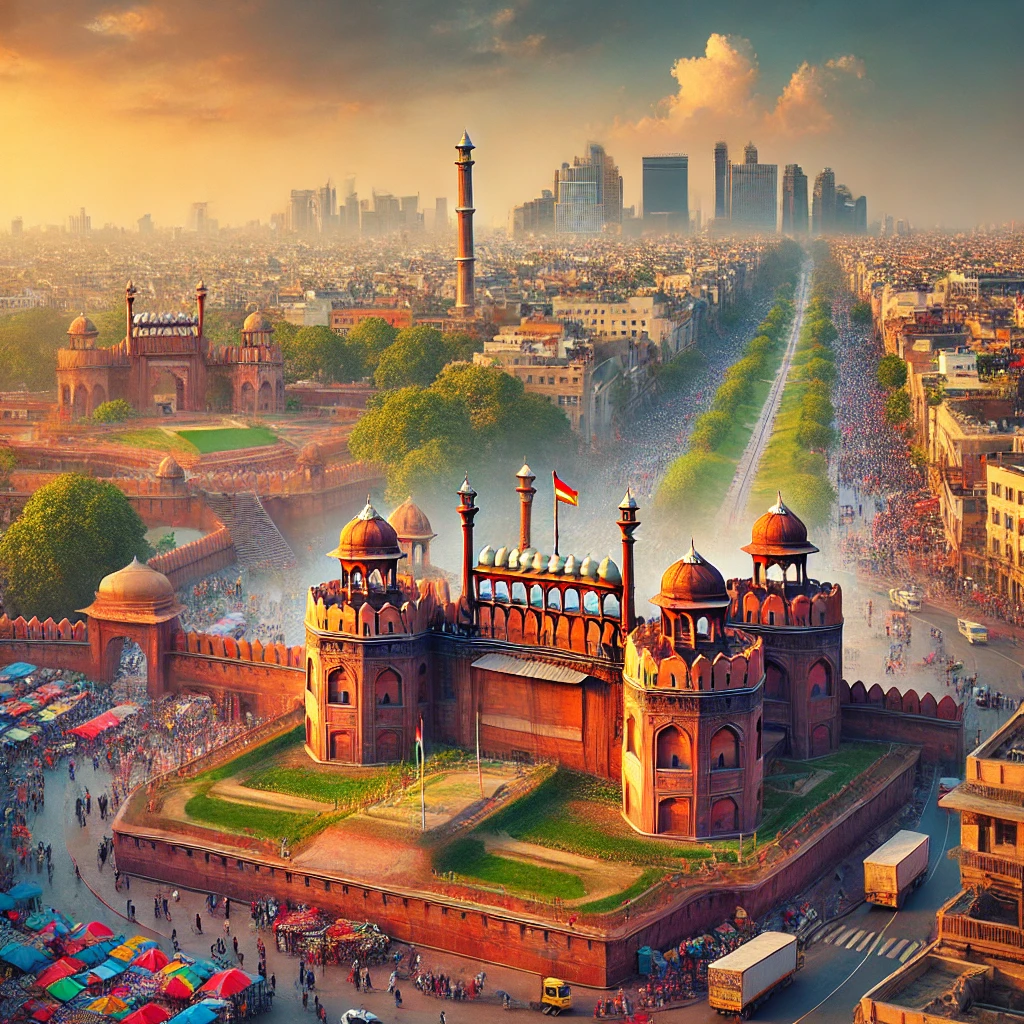
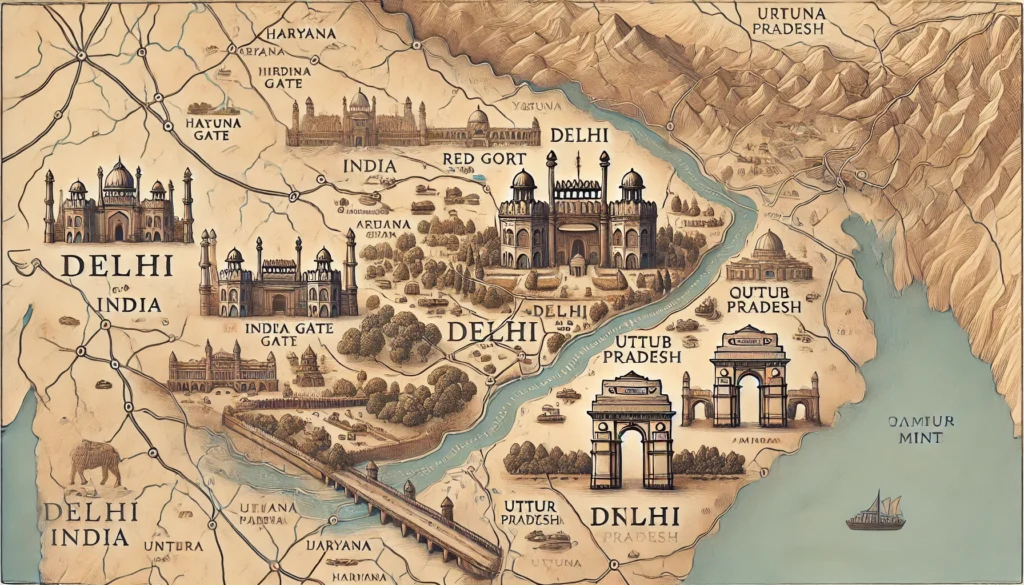
Geographical Location of Delhi
The geographical location of Delhi gives it a prominent place in the northern region of India. It is an important center of the country, from where different parts of India can be easily connected. Due to its strategic position, Delhi has remained significant throughout history as well as in modern times.
1. Latitude and Longitude
Delhi is located at 28.61° North Latitude and 77.23° East Longitude. It lies in the Northern Hemisphere and forms part of the north-western region of the Indian subcontinent.
2. Boundary and Area
The total area of Delhi is approximately 1,484 square kilometres.
- Haryana lies to the north, west, and south of Delhi.
- Uttar Pradesh lies to the east, across the Yamuna River.
3. Rivers and Water Sources
Yamuna River
The Yamuna River is the main river of Delhi and flows through its eastern part. It is the primary source of water for the city and holds great historical importance.
The Yamuna floodplain is suitable for agriculture and helps in flood control, but rapid urban development has increased pollution in the river.
4. Topography (Physical Structure)
Delhi is mainly a part of the Gangetic Plain. The terrain is largely flat, though some elevated areas exist.
Aravalli Hills
The Aravalli Hills extend across southern Delhi. These hills contribute to green areas such as Sanjay Van and the Asola Bhatti Wildlife Sanctuary, helping maintain ecological balance.
Most of Delhi’s soil is fertile, making it suitable for agriculture and horticulture.
5. Climate and Weather
Delhi experiences a tropical monsoon climate with four main seasons:
- Summer (March–June): Temperature can rise up to 45°C.
- Monsoon (July–September): Rainfall mainly affects the Yamuna basin.
- Winter (December–February): Temperature may drop to around 4°C.
- Spring & Autumn: Pleasant weather during February–March and October–November.
6. National Capital Region (NCR)
Delhi is part of the National Capital Region (NCR), which includes surrounding cities such as Gurugram, Noida, Ghaziabad, and Faridabad. This region was developed to reduce population pressure and manage urban growth.
7. Natural Resources and Environment
- Yamuna Floodplain: Important for agriculture, groundwater recharge, and biodiversity.
- Green Areas: The Aravalli range and Delhi Ridge help maintain environmental balance.
8. Geographical Importance for Transportation
Delhi’s central location makes it a major transportation hub. National highways, railways, and air routes extend from Delhi to all parts of India.
It provides easy access to the Himalayan region, the western desert, and the fertile Gangetic plains.
Conclusion
Delhi’s geographical location makes it the political, economic, and cultural center of India. The Yamuna River, Aravalli Hills, fertile plains, and central connectivity give Delhi both historical importance and modern relevance.
History of Delhi
The history of Delhi reflects India’s rich and diverse past. For thousands of years, the city has been a center of civilization, culture, politics, and commerce. Its journey spans from ancient mythology to becoming the capital of modern India.
1. Ancient Period

⭐ Recommended Study Resource
Explore a highly rated educational resource selected to support learning, revision, and exam preparation with trusted content and positive reader feedback.
Mahabharata Era (c. 1200–800 BCE)
Delhi was originally known as Indraprastha, the capital of the Pandavas as described in the Mahabharata. It is believed to have been a magnificent city on the banks of the Yamuna River and played a central role in the Mahabharata war.
Maurya and Gupta Periods (322 BCE – 550 CE)
During the Maurya Empire, Delhi was economically and strategically important. Under the Gupta Empire, it emerged as a center of education, art, and culture.
2. Medieval Period
Delhi Sultanate (1206–1526)
Slave Dynasty (1206–1290)
Qutbuddin Aibak founded the Delhi Sultanate. Important constructions such as the Qutub Minar and Quwwat-ul-Islam Mosque were built during this time.
Khilji Dynasty (1290–1320)
Alauddin Khilji expanded the empire and strengthened Delhi as a military and commercial center.
Tughlaq Dynasty (1320–1414)
Rulers like Muhammad bin Tughlaq and Firoz Shah Tughlaq developed new settlements such as Tughlaqabad.
Sayyid and Lodi Dynasties (1414–1526)
The Lodi dynasty contributed significantly to Delhi’s architecture by building mosques, gardens, and tombs.
Mughal Period (1526–1857)
After the First Battle of Panipat in 1526, Babur founded the Mughal Empire. In 1638, Shah Jahan made Delhi the Mughal capital and named it Shahjahanabad.
Major constructions of this era include the Red Fort, Jama Masjid, and Chandni Chowk. Delhi became a major center of art, culture, and architecture.
3. Colonial Period
Delhi was ruled by the Marathas in the late 18th century and was captured by the British in 1803.
Revolt of 1857
Delhi became the center of the First War of Independence in 1857. Mughal Emperor Bahadur Shah Zafar was exiled, and British control was firmly established.
Establishment of New Delhi (1911–1931)
In 1911, the British shifted India’s capital from Kolkata to Delhi. New Delhi was designed by Sir Edwin Lutyens and Herbert Baker and inaugurated in 1931.
4. Modern Period
Independence and Partition (1947)
Delhi played a major role in India’s freedom struggle and witnessed a massive influx of refugees during Partition, leading to rapid urban and industrial growth.
Delhi in Independent India
Delhi became the capital of India in 1950. In 1991, it was granted the status of the National Capital Territory (NCT) with partial administrative autonomy.
5. Seven Cities of Delhi
- Fort Rai Pithora – Prithviraj Chauhan
- Siri – Alauddin Khilji
- Tughlaqabad – Ghiyasuddin Tughlaq
- Jahanpanah – Muhammad bin Tughlaq
- Firozabad – Firoz Shah Tughlaq
- Dinpanah – Sher Shah Suri and Humayun
- Shahjahanabad – Shah Jahan
6. Importance of Delhi
- Political Center: The heart of India’s governance.
- Cultural Heritage: Home to monuments, museums, and art institutions.
- Modern Development: Rapid growth in education, technology, and commerce.
Conclusion
The history of Delhi makes it a powerful symbol of India’s cultural and historical identity. From ancient civilizations to a modern capital, Delhi represents a unique blend of continuity and change, where the past and present coexist in harmony.
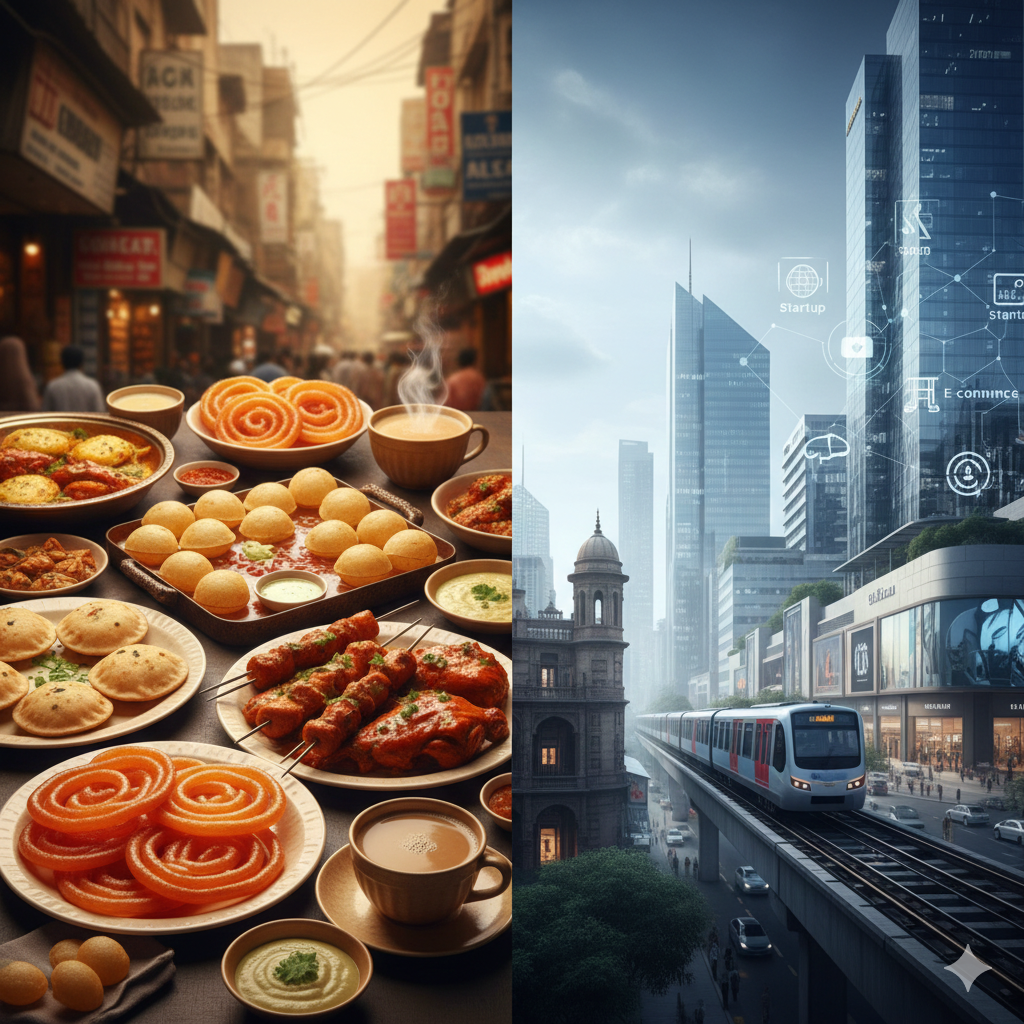
Food in Delhi
Delhi’s food is a reflection of its culture and history. The cuisine of the city is a fusion of various traditions, religions, and regional flavours. From street food and Mughlai delicacies to Punjabi dishes and modern restaurant cuisine, Delhi truly feels like a paradise for food lovers.
1. Street Food of Delhi
Delhi’s street food is famous all over India for its taste, variety, and affordability.
a) Chandni Chowk Cuisine
Paratha Wali Gali
Famous for stuffed parathas filled with potatoes, paneer, mixed vegetables, dry fruits, and cheese.
Dahi Bhalle
Soft lentil dumplings soaked in yogurt and served with sweet and spicy chutneys.
Nagori Halwa and Bedmi Puri
A traditional breakfast combination, especially popular in Old Delhi.
Jalebi
Hot, sweet, and juicy jalebis are a favourite dessert in Chandni Chowk.
b) Karol Bagh and Sarojini Nagar
Golgappas
Crispy golgappas filled with spicy, tangy, and sweet water are extremely popular.
Chaat
Aloo Tikki, Papdi Chaat, Bhalle, and Raj Kachori are widely enjoyed street snacks.
Momos (Dim Sum)
Steamed and fried momos have become an integral part of Delhi’s street food culture.
2. Mughlai Cuisine
Mughlai food in Delhi is a legacy of the Delhi Sultanate and the Mughal era, known for its rich flavours, slow cooking techniques, and aromatic spices.
a) Main Dishes
Biryani
Chicken and mutton biryani are especially famous in Old Delhi.
Kebabs
Galouti Kebab, Shami Kebab, and Tikka are widely loved. Restaurants like Karim’s are renowned for authentic Mughlai cuisine.
Butter Chicken
A modern dish with Mughlai roots, butter chicken is one of Delhi’s most popular dishes.
Nihari
A slow-cooked mutton or beef curry, traditionally eaten for breakfast.
Rumali Roti and Naan
Thin flatbreads served with curries and kebabs.
3. Punjabi and North Indian Cuisine
Punjabi cuisine has deeply influenced Delhi’s food culture, especially after Partition.
a) Famous Dishes
- Chole Bhature – the most popular breakfast in Delhi
- Dal, Rajma, and Rice – staple home-style meals
- Sarson ka Saag and Makki ki Roti – winter special
- Lassi – a thick, creamy traditional drink
b) Punjabi Dhabas and Restaurants
Dhabas in Delhi are famous for rich gravies, butter-loaded dishes, and paneer-based preparations.
4. Modern and International Cuisine
a) Multi-Cuisine Restaurants
Delhi’s five-star hotels, cafes, and restaurants serve global cuisines such as Italian, Chinese, Thai, and continental food.
b) Popular Food Hubs
Hauz Khas Village, DLF Cyber Hub, and Connaught Place are known for cafés and fusion food. Innovations like pizza samosas and chocolate momos are popular trends.
5. Sweets and Desserts
a) Traditional Sweets
- Rasgulla
- Sohan Halwa
- Boondi Laddoo
b) Modern Desserts
Cheesecakes, brownies, and ice creams are popular among the youth. Famous places include Big Chill Café and Amul outlets.
6. Tea and Street Drinks
a) Tea Culture
Masala chai and kulhad chai are enjoyed across the city, often accompanied by samosas and pakoras.
b) Other Beverages
- Kulfi-Falooda – especially popular in Chandni Chowk
- Mango Panna and Wood Apple (Bael) Sharbat in summer
- Lemonade and Masala Soda
7. Food Festivals and Events
- Delhi Street Food Festival
- Great Indian Food Festival
8. Top Food Spots of Delhi
- Chandni Chowk: Paratha Wali Gali, Karim’s, traditional sweet shops
- Connaught Place: Modern cafés and fine-dining restaurants
- Sarojini Nagar & Lajpat Nagar: Famous for street food
- Saket & Hauz Khas: International and fusion cuisine
Conclusion
Delhi’s food represents its diversity and cultural richness. Whether it is street food, traditional cuisine, or modern dishes, every food lover can find something to enjoy. Food in Delhi is not just about taste, but also about experiencing the city’s culture and lifestyle.
Modernity and Trade in Delhi
Delhi: A Confluence of Modernity and Commerce
Delhi, the capital of India, is not only a center of historical and Cultural Heritage but also a major hub of modernity and commerce. The city plays a vital role in India’s economy, trade, and modern lifestyle.
1. Modernity in Delhi

⭐ Recommended Study Resource
Explore a highly rated educational resource selected to support learning, revision, and exam preparation with trusted content and positive reader feedback.
a) Modern Architecture and Infrastructure
Delhi Metro
The Delhi Metro is one of India’s most modern and efficient transportation systems.
Modern Buildings and Skyscrapers
Areas such as Connaught Place, Barakhamba Road, Saket, and Cyber Hub (Gurugram) showcase modern corporate architecture.
Smart City Initiative
Under the Smart City Project, technology-driven infrastructure and green spaces are being developed.
b) Technological and Digital Advancements
Delhi has witnessed rapid growth in e-commerce, IT startups, and fintech. Free Wi-Fi zones and digital service centers have made daily life more convenient.
c) Modern Lifestyle
Mall culture has expanded rapidly, with places like DLF Mall of India and Select City Walk becoming popular shopping and entertainment destinations.
Cafes, pubs, and food hubs in Hauz Khas Village, Connaught Place, and Cyber Hub reflect the influence of global culture and fashion.
2. Business in Delhi
a) Historical Perspective
Delhi has been a center of trade since ancient times. Markets like Chandni Chowk have functioned as commercial hubs since the Mughal era.
b) Present-Day Business Scenario
WHOlesale Markets
- Sadar Bazaar – India’s largest wholesale market
- Khari Baoli – Asia’s largest spice market
Business Districts
Connaught Place, Nehru Place, and Gurugram are major centers of trade and finance.
Electronics Market
Nehru Place is India’s largest IT and electronics market.
c) Major Industries
- Fashion and Textiles
- Handloom and Handicrafts (Delhi Haat, trade fairs)
- IT and Software
- Food and Restaurant Industry
d) Startup Ecosystem
Delhi-NCR is the second-largest startup hub in India. Startups like Flipkart, Zomato, and Paytm emerged from this region, supported by domestic and international investors.
3. Economic Progress of Delhi
a) GDP Contribution
Delhi has one of the highest per capita incomes in India, with trade, services, and manufacturing contributing significantly to its economy.
b) Foreign Investment
Foreign Direct Investment (FDI) has increased rapidly. Indira Gandhi International Airport plays a key role in global trade and connectivity.
c) Trade Fairs and Expos
- Pragati Maidan – international trade fairs and exhibitions
- India Expo Centre, Greater Noida – global business events
4. Employment and Entrepreneurship
a) Employment Opportunities
Delhi offers employment in sectors such as healthcare, education, IT, and business, attracting youth from across India.
b) Entrepreneurship
Government initiatives like Startup India and Make in India promote entrepreneurship. Markets such as Delhi Haat support small and medium enterprises.
5. Challenges and Solutions
Challenges
- Rising pollution
- Traffic congestion and infrastructure pressure
- Overcrowding in unplanned commercial areas
Solutions
- Expansion of public transport and green spaces
- Smart City initiatives
- Digital India for transparent administration
Conclusion
Delhi stands as a symbol of modernity and commerce. Beyond politics and administration, it is a major economic and cultural force. With advanced infrastructure, strong business activity, and global connectivity, Delhi continues to rank among India’s most progressive cities.
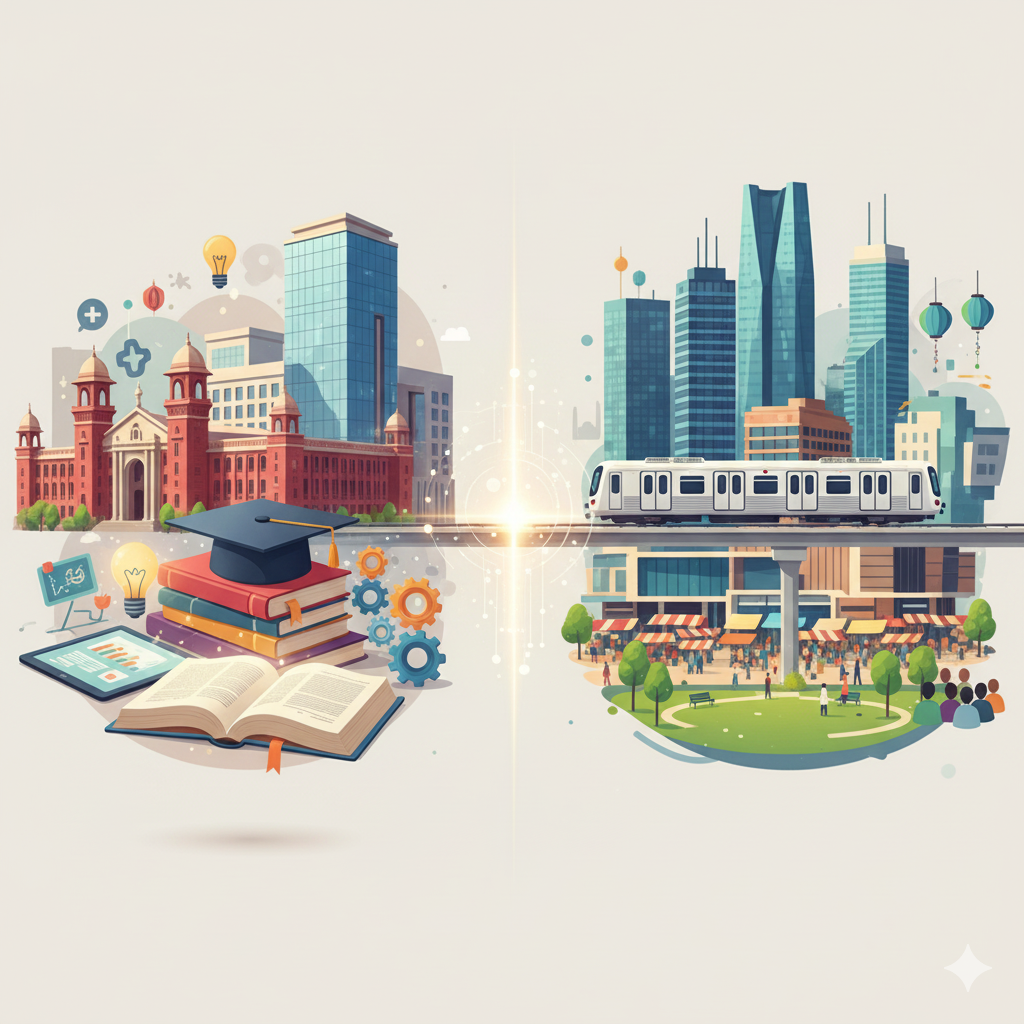
Education and Institutions in Delhi
Delhi: Education and Major Institutions
Delhi, the capital of India, is a major centre of education. The educational institutions of the city are renowned not only at the national level but also internationally. Delhi offers excellent educational facilities at every stage, from primary education to higher and professional studies.
1. Educational Structure of Delhi
a) Primary and Secondary Education
Delhi has a large network of government, private, and international schools. Schools affiliated with CBSE and ICSE boards are widely available.
The Delhi Government has introduced initiatives such as the Mohalla Classroom and the Happiness Curriculum, which have significantly improved the quality of education in government schools.
b) Centre of Higher Education
Delhi is a major hub of higher education, hosting some of India’s top universities and colleges. Both traditional academic disciplines and modern professional courses are promoted here.
2. Major Educational Institutions of Delhi
a) Universities
University of Delhi (DU)
One of the most prestigious universities in India, DU includes renowned colleges such as St. Stephen’s College, Hindu College, and Shri Ram College of Commerce (SRCC). It offers excellence in Arts, Science, Commerce, and Management.
Jawaharlal Nehru University (JNU)
JNU is famous for social sciences, international studies, and language programmes. The university is also known for its academic and intellectual debates.
Indira Gandhi National Open University (IGNOU)
IGNOU is the world’s largest distance learning institution, providing education to millions of students across India and abroad.
Guru Gobind Singh Indraprastha University (GGSIPU)
A leading university for professional courses, offering education in engineering, management, law, and health sciences.
b) Institutes of Engineering and Technology
Indian Institute of Technology, Delhi (IIT Delhi)
One of the top technical institutes in India, IIT Delhi is renowned for engineering, research, and innovation.
Delhi Technological University (DTU)
Formerly known as Delhi College of Engineering (DCE), DTU is a centre of excellence in engineering and technology.
c) Medical Institutions
All India Institute of Medical Sciences (AIIMS)
AIIMS is India’s most prestigious medical institute and a leader in medical education and research.
Maulana Azad Medical College (MAMC)
A major centre for medical education and healthcare services in Delhi.
d) Management and Communication Institutes
Indian Institute of Mass Communication (IIMC)
Renowned for studies in journalism, media, and communication.
Faculty of Management Studies (FMS), University of Delhi
One of the most prestigious management institutes in India.
e) Law Institutions
National Law University, Delhi (NLU Delhi)
One of India’s top law universities, offering excellence in legal education and justice studies.
Faculty of Law, University of Delhi
A major hub for legal education and research.
f) Other Important Institutions
- National School of Drama (NSD) – theatre and dramatic arts
- Indian Statistical Institute (ISI) – statistics and analytical studies
- Siri Fort Auditorium – cultural and educational activities
3. Research and Innovation in Delhi
Research institutions such as CSIR and DRDO contribute significantly to scientific and technological development. The Indian Agricultural Research Institute (IARI) is a leading centre for agricultural research.
Areas like Nehru Place and Gurugram are witnessing rapid growth in startups and technological innovation.
4. Education Reforms and Initiatives
a) Delhi Government Initiatives
- Happiness Curriculum: Focus on students’ mental and emotional well-being
- Entrepreneurship Mindset Curriculum (EMC): Promotes entrepreneurial thinking
- Mission Foundation: Improves basic reading, writing, and numeracy skills
b) Digital Education
The use of smart classrooms, digital boards, and online learning platforms is increasing rapidly.
5. Educational Importance of Delhi
Students from all parts of India come to Delhi for education. The city’s academic environment encourages holistic development and enables students to excel at national and international levels.
Conclusion
Delhi stands as India’s leading centre of education and institutions. The combination of academic excellence, institutional diversity, and progressive government initiatives makes Delhi the educational hub of India.

⭐ Recommended Study Resource
Explore a highly rated educational resource selected to support learning, revision, and exam preparation with trusted content and positive reader feedback.
Delhi: Population and Lifestyle
Delhi reflects diverse aspects of population and lifestyle. Beyond being an administrative and cultural centre, the city is home to people from varied social, economic, and cultural backgrounds.
1. Population: A Diverse Society
a) Population Size and Density
Delhi is one of the most populous metropolitan cities in India. According to 2021 estimates, the population is around 2 crore.
The population density is approximately 11,000 persons per square kilometre, making Delhi one of the most densely populated cities in the world. About 97% of Delhi is urban.
b) Demographic Diversity
Religious Diversity
Delhi is home to Hindus, Muslims, Sikhs, Christians, Jains, and people of other religions. Major religious groups include Hindus (81%), Muslims (12.9%), Sikhs (4%), and Christians (0.9%).
Linguistic Diversity
Hindi, Punjabi, Urdu, and English are widely spoken. Due to migration, languages such as Bengali, Malayalam, and others are also common.
Migrant Population
People migrate to Delhi from across India for employment, education, and better living standards.
c) Social Structure
Delhi’s society includes people from different classes, castes, and income levels, combining traditional values with a modern and global outlook.
2. Lifestyle of Delhi
a) Busy and Modern Lifestyle
The work culture in Delhi is fast-paced and competitive, influenced by corporate, government, startup, and retail sectors.
b) Living Conditions
Accommodation
- Posh areas: Lutyens’ Zone, Vasant Vihar, ChanakyaPuri
- Middle-class areas: Preet Vihar, Rajouri Garden, Janakpuri
- Slum areas: Yamuna Pushta, parts of Aurangabad
Food Culture
Food is an integral part of Delhi’s lifestyle, ranging from street food to luxury dining.
Fashion and Shopping
Delhi is a fashion hub, offering everything from affordable street markets to premium brands in malls such as DLF and Ambience.
c) Entertainment and Culture
Multiplexes, theatres, pubs, music concerts, and cafés attract the youth. Festivals such as Diwali, Holi, Eid, Baisakhi, and Christmas are celebrated with great enthusiasm.
d) Health and Fitness
Gyms, yoga centres, parks, and fitness clubs are widespread, reflecting growing health awareness.
3. Impact of Population on Lifestyle
a) Congestion and Pollution
High population density has led to congestion and pollution. Air quality often deteriorates, especially during winter.
b) Pressure on Resources
Rapid population growth puts pressure on water supply, electricity, housing, and transport systems.
c) Social Issues
Slum areas face challenges such as low living standards, unemployment, and informal labour.
4. Lifestyle Classes in Delhi
- Upper Class: Elite areas, luxury lifestyle, international exposure
- Middle Class: Apartments, focus on education and career growth
- Lower Class: Daily wage work and small-scale occupations
5. Challenges and Opportunities
Challenges
- Air and water pollution
- Traffic congestion
- Housing shortages
Opportunities
- Smart City projects
- Green initiatives
- Expansion of metro and road infrastructure
Conclusion
Delhi’s population and lifestyle symbolise diversity and growth. Despite challenges, the city’s energy, opportunities, and cultural vibrancy make it one of India’s most dynamic and important cities.
References

⭐ Recommended Study Resource
Explore a highly rated educational resource selected to support learning, revision, and exam preparation with trusted content and positive reader feedback.
- Government of India. Ministry of Environment, Forest and Climate Change – Air Pollution Reports.
- Central Pollution Control Board (CPCB). Air Quality Index (AQI) Data and Environmental Statistics.
- Government of NCT of Delhi. Delhi Economic Survey and Urban Development Reports.
- Census of India. Population and Urbanisation Data (2011–2021 Estimates).
- Delhi Jal Board (DJB). Water Supply, Groundwater and Yamuna River Reports.
- Ministry of Housing and Urban Affairs. Smart City Mission and Urban Transport Initiatives.
- World Health Organization (WHO). Urban Air Pollution and Public Health Studies.
- United Nations Environment Programme (UNEP). Climate Change and Sustainable Cities Reports.