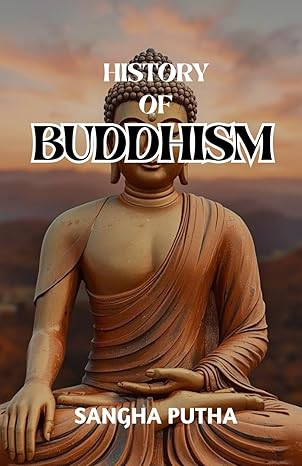
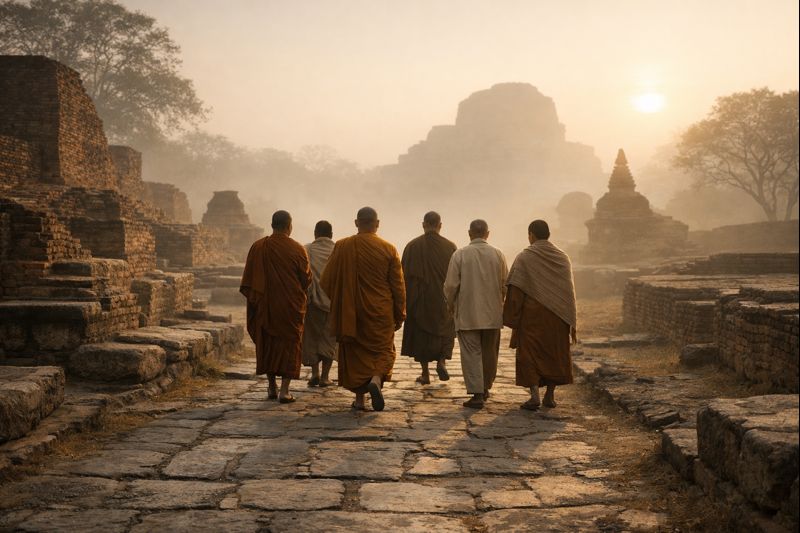
Buddhist Sangha and Its Expansion: A Journey of Collective Awakening
There was a time in my life when progress felt fast, opportunities seemed endless, yet something essential was missing. Days were filled with information, conversations, and ambition, but nights were often silent and restless. In that silence, a quiet question emerged again and again: Why does modern life feel so connected, yet so deeply lonely? It was during this phase of inner uncertainty that my journey toward understanding the Buddhist Sangha and Its Expansion truly began.
Like many seekers, my first encounter with Buddhism came through its philosophy of suffering and liberation. The Four Noble Truths explained pain with remarkable clarity, and the Eightfold Path offered a disciplined way forward. Yet it was not these teachings alone that left the deepest impression on me. What struck me most was the Buddha’s emphasis on Sangha—the community. Liberation, I realized, was never imagined as a purely individual escape, but as a shared human responsibility.
The broader context of Buddhist Sangha and Its Expansion helps us understand how spiritual communities shaped long-term civilizational change.
As I read more, I discovered that the Sangha was not merely an institution created for monks and renunciants. It was a revolutionary social idea in an age dominated by hierarchy, caste divisions, and ritual authority. The Buddha challenged this structure by creating a community where birth did not determine dignity, and where ethical conduct mattered more than lineage. This realization forced me to reflect on my own social environment—how often we measure worth through status rather than character.
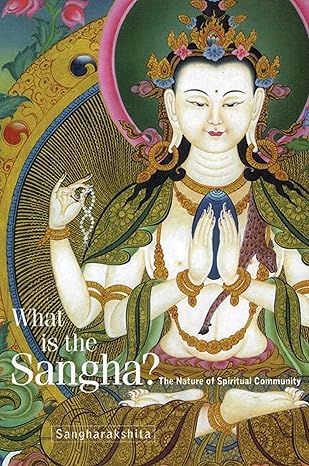
The story of the Buddhist Sangha felt strangely modern. In a world overwhelmed by competition, isolation, and mental distress, the Sangha offered an alternative vision: a disciplined yet compassionate collective, bound not by blood or power, but by shared values and mutual care. The Sangha functioned as a space where individuals could grow spiritually while remaining deeply connected to others. It was neither escapism nor withdrawal, but a conscious reorganization of human life.
While exploring its historical roots, I began to see the Sangha as a living response to human vulnerability. The Buddha understood that wisdom without support could easily fade, and discipline without compassion could turn rigid. By establishing the Sangha, he ensured that the Dhamma would not remain abstract philosophy, but a lived experience—practiced, corrected, and preserved collectively. This insight changed how I viewed learning itself: knowledge survives not through books alone, but through communities that embody it.
My personal reflections soon merged with historical curiosity. How did a small group of wandering ascetics transform into a global spiritual network spanning Sri Lanka, Southeast Asia, Central Asia, China, Korea, Japan, and Tibet? What allowed the Buddhist Sangha to cross cultural, linguistic, and political boundaries while maintaining its ethical core? These questions revealed that the expansion of the Sangha was not driven by force or conversion, but by example, discipline, and moral credibility.
The expansion of the Buddhist Sangha also highlighted a powerful paradox. Although its members renounced worldly power, their influence shaped kings, empires, education systems, and social ethics. From Emperor Ashoka’s patronage to the great monastic universities of Nalanda and Vikramashila, the Sangha became a guiding moral force rather than a ruling authority. This reminded me that true influence often grows from restraint, not domination.
In my own life, the idea of Sangha slowly transformed from a historical concept into a personal lesson. It challenged the modern obsession with self-made success and individual achievement. The Sangha taught me that growth is sustainable only when supported by ethical communities, shared responsibility, and mindful relationships. Even outside monastic life, its principles remain deeply relevant to families, workplaces, and societies struggling with fragmentation.
This article, therefore, is not merely a historical account of the Buddhist Sangha. It is a deeper reflection on Buddhist Sangha and Its Expansion across regions, cultures, and centuries—an expansion that reshaped civilizations and continues to offer guidance in an age of anxiety, conflict, and disconnection. By weaving together historical analysis and personal reflection, this exploration seeks to answer a timeless question: Can humanity still learn to walk together on the path of wisdom?
Meaning and Concept of the Buddhist Sangha
To understand the true depth of the Buddhist Sangha, one must first move beyond its surface-level definition. In common usage, the Sangha is often described simply as the community of Buddhist monks and nuns. While this definition is not incorrect, it remains incomplete. In Buddhist thought, the Sangha represents a profound ethical and spiritual structure—one designed to preserve wisdom, cultivate discipline, and sustain collective awakening across generations.
The term Sangha originates from the ancient Indic languages of Pali and Sanskrit, where it broadly means an “assembly,” “association,” or “community.” In the context of Buddhism, however, it acquires a specialized meaning. The Sangha refers to those who have consciously committed themselves to the path laid down by the Buddha, living according to the Dhamma and the Vinaya. This commitment transforms the Sangha from a social gathering into a moral institution.
Sangha as One of the Three Jewels
In Buddhism, spiritual refuge is taken in the Three Jewels (Triratna): the Buddha, the Dhamma, and the Sangha. The placement of the Sangha alongside the Buddha and his teachings is deeply significant. It indicates that wisdom alone is insufficient unless it is practiced, embodied, and transmitted through a living community. The Sangha acts as the human bridge between timeless truth and everyday life.
From this perspective, the Sangha is not secondary to enlightenment—it is essential to it. The Buddha may have discovered the path, and the Dhamma may articulate it, but without the Sangha, these teachings would risk remaining theoretical. The Sangha ensures continuity, interpretation, and ethical accountability, allowing the Dhamma to remain a lived reality rather than a distant ideal.
Monastic Sangha and the Ideal of Renunciation
Historically, the Buddhist Sangha first took shape as a monastic community of renunciants who voluntarily stepped away from household life. This renunciation was not an act of rejection toward society, but a disciplined experiment in simplified living. By reducing material attachments, the monastic Sangha sought to create conditions favorable for mindfulness, ethical conduct, and insight.
The monastic Sangha was governed by the Vinaya, a detailed code of conduct that regulated behavior, relationships, and communal harmony. Far from being restrictive, these rules served a liberating purpose. They protected the community from internal conflict, ego-driven authority, and moral decay. In my own reflection, this balance between freedom and discipline revealed a timeless lesson: structure, when guided by ethical intent, can deepen rather than limit human freedom.
The Broader Concept of the Noble Sangha
Beyond the institutional monastic order lies the concept of the Noble Sangha (Ariya Sangha). This refers not merely to ordained monks and nuns, but to all individuals—monastic or lay—who have attained stages of spiritual realization. In this sense, the Sangha transcends robes, rituals, and titles. It becomes a community of practice defined by inner transformation rather than external identity.
This broader understanding challenges rigid boundaries between renunciant and householder life. It suggests that the essence of the Sangha lies not in physical withdrawal from society, but in ethical clarity, mental discipline, and compassionate engagement. Such an interpretation makes the Sangha deeply relevant to modern life, where spiritual aspiration must often coexist with professional and social responsibilities.
Many scholars interpret Buddhist Sangha and Its Expansion as a unique model of ethical institutional development in world history.
Sangha as a Social and Ethical Experiment
At a societal level, the Buddhist Sangha represented a radical departure from the norms of its time. In an era marked by caste hierarchy and ritual privilege, the Sangha was founded on principles of equality and moral merit. Entry into the Sangha was not determined by birth, wealth, or social rank, but by willingness to follow the path of ethical conduct and wisdom.
This inclusive structure transformed the Sangha into one of history’s earliest sustained experiments in ethical community living. Decisions were made collectively, conflicts were resolved through dialogue, and authority was balanced by shared responsibility. The Sangha demonstrated that social harmony could be built not through coercion, but through mutual respect and common purpose.
The Sangha as a Living Institution
Perhaps the most enduring aspect of the Buddhist Sangha is its adaptability. While its core ethical principles remained stable, its external forms evolved across regions and cultures. As Buddhism spread beyond India, the Sangha absorbed local languages, customs, and educational methods without compromising its foundational values. This flexibility allowed it to survive political change, cultural diversity, and historical upheaval.
Reflecting on this adaptability, I came to see the Sangha not as a rigid religious institution, but as a living organism—capable of growth, self-correction, and renewal. Its resilience lay in its ability to preserve meaning while allowing form to change. In a rapidly transforming modern world, this lesson feels especially relevant: institutions endure not by resisting change, but by aligning change with ethical clarity.
Thus, the meaning of the Buddhist Sangha extends far beyond its historical origins. It embodies a vision of collective awakening, ethical responsibility, and shared human growth. Understanding this concept is essential before tracing the Sangha’s historical expansion, for without grasping its inner logic, its remarkable journey across continents and centuries cannot be fully appreciated.
The Establishment of the Buddhist Sangha
The establishment of the Buddhist Sangha was not the result of a grand plan or institutional ambition. It emerged organically from human encounter, lived experience, and shared transformation. After attaining enlightenment under the Bodhi tree at Bodh Gaya, the Buddha did not immediately seek followers or construct an organization. Instead, he spent weeks in silent reflection, contemplating whether the profound truth he had realized could be understood by others.
This moment of hesitation reveals something deeply human about the origins of the Sangha. The Buddha recognized that awakening was subtle, demanding, and easily misunderstood. Yet compassion prevailed over doubt. Moved by concern for those still trapped in suffering, he chose to teach—not to convert, but to share a path of liberation. The Sangha would be born from this decision to walk alongside others rather than remain alone in insight.
The First Disciples and the Birth of Community
The formal beginning of the Buddhist Sangha can be traced to the Buddha’s first sermon at the Deer Park in Sarnath. There, he encountered the five ascetics (Pañcavaggiya) who had previously practiced severe austerities with him. When these five understood the essence of the Middle Way and realized the Dhamma, they requested ordination. With this simple act, a solitary awakening transformed into a shared journey.
The Buddha’s words, “Come, bhikkhu” (Ehi Bhikkhu), marked more than an invitation—they established a new form of human association. No rituals of birth, caste, or wealth were required. What mattered was intention, understanding, and commitment to ethical living. This moment symbolizes the Sangha’s core principle: belonging is earned through practice, not inherited through status.
Ordination and the Spirit of Equality
Early ordination into the Sangha was strikingly simple, reflecting its ethical foundation rather than ceremonial complexity. The renunciant life was open to individuals from diverse backgrounds—princes, merchants, farmers, and even former outcasts. By accepting all who sincerely sought liberation, the Sangha challenged the rigid social hierarchies of ancient Indian society.
This radical inclusivity transformed the Sangha into a quiet social revolution. Within its boundaries, personal conduct outweighed social identity. In my own reflection, this aspect of the Sangha felt especially powerful. It questioned modern forms of exclusion that persist today—based on class, education, or privilege—and offered a timeless reminder that dignity arises from character, not credentials.
The early phase of Buddhist Sangha and Its Expansion reveals how small spiritual communities can evolve into enduring institutions.
The Role of Vinaya in Shaping the Sangha
As the community grew, the need for structure became evident. The Vinaya evolved gradually in response to real situations. Each rule emerged from lived experience, addressing conflicts, misunderstandings, or ethical lapses. This adaptive process ensured that discipline remained grounded in compassion rather than authority.
The Vinaya served not as a mechanism of control, but as a framework for harmony. It regulated relationships, resolved disputes, and protected the Sangha’s moral integrity. This balance between flexibility and discipline offers a profound lesson for institutions of all kinds: rules are most effective when they respond to human needs rather than abstract ideals.
From Individual Seekers to a Collective Path
With the formation of the Sangha, spiritual practice was no longer an isolated endeavor. Monks traveled, taught, debated, and supported one another. Learning occurred through dialogue, shared meditation, and communal reflection. This collective approach ensured that wisdom was refined through interaction rather than preserved as personal insight alone.
Over time, the Sangha became a space where individual transformation contributed to collective stability, and collective discipline supported individual growth. This mutual relationship between self and community formed the backbone of the Sangha’s resilience. It ultimately laid the foundation for Buddhist Sangha and Its Expansion across regions, cultures, and centuries.
The Sangha as the Buddha’s Enduring Legacy
Unlike many spiritual founders who left behind texts or doctrines alone, the Buddha’s most enduring legacy was the Sangha itself. He understood that teachings require living custodians—individuals who embody, preserve, and transmit wisdom through example. The Sangha fulfilled this role, becoming the ethical backbone of the Buddhist tradition.
As I reflected on this historical moment, I realized that the establishment of the Sangha was not merely the creation of a religious order. It was the foundation of a sustainable spiritual ecosystem—one capable of adapting, correcting itself, and guiding humanity long after the Buddha’s physical presence had ended.
Thus, the establishment of the Buddhist Sangha marks a turning point in human spiritual history. It transformed enlightenment from a solitary realization into a shared responsibility, laying the groundwork for the Sangha’s remarkable expansion across cultures, continents, and centuries.

Early Expansion of the Buddhist Sangha in India
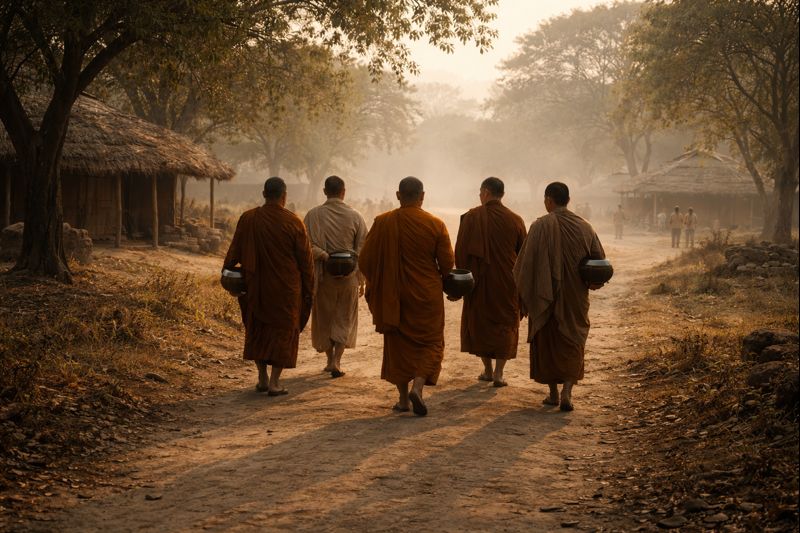
Once the Buddhist Sangha had taken root, its expansion across the Indian subcontinent unfolded not through conquest or compulsion, but through quiet movement, ethical example, and sustained dialogue with society. The early monks did not seek to build empires or impose belief systems. Instead, they walked village to village, town to town, carrying little more than their robes, bowls, and a disciplined way of life that spoke louder than words.
This early phase of expansion reveals an important pattern: the Sangha grew because it addressed real human needs. In a society marked by ritual complexity, caste stratification, and spiritual uncertainty, the Sangha offered clarity, accessibility, and moral consistency. The Dhamma was preached in local languages, explained through relatable examples, and practiced openly in everyday settings. This foundational stage laid the groundwork for what would later become Buddhist Sangha and Its Expansion across regions, cultures, and centuries.
Geographical Spread from the Middle Ganges Region
The initial expansion of the Sangha occurred in the fertile and densely populated regions of the Middle Ganges valley. Areas such as Magadha, Kosala, Vaishali, and Kashi became early centers of Buddhist activity. These regions were economically vibrant and intellectually active, providing fertile ground for new philosophical ideas.
Monasteries were often established near trade routes, urban centers, and royal capitals. This strategic positioning allowed monks to interact with merchants, travelers, scholars, and rulers alike. Over time, these monasteries evolved into hubs of learning and ethical guidance, extending the influence of the Sangha far beyond their immediate surroundings.
Royal Patronage and Social Acceptance
While the Sangha was fundamentally independent of political power, royal patronage played a crucial role in its early expansion. Kings such as Bimbisara and Prasenajit offered land, resources, and protection to monastic communities. Importantly, this support did not translate into control. The Sangha maintained its autonomy, reinforcing its moral authority and public trust.
At the same time, the Sangha earned acceptance among common people. Lay followers supported monks through alms, while receiving ethical guidance and spiritual instruction in return. This reciprocal relationship created a sustainable model of coexistence between renunciant and household life. Reflecting on this balance, I saw how mutual respect—rather than dependency—enabled the Sangha to grow without losing integrity.
Historians often emphasize Buddhist Sangha and Its Expansion in India as a model of peaceful religious diffusion.
Role of Lay Communities in Expansion
The expansion of the Sangha cannot be understood without acknowledging the role of lay supporters. Householders provided food, shelter, and material necessities, while monks offered teachings, counseling, and moral leadership. This partnership allowed the Sangha to remain rooted in society while maintaining its spiritual focus.
Through festivals, sermons, and daily interactions, Buddhist ideas entered domestic life. Ethical concepts such as non-violence, right livelihood, and compassion gradually influenced social behavior. The Sangha thus functioned not only as a spiritual institution but also as a catalyst for ethical reform within society.
Inclusion of Women and the Bhikkhuni Sangha
A defining moment in the early expansion of the Buddhist Sangha was the establishment of the Bhikkhuni Sangha, the order of ordained women. Led by Mahapajapati Gotami, this development challenged deeply entrenched gender norms. It expanded the Sangha’s reach and reinforced its commitment to spiritual equality.
The inclusion of women strengthened the Sangha’s social impact. Female renunciants became teachers, exemplars, and custodians of the Dhamma. Their presence signaled that liberation was not limited by gender—a message that resonated powerfully across social boundaries and contributed to the Sangha’s broader acceptance.
Monastic Education and the Transmission of Knowledge
As the Sangha expanded, monasteries gradually transformed into centers of learning. Monks memorized, debated, and transmitted the Buddha’s teachings orally, ensuring doctrinal consistency while allowing interpretive flexibility. This emphasis on education laid the foundation for later monastic universities such as Nalanda.
Knowledge within the Sangha was preserved through communal recitation and dialogue. This collective approach minimized distortion and strengthened shared understanding. From a personal perspective, this method highlighted the importance of dialogue in sustaining truth—a lesson that remains relevant in today’s fragmented information landscape.
Ethical Authority and Cultural Adaptation
The Sangha’s ethical authority emerged from its conduct rather than its claims. Monks were expected to live visibly ethical lives, adhering to simplicity, non-violence, and mindfulness. This consistency built trust among diverse communities and facilitated cultural adaptation.
As the Sangha entered different regions, it absorbed local customs without compromising its ethical core. This ability to adapt while maintaining integrity explains why the Sangha expanded steadily rather than explosively. It grew through resonance, not resistance.
In sum, the early expansion of the Buddhist Sangha in India was a measured, organic process. It combined spiritual depth with social engagement, independence with cooperation, and discipline with compassion. These qualities not only enabled the Sangha to survive the Buddha’s lifetime but also prepared it for its future transformation into a pan-Asian spiritual tradition.
Emperor Ashoka and the Global Expansion of the Buddhist Sangha
The history of the Buddhist Sangha reached a decisive turning point with the rise of Emperor Ashoka, one of the most powerful rulers of ancient India. Before his transformation, Ashoka was known for military ambition and territorial expansion. His empire stretched across much of the Indian subcontinent, unified through conquest and administrative strength. Yet it was not political power, but moral awakening that would ultimately define his legacy and reshape the destiny of the Buddhist Sangha.
The catalyst for this transformation was the devastating Kalinga War. The immense human suffering witnessed on the battlefield—countless deaths, displacement, and grief—left Ashoka deeply shaken. Historical inscriptions reveal a ruler who confronted the consequences of violence not with pride, but with remorse. In this moment of ethical reckoning, Ashoka turned toward the teachings of the Buddha, finding in them a path of responsibility, restraint, and compassion.
A Moral Conversion, Not a Political Strategy
|
Recommended ProductA valuable resource for understanding the life and legacy of Emperor Ashoka and early Buddhism. 👉 Check Price on Amazon |
Ashoka’s embrace of Buddhism was not a superficial act of royal patronage. Rather than declaring Buddhism as a state religion or enforcing conversion, he adopted the Dhamma as a personal ethical guide. This distinction is crucial. Ashoka’s support for the Sangha stemmed from moral conviction, not political calculation. By choosing persuasion over coercion, he preserved the spiritual integrity of the Sangha while amplifying its reach.
Reflecting on this moment, I was struck by the contrast between power and restraint. Ashoka demonstrated that influence rooted in ethics could travel farther than authority imposed by force. In an age where political expansion often meant cultural domination, his approach offered a radically different model—one that allowed ideas to spread without erasing diversity.
State Support and Institutional Strengthening of the Sangha
Under Ashoka’s reign, the Buddhist Sangha received unprecedented institutional support. Monasteries were constructed, pilgrimage sites were preserved, and resources were allocated for education and welfare. Importantly, these measures strengthened the Sangha’s infrastructure without compromising its autonomy. Monks continued to live by the Vinaya, free from royal interference in doctrinal matters.
Ashoka also encouraged internal discipline and unity within the Sangha. Historical accounts suggest his involvement in supporting councils aimed at preserving doctrinal consistency and resolving internal disputes. This emphasis on ethical coherence ensured that expansion did not lead to fragmentation—a challenge faced by many rapidly growing traditions.
The Missionary Movement and Global Outreach
Perhaps Ashoka’s most enduring contribution was his support for the missionary movement. Rather than armies, he sent envoys of peace—monks and teachers tasked with sharing the Dhamma across regions. These missions extended beyond India to Sri Lanka, Central Asia, Southeast Asia, and the Hellenistic world. This decisive phase marked a transformative moment in Buddhist Sangha and Its Expansion, turning a regional monastic order into a global spiritual network.
The mission to Sri Lanka, led by Mahinda, Ashoka’s son according to tradition, stands as a landmark moment. Buddhism took firm root on the island, shaping its culture, governance, and religious identity for centuries. This successful transmission demonstrated that the Sangha could adapt to new cultural contexts without losing its ethical foundation.
Under imperial support, Buddhist Sangha and Its Expansion entered a new transregional phase.
Edicts, Ethics, and the Language of Compassion
Ashoka’s edicts, inscribed on pillars and rocks across his empire, reveal a ruler deeply committed to moral governance. These inscriptions promoted values such as non-violence, tolerance, respect for all sects, and care for the vulnerable. Rather than promoting Buddhist doctrine explicitly, they articulated universal ethical principles accessible to all.
This approach strengthened the Sangha’s moral credibility. By aligning state governance with ethical values rather than dogma, Ashoka created an environment in which the Sangha’s teachings could flourish organically. From my perspective, this highlights a powerful lesson: lasting change emerges when ethics are shared, not imposed.
From a Regional Order to a Global Institution
With Ashoka’s support, the Buddhist Sangha transitioned from a regional spiritual community into a transnational institution. Trade routes became pathways for ideas, and monasteries became cultural bridges connecting distant societies. The Sangha’s emphasis on discipline, education, and compassion allowed it to integrate into diverse civilizations without erasing local identities.
This phase of expansion also tested the Sangha’s resilience. As it entered new cultural and political environments, it faced challenges of interpretation, language, and practice. Yet its core ethical commitments provided a stable anchor. The Sangha’s ability to balance continuity and adaptation explains its remarkable longevity.
In reflecting on Ashoka’s role, I came to see the global expansion of the Buddhist Sangha not as an accident of history, but as the result of a rare convergence—moral leadership meeting a disciplined spiritual institution. Together, they demonstrated that ideas rooted in compassion and restraint could travel across borders, outlasting empires and transforming human consciousness.

Spread of the Buddhist Sangha Across Asia
With the foundations laid in India and strengthened under Emperor Ashoka, the Buddhist Sangha began one of the most remarkable cultural journeys in human history. Unlike expansions driven by political domination or economic control, the Sangha traveled along paths of learning, trade, and spiritual curiosity. As monks moved beyond the Indian subcontinent, the Sangha encountered new languages, philosophies, and social structures—each encounter reshaping its outer form while preserving its ethical core. This continental journey became a defining phase in Buddhist Sangha and Its Expansion, transforming a regional monastic order into a pan-Asian spiritual tradition.
This trans-Asian expansion reveals a defining characteristic of the Buddhist Sangha: its capacity for adaptation without dilution. Rather than imposing a uniform religious culture, the Sangha entered into dialogue with local traditions. This approach allowed Buddhism to become deeply rooted in diverse societies, giving rise to multiple schools and practices unified by shared values of compassion, discipline, and wisdom.
Sri Lanka and the Establishment of Theravada Tradition
Sri Lanka stands as one of the earliest and most enduring centers of Buddhist monastic life outside India. Following the mission led by Mahinda, Buddhism took firm institutional root on the island. The Sangha became closely integrated with royal authority while maintaining its spiritual autonomy. Over time, Sri Lanka emerged as the guardian of the Theravada tradition, emphasizing textual preservation, monastic discipline, and meditative practice.
Monasteries in Sri Lanka evolved into centers of education and cultural continuity. The preservation of the Pali Canon on the island ensured the survival of early Buddhist teachings even as Buddhism declined in parts of India. Reflecting on this, I realized how the Sangha’s commitment to learning transformed it into a vessel of historical memory, protecting wisdom through centuries of change.
Central Asia and the Silk Route Networks
As trade routes expanded across Central Asia, the Sangha followed the flow of merchants and caravans along the Silk Road. Monasteries arose in oasis cities, serving as spiritual havens for travelers and centers of translation and debate. These institutions played a crucial role in transmitting Buddhist ideas between India, Persia, and China.
In these multicultural settings, the Sangha encountered Zoroastrian, Greek, and indigenous beliefs. Rather than retreating into isolation, Buddhist monks engaged in intellectual exchange, refining philosophical concepts and expanding interpretive frameworks. This cross-cultural dialogue strengthened the Sangha’s intellectual resilience and broadened its appeal.
China and the Transformation of Monastic Culture
The arrival of Buddhism in China marked one of the most significant transformations in the history of the Sangha. Chinese society, shaped by Confucian ethics and Daoist philosophy, presented both challenges and opportunities. Early monks faced skepticism regarding monastic celibacy and withdrawal from family obligations.
Over time, the Sangha adapted by emphasizing social harmony, ethical conduct, and scholarship. Translation projects flourished, rendering Buddhist texts into Chinese and reshaping doctrinal expression. Schools such as Chan (Zen) emerged, blending meditation with Chinese cultural sensibilities. This evolution demonstrated the Sangha’s capacity to reinterpret practice without compromising core principles.
The Asian phase of Buddhist Sangha and Its Expansion demonstrated remarkable cultural adaptability.
Korea and Japan: Cultural Refinement of the Sangha
From China, the Sangha expanded into Korea and Japan, where it became intertwined with court culture, art, and education. In Korea, Buddhism served as a unifying ethical framework, while in Japan it influenced aesthetics, philosophy, and governance. Monastic institutions adapted to local contexts, contributing to social stability and cultural creativity.
Japanese Zen, in particular, reflected the Sangha’s emphasis on direct experience and disciplined practice. Its influence extended beyond monasteries into poetry, architecture, and martial traditions. Observing this cultural integration, I was struck by how the Sangha’s values could shape entire civilizations without demanding uniformity.
Tibet and the Vajrayana Synthesis
In Tibet, the Sangha encountered a rugged environment and rich indigenous traditions. The resulting synthesis gave rise to Vajrayana Buddhism, characterized by ritual, symbolism, and advanced meditative techniques. Monastic institutions in Tibet became centers of philosophical study, preserving vast bodies of knowledge.
Despite its complex forms, Tibetan Buddhism remained anchored in ethical discipline and compassionate intent. The Sangha’s ability to integrate local practices while maintaining doctrinal coherence exemplified its adaptive genius. This adaptability ensured the Sangha’s survival even amid political upheaval and exile.
Unity Through Diversity
Across Asia, the Buddhist Sangha assumed diverse expressions, yet retained a shared ethical foundation. Whether through Theravada simplicity, Mahayana compassion, or Vajrayana ritual, the Sangha embodied a unified commitment to liberation and collective responsibility.
This unity through diversity offers a powerful lesson for the modern world. It suggests that shared values need not erase cultural difference. In reflecting on the Sangha’s Asian journey, I came to see it as a model for global coexistence—one where dialogue replaces domination, and ethical purpose guides adaptation.
Thus, the spread of the Buddhist Sangha across Asia stands as a testament to the enduring power of ideas rooted in discipline, compassion, and communal practice. Its journey reshaped civilizations, preserved wisdom, and continues to influence millions of lives across the continent.
The Buddhist Sangha as a Social and Educational Institution
Beyond its spiritual mission, the Buddhist Sangha gradually evolved into one of the most influential social and educational institutions in Asian history. While its primary goal remained liberation from suffering, the Sangha inevitably interacted with society, responding to its ethical, intellectual, and cultural needs. Through this interaction, monastic communities became centers of learning, moral guidance, and social stability.
Unlike political or economic institutions, the Sangha did not seek control over society. Its influence emerged organically from trust, consistency, and ethical conduct. This form of influence was subtle yet profound. As I reflected on this dimension, I realized that the Sangha demonstrated how education and ethics, when combined, could transform societies without coercion.
Monasteries as Centers of Learning
From an early stage, Buddhist monasteries functioned as institutions of education. Monks engaged in the systematic study of scriptures, philosophy, logic, and meditation. Over time, these monastic centers expanded their curricula to include grammar, medicine, astronomy, and debate. This holistic approach to knowledge reflected the Buddhist understanding that wisdom involves both intellectual clarity and ethical maturity.
Great monastic universities such as Nalanda, Vikramashila, Odantapuri, and Taxila attracted students from across Asia. These institutions were international in character, fostering dialogue between cultures and schools of thought. Knowledge was transmitted not through rote learning alone, but through discussion, critical inquiry, and experiential practice. This educational model emphasized understanding over memorization.
Through education networks, Buddhist Sangha and Its Expansion reshaped intellectual life across Asia.
Preservation and Transmission of Knowledge
The Sangha played a crucial role in preserving knowledge during periods of political instability and social change. Monks meticulously memorized texts, maintained manuscripts, and organized councils to ensure doctrinal consistency. In doing so, they safeguarded not only Buddhist teachings but also broader intellectual traditions.
Translation projects undertaken by the Sangha facilitated the cross-cultural transmission of ideas. Texts were rendered into multiple languages, allowing philosophical concepts to travel across linguistic boundaries. Reflecting on this effort, I came to appreciate the Sangha as an early global network of knowledge-sharing—one driven by ethical responsibility rather than profit or prestige.
The Sangha as a Moral and Social Guide
In everyday life, the Sangha functioned as a moral compass for communities. Monks offered guidance on ethical conduct, conflict resolution, and personal discipline. Their visible commitment to simplicity and non-violence reinforced public trust, allowing their teachings to resonate beyond formal sermons.
Festivals, public teachings, and daily interactions connected the Sangha to lay society. Through these engagements, Buddhist values influenced social norms related to compassion, generosity, and right livelihood. In my own reflection, this role of the Sangha highlighted the importance of ethical leadership rooted in example rather than authority.
Education as Ethical Formation
Education within the Sangha was never value-neutral. Learning was inseparable from ethical cultivation. Students were expected to embody humility, discipline, and mindfulness alongside intellectual growth. This integration ensured that knowledge served liberation rather than domination.
Such an approach contrasts sharply with modern systems that often separate education from ethics. The Sangha’s model suggests that true education transforms character as much as intellect. This insight felt particularly relevant in a world grappling with technological advancement without moral clarity.
Inclusivity and Social Mobility
The Sangha’s educational institutions were remarkably inclusive. Admission was based on aptitude and commitment rather than birth or wealth. This openness provided opportunities for social mobility and intellectual development that were otherwise inaccessible. The Sangha thus functioned as a leveling force, challenging entrenched hierarchies through education.
By offering learning to individuals from diverse backgrounds, the Sangha fostered social cohesion. Its emphasis on dialogue and mutual respect created spaces where differences could be explored without hostility. This inclusive ethos remains a powerful lesson for pluralistic societies today.
A Model of Sustainable Institutional Influence
What distinguished the Sangha as an institution was its sustainability. Its reliance on ethical authority rather than coercive power allowed it to endure across centuries. Even as political regimes rose and fell, monastic communities adapted while preserving core values.
Reflecting on this durability, I came to see the Sangha as a model for institutions seeking long-term relevance. Its success lay not in expansion for its own sake, but in maintaining alignment between purpose, practice, and community.
Thus, the Buddhist Sangha’s role as a social and educational institution reveals a dimension of its historical journey often overlooked. Within the broader narrative of Buddhist Sangha and Its Expansion, this institutional strength proved decisive—by nurturing minds and shaping ethics, the Sangha influenced civilizations from within, demonstrating that lasting change arises when learning is guided by compassion and wisdom.
|
Amazon Product Title HereBrief product description goes here. 👉 Check Price on Amazon |
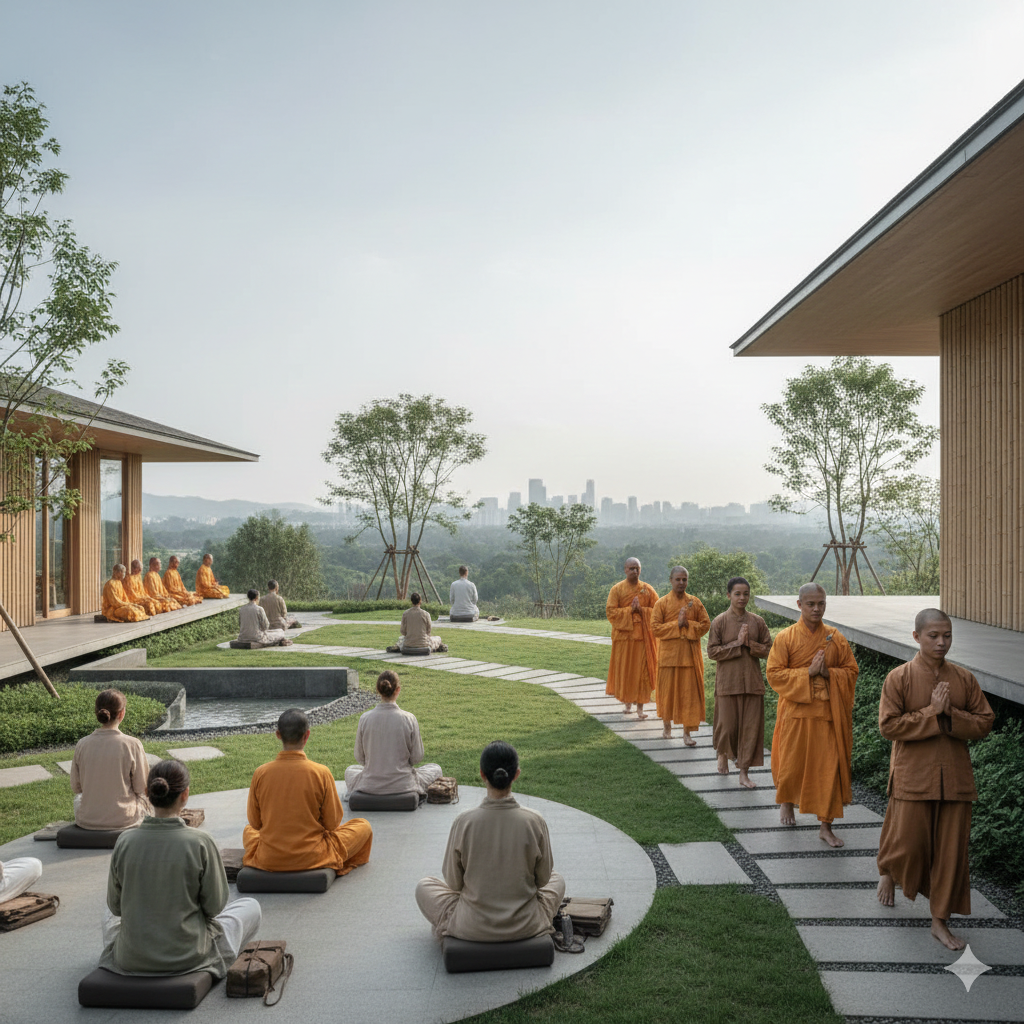
Challenges, Decline, and Internal Transformations of the Sangha
No institution, however ethically grounded, remains untouched by time, power, or human limitation. The Buddhist Sangha, despite its profound moral foundation, faced numerous challenges as it expanded across regions and centuries. Understanding these challenges is essential, not to diminish the Sangha’s legacy, but to appreciate its capacity for self-reflection, adaptation, and renewal.
As I reflected on this phase of the Sangha’s history, I realized that decline does not always signify failure. Often, it reveals the tension between ideals and lived realities—a tension that, when acknowledged honestly, becomes a source of transformation rather than collapse.
Internal Fragmentation and Doctrinal Diversity
One of the earliest challenges faced by the Sangha was internal fragmentation. As Buddhism spread across vast geographical and cultural landscapes, differences in interpretation and practice naturally emerged. Schools of thought such as Theravada, Mahayana, and later Vajrayana developed distinct philosophical emphases and ritual expressions.
While these differences enriched Buddhist thought, they also introduced tension. Debates over doctrine, discipline, and authority sometimes strained communal unity. Yet, rather than leading to total rupture, these divisions often resulted in creative dialogue. The Sangha’s ability to accommodate diversity while retaining shared ethical commitments became both a challenge and a strength.
Institutional Wealth and Ethical Risk
As monastic institutions gained royal patronage and economic resources, new risks emerged. Wealth brought stability, but it also invited complacency and dependency. In some regions, monasteries accumulated land and influence, blurring the boundary between spiritual service and institutional power.
This shift raised critical ethical questions. Could renunciation coexist with material abundance? How could the Sangha maintain moral authority while benefiting from political support? Reflecting on these questions, I was reminded that ethical vigilance is essential for any institution entrusted with influence.
Periods of crisis did not halt Buddhist Sangha and Its Expansion, but rather redirected its geographical center.
Political Invasions and External Disruptions
The decline of Buddhism in its land of origin remains one of the most complex chapters in the Sangha’s history. From the late first millennium onward, political upheavals, changing patronage patterns, and invasions disrupted monastic life in India. Great centers of learning were damaged or abandoned, severing networks of education and practice.
These events were not merely destructive; they reshaped the Sangha’s geographical center. As Buddhism declined in India, it flourished elsewhere, carried by monks who preserved teachings in new lands. This shift illustrates how decline in one region can coincide with renewal in another.
Ritualization and Loss of Experiential Focus
In some contexts, the Sangha faced criticism for excessive ritualization and scholasticism. When formal practices overshadowed lived experience, spiritual vitality risked being reduced to routine. This challenge prompted reform movements emphasizing meditation, mindfulness, and direct insight.
Such reforms highlight the Sangha’s capacity for self-correction. Rather than rigidly defending established forms, many monastic communities revisited foundational principles, renewing emphasis on practice over performance.
Adaptation Through Reform and Renewal
Periods of crisis often gave rise to reformers within the Sangha—teachers who sought to restore ethical clarity and practical relevance. These figures emphasized simplicity, discipline, and engagement with lay society. Through reform, the Sangha reasserted its core values while responding to changing circumstances.
From my perspective, this pattern of decline followed by renewal offers a powerful lesson. Institutions endure not by denying failure, but by learning from it. Within the broader history of Buddhist Sangha and Its Expansion, such internal transformations proved essential to its survival across cultures and centuries.
The Human Dimension of Institutional Change
Ultimately, the challenges faced by the Buddhist Sangha reflect the human condition itself. Institutions are shaped by the intentions, limitations, and aspirations of individuals. Recognizing this humanity prevents idealization and invites responsible participation.
In reflecting on the Sangha’s transformations, I came to appreciate its honesty. Rather than presenting itself as flawless, its history reveals an ongoing effort to align practice with principle. This humility, perhaps more than any structural feature, explains the Sangha’s enduring relevance.
Thus, the challenges and transformations of the Buddhist Sangha do not diminish its significance. Instead, they illuminate its resilience—a resilience grounded in ethical reflection, communal accountability, and the courage to change.
The Buddhist Sangha in the Modern World
In the modern world, marked by rapid technological change, individualism, and constant motion, the relevance of the Buddhist Sangha may appear uncertain at first glance. Monastic life, with its emphasis on simplicity and renunciation, seems distant from urban routines driven by productivity, consumption, and digital connectivity. Yet, upon closer reflection, the Sangha’s presence today feels not outdated, but urgently necessary.
Modern societies are more connected than ever before, yet experiences of loneliness, anxiety, and ethical confusion are widespread. In this context, the Sangha offers something rare: a living example of community grounded in mindfulness, shared responsibility, and ethical restraint. Rather than retreating from the world, contemporary expressions of the Sangha engage directly with modern suffering—mental distress, social fragmentation, and loss of meaning.
Revival and Reform Movements
Across Asia and beyond, the twentieth and twenty-first centuries have witnessed significant revival movements within the Buddhist Sangha. Reformers emphasized meditation, social engagement, and education, seeking to reconnect monastic life with lived human experience. Practices such as Vipassana, once confined to monasteries, became accessible to lay practitioners across cultures.
These movements challenged rigid institutionalism without abandoning discipline. By simplifying rituals and highlighting mindfulness, the Sangha renewed its relevance for modern seekers. Observing this renewal, I felt that the Sangha was not resisting modernity, but responding to it thoughtfully—offering depth in an age of distraction.
Engaged Buddhism and Social Responsibility
One of the most significant modern transformations of the Sangha is the rise of Engaged Buddhism. Monks and nuns now actively address issues such as poverty, environmental degradation, conflict resolution, and human rights. This engagement reflects a reinterpretation of compassion—not as withdrawal from suffering, but as ethical participation in the world.
In regions affected by war and inequality, members of the Sangha have served as mediators, educators, and caregivers. Their work demonstrates that renunciation does not imply indifference. Rather, it creates moral clarity necessary for responsible action. This understanding reshaped my own perception of spirituality—from personal escape to collective responsibility.
In the contemporary era, Buddhist Sangha and Its Expansion continues to influence global spiritual discourse.
The Sangha Beyond Monasteries
In contemporary contexts, the idea of Sangha has expanded beyond traditional monastic boundaries. Lay meditation groups, online communities, and interfaith dialogues embody Sangha principles without formal ordination. These spaces emphasize shared practice, ethical dialogue, and mutual support.
While this expansion raises questions about authenticity and discipline, it also reflects the Sangha’s adaptability. The core idea—walking the path together—remains intact. From my experience, these modern Sanghas demonstrate that community can be cultivated even amid diverse lifestyles and commitments.
Globalization and Cultural Translation
As Buddhism spreads globally, the Sangha faces the challenge of cultural translation. Western societies, shaped by secularism and individual autonomy, often reinterpret Buddhist practices through psychological or therapeutic lenses. While this approach increases accessibility, it risks detaching practice from its ethical and communal roots.
This tension invites reflection rather than rejection. The Sangha’s task in the modern world is not to resist reinterpretation, but to ensure that mindfulness remains connected to ethical awareness and compassion. In this balance between accessibility and depth lies the future of the Sangha’s global presence.
Personal Reflection: Learning from the Modern Sangha
In my own life, encounters with modern expressions of the Sangha—through meditation groups, retreats, and teachings—reshaped my understanding of community. I learned that Sangha is not defined by physical proximity alone, but by shared intention and ethical commitment. Even brief moments of collective silence revealed the power of presence over performance.
The Sangha taught me that growth does not require isolation. On the contrary, awareness deepens when supported by others who share the same path. This realization challenged modern myths of self-sufficiency and reminded me that wisdom flourishes through connection.
The Sangha as a Response to Modern Crisis
In an age of ecological crisis, social polarization, and psychological strain, the Sangha offers a countercultural model. Its emphasis on moderation, compassion, and interdependence directly addresses the roots of modern suffering. Rather than offering quick solutions, it cultivates long-term ethical resilience.
Thus, the Buddhist Sangha in the modern world stands not as a relic of the past, but as a quiet response to contemporary crisis. Within the broader history of Buddhist Sangha and Its Expansion, its modern renewal demonstrates that ethical communities can adapt to new realities while preserving timeless values. Its continued relevance lies in its ability to remind humanity of a simple truth: liberation is not a solitary achievement, but a shared journey shaped by mindful communities.
Relevance of the Buddhist Sangha for the Future World
As humanity steps into an uncertain future shaped by technological acceleration, environmental instability, and social fragmentation, the question of ethical direction becomes unavoidable. Scientific progress has expanded human capability, yet moral wisdom has not always kept pace. In this context, the Buddhist Sangha offers more than historical insight—it presents a living framework for navigating the future with balance, responsibility, and compassion.
The relevance of the Sangha lies not in preserving ancient forms, but in sustaining timeless principles. At its core, the Sangha embodies interdependence, disciplined freedom, and collective care. These values directly address the crises of the future world, where isolated individualism and unchecked consumption threaten both psychological well-being and planetary survival.
Ethical Community in an Age of Individualism
The future world is increasingly defined by individual autonomy, digital identity, and personal branding. While these trends empower expression, they often weaken genuine human connection. The Sangha counters this trajectory by affirming that personal growth flourishes within ethical communities. It reminds us that freedom without responsibility leads to fragmentation.
By emphasizing shared practice and mutual accountability, the Sangha offers a model of belonging without conformity. This balance—unity without uniformity—may prove essential for societies seeking cohesion amid diversity. Reflecting on this, I see the Sangha as a quiet corrective to cultures that celebrate independence while neglecting interdependence.
Mindfulness as a Future Skill
In the coming decades, attention may become one of humanity’s most endangered resources. Algorithms compete relentlessly for focus, shaping behavior through distraction rather than awareness. The Sangha’s disciplined cultivation of mindfulness stands as a radical response to this challenge.
Mindfulness, when grounded in ethical intention, trains individuals to pause, reflect, and respond wisely. Within the Sangha, mindfulness is not reduced to a productivity tool; it is a moral practice that aligns thought, speech, and action. Such alignment will be indispensable in a future where decisions carry far-reaching consequences.
Compassion in a Polarized World
Global societies are increasingly divided by ideology, identity, and fear. Polarization thrives on dehumanization, reducing individuals to categories rather than recognizing shared vulnerability. The Sangha’s emphasis on compassion offers an alternative ethic—one that begins with understanding suffering rather than assigning blame.
In envisioning the future, the Sangha provides a framework for dialogue rooted in empathy. It teaches that disagreement need not lead to hostility, and that ethical listening can dissolve entrenched conflict. This capacity for compassionate engagement may become one of humanity’s most vital survival skills.
Ecological Responsibility and Interdependence
The environmental crisis exposes a fundamental misunderstanding of humanity’s place in the natural world. The Sangha’s worldview, grounded in interdependence, challenges the illusion of separation between humans and nature. Simplicity, restraint, and mindful consumption—core monastic values—directly address ecological imbalance.
Rather than promoting sacrifice through fear, the Sangha frames sustainability as ethical clarity. Living with less becomes an expression of awareness rather than deprivation. In this sense, the Sangha offers a moral imagination for ecological responsibility—one that could guide future societies toward sustainable coexistence.
Education for Wisdom, Not Just Information
The future will demand not only technical expertise, but moral discernment. Artificial intelligence, biotechnology, and global networks amplify human power, making ethical judgment more critical than ever. The Sangha’s educational model integrates knowledge with character formation.
By uniting learning with ethical cultivation, the Sangha suggests a path forward for education systems struggling to balance innovation with integrity. From my reflection, this integration may determine whether future progress becomes a source of liberation or harm.
A Vision of Shared Liberation
Perhaps the most profound relevance of the Buddhist Sangha for the future world lies in its vision of liberation as a shared endeavor. In contrast to narratives of personal success and competitive achievement, the Sangha affirms that true freedom emerges collectively.
This vision challenges dominant assumptions about progress. It suggests that humanity’s future will not be secured through dominance or accumulation, but through ethical solidarity. The Sangha does not promise utopia; it offers a disciplined hope grounded in practice, patience, and compassion.
In contemplating the future, I came to see the Sangha not as an institution bound to monasteries or traditions, but as a principle of living together wisely. Its relevance lies in its quiet insistence that the path forward must be walked together—mindfully, ethically, and with care for all forms of life.
Conclusion: The Buddhist Sangha as a Living Legacy
As this exploration of Buddhist Sangha and Its Expansion draws to a close, one truth becomes unmistakably clear: the Sangha is not a relic of history, nor a distant monastic ideal frozen in time. It is a living legacy—one that continues to evolve, respond, and guide humanity through changing ages and circumstances. From its humble beginnings among wandering ascetics to its presence across continents, the Sangha has endured not through power, but through purpose.
The story of the Sangha reveals that true legacy is not measured by monuments or institutions alone, but by the ethical imprint left on human consciousness. The Buddha did not leave behind an empire; he left behind a community capable of sustaining wisdom. Through discipline, compassion, and collective responsibility, the Sangha preserved teachings that might otherwise have faded into abstraction.
Reflecting on this journey, I realized that the Sangha’s greatest contribution lies in its understanding of human vulnerability. It acknowledges suffering not as a failure, but as a shared condition. In doing so, it offers a path that transforms pain into insight and isolation into connection. This recognition feels especially vital in a world that often hides suffering behind success.
The Sangha also teaches that freedom is inseparable from responsibility. Liberation, in the Buddhist sense, is not an escape from others, but a deepening of awareness within relationships. This lesson challenges modern narratives that equate happiness with independence alone. Instead, the Sangha reminds us that ethical communities are essential for sustained human flourishing.
What moved me most throughout this reflection was the Sangha’s quiet resilience. Despite facing decline, division, and disruption, it never abandoned its ethical core. Instead, it adapted—sometimes painfully, often imperfectly—but always with a willingness to learn and renew. This capacity for self-correction offers hope in an era where institutions often resist accountability.
The legacy of the Buddhist Sangha, therefore, is not confined to monasteries or religious identity. It lives wherever individuals choose mindfulness over haste, compassion over indifference, and cooperation over domination. It lives in classrooms that teach wisdom alongside knowledge, in communities that value dialogue over division, and in lives that seek meaning beyond accumulation.
As I carry these insights forward, I see the Sangha less as an external institution and more as an inner commitment—a commitment to walk the path of awareness with others. In a fractured world, this commitment may be one of humanity’s most powerful resources. The Sangha does not promise certainty, but it offers companionship on the journey toward understanding.
Ultimately, Buddhist Sangha and Its Expansion stands as a reminder that history is shaped not only by rulers and revolutions, but by communities of practice. Its living legacy invites us to ask a simple yet transformative question: How might the world change if we chose to walk together, guided by wisdom and compassion?
Frequently Asked Questions (FAQs)
The following questions help clarify key aspects of Buddhist Sangha and Its Expansion, addressing historical development, institutional structure, and its relevance in both ancient and modern contexts.
What is the Buddhist Sangha?
The Buddhist Sangha refers to the community of individuals who follow the path taught by the Buddha. Traditionally, it includes ordained monks and nuns who live according to the Vinaya (monastic discipline). In a broader sense, it also refers to the Noble Sangha—those who have attained stages of spiritual realization, whether monastic or lay. The Sangha is one of the Three Jewels of Buddhism, alongside the Buddha and the Dhamma.
Why is the Sangha considered essential in Buddhism?
The Sangha is essential because it preserves, practices, and transmits the Buddha’s teachings across generations. While the Buddha discovered the path and the Dhamma explains it, the Sangha embodies it in daily life. Through communal discipline, ethical accountability, and shared learning, the Sangha ensures that Buddhism remains a lived tradition rather than a purely theoretical philosophy.
How did the Buddhist Sangha expand beyond India?
The expansion of the Buddhist Sangha beyond India occurred primarily through peaceful means such as teaching, dialogue, and cultural exchange. Support from Emperor Ashoka played a significant role, as monks were sent as missionaries to regions like Sri Lanka, Central Asia, and Southeast Asia. Trade routes, especially the Silk Road, further facilitated the spread of monastic communities across Asia.
What role did Emperor Ashoka play in the expansion of the Sangha?
Emperor Ashoka supported the Buddhist Sangha after his moral transformation following the Kalinga War. Rather than enforcing religious conversion, he promoted ethical governance, built monasteries, protected pilgrimage sites, and supported missionary activities. His patronage strengthened the Sangha institutionally while preserving its spiritual autonomy.
What are the main traditions of the Buddhist Sangha?
The Buddhist Sangha developed into several major traditions over time. Theravada emphasizes monastic discipline and early scriptures, particularly in Sri Lanka and Southeast Asia. Mahayana highlights compassion and the Bodhisattva ideal, flourishing in East Asia. Vajrayana integrates ritual and advanced meditation practices, especially in Tibet and Himalayan regions. Despite differences, all share common ethical foundations.
Why did Buddhism decline in India despite its early success?
Buddhism declined in India due to a combination of factors, including political instability, loss of royal patronage, internal fragmentation, and external invasions. Monastic institutions were disrupted, and support networks weakened. However, Buddhism continued to thrive outside India, preserved by the Sangha in other parts of Asia.
Does the Buddhist Sangha still exist in the modern world?
Yes, the Buddhist Sangha remains active across Asia and globally. Monastic communities continue to practice, teach, and adapt to contemporary contexts. Additionally, modern forms of Sangha have emerged through lay meditation groups, engaged Buddhism, and international spiritual communities, extending Sangha principles beyond traditional monastic settings.
How is the Buddhist Sangha relevant to modern life?
The Sangha offers a model of ethical community, mindfulness, and shared responsibility—values increasingly relevant in a fast-paced, fragmented world. It addresses modern challenges such as loneliness, mental stress, ecological crisis, and ethical confusion by emphasizing compassion, discipline, and interdependence.
Can laypeople be part of the Buddhist Sangha?
While traditional Sangha refers to ordained monks and nuns, Buddhism also recognizes the Noble Sangha, which includes lay practitioners who attain spiritual insight. In modern contexts, many lay communities embody Sangha principles through shared practice, ethical living, and mutual support, even without formal ordination.
What is the lasting legacy of the Buddhist Sangha?
The lasting legacy of the Buddhist Sangha lies in its ability to sustain wisdom through community. Within the broader historical narrative of Buddhist Sangha and Its Expansion, this enduring capacity for adaptation and ethical continuity explains why the Sangha has influenced cultures, education systems, and moral thought for over two millennia. Its legacy continues wherever individuals and communities choose mindful cooperation over isolation.
References
- Gethin, Rupert. The Foundations of Buddhism. Oxford University Press, 1998.
- Keown, Damien. Buddhism: A Very Short Introduction. Oxford University Press, 2013.
- Harvey, Peter. An Introduction to Buddhism: Teachings, History and Practices. Cambridge University Press, 2012.
- Thapar, Romila. Ashoka and the Decline of the Mauryas. Oxford University Press, 2012.
- Rhys Davids, T. W. Buddhist India. Motilal Banarsidass, 2007.
- Strong, John S. The Buddha: A Short Biography. Oneworld Publications, 2001.
- Schopen, Gregory. Buddhist Monks and Business Matters. University of Hawai‘i Press, 2004.
- Williams, Paul. Mahayana Buddhism: The Doctrinal Foundations. Routledge, 2009.
- Cousins, L. S. “The Origins of Insight Meditation.” Buddhist Studies Review, Vol. 3, No. 1, 1984.
- Sen, Amartya. The Argumentative Indian. Farrar, Straus and Giroux, 2005.