

Teachings of Mahavira and Buddha: A Journey of Non-Violence, Compassion, and Self-Realization

Introduction: How the Teachings of Mahavira and Buddha Shaped My Understanding of Life

There are moments in life when external success no longer brings inner satisfaction. Amid constant competition, social pressure, and the relentless pace of modern living, a sense of restlessness quietly settles within the mind. I reached such a phase when, despite progress and achievement, inner peace felt distant. This inner conflict led me to question the true meaning of happiness, balance, and purpose.

It was during this period of reflection that I encountered the teachings of Mahavira and Buddha. At first, these teachings appeared to belong solely to ancient history and religious philosophy. However, as I explored the teachings of Mahavira and Buddha more deeply, I realized that their ideas speak directly to the challenges of the present world. Concepts such as non-violence, compassion, self-restraint, and the Middle Path are not abstract ideals but practical principles for leading a conscious and meaningful life.

Teachings of Mahavira and Buddha book

Recommended Product (Best Choice)

Buy Now on Amazon

Mahavira and Buddha emerged in an era marked by ritualism, social inequality, and violence. Instead of reinforcing rigid traditions, the teachings of Mahavira and Buddha emphasized inner transformation, ethical conduct, and personal responsibility. Mahavira advocated absolute non-violence and non-attachment as the foundation of spiritual freedom, while Buddha analyzed the nature of suffering and offered a balanced path toward liberation through awareness and compassion. Both thinkers shifted the focus from external worship to inner awakening.

This article is not merely an academic exploration of their philosophies; it is a personal journey shaped by lived experiences and introspection. Through my engagement with the teachings of Mahavira and Buddha, I began to view conflict, desire, and suffering from a new perspective. Their insights helped me recognize how uncontrolled ambition, anger, and attachment quietly shape our daily choices and emotional well-being.

In today’s world—defined by anxiety, polarization, consumerism, and emotional fatigue—the teachings of Mahavira and Buddha offer a timeless framework for harmony and self-awareness. They remind us that peace cannot be imposed from outside; it must arise from disciplined thought, mindful action, and compassionate relationships.

Mahavira and Buddha: Voices of Peace Born in an Age of Turmoil

The sixth century BCE was a period of profound transformation and unrest in the Indian subcontinent. Social structures were rigid, religious practices had become heavily ritualistic, and moral clarity was increasingly overshadowed by external displays of piety. It was in this atmosphere of inequality, violence, and spiritual dissatisfaction that Mahavira and Gautama Buddha emerged as transformative figures. The teachings of Mahavira and Buddha did not seek to overthrow political authority; instead, they challenged the inner foundations of human conduct, offering peace as a personal and ethical pursuit rather than a ritual obligation.

Social and Religious Conditions in Pre-Buddhist India

Indian society during this period was dominated by complex Vedic rituals and sacrificial ceremonies. Religious authority largely rested with the priestly class, and salvation was believed to be attainable only through elaborate rites, chants, and offerings. Animal sacrifice was often justified as a sacred duty, embedding violence within the very structure of religious life. For ordinary people, spirituality had become inaccessible and intimidating.

The caste system had hardened into an inflexible social hierarchy. An individual’s birth determined their status, occupation, and access to education and religious knowledge. Lower social groups were excluded from spiritual participation and treated as inherently inferior. This deep-rooted inequality not only limited human dignity but also created widespread dissatisfaction and ethical decay within society.

At the same time, economic changes were reshaping social consciousness. The growth of cities, trade, and merchant communities encouraged independent thinking and questioned traditional authority. People began seeking spiritual paths that addressed personal suffering, moral responsibility, and inner freedom rather than inherited privilege or ritual correctness. This intellectual climate created the conditions in which the teachings of Mahavira and Buddha could deeply resonate with the masses.

Mahavira: The Height of Renunciation and Self-Discipline

Mahavira was born into a royal family surrounded by comfort and privilege. Yet, at a young age, he renounced worldly life in search of ultimate truth. His journey was marked by intense self-discipline, austere practices, and prolonged meditation. Mahavira’s life itself became a message—demonstrating that liberation is achieved not through possessions or power, but through mastery over one’s desires and actions.

Central to Mahavira’s philosophy was the principle of absolute non-violence. Within the broader teachings of Mahavira and Buddha, this idea represents one of the strongest ethical foundations. For Mahavira, non-violence was not limited to physical acts but extended to thoughts, words, and intentions. Every living being, no matter how small, was worthy of respect. He emphasized self-restraint, non-attachment, and moral purity as essential steps toward freeing the soul from the bondage of karma.

Mahavira also introduced the idea of non-absolutism, recognizing that truth is complex and multi-dimensional. By encouraging tolerance and intellectual humility, his teachings promoted peaceful coexistence in a diverse society. Even today, his philosophy remains a vital pillar within the teachings of Mahavira and Buddha that challenges materialism and moral indifference.

Gautama Buddha: From the Search for Suffering to Enlightenment

Gautama Buddha’s spiritual quest began with an encounter with the realities of old age, illness, and death—experiences that shattered the illusion of permanent happiness. Renouncing his princely life, he embarked on a search to understand the root of human suffering. Unlike many ascetics of his time, Buddha eventually rejected extreme self-mortification, realizing that it led neither to wisdom nor to freedom.

Buddha formulated the Middle Path, a balanced approach that avoids both excessive indulgence and severe austerity. Through the Four Noble Truths and the Eightfold Path, he provided a practical framework for understanding suffering, its causes, and its cessation. These ideas form the practical core of the teachings of Mahavira and Buddha that continue to guide modern seekers.

Compassion and awareness formed the heart of Buddha’s philosophy. He taught that suffering arises from ignorance and craving, and that by transforming the mind, individuals can transform their lives. Like Mahavira, Buddha shifted the focus from ritual performance to inner realization, making spiritual awakening accessible to all, regardless of social background.

Together, the teachings of Mahavira and Buddha responded to an age of unrest with messages of inner discipline, ethical living, and universal compassion. Though their paths differed, both offered timeless insights that continue to guide humanity toward peace in times of conflict and uncertainty.

Teachings of Mahavira: The Path to the Freedom of the Soul

The central aim of Mahavira’s philosophy is the liberation of the soul from the bondage of karma. According to him, every living being possesses a pure and conscious soul, but this soul becomes entangled in the cycle of birth and death due to actions, desires, and attachments. Within the broader teachings of Mahavira and Buddha, Mahavira’s path especially emphasizes inner purification through self-awareness, discipline, and moral responsibility as the true means of spiritual freedom.

Non-Violence: Not Only in Action, but in Thought

teachings of Mahavira and Buddha book

Recommended Product (Best Value Choice)

Buy Now on Amazon

Non-violence (Ahimsa) is the cornerstone of Mahavira’s teachings. For Mahavira, non-violence does not end with refraining from physical harm; it extends to speech, intention, and thought. Harboring anger, hatred, or ill will toward any living being is considered a subtle form of violence. This interpretation transforms ahimsa from a social ethic into a deep inner discipline within the teachings of Mahavira and Buddha.

In an age when animal sacrifice and ritualized violence were widely accepted, Mahavira’s insistence on reverence for all forms of life was revolutionary. He taught that true peace cannot exist as long as the mind remains violent. Only when compassion governs thought and behavior can harmony emerge both within the individual and in society.

My First Personal Practice of Non-Violence

My first conscious attempt to practice non-violence was not in avoiding physical harm, but in controlling my reactions during moments of disagreement. Choosing silence over anger, listening instead of interrupting, and responding with patience required constant awareness. These small acts revealed how deeply aggression is embedded in everyday behavior.

Over time, I realized that non-violence is not weakness but strength. It demands courage to restrain the ego and clarity to understand others without hostility. Practicing ahimsa gradually brought a sense of inner stability and transformed conflict into dialogue.

Non-Attachment: Contentment in Simplicity

Aparigraha, or non-attachment, is another foundational principle of Mahavira’s philosophy. He believed that the urge to possess—whether wealth, status, or control—creates fear, insecurity, and suffering. The more we cling to possessions and identities, the more vulnerable we become to loss and anxiety. This insight forms an important ethical pillar within the teachings of Mahavira and Buddha.
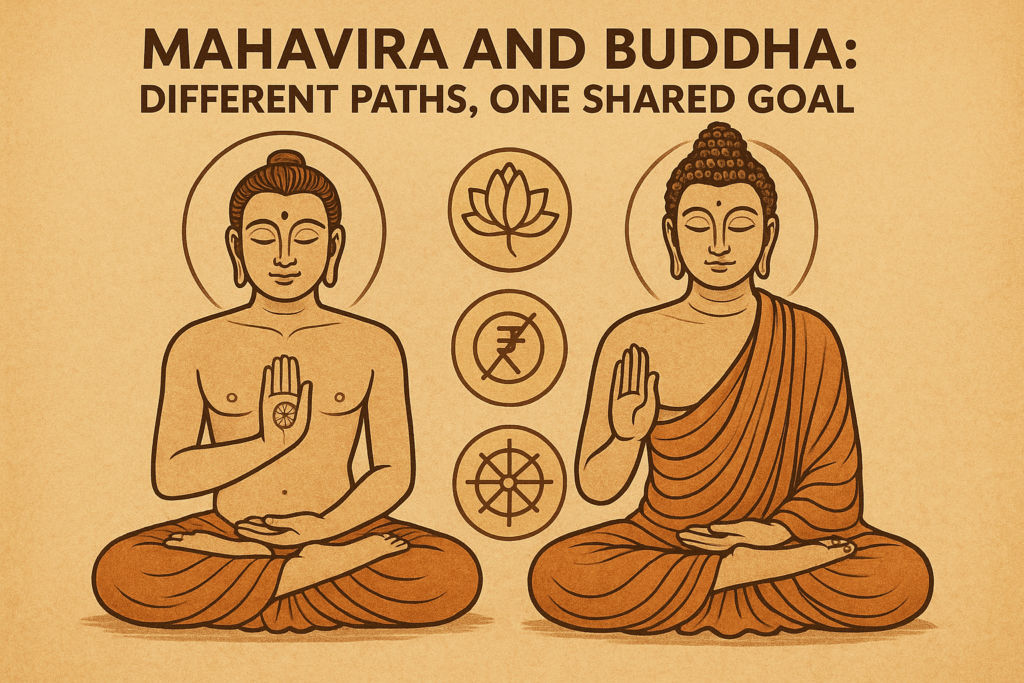
Mahavira and Buddha: Different Paths, One Shared Goal

Mahavira and Gautama Buddha are often presented as representatives of two distinct spiritual traditions, yet a deeper examination reveals a remarkable convergence in their ultimate vision. Both emerged during a period of moral decline, social inequality, and ritual excess. Their teachings were not aimed at creating competing religious systems, but at guiding individuals toward freedom from suffering, ignorance, and ethical confusion. While their methods differed, their destination remained the same—inner liberation and universal compassion.

Amazon Affiliate Product

Recommended Product (Best Choice)

Buy Now on Amazon

Similarities

Despite philosophical and methodological differences, Mahavira and Buddha shared several foundational principles that continue to shape ethical and spiritual thought.

  • Non-Violence: Both Mahavira and Buddha placed non-violence at the heart of their teachings. Mahavira articulated ahimsa in its most absolute form, extending it to thought, speech, and intention. Buddha emphasized compassion, loving-kindness, and mindfulness as practical expressions of non-violence. In both traditions, violence is understood not merely as physical harm but as a disturbance of inner harmony.
  • Inner Purification: External rituals and social status were rejected by both thinkers in favor of inner moral discipline. Mahavira focused on the purification of the soul through self-restraint and ethical conduct, while Buddha emphasized mental clarity achieved through mindfulness and wisdom. In both cases, spiritual progress depends on inner transformation rather than outward observance.
  • Responsibility for One’s Actions: A central similarity lies in their understanding of karma. Both Mahavira and Buddha taught that individuals are responsible for their actions and their consequences. Liberation is not granted by divine intervention but attained through conscious effort, ethical living, and self-awareness. This view empowers individuals to take responsibility for their own spiritual growth.

These shared principles explain why the teachings of Mahavira and Buddha transcend religious boundaries and function as universal ethical frameworks relevant to all human societies.

Differences

While their core values align, Mahavira and Buddha differed significantly in their approach to discipline, philosophy, and the nature of liberation.

Mahavira emphasized strict asceticism and rigorous self-discipline. He believed that karmic bonds are extremely subtle and can be destroyed only through intense restraint, fasting, and control over the senses. Jain spiritual practice, therefore, often involves severe austerities aimed at complete purification of the soul.

Buddha, in contrast, rejected both indulgence and extreme asceticism. His realization of the Middle Path emerged from personal experience, recognizing that excessive self-mortification leads to exhaustion rather than enlightenment. Buddha advocated balance, awareness, and moderation, making spiritual practice accessible to both monastics and householders.

Philosophically, the two diverged on the concept of the self. Mahavira affirmed the existence of an eternal soul bound by karma, whereas Buddha denied a permanent self through the doctrine of non-self (Anatta). According to Buddha, suffering arises not from the soul but from ignorance and craving, and liberation comes through insight into impermanence.

Their ultimate goals are described using different terms. Mahavira spoke of moksha, the complete liberation of the soul from karmic bondage, while Buddha described nirvana as the cessation of craving and suffering. Though conceptually distinct, both states represent absolute freedom, peace, and ethical clarity.

Rather than opposing one another, the teachings of Mahavira and Buddha complement each other. One highlights the power of discipline and renunciation, while the other emphasizes balance and insight. Together, they demonstrate that spiritual liberation can be approached through different paths, all rooted in compassion, responsibility, and self-awareness.

Relevance of the Teachings of Mahavira and Buddha in Modern Life

Modern life is defined by speed, competition, and constant mental stimulation. While technological advancement has improved material comfort, it has also intensified stress, anxiety, and emotional disconnection. In this environment, the teachings of Mahavira and Gautama Buddha emerge not as ancient religious doctrines, but as practical frameworks for living with balance, awareness, and ethical clarity.

Both Mahavira and Buddha emphasized inner transformation over external control. Many of today’s challenges—burnout, anger, insecurity, and dissatisfaction—do not arise solely from circumstances, but from habitual mental reactions. By addressing the roots of suffering within the mind, their teachings remain deeply relevant to contemporary life.

Mental Health and Inner Stability

Mental health concerns have become a defining issue of the modern age. The pressure to succeed, constant comparison through social media, and uncertainty about the future have created widespread psychological strain. Buddha’s analysis of suffering offers valuable insight: dissatisfaction arises from craving and resistance, not merely from external conditions.

Practices such as mindfulness, right awareness, and meditation—central to Buddhist teaching—help individuals observe thoughts without becoming overwhelmed by them. Mahavira’s emphasis on self- discipline and control over desires complements this approach by encouraging restraint and ethical consistency. Together, these teachings foster emotional resilience and mental clarity.

Consumerism and the Search for Balance

Modern economies thrive on consumption, promoting the belief that happiness increases with accumulation. Mahavira’s principle of non-attachment (Aparigraha) directly challenges this mindset. He taught that excessive possession leads to fear, dependency, and inner unrest rather than security.

Buddha’s Middle Path reinforces this wisdom by rejecting both indulgence and extreme renunciation. In a world driven by excess, moderation becomes an act of awareness. Distinguishing between genuine needs and endless desires allows individuals to experience contentment without withdrawal from society.

Social Harmony and Tolerance

Contemporary societies are increasingly divided by ideology, identity, and political polarization. Intolerance often replaces dialogue, leading to conflict and misunderstanding. Mahavira’s doctrine of non-absolutism encourages respect for multiple perspectives, reminding us that truth is complex and cannot be captured by a single viewpoint.

Buddha’s teachings on compassion and loving-kindness provide the emotional foundation for peaceful coexistence. When individuals learn to see others not as adversaries but as fellow beings shaped by suffering, empathy replaces hostility. Such an approach is essential for sustaining democratic and pluralistic societies.

Personal Relationships and Emotional Awareness

Conflicts in personal relationships often arise from unmet expectations, ego, and poor communication. Mahavira’s concept of non-violence extends beyond physical harm to include speech and intention. Harsh words, emotional manipulation, and silent resentment are also forms of violence that damage relationships.

Buddha’s emphasis on mindfulness helps individuals recognize emotions as temporary experiences rather than permanent truths. By observing anger, jealousy, or fear without identification, one can respond with clarity instead of impulse. This awareness strengthens trust, patience, and emotional maturity within relationships.

Ethical Leadership and Decision-Making

In modern institutions, leadership is often associated with authority, control, and short-term outcomes. Mahavira and Buddha offered a different model of leadership grounded in moral responsibility and self-restraint. Their influence was not enforced through power, but earned through integrity and example.

Applying these principles in politics, governance, and business encourages decisions that prioritize long-term well-being over immediate gain. Ethical leadership rooted in compassion and accountability creates trust and sustainable progress in complex social systems.

Ultimately, the teachings of Mahavira and Buddha provide timeless guidance for navigating modern complexities. They do not ask individuals to reject progress or retreat from the world, but to engage with it consciously. By integrating non-violence, moderation, and awareness into daily life, modern humanity can rediscover balance, purpose, and inner freedom.

My Personal Learnings — Lessons from the Process

Engaging with the teachings of Mahavira and Gautama Buddha was not merely an intellectual exercise for me; it gradually became a deeply personal journey. In the beginning, I approached these philosophies as historical and ethical systems meant to be understood and analyzed. Over time, however, they began to function as mirrors, reflecting my own habits, reactions, and inner conflicts. This shift from study to experience was neither quick nor effortless—it unfolded through self-examination, mistakes, and moments of uncomfortable honesty.

Amazon Affiliate Product

Recommended Product (Best Value Choice)

Buy Now on Amazon

One of the earliest lessons I encountered was the true meaning of non-violence. Previously, I had associated non-violence primarily with the absence of physical harm. As I became more attentive to my thoughts and speech, I recognized how impatience, sarcasm, and silent resentment carried their own forms of aggression. There were instances where I defended my opinions harshly, believing that being right justified my tone. The discomfort that followed such moments revealed that harm can occur even without visible action. Mahavira’s emphasis on restraint helped me understand that ethical strength lies in conscious response, not impulsive reaction.

Buddha’s teachings offered a transformative insight into the nature of suffering. I often attributed my frustration to external circumstances—missed opportunities, unmet expectations, or the behavior of others. Through reflection and mindful observation, it became clear that much of my distress arose from internal craving and resistance. When outcomes failed to align with my expectations, suffering inevitably followed. Recognizing this pattern did not eliminate difficulty, but it reduced the sense of helplessness. Responsibility shifted inward, opening space for awareness and choice.

The principle of non-attachment emerged as another powerful lesson. I once believed that greater control, recognition, and accumulation would provide security. Instead, they increased anxiety and restlessness. Gradually limiting unnecessary desires—whether material, emotional, or social—created an unexpected sense of freedom. This practice was not about renunciation, but about clarity. Mahavira’s teaching revealed that simplicity is not the absence of ambition, but the presence of intention.

Buddha’s Middle Path became a guiding framework during periods of imbalance. At times, I pursued rigid self-discipline, expecting perfection from myself; at other times, I drifted toward indulgence and avoidance. Both extremes led to dissatisfaction. The Middle Path taught me that growth requires consistency rather than intensity. Balance, not pressure, sustains long-term transformation.

Perhaps the most meaningful realization was that progress is rarely linear. I repeated the same mistakes, struggled with old habits, and questioned my own sincerity. In these moments, Buddha’s teaching of compassion extended inward. Instead of harsh self-judgment, I learned to observe failure as part of the process. Awareness replaced blame, allowing learning to continue without discouragement.

Through this journey, I came to understand that philosophy becomes meaningful only when lived. The teachings of Mahavira and Buddha did not make me flawless, but they made me more attentive, patient, and grounded. Remembering non-violence during conflict, non-attachment during desire, and mindfulness during distress has gradually reshaped my approach to life. This process remains ongoing, but it has transformed understanding into experience—and belief into practice.

Conclusion and Inspirational Message

The teachings of Mahavira and Buddha are not relics of ancient history; they are living guidelines for navigating the complexities of modern life. Both thinkers emphasized that peace, freedom, and fulfillment do not arise from external success or material accumulation, but from inner discipline, ethical awareness, and conscious living. Their philosophies remind us that lasting change begins within the individual.

Mahavira’s principles of non-violence and non-attachment challenge us to examine how our thoughts, speech, and desires shape our reality. Buddha’s insights into suffering and mindfulness invite us to observe life with clarity rather than resistance. Together, their teachings encourage a life rooted in responsibility, compassion, and balance. They do not demand withdrawal from the world, but a deeper and more thoughtful engagement with it.

In an age marked by stress, polarization, and constant distraction, these teachings offer a pause—a moment to reflect, realign, and respond rather than react. They show that even small shifts in awareness, such as choosing patience over anger or moderation over excess, can create meaningful transformation. Ethical living, as envisioned by Mahavira and Buddha, is not an idealistic concept but a practical daily practice.

This journey of understanding is ongoing. Philosophy becomes truly valuable only when it moves beyond ideas and enters lived experience. When non-violence guides our interactions, non-attachment shapes our desires, and mindfulness informs our choices, the teachings of Mahavira and Buddha become part of our everyday life. The inspirational message they leave us with is simple yet profound: inner freedom is possible for anyone willing to observe, discipline, and transform the self.


Frequently Asked Questions (FAQ)

What is the main goal of the teachings of Mahavira and Buddha?

The primary goal of both teachings is liberation from suffering and ignorance. Mahavira focused on the purification and freedom of the soul from karmic bondage, while Buddha emphasized understanding the nature of suffering and achieving liberation through awareness and insight.

Are the teachings of Mahavira and Buddha relevant in modern times?

Yes, their teachings are highly relevant today. Principles such as non-violence, non-attachment, mindfulness, and moderation address modern challenges like stress, consumerism, and social conflict, offering practical tools for mental and ethical balance.

How does Mahavira’s concept of non-violence differ from Buddha’s approach?

Mahavira’s concept of non-violence is absolute and applies to thought, speech, and action. Buddha’s approach emphasizes compassion and loving-kindness as practical expressions of non-violence, focusing on reducing suffering through awareness.

Can these teachings be applied to everyday household life?

Absolutely. The teachings of Mahavira and Buddha are not limited to monks or ascetics. Values such as self-restraint, balance, ethical conduct, and mindfulness can be practiced within family life, work, and social relationships.

What can readers take away from this article?

Readers can learn that meaningful change begins with inner awareness. By applying small but conscious shifts in behavior and mindset, individuals can cultivate peace, responsibility, and long-term emotional well-being in their daily lives.

References

  • The Dhammapada – Translated by Eknath Easwaran, Nilgiri Press. A foundational Buddhist text outlining the core teachings of Gautama Buddha on suffering, mindfulness, and liberation.
  • Amazon Affiliate Product

    Recommended Product (Best Choice)

    Buy Now on Amazon
  • Majjhima Nikaya (The Middle Length Discourses of the Buddha) – Translated by Bhikkhu Ñāṇamoli and Bhikkhu Bodhi. Provides detailed insight into the Buddha’s philosophy, the Middle Path, and ethical living.
  • Acaranga Sutra – One of the earliest Jain texts, presenting the teachings of Mahavira on non-violence, ascetic discipline, and self-restraint.
  • Tattvartha Sutra by Umasvati – A classical Jain philosophical work explaining karma, the soul, liberation, and ethical conduct in a systematic manner.
  • Padmanabh S. Jaini, The Jaina Path of Purification, University of California Press. A scholarly study of Jain philosophy and Mahavira’s teachings.
  • Walpola Rahula, What the Buddha Taught, Grove Press. A clear and authoritative introduction to Buddhist thought and practice.
  • Radhakrishnan, S., Indian Philosophy, Vol. I, Oxford University Press. Discusses Jainism and Buddhism within the broader context of Indian philosophical traditions.

Leave a Comment

Your email address will not be published. Required fields are marked *

Scroll to Top