Introduction — Why This Subject Matters to Me
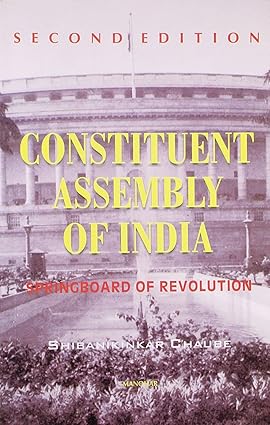
The Formation of the Constituent Assembly is not just a historical milestone in India’s journey toward independence; it is a powerful example of how dialogue, diversity, and collective vision can shape the destiny of a nation. When I first began reading the debates and discussions of the Assembly, I was struck by the breadth of ideas and the sincerity with which members approached the task of constitution-making. It was not merely a political exercise; it was an emotional, intellectual, and deeply human effort to define what India would stand for in the decades to come.
This subject feels personally significant to me because it teaches the value of patience, understanding, and the willingness to embrace different perspectives. In today’s world, where disagreements often lead to division, the Formation of the Constituent Assembly reminds us that differences do not weaken a society—they strengthen it when guided by mutual respect and a shared purpose. The members of the Assembly came from diverse regions, backgrounds, ideologies, and social positions, yet they found common ground by placing the nation above personal preferences.
As I studied the journey behind the Formation of the Constituent Assembly, I realized that the Constitution is not just a document; it is a reflection of countless hours of discussion, compromise, conviction, and hope. The process made me rethink how I view leadership and decision-making in my own life. It showed me that real progress is achieved not by silencing opposing voices, but by listening to them with honesty and empathy.
Personal Connection & Inspiration
My personal inspiration for writing about the Formation of the Constituent Assembly began the moment I read excerpts from its early debates. I felt an unexpected emotional connection to the sincerity behind each argument and the passion for building a fair and just nation.
Background of the Constituent Assembly (Historical Context)
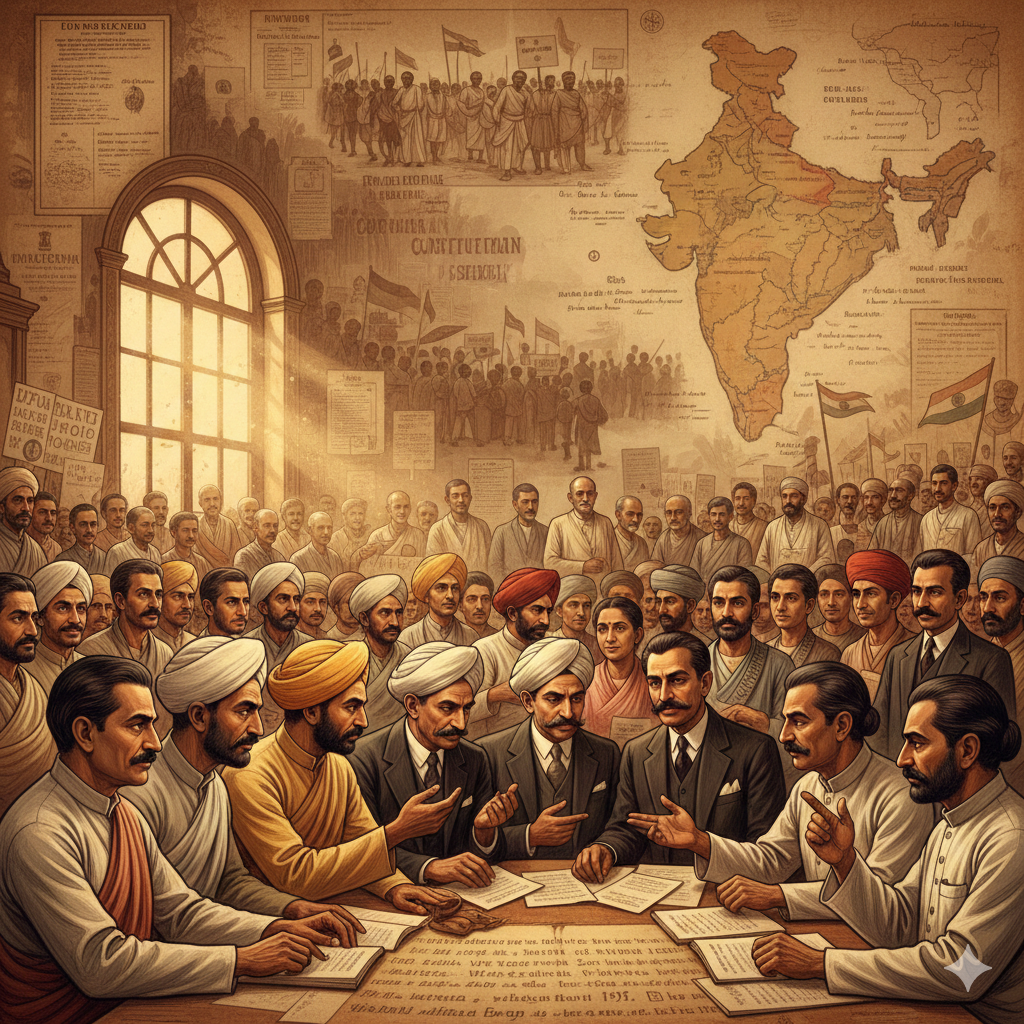
The Formation of the Constituent Assembly did not emerge overnight; it was the culmination of a long historical process in which political awakening, social reform movements, and sustained popular agitation converged to demand not just freedom from colonial rule, but also a stable constitutional order for a newly independent nation. Over the nineteenth and early twentieth centuries, Indian thinkers, reformers and political leaders gradually shaped the idea that political self-rule must be anchored in written principles guaranteeing rights, representation and an organized framework of governance.
By the 20th century, local reforms, nationalist rhetoric and global constitutional experiments had created a distinct constitutional imagination among Indian leaders. They were increasingly persuaded that a sovereign India required more than the simple transfer of power; it required a charter that would reflect the aspirations of a plural society. This evolving vision ultimately strengthened the demand for the Formation of the Constituent Assembly that could legitimately frame the Constitution of India.
The decades leading up to 1946 saw a sequence of institutional experiments, political negotiations and popular movements that together set the stage for the Assembly. Indian political organizations moved from protest politics to serious engagement with constitutional possibilities. Within these arenas, leaders debated fundamental questions about the future polity, laying the intellectual groundwork for the Formation of the Constituent Assembly in independent India.
World events also played a decisive role. The experience of two world wars and the decline of imperial power created a political moment when the transfer of power became inevitable. In this global and domestic context, Indian leaders insisted that the Formation of the Constituent Assembly should accompany independence so that the new nation would begin its journey with a clear constitutional framework.
Independence Movement and Democratic Aspirations
The Indian independence movement fundamentally shaped the democratic aspirations that the Assembly would later attempt to enshrine. Mass movements and widespread public engagement fostered a political culture that valued representation and civic rights. These democratic expectations strengthened the legitimacy and urgency behind the Formation of the Constituent Assembly.
Earlier Proposals and the Need for a Constitution
Long before 1947, several proposals and constitutional experiments pointed toward the necessity of a comprehensive constitution. These earlier blueprints revealed both the limitations of colonial frameworks and the growing appetite for a distinctly Indian constitutional order. Ultimately, the Formation of the Constituent Assembly emerged as the institutional response to this decades-long demand for a durable democratic foundation.
Formation of the Constituent Assembly — Process and Major Events
The Formation of the Constituent Assembly was one of the most defining moments in India’s political history. It was not merely an administrative step, but a transformative event that marked the transition from colonial rule to a sovereign, democratic nation. The need for a Constituent Assembly arose from decades of political struggle, evolving ideas of self-governance, and the collective desire to create a constitutional framework that reflected India’s diversity, aspirations, and commitment to justice. After prolonged negotiations, the British government formally accepted the idea and, in 1946, initiated the process of setting up an Assembly responsible for drafting the Constitution of independent India.
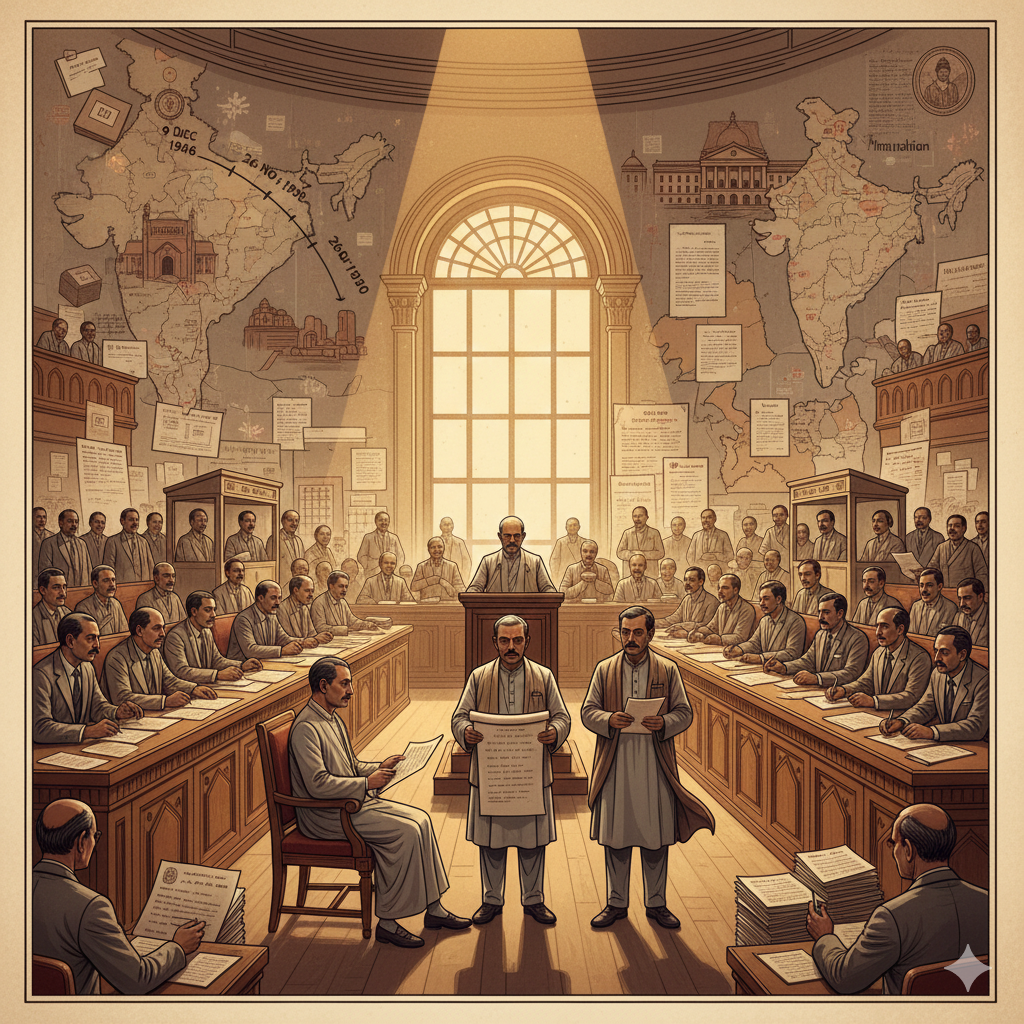
The Assembly convened for the first time on 9 December 1946 in New Delhi. The atmosphere was charged with excitement and responsibility—leaders who had spent their lives fighting for freedom were now tasked with designing the blueprint for the new nation. Committees were formed, debates were conducted, and detailed discussions took place on every major aspect of governance: fundamental rights, the federal structure, judiciary, elections, minorities, and administrative systems. One of the most significant decisions was appointing Dr. B.R. Ambedkar as the Chairman of the Drafting Committee, whose role in shaping the final Constitution became monumental.
The Constituent Assembly worked tirelessly for nearly three years, holding 11 sessions over 165 days of recorded debates. The drafting process involved constant revision, negotiation and compromise, ensuring that the Constitution was not just legally sound but reflective of India’s socio-cultural fabric. The partition of India in 1947 added urgency and complexity to the Assembly’s task, as issues of citizenship, minority protection, and national integration required immediate solutions. Despite these challenges, the Assembly completed its work with remarkable dedication. On 26 November 1949, the Constitution was adopted, and on 26 January 1950—now celebrated as Republic Day—it came into full effect, marking the success of the Formation of the Constituent Assembly.
Election and Nomination Process
The Constituent Assembly was formed through a partly elected and partly nominated system designed to ensure broad-based representation. Members from British Indian provinces were elected indirectly by the provincial legislative assemblies, which themselves were formed through limited franchise elections. Seats were allocated proportionally based on population, and representation was provided to various communities, including scheduled castes, minorities and different regions. This indirect election model aimed to reflect democratic principles even within the constraints of colonial administrative structures.
Princely states were allotted separate seats, and although their participation was initially uncertain, many eventually joined the Assembly. Representatives from these states were nominated by their rulers or selected through internal procedures. Political parties, especially the Indian National Congress and the Muslim League, played crucial roles in selecting candidates. While the Congress secured a majority of seats, other political groups and independent members also participated, ensuring that diverse political opinions were represented in the deliberations.
Overall, the selection system—though imperfect—was designed to bring together India’s social, cultural, and regional variety under one constitutional platform. It allowed leaders with different backgrounds, ideologies and priorities to contribute to the making of a national charter that would guide India’s democratic future.
Key Members and Their Roles
The Constituent Assembly included some of the most influential minds of the era—leaders, scholars, social reformers and legal experts who each brought a distinctive perspective. Dr. Rajendra Prasad served as the President of the Assembly and provided steady leadership throughout the proceedings. Jawaharlal Nehru, with his vision of a modern, secular India, played a major role in shaping the philosophical basis of the Constitution, particularly through the Objectives Resolution. Sardar Vallabhbhai Patel, known for his administrative acumen, guided discussions on federalism, integration of princely states and the structure of the civil services.
Dr. B.R. Ambedkar, as the Chairman of the Drafting Committee, became the principal architect of the Constitution. His deep understanding of law, political theory and social justice shaped many essential provisions, including fundamental rights, constitutional remedies, and safeguards for marginalized communities. Other prominent members—such as Maulana Abul Kalam Azad, Hansa Mehta, Alladi Krishnaswami Aiyar, Gopalaswami Ayyangar and K.M. Munshi—made significant contributions across areas ranging from education and minority rights to judicial independence and administrative design.
The Assembly also included women members who played important roles in advocating gender equality, social reform and inclusive governance. Collectively, these leaders ensured that the Constitution became not merely a legal document but a moral and social charter, reflecting the aspirations of millions.
Interesting Anecdotes
The debates of the Constituent Assembly are filled with fascinating anecdotes that reveal the human side of constitution-making. In one memorable instance, a heated argument on fundamental rights led to an unusually long applause session, showing how deeply the members felt about securing individual freedoms. On another occasion, several members submitted handwritten notes with alternative suggestions on the draft articles—some of these seemingly small comments later evolved into major constitutional provisions.
A charming detail from the debates is that many members spoke in their regional languages, requiring real-time translation to ensure that every voice was understood. This not only demonstrated India’s linguistic diversity but also the Assembly’s commitment to inclusive dialogue. Such anecdotes highlight that the Constitution of India was born not just out of legal debates but out of passion, conviction and genuine collaboration among people who dreamed of building a just and united nation.
Constitutional Debates and Controversies — Major Issues
The deliberations following the Formation of the Constituent Assembly stand among the most consequential political and moral debates in modern Indian history. What makes these sessions remarkable is not merely their scale or the prestige of those who spoke, but the depth and seriousness with which fundamental questions about the nation’s character were discussed. Members confronted problems that combined legal complexity with deep social meaning: How should a plural society be governed? What guarantees should citizens have against majoritarian impulses? How should linguistic, religious and regional differences be acknowledged without fragmenting the unity of the state? These were not academic questions. The answers would determine the shape of Indian democracy, the protection of vulnerable communities, and the balance between liberty and order for generations to come.
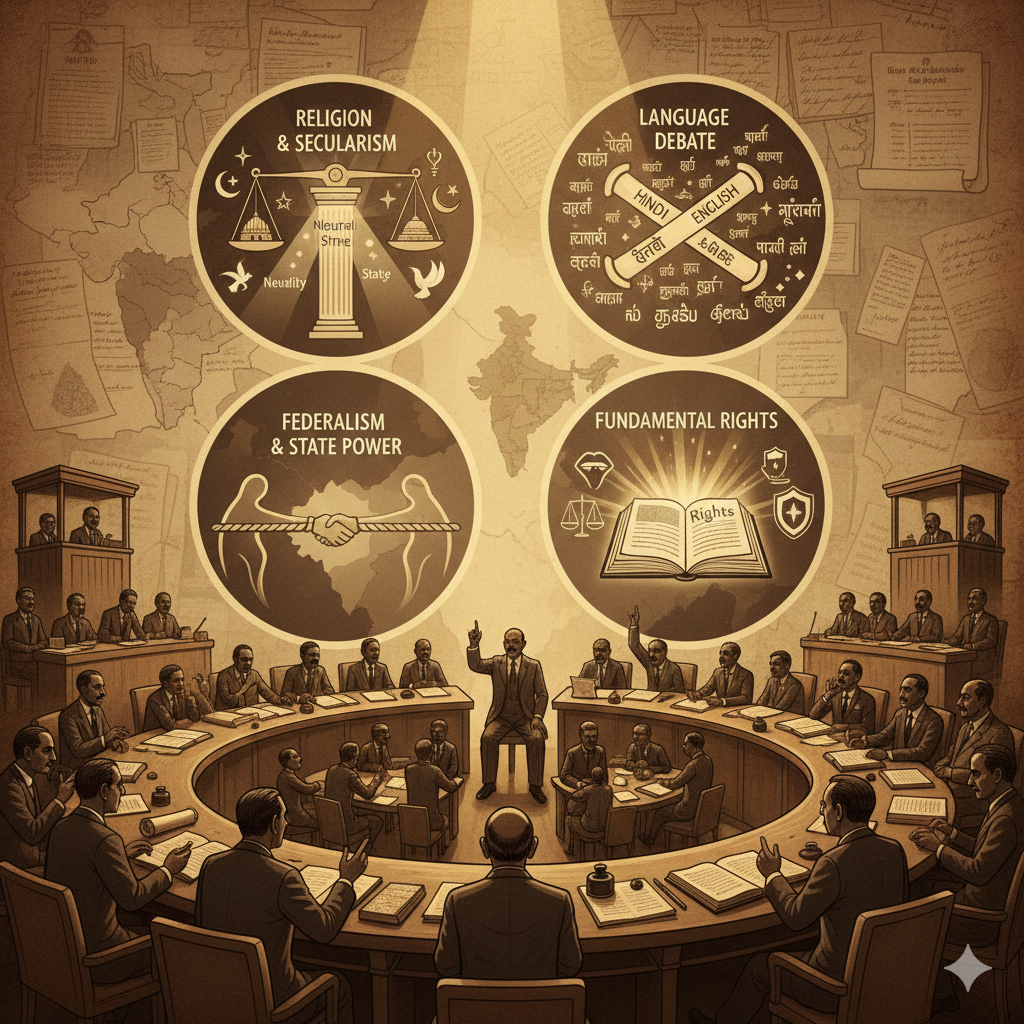
The debates were sustained, intense and often emotionally charged. Delegates approached each subject from different vantage points: some foregrounded individual liberty and classical liberal principles, others emphasized social justice and state responsibility, while yet others highlighted the need for political stability and administrative effectiveness. Compromise, therefore, was not a sign of weakness but the very mechanism through which a durable consensus was forged. Important themes—religion and secularism, the role of language, federal structure, and the list of fundamental rights—saw prolonged discussion, amendments, and negotiations across various committees after the Formation of the Constituent Assembly. The Assembly showed a belief in reasoned debate as the method for finalizing a document that would be acceptable across India’s social spectrum.
Another striking feature of the Assembly’s discourse was its awareness of historical context. The memory of communal violence, the experience of colonial administrative practices, and international developments in constitutional design all informed arguments. Delegates repeatedly noted that the Constitution should not only enshrine legal norms, but also foster a political culture capable of sustaining democratic values. In short, the debates were as much about law as about nation-building following the Formation of the Constituent Assembly.
Key Points of Deliberation: Religion, Secularism, and Languages
Religion and the place of the state in relation to faith were among the most sensitive issues the Assembly faced. In the immediate aftermath of Partition and communal strife, delegates were acutely conscious that the state needed to signal an unequivocal commitment to equal treatment for all citizens. Many argued for a clear separation between religion and state—advocating a secular state that neither favored nor discriminated against any faith. Others, mindful of India’s deep cultural and religious pluralism, cautioned against a rigid separation that might alienate communities whose public life had long been interwoven with religious practices.
The resulting constitutional language struck a balance: the state would remain neutral in matters of religion, protect freedom of conscience and practice, and yet allow space for religious communities to practice their beliefs within the law. This compromise recognized both the need to prevent state-sponsored discrimination and the social reality of religion’s role in many citizens’ lives.
Language, too, provoked significant debate. India’s linguistic diversity meant that policies around official languages, education and administration had enormous political consequences. While many Assembly members supported Hindi as a national link language, others—particularly from the south and non-Hindi regions—feared cultural domination and insisted on safeguards for regional languages. The practical solution was pragmatic: designate Hindi and English for official purposes, commit to the progressive development of Hindi, and ensure protections for regional languages and scripts. This approach sought to respect linguistic plurality while providing administrative continuity during the transition to independence.
Debates over Small and Large States, and Fundamental Rights
The question of territorial organization—how power should be distributed between the Centre and provinces (later states)—occupied the Assembly’s attention because it touched both administrative efficiency and democratic fairness. Some delegates argued for a strong central government to preserve unity and manage economic planning; others recommended greater provincial autonomy to respect regional differences and local self-government. The compromise that emerged favored a quasi-federal model: a strong Centre with clearly demarcated powers, paired with meaningful state autonomy and mechanisms for cooperative federalism. This model attempted to reconcile the need for national integration with the demand for regional agency.
Fundamental rights formed the moral core of many debates. Delegates discussed at length which rights should be guaranteed, their scope, and how to enforce them. There was vigorous defense of civil liberties—freedom of speech, equality before law, protection against discrimination—alongside recognition that social and economic rights (such as measures for upliftment of disadvantaged groups) required state intervention. Tensions emerged about whether certain rights should be absolute or subject to reasonable restrictions in the interest of public order, morality, or social welfare.
The eventual scheme of fundamental rights in the Constitution attempted to reconcile these aims: it provided a set of justiciable civil liberties, while also allowing Parliament the limited power to impose restrictions under clearly defined conditions. Complementing these rights were directive principles of state policy—non-justiciable guidelines meant to steer the state toward social justice and welfare. Together, these provisions reflected a dual commitment: to protect individual liberties against arbitrary state action, and to enable progressive policies that remedied structural inequalities.
In sum, the Assembly’s debates on religion, language, federal structure, and fundamental rights display the careful calibration that went into India’s constitutional architecture. They reveal a conscious effort to build an inclusive polity—one that could accommodate plural identities while upholding universal principles of justice and democratic governance.
My Personal Learnings — Lessons from the Process
Understanding the journey following the Formation of the Constituent Assembly has taught me that nation-building is not merely an administrative or political task—it is a deeply human process driven by values, dialogue and collective responsibility. As I studied the debates, compromises and decisions made by the members, I realized how their patience, moral conviction and commitment to the public good shaped the foundation of modern India. The Assembly did not work with unlimited time or ideal circumstances; it worked amid conflicts, uncertainty and the emotional wounds of Partition. Yet despite this, the members held on to a vision larger than themselves, choosing cooperation over conflict and principle over personal interest.
What struck me most was how each decision—small or large—reflected a conscious attempt to balance justice with practicality, freedom with social order, and diversity with national unity. The Assembly’s work revealed that democracy cannot be built on the majority’s will alone; it requires listening to minority voices, respecting dissent and patiently stitching together agreements that uphold the dignity of all. This understanding changed the way I view leadership and public participation after studying the Formation of the Constituent Assembly.
Equally important was the realization that a constitution is not just a legal document—it is a moral document. It reflects not only what a nation is, but what it aspires to be. The Assembly’s debates around equality, justice and liberty reminded me that these values are not abstract ideals; they require daily commitment from citizens and institutions alike. The Constitution thus became, in my understanding, a living guide: a reminder that progress is sustained when people embrace both rights and responsibilities with sincerity.
Finally, the process taught me that diversity is not a barrier but a resource. The Constituent Assembly was composed of people from different religions, regions, castes, genders and ideologies. Their ability to collaborate demonstrated that a nation becomes stronger when every voice can find space in the larger narrative. This insight remains profoundly relevant as India continues to navigate questions of identity, belonging and social harmony.
Leadership, Conflict and Compromise
The Constitution-making process highlights that leadership is not about dominance or control; it is about empathy, clarity of purpose and the courage to listen. Many members of the Assembly held strong and sometimes opposing views, yet they approached disagreements with dignity and a willingness to understand the other side. This quality of listening—paired with rational debate—was one of the Assembly’s greatest strengths. It showed that leadership thrives not by suppressing dissent but by engaging with it constructively.
Conflict, rather than being an obstacle, became a tool for refinement. Every disagreement pushed members to think deeper, articulate their arguments better and adjust their positions when necessary. Compromise was not viewed as a defeat but as a democratic virtue. It enabled the Assembly to arrive at solutions that were inclusive, stable and practical. This attitude toward conflict resolution stands in sharp contrast to the polarized environments we often see today, reminding us that genuine leadership must rise above ego and focus on the collective good.
Another essential insight is that visionary leadership looks beyond the immediate moment. The Assembly framed provisions not only for the problems of their time but also for challenges that future generations might face. This long-term thinking allowed the Constitution to remain relevant decades later, despite immense social, economic and technological change. It teaches us that true leadership is measured by how well one prepares the ground for those who come after.
How These Lessons Apply Today
In today’s world—marked by rapid technological change, social pressures and political differences—the lessons from the Constituent Assembly are more relevant than ever. First, we must revive the spirit of dialogue. Public discourse today often equates disagreement with hostility, but the Assembly showed that disagreement can be productive when rooted in respect. By practising open communication in communities, workplaces and governance, we can strengthen democratic culture at every level.
Second, we must embrace diversity as a foundational strength. Whether linguistic, cultural, religious or ideological, differences enrich our collective imagination. When we include diverse perspectives in problem-solving, we arrive at solutions that are more inclusive and sustainable. Just as the Assembly welcomed varied voices in shaping the Constitution, modern India must ensure that every citizen feels heard and valued.
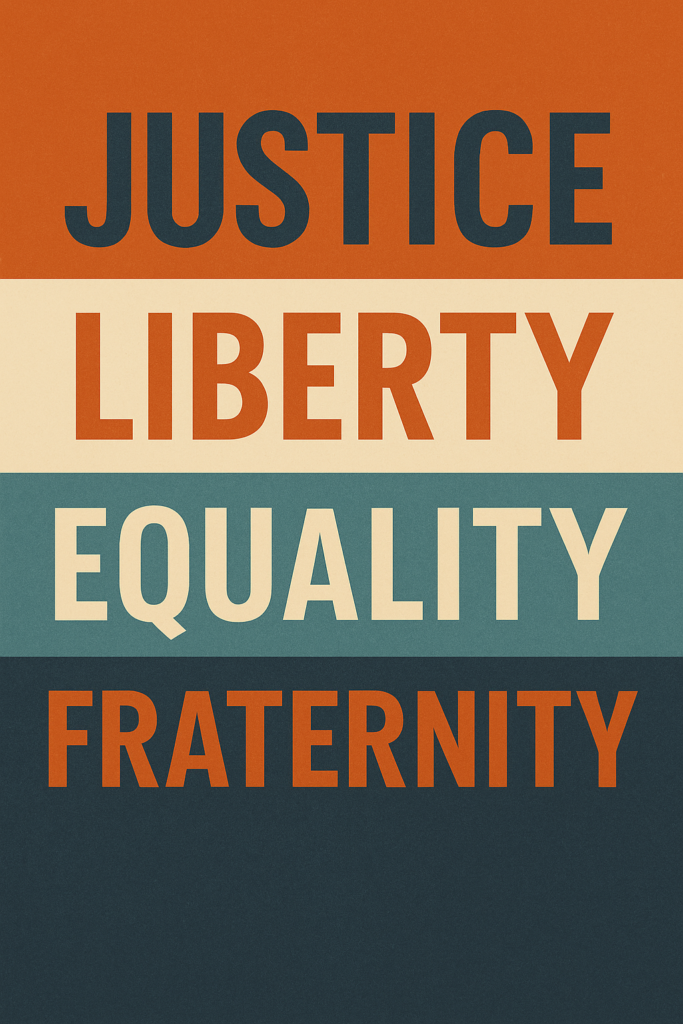
Finally, the most important application of these lessons lies in responsible citizenship. Rights and freedoms become meaningful only when paired with civic responsibility—respecting laws, participating in democratic processes, supporting social harmony and protecting the dignity of others. If citizens today uphold the constitutional values of justice, liberty, equality and fraternity in their daily lives, our democracy will not only survive challenges but emerge stronger and more resilient.
Outcomes and Contemporary Relevance
The adoption of the Constitution marked a watershed moment in India’s political life: it converted the promise of freedom into a concrete institutional framework and set the standards by which the new republic would govern itself. The success of the Formation of the Constituent Assembly ensured that independence was accompanied by a carefully debated constitutional order rather than an ad-hoc transfer of power. Beyond legal provisions and administrative structures, the Constitution established a shared language of rights, duties and values that would guide public life. Its preamble—invoking justice, liberty, equality and fraternity—served as both an aspiration and a yardstick for governance.
The Constitution’s design combined durability with flexibility. It created stable institutions—parliamentary democracy, an independent judiciary, and a federal framework—while also allowing mechanisms for amendment so that the document could evolve with changing social and political needs. This balance between permanence and adaptability proved crucial: it allowed India to negotiate major challenges over decades without abandoning the rule of law. The emphasis on fundamental rights and legal remedies gave citizens tools to claim justice and check state excesses, while directive principles signaled a long-term commitment to social and economic welfare.
Importantly, the Constitution was not merely an elite project; it carried the legitimacy of mass movements and popular aspirations that had culminated in the Formation of the Constituent Assembly. Its provisions reflected not only legal reasoning but also moral and social priorities—such as removing historical inequalities and expanding access to education, representation and opportunity. In the contemporary era—facing globalization, technological change and new social tensions—the Constitution remains the primary instrument for negotiating rights, responsibilities and public order.
Impact after the Constitution Came into Force
Once the Constitution came into force, its most immediate impact was to institutionalize fundamental rights and legal remedies that citizens could invoke against state actions. The creation of a robust judiciary gave ordinary people access to justice and a forum to challenge arbitrary decisions. Politically, the Constitution facilitated the peaceful transfer of power through regular elections and established mechanisms for dispute resolution between the Centre and states, strengthening political stability.
The document also set in motion significant social reforms: affirmative measures to address historical disadvantages, legal safeguards for minorities, and state responsibility for welfare-oriented policies. Over time, constitutional provisions enabled progressive legislation in areas like land reform, education expansion and social welfare, contributing to broad-based social change even if outcomes varied across regions.
Message for Today’s Citizen
For contemporary citizens, the Constitution’s message is both empowering and demanding. It empowers by guaranteeing rights—freedom of expression, equality before the law and protections for minorities—but it also demands active citizenship and responsibility. The legacy of the Formation of the Constituent Assembly reminds us that democratic institutions remain strong only when citizens actively participate in the democratic process, respect others’ rights, and commit to the common good.
In practice, this means voting thoughtfully, holding public institutions accountable, engaging in respectful public discourse, and protecting the dignity of all fellow citizens. The Constitution gives us the tools to build a plural, just and resilient society—but realizing that promise depends on each person’s willingness to exercise rights responsibly and to defend the constitutional framework when it is tested.
Conclusion and Inspirational Message
The journey that began with the Formation of the Constituent Assembly teaches us that building a nation’s constitutional order is at once a legal exercise and a moral undertaking. It required patience, robust debate, and the willingness of diverse actors to find common ground. The Assembly members demonstrated that disagreement need not fracture a polity; when handled with respect and reason, it can lead to durable consensus. Their work turned lofty ideals—justice, liberty, equality and fraternity—into practical institutions and procedures that could be tested, amended and applied across a vast and plural society.
What inspires most is not only the brilliance of individual contributions but the collective commitment to a shared future. Leaders set aside narrow interests, experts translated principles into provisions, and ordinary citizens embraced a new political imagination. The Constitution that emerged from the Formation of the Constituent Assembly is therefore more than text: it is a social contract that asks each generation to uphold its spirit. It invites citizens to claim their rights responsibly and to participate in public life with dignity and restraint.
For contemporary readers, the Assembly’s example is a reminder that democratic institutions survive and thrive when citizens practice civic virtues—listening, compromise, and the courage to defend pluralism. The Constitution gives us both rights and responsibilities: rights that protect individuals from abuse, and responsibilities that sustain the common good. If we carry forward the Assembly’s lessons—prioritizing dialogue over polarization, seeking justice while protecting liberty, and treating diversity as strength—we not only honor the founders’ labor but also strengthen our democracy for future challenges.
Frequently Asked Questions (FAQ)
When and why was the Constituent Assembly formed?
The Constituent Assembly first met on 9 December 1946. It was formed to draft a constitution for independent India so that the transfer of power would be accompanied by a clear constitutional framework reflecting the aspirations and rights of the people.
Who drafted the Constitution?
The Drafting Committee, chaired by Dr. B.R. Ambedkar, prepared the detailed draft. The Committee worked with inputs from many members, specialized subcommittees and extensive debates before the full Assembly adopted the final text on 26 November 1949.
When did the Constitution come into effect?
The Constitution of India came into effect on 26 January 1950. That date is celebrated annually as Republic Day, marking India’s transition to a fully sovereign republic governed by its own constitutional law.
Can the Constitution be changed?
Yes. The Constitution provides a defined amendment procedure. Amendments are enacted by Parliament under specified rules; some types of changes require state ratification to preserve the federal balance.
What is the core message of the Constitution?
The core message is the commitment to justice, liberty, equality and fraternity. It seeks to protect individual rights while enabling the state to promote social welfare—inviting citizens to exercise rights responsibly and to participate actively in democratic life.
References
- Constituent Assembly Debates (Official Reports), Government of India Publications.
- The Making of the Indian Constitution – Reports and Notes by Dr. B.R. Ambedkar and the Drafting Committee.
- National Archives of India – Original documents, proceedings, and archival records related to the Constituent Assembly.
- The Nehru Report (1928), Home Rule documents, and other historical materials from the Indian Independence Movement.
- Academic books, research papers and verified historical sources on the framing of the Constitution of India.