
Tughlaq Dynasty (1320–1414)
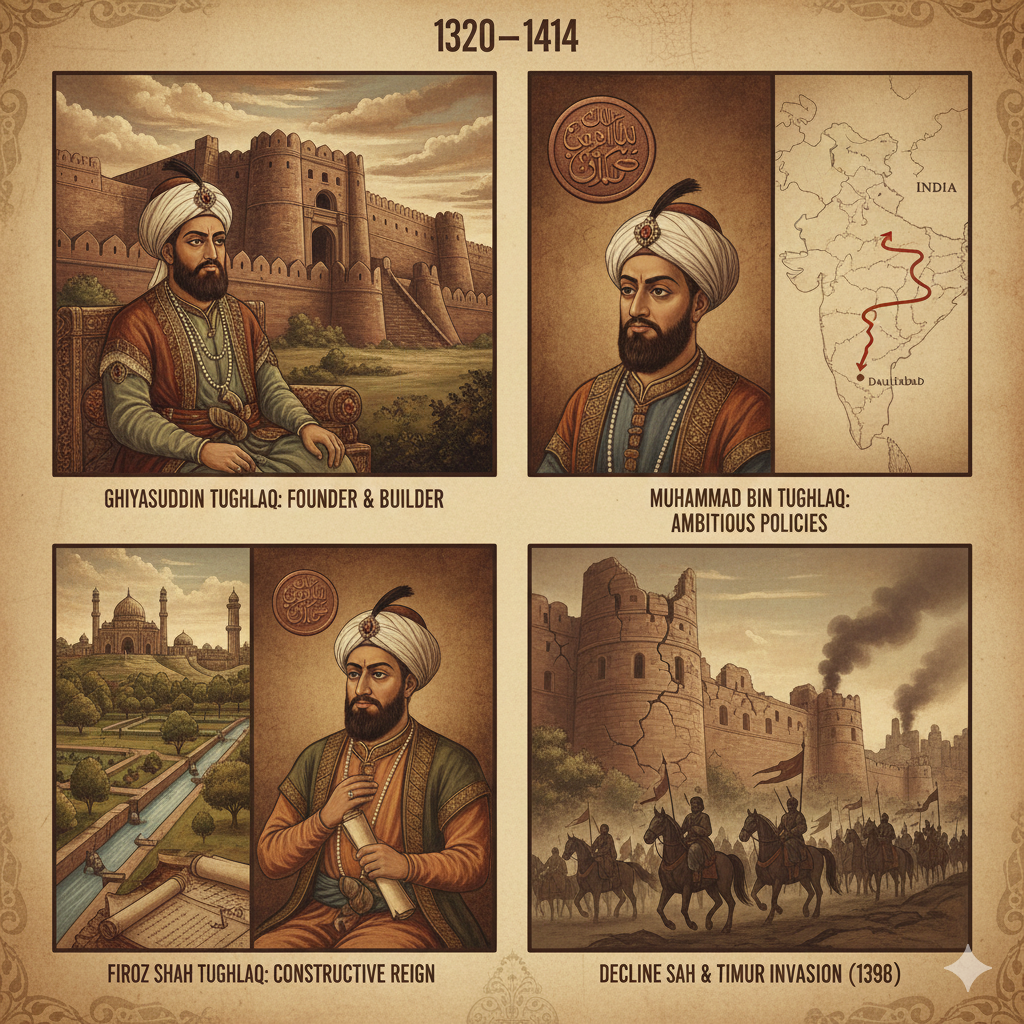
The Tughlaq dynasty (1320–1414) was one of the most significant dynasties of the Delhi Sultanate. Founded by Ghiyasuddin Tughlaq, it marked the third major ruling family of the Sultanate and governed for nearly a century. The Tughlaqs are remembered for their administrative reforms, architectural achievements, and attempts to bring political stability. Their story reflects both vision and challenges, making it an important chapter in medieval Indian history.
Major Rulers of the Tughlaq Dynasty
1. Ghiyasuddin Tughlaq (1320–1325)
- Founder of the Tughlaq dynasty.
- Expanded the boundaries of the Delhi Sultanate and introduced administrative reforms.
- Constructed the fortified city of Tughlaqabad.
- Died in 1325 in an accident, believed by some to be a conspiracy.
2. Muhammad bin Tughlaq (1325–1351)
- Son of Ghiyasuddin Tughlaq.
- A highly educated and visionary ruler, but many of his experiments failed.
Major Policies of Muhammad bin Tughlaq
- Transfer of Capital: Ordered the shifting of the capital from Delhi to Devagiri (Daulatabad).
- Token Currency: Initiated the circulation of copper and iron coins.
- Both policies faced widespread criticism due to implementation failures.
3. Firoz Shah Tughlaq (1351–1388)
- His rule is remembered as a period of relative peace and stability.
- Introduced several social and administrative reforms.
- Built roads, canals, gardens, and mosques.
- Focused on improving the tax system and supporting farmers.
4. Nasiruddin Muhammad Shah (1388–1394)
- Successor after Firoz Shah Tughlaq.
- A weak ruler, under whom the decline of the dynasty began.
5. Mahmud Tughlaq (1394–1414)
- The last ruler of the Tughlaq dynasty.
- The Delhi Sultanate became severely weakened after Timur's invasion in 1398.
- His ineffective leadership contributed to the end of the dynasty.
Key Features of the Tughlaq Dynasty
1. Architecture
The Tughlaqs built strong, massive structures using a unique architectural style. Notable examples include Tughlaqabad and several forts in Delhi.
2. Administrative Reforms
Both Ghiyasuddin and Firoz Shah introduced measures to strengthen the administrative system and improve governance.
3. Social Policies
Firoz Shah Tughlaq strictly enforced Jaziya (a tax on non-Muslims), reflecting his firm approach to religious policy.
4. Reasons for Decline
- The devastating invasion of Timur in 1398.
- Weak and ineffective successors.
- Internal political instability.
Conclusion
The Tughlaq dynasty came to an end in 1414 and was succeeded by the Sayyid dynasty. Although the Tughlaqs contributed significantly to the Delhi Sultanate—especially in architecture and administration—their ambitious but unsuccessful policies, combined with external invasions and internal weaknesses, ultimately led to their downfall. Their legacy remains an important lesson in leadership, governance, and the challenges of balancing vision with practical execution.
Major Rulers of the Tughlaq Dynasty
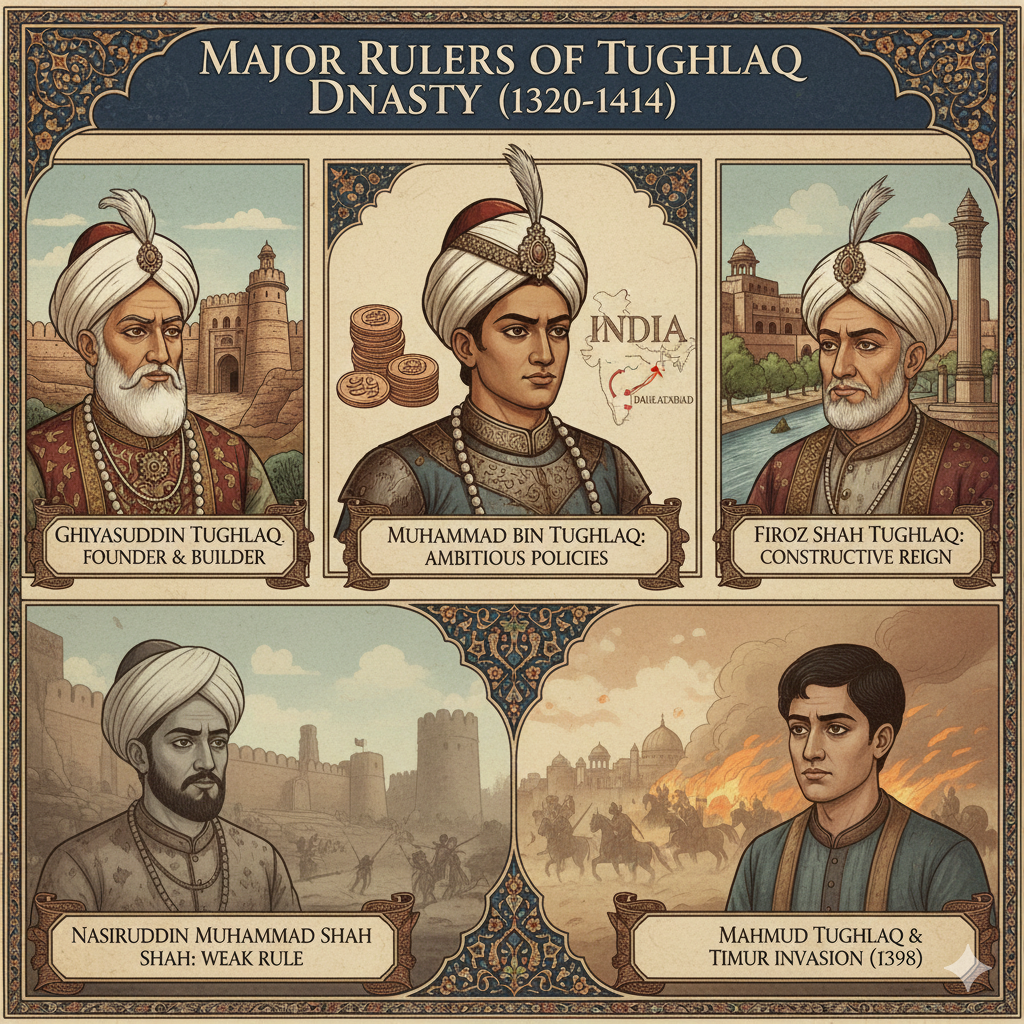
The Tughlaq dynasty (1320–1414) was an important and influential period of the Delhi Sultanate. Its major rulers played a significant role in administrative reforms, empire expansion, and architectural development. Below is a detailed description of the key rulers and their contributions.
1. Ghiyasuddin Tughlaq (1320–1325)
Reign
Ghiyasuddin Tughlaq, earlier known as Ghazi Malik, founded the Tughlaq dynasty after overthrowing the Khilji dynasty in 1320. He was a Turkish slave who rose to power through bravery and strategic intelligence.
Major Achievements
- Establishment of Power: Strengthened the Delhi Sultanate and restored stability.
- Expansion of the Empire: Successfully conquered Bengal and Orissa.
- Architecture: Built the fortified city of Tughlaqabad in Delhi, showcasing his administrative and military vision.
- Administrative Reforms: Organized the agricultural tax system and promoted the interests of farmers.
Death
In 1325, he died in an unusual accident. Some historians believe it was a conspiracy by his son, Muhammad bin Tughlaq.
2. Muhammad bin Tughlaq (1325–1351)
Reign
Muhammad bin Tughlaq, son of Ghiyasuddin Tughlaq, is considered the most controversial and scholarly ruler of the Delhi Sultanate. His ambitious plans often failed due to poor execution.
Major Achievements and Policies
Change of Capital
- Shifted the capital from Delhi to Devagiri (Daulatabad).
- Objective: Strengthen control over southern India.
- Result: The plan failed, causing immense hardship to the public and weakening the empire.
Reform of the Coinage System
- Issued copper and iron token coins.
- Objective: Resolve the shortage of silver and improve the economy.
- Result: Failure due to widespread counterfeit coins.
Military Operations
- Attempted campaigns in Khurasan, Gujarat, and Kashmir.
- Excessive taxation and harsh policies led to public discontent.
Land Revenue Reforms
- Imposed heavy taxes on agriculture.
- Insisted on tax collection even during famines, causing widespread rebellions.
Personal Traits
He was a deep scholar of philosophy, science, and mathematics. His failures came mainly from haste and weak implementation.
Death
He died in 1351 during an expedition to Sindh.
3. Firoz Shah Tughlaq (1351–1388)
Reign
After Muhammad bin Tughlaq, his cousin Firoz Shah Tughlaq ascended the throne. He was an efficient and religious ruler who brought stability to the Sultanate.
Major Achievements
- Administrative Reforms: Strictly enforced Jaziya tax; simplified taxation and supported farmers.
- Social Welfare: Established hospitals, orphanages, and promoted public welfare.
- Infrastructure: Constructed roads, canals, bridges, and gardens.
- Architecture: Built Firoz Shah Kotla and restored the Hauz Khas complex.
- Military Operations: Consolidated control over Bengal, Orissa, and Sindh, suppressing revolts effectively.
Death
After his death in 1388, the dynasty began to weaken.
4. Nasiruddin Muhammad Shah (1388–1394)
Reign
Following Firoz Shah Tughlaq, political struggles emerged. Nasiruddin Muhammad Shah was a weak ruler, under whose reign instability increased.
Events
- Regional governors began to declare independence.
- The central authority of the Delhi Sultanate weakened significantly.
5. Mahmud Tughlaq (1394–1414)
Reign
Mahmud Tughlaq was the last ruler of the dynasty. His rule witnessed the devastating invasion of Timur in 1398.
Timur’s Invasion
- Timur attacked Delhi and looted it extensively.
- The Delhi Sultanate collapsed politically and economically.
Downfall
The Tughlaq dynasty ended in 1414 and was replaced by the Sayyid dynasty.
Conclusion
The rulers of the Tughlaq dynasty were known for their unique policies, architectural contributions, and governance styles. Ghiyasuddin brought stability, Muhammad bin Tughlaq introduced ambitious experiments, and Firoz Shah focused on social welfare. However, weak successors and the invasion of Timur ultimately led to the dynasty’s fall.
Tughlaq Dynasty: Geographical Location
The Tughlaq dynasty (1320–1414) expanded the Delhi Sultanate to one of its largest extents. Although they succeeded in widening the empire, maintaining unity across such a vast region proved challenging.
Geographical Extent of the Tughlaq Empire
1. North India
- Delhi: Political and administrative center of the empire.
- Major regions under control: Punjab, Haryana, Uttar Pradesh, Rajasthan, and Bihar.
- The Ganga–Yamuna Doab remained a crucial agricultural and economic zone.
2. Central India
- Regions like Malwa, Chanderi, and Bundelkhand were under Tughlaq control.
- These areas contributed significantly through agriculture and taxation.
3. South India
- The Tughlaqs attempted multiple military campaigns in the Deccan.
- Daulatabad (Devagiri): Muhammad bin Tughlaq tried shifting the capital here.
- Vijayanagara Empire restricted Tughlaq influence in the South.
- Parts of Karnataka and Andhra Pradesh were temporarily controlled.
4. West India
- Gujarat and Sindh were important western provinces.
- These regions provided access to sea routes and trade networks.
5. East India
- Early expansion included Bengal, Orissa, and Assam.
- Bengal later became independent due to weak central authority.
6. Frontier Regions
- The empire extended into northwestern India, including areas of present-day Pakistan and Afghanistan.
- These regions constantly faced threats from Mongol invasions.
Important Geographical Features
- Ganga–Yamuna Doab: The economic backbone with high agricultural output.
- Deccan Region: Militarily important but difficult to control permanently.
- Daulatabad: A strategic but unsuccessful capital shift.
- Rajputana (Rajasthan): Frequent revolts from Rajput rulers.
Geographical Challenges
- The empire was too vast for effective administration.
- Distant provinces like Bengal, Gujarat, and the Deccan often rebelled.
- Natural barriers like the Vindhyas hindered control between North and South.
- Constant Mongol threats weakened the northern frontiers.
Conclusion
The Tughlaq dynasty expanded the territorial boundaries of the Delhi Sultanate but could not maintain long-term unity. Vast geography, administrative complexities, and continuous rebellions weakened the empire. The fall of the Tughlaqs opened the way for the rise of new regional powers in India.
Features of the Tughlaq Dynasty
The Tughlaq dynasty (1320–1414) ruled the Delhi Sultanate for nearly 94 years and created a distinct legacy in Indian history. The dynasty is known for its experiments and reforms in administration, military organization, social policy, architecture, and religious affairs. Below are the major features of the Tughlaq dynasty explained in detail.
1. Administrative Reforms and Policies
Central Administration
- The rulers of the Tughlaq dynasty established a strong and centralized administrative system.
- Ghiyasuddin Tughlaq developed a transparent and efficient tax collection system.
- Firoz Shah Tughlaq kept taxes stable and ensured they matched the capacity of the farmers.
Empire Expansion and Management
- The empire was divided into provinces called Iqtas for better administration.
- Each province was governed by an appointed officer who reported directly to the Sultan.
Coinage System
- Muhammad bin Tughlaq introduced token currency made of copper and iron.
- Although this experiment failed, it showed efforts to reform the monetary system.
Land Revenue Reforms
- Farmers were taxed based on the productivity of their land.
- Firoz Shah Tughlaq granted relief to farmers during periods of famine.
2. Architecture and Construction Works
New Architectural Style
- Tughlaq architecture emphasized simplicity, strength, and utility.
- Red sandstone and grey stone were widely used.
Important Construction Works
Ghiyasuddin Tughlaq
- Built the famous Tughlaqabad Fort, noted for its strong walls and military planning.
Muhammad bin Tughlaq
- Constructed several forts and cities, though many projects remained unfinished.
Firoz Shah Tughlaq
- Built Firoz Shah Kotla in Delhi.
- Constructed canals along the Yamuna and other rivers.
- Established hospitals, mosques, and other public buildings.
3. Social and Economic Policies
Social Reforms
- Firoz Shah Tughlaq encouraged social welfare and religious reforms.
- Established orphanages, hospitals, and provided financial help to the needy.
Agricultural and Irrigation Reforms
- Constructed canals for irrigation and water management.
- Introduced canal projects on rivers such as the Yamuna and Sutlej.
- Provided seeds and loans to farmers to increase agricultural production.
4. Military Organization and Campaigns
Military Strength
- The Tughlaq rulers focused on building a strong and well-equipped army.
- Muhammad bin Tughlaq planned large military expeditions to regions like Khurasan and Kashmir, although many of them failed.
Defense System
- Major cities like Delhi were defended by strong forts and military structures.
- Provinces had their own military units to maintain security.
5. Religious Policy
Propagation of Islam
- The Tughlaq rulers governed according to Islamic law (Sharia).
- Firoz Shah Tughlaq strictly enforced the Jaziya tax on non-Muslims.
Tolerance
- Ghiyasuddin Tughlaq and Muhammad bin Tughlaq showed religious tolerance.
- Firoz Shah, however, adopted a stricter approach towards non-Muslim communities.
6. Failures and Reasons for Collapse
Unsuccessful Policies of Muhammad bin Tughlaq
- The shifting of the capital from Delhi to Daulatabad.
- Economic crisis caused by counterfeit coins in token currency.
- Heavy taxation that caused dissatisfaction among farmers.
Internal Rebellion and Timur’s Invasion
- Weak rulers allowed governors to declare independence.
- In 1398, Timur’s invasion devastated Delhi and weakened the Sultanate.
political instability
- Power struggles after the death of Firoz Shah Tughlaq led to rapid decline.
- The Sultanate collapsed during the rule of Mahmud Tughlaq.
7. Other Major Features of the Tughlaq Dynasty
Education and Knowledge
- Muhammad bin Tughlaq had deep interest in science, mathematics, and philosophy.
- He is often called the “King of Knowledge.”
Art and Culture
- The rulers encouraged Persian literature and Islamic art.
Conclusion
The Tughlaq dynasty introduced significant reforms in administration, architecture, and social welfare. While several policies failed, their overall impact on governance and medieval architecture was long-lasting. The dynasty eventually fell due to internal weaknesses and Timur’s invasion, but its contributions left a lasting impression on Indian History.
Architecture of the Tughlaq Dynasty
The architecture of the Tughlaq dynasty is an important chapter in medieval Indian history. Known for its simplicity, robustness, and practicality, Tughlaq architecture blended local Indian styles with Islamic influences.
Key Features of Tughlaq Architecture
Simplicity and Robustness
- Buildings emphasized strength and functionality rather than decoration.
- Red sandstone and grey stone were commonly used.
- Structures were designed for long-term durability.
Battered Walls
- Walls were slightly inclined outward to ensure greater stability.
Domes and Arches
- Domes were small, simple, and strong.
- Arches were plain and lacked intricate ornamentation.
Strategic Approach
- Fortified architecture was designed with military needs in mind.
- Security and defense were the main principles behind construction.
Road and Canal Construction
- Firoz Shah Tughlaq constructed extensive canals and drainage systems.
- These systems supported agriculture and trade.
Major Architectural Structures of the Tughlaq Dynasty
1. Tughlaqabad Fort (Ghiyasuddin Tughlaq)
- Location: Delhi
- Construction: Built between 1321–1325 by Ghiyasuddin Tughlaq
- Features:
- Massive walls and strong defense system.
- Contained a palace, mosque, and water reservoir.
- Was abandoned due to water scarcity and later policies of Muhammad bin Tughlaq.
2. Tomb of Ghiyasuddin Tughlaq
- Location: Tughlaqabad, Delhi
- Features:
- Octagonal domed structure built on a raised platform.
- Combination of Hindu and Islamic architectural patterns.
- Built with strong stone walls.
3. Firoz Shah Kotla (Firoz Shah Tughlaq)
- Location: Delhi
- Construction: Built in 1354
- Features:
- Located near the Yamuna River.
- Houses the Ashoka Pillar, brought and installed by Firoz Shah.
- Contains a mosque, palace, and Diwan-e-Aam.
4. Jahanpanah (Muhammad bin Tughlaq)
- Location: Delhi
- Construction: Around 1326–1327
- Objective:
- To unite the existing forts of Siri and Qila Rai Pithora.
- To strengthen the security of the capital.
5. Reconstruction of Hauz Khas (Firoz Shah Tughlaq)
- Reconstructed the old reservoir.
- Improved water management and irrigation.
- Built a madrasa and tomb around the area.
6. Mosques and Tombs
- Several mosques and tombs were built during the Tughlaq period.
- These structures reflected simple Islamic architectural elements.
- Tombs were mostly octagonal with domes.
Importance of Tughlaq Architecture
- Known for durability and practicality.
- Blended Indian and Islamic architectural traditions.
- Military structures and religious buildings showcased functional design.
- Influenced the architectural development during the Mughal period.
Conclusion
The architecture of the Tughlaq dynasty represents a key phase in Indian medieval architectural history. Their buildings, though simple, were strong, effective, and strategically designed. The fusion of Islamic and local styles, along with focus on durability, makes Tughlaq architecture an important chapter in India’s heritage.
Administrative Reforms of the Tughlaq Dynasty
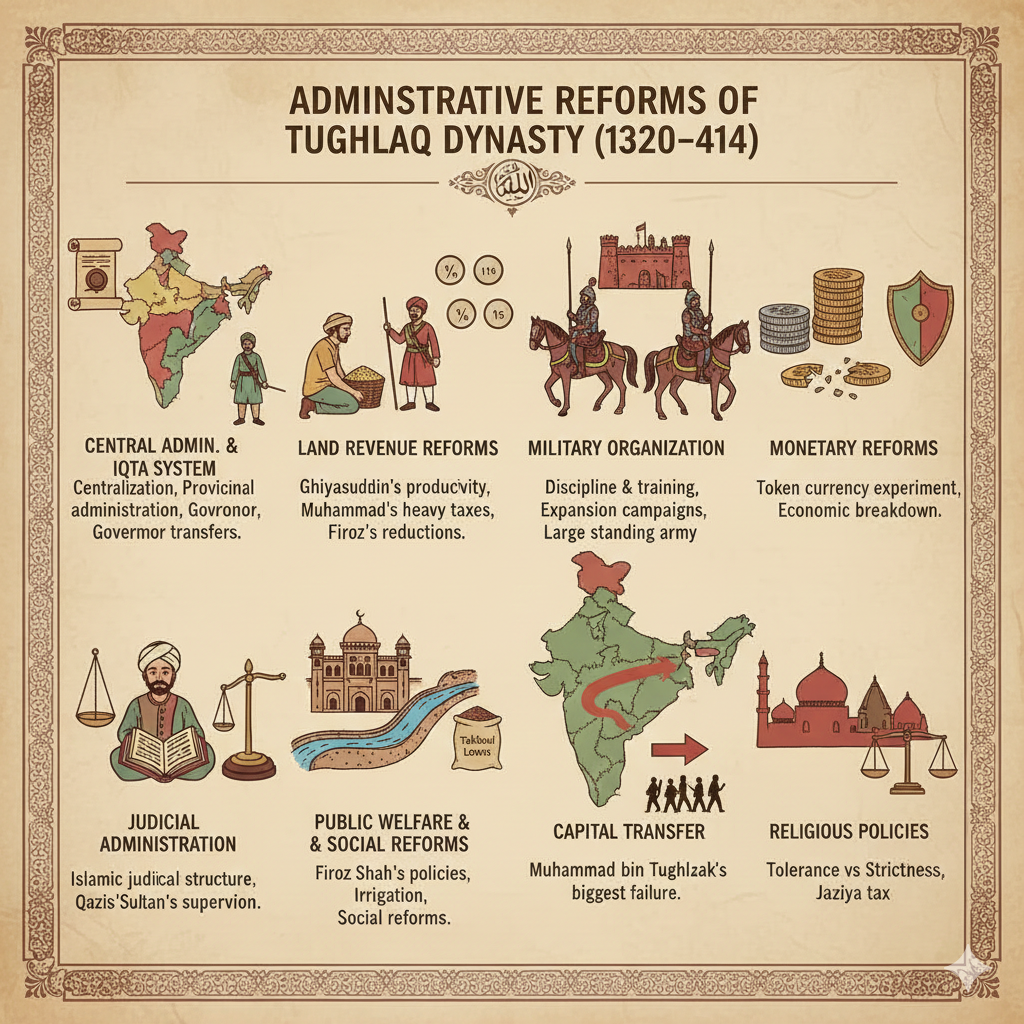
The Tughlaq dynasty (1320–1414) ruled over several major regions of the Delhi Sultanate. Their administrative reforms played a crucial role in stabilizing and expanding the empire. The rulers introduced innovations in administration, taxation, military structure, and socio-economic systems. While some reforms proved successful, others failed due to poor execution.
1. Centralization and Provincial Administration
- The Tughlaq rulers attempted to create a well-organized and centralized empire.
- The empire was divided into Iqtas (provinces).
- Each Iqta was administered by an Iqtadar (Governor).
- Iqtadars were responsible for land revenue collection and local administration.
- They were frequently transferred to prevent the rise of independent authorities.
2. Land Revenue Reforms
Ghiyasuddin Tughlaq (1320–1325)
- Taxes were imposed based on land productivity.
- One-tenth to one-third of agricultural output was taken as revenue.
- Relief provisions were made for farmers during famines.
Muhammad bin Tughlaq (1325–1351)
- Imposed heavy taxes in South India to strengthen revenue.
- Introduced scientific land measurement and weighing methods.
- Excessive taxes led to farmer revolts and failure of the policy.
Firoz Shah Tughlaq (1351–1388)
- Reduced and stabilized taxes for farmers.
- Provided relief during natural calamities such as floods and famine.
- Collected one-fifth of land revenue as Jaziya from non-Muslims.
3. Military Organization
Ghiyasuddin Tughlaq
- Improved discipline and efficiency in the army.
- Paid salaries regularly to soldiers.
- Merit-based recruitment was emphasized.
Muhammad bin Tughlaq
- Attempted to build a large and well-trained army.
- Trained soldiers for long-distance military campaigns.
- Launched ambitious expeditions to Khurasan and Kashmir which ultimately failed.
Firoz Shah Tughlaq
- Reduced military expenditure by limiting campaigns.
- Maintained regular military training systems.
4. Monetary and Economic Reforms
Ghiyasuddin Tughlaq
- Introduced an effective currency system to promote trade and economic growth.
Muhammad bin Tughlaq
- Issued copper and iron coins equivalent to gold and silver currency.
- The policy failed due to the widespread circulation of counterfeit coins.
Firoz Shah Tughlaq
- Improved the currency system and stabilized the financial condition of the empire.
- Constructed roads and canals to boost trade and commerce.
5. Judicial Reforms
- Islamic law (Sharia) was strictly implemented in the judicial system.
- Qazis (judges) were given autonomy in judicial matters.
- The Sultan and his officials supervised judicial administration.
6. Public Welfare and Social Reforms
Efforts of Firoz Shah Tughlaq
- Established hospitals, orphanages, and madrasas.
- Constructed canals for irrigation and water supply.
- Introduced Takkavi Loans (agricultural loans) for farmers.
7. Capital Transfer
Muhammad bin Tughlaq
- Attempted to shift the capital from Delhi to Daulatabad.
- The aim was to strengthen control over both northern and southern regions.
- The plan failed due to hardships faced by citizens and soldiers.
8. Religious Administration and Policies
Ghiyasuddin Tughlaq
- Practiced religious tolerance.
Muhammad bin Tughlaq
- Adopted a flexible approach to religious matters.
- Patronized Hindu temples and Sanskrit scholars.
Firoz Shah Tughlaq
- Imposed strict Islamic laws.
- Enforced Jaziya tax on non-Muslims.
- Destroyed some Hindu temples and promoted mosque construction.
Failures and Limitations of Administrative Reforms
- Muhammad bin Tughlaq’s overly ambitious policies led to administrative failure.
- Public dissatisfaction increased due to the capital shift and monetary reforms.
- Rebellions emerged due to harsh taxation and poor administration.
- The weak successors led to the gradual collapse of the empire.
- Timur’s invasion (1398) shattered the administrative structure completely.
Conclusion
The Tughlaq dynasty introduced several innovative administrative reforms aimed at strengthening the empire. However, the gap between vision and execution resulted in the failure of many policies. Despite this, their reforms remain an important part of Medieval Indian governance History.
Social Policies of the Tughlaq Dynasty
The social policies of the Tughlaq rulers were deeply influenced by religion and the social structure of the time. Society was divided on religious, economic, and caste lines. While some rulers attempted to maintain social balance, their policies were largely shaped by Islamic law (Sharia).
1. Religious Policy and Tolerance
Ghiyasuddin Tughlaq (1320–1325)
- Promoted religious tolerance.
- Encouraged harmony between Hindus and Muslims.
Muhammad bin Tughlaq (1325–1351)
- Flexible in religious matters.
- Patronized Hindu temples and invited Sanskrit scholars.
- Tried reducing discrimination based on religion and caste.
Firoz Shah Tughlaq (1351–1388)
- Adopted strict religious policies.
- Enforced Jaziya tax on non-Muslims.
- Destroyed Hindu temples and promoted mosque construction.
- Encouraged conversion to Islam.
2. Caste and Class System
- Ruling Class: Muslim elites and nobility.
- Peasants: Responsible for agriculture and taxes.
- Craftsmen and Merchants: Involved in trade and urban occupations.
- Non-Muslims: Mostly Hindus who paid Jaziya and other taxes.
- Muslims were prioritized in administration and military positions.
3. Status of Women
- Women had limited societal rights.
- Purdah system and polygamy existed among Muslims.
- Sati, child marriage, and caste restrictions existed among Hindus.
- No significant improvements were made for women's upliftment.
4. Education and Culture
- The Tughlaq rulers promoted education and culture.
- Madrasas and mosques became centers of learning.
- Persian, Arabic, and Sanskrit literature flourished.
- Muhammad bin Tughlaq patronized both Indian and Islamic scholars.
5. Slavery
- The practice of slavery increased during the Tughlaq dynasty.
- Firoz Shah Tughlaq purchased and employed over 180,000 slaves.
- Training centers were established for slaves.
6. Public Welfare Policies
- Firoz Shah established hospitals, orphanages, and welfare centers.
- Provided free food and treatment for the poor.
- Helped farmers with irrigation systems and agricultural loans.
7. Status of Religious Minorities
- Jaziya tax was imposed on Hindus and other non-Muslims.
- Religious festivals were allowed but sometimes restricted.
- Conversions to Islam were encouraged in some areas.
8. Construction of Religious Buildings
- Many mosques, tombs, and madrasas were built.
- The architecture reflected simplicity and Islamic influence.
- The destruction of Hindu temples created social discontent.
Impact of Social Policies
Positive Effects
- Efforts were made to organize society.
- Education and cultural activities flourished.
- Public welfare improved living conditions.
Negative Effects
- Religious intolerance led to social unrest.
- Jaziya tax and restrictions increased resentment among non-Muslims.
- Slavery deepened social inequality.
Conclusion
The social policies of the Tughlaq dynasty varied according to the rulers’ personality and religious views. While Ghiyasuddin and Muhammad bin Tughlaq promoted tolerance, Firoz Shah’s strict policies widened social divisions. The period saw cultural growth but also deep social inequalities.
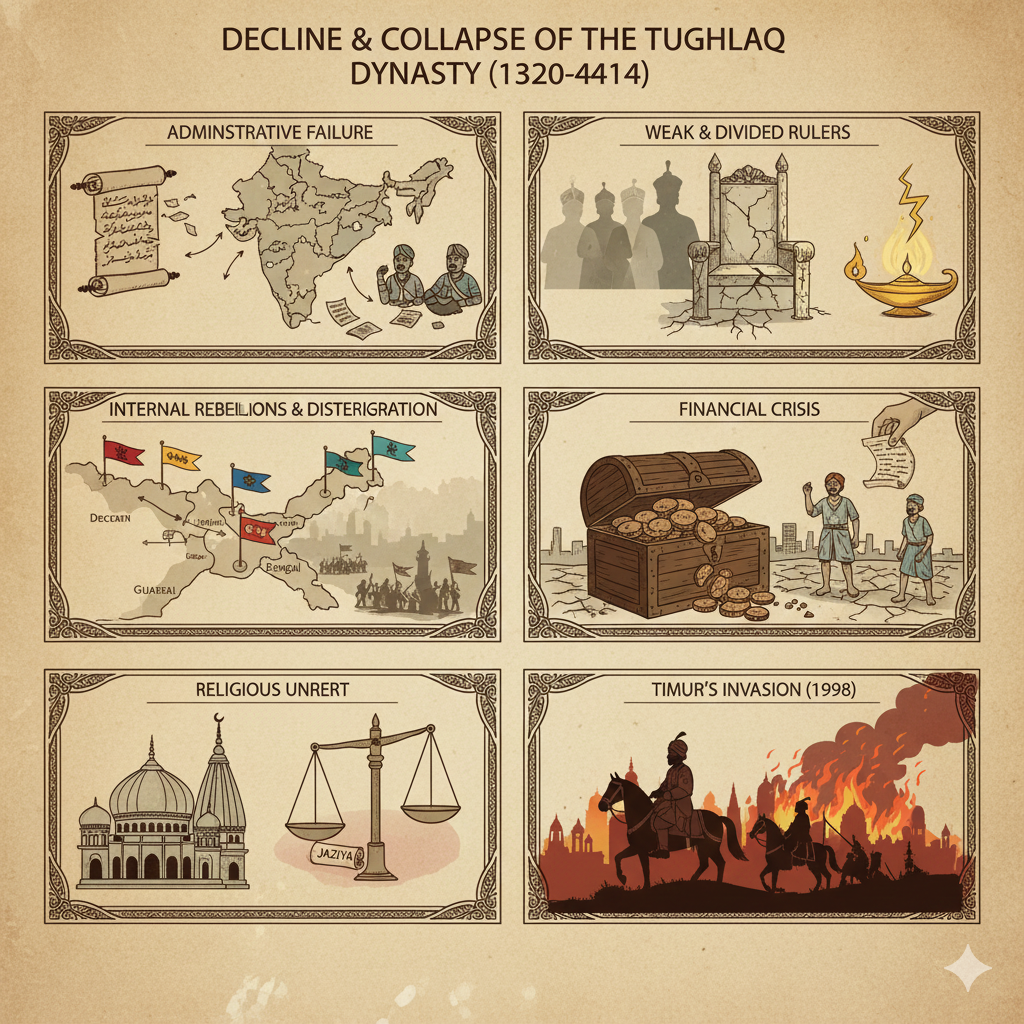
Causes of the Collapse of the Tughlaq Dynasty
The fall of the Tughlaq dynasty (1320–1414) resulted from a combination of political, administrative, economic, and social factors. Although the dynasty initially built a strong foundation in the Delhi Sultanate, its decline was accelerated by weak successors, failed policies, and widespread rebellions.
1. Administrative Weaknesses
- Many administrative reforms were poorly implemented.
- Muhammad bin Tughlaq’s ambitious plans, such as the transfer of capital and token currency, ended in failure.
- The Iqtadari system weakened as provincial rulers began asserting independence.
- Centralized authority was not strong enough to control rebellions and rising instability.
2. Weak Successors
- After strong rulers like Ghiyasuddin and Muhammad bin Tughlaq, the dynasty was ruled by weak kings.
- Power struggles increased after the death of Firoz Shah Tughlaq.
- Weak leadership resulted in corruption, mismanagement, and administrative collapse.
3. Internal Rebellions and Provincial Disintegration
- The vast empire became difficult to govern effectively.
- Major provinces such as Bengal, Gujarat, and the Deccan declared independence.
- In the south, the rise of the Vijayanagara Empire weakened Tughlaq influence.
- Rajput and Afghan chiefs also revolted and refused to acknowledge the authority of the Tughlaqs.
4. Financial Crisis
- Economic mismanagement weakened the empire.
- Muhammad bin Tughlaq’s copper coin experiment and heavy taxation resulted in financial instability.
- High taxes caused revolts among farmers.
- Although Firoz Shah reduced taxes, it was insufficient to restore economic stability.
- Continuous wars and campaigns drained the treasury.
5. Religious Fanaticism
- Firoz Shah Tughlaq encouraged religious conservatism and strict enforcement of Islamic laws.
- The Jaziya tax was imposed harshly on non-Muslims, creating societal discontent.
- The destruction of some Hindu temples led to widespread resentment.
- Religious intolerance fueled rebellions and social unrest.
6. Foreign Invasion
- Foreign invasions were a major factor in the dynasty’s downfall.
- In 1398, Timur (Timurlang) invaded Delhi and plundered it mercilessly.
- The invasion caused massive destruction, economic collapse, and administrative paralysis.
- After Timur’s invasion, the Delhi Sultanate became too weak to recover.
7. Military Weaknesses
- Muhammad bin Tughlaq’s military expeditions failed due to unrealistic planning.
- The army suffered from poor discipline and low morale.
- Under Firoz Shah Tughlaq, military operations became limited, strengthening external forces.
- The weakened army could not suppress provincial revolts or defend against foreign invasions.
8. Social Dissatisfaction
- Heavy taxes on farmers and laborers led to widespread discontent.
- Economic and religious policies created tension among various social groups.
- The increase in slavery and destruction of temples angered many communities.
- Social frustration contributed to rebellions and the fragmentation of the empire.
9. Ambitious and Impractical Plans
- Muhammad bin Tughlaq’s ambitious policies significantly contributed to the decline:
- Capital Transfer: The attempt to shift the capital to Daulatabad failed disastrously.
- Currency Reforms: Token currency led to widespread economic chaos due to counterfeit coins.
- High Taxes: Excessive taxation forced farmers to revolt and weakened agricultural productivity.
10. Lack of Continuity in Leadership
- Internal power struggles weakened the central authority.
- Successors of the Tughlaq dynasty were incompetent and incapable of maintaining stability.
- Royal family conflicts and succession disputes led to administrative disintegration.
Conclusion
The fall of the Tughlaq dynasty was a consequence of weak leadership, administrative failures, and growing internal rebellions. Foreign invasions and widespread social dissatisfaction accelerated the decline. After Timur’s devastating attack, the Tughlaq administration collapsed entirely, and in 1414, the Sayyid dynasty replaced the Tughlaqs. The decline of the Tughlaq dynasty marked the weakening of the Delhi Sultanate in medieval Indian history.
Conclusion
The collapse of the Tughlaq dynasty was the result of a combination of weak leadership, administrative failures, economic mismanagement, and widespread social discontent. The ambitious yet poorly executed policies of Muhammad bin Tughlaq, along with the religious intolerance during Firoz Shah’s reign, created instability across the empire. Continuous rebellions, rising provincial independence, and a weakening central authority further accelerated the decline. The devastating invasion of Timur in 1398 completely shattered the Delhi Sultanate’s administrative structure, making recovery impossible. By 1414, the Tughlaq dynasty came to an end, marking a significant turning point in medieval Indian history and the beginning of the Sayyid dynasty.
References
- Satish Chandra, Medieval India: From Sultanat to the Mughals.
- Irfan Habib, A People’s History of India – The Delhi Sultanate.
- R.S. Sharma, India’s Ancient Past and Medieval Developments.
- NCERT – History Textbook (Class 7–12), Medieval India Chapters.
- J.L. Mehta, Advanced Study in the History of Medieval India.
- Archaeological Survey of India (ASI) Reports on Tughlaq Monuments.
1. who founded the Tughlaq Dynasty?
Ghiyasuddin Tughlaq founded the Tughlaq Dynasty in 1320 CE after overthrowing the Khilji dynasty. He became the first ruler of the Tughlaq Sultanate and strengthened the Delhi Sultanate.
2. Why is Muhammad bin Tughlaq famous in Indian history?
Muhammad bin Tughlaq is famous for his ambitious administrative experiments, including the transfer of the capital from Delhi to Daulatabad and the introduction of token currency. However, many of these policies failed due to poor implementation.
3. What were the major achievements of Firoz Shah Tughlaq?
Firoz Shah Tughlaq built canals, roads, hospitals, gardens, and educational institutions. He also promoted irrigation projects and implemented several welfare measures for farmers and the poor.
4. What is Tughlaqabad Fort and who built it?
Tughlaqabad Fort is a massive fortified city in Delhi built by Ghiyasuddin Tughlaq. It is one of the finest examples of Tughlaq architecture and military planning.
5. What were the main features of Tughlaq architecture?
Tughlaq architecture emphasized strength, simplicity, and functionality. Buildings were constructed with sloping walls, strong fortifications, domes, arches, and durable stone materials.
6. What were the main reasons for the decline of the Tughlaq Dynasty?
The decline of the Tughlaq Dynasty was caused by failed administrative policies, weak successors, internal rebellions, economic problems, and Timur's devastating invasion of Delhi in 1398.
7. When did the Tughlaq Dynasty end?
The Tughlaq Dynasty ended in 1414 CE after the fall of Mahmud Tughlaq. It was succeeded by the Sayyid dynasty in the Delhi Sultanate.