
Introduction: Personal Connection and Purpose of This Article
Whenever I read about the rise of the Magadha Empire, one question consistently echoed in my mind: What made this seemingly ordinary kingdom transform into one of the most powerful political forces of ancient India? This question was not just historical—it was deeply philosophical, connected to leadership, strategy, social harmony, and the long-term vision required to build any great civilization. During my travels across the historical landscapes of Bihar, when I stood near the serene expanses surrounding the Ganga plains, I felt an unexpected personal connection. The fragrance of the soil, the steady flow of the river, and the vast green fields revealed something profound: geography is not merely a physical backdrop; it shapes the destiny of societies.
My exploration of Magadha was not just a physical journey—it became an internal journey of curiosity, reflection, and learning. As I studied the decisions and reforms of rulers like Bimbisara, Ajatashatru, and Chandragupta, I realized that empires are not built by warfare alone. They emerge from intelligent economic policies, disciplined administrative systems, and leaders who think beyond their lifetime. In today’s world—whether in governance, business, or personal growth—these lessons feel more relevant than ever. Understanding how Magadha transitioned from a regional power to a mighty empire inspired me to reflect on the qualities and structures that determine long-term success.
The purpose of this article is not simply to recount historical events, dates, and dynasties. Instead, I aim to present the rise of the Magadha Empire as a living source of inspiration. Here, you will find a detailed analysis of political strategies, economic frameworks, military strength, religious movements, and cultural evolutions. Alongside these historical insights, I will also share my personal reflections drawn from travel experiences, observations, and years of learning. My hope is that as you read this, you do not merely gain historical knowledge—you gain perspective, motivation, and a deeper understanding of how civilizations rise and how individuals can rise with them.
Example Product Title
👉 Buy on AmazonDisclosure: As an Amazon Associate, I earn from qualifying purchases.
Geographical and Cultural Context of Magadha
Geographical Location and Resources
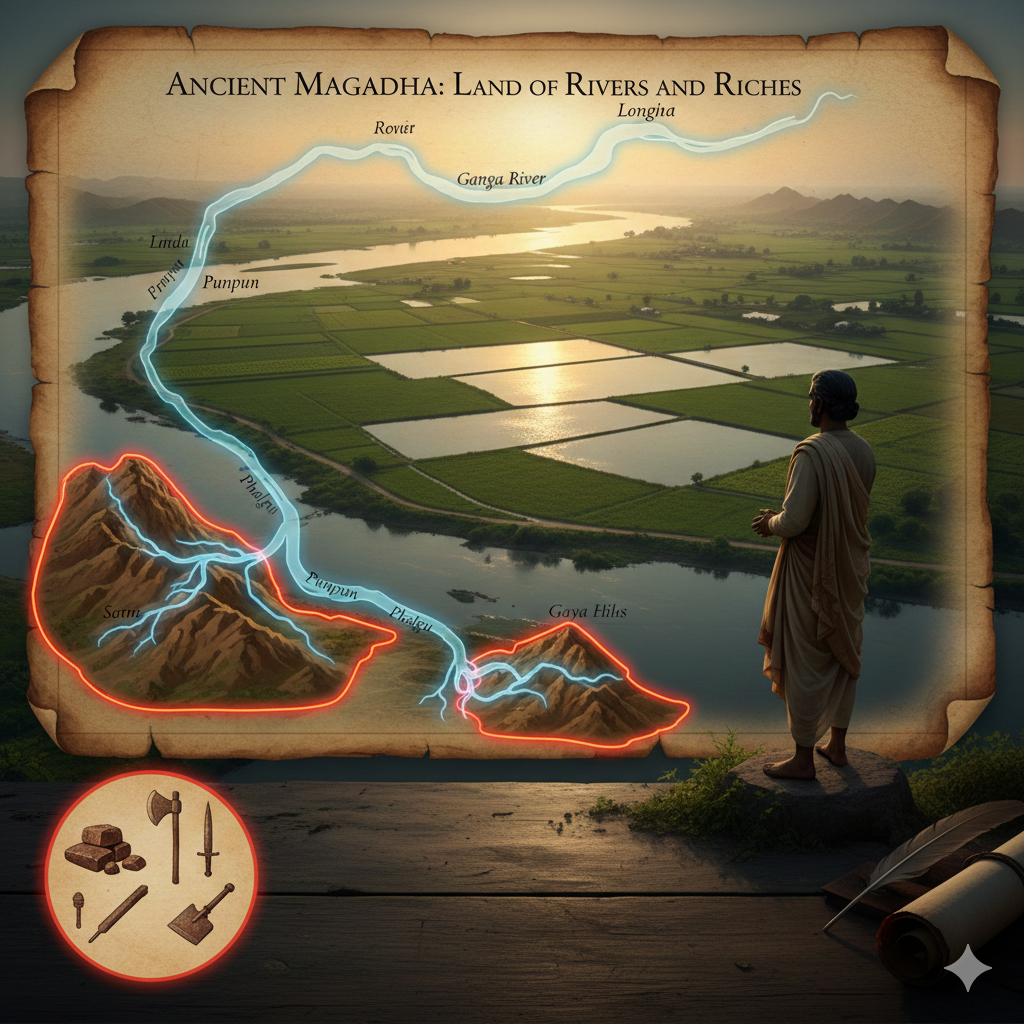
The geographical position of Magadha played an instrumental role in shaping its rise as a dominant ancient power. Situated in the southern part of present-day Bihar and extending into regions of Jharkhand, Magadha was naturally protected and agriculturally rich. The convergence of major rivers such as the Ganga, Son, Punpun, and Phalgu created a fertile basin that supported extensive agriculture, trade, and human settlement. These rivers provided not only abundant water for cultivation but also served as important transportation routes, connecting Magadha to other economic and cultural centers of the subcontinent.
To the south, the rugged hills of Rajgir and Gaya offered natural fortification against invasions, giving the kingdom a defensive advantage over other Mahajanapadas. The region was also endowed with valuable mineral resources, particularly iron ore, which proved crucial in the development of Magadha’s military power. The availability of metals enhanced weapon production, agricultural tools, and construction activities. The fertile alluvial soil of the Ganga plains allowed multiple harvests in a year, increasing productivity, population, and state revenue. Together, these geographical advantages provided Magadha with a strong foundation that enabled its rapid growth and supremacy.
Tribal and Janapada Background
In its early phase, Magadha’s social structure was shaped by a blend of tribal groups and local clans. Continuous cultural exchange with neighboring regions such as Anga, Videha, and Chedi enriched its social fabric, making it more adaptable and diverse. One of the unique features of Magadha’s early society was its limited dependence on rigid Brahmanical traditions, which allowed for greater intellectual openness. This is one of the reasons why the teachings of Buddhism and Jainism later found fertile ground in this region.
The tribal communities of Magadha had their own customs, governance practices, and systems of social organization. Instead of suppressing these groups, the early Magadhan rulers integrated them into the expanding state structure. This inclusion strengthened administrative stability and promoted social unity. The interaction between tribal institutions and emerging state mechanisms created a flexible political environment, where innovation and reform were possible. This diverse janapada background thus laid the foundation for Magadha’s cultural richness and played a crucial role in the kingdom’s long-term political and ideological evolution.
Political Causes Behind the Rise of Magadha
Political Strategies: Centralization and Military Strength
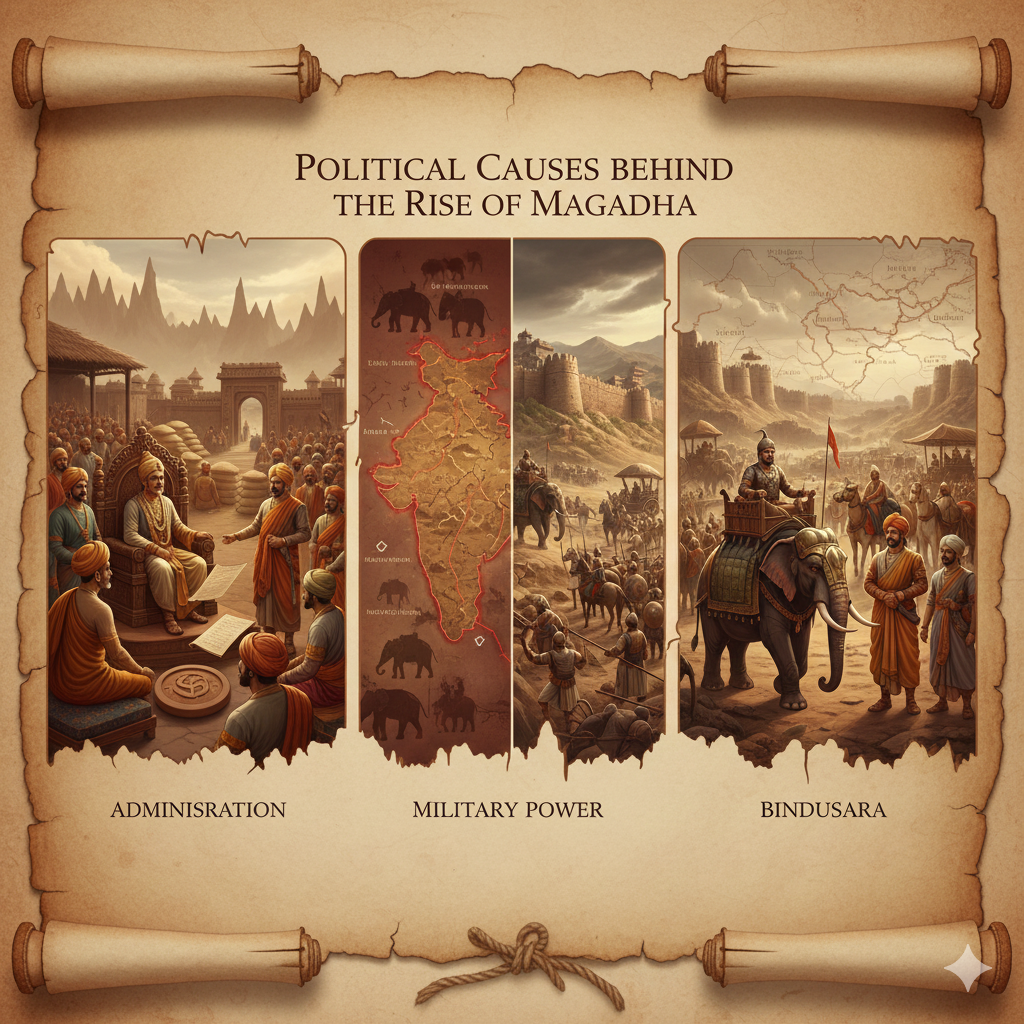
One of the clearest political reasons for Magadha’s rise was its early and effective move toward centralized governance. While many contemporaneous janapadas remained loosely organized confederations, Magadha invested in institutional consolidation: power was concentrated around a strong royal center that could make and enforce decisions quickly. Centralization enabled the monarch to standardize revenue collection, mobilize resources for public works, and implement coherent policies across a growing territory. Local chiefs and tribal leaders were often incorporated into the state apparatus through offices, grants, or alliances rather than being simply suppressed, creating a layered but controllable administrative network.
Example Product Title
👉 Buy on AmazonDisclosure: As an Amazon Associate, I earn from qualifying purchases.
Parallel to administrative centralization was deliberate military modernization. Access to local iron deposits allowed sustained production of better weapons and tools, giving Magadhan armies technological advantages over many rivals. The state also developed a mixed military composed of chariots, infantry, cavalry, and war-elephants — a combination that proved decisive in pitched battles and regional campaigns. Defensive geography (hill forts around Rajgir, riverine barriers at Pataliputra) was augmented by constructed fortifications and logistics networks, which helped project power and secure supply lines. Beyond brute force, Magadhan rulers used diplomacy, marital ties, and strategic alliances to neutralize threats, expand influence, and buy time for consolidation. This blend of centralized administration, military capability, and pragmatic diplomacy formed the core political strategy that propelled Magadha from a regional janapada to a dominant state.
Key Rulers and Their Policies (Bimbisara, Ajatashatru, Bindusara)
The rise of Magadha is inseparable from the policies of several formative rulers whose combined actions created continuity and momentum. Bimbisara (often credited as a founder of Magadha’s early expansion) pursued a policy of diplomatic expansion and internal reform. He forged alliances through marriage and treaty, incorporated neighboring territories, and patronized religious and intellectual movements. His approach balanced military action with persuasion and administrative building, creating a resilient state core.
Ajatashatru, Bimbisara’s successor, shifted the balance more decisively toward military assertion and structural consolidation. He is traditionally credited with aggressive campaigns against rival republican and monarchic polities, and with strengthening fortifications and army organization. Ajatashatru’s reign marked a phase of territorial enlargement and administrative tightening: conquered regions were integrated more firmly into the Magadhan bureaucracy, and revenues were redirected to support sustained military and infrastructural investment.
Bindusara, who followed, continued both consolidation and diplomatic outreach. Under his rule Magadha extended its influence beyond immediate neighbors, establishing trade and political contacts farther afield. Bindusara consolidated administrative gains and ensured a degree of fiscal stability that set the stage for even larger imperial projects by later dynasties. Together, the policies of these rulers — selective warfare, diplomatic engagement, administrative integration, and economic consolidation — created a durable political framework. That framework allowed Magadha not only to expand rapidly but also to sustain and institutionalize power over a wide territory, laying the groundwork for subsequent imperial formations.
Economic and Social Causes
Agriculture, Trade, and Revenue Systems
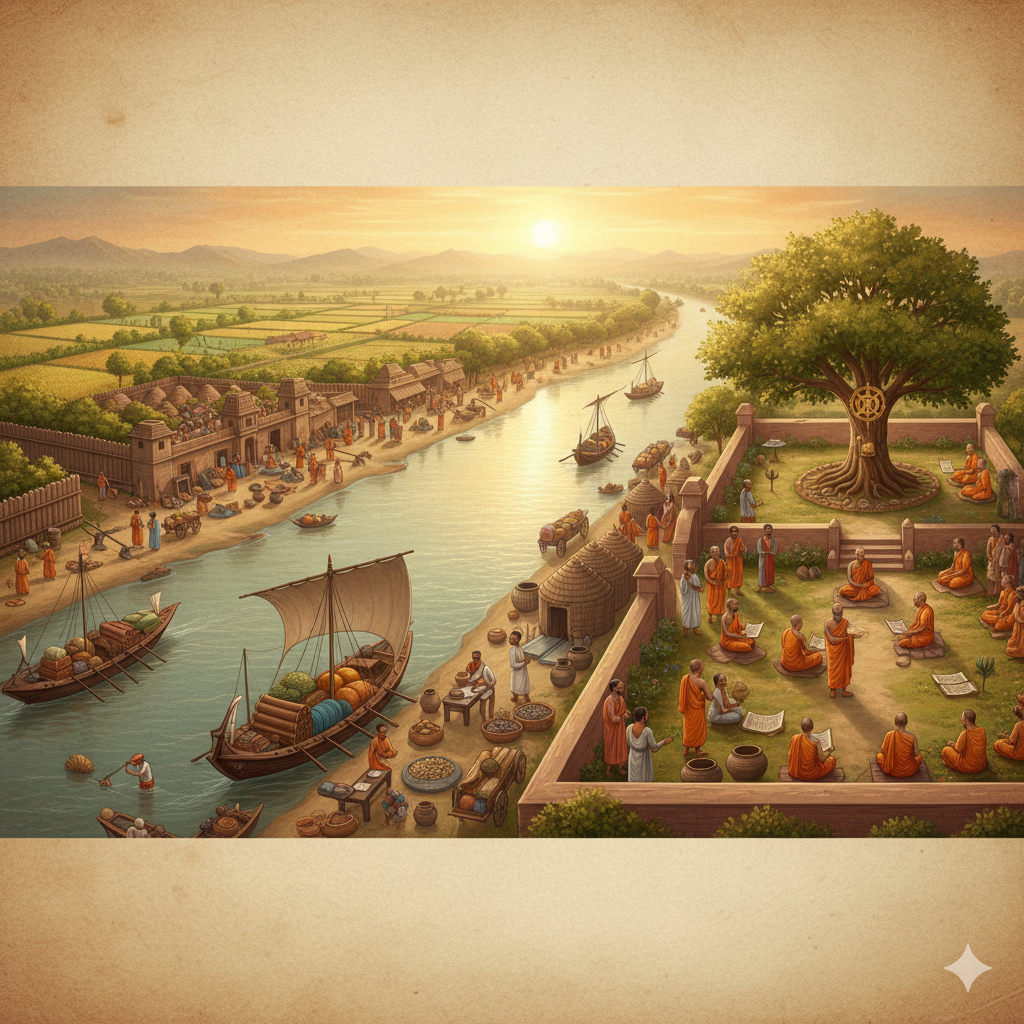
Agriculture formed the backbone of Magadha’s economy and created the material conditions for long-term state-building. The fertile alluvial plains of the Ganga and its tributaries enabled multi-cropping and surplus production, which in turn supported population growth and urban settlements. Reliable food surpluses allowed rulers to tax agricultural output, creating a predictable revenue base that could fund public works, military upkeep, and administrative expansion. The state gradually standardized land assessment and collection practices, which reduced local arbitrariness and made fiscal planning possible at a larger scale.
Trade complemented agriculture by turning Magadha into a commercial hub. Riverine routes—especially along the Ganga and its tributaries—linked inland production zones with market towns and export gateways. Goods such as grains, textiles, metal tools, and timber moved across these networks, encouraging specialization and artisanal production in urban centres like Pataliputra and Champa. The proximity of iron ore deposits lowered production costs for tools and weapons, increasing both agricultural productivity and military self-sufficiency.
Crucially, Magadhan rulers invested revenue into infrastructure that amplified economic returns: roads, bridges, warehouses, docks, and fortifications improved market access and reduced transaction costs. The state also fostered commercial alliances and regulated marketplaces to ensure flow of goods and tax compliance. Together, a reliable agrarian base, expanding trade networks, and an institutionalized revenue system created the fiscal capacity needed for sustained political and territorial growth.
Example Product Title
👉 Buy on AmazonDisclosure: As an Amazon Associate, I earn from qualifying purchases.
Urbanization and Buddhist/Jain Influence
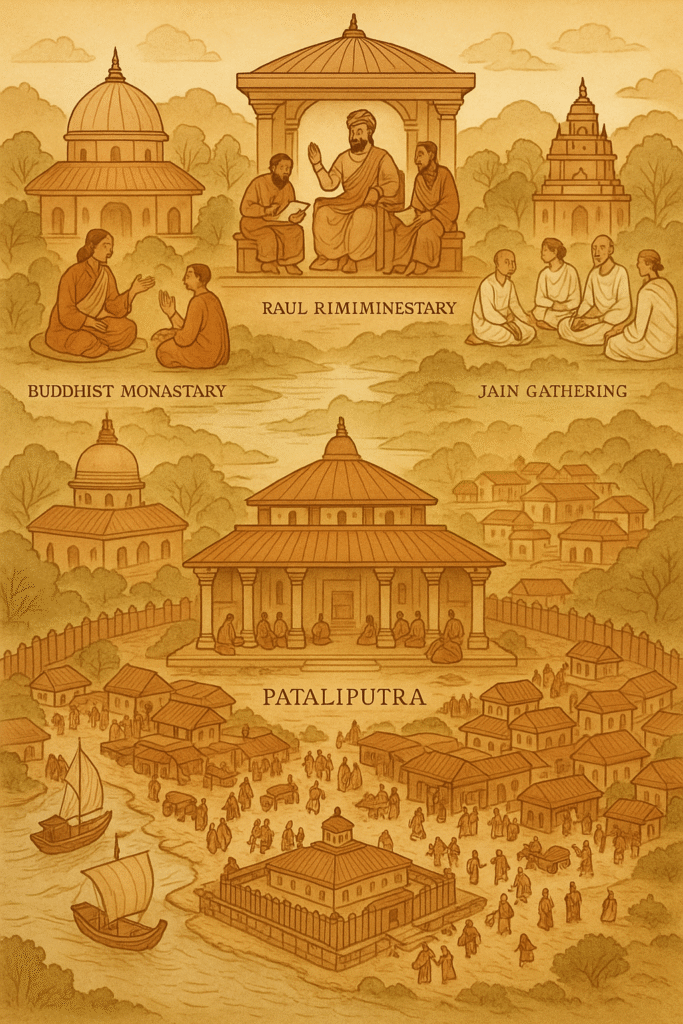
Urbanization played a transformative social role in Magadha’s rise. Cities like Pataliputra became administrative, commercial, and intellectual hubs where bureaucratic record-keeping, surplus storage, and specialized crafts concentrated. Urban centres supported professional administrators, merchants, artisans, and service providers, forming a socio-economic class that both benefited from and reinforced state structures. Dense settlement patterns also facilitated communication, mobilization, and cultural exchange, making it easier for rulers to govern larger territories.
Concurrently, the spread of heterodox movements—principally Buddhism and Jainism—shaped social attitudes and institutional life. These movements questioned ritual hierarchies, advocated ethical reforms, and promoted community-oriented networks (sanghas, samitis) that were socially inclusive and organizationally robust. Royal patronage of these traditions generated new forms of social legitimacy and created institutional partners for the state: monasteries and mendicant communities functioned as centres of learning, social welfare, and informal administration.
The combined effect of urban growth and religious dynamism was a flexible social environment conducive to innovation. Cities provided the material infrastructure and human capital; Buddhist and Jain institutions supplied intellectual capital, moral authority, and civic networks that helped integrate diverse populations. This mix of economic density and ideological plurality strengthened social cohesion while enabling the administrative and cultural scalability necessary for Magadha’s long-term expansion.
Cultural and Religious Dimensions and Their Impact
Contribution of Buddhist and Jain Movements
The rise of Buddhism and Jainism in Magadha introduced profound social and institutional changes that helped shape the kingdom’s trajectory. Both movements challenged orthodox ritual hierarchies and promoted ethical frameworks that emphasized non-violence, compassion, and communal care. Monastic communities (sanghas) and Jain assemblies functioned as organized social units that offered education, welfare, and dispute-resolution mechanisms—roles that complemented and sometimes partnered with state institutions. Their moral authority and organizational capacity gave rulers alternative sources of legitimacy and channels for communicating reforms.
Royal patronage accelerated the growth of these traditions and encouraged them to become centers of learning and social service. Monasteries and Jain samitis served not only spiritual needs but also preserved literary knowledge, trained scribes and teachers, and hosted travelers and pilgrims—thereby knitting together regional networks of trade, information, and culture. In short, the Buddhist and Jain movements supplied Magadha with institutional partners that reinforced social cohesion, created hubs of intellectual exchange, and contributed indirectly to administrative stability and long-term state formation.
Education, Arts, and Secular Policies
Education and the arts in Magadha developed in tandem with the state’s administrative and economic expansion. Monastic schools and informal scholarly networks cultivated expertise in logic, rhetoric, medicine, and statecraft—skills useful to both religious communities and secular administration. Urban centers became crucibles for artistic innovation: architecture, coinage design, metalwork, and narrative art all flourished, projecting the kingdom’s cultural identity and economic vitality.
Equally important was the relative religious tolerance practiced by Magadhan rulers. By supporting multiple sects and allowing intellectual plurality, the state avoided rigid ideological monopolies and benefited from a lively marketplace of ideas. This secular posture encouraged civic participation across diverse groups and reduced the risk of factionalism. In combination, educational institutions, artistic patronage, and inclusive policies produced a culturally dynamic environment that strengthened Magadha’s internal resilience and enhanced its appeal to neighboring regions.
Example Product Title
👉 Buy on AmazonDisclosure: As an Amazon Associate, I earn from qualifying purchases.

Administrative Structure and Governance of Magadha
Key Policies: Justice, Taxation, and Central Administration
The administrative strength of Magadha lay in its well-designed policies related to justice, taxation, and centralized governance. The justice system integrated local customary courts with royal oversight, creating a dual mechanism where village-level disputes were resolved quickly by local officials, while serious or politically sensitive cases were handled by the king’s court. This layered judicial structure ensured accessibility, consistency, and public trust in the state’s authority.
In terms of taxation, Magadha developed one of the earliest systematic revenue structures in ancient India. Land-based taxation became the primary source of state income, supported by standardized assessment and recording practices. Regularized tax collection provided a steady financial base that funded the expansion of the military, construction of infrastructure, and salaries of administrative personnel. The emphasis on accurate record-keeping and centralized monitoring minimized local corruption and ensured that resources were distributed according to state priorities.
The central administration operated through a hierarchy of provincial governors, tax collectors, military commanders, and record-keepers who were directly accountable to the king. This bureaucratic chain ensured swift implementation of royal commands across the territory. Documentation, auditing, and accountability norms made the system relatively transparent and capable of long-term planning. Together, these policies created a governance model that balanced efficiency, order, and stability—one of the foundational pillars behind Magadha’s rise.
Feudalism and Policies to Control It
Feudal tendencies—where local chiefs accumulate excessive autonomy and resist central authority—posed major challenges to many ancient polities. Magadha, however, adopted deliberate strategies to restrict such tendencies. One method was the integration of tribal leaders and local chieftains into the state’s administrative framework by granting them official posts or limited privileges. This approach reduced the risk of rebellion while maintaining cooperation.
Another strategy involved retaining core powers—military authority, judicial functions, and major fiscal controls—firmly in the hands of the central government. Land grants and honorary titles were offered, but without allowing independent armed forces or separate tax systems. Strengthened military logistics and centralized revenue ensured that no regional elite could challenge the state’s supremacy. These combined measures effectively curbed feudal fragmentation, enabling Magadha to maintain administrative unity and strategic coherence across its expanding territory.
Lessons from Magadha for Today (Inspiring and Educational)
The rise of the Magadha Empire is not just a historical episode—it is a powerful model of strategic thinking, social harmony, economic planning, and visionary leadership. While studying Magadha’s political and cultural evolution, I realized that the greatness of any civilization lies not only in its resources but in the wisdom with which those resources are used. Magadha teaches us that progress begins from within: in the clarity of decisions, the courage to reform, openness to new ideas, and the ability to unite people for a common purpose. Even today, whether one is leading an organization, managing a business, working for social change, or pursuing personal growth, the timeless principles reflected in Magadha’s journey hold deep relevance.
What struck me most was how the rulers of Magadha embraced change rather than feared it. They organized their administration, strengthened their economy, and viewed diversity not as a threat but as a collective strength. This perspective helped me understand that true progress is not only about achieving success but about building success that is sustainable, inclusive, and adaptable. In a world full of competition, social complexities, economic challenges, and personal conflicts, Magadha stands as a reminder that with clarity of purpose and unity of effort, even the most daunting tasks can become achievable.
Leadership Lessons
One of the most compelling lessons we learn from Magadha is the essence of leadership. Kings like Bimbisara, Ajatashatru, and Chandragupta Maurya demonstrated remarkable foresight and adaptability. They understood the importance of acting decisively while keeping long-term implications in mind. A true leader is not just someone who stands firm in difficult times but someone who guides others toward the right direction despite uncertainty. This realization profoundly shaped my own thinking about leadership.
Leadership, as the Magadhan rulers exemplified, is not merely about authority but about building trust. Bimbisara strengthened diplomacy, Ajatashatru reinforced security through military strategy, and Chandragupta built a strong administrative framework—yet all of them succeeded because they brought people together. In the modern context, this lesson remains essential. Whether within a team, family, or community, a leader thrives when they prioritize communication, transparency, and cooperation. Magadha teaches us that leadership demands not just quick decisions, but the moral courage to take the right decisions—even when they are not immediately popular.
Lessons on Economy and Social Harmony
Magadha’s economic strength taught me that resources become powerful only when managed effectively. Its balanced approach to agriculture, trade, and revenue systems created stability—an insight that applies equally today to businesses, institutions, and personal financial planning. We often seek more resources, but Magadha’s story reveals that true success lies in using existing resources wisely, systematically, and sustainably.
Social harmony was another defining factor behind Magadha’s success. The influence of Buddhism and Jainism nurtured an environment of openness, dialogue, and ethical living. From this, I learned that meaningful progress is possible only when societies—or teams—are united rather than divided. Whether in professional spaces or community life, cooperation, tolerance, and shared purpose pave the way for long-term success. In today’s increasingly polarized world, Magadha reminds us that stability and progress emerge from embracing diversity and transforming it into collective strength.
Ultimately, the story of Magadha is not just a historical narrative—it is a reservoir of guiding principles for modern life. Leadership, economic management, and social harmony form the three pillars of sustainable growth. Magadha achieved greatness through them, and we can too—by combining vision, patience, and unity in our personal and collective journeys.
FAQ — Questions & Answers
Q1: When did the rise of the Magadha Empire occur?
The rise of Magadha is generally placed between the 6th and 4th centuries BCE, during the Mahajanapada period. Under rulers like Bimbisara and Ajatashatru, Magadha consolidated territory, strengthened administrative structures, and expanded economically and militarily. These processes set the stage for later imperial formations, most notably the Mauryan Empire, which built upon Magadha’s institutional and fiscal foundations to create a larger, more integrated polity.
Q2: What were the main political factors behind Magadha’s expansion?
Key political drivers included effective centralization of power, strategic use of diplomacy and marriage alliances, and a deliberate policy of military modernization. Magadha integrated local chiefs into the state apparatus rather than dismantling them, developed fortifications and logistics, and used both force and negotiation to enlarge its influence. This combination of administration, diplomacy, and military capability enabled rapid territorial consolidation.
Q3: How did economic systems support Magadha’s growth?
Agriculture provided a stable revenue base due to fertile alluvial plains and multi-cropping potential. Standardized taxation and land assessment generated predictable income, which funded infrastructure, garrisons, and public works. Riverine trade networks, urban artisanal production, and proximity to iron resources further expanded economic capacity. Together these elements created the fiscal resilience necessary for sustained expansion and state formation.
Q4: What role did Buddhism and Jainism play in Magadha?
Buddhism and Jainism influenced Magadha both socially and institutionally by promoting ethical discourse, alternative social networks (sanghas and samitis), and centers of learning. Royal patronage allowed monasteries and assemblies to flourish as hubs of education, social welfare, and exchange. These institutions complemented state structures by providing moral legitimacy, administrative talent, and networks that extended the kingdom’s cultural and political reach.
Q5: What practical lessons from Magadha are relevant today?
Magadha teaches enduring lessons about strategic governance: align resources with long-term planning, build inclusive institutions, and combine administrative efficiency with social cohesion. Leadership that balances diplomacy, reform, and decisive action can create resilient systems. For modern organizations and societies, Magadha’s example underscores the importance of sustainable economic policy, infrastructural investment, and integrating diverse communities into a shared institutional framework.
Conclusion
The rise of the Magadha Empire is not merely a historical narrative—it is a timeless lesson in leadership, governance, economic planning, and social cohesion. Throughout this article, we explored how geographical advantages, strategic policies, centralized administration, and an atmosphere of intellectual openness transformed Magadha into a powerful and enduring state. From both historical insight and personal reflection, one truth becomes clear: long-term success is not determined by the abundance of resources, but by the wisdom with which those resources are utilized. For today’s leaders, entrepreneurs, policymakers, and communities, Magadha offers a guiding principle—cultivate vision, strengthen institutions, and transform diversity into collective strength.
Example Product Title
👉 Buy on AmazonDisclosure: As an Amazon Associate, I earn from qualifying purchases.
References
- R.S. Sharma — Ancient India: A History Text (NCERT Publication)
- R.S. Sharma — The Rise of Magadha and the Mauryan Empire
- D.N. Jha — Ancient India: Social and Economic History
- A.L. Basham — The Wonder That Was India
- Buddhist and Jain Literature — Anguttara Nikaya, Jain Agamas
- Archaeological Survey of India (ASI) — Excavation Reports
- Various historical research papers and academic sources
