


Geographical Location of Meghalaya
Meghalaya’s geographical location gives it a special place in the north-eastern part of India. This state is known for its high hills, greenery, and unique climate. Let us understand its geographical location in detail.
Location and Boundaries
Situation
Meghalaya is located in the north-east of India and extends between approximately 22° to 26° North latitude and 89° to 93° East longitude.
Boundaries
- North and North-West: Assam
- South and West: Bangladesh
Area and Landforms
Area
Meghalaya covers an area of 22,429 sq km, which is about 0.68% of India’s total area.
Mountainous Terrain
Meghalaya is divided into three major hilly regions:
- Khasi Hills
- Jaintia Hills
- Garo Hills
These hills are part of the ancient Gondwana landmass and mainly form a plateau region.
Elevation and Landforms
- Elevation ranges from 1,000 to 2,000 metres above sea level.
- Shillong Peak (1,965 m) is the highest peak in the state.
- Large numbers of valleys, waterfalls, and caves make this region naturally rich and scenic.
Rivers and Water Resources
Meghalaya has many rivers and streams that are vital for agriculture and hydropower.
North-Flowing Rivers
- Nongpoh
- Umiam
South-Flowing Rivers
- Mavpa
- Baghmara
Umiam Lake
Umiam Lake is the largest artificial lake in the state and is famous for its cleanliness and crystal-clear water.
Climate of Meghalaya
Meghalaya has a subtropical, humid climate and is one of the rainiest states in India. Cherrapunji and Mawsynram are known for receiving some of the highest rainfall in the world.
- Annual average rainfall: 1,200 mm to 11,000 mm
Climate by Season
Summer (April to June)
- Average temperature: 20°C to 25°C
- Mildly hot and humid
Rainy Season (July to September)
- Heavy monsoon rainfall
- Important for agriculture and water sources
Winter (October to February)
- Average temperature: 4°C to 15°C
- Cool and pleasant weather
Mountain Climate
Hilly areas like the Khasi, Garo, and Jaintia Hills experience cooler temperatures and higher rainfall due to elevation.
Humidity
Humidity remains high throughout the year, especially during monsoon, ranging between 70% to 90%.
Wind and Monsoon Influence
The southwest monsoon brings moisture from the Bay of Bengal, causing continuous and heavy rainfall.
Natural Effects
High rainfall and humidity support dense forests, rivers, and waterfalls. However, heavy rains can sometimes lead to floods and landslides.
Vegetation and biodiversity
About 70% of Meghalaya is covered with forests. The state is rich in both tropical and temperate forests. Sal and pine trees are commonly found here.
Geographical Importance
Natural Resources
Meghalaya is rich in mineral resources such as limestone, coal, and dolomite.
Strategic Location
Its border with Bangladesh makes it important for trade, connectivity, and strategic security.
Tourism and Terrain
The mountainous terrain makes Meghalaya a popular tourist destination full of natural attractions.
Overall Importance
Meghalaya’s geographical location plays a major role in India’s monsoon climate and biodiversity system. Its mountain ranges, rivers, and waterfalls define it as the true “Abode of the Clouds.”
Location of Meghalaya
Meghalaya, located in the north-eastern region of India, is strategically placed for both cultural and economic connectivity with Assam and other northeastern states.
Characteristics of Geographical Location
Latitude and Longitude
Meghalaya lies between 22° to 26° N latitude and 89° to 93° E longitude, placing it in the tropical to subtropical zone.
Boundaries
North and North-West: Assam
South and West: Bangladesh
Natural Places
Meghalaya’s landscape is dominated by hilly regions such as the Garo, Khasi, and Jaintia Hills. Its geographical location defines it as the “Abode of the Clouds.”
Climatic Effects
Its elevation and location make it one of the rainiest regions in the world, with Mawsynram and Cherrapunji receiving exceptional rainfall.
Strategic Importance
Its border with Bangladesh enhances its strategic and trade significance for India and the northeastern states.
⭐ Editor's Choice
Discover a highly rated product selected for its quality, functionality, and positive customer feedback.
View Details & Reviews →Shillong – The Capital of Meghalaya
Shillong, the capital of Meghalaya, is often referred to as the “Scotland of the East.” It is famous for its natural beauty, temperate climate, and rich cultural heritage.
Features of Shillong
Geographical Location
Shillong is situated at a height of 1,525 metres (4,990 ft) above sea level, among the Khasi Hills.
Establishment and Naming
Shillong is named after the Khasi deity Lei Shyllong. It became the capital of Assam in 1874 and later the capital of Meghalaya in 1972.
Climate
Shillong enjoys a pleasant climate throughout the year, with summer temperatures ranging between 23°C and 25°C, and winter temperatures between 4°C and 8°C.
Tourism
- Shillong Peak (1,965 m) – Highest point in the city
- Elephant Falls
- Umiam Lake
- Ward’s Lake
Cultural Importance
Shillong is the centre of Meghalaya’s tribal culture, especially the Khasi tribe. It is also known for music, festivals, and educational institutions.
Education and Administration
Major educational institutions include:
- North-Eastern Hill University (NEHU)
- Indian Institute of Management (IIM)
- North East Indian Institute of Medical Sciences
Economic and Transport Importance
Shillong is the administrative and economic hub of Meghalaya and is connected by road to Assam and neighbouring states. The Umroi Airport connects Shillong to the rest of the country.
Area of Meghalaya
The area of Meghalaya is about 22,429 sq km, forming roughly 0.68% of India’s total geographical area. Despite being a small state, its biodiversity and natural beauty give it a special identity.
Features Related to Area
Location by Area
Meghalaya is one of the smaller states of India in terms of land area.
Physiographic Division
- Khasi Hills
- Jaintia Hills
- Garo Hills
Forest Area
About 70% of the state is covered with dense tropical and subtropical forests.
Land Use
Most of the land is mountainous, which limits agricultural land. Rice, potatoes, and bamboo are major crops.
Population Density
With about 132 people per sq km (2021), Meghalaya has a lower population density than many Indian states.
Major Mountain Ranges of Meghalaya
Meghalaya’s mountain ranges define its geographical and cultural identity. The state’s major ranges are the Khasi, Jaintia, and Garo Hills.
1. Khasi Hills
- Located in the central part of the state
- Highest hill range of Meghalaya
- Includes Shillong Peak (1,965 m)
- Home to Cherrapunji and Mawsynram
- Famous for waterfalls, caves, and living root bridges
2. Jaintia Hills
- Situated east of the Khasi Hills
- Known for dense forests and minerals like limestone and coal
- Home to Krem Liat Prah – the longest cave in India
- Rich in agriculture and wildlife
3. Garo Hills
- Located in western Meghalaya
- Inhabited mainly by the Garo tribe
- Known for biodiversity and wildlife
- Includes the Nokrek Biosphere Reserve (UNESCO protected)
- Main peak: Nokrek Peak (1,412 m)
Overall Characteristics of Mountain Ranges
- Part of ancient Gondwana landmass
- Named after major tribes (Khasi, Jaintia, Garo)
- Filled with natural beauty such as waterfalls and caves
- Major tourist attractions contributing to the state economy
Conclusion
Meghalaya’s geographical location, mountains, rivers, climate, and natural diversity make it one of India’s most unique states. Its lush hills, heavy rainfall, and rich biodiversity truly justify its name, the “Abode of the Clouds.” From strategic importance to natural wealth, Meghalaya stands out as a region of exceptional environmental, cultural, and economic value.
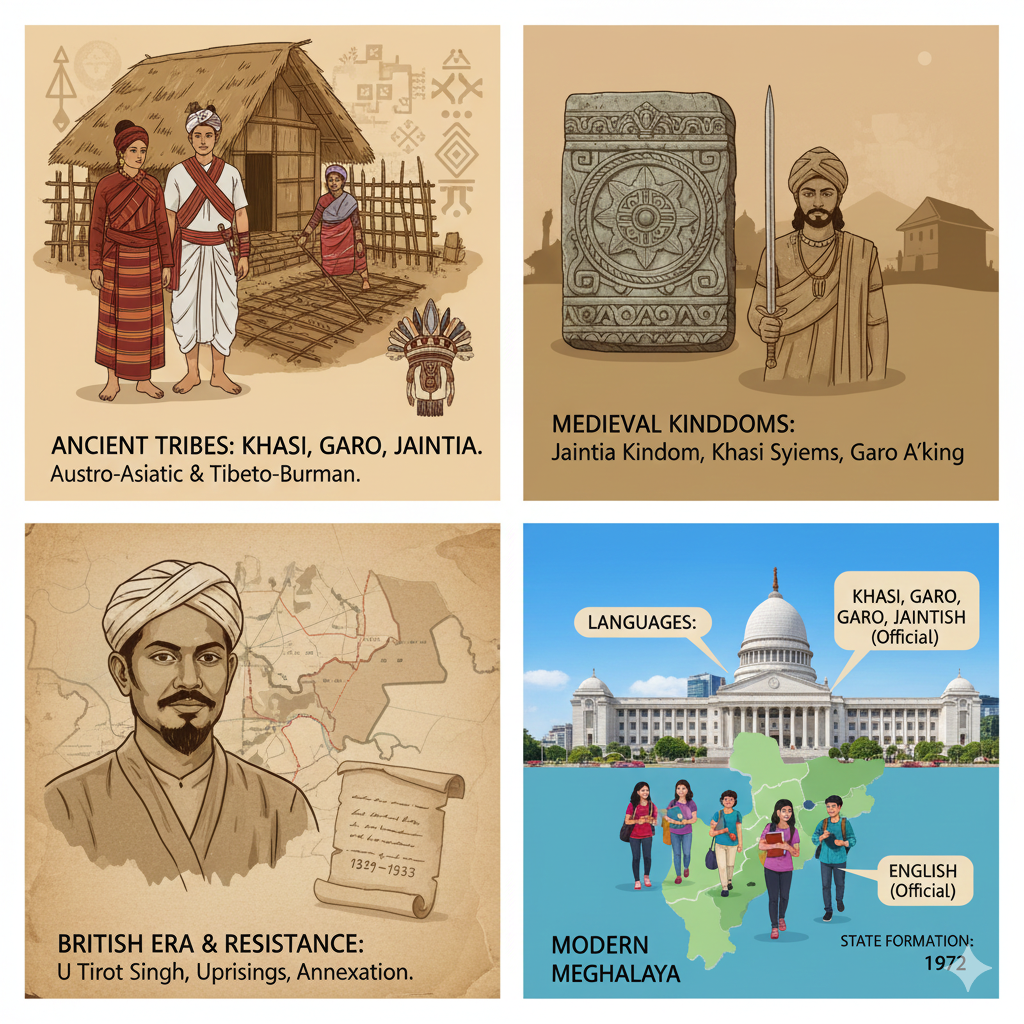

Religion, Culture, and Folk Dances of Meghalaya
Religion in Meghalaya
Religious diversity in Meghalaya reflects its tribal and cultural traditions. Religion in the state is a mix of tribal beliefs, modern influences, and missionary activities. Although Christianity is the dominant religion, traditional tribal faiths and other religions also hold an important place.
1. Major Religions
(a) Christianity
- About 70% of Meghalaya’s population follows Christianity.
- Christianity is mainly practiced among the Khasi, Garo, and Jaintia tribes.
- It spread widely due to missionary activities during British rule in the 19th and 20th centuries.
- Along with religion, education and healthcare also expanded.
Major Christian Denominations
- Catholic
- Protestant — Presbyterian, Baptist, and others
(b) Tribal Religions
Nature-Worship
Traditional tribal religions of the Khasi and Garo communities focus on nature and ancestor worship.
Khasi Tribe – Niam Tre
- The traditional religion of the Khasi people.
- Worship of the Sun, Moon, and Water deities.
Garo Tribe – Sangsharak
- The traditional religion of the Garo people.
- Based on respect for nature and ancestral spirits.
However, the number of followers of traditional religions is decreasing as conversions to Christianity grow.
2. Other Religions
(i) Hinduism
- 8–10% of the population follows Hinduism.
- Mainly practiced by Bengalis, Nepalis, Marwaris, and Assamese communities.
- Durga Puja and Diwali are major celebrations.
(ii) Islam
- 1–2% of the population practices Islam.
- Muslims are mainly found in urban and border areas.
(iii) Sikhism, Buddhism, and Others
A small number of Sikhs, Buddhists, and Jains reside in Meghalaya, mostly in urban business communities.
3. Religious Structure (Percentage)
- Christian – 70%
- Traditional tribal religions – 15–20%
- Hindu – 8–10%
- Muslim – 1–2%
- Others (Sikh, Buddhist, Jain) – <1%
4. Religious Festivals
(i) Christian Festivals
- Christmas
- Easter
- Good Friday
(ii) Traditional Tribal Festivals
Khasi Tribe
- Suk Mynsiem: Celebrated after harvest.
Garo Tribe
- Wangala: Agricultural festival dedicated to the Sun God Saljong.
Jaintia Tribe
- Behdienkhlam: Celebrated to ward off evil spirits and bring prosperity.
(iii) Hindu Festivals
- Durga Puja
- Holi
- Diwali
(iv) Muslim Festivals
- Eid-ul-Fitr
- Eid-ul-Azha
5. Religious Harmony
People of different religions live peacefully in Meghalaya. Despite diverse beliefs, communal tension is rare, and religious harmony is a hallmark of the state.
Conclusion
Meghalaya’s religious landscape blends tribal traditions with modern religions. Christianity is dominant, but traditional faiths and other communities also play vital roles. Despite religious diversity, the state is known for unity, cultural balance, and mutual respect.
Culture and Traditions of Meghalaya
The culture of Meghalaya is seen in the customs, traditions, and lifestyles of its major tribes — Khasi, Garo, and Jaintia. The state is renowned for its matrilineal society, festivals, music, dance, handicrafts, and deep connection with nature.
1. Matrilineal Society
- The Khasi and Garo tribes follow a matrilineal (matriarchal) system.
- Family name and property pass from mother to daughter.
- The youngest daughter (Khaduh) inherits the property.
- Women lead social structures, while men handle political affairs.
2. Traditions and Customs
(i) Khasi Tribe
- Religion: Follows the Niam Tre faith, focused on nature and ancestor worship.
- Marriage Customs: After marriage, the husband lives in the wife's home.
(ii) Garo Tribe
- Follows the Sangsharak religion.
- Conducts ceremonies during birth, marriage, and death.
(iii) Jaintia Tribe
- Follows traditions similar to the Khasi tribe.
- Behdienkhlam is a major cultural festival.
3. Music and Dance
Traditional Music
Folk music is based on nature, rituals, and daily life. Flutes, drums, and damah are the main traditional instruments.
Dances
Khasi Dances
- Shad Suk Mynsiem: Harvest celebration dance.
- Shad Nongkrem: A culturally significant Khasi dance festival.
Garo Dances
- Wangala Dance: Dedicated to Sun God Saljong.
- Doroja Dance: Performed during weddings and social gatherings.
Jaintia Dances
- Behdienkhlam Dance: Performed to ward off evil spirits.
- Laho Dance: A joyful community dance.
4. Festivals
Khasi Festivals
- Suk Mynsiem
- Nongkrem Dance Festival
Garo Festivals
- Wangala (Festival of 100 Drums)
- Doroja
Jaintia Festivals
- Behdienkhlam
- Laho Dance
5. Traditional Apparel and Jewellery
Khasi Tribe
- Women wear Jainsem.
- Men wear a dhoti and turban.
Garo Tribe
- Women wear Dakmanda.
- Men wear traditional Gongla.
Jewellery includes silver and gold ornaments, beads, and traditional bracelets.
6. Arts and Handicrafts
- Bamboo and cane crafts — baskets, mats, furniture.
- Wood carving is a traditional art.
- Garo women weave beautiful traditional garments.
7. Food
- Jadoh: A traditional Khasi rice-meat dish.
- Nakham Bitchi: A Garo dish made from dried fish.
- Tungrimbai: Fermented soybean dish of the Khasi.
- Local rice wine called Kiad.
⭐ Editor's Choice
Discover a highly rated product selected for its quality, functionality, and positive customer feedback.
View Details & Reviews →8. Sports and Traditional Games
- Archery is a popular traditional sport.
- Rongkla — a traditional Garo game.
9. Community Living
Community life and cooperation are core elements of Meghalaya’s culture. Village communities follow collective decision-making and harmonious living.
Conclusion
The culture of Meghalaya blends nature, traditions, and modernity. Its festivals, matrilineal society, music, and dance make it culturally rich and distinct from other regions of India.
Folk Dances and Music of Meghalaya
Folk dances and music are integral to the cultural identity of Meghalaya. They express the life, traditions, and religious beliefs of tribal communities and play a central role in festivals and social gatherings.
1. Folk Dances
(i) Dances of the Khasi Tribe
Suk Mynsiem
- Also known as the “Dance of the Happy Soul.”
- Celebrated after the harvest season.
- Men dance with swords and shields, while women wear traditional attire.
Shad Nongkrem
- A festive dance dedicated to the harvest deity.
- Women dance in a circle while men play drums and flutes.
Siew Dance
- Performed on both social and religious occasions.
(ii) Dances of the Garo Tribe
Wangala Dance
- Most famous Garo dance.
- Also called the “Dance of the 100 Drums.”
- Dedicated to the Sun God Saljong.
- Men and women dance together wearing traditional costumes.
Doroja Dance
- A part of wedding rituals and social celebrations.
(iii) Dances of the Jaintia Tribe
Behdienkhlam Dance
- A major ritual dance performed to ward off evil spirits.
- Wooden pillars are decorated and immersed in water during the event.
Laho Dance
- A joyful community dance where women dance between two men.
2. Folk Music
Folk music in Meghalaya is inspired by nature, spirituality, and community life. Each tribe has distinct musical styles and instruments.
Khasi Music
- Features themes of love, nature, and society.
- Uses drums, flutes, and guitars.
- Khasi Hymns are popular religious songs.
Garo Music
- Includes songs related to religion and social customs.
- Uses instruments like the Adil and drums.
Jaintia Music
- Composed for religious ceremonies and social functions.
- Features flutes, drums, and string instruments.
3. Traditional Musical Instruments
- Drum: Main instrument for festivals and dances.
- Flute: Used by Khasi and Garo tribes.
- Tangmuri: Traditional pipe instrument of the Khasi tribe.
- Chambarang: A tanpura-like instrument of the Garo tribe.
- Various drums: Important across all tribes.
4. Major Dance Festivals
- Shad Suk Mynsiem – Khasi dance festival.
- Wangala Utsav – Garo festival of 100 drums.
- Behdienkhlam Festival – Jaintia religious festival.
- Longkhlam Festival – Celebrated for health and prosperity.
5. Blend of Modern and Traditional Music
Modern influences like rock and western music also enrich Meghalaya’s music culture. Shillong is known as the “Rock Capital of India”. This blend of traditional and modern music reflects Meghalaya’s evolving cultural identity.
Conclusion
The folk dances and music of Meghalaya preserve its cultural heritage. They play an important role in religious ceremonies, festivals, and community life. Combined with modern influences, they make Meghalaya’s cultural identity truly unique.
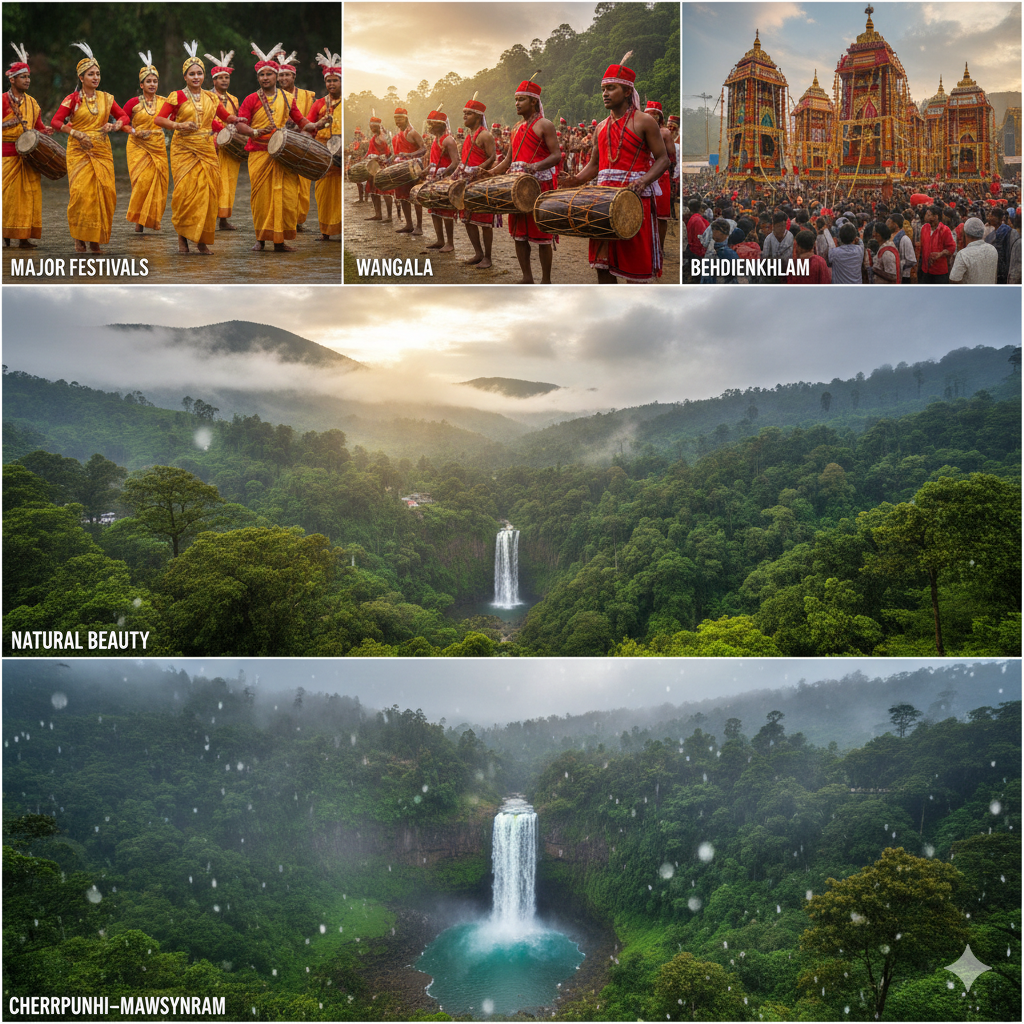
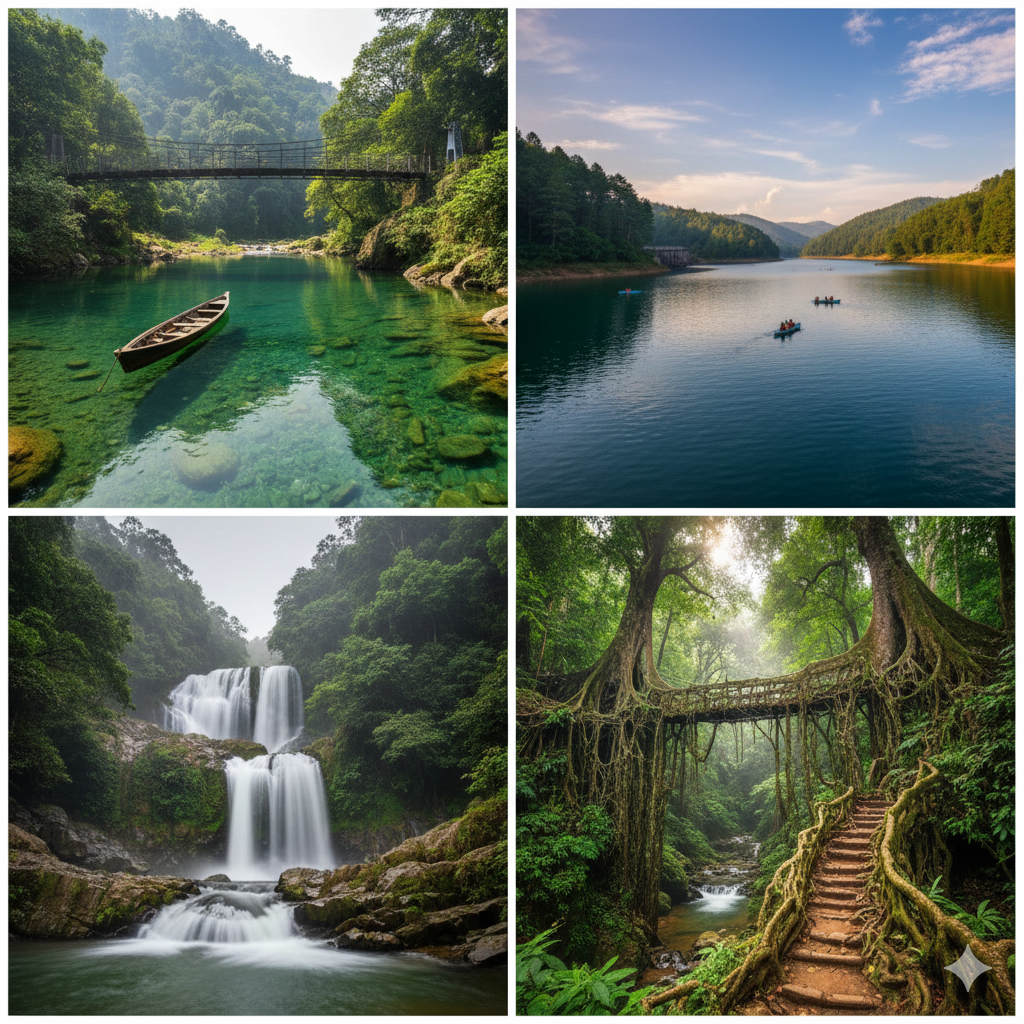
Dawki River, Umiam Lake, Elephant Falls & Living Root Bridges of Meghalaya
Dawki River (Umngot River): A Transparent Miracle of Nature
Dawki River, also known as the Umngot River, is one of Meghalaya’s most iconic natural attractions. It flows between India and Bangladesh and is world-famous for its crystal-clear water, where boats appear to float in the air.
1. Location of Dawki River
- Located in Dawki village in the Khasi Hills of Meghalaya.
- About 82 km south of Shillong, near the Bangladesh border.
- Flows close to the Dawki Checkpost on the India–Bangladesh border.
2. Characteristics of the River
(i) transparency of Water
- The water is so clear that stones and riverbeds are visible.
- A paradise for tourists, nature lovers, and photographers.
(ii) Border Importance
- The river flows between India and Bangladesh, crucial for cross-border movement.
- The Dawki Suspension Bridge is part of the Indo–Bangladesh trade route.
(iii) Environmental Beauty
- Surrounded by greenery, limestone rocks, and peaceful landscapes.
- Perfect destination for relaxation and scenic views.
3. Major Attractions
(i) Boating
The transparent water creates a magical boating experience where the boat appears to be floating in mid-air.
(ii) Dawki Suspension Bridge
Built in 1932 during British rule, the bridge offers panoramic views of the river and surroundings.
(iii) Fishing
Fish can be seen clearly due to the water clarity; local communities rely on fishing.
(iv) Camping & Adventure
- Camping by the riverbanks
- Trekking
- Kayaking
- Swimming (in safe zones)
4. Social & Cultural Importance
The Khasi tribe considers the river sacred. Its water is used for agriculture, fishing, and daily life.
5. Travel Information
(i) Best Time to Visit
- October to April: Cleanest water and clear skies.
- Post-monsoon greenery enhances the beauty.
(ii) How to Reach
- From Shillong: 82 km via taxi or bus.
- Nearest Railway Station: Guwahati.
- Nearest Airport: Shillong Airport.
(iii) What to Carry
- Camera
- Waterproof clothing
- Comfortable shoes
- Snacks and essential medicines
6. Environmental Protection
Strict measures ensure water clarity—plastic use is limited, and waste is managed carefully. Tourists are advised to maintain cleanliness.
7. Role in Local Economy
Tourism, boating, and fishing form major sources of income for locals.
8. Conclusion
Dawki River is one of Meghalaya’s most mesmerizing destinations. Its transparency, natural beauty, and calm surroundings make it a must-visit for nature lovers, photographers, and adventure seekers.
Umiam Lake: Meghalaya’s Serene Water Paradise
Umiam Lake, also called “Bara Pani,” is a stunning man-made reservoir located about 15 km north of Shillong. It is popular for its scenic beauty, water sports, and peaceful environment.
1. Formation and History
- Created in 1965 as part of a hydroelectric project on the Umiam River.
- Originally built for power generation, now a major tourist attraction.
2. Geographical Location
- Located on National Highway-6 between Shillong and Guwahati.
- Surrounded by the lush Khasi Hills.
3. Features of the Lake
(i) Natural Beauty
- Blue waters with reflections of forests and mountains.
- Magnificent sunrise and sunset views.
(ii) Water Level and Area
- Covers an area of approximately 220 sq km.
- Largest reservoir lake in Meghalaya.
(iii) Environmental Importance
- Primary water source for Shillong and nearby areas.
- Supports rich biodiversity.
4. Tourist Attractions & Activities
⭐ Editor's Choice
Discover a highly rated product selected for its quality, functionality, and positive customer feedback.
View Details & Reviews →(i) Water Sports
- Paddle boating
- Speed boats
- Houseboats
- Kayaking
- Water skiing
- Scooter rides
(ii) Picnic Spots
The surroundings are ideal for picnics, family outings, and nature walks.
(iii) Camping & Photography
The calm lakeside is perfect for camping and photography enthusiasts.
(iv) Adventure Activities
- Trekking around the hills
- Cycling trails
5. Environmental Importance
The lake supports aquatic life, serves as a water source, and contributes to the region's ecosystem. Strict measures are taken to prevent pollution.
6. Major Sites Around the Lake
- Nehru Park: Ideal for families and children.
- Umiam Water Sports Complex: Hub for water activities.
- Don Bosco Museum: Showcases Northeast Indian culture.
7. Travel Information
(i) Best Time to Visit
- October to March: Pleasant weather and full lake.
(ii) How to Reach
- 15 km from Shillong by taxi or private vehicle.
- Nearest Airport: Shillong Airport (30 km).
- Nearest Railway Station: Guwahati (100 km).
Entry Fee
A nominal fee is charged for entry and water sports.
8. Local Culture & Significance
The Khasi community depends on the lake for fishing and small-scale agriculture. It holds economic and cultural importance for the locals.
9. Conservation Efforts
Plastic use is restricted, and strict cleanliness rules are enforced to preserve the lake’s natural beauty.
10. Conclusion
Umiam Lake is a treasure of Meghalaya’s natural beauty. Its calm atmosphere, water sports, and scenic landscapes make it one of the most captivating tourist spots in the state.
Elephant Falls: A Three-Tiered Wonder of Meghalaya
Elephant Falls, located near Shillong, is one of Meghalaya’s most famous waterfalls. Known in Khasi as “Ka Kshaid Lai Pateng Khohsiew,” meaning “three-step waterfall,” it flows beautifully in three cascading layers.
1. Location & Access
- Located about 12 km from Shillong.
- Just a 30-minute drive from Shillong city.
- Nearest Airport: Shillong Airport.
2. History of Naming
During British rule, a rock beside the waterfall resembled an elephant, giving the falls its name. The rock was destroyed in the 1897 earthquake, but the name still remains.
3. Features of the Waterfall
(i) Three-Stage Waterfall
- First stage: Wide, gentle flow of water.
- Second stage: Water cascades over rocky steps.
- Third stage: Most spectacular, powerful fall.
(ii) Greenery & Surroundings
- Dense forests and lush vegetation surround the falls.
- During monsoon, the waterfall becomes more dramatic.
4. Tourist Attractions
(i) Nature Photography
Ideal spot for photography, especially after monsoon.
(ii) Picnic Spot
The area around the falls is perfect for family outings and picnics.
(iii) Cultural Experience
Local Khasi residents make the visit more meaningful with insights into their culture and lifestyle.
5. Travel Information
(i) Best Time to Visit
- October to March: Pleasant weather and cleaner water.
- Monsoon (June–September): Falls are at their full glory but travel can be difficult due to heavy rain.
Entry Fee
Visitors are charged a nominal entry fee; extra charges may apply for cameras.
(iii) What to Carry
- Comfortable shoes
- Waterproof clothing
- Snacks and water
- Camera
6. Environmental Importance
The area is rich in biodiversity, with various plants and birds. Tourists are encouraged to maintain cleanliness and avoid plastic waste.
7. Local Tourism Importance
Local shops sell handicrafts and souvenirs. Tourism supports the local Khasi community through food stalls, guides, and shops.
8. Tips & Precautions
- Rocks near the waterfall can be slippery.
- Avoid going too close to strong water flow during monsoon.
- Hire a local guide for a deeper understanding of the place.
9. Conclusion
Elephant Falls is a stunning natural attraction known for its three-tiered structure and peaceful surroundings. It is a must-visit destination for nature lovers, photographers, and tourists exploring Meghalaya.
Living Root Bridges: A Natural Marvel of Meghalaya
Living Root Bridges are among the world’s most unique natural structures, created from the aerial roots of rubber trees (Ficus elastica). They showcase the ingenuity of Meghalaya’s indigenous tribes and represent perfect harmony between humans and nature.
1. What is a Living Root Bridge?
- Made by guiding the roots of rubber trees across rivers or streams.
- Roots take 10–15 years to grow strong enough to form a usable bridge.
- Some bridges last 100–500 years.
2. Prime Locations
- Cherrapunji (Sohra): Home to the famous Double Decker Living Root Bridge.
- Mawlynnong: Asia's cleanest village with root bridges.
- Riwai and Nongriat: Popular trekking destinations with root bridges.
3. Construction Process
- Built by Khasi and Jaintia tribes over generations.
- Bamboo and wood are used to guide the roots across the stream.
- Roots gradually grow into strong, natural bridges.
4. Features of Living Root Bridges
(i) Natural & Sustainable
- Completely eco-friendly structures.
- No artificial materials used.
(ii) Strong & Flexible
- Strength increases over time.
- Can withstand floods and heavy rains.
(iii) Part of Natural Beauty
The lush greenery and streams around the bridges enhance their charm.
5. Tourist Attractions & Activities
(i) Trekking
The trek to the Double Decker Bridge requires climbing nearly 3,500 steps through forests and hills.
(ii) Photography
The bridges and surrounding landscapes are perfect for photography.
(iii) Cultural Experience
Tourists experience the traditional knowledge of the Khasi and Jaintia tribes.
6. Importance of Living Root Bridges
(i) Environmental Importance
- Sustainable structures that protect against flood damage.
- Promote eco-friendly tourism.
(ii) Cultural Importance
- Symbol of tribal wisdom and hard work.
- Represents harmony between people and nature.
(iii) Centre of Tourism
- Attract thousands of tourists annually.
- Boosts the local economy.
7. Travel Information
(i) Best Time to Visit
- October to April: Ideal weather for trekking.
- Monsoon also offers beautiful scenery, but paths may be slippery.
(ii) How to Reach
- Reach Cherrapunji from Shillong by taxi or bus.
- Nearest Airport: Shillong Airport.
- Nearest Railway Station: Guwahati.
8. environmental conservation Efforts
- Plastic and garbage are strictly prohibited.
- Surrounding vegetation is protected.
9. Conclusion
Living Root Bridges are a testament to human patience and nature’s extraordinary capability. They provide a unique travel experience and inspire visitors to live in harmony with nature.