

Nagaland: History, Tribes, Hornbill Festival & Tourism Guide 2026
Introduction
Nagaland is one of India’s most culturally rich and naturally beautiful states, located in the northeastern region of the country. Known for its tribal heritage, Hornbill Festival, scenic mountains, and vibrant traditions, Nagaland attracts tourists and culture lovers from around the world. From Dzukou Valley and Japfu Peak to colorful tribal festivals and handloom crafts, the state offers a unique blend of history, nature, and cultural diversity.
Table of Contents
- Geography of Nagaland
- History of Nagaland
- Tribes and Culture
- Hornbill Festival
- Languages Spoken in Nagaland
- Economy of Nagaland
- Tourist Places in Nagaland
- Religion in Nagaland
- Natural Beauty of Nagaland
- Unique Features of Nagaland
- Frequently Asked Questions
Geography of Nagaland
Nagaland is famous for its lush green hills, peaceful valleys, and breathtaking mountain landscapes. The state is located in Northeast India and shares borders with Arunachal Pradesh, Assam, Manipur, and Myanmar.
Key Geographical Highlights
- Capital: Kohima
- Area: Approximately 16,579 square kilometers
- Major Tourist Landscapes: Dzukou Valley and Japfu Peak
- Climate: Pleasant and cool throughout most of the year
History of Nagaland
Nagaland has a rich historical and cultural background deeply connected with tribal traditions and community life. During the 19th century, the region came under British administration. After India’s independence, Nagaland officially became the 16th state of India on 1 December 1963.
Tribes and Culture of Nagaland
Nagaland is popularly known as the “Land of 16 Tribes.” Each tribe has its own language, customs, festivals, traditional attire, and social practices that make the state culturally unique.
Major Tribes of Nagaland
- Ao Tribe
- Angami Tribe
- Chakhesang Tribe
- Sema (Sumi) Tribe
- Konyak Tribe
- Phom Tribe
Hornbill Festival
The Hornbill Festival is the most famous cultural festival of Nagaland and is celebrated every year in December near Kohima at Kisama Heritage Village. Known as the “Festival of Festivals,” it showcases traditional dances, tribal music, food, crafts, and the rich heritage of Naga communities.
Languages Spoken in Nagaland
- Official Language: English
- Common Languages: Nagamese and local tribal languages
English is widely used in administration and education, while Nagamese acts as a common communication language among different tribes.
Economy of Nagaland
The economy of Nagaland is mainly based on agriculture, handicrafts, and traditional cottage industries. Bamboo products, handloom textiles, and woodcraft industries provide employment to many local communities.
Main Agricultural Crops
- Rice
- Maize
- Sugarcane
- Potatoes
Tourist Places in Nagaland
Nagaland attracts tourists because of its natural beauty, peaceful environment, and tribal culture.
Popular Tourist Attractions
- Kohima War Cemetery
- Dzukou Valley
- Mokokchung
- Tuensang
- Intanki National Park
Religion in Nagaland
Nagaland is predominantly a Christian-majority state. However, traditional tribal beliefs and indigenous cultural practices are still preserved in several communities.
Natural Beauty of Nagaland
Because of its green forests, mountains, rivers, and pleasant climate, Nagaland is often called the “Switzerland of the East.” The state is known for its peaceful environment and scenic landscapes.
Unique Features of Nagaland
- Traditional bamboo dance and indigenous folk music
- Famous handloom and handicraft products
- Rich tribal heritage and colorful festivals
- Beautiful trekking destinations and mountain valleys
Frequently Asked Questions
Why is Nagaland famous?
Nagaland is famous for its tribal culture, Hornbill Festival, scenic mountains, and natural beauty.
Which is the capital of Nagaland?
Kohima is the capital city of Nagaland.
What is the Hornbill Festival?
The Hornbill Festival is Nagaland’s most famous cultural festival celebrated every December.
Which are the best tourist places in Nagaland?
Dzukou Valley, Kohima, Mokokchung, and Intanki National Park are popular tourist attractions in Nagaland.
Conclusion
Nagaland is one of the most culturally rich and naturally beautiful states in Northeast India. Known for its tribal heritage, colorful festivals, scenic mountains, and unique traditions, the state reflects a perfect blend of history, culture, and natural beauty.
From the breathtaking landscapes of Dzukou Valley and Japfu Peak to the vibrant Hornbill Festival and diverse tribal communities, Nagaland offers a unique cultural and tourism experience.
With growing tourism, handicrafts, and sustainable development, Nagaland is steadily progressing while maintaining its cultural roots and environmental beauty.
References
- Government of Nagaland – Official Portal
- Nagaland Tourism Department
- India Census Reports
- Ministry of Development of North Eastern Region (DoNER)
- Research Publications on Naga Tribes and Culture
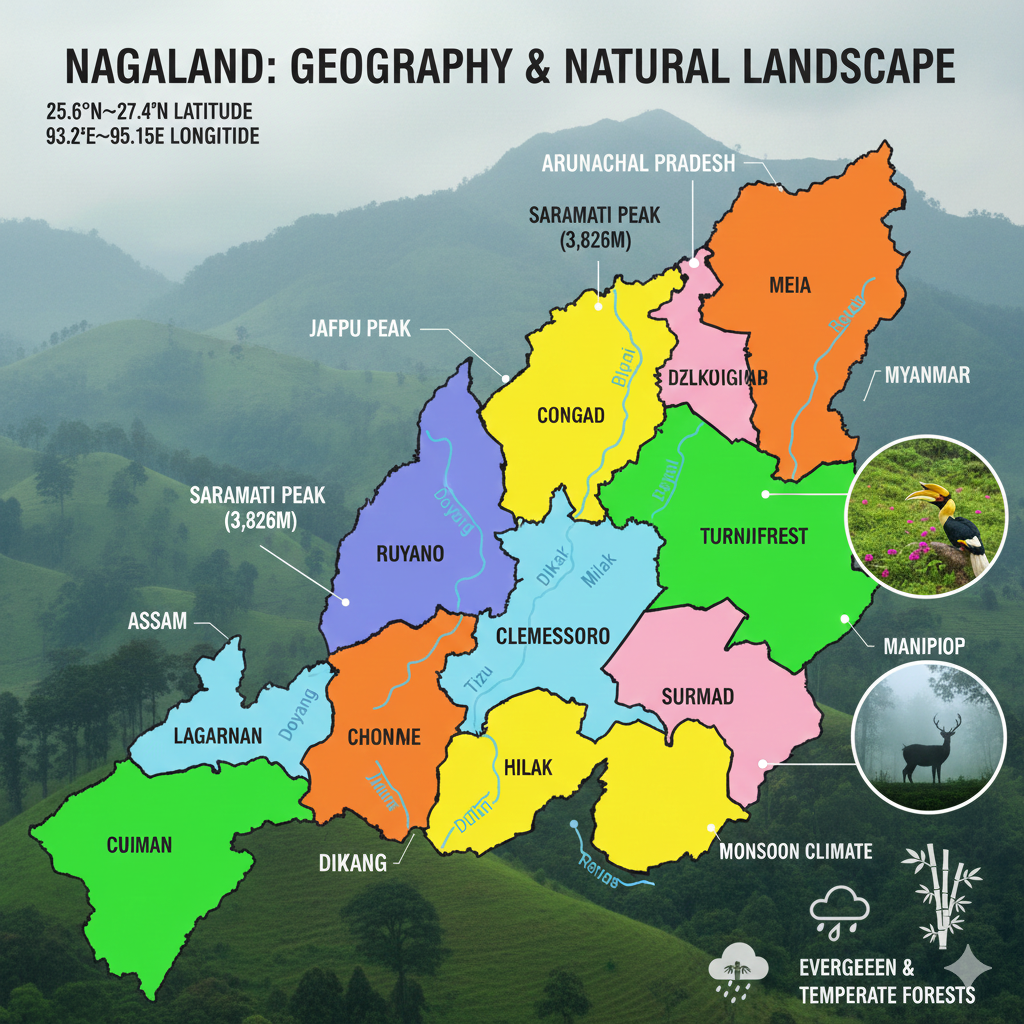
Nagaland Geography, Kohima, Dzukou Valley & Major Mountains Guide 2026
Introduction
Nagaland is one of the most naturally beautiful states in Northeast India, known for its green mountains, peaceful valleys, rich biodiversity, and cultural heritage. From Kohima and Dzukou Valley to Japfu Peak and Shilloi Lake, the state offers breathtaking landscapes and unique tourism experiences.
Table of Contents
- Geographical Location of Nagaland
- Climate and Rivers
- Forests and Biodiversity
- Kohima – Capital of Nagaland
- Japfu Peak
- Dzukou Valley
- Tourism Importance
- Frequently Asked Questions
Geographical Location of Nagaland
Nagaland is located in the northeastern region of India and is known for its mountainous terrain, green valleys, forests, and rich biodiversity. The geography of the state plays an important role in shaping its culture, environment, and traditional lifestyle.
Location and Boundaries
- Region: Northeast India
-
Boundaries:
- North – Arunachal Pradesh
- West – Assam
- South – Manipur
- East – Myanmar
- Geographical Coordinates: 25.6° N to 27.4° N latitude and 93.2° E to 95.15° E longitude
- Total Area: Approximately 16,579 sq km
Topography
Nagaland is mainly a mountainous state filled with hills, valleys, and elevated landscapes.
- Highest Peak: Saramati Peak (3,826 metres)
- Major Landscapes: Japfu Peak and Dzukou Valley
- Terrain: Rolling hills, mountain ranges, and forest valleys
Climate and Rivers
Climate of Nagaland
Nagaland experiences a tropical monsoon climate with pleasant weather throughout most of the year.
- Summer Temperature: 21°C to 40°C
- Winter Temperature: 4°C to 24°C
- Annual Rainfall: 1500 mm to 2000 mm
- Monsoon Season: June to September
Major Rivers
The rivers of Nagaland support agriculture, irrigation, fish farming, and local ecosystems.
- Dikhu River
- Dangki River
- Tenganga River
- Juluki River
- Milak River
Forests and Biodiversity
More than 70% of Nagaland is covered with forests, making it one of the greenest states in India.
- Forest Types: Evergreen and temperate forests
- Major Trees: Bamboo, pine, sal, and mahogany
- Famous Bird: Great Hornbill
- Wildlife: Elephants, wild buffaloes, and deer species
Nagaland is also known for its rare plant species, rich biodiversity, and eco-tourism opportunities.
Kohima – Capital of Nagaland
Kohima, the capital city of Nagaland, is famous for its scenic beauty, historical significance, and tribal culture.
Important Facts About Kohima
- Elevation: 1,444 metres above sea level
- Known For: Battle of Kohima and Hornbill Festival
- Nearest Railway Station: Dimapur
- Distance from Dimapur: Approximately 74 km
Major Attractions in Kohima
- Kohima War Cemetery
- Dzukou Valley
- Japfu Peak
- Kohima Museum
Kohima reflects the rich heritage and traditions of the Angami Naga tribe and remains one of the most important cultural centers in Northeast India.
Japfu Peak
Japfu Peak is one of the most famous mountain peaks in Nagaland and a popular destination for trekking and adventure tourism.
- Height: 3,048 metres
- Location: Kohima district
- Famous For: Trekking, sunrise views, and giant rhododendron trees
The peak offers breathtaking panoramic views and is surrounded by dense forests and rich vegetation.
Dzukou Valley
Dzukou Valley is one of the most beautiful valleys in Northeast India and is often called the “Paradise of the Northeast.”
- Location: Nagaland–Manipur border
- Elevation: Approximately 2,452 metres
- Famous For: Green meadows, seasonal flowers, trekking, and camping
The valley attracts thousands of tourists every year because of its peaceful environment and breathtaking natural scenery.
Tourism Importance
Tourism plays an important role in Nagaland’s economy. The state attracts domestic and international visitors because of its natural beauty, mountains, trekking routes, tribal culture, and festivals.
- Adventure tourism
- Eco-tourism
- Cultural tourism
- Trekking and camping
The government of Nagaland is continuously improving tourism infrastructure to promote travel and eco-friendly tourism in the region.

History of Nagaland, Tribes, Culture & Hornbill Festival Guide 2026
Introduction
Nagaland is one of the most culturally diverse states in Northeast India, known for its tribal traditions, colorful festivals, rich history, and vibrant heritage. From ancient tribal societies to the world-famous Hornbill Festival, Nagaland reflects a unique blend of tradition, identity, and cultural pride.
Table of Contents
- History of Nagaland
- Ancient and Colonial Period
- Naga Movement and Statehood
- Tribes and Culture
- Traditional Festivals
- Dance, Music, and Handicrafts
- Food and Cuisine
- Hornbill Festival
- Frequently Asked Questions
History of Nagaland
The history of Nagaland is deeply connected with tribal communities, cultural identity, and traditional village life. The region has preserved its customs and heritage for centuries despite political and social changes.
Ancient Period
- Nagaland has been home to several tribal communities since ancient times.
- Major tribes included Angami, Ao, Konyak, Sema, and Lotha.
- Most tribal communities depended on agriculture and forest resources.
- Ancient Naga history was mainly preserved through oral traditions and folklore.
Medieval Period
Due to its mountainous terrain and isolated villages, Nagaland remained outside the control of major medieval empires. Tribal communities maintained independent village systems and preserved their traditional customs and governance.
Colonial Period
- British influence expanded into the region during the 19th century.
- After the Treaty of Yandaboo in 1826, British administration gradually extended toward Naga areas.
- Missionaries introduced Christianity, education, and literacy.
- The Battle of Kohima became an important historical event in the region.
Naga Movement and Statehood
After India’s independence, Naga leaders demanded greater autonomy and recognition of tribal identity.
- In 1946, the Naga National Council (NNC) was formed.
- Angami Zapu Phizo became a major political leader of the Naga movement.
- In 1957, Naga Hills became a special administrative region.
- On 1 December 1963, Nagaland officially became the 16th state of India.
Peace talks and development efforts continue in modern Nagaland while preserving tribal identity and traditions.
Tribes and Culture of Nagaland
Nagaland is widely known as the “Land of Festivals” and the “State of 16 Tribes.” Each tribe has its own language, customs, attire, music, and social traditions.
Major Tribes of Nagaland
- Angami Tribe
- Ao Tribe
- Konyak Tribe
- Sema (Sumi) Tribe
- Lotha Tribe
- Phom Tribe
- Chakhesang Tribe
- Rengma Tribe
Traditional Lifestyle
- Villages traditionally followed self-governance systems.
- Morung (community hall) played an important social and cultural role.
- Traditional attire includes colorful shawls, beads, and ornaments.
- Bamboo, cane, and woodcraft are widely used in daily life.
Dance, Music, and Handicrafts
Dance and music are important parts of Naga cultural identity and community celebrations.
Popular Traditional Dances
- Angami Dance: Traditional warrior dance
- Sema Dance: Harvest celebration dance
- Phom Dance: Symbol of peace and happiness
Traditional music uses drums, flutes, folk instruments, and tribal songs.
Handicrafts and Art
- Bamboo and cane crafts
- Wood carvings
- Handwoven shawls
- Traditional jewelry and ornaments
Festivals and Celebrations
Nagaland is famous for its colorful festivals, which reflect tribal traditions, agriculture, and community celebrations.
Major Festivals of Nagaland
- Hornbill Festival
- Sekrenyi Festival
- Moatsu Festival
- Tuluni Festival
- Oling Festival
Food and Cuisine of Nagaland
Naga cuisine is known for smoked meat, bamboo shoots, herbs, and spicy traditional dishes.
- Rice is the staple food.
- Popular dishes include smoked pork and bamboo shoot curry.
- Fermented bamboo products are commonly used.
- Traditional herbs and spices are important ingredients.
Religion in Nagaland
Most people in Nagaland follow Christianity, while some tribal communities still preserve traditional indigenous beliefs and cultural practices.
Hornbill Festival – Pride of Nagaland
The Hornbill Festival is the biggest and most famous cultural event in Nagaland. It is celebrated every December near Kohima at Kisama Heritage Village and showcases the traditions of Naga tribes.
Important Information
- Dates: 1st to 10th December
- Venue: Kisama Heritage Village near Kohima
- Known As: Festival of Festivals
- Main Attraction: Tribal dances, music, food, crafts, and cultural performances
Main Attractions of the Festival
- Traditional tribal performances
- Warrior dances and martial arts
- Bamboo and cane handicrafts
- Local food and cultural exhibitions
- Music concerts and adventure sports
The festival attracts thousands of tourists from India and around the world every year.

Languages and Economy of Nagaland – Complete Guide 2026
Introduction
Nagaland is widely known for its rich tribal heritage, linguistic diversity, agriculture, handicrafts, and growing tourism industry. The state is home to several tribal communities, each with its own language, traditions, and cultural identity. Along with cultural richness, Nagaland’s economy is strongly connected to agriculture, bamboo industries, tourism, and traditional crafts.
Table of Contents
- Languages of Nagaland
- Major Tribal Languages
- Nagamese and Official Language
- Language Preservation
- Economy of Nagaland
- Agriculture and Organic Farming
- Industries and Handicrafts
- Tourism and Trade
- Challenges and Future Prospects
- Frequently Asked Questions
Languages of Nagaland
Nagaland is one of the most linguistically diverse states in Northeast India. More than 20 tribal languages and dialects are spoken across the state, and most belong to the Tibeto–Burman language family.
Main Features of Naga Languages
- Most languages are tonal in nature.
- Languages are closely connected to tribal identity and folklore.
- Traditional songs, rituals, and stories are preserved through local languages.
- Many tribal languages were historically oral in nature.
Major Tribal Languages
- Angami Tribe: Angami language
- Ao Tribe: Ao language
- Konyak Tribe: Konyak language
- Sema (Sumi) Tribe: Sumi language
- Lotha Tribe: Lotha language
- Rengma Tribe: Rengma language
- Phom Tribe: Phom language
Each tribal language represents unique customs, oral traditions, and cultural heritage.
Nagamese and Official Language
- Official Language: English
- Common Communication Language: Nagamese
English is widely used in administration, education, and official work, while Nagamese acts as a common communication language between different tribes and communities.
Nagamese is a simplified blend of Assamese and local tribal languages and is commonly spoken in markets and daily interactions.
Writing System and Language Preservation
Traditionally, many Naga languages did not have a written script. Christian missionaries later introduced the Roman script, which is now widely used for writing tribal languages.
Language Preservation Efforts
- Promotion of tribal literature and folklore
- Local language education in schools
- Digital preservation of oral traditions
- Cultural festivals promoting tribal identity
Despite modernization and urbanization, several efforts are being made to preserve endangered tribal languages and cultural traditions.
Economy of Nagaland
The economy of Nagaland is mainly based on agriculture, handicrafts, tourism, and traditional industries. The state’s geography, forests, and tribal culture strongly influence its economic activities.
Agriculture and Organic Farming
Agriculture is the primary occupation for a large section of the population in Nagaland.
Main Agricultural Activities
- Shifting cultivation (Jhum cultivation)
- Rice farming
- Maize and millet production
- Cash crops such as ginger, chilli, and sugarcane
Organic Farming and Horticulture
- Pineapple, oranges, lemon, and jackfruit are widely grown.
- Organic farming is increasing rapidly in the state.
- The Nagaland Organic Mission promotes sustainable farming practices.
Industries and Handicrafts
Traditional handicrafts and bamboo industries are major sources of employment in Nagaland.
Major Industries
- Bamboo and cane products
- Wood carving
- Handloom textiles
- Cottage industries
Bamboo Industry
Nagaland is often called the “Bamboo Hub of India” because bamboo is widely used for furniture, handicrafts, construction materials, and paper products.
Tourism and Trade
Tourism is becoming an important part of Nagaland’s economy due to the state’s natural beauty, tribal culture, and famous festivals.
Major Tourist Attractions
- Kohima
- Dzukou Valley
- Dimapur
- Mokokchung
- Shilloi Lake
The Hornbill Festival attracts both Indian and international tourists every year and significantly supports local businesses and handicraft industries.
Trade and Commerce
- Dimapur is the main commercial center of Nagaland.
- Bamboo products and handicrafts are major trade items.
- Border trade with Myanmar has economic importance.
Infrastructure and Development
- Road transport is the primary transportation system.
- Dimapur has the state’s main airport and railway station.
- Government projects are improving connectivity and rural infrastructure.
- Digital banking and financial services are expanding gradually.
Challenges and Future Prospects
Major Challenges
- Limited industrial development
- Infrastructure challenges in remote areas
- Declining soil fertility in some regions
- Employment opportunities still need expansion
Future Opportunities
- Growth in eco-tourism and cultural tourism
- Expansion of organic farming
- Export opportunities in bamboo and handicrafts
- Development in education and digital sectors
With government support and sustainable development initiatives, Nagaland has strong potential for future economic growth.
Conclusion
Nagaland is one of the most culturally diverse and naturally beautiful states in Northeast India. Known for its tribal languages, traditional heritage, handicrafts, and scenic landscapes, the state reflects a unique blend of culture, History, and natural beauty.
The people of Nagaland have successfully preserved their languages, customs, and community traditions while adapting to modern education, tourism, and economic development. Agriculture, bamboo industries, handicrafts, and eco-tourism continue to play an important role in the state’s growth.
With increasing focus on sustainable development, organic farming, cultural tourism, and infrastructure improvement, Nagaland is steadily progressing toward a stronger future while maintaining its rich tribal identity and cultural heritage.
References
- Government of Nagaland – Official Portal
- Ministry of Development of North Eastern Region (DoNER)
- India Census Reports
- Nagaland Tourism Department
- Archaeological Survey of India (ASI)
- Research Publications on Naga Tribes and Culture
- North East India Studies and Academic Journals
1. Why is Nagaland known as the "Land of Festivals"?
Nagaland is called the "Land of Festivals" because its numerous tribes celebrate colorful cultural festivals throughout the year, showcasing traditional dances, music, rituals, and community traditions.
2. What is the Hornbill Festival and why is it famous?
The Hornbill Festival is Nagaland's most famous cultural event, celebrated every year from 1st to 10th December at Kisama Heritage Village near Kohima. It highlights tribal culture, handicrafts, folk dances, music, and local cuisine.
3. What is the capital of Nagaland?
Kohima is the capital of Nagaland. It is known for its historical significance, scenic beauty, Kohima War Cemetery, and as the venue of the Hornbill Festival.
4. Which are the major tribes of Nagaland?
Major tribes of Nagaland include the Angami, Ao, Konyak, Sumi (Sema), Lotha, Phom, Chakhesang, and Rengma tribes. Each tribe has its own language, customs, and traditional attire.
5. Which are the most popular tourist places in Nagaland?
Popular tourist destinations in Nagaland include Dzukou Valley, Kohima, Japfu Peak, Mokokchung, Shilloi Lake, Intanki National Park, and Kisama Heritage Village.
6. What is the main occupation of the people of Nagaland?
Agriculture is the primary occupation in Nagaland. Rice, maize, millet, sugarcane, and organic crops are widely cultivated, while handicrafts and tourism also contribute significantly to the economy.
7. Which language is officially used in Nagaland?
English is the official language of Nagaland. Nagamese is widely used as a common communication language among different tribes, along with various tribal languages.