Introduction to Assam

Introduction to Assam – Geography, Culture, History & Importance

Introduction to Assam

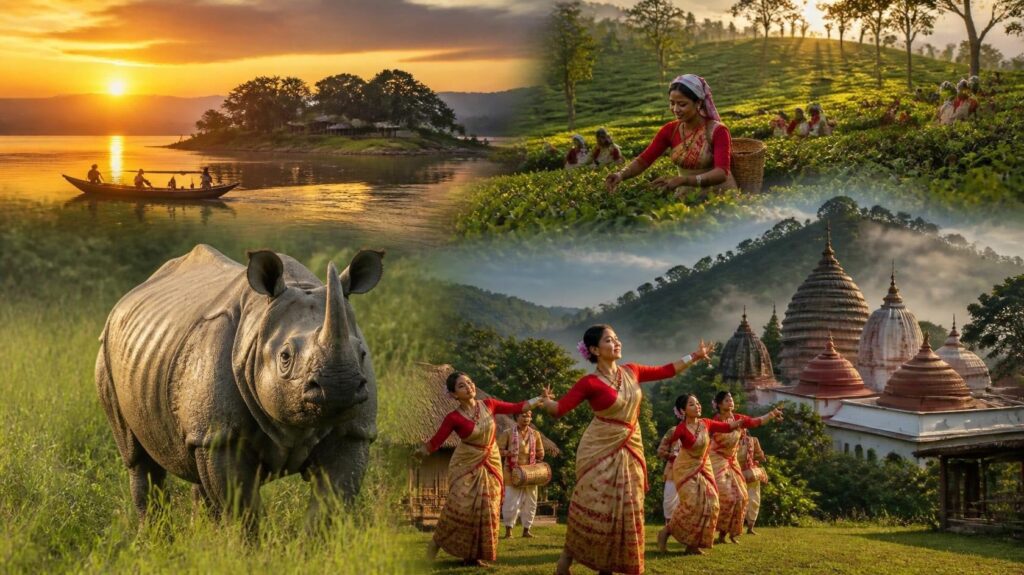
Assam is a rich and culturally diverse state located in the north-eastern part of India. Its natural beauty, unique traditions, and historical importance make it special.

Geographical Location

Assam is bordered by Bhutan and Arunachal Pradesh in the north, Nagaland and Manipur in the east, Meghalaya and Tripura in the south, and West Bengal and Bangladesh in the west. It is surrounded by the Brahmaputra and Barak river valleys.

History

The history of Assam has been varied and rich from ancient times to modern times. It was also known as Kamarupa. The Ahom dynasty ruled the region for about 600 years and made Assam a powerful state.

Culture and Traditions

The culture of Assam is reflected in its colourful folk art, dance, music, and festivals. The famous festival here is Bihu, which is related to agriculture and celebrated three times a year. Assamese and Bodo are the main languages spoken in the state.

Natural Wealth

Assam is famous for its greenery, tea gardens, wildlife sanctuaries, and natural resources. The state has world heritage sites like Kaziranga National Park and Manas National Park. Assam’s tea production is renowned worldwide.

Economic Activities

The economy of Assam is mainly based on agriculture and tea production. Apart from this, the state also has reserves of oil and natural gas.

Tourist Spots

  • Kamakhya Temple – The main center of Shakti worship.
  • Kaziranga National Park – Famous for the one-horned rhinoceros.
  • Majuli Island – The world’s largest river island located on the Brahmaputra River.

Conclusion

Assam is an important state of India due to its natural beauty, cultural heritage, and economic contribution. It attracts everyone with its diversity and charm.


Geographical Location of Assam

Assam is located in the north-eastern part of India and covers an area of about 78,438 square kilometers. The state lies in the foothills of the Himalayas and is famous for the fertile lands of the Brahmaputra and Barak Valley. Its geographical setting holds great natural, economic, and cultural significance.

Location and Boundaries

Latitude and Longitude

  • Assam lies between 24° to 28° N latitude and 89° to 96° E longitude.

Boundaries

  • North: Bhutan and Arunachal Pradesh
  • East: Nagaland and Arunachal Pradesh
  • South: Meghalaya, Tripura, and Mizoram
  • West: West Bengal and Bangladesh

Major Geographical Features

Brahmaputra River and Its Valley

The Brahmaputra River, the lifeline of Assam, originates from Tibet and enters Assam via Arunachal Pradesh. Flowing westward, it forms a wide and fertile valley that supports agriculture and human settlement.

Barak River Valley

Located in southern Assam, the Barak River and its tributaries serve as major water sources. This valley is known for fertile lands favorable for crops like rice, sugarcane, and oilseeds.

Hills and Plateaus

Assam is surrounded by hills, including the Cachar Hills and Karbi Anglong. These areas are known for rich biodiversity.

Climate

The climate of Assam is sub-tropical humid with long summers and an extended rainy season. The annual rainfall ranges between 200–300 cm, supporting dense forests and tea plantations.

Forests and Wildlife

Assam is home to dense forests and wildlife sanctuaries. It hosts rare species such as the one-horned rhinoceros, elephants, leopards, and several unique bird species.

Geographical Importance

Agriculture

The fertile soil of the Brahmaputra and Barak valleys is ideal for agricultural activities.

Tea Production

The high altitudes and rich soil contribute to Assam tea, which is globally renowned.

Tourism

Hills, rivers, wildlife sanctuaries, and cultural heritage make Assam a thriving tourist destination.

The geographical location of Assam not only enhances its economic and cultural significance but also makes it a unique center of natural beauty and resources.

History of Assam – Ancient, Medieval, Colonial & Modern Era

History of Assam

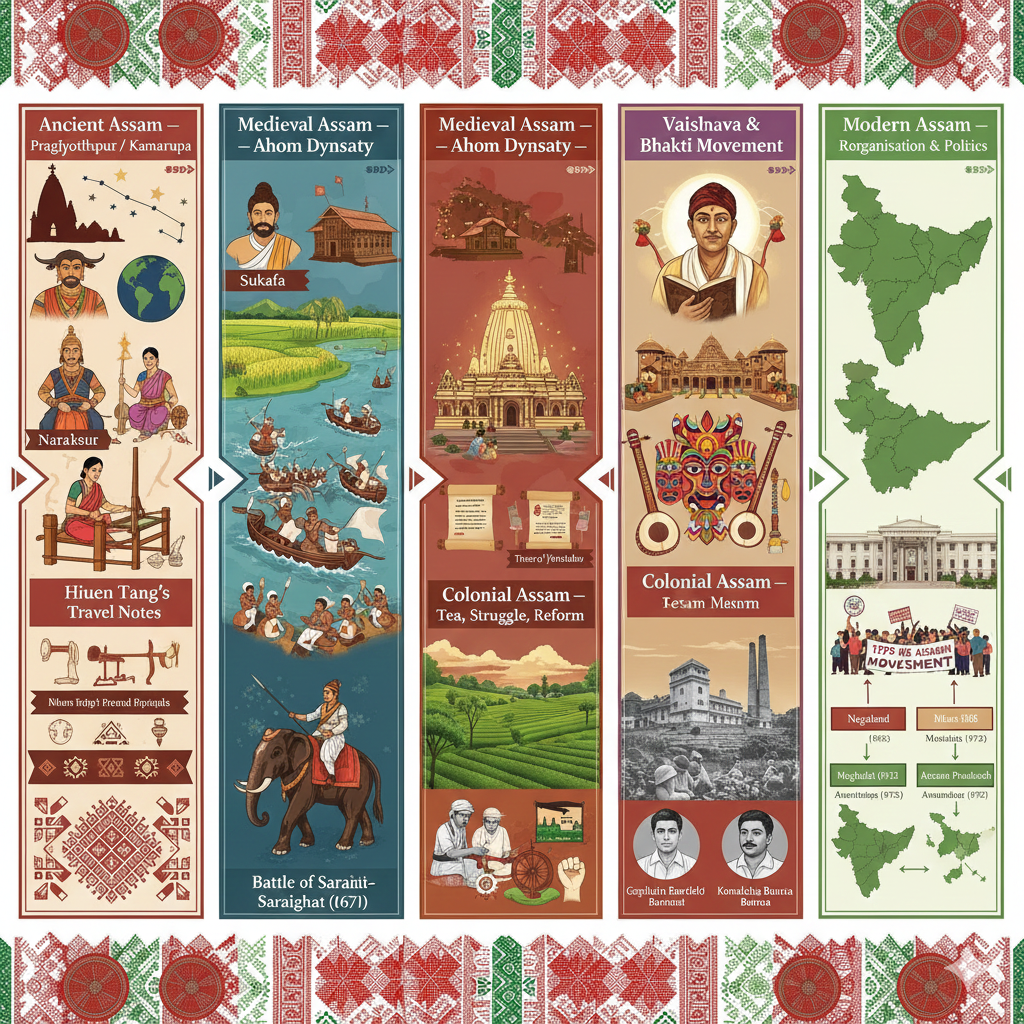
The history of Assam has witnessed various cultures, traditions, and rulers from ancient to modern times. Assam derives its name from the Ahom rulers, who governed the region for around 600 years. The state was also known as Kamarupa in ancient times.

Ancient History

Vedic and Puranic Period

  • Assam is mentioned in ancient texts and epics by the names Pragjyotishpur and Kamarupa.
  • Pragjyotishpur means “the place of ancient astrology.”
  • Assam is connected with the Mahabharata period. Rulers like King Narakasur and Bhagadatta are mentioned in the Mahabharata.
  • Kamarupa was an important centre of Tantric and Shakti worship.

Kamarupa Kingdom (4th to 12th Century)

  • The rulers of the Kamarupa Kingdom belonged to the Varman, Pala, and Vishnugupta (aka Gupta) dynasties.
  • During this period, Assam became a major centre of art, culture, and religion.
  • The works of Banabhatta such as Harshacharita and the travelogues of Chinese traveller Hiuen Tsang describe the Kamarupa Empire.

Medieval History

Ahom Kingdom (13th to 19th Century)

  • In 1228, Sukafa, the leader of the Ahom community, entered Assam and founded the Ahom Kingdom.
  • The Ahom rulers governed Assam for approximately 600 years.
  • They protected Assam from external invaders, especially the Mughals.
  • The Battle of Saraighat (1671) is a significant event where Ahom general Lachit Borphukan defeated the Mughal forces.
  • Agricultural development and cultural prosperity increased under Ahom rule.

Reconstruction of Kamakhya Temple

The Ahom rulers rebuilt the Kamakhya Temple and several other religious sites, strengthening the religious and cultural heritage of Assam.

Vaishnava Movement

In the 15th century, the great saint Srimanta Shankardev preached the Vaishnava religion. He promoted the Bhakti movement and enriched Assam’s traditions in art, music, and theatre.

Colonial History (1826–1947)

Arrival of the British

The British took control of Assam following the Treaty of Yandabo in 1826. They introduced the tea industry in Assam, making it internationally famous.

Contribution to the Freedom Struggle

  • The people of Assam actively participated in the Indian freedom movement.
  • Leaders like Gopinath Bordoloi and Kanaklata Barua played significant roles in the struggle for independence.

Modern History (After 1947)

Assam After Independence

After India gained independence in 1947, Assam became an Indian state. Since the 1960s, Assam has seen several political and social movements. The movement from 1979–85 (against foreign infiltrators) left a deep impact on the state’s politics.

Formation of New States

  • Nagaland was separated from Assam in 1963.
  • Meghalaya, Mizoram, and Arunachal Pradesh were formed in 1972, carving out new states from Assam.

Cultural and Historical Importance of Assam

  • Assam has been a centre of cultural, religious, and commercial activities since ancient times.
  • Its architecture, art, and religious traditions reflect a rich historical heritage.
  • The Ahom and Kamarupa kingdoms helped Assam establish a distinct identity that remains relevant even today.

Conclusion

The history of Assam not only highlights its cultural and political evolution but also shows that the region is an essential part of India’s rich heritage. From ancient to modern times, Assam has preserved its unique identity.
Culture & Traditions of Assam Dance, Festivals, Art, Music & Heritage
Culture and Traditions of Assam – Festivals, Language, Food & Bihu

Culture and Traditions of Assam

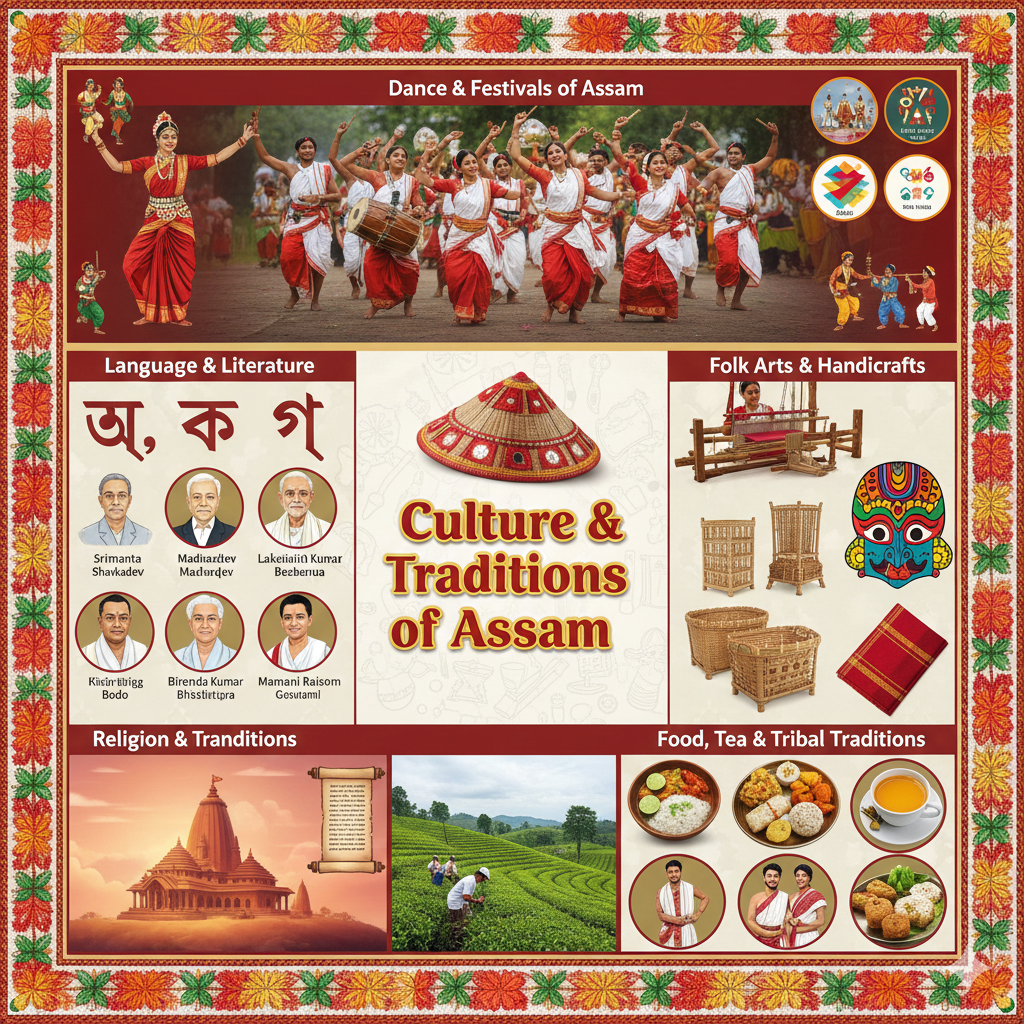
Assam is one of the most culturally rich states of India. Its culture is reflected in colourful traditions, folk arts, festivals, and music. The cultural heritage of Assam is a blend of various tribes, languages, and religions. Its diversity and deep traditional roots give it a special place on India's cultural map.

Language and Literature

Language

  • The major language of Assam is Assamese, which has the status of the official language.
  • Other widely spoken languages include Bodo, Bengali, and various tribal languages.

Literature

  • Assamese literature began with ancient poetry and sacred texts.
  • Saints like Srimanta Shankardev and Madhavdev enriched Assamese literature while promoting Vaishnavism.
  • In modern Assamese literature, writers such as Lakshminath Bezbarua, Birendra Kumar Bhattacharya, and Mamani Raisom Goswami made significant contributions.

Festivals

Bihu

Bihu is the most important festival of Assam. It is associated with agriculture and seasonal changes. There are three types of Bihu:

  • Rangali Bihu (Bohag Bihu) – Celebrated in April. It marks the Assamese New Year and the post-harvest season.
  • Bhogali Bihu (Magh Bihu) – Celebrated in January. It is a festival of feasting after the harvest.
  • Kathi Bihu (Kangali Bihu) – Celebrated in October–November. A simpler celebration when crops are still growing.

Ambubachi Fair

This is a religious festival celebrated at the Kamakhya Temple, symbolizing the worship of the Mother Goddess.

Festivals of Bodo Tribes

  • Bathou Puja
  • Khagaria Puja

Folk Arts and Crafts

Folk Art

  • Sattriya Dance – Associated with Vaishnavism and popularized by Shankardev.
  • Bihu Dance – The main folk dance of Assam, performed by men and women together.

Handicrafts

  • Assam is renowned for silk weaving, especially Muga Silk and Pat Silk.
  • Bamboo and cane products such as baskets, furniture, and traditional umbrellas are widely made.
  • The traditional Gamocha (white cloth with red embroidery) is an integral part of Assamese culture.

Religious Traditions

Kamakhya Temple

The Kamakhya Temple is an important centre of Shakti worship. It is known for Tantric practices and the Ambubachi fair.

Vaishnavism

In the 15th century, Shankardev spread the Vaishnava faith. He also established Sattra institutions, where religious and cultural activities were performed.

Music and Dance

Music

Assamese music reflects nature, love, and life. Bihu songs and Bodo songs form a major part of Assam’s musical tradition.

Dance

Apart from Bihu and Sattriya, the dances of the Karbi and Missing tribes are also popular.

Food and Drink

Traditional Food

  • Assamese cuisine is simple, flavorful, and made with natural ingredients.
  • Rice is the staple food, cooked in various ways.
  • Famous dishes include Fish Tenga, Alu Pitika, and Poita Bhaat.

Sweets

Pitha (rice and jaggery sweet) is a popular delicacy.

Tea

Assam tea is world-famous and an integral part of Assamese culture.

Traditional Clothes

Mekhela Chador

The traditional attire of Assamese women, usually made from silk.

Gamocha

A white cloth with red embroidery, used in all cultural and religious ceremonies.

Tribal Culture

Bodo Tribe

Known for their vibrant music and dance traditions.

Missing Tribe

Famous for traditional dances and handicrafts.

Karbi and Kachari Tribes

These tribes are known for unique costumes, food habits, and festivals.

Conclusion

The culture of Assam reflects its diversity and heritage. Traditions here beautifully blend ancient customs and modern practices. Music, dance, festivals, and handicrafts form the cultural soul of Assam, making it a centre of attraction not only in India but across the world.


Bihu

Bihu is the most prominent and culturally significant festival of Assam. It is closely associated with agriculture, nature, and Assamese lifestyle. Bihu is celebrated in three main forms, each linked to a different phase of farming.

Types of Bihu

Rangali Bihu (Bohag Bihu)

Time: April (Baisakh)

Importance: Celebrated to welcome the Assamese New Year and mark the post-harvest season. It is considered the “Festival of Festivals.”

Features

  • People wear new clothes and greet each other.
  • Bihu dance and music are performed with traditional instruments like dhol, pepa, and flute.
  • Traditional dishes such as pitha, laru, and rice-based sweets are prepared.

Bhogali Bihu (Magh Bihu)

Time: January (Magh)

Importance: A festival of feasting after harvesting. Also known as the “Festival of Food and Fire.”

Features

  • Community feasting (Bhoj Kudi) is organized.
  • A “Meji” (a fire structure) is lit and worshipped.
  • Traditional games like gilli-danda and wrestling are conducted.

Kathi Bihu (Kangali Bihu)

Time: October–November (Kartik)

Importance: Celebrated during the crop-growing period with simple rituals. Called “Kangali Bihu” because food supplies are low during this time.

Features

  • People pray for a good harvest.
  • Homes and fields are decorated with diyas and earthen lamps.

Activities and Traditions during Bihu

Bihu Dance

The traditional folk dance of Assam, performed during Rangali Bihu with energetic movements and rhythmic music.

Bihu Songs

These songs express themes of agriculture, love, nature, and joy of life. Traditional instruments like dhol, pepa, and flute are used.

Traditional Dishes

  • Til pitha
  • Coconut laru
  • Jaggery sweets
  • Fermented rice dishes

Gamocha

The traditional gamocha holds great significance in all Bihu celebrations and symbolizes respect.

Social Gatherings

People visit homes, exchange greetings, participate in community events, and strengthen social bonds.

Cultural Significance of Bihu

  • Bihu symbolizes Assamese culture and collective identity.
  • It reflects rural life, agriculture, and respect for nature.
  • It unites people beyond caste, religion, and social boundaries.

Conclusion

Bihu is the heart of Assam and an integral part of Assamese life. Rangali, Bhogali, and Kathi Bihu, with their unique traditions and rituals, beautifully represent Assam’s unity in diversity.

Natural Wealth of Assam Forests, Rivers, Wildlife, Minerals & Biodiversity
Natural Wealth of Assam – Forests, Rivers, Minerals, Wildlife & Biodiversity

Natural Wealth of Assam

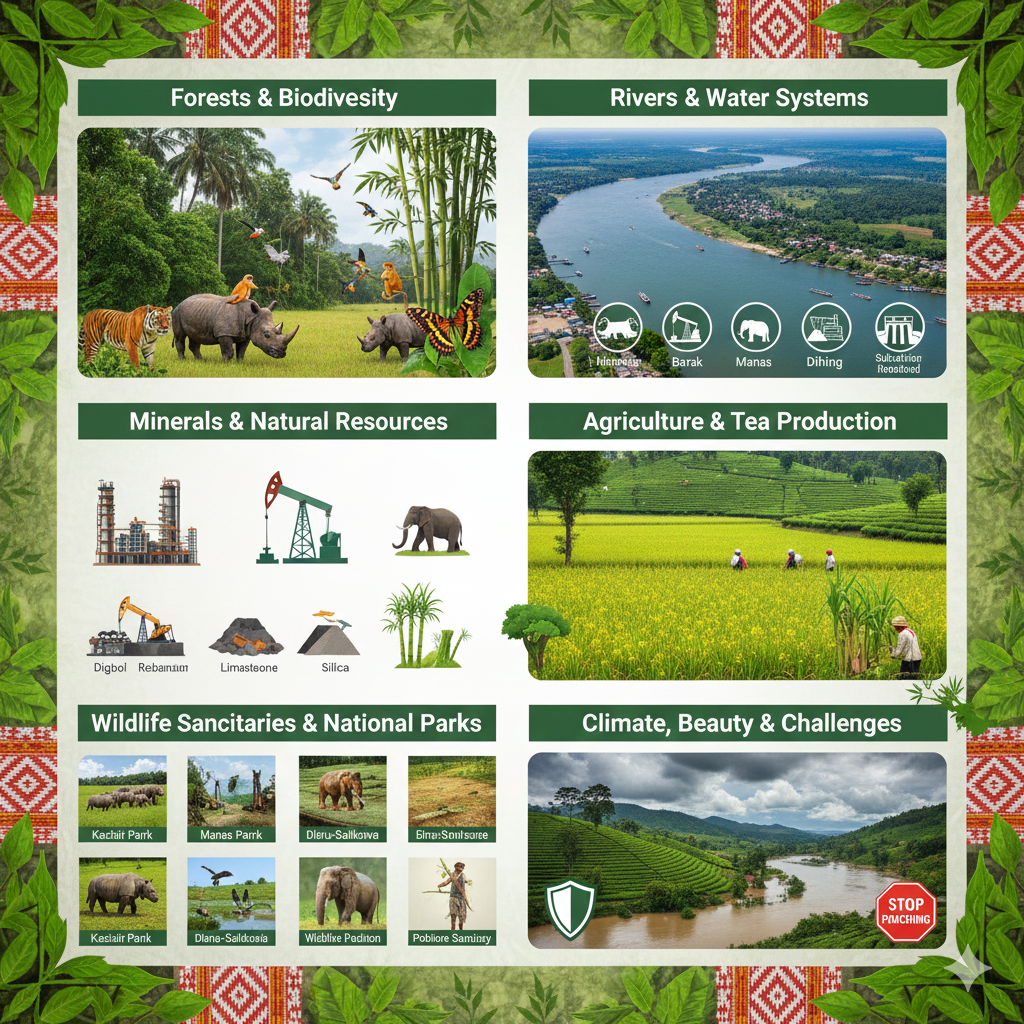
Assam is a northeastern state of India, famous for its unique natural beauty and rich biodiversity. Its geographical diversity, fertile land, dense forests, rivers, and mineral resources make it a treasure of natural wealth. The environment of Assam not only supports the livelihood of its people but also plays a major role in global biodiversity conservation.

1. Forests and Biodiversity

Vegetation

  • Tropical rainforests, semi-evergreen forests, and grasslands are found in Assam.
  • Bamboo and sugarcane forests are major vegetation types.
  • The state is rich in rare species of medicinal plants and herbs.

Wildlife

  • Assam is home to many rare and endangered species.
  • Kaziranga National Park is world-famous for the one-horned rhinoceros (Indian Rhinoceros).
  • Manas National Park, a UNESCO World Heritage Site, is home to Bengal tigers, Asian elephants, and golden langurs.
  • Over 800 species of birds and hundreds of species of butterflies are found in Assam.

2. Rivers and Water Resources

Brahmaputra River

The Brahmaputra is the most important river of Assam, providing water, irrigation, and transportation. Its fertile plains support agriculture, livestock, and settlements.

Other Rivers

  • Barak River
  • Manas River
  • Subansiri River
  • Dihing River

These rivers play a crucial role in maintaining Assam’s water supply and biodiversity.

Hydroelectric Projects

The rivers of Assam are suitable for hydroelectric power production. Several hydroelectric projects are operating on the Subansiri River.

3. Mineral Wealth

Crude Oil and Natural Gas

  • Duliajan and Digboi are among the oldest and most important oil fields in India.
  • Oil and natural gas contribute significantly to Assam’s economy.

Coal

High-quality coal is found in the Dibrugarh and Tinsukia districts.

Limestone and Silica

These minerals are important in construction and cement production.

Mineral Conservation

The Government of Assam focuses on sustainable use and conservation of mineral resources.

4. Agriculture and Fertile Land

Main Crops

  • Rice
  • Tea
  • Sugarcane
  • Jute
  • Mustard

Tea Plantation

Assam is world-famous for its tea. It produces more than 50% of India’s total tea output.

Bamboo Production

Assam is a leading state in bamboo production, which is used in construction, handicrafts, and the paper industry.
5. Wildlife Sanctuaries and National Parks

  • Kaziranga National Park – Famous for one-horned rhinoceros.
  • Manas National Park – Home to Bengal tiger and golden langur.
  • Dibru-Saikhowa National Park – Known for its bird diversity.
  • Pobitora Wildlife Sanctuary – Known for high rhino population density.

6. Climate and Natural Beauty

Assam has a tropical climate and remains green throughout the year. Monsoon brings heavy rainfall, giving life to its rivers and forests. The Brahmaputra Valley, tea gardens, and hill regions form the core of Assam’s natural beauty.

7. Environmental Challenges

Brahmaputra Floods

Assam faces annual floods due to the Brahmaputra River, leading to loss of life, crops, and property.

Deforestation

Industrialization and agricultural expansion have caused significant deforestation.

Threats to Wildlife

Poaching and habitat loss pose serious threats to many species.

Conclusion

Assam’s natural wealth forms the foundation of its economy and culture. Its rivers, forests, biodiversity, and mineral resources contribute significantly both nationally and globally. Ensuring conservation and sustainable use of these resources is essential so that future generations can continue to benefit from Assam’s natural heritage.
Kaziranga National Park Rhinoceros, Wildlife, Grasslands & Brahmaputra
Kaziranga & Manas National Park – Biodiversity, Wildlife, Location & Tourism

Kaziranga National Park

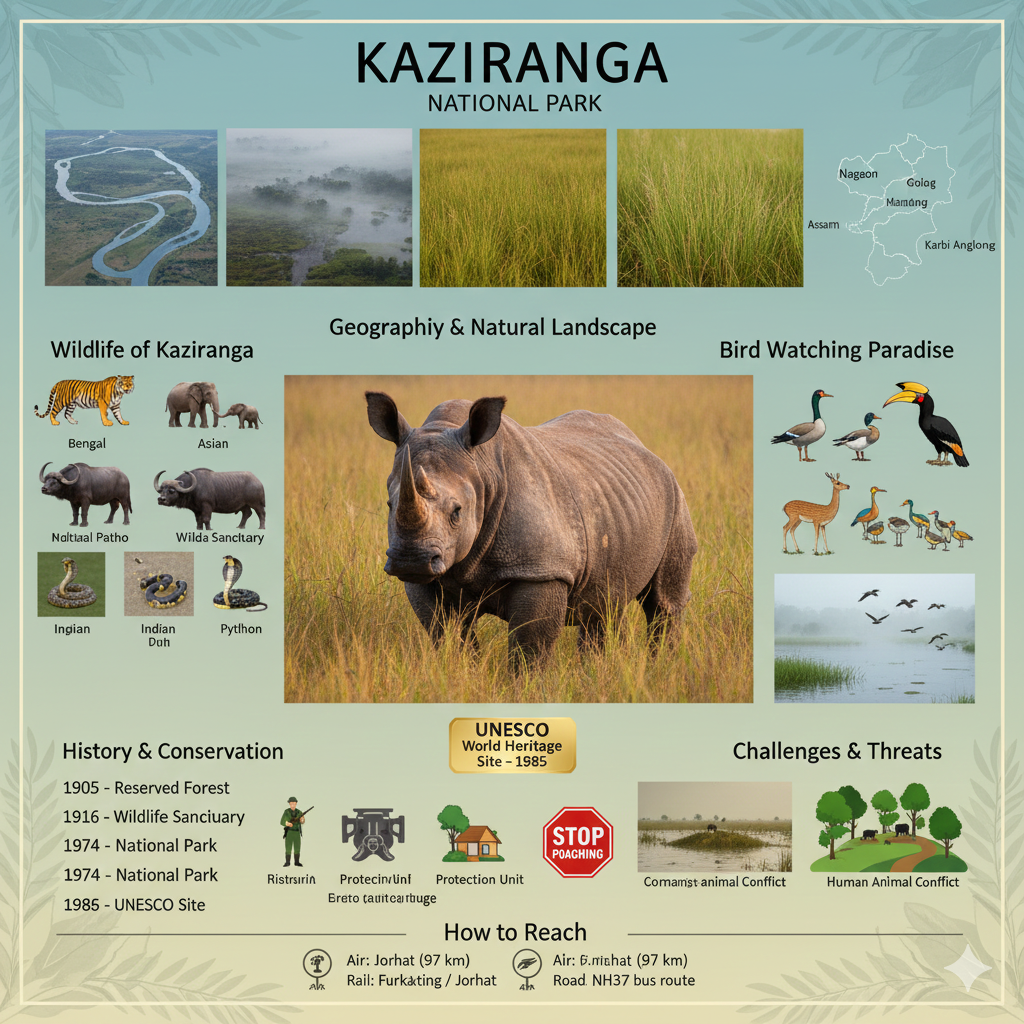
Kaziranga National Park is known for its unique biodiversity, dense forests, and especially the one-horned Indian Rhinoceros. It was recognized as a UNESCO World Heritage Site in 1985. Kaziranga is an important destination for wildlife enthusiasts and a key site for environmental conservation.

Geographical Location

  • Location: Spread across Nagaon, Karbi Anglong, and Golaghat districts of Assam.
  • Area: Approximately 430 square kilometers.

Geographical Features

  • Located on the banks of the Brahmaputra River.
  • Covered with grasslands, marshlands, and tropical forests.
  • Contains several small rivers and natural reservoirs that serve as water sources for wildlife.

History

  • 1905 – Declared a reserved forest.
  • 1916 – Given the status of Wildlife Sanctuary.
  • 1974 – Declared a National Park.
  • 1985 – Listed as a UNESCO World Heritage Site.

Flora and Ecology

Kaziranga consists of tropical evergreen forests, marshlands, grasslands, and shallow lakes.

Grasslands

Kaziranga has some of India’s largest and densest grasslands.

Main Tree Species

  • Aranya (Fig Tree)
  • Mango
  • Bamboo
  • Sugarcane

Wildlife

One-Horned Rhinoceros

  • Kaziranga is famous for having the world’s largest population of one-horned rhinoceros.
  • It holds nearly two-thirds of the global population of this species.

Other Mammals

  • Bengal Tiger (highest tiger density among reserves)
  • Asian Elephant
  • Wild Buffalo
  • Swamp Deer

Birds

  • Over 400 bird species are found here.
  • Great Hornbill
  • Bar-headed Goose
  • Brahminy Duck

Reptiles

  • Indian Python
  • King Cobra
  • Various species of turtles

Main Attractions

Safari

Jeep and elephant safaris allow tourists to explore wildlife closely.

Bird Watching

Kaziranga is a paradise for bird lovers and photographers.

Beauty of the Brahmaputra

The scenic Brahmaputra River enhances the natural beauty of the region.

Environmental Challenges

Flood Risk

Annual flooding of the Brahmaputra River causes significant damage to wildlife and the ecosystem.

Illegal Hunting

Poaching of rhinos for horn smuggling remains a major concern.

Human-Animal Conflict

Villages around the park often face conflicts with wild animals.

Conservation Efforts

Government Initiatives

Special laws and measures have been implemented by the Assam and Indian governments for wildlife protection.

UNESCO & International Support

International organizations provide funding and technical assistance for biodiversity conservation.

Community Involvement

Local communities are actively involved in conservation and eco-tourism.

How to Reach

  • Air: Jorhat (97 km) and Guwahati (217 km) are the nearest airports.
  • Rail: Furkating and Jorhat are the nearest railway stations.
  • Road: Regular bus services connect Kaziranga to Guwahati and nearby cities.

Conclusion

Kaziranga National Park is a symbol of India’s rich natural and biodiversity heritage. It attracts tourists from all over the world and serves as an important centre for wildlife conservation and environmental education. Continued conservation efforts are essential to preserve this natural treasure for future generations.


Manas National Park

Manas National Park is a major national park and UNESCO World Heritage Site in Assam. It is renowned for its biodiversity, scenic landscapes, and protected wildlife. The park is home to tigers, elephants, and many rare species, making it an important centre of ecotourism.

Location and Geographical Features

  • Location: Spread across Barpeta, Baksa, Chirang, and Kokrajhar districts of Assam.
  • Area: Approximately 950 square kilometers.
  • Geography: Located in the foothills of the Himalayas, sharing a border with Bhutan.
  • The Manas River is the main river supporting the park’s ecosystem.
  • Dense forests, grasslands, and marshy riverbanks form the park’s natural surroundings.

History

  • 1928 – Declared a Wildlife Sanctuary.
  • 1985 – Declared a UNESCO World Heritage Site.
  • 1990s – Placed on the “World Heritage in Danger” list due to poaching and regional unrest.
  • Removed from danger list after successful conservation efforts.

Biodiversity

Vegetation

  • Tropical evergreen and semi-evergreen forests.
  • Bamboo and sugarcane forests.
  • Extensive grasslands that support diverse wildlife.

Wildlife

Mammals

  • Tiger: Protected under Project Tiger.
  • Asian Elephant: Largest population in Assam.
  • Golden Langur: A rare and endangered species.
  • Black Bear and Bhutanese Snow Bear.
  • Pygmy Hog and Hispid Hare (both rare species).

Birds

  • Over 450 bird species.
  • Great Hornbill
  • Brahmaputra Duck
  • River Tern
  • Migratory birds visit during winters.

Reptiles and Amphibians

  • Indian Python
  • King Cobra
  • Various species of water turtles

Main Attractions

Manas River

The Manas River is the lifeline of the park and enhances its scenic beauty.

Safari

Jeep and elephant safaris offer visitors a chance to explore wildlife up close.

Wildlife Reserve

The park includes tiger reserves, biosphere reserves, and elephant conservation zones.

Bird Watching

Manas is an excellent destination for bird enthusiasts.

Bhutan Border Landscape

The picturesque view of the Bhutan foothills adds to the beauty of Manas.

Environmental Challenges

Illegal Hunting

Poaching of rhinos and other animals has been a major problem in the past.

Human-Animal Conflict

Communities living near the park face increasing conflicts with wildlife.

Floods

Seasonal flooding of the Manas River causes ecological damage.

Regional Unrest

Political instability in the 1990s severely affected conservation efforts.

Conservation Efforts

National & International Support

UNESCO and global organizations have provided technical and financial support for conservation.

Project Tiger & Project Elephant

These initiatives protect tigers and elephants in the region.

Community Participation

Local communities are engaged through eco-tourism, jobs, and environmental education.

How to Reach

  • Air: Nearest airport is Guwahati (176 km).
  • Rail: Barpeta Road is the nearest railway station.
  • Road: Buses and taxis are available from Guwahati and nearby towns.

Conclusion

Manas National Park is a magnificent symbol of Assam’s biodiversity. It plays a crucial role in wildlife conservation and significantly contributes to tourism and regional development. With continued conservation efforts and community involvement, this priceless heritage can be preserved for future generations.

Economic Activities of Assam Agriculture, Tea, Oil, Forests & Tourism
Economic Activities of Assam – Agriculture, Tea, Petroleum, Tourism & Industries

Economic Activities of Assam

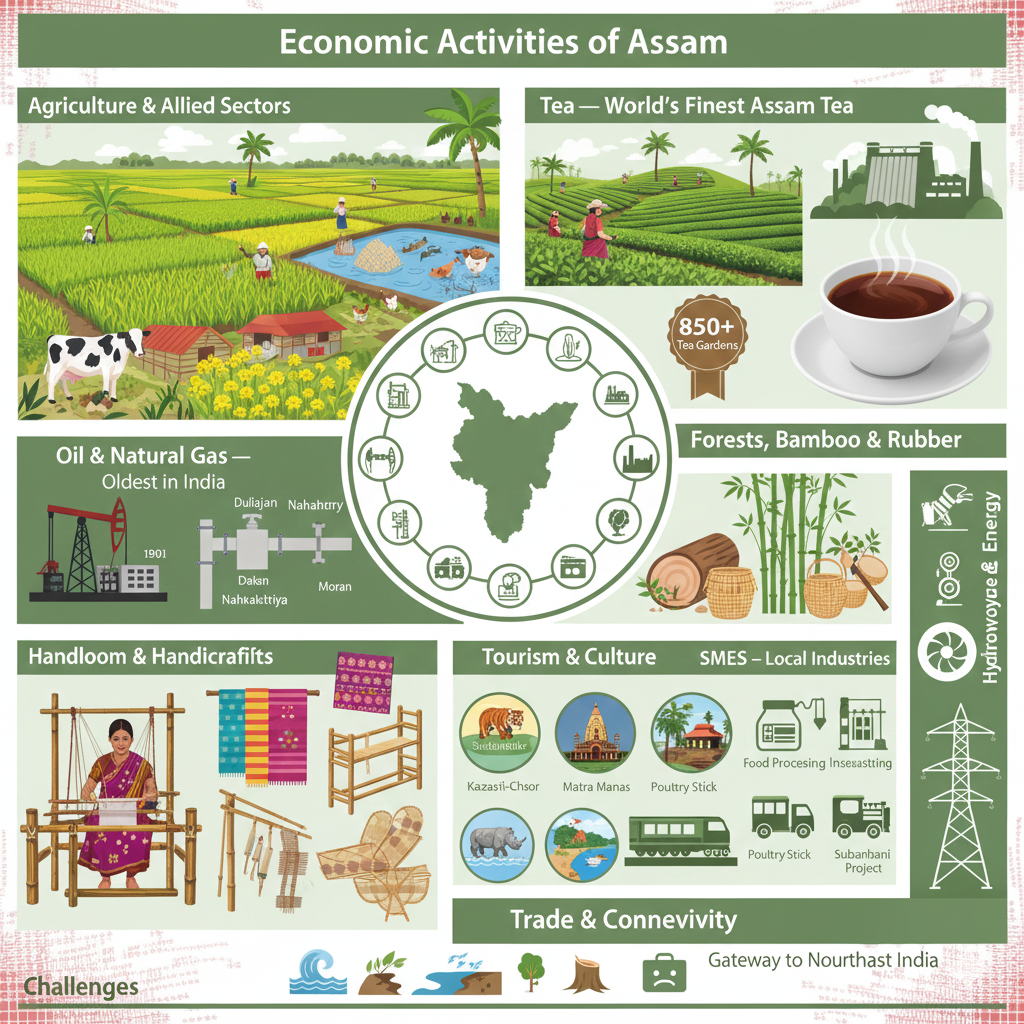
The economy of Assam is mainly based on agriculture, the tea industry, petroleum, forest resources, and handicrafts. Tourism and biodiversity conservation also play an important role in supporting the state’s economic structure.

1. Agriculture and Related Activities

Agriculture is the backbone of Assam’s economy.

Main Crops

  • Rice: The main food crop of Assam, grown in three varieties:
    • Sali (winter crop)
    • Ahu (summer crop)
    • Bao (grown in submerged areas)
  • Tea: Assam is the largest tea-producing region in the world, famous for its strong flavour and quality.
  • Pulses and Oilseeds: Mustard, sunflower, and groundnut are widely cultivated.
  • Fruits and Vegetables: Banana, coconut, papaya, and bamboo are important crops.

Other Agricultural Activities

  • Fisheries: Due to the Brahmaputra and Barak rivers, fisheries are a major economic activity.
  • Animal Husbandry: Dairy farming, poultry, and pig farming support rural livelihoods.

2. Tea Industry

  • Assam is India’s largest tea-producing state.
  • Assam tea is world-famous.
  • The state has more than 850 tea gardens.
  • The tea industry provides employment to millions of people.
  • Tea contributes significantly to both the state and national economy.

3. Petroleum and Natural Gas

  • Assam is India’s oldest oil-producing state.
  • Digboi Refinery (1901) is Asia’s first oil refinery.
  • Major oil fields include:
    • Duliajan
    • Naharkatiya
    • Moran
  • Petroleum and natural gas form a major pillar of Assam’s economy.

4. Forest-Based Industries

Wood and Bamboo Industry

  • Bamboo and wood are used in furniture, handicrafts, and paper industries.
  • Assam’s bamboo industry is famous across India.

Rubber Production

Rubber plantations are a growing sector contributing to the state’s industrial economy.

5. Handicrafts and Handloom Industry

Traditional handicrafts and handloom weaving are an integral part of Assam’s culture and economy.

Main Products

  • Mekhela-Chador, Gamosa, and silk garments
  • Bamboo and cane products such as baskets and decorative items

This industry provides employment to a large number of rural women.

6. Tourism Industry

Assam’s natural beauty and cultural richness make tourism an essential source of income.

Main Tourist Attractions

  • Kaziranga National Park and Manas National Park – famous for wildlife and biodiversity.
  • Kamakhya Temple – a major religious destination.
  • Majuli Island – the world’s largest river island.

The tourism industry promotes local employment and boosts the regional economy.

7. Small and Medium Scale Industries

Assam has several small and medium industries that provide local employment and support economic growth.

Key Areas

  • Food processing
  • Agarbatti manufacturing
  • Fisheries and poultry farming

8. Hydropower and Energy Generation

Due to the Brahmaputra and its tributaries, Assam has immense potential for hydropower generation. Several hydroelectric projects strengthen the state's energy infrastructure.

9. Trade and Transport

Assam serves as a major trading centre for Northeast India. The Brahmaputra River and an expanding road network support trade and connectivity.

Economic Challenges

Flooding and Erosion

Annual floods of the Brahmaputra and its tributaries damage agriculture, homes, and infrastructure.

Poaching & Environmental Degradation

Wildlife conservation faces threats from poaching and habitat loss.

Slow Industrial Progress

Modern industries and advanced technology are limited in the state.

Unemployment

Due to dependence on agriculture, Assam lacks adequate employment opportunities for youth.

Conclusion

Agriculture, tea, petroleum, and handicrafts are the major contributors to Assam’s economy. Its rich natural resources and cultural heritage provide great opportunities for development. By resolving challenges such as floods, environmental degradation, and unemployment, Assam can achieve faster and more sustainable economic growth.

Tourist Spots of Assam Wildlife, Rivers, Temples & Heritage
Tourist Spots in Assam – Top Attractions, Wildlife, Heritage & Travel Guide

Tourist Spots in Assam

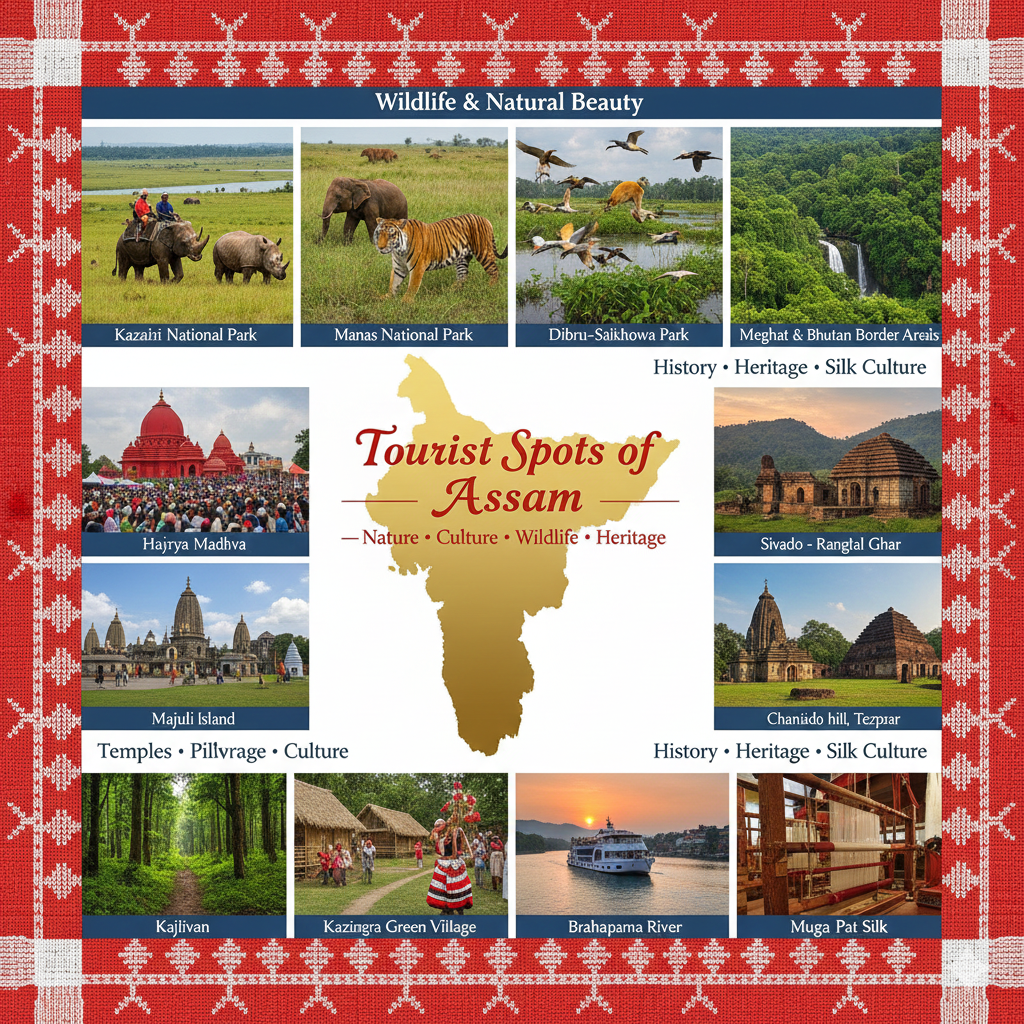
Assam is famous for its natural beauty, biodiversity, cultural heritage, and historical sites. The tourist destinations offer a blend of natural, religious, and cultural experiences to visitors.

1. Kaziranga National Park

Feature: A UNESCO World Heritage Site known for the one-horned rhinoceros.

What to See

  • Jeep and Elephant Wildlife Safari
  • Bengal tigers, wild elephants, and various bird species
  • Magnificent views of the Brahmaputra River

Location: Nagaon and Golaghat districts

2. Manas National Park

Feature: A UNESCO World Heritage Site famous for tigers and rare wildlife.

What to See

  • Tigers, elephants, golden langurs, rare species
  • Stunning view of the Manas River and Himalayan foothills

Location: Barpeta district

3. Majuli Island

Feature: The largest river island in the world, located on the Brahmaputra.

What to See

  • Vaishnava Satras (monasteries) and cultural traditions
  • Birdwatching
  • Traditional handicrafts and bamboo products

Location: Near Jorhat

4. Kamakhya Temple

Feature: One of the 51 Shaktipeeths of India, dedicated to Goddess Kamakhya.

What to See

  • Unique temple architecture
  • Religious gatherings during Ambubachi Mela

Location: Nilachal Hill, Guwahati

5. Sivasagar

Feature: A historical city of the Ahom Dynasty.

What to See

  • Sivadol (temple dedicated to Lord Shiva)
  • Rang Ghar (Asia’s oldest amphitheatre)
  • Talatal Ghar (historic palace of Ahom kings)

Location: Sivasagar district

6. Tezpur

Feature: Known as the “Cultural City of Assam.”

What to See

  • Agnigarh – associated with Mahabharata legends
  • Beautiful views of Nilachal Hills and Brahmaputra
  • Local music and dance

Location: Sonitpur district

7. Dibru-Saikhowa National Park

Feature: One of the richest biodiversity reserves in Northeast India.

What to See

  • Rare birds such as the white-winged wood duck
  • Grasslands and aquatic ecosystems

Location: Dibrugarh and Tinsukia districts

8. Hajo

Feature: A holy place for Hindus, Muslims, and Buddhists.

What to See

  • Hayagriva Madhava Temple
  • Powa Mecca (Muslim pilgrimage site)
  • Ancient Buddhist sites

Location: Near Guwahati

9. Charaideo (Cheraido)

Feature: Known as the “Pyramid of the Ahom Empire.”

What to See

  • Tombs of Ahom kings
  • Historical and cultural monuments

Location: Near Sivasagar

10. Kajlivan

Feature: Known for stories of Arjuna and Ulupi from Mahabharata.

What to See

  • Dense forests and natural beauty
  • Religious and historical places

Location: Near Tezpur

11. Sualkuchi

Feature: Known as the “Silk Village of Assam.”

What to See

  • Muga and Pat silk weaving
  • Live view of the silk production process

Location: About 35 km from Guwahati

12. Kaziranga Green Village (Rural Tourism)

Feature: Showcases rural Assamese lifestyle and culture.

What to See

  • Local handicrafts and traditional dance
  • Interaction with village communities

Location: Near Kaziranga

13. Cruise on the Brahmaputra River

Feature: Offers a scenic experience of Assam’s natural beauty.

What to See

  • Beautiful sunset views
  • Riverside villages and wildlife

14. Meghalaya and Bhutan Border Areas

Feature: Bordering regions offer waterfalls, forests, and stunning landscapes.

What to See

  • Waterfalls and hill views
  • Varied wildlife

Economic Role of Tourism

  • Provides employment to local communities
  • Promotes the cultural heritage of the state
  • Improves infrastructure and transportation

Conclusion

The tourist places of Assam are naturally and culturally rich and form a significant part of the state’s economic and cultural identity. The Brahmaputra River, wildlife sanctuaries, historical monuments, and religious places make Assam a unique tourist destination. With environmental protection and tourism promotion, Assam is strengthening its identity on the global tourism map.

Final Conclusion

Assam is a precious state in Northeast India, known for its rich natural wealth, biodiversity, and cultural traditions. World Heritage Sites like Kaziranga and Manas, natural wonders like Majuli, and sacred sites like Kamakhya Temple attract tourists from across the globe. Assam’s economy is supported by tea, agriculture, petroleum, handicrafts, and tourism. Despite challenges such as floods, unemployment, and slow industrial growth, the state's immense potential and vibrant heritage provide a strong foundation for future development. Proper conservation and management of resources will ensure Assam’s continuous growth and preservation of its unique identity.

References

  • Government of Assam – Tourism Department
  • UNESCO World Heritage Centre – Kaziranga & Manas National Park
  • Assam State Biodiversity Board
  • Ministry of Tourism, Government of India
  • Assam Tourism Official Website

Leave a Comment

Your email address will not be published. Required fields are marked *

Scroll to Top