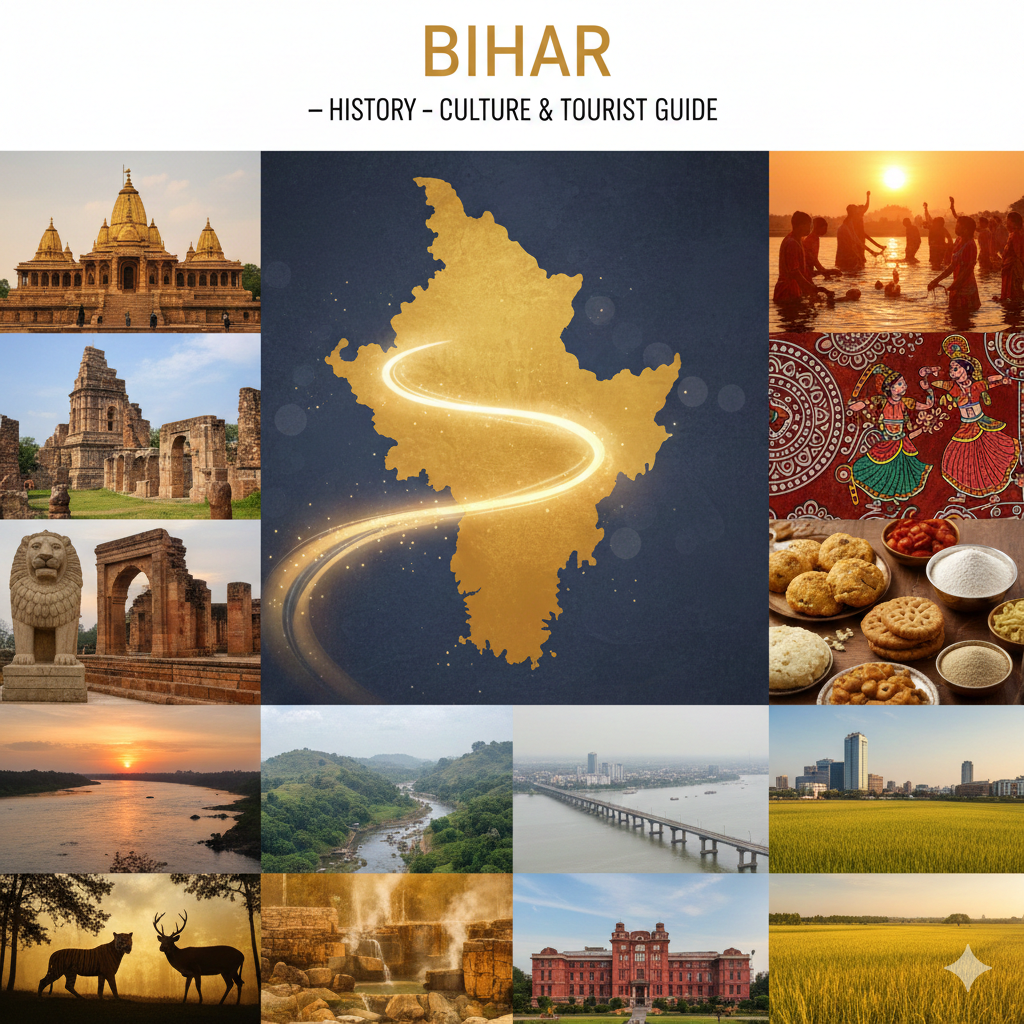
Bihar — A Detailed Introduction, History, Culture and Tourist Guide
Detailed introduction of Bihar
Bihar is a historically and culturally important state of India. It is located in the eastern part of the country and is known for its rich history, ancient educational centres and diverse cultural heritage. The name "Bihar" derives from the Sanskrit word Vihāra, meaning a monastery or place associated with Buddhist learning.
Geographical location
Location & Boundaries
- Region: North-eastern part of India (eastern India).
- To the north: Nepal.
- To the south: Jharkhand.
- To the east: West Bengal.
- To the west: Uttar Pradesh.
Area & Rivers
- Area: Approximately 94,163 square kilometres (13th largest state in India).
- Major rivers: Ganga, Kosi, Gandak, Son, Punpun and Bhagmati.
Capital
Capital: Patna.
History
The history of Bihar is ancient and glorious, spanning many important empires and cultural movements.
Ancient period
- Bihar was the heartland of the Magadha Empire (centres such as Rajgir and Pataliputra).
- The Maurya dynasty (including Chandragupta Maurya and Emperor Ashoka) and the Gupta dynasty ruled here.
- Bihar is the birthplace of Buddhism and Jainism; Mahatma Buddha attained enlightenment at Bodh Gaya.
- World-famous ancient universities such as Nalanda and Vikramshila were located in Bihar.
Medieval period
During the medieval period, the region came under the influence of various Muslim rulers and witnessed significant cultural exchange.
Modern period
Bihar played an important role in India’s freedom struggle. Notable events include the Champaran movement led by Mahatma Gandhi and the broader participation in the Revolt of 1857.
Culture and language
Languages
- Official language(s): Hindi (and Urdu is also recognized in many contexts).
- Other major languages: Bhojpuri, Maithili, Magahi, Angika and Bajjika.
- Maithili: Recognised in the Eighth Schedule of the Constitution of India.
Folk culture & Festivals
- Folk dances: Jhumar, Jat-Jatin, Bidesia.
- Folk songs: Sohar, Kajri, Chhath songs.
- Major festivals: Chhath Puja (the most prominent festival), Diwali, Holi, Dussehra and Makar Sankranti.
Food
Traditional and well-known foods include litti-chokha, sattu, thekua, mach-bhaat and various forms of pitha.
Natural resources & Agriculture
The plains of Bihar are fertile, helped by the irrigation potential of the Ganga and its tributaries.
Main crops
- Rice (paddy), wheat, maize, sugarcane and pulses are the primary crops.
Minerals
Local availability of materials such as lime and sand is noted in districts like Buxar and Gaya.
Administrative structure
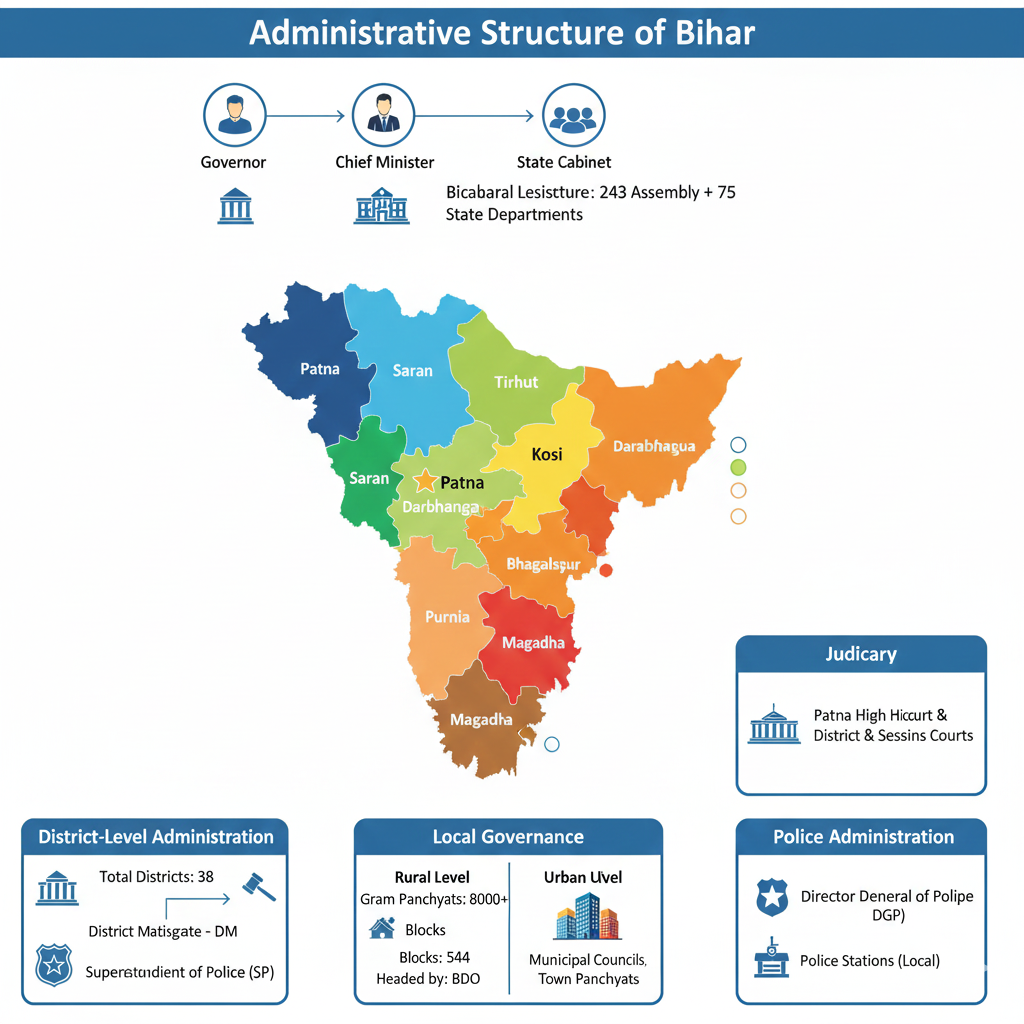
- Divisions: 9 divisions.
- Districts: 38 districts.
- State Assembly: 243 seats.
- Lok Sabha seats: 40.
- Rajya Sabha seats: 16.
Education and development
Ancient centres and present institutions
Ancient centres of learning such as Nalanda and Vikramshila made Bihar a historic seat of education. In contemporary times, institutions such as Patna University and a revived Nalanda University are important educational centres.
Challenges
Major development challenges include illiteracy, unemployment and gaps in infrastructure, which are areas of ongoing focus.
Economy
Bihar’s economy is largely agriculture-based, supplemented by small industries and traditional crafts.
Main agricultural produce
- Paddy, wheat, maize and sugarcane are the main crops.
Industries
Local industries include sugar, handloom and fisheries, along with traditional handicrafts.
Tourist spots
Bihar hosts several important religious, historical and natural sites:
- Religious & Pilgrimage: Bodh Gaya (Mahabodhi Temple), Pawapuri (Jain pilgrimage).
- Historical & Educational: Ruins of Nalanda University, Vikramshila University, Rajgir, Vaishali and Pataliputra.
- Natural: Valmiki National Park, Rajgir hot springs.
Society and culture
Bihar's folk music, dance, arts and handicrafts form a distinct identity. Chhath Puja is celebrated with great reverence and is a defining cultural feature of the state.
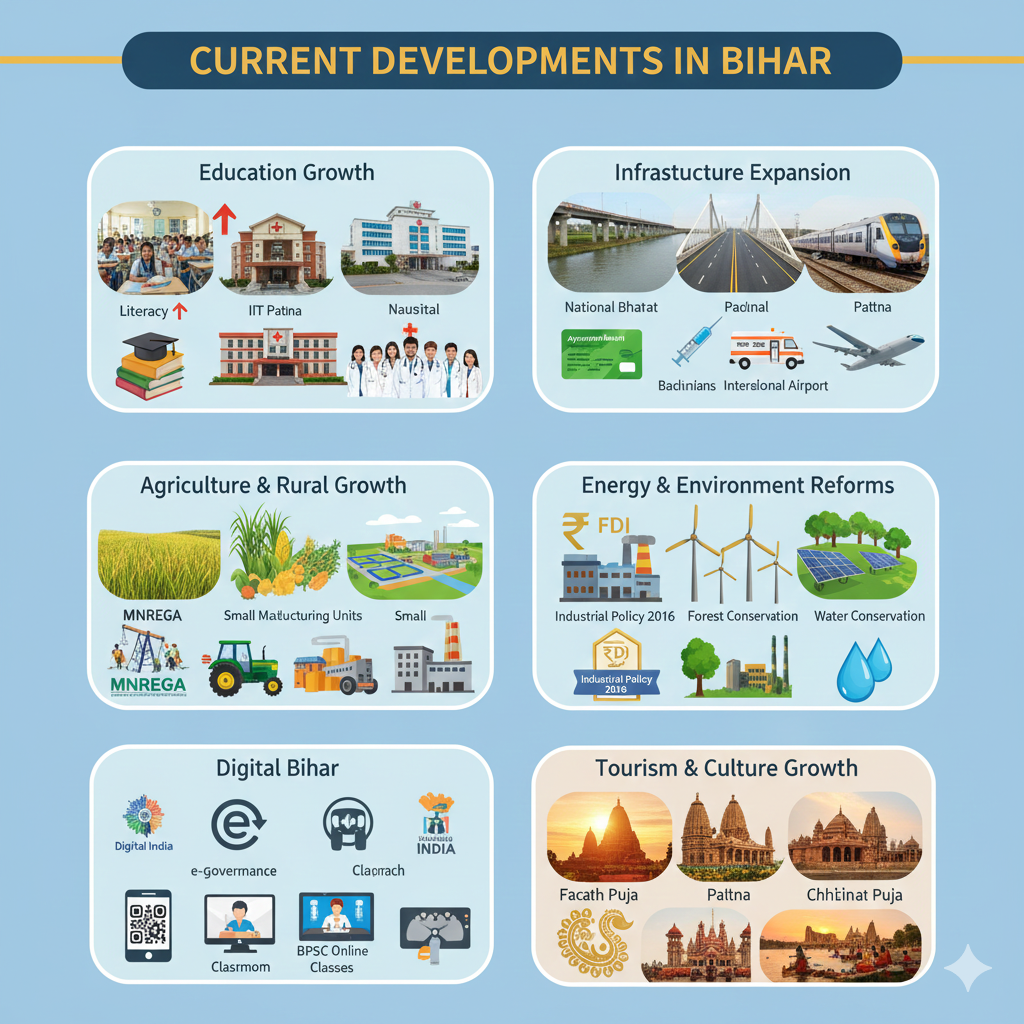
Current developments
In recent years, Bihar has made efforts to improve education, infrastructure and health services. Ongoing projects aim to address development challenges and expand opportunities.
⭐ Editor's Choice
Discover a highly rated product selected for its quality, functionality, and positive customer feedback.
View Details & Reviews →Features — What Bihar is known for
Religious & Cultural Centre
Bihar is historically the centre of Indian civilisation and spiritual learning.
Chhath Puja
Chhath Puja is one of the state's most significant and widely observed festivals.
Ancient Learning
Home to Nalanda and Vikramshila — ancient international centres of education.
Freedom Movement
Bihar’s role in India’s freedom struggle — notable events like the Champaran Satyagraha.
Quick facts
- Area: ~94,163 sq km.
- Population: Around 12 crore (as of 2021).
- Capital: Patna.
- Districts: 38.
- Assembly seats: 243.
- Lok Sabha seats: 40.
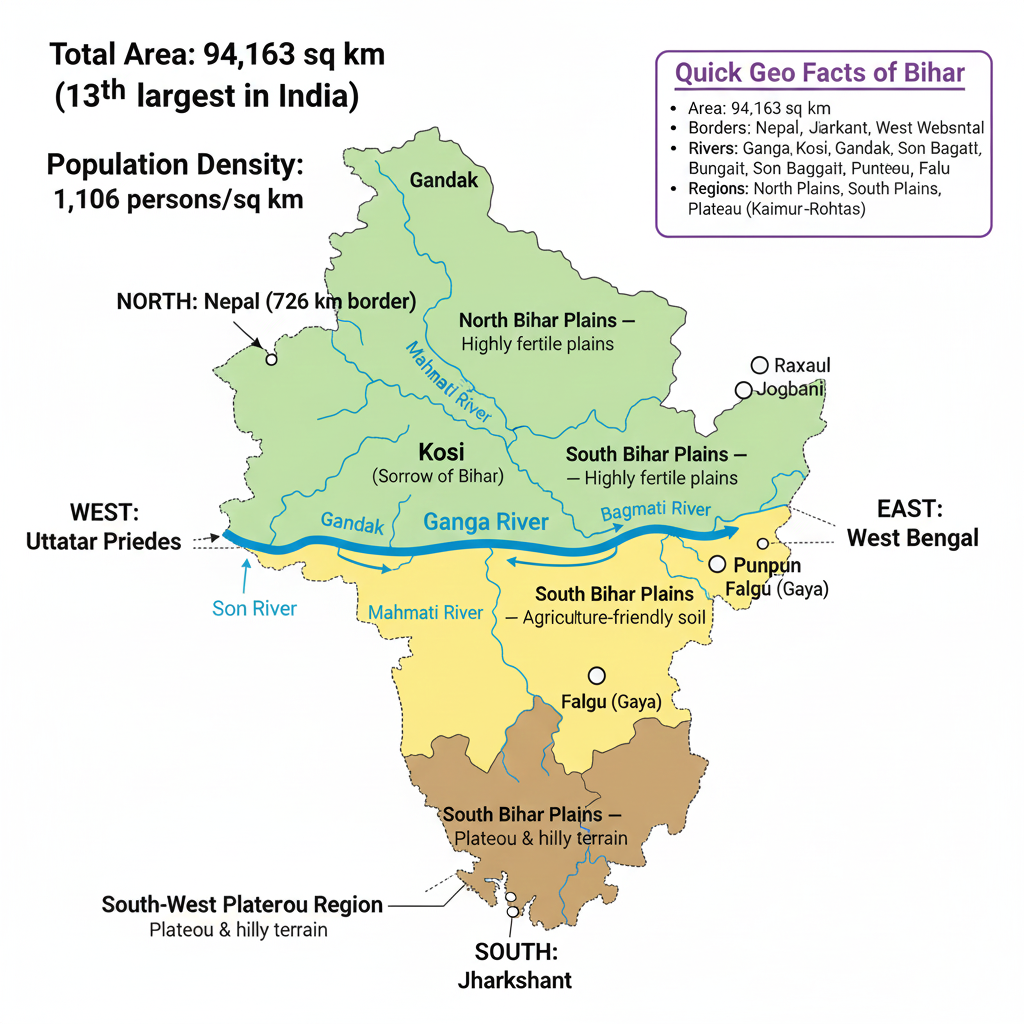
Geographical Location of Bihar
Bihar is a major state located in the eastern part of India, whose geographical location makes it an important regional and cultural hub.
Status and Extent
Latitude and Longitude
Bihar is located between 24°20’10” to 27°31’15” North latitude and 83°19’50” to 88°17’40” East longitude.
Area
The total area of the state is 94,163 square kilometers, which is about 3% of India’s total area.
Boundaries
- North: Nepal
- South: Jharkhand
- East: West Bengal
- West: Uttar Pradesh
Major Geographic Regions
Bihar can be divided into three major geographical regions:
1. Plain Area of North Bihar
- Located on the northern side of the river Ganga.
- Drained by the Kosi, Gandak, Bagmati, and Ghaghara rivers.
- Forms part of the fertile Gangetic plain.
2. Plains of South Bihar
- Situated to the south of the Ganga river.
- Mainly influenced by the Son and Falgu rivers.
- The plains are fertile but relatively dry compared to North Bihar.
3. Plateau and Hilly Areas
- Mainly located near the border of Jharkhand.
- Parts of the Vindhya range appear in Kaimur and Rohtas districts.
Climatic and Seasonal Characteristics
The climate of Bihar is mainly tropical monsoonal.
Summer (March to June)
- Temperature ranges from 30°C to 45°C.
- Hot winds (Loo) are common.
Rainy Season (July to September)
- Average monsoon rainfall is around 1,200 mm.
- Floods are common due to rivers like Kosi and Gandak.
Winter (December to February)
- Temperature ranges from 4°C to 20°C.
Rivers and Water Resources
Bihar is often called the “State of Rivers”.
Major Rivers
- Ganga: Flows through the middle of the state and divides North and South Bihar.
- Kosi: Known as the “Sorrow of Bihar” due to frequent flooding.
- Gandak, Bagmati, Ghaghara, Punpun, and Son are other major rivers.
Soil and Agriculture
Soil of North Bihar
- Alluvial soil, extremely fertile.
- Main crops: paddy, maize, sugarcane.
Soil of South Bihar
- Black and loamy soil.
- Main crops: wheat, pulses, oilseeds.
Forests and Biodiversity
Forest cover in Bihar is limited to around 7% of the total area.

⭐ Editor's Choice
Discover a highly rated product selected for its quality, functionality, and positive customer feedback.
View Details & Reviews →Valmiki National Park
- Located in West Champaran near the Nepal border.
- Home to tigers, leopards, deer, and various bird species.
Features and Challenges
- Bihar's geographical location makes it highly suitable for agriculture.
- Major problems include floods and soil erosion.
- Uneven monsoon distribution due to climate change is a rising concern.
The complex river system and geographical diversity make Bihar a unique and significant state.
Capital of Bihar — Patna
Patna is the capital and the largest historical city of Bihar. It is situated on the southern bank of the river Ganges.
Historical Importance of Patna
- In ancient times, Patna was known as Pataliputra.
- It served as the capital of major empires such as the Maurya, Gupta, and Nanda empires.
- It has been an important centre for Buddhism, Jainism, Sikhism, and Hinduism.
Geographical Location of Patna
- Latitude & Longitude: 25.6°N, 85.1°E
- Rivers: Located near the confluence of the Ganga, Gandak, Son, and Punpun rivers.
Modern Patna
Development
Patna is a major centre for education, business, healthcare, and administration.
Important Institutions
- Patna University (one of India’s oldest universities)
- Nalanda Medical College
- Indian Institute of Technology (IIT Patna)
Transportation
- Patna Airport: Jayprakash Narayan International Airport.
- Well-connected to major Indian cities through road and rail.
Tourist Spots in Patna
- Golghar: A historic grain storage structure from the British era.
- Gandhi Ghat: A famous riverfront ghat on the Ganges.
- Patan Devi Temple: One of the ancient temples of the city.
- Sanjay Gandhi Biological Park: Known for its wildlife and botanical diversity.
Patna, with its deep historical roots and cultural significance, is rapidly developing as a modern and progressive city.
Area of Bihar
Bihar has a total area of 94,163 square kilometers. It ranks 13th among the states of India in terms of area.
Area Comparison
- Bihar covers almost 3% of the total area of India.
- Although relatively small in area, Bihar ranks first in population density in India.
Distribution of Area
Bihar is divided into three major geographical regions:
1. Plain Area of North Bihar
- Lies north of the Ganga river.
- Highly fertile region.
2. Plains of South Bihar
- Located south of the Ganga.
- Soil is suitable for agriculture.
3. Plateau and Hilly Areas
- Located in the south-western region (Kaimur and Rohtas districts).
Density
According to the 2011 Census, Bihar has a population density of 1,106 persons per square kilometre, making it the most densely populated state in India.
The limited area and growing population create challenges related to resource management and development.
Boundaries of Bihar
Limit (Border Details)
- North: Nepal (International border)
- East: West Bengal
- West: Uttar Pradesh
- South: Jharkhand
Special Facts about Bihar's Borders
Border with Nepal (North)
- Total length of the border: 726 km.
- Major border posts include Raxaul and Jogbani.
- Important for trade, transit, and cultural exchange.
Border with Uttar Pradesh (West)
- Major rivers like the Ganga and Gandak flow near this border.
- Cities such as Gorakhpur and Varanasi are closely connected with Bihar.
Border with West Bengal (East)
- Areas near the Siliguri Corridor (Chicken Neck) are strategically important.
- Districts like Bhagalpur and Katihar are close to the Bengal region.
Border with Jharkhand (South)
- Jharkhand was part of Bihar before becoming a separate state in 2000.
- Strong economic and cultural ties exist between cities like Patna and Ranchi.
The geographical position and boundaries of Bihar connect it not only with other Indian states but also with the neighbouring country of Nepal.
Main Rivers of Bihar
Bihar is known as the “State of Rivers” because many major rivers flow through it. These rivers play an essential role in the state’s agriculture, economy, and culture.
Major Rivers of Bihar
1. River Ganges
- The most important river of Bihar.
- Flows through the middle of the state, dividing North and South Bihar.
- Passes through major cities such as Patna, Bhagalpur, and Munger.

⭐ Editor's Choice
Discover a highly rated product selected for its quality, functionality, and positive customer feedback.
View Details & Reviews →2. Kosi River
- Known as the “Sorrow of Bihar” due to frequent flooding.
- Originates in Nepal and affects several districts of Bihar.
- Eventually merges with the Ganga.
3. Gandak River
- Also originates in Nepal.
- Irrigates West Champaran, Saran, and Muzaffarpur districts.
- Also known as the Narayani River.
4. Son River
- Originates from Amarkantak in Madhya Pradesh.
- Flows through several districts of Bihar before joining the Ganga.
- Important for irrigation and power generation through its dams.
5. Bagmati River
- Originates in Nepal.
- Flows through North Bihar and contributes to seasonal flooding.
6. Punpun River
- A tributary of the Ganga.
- Flows mainly through South Bihar districts.
7. Falgu River
- Flows through the Gaya district.
- Considered sacred and significant for the Pinddaan ritual in Gaya.
8. Mahananda River
- Flows along the north-eastern part of Bihar and West Bengal.
- Tributary of the Ganga.
Importance of Rivers
- Irrigation & Agriculture: Rivers irrigate the fertile plains of Bihar.
- Floods: Kosi, Gandak, and Bagmati are major flood-causing rivers.
- Religious Importance: Rivers like Ganga, Falgu, and Son hold sacred value.
Bihar’s rivers are a vital natural resource but also pose challenges such as annual flooding. Proper management and conservation are essential.
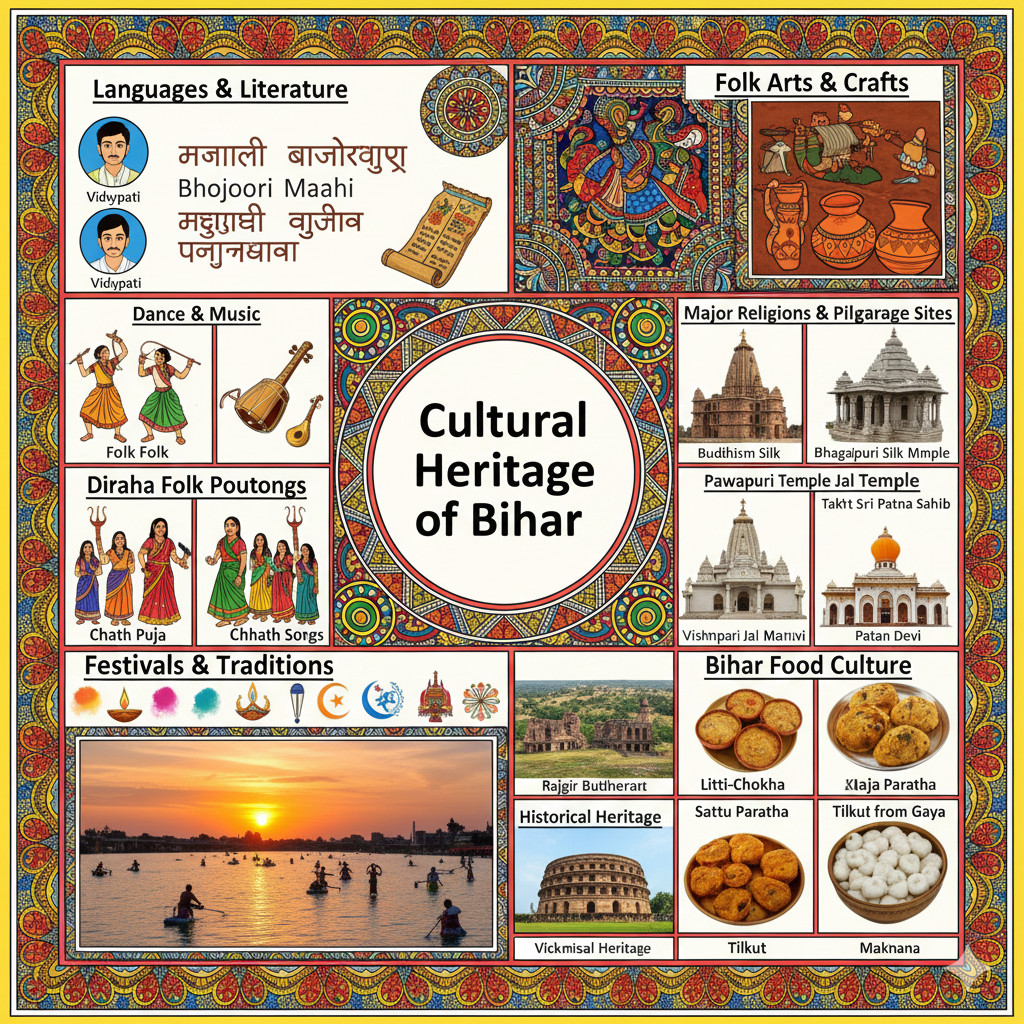
Cultural Heritage of Bihar
Bihar is an integral part of India’s cultural and historical heritage. Its culture has evolved from ancient times to the modern era. The language, art, festivals, religious places, and traditions of Bihar give it a unique and rich identity.
1. Languages and Literature
Languages
- Maithili (included in the 8th Schedule)
- Bhojpuri
- Magahi
- Angika
- Vajjika
Literature
- Vidyapati – Prominent poet of Maithili literature.
- Bhikhari Thakur – Known as the “Shakespeare of Bhojpuri”.
- Saint Tulsidas and Saint Kabir also influenced the literature of Bihar.
2. Folk Arts and Crafts
(a) Mithila Painting (Madhubani Art)
Widely practiced in the Mithila region, this art form uses natural colours, geometric designs and is famous worldwide.
(b) Pottery and Terracotta
Clay crafts and pottery are popular in rural areas of Bihar.
(c) Embroidery and Weaving
Bhagalpuri Silk (Tasar Silk) is popularly known as the “Queen of Silk”.
3. Dance and Music
(a) Folk Dance
- Jhumar: Performed during festivals and special occasions.
- Biraha: Expresses themes of love and separation.
Music
Bihar’s musical tradition includes classical, folk, and devotional music. Popular forms include Chhath songs, Kajri, Sohar, and Bidai songs.
4. religion and Pilgrimage Sites
Bihar has played a major role in shaping Buddhism, Jainism, Hinduism, and Sikhism.
(a) Buddhism
- Mahabodhi Temple (Bodh Gaya): Site where Gautam Buddha attained enlightenment; a UNESCO World Heritage Site.
- Nalanda University: An ancient global centre of education.
(b) Jainism
- Pavapuri: Place of Nirvana of Lord Mahavira.
(c) Hinduism
- Gaya: Known for Pinddaan rituals and ancestral offerings.
- Patan Devi Temple (Patna): One of the Shakti Peethas.
(d) Sikhism
- Takht Sri Harmandir Sahib (Patna Sahib): Birthplace of Guru Gobind Singh Ji.
5. Celebrations and Traditions
(a) Chhath Puja
The biggest festival of Bihar, dedicated to Sun worship. Celebrated with great devotion on riverbanks such as the Ganga.
(b) Other Major Festivals
- Holi
- Dussehra
- Diwali
- Eid
- Sohrai
- Kanwar Yatra
6. Historical and Cultural Sites
(a) Historical Places
- Rajgir: First capital of the Maurya and Gupta empires.
- Vikramshila University: Ancient centre of learning.
(b) Cultural Places
- Golghar (Patna): British-period grain storage structure.
- Mithila Region: Famous for its paintings and folk art.
7. Food
Bihar’s food traditions form an important part of its cultural heritage.
Main Dishes
- Litti-chokha
- Sattu Paratha
- Khaja (famous sweet of Silav)
- Tilkut (Gaya)
8. Folk Traditions and Customs
(a) Marriage Ceremonies
Traditional Maithili and Bhojpuri weddings are known for their unique rituals.
(b) Customs
- In Mithila, Paan and Makhana are used to welcome guests.
- Folk songs like Sohar and marriage songs preserve cultural traditions.
Language and Population of Bihar
Bihar is culturally and linguistically diverse. Its languages and population structure reflect its heritage and diversity.
1. Language
(a) Official Languages
- Hindi: Official language and used for government work and education.
- Urdu: Second official language, widely used in the Muslim community.
(b) Regional Languages

⭐ Editor's Choice
Discover a highly rated product selected for its quality, functionality, and positive customer feedback.
View Details & Reviews →Maithili
- Region: Darbhanga, Madhubani, Samastipur.
- Listed in the 8th Schedule of the Constitution.
- Vidyapati is a famous Maithili poet.
Bhojpuri
- Region: Arrah, Buxar, Saran (Western Bihar).
- Bhojpuri songs and cinema have global recognition.
Magahi
- Region: Gaya, Nawada, Patna (Magadha region).
- Derived from ancient Magadhi language.
Angika
- Region: Bhagalpur, Munger (Ang region).
- Known for its folk songs and literature.
Vajjika
- Region: Vaishali, Muzaffarpur.
- Considered a language between Maithili and Bhojpuri.
(c) Other Languages and Dialects
- Santhali and other tribal languages (tribal areas).
- Punjabi, Bengali, Marathi spoken among migrant communities.
2. Population
(a) Total Population
Approx. 13 crore (2021 estimate). Bihar is the third most populous state in India.
Population Density
About 1,100 persons per sq km — almost three times the national average (382 per sq km).
(b) Rural and Urban Population
- Rural: 89% population; agriculture-dependent.
- Urban: 11% population; major cities include Patna, Gaya, Muzaffarpur.
(c) Population Distribution
- North Bihar: Highly populated (Kosi, Mithila, Seemanchal).
- South Bihar: Relatively lower density.
3. Social Structure
(a) Religion-wise Population
- Hindus: About 82%
- Muslims: About 17%
- Others: Christians, Sikhs, Buddhists, Jains
(b) Caste Structure
- Upper Castes: Brahmin, Bhumihar, Rajput
- OBC: Yadav, Kushwaha, Kurmi
- SC/ST: Chamar, Musahar, Paswan
(c) Sex Ratio
About 918 females per 1000 males. Though lower than the national average, it is improving.
4. Literacy Rate
- Total Literacy: 61.8%
- Male Literacy: 71.2%
- Female Literacy: 51.5%
Initiatives such as Mukhyamantri Balika Cycle Yojana and Sarva Shiksha Abhiyan aim to improve literacy levels.
5. Migration
Due to limited employment opportunities, many people migrate to other states and countries.
Major Destinations
- Uttar Pradesh
- Delhi
- Maharashtra
- Gulf Countries
Migration impacts the economy and social structure of Bihar.
6. Challenges of Population Growth
- High population growth rate compared to other states.
- Pressure on education, healthcare, and employment.
- Limited urbanisation results in lack of basic amenities.

Economy of Bihar
The economy of Bihar is diverse, comprising agriculture, industry, services, trade, and transportation. Although the state’s economy has improved in recent years, several challenges and developmental needs remain.
1. Agriculture and Rural Economy
Agriculture is the largest contributor to Bihar’s economy. About 89% of the population lives in rural areas and depends on agriculture.
(a) Major Agricultural Products
- Paddy: Bihar is one of India’s largest paddy-producing states.
- Sugarcane: Cultivated extensively, especially in Western Bihar.
- Wheat: Suitable yield due to the cold winter climate.
- Maize: Bihar is among the leading maize producers in India.
- Pulses and Oilseeds: Well-cultivated in several districts.
- Fruits & Vegetables: Potato, cabbage, brinjal, tomato, mango, banana, and buttermilk fruit varieties.
(b) Irrigation and Agricultural Methods
- Bihar faces irrigation challenges, especially in North Bihar due to frequent Floods.
- Irrigation facilities: Reservoirs, canals, and modern irrigation projects are being expanded.
- River-based irrigation: Mainly dependent on the Ganga, Kosi, Gandak, and other rivers.
(c) Challenges in Agriculture
- Floods: Annual floods cause crop damage.
- Drought: Weather variability impacts production.
- Traditional methods: Slow adoption of modern agricultural techniques.
2. Industry and Manufacturing
Although progress is visible, Bihar's industrial sector is still developing.
(a) Major Industries
- Food Processing: Rice mills, sugar mills, and agro-processing units.
- Raw Material-Based Industries: Paper, wood products, leather goods, and sugar.
- Textile Industry: Bhagalpuri Silk (Tasar Silk) and traditional textile crafts.
- Mineral Industry: Limited mineral resources, but limestone, marble, and coal are present in some areas.
(b) Industrial Challenges
- Infrastructure gaps: Lack of basic industrial infrastructure.
- Electricity shortage: Inconsistent power supply in industrial zones.
- Low investment: Shortage of large-scale capital investment.
3. Services and Trade
(a) Trade and Commerce
- Trade focuses on agricultural products, textiles, and local handicrafts.
- Major business hubs: Patna, Bhagalpur, Gaya, Madhubani.
- Public Distribution System (PDS) and APMC govern much of the agricultural trade.
(b) Financial Services
- Bihar has branches of nationalised banks and financial institutions.
- Government schemes like Saksham Loan Yojana support economic development.
(c) Tourism and Services
- Buddhist and Jain pilgrimage sites such as Bodh Gaya, Nalanda, Vaishali.
- Growth in religious, historical, educational and medical tourism.
4. Transport and Communication

⭐ Editor's Choice
Discover a highly rated product selected for its quality, functionality, and positive customer feedback.
View Details & Reviews →(a) Road Transport
- Road networks are improving, but some remote areas still lack connectivity.
- National Highways and State Highways connect Bihar to other states.
- Bicycles and motorcycles are common modes of local transport.
(b) Rail Transport
- Bihar has an extensive railway network.
- Major railway hubs: Patna and Muzaffarpur.
- Connected to major trade routes across India.
(c) Air Transport
- Jayaprakash Narayan International Airport (Patna) is the major airport.
- Air services connect Bihar with major Indian cities.
5. Human Resources and Labour
(a) Workers and Labour Force
- Most workers are employed in agriculture and construction.
- A significant number work as migrant labourers in other states and countries.
- Skill development schemes have been launched to improve workforce quality.
(b) Education and Skills
- Efforts are being made to improve education and vocational training.
- Skill Development Centres promote entrepreneurship and employability.
6. Efforts to Develop the Economy
- Government Initiatives: Focus on employment generation, infrastructure development, and agricultural reforms.
- Modern Agricultural Technology: Emphasis on smart agriculture and solar-energy-based schemes to address climate challenges.
- Industry and Investment: Policies like Bihar Industrial Policy and Bihar Investment Summit aim to attract industrial investment.

Tourist Places of Bihar
Bihar is rich in historical, religious, cultural, and natural heritage. The state contains important Buddhist, Hindu, Jain, and Muslim pilgrimage sites. Tourists visit Bihar to explore its ancient History, architecture, spirituality, and natural beauty.
1. Buddhist and Jain Pilgrimage Sites
Bihar is one of the most important regions for Buddhism and Jainism, especially destinations such as Gaya, Bodh Gaya, Nalanda, Rajgir, and Pavapuri.
(a) Bodh Gaya
- The most sacred Buddhist site, where Gautam Buddha attained enlightenment.
- The Mahabodhi Temple is a UNESCO World Heritage Site.
- The Bodhi Tree marks the exact spot of Buddha’s enlightenment.
- Millions of followers and tourists visit annually.
(b) Nalanda
- Home to the ancient Nalanda University, one of the world’s earliest residential universities.
- An important centre for Buddhist learning and intellectual development.
- The ruins of Nalanda still display ancient educational excellence.
- Nearby sites like Son Bhandar Caves, Stupas, and Kumargram ruins are also historically significant.
(c) Vaishali
- One of the oldest republics (Vajji Confederacy) of ancient India.
- A major centre for Buddhism; linked with several events of Buddha’s life.
- Main attractions: Lakshmana Stupa, Great Stupa, Ashoka Pillar.
(d) Rajgir
- Located near Gaya; sacred for both Buddhism and Jainism.
- Important sites: Rajgir Palace, Son Bhandar Caves, Golden Temple.
- Nearby: Vijaygiri Mountain and ancient Nalanda University.
- Gopal Temple and Jain Temples are major attractions.
(e) Pavapuri
- The place where Lord Mahavira attained Nirvana.
- Major sites include the Jal Mandir and Ashtalakshmi Temple.
2. Hindu Pilgrimage Sites
(a) Gaya
- Home to the sacred Vishnupad Temple and Brahmayoni Hills.
- A major site for Pinddaan (ancestral rituals).
- Known as one of the three most sacred Pinddaan destinations—Prayagraj, Kashi, and Gaya.
(b) Patna
- Takht Sri Patna Sahib – Birthplace of Guru Gobind Singh Ji.
- Mahavir Mandir and Siddheshwar Mahadev Temple are significant Hindu temples.
- Buddha Smriti Park and Golghar are major historical sites.
(c) Mokama
- Mokama Ghat is famous for its scenic view.
- The temple of Maa Kali is extremely popular among devotees.
3. Historical Places
(a) Bhagalpur
- Known for its ancient Silk Industry.
- Main sites: Gandhi Maidan, Arrah Fort, Memorial sites.
- Sangrampur Fort and Sonamath are culturally significant.
(b) Muzaffarpur
- Historical locations such as Lichchavi-era remains, Ramnagar Fort.
- Famous for Buddhist sites and old heritage structures.
4. Natural Sites
(a) Udaigiri & Vikramshila Region
- Known for stunning natural landscapes and Buddhist heritage.
- Located near the historic Vikramshila University.
(b) Sultanganj
- Located on the banks of the Ganga river.
- Popular for holy dips and scenic river views.
5. Lakes and Waterfalls
(a) Kiul Falls
- A beautiful waterfall located in Gaya district.
- A popular nature destination.
(b) Lakes Around Patna
- Hammam Talab and several riverine lakes are popular spots.
6. Other Important Sites
(a) Sun Temple (Gaya)
- Dedicated to the Sun God; a popular pilgrimage site.
(b) Sasaram
- Located in Rohtas district.
- Major historical structures: Rohtas Fort and Kumharwar Fort.

⭐ Editor's Choice
Discover a highly rated product selected for its quality, functionality, and positive customer feedback.
View Details & Reviews →Society and Culture of Bihar
The society and culture of Bihar form one of the oldest and richest cultural heritages in the Indian subcontinent. Bihar has been a meeting point of diverse religions, castes, and languages. It is known for its traditions, art, literature, music, festivals, and social customs.
1. Social Structure
(a) Caste System
- Upper Castes: Brahmin, Bhumihar, Rajput
- OBC: Yadav, Kushwaha, Kurmi
- Dalit Castes: Chamar, Musahar, Paswan
- Tribal Communities: Munda, Santhal, and others in southern Bihar
(b) Family Structure
- Traditional joint family system is prevalent.
- Nuclear families are increasing due to urbanisation.
- Senior members play a significant role in family decisions.
(c) Gender Discrimination
- Women traditionally had limited roles, but change is growing.
- Women are increasingly active in education, politics, and employment.
- Government schemes promote women empowerment.
2. Cultural Heritage
(a) Arts and Crafts
- Patna School of Painting: A blend of Mughal and Rajasthani styles.
- Bhagalpuri Silk: A major handicraft produced in Bhagalpur.
- Madhubani Art: A world-famous folk art done by women in Madhubani and Darbhanga regions.
(b) Music and Dance
- Folk Music: Includes Chhath songs, Sohar, folk hymns.
- Classical Music: Dhrupad, Thumri, Dadra traditions.
- Dance Forms:
- Lavani (rural areas)
- Jhumar (tribal communities)
(c) Literature and Language
- Maithili Literature: Inspired by poets like Vidyapati.
- Bhojpuri Literature: Depicts folk life and traditions.
- Magahi Literature: Associated with the ancient Magadha Empire.
- Hindi Literature: Important writers include Jaishankar Prasad, Dinesh Chandra Mallick, and Phanishwar Nath Renu.
3. Religion and Traditions
(a) Major Festivals
- Chhath Puja: The most important festival dedicated to the Sun God.
- Makar Sankranti: Important agricultural festival.
- Eid and Muharram: Celebrated by the Muslim community.
- Holi and Diwali: Celebrated with vibrancy throughout Bihar.
(b) Religious Places
- Bodh Gaya: Most sacred Buddhist pilgrimage site.
- Pavapuri: Major Jain pilgrimage centre.
- Gaya and Patna: Important Hindu religious destinations.
4. Food and Costumes
Food
- Litti-Chokha: The most iconic food of Bihar.
- Sattu: Popular especially in summer.
- Machh-Bhat: Fish and rice—common in many regions.
- Dates & Sesame Laddus: Popular during Makar Sankranti and Chhath Puja.
Costumes
- Men traditionally wear dhoti, lungi, and shirts.
- Women commonly wear sarees.
- Madhubani Sarees and Bhagalpuri Silk Sarees are iconic.