
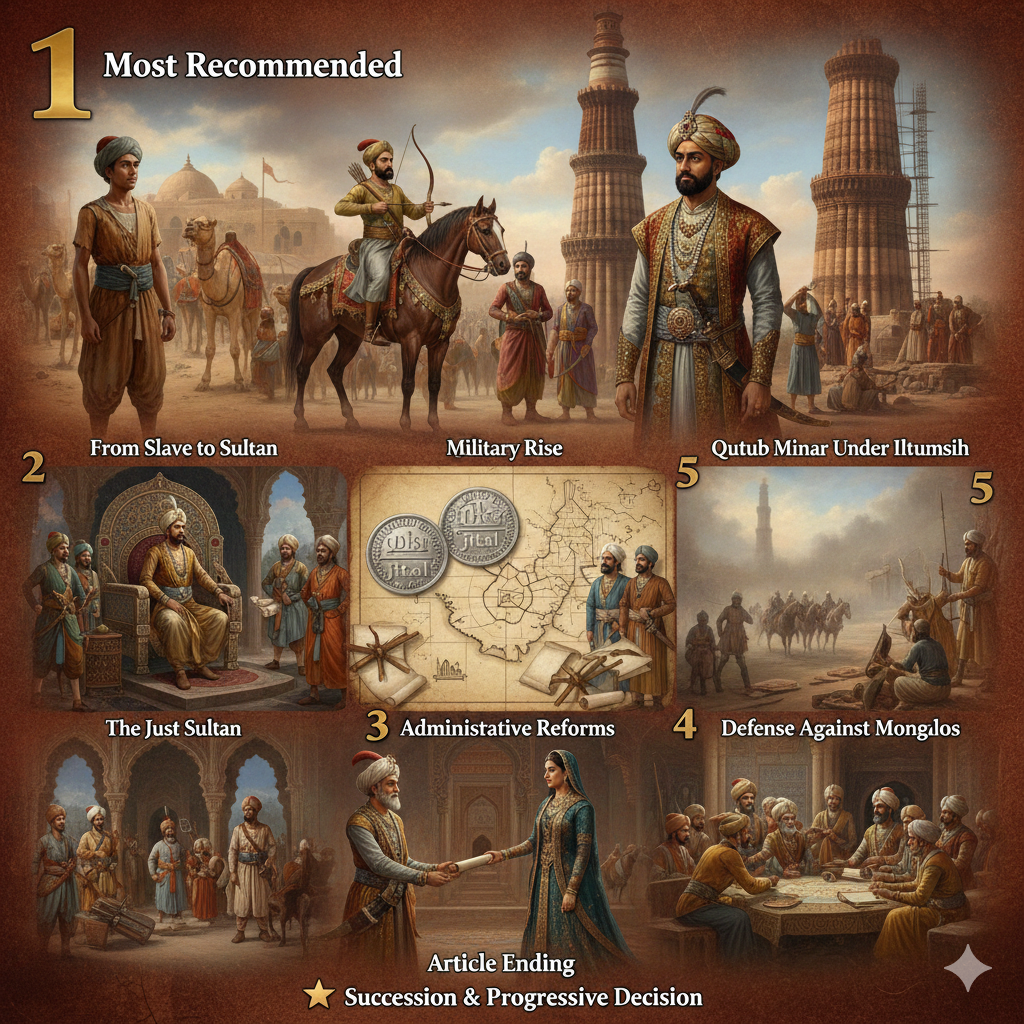
Iltutmish (1211–1236 CE): The Real Founder of the Delhi Sultanate
By Shashi Nehara
Table of Contents
Introduction
How did a slave become one of the greatest rulers of medieval India?
Iltutmish (1211–1236 CE) was the most powerful ruler of the Slave Dynasty and is widely regarded as the real founder of the Delhi Sultanate. Through military strength, administrative reforms and political intelligence, he transformed a weak Sultanate into a stable and centralized empire.
He introduced the iqta system, standardized coinage and strengthened central authority. His reign also witnessed the completion of the Qutub Minar and the expansion of the Delhi Sultanate across North India.
Birth and Early Life
Iltutmish was born into a Turkic family in Central Asia. During his childhood, he was sold into slavery and later brought to India. Despite these hardships, his intelligence, courage and military skills helped him rise rapidly in political and military circles.
Rise Under Qutbuddin Aibak
Qutbuddin Aibak recognized Iltutmish’s talent and appointed him to important administrative and military positions. Over time, Iltutmish became one of Aibak’s most trusted officers and was eventually freed from slavery.
His early struggles shaped him into a disciplined and capable ruler known for administrative efficiency and political wisdom.
Accession to the Throne (1211 CE)
After the death of Qutbuddin Aibak in 1210 CE, political instability spread across the Delhi Sultanate. Aram Shah, who succeeded Aibak, proved to be an ineffective ruler.
The Turkish nobles invited Iltutmish, then governor of Badaun, to assume power. He defeated Aram Shah and became the Sultan of Delhi in 1211 CE.
Challenges Faced by Iltutmish
- Suppression of rebellious governors
- Threat of Mongol invasions under Genghis Khan
- Need for political legitimacy
- Consolidation of the Delhi Sultanate
In 1229 CE, the Abbasid Caliph formally recognized Iltutmish as the Sultan of Delhi and granted him the title “Sultan-e-Azam.”
Administrative Reforms of Iltutmish
Iltutmish introduced several administrative reforms that strengthened the political and economic structure of the Delhi Sultanate.
Iqta System
He organized the iqta system under which land assignments were granted to nobles and military officers in return for administrative and military services. This system improved revenue collection and governance.
Introduction of Coins
Iltutmish introduced standardized coins such as the silver tanka and copper jital. These coins stabilized the economy and encouraged trade across the Sultanate.
Strengthening Central Authority
He brought distant provinces under the direct control of Delhi and reduced the power of rebellious governors. This helped establish a centralized administration.
Political and Military Achievements
Protection Against Mongol Threats
Iltutmish successfully protected the Delhi Sultanate from Mongol invasions through careful diplomacy and strategic policies.
Territorial Expansion
He consolidated the Sultanate by bringing Bengal, Bihar, Sindh and several Rajput territories under his control.
Formation of the Chalisa
Iltutmish formed a group of forty Turkish nobles known as the Chalisa or Turkan-e-Chahalgani. This group assisted in administration and governance.
Architecture and Qutub Minar
Iltutmish made important contributions to Indo-Islamic architecture and completed several significant monuments during his reign.
Completion of Qutub Minar
The Qutub Minar, started by Qutbuddin Aibak, was completed during the reign of Iltutmish. It remains one of the finest examples of early Indo-Islamic architecture in India.
Sultan Garhi Tomb
Iltutmish built the tomb of his son Nasiruddin Mahmud at Sultan Garhi, considered the first Islamic tomb in India.
Death and Succession
Iltutmish died in 1236 CE. Before his death, he chose his daughter Razia Sultan as his successor because of her intelligence and administrative abilities.
Razia Sultan later became the first woman ruler of the Delhi Sultanate.
Legacy of Iltutmish
Iltutmish transformed the Delhi Sultanate from a fragile kingdom into a strong and organized empire. His administrative reforms, military achievements and political vision ensured long-term stability in North India.
“From slavery to the throne of Delhi, Iltutmish’s life remains one of the most inspiring stories in medieval Indian history.”
Why Iltutmish is Important
- Strengthened the Delhi Sultanate
- Introduced silver tanka and copper jital
- Organized the iqta system
- Completed the Qutub Minar
- Protected India from Mongol threats
Quick Revision Table
| Topic | Details |
|---|---|
| Dynasty | Slave Dynasty |
| Reign | 1211–1236 CE |
| Coins Introduced | Silver Tanka and Copper Jital |
| Famous Group | Chalisa |
| Important Monument | Qutub Minar |
| Successor | Razia Sultan |
Frequently Asked Questions (FAQs)
Why is Iltutmish called the real founder of the Delhi Sultanate?
Iltutmish strengthened administration, introduced coinage, suppressed rebellions and established political stability in the Delhi Sultanate.
Which coins were introduced by Iltutmish?
Iltutmish introduced the silver tanka and copper jital.
Who completed the Qutub Minar?
Iltutmish completed the Qutub Minar started by Qutbuddin Aibak.
What was the Chalisa?
The Chalisa was a group of forty Turkish nobles formed by Iltutmish to assist in administration and governance.
Conclusion
Iltutmish was one of the greatest rulers of medieval India. Through administrative reforms, military strength and political wisdom, he laid the foundation of a powerful Delhi Sultanate.
His contributions to administration, currency, architecture and governance left a lasting impact on Indian history, which is why historians regard him as the real founder of the Delhi Sultanate.
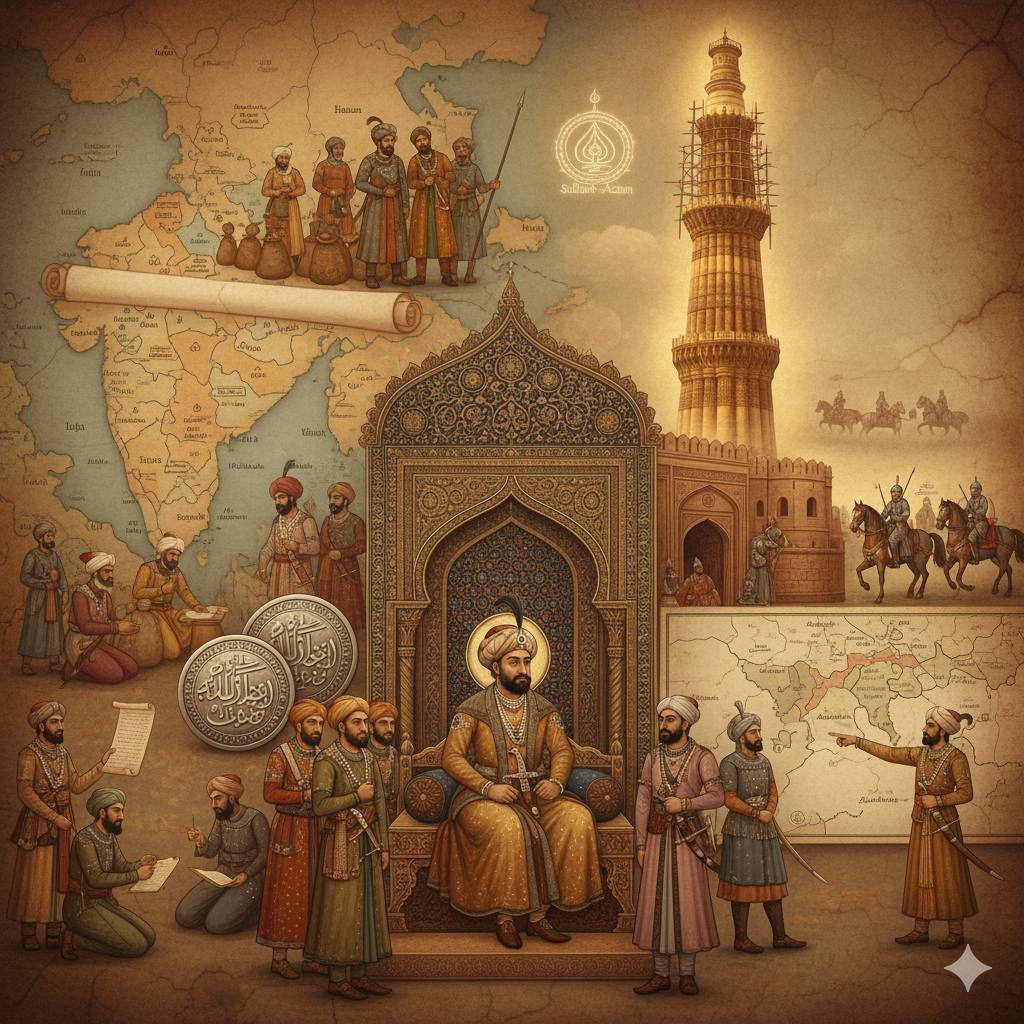
Administrative Reforms of Iltutmish
Iltutmish is regarded as the real founder of the Delhi Sultanate because he established a strong and centralized administrative system. His reforms brought political stability, improved revenue collection and strengthened the military structure of the Sultanate.
1. Organisation of the iqta system
Iltutmish reorganised the Iqta system, a land revenue arrangement in which officers and soldiers received land assignments instead of regular salaries.
- Iqtadars were responsible for collecting revenue and maintaining troops.
- Strict regulations were introduced to prevent misuse of power.
- The system improved administration and strengthened military control.
2. Introduction of Standardised Coinage
To strengthen the economy, Iltutmish introduced a uniform currency system across the Sultanate.
- He issued the silver Tanka and copper Jital.
- These coins promoted trade and economic stability.
- The new currency system became the foundation of the Sultanate’s economy.
3. Strengthening Central Authority
- Iltutmish brought distant provinces under the direct control of Delhi.
- He suppressed rebellious governors and regional rulers.
- This reduced political fragmentation and strengthened central administration.
4. Formation of the Chalisa
Iltutmish formed an influential group of forty Turkish nobles known as the Chalisa or Turkan-e-Chahalgani.
- The Chalisa assisted the Sultan in administration and governance.
- It helped maintain political stability during his reign.
- Although powerful later, it initially strengthened the Sultanate.
5. Judicial and Religious Reforms
- Iltutmish strengthened the justice system based on Islamic law (Sharia).
- Qazis were appointed to oversee judicial and religious matters.
- This created greater uniformity in legal administration.
6. Military and Security Reforms
- Strategic forts were repaired and strengthened to defend the empire.
- The army was reorganised to improve military efficiency.
- Delhi was developed into a secure administrative capital.
7. Recognition from the Abbasid Caliph
- Iltutmish sought recognition from the Abbasid Caliph to legitimize his rule.
- In 1229 CE, he received the title “Sultan-e-Azam.”
- This increased his prestige in the Islamic world.
Impact of Administrative Reforms
- The reforms brought political and economic stability to the Delhi Sultanate.
- They created a centralized and efficient administrative structure.
- Iltutmish strengthened the foundation of the Slave Dynasty.
- His administrative policies influenced later rulers of the Delhi Sultanate.
Political Achievements of Iltutmish
Iltutmish was one of the most capable rulers of medieval India. Through military strength, diplomacy and political intelligence, he transformed the Delhi Sultanate into a powerful and stable empire.
1. Consolidation of the Delhi Sultanate
- Iltutmish declared Delhi as the political center of the Sultanate.
- He strengthened administration and centralized authority.
- His rule transformed the Sultanate into a powerful empire.
2. Suppression of Provincial Revolts
- Several provinces revolted after the death of Qutbuddin Aibak.
- Iltutmish regained control over Bengal, Bihar, Awadh and Sindh.
- Strategic forts like Gwalior and Ranthambore were captured.
3. Campaigns Against Rajput States
- Iltutmish weakened powerful Rajput kingdoms such as Ajmer and Kalinjar.
- He captured important forts including Ranthambore and Mandu.
- These victories strengthened the Sultanate’s territorial control.
4. Protection from Mongol Threats
- During his reign, Genghis Khan pursued Jalaluddin Mangburni into India.
- Iltutmish wisely avoided direct conflict with the Mongols.
- His diplomatic strategy protected North India from invasion.
5. Recognition from the Abbasid Caliph
- In 1229 CE, the Abbasid Caliph formally recognized Iltutmish as Sultan.
- He received the title “Sultan-e-Azam.”
- This enhanced the political legitimacy of the Delhi Sultanate.
6. Strengthening the Slave Dynasty
- Iltutmish provided political stability to the Slave Dynasty.
- His reforms laid the foundation for future rulers.
- He is therefore regarded as the real founder of the Delhi Sultanate.
7. Expansion of the Empire
- He expanded the Sultanate into regions such as Malwa and Central India.
- Trade routes and strategic territories were brought under control.
- This increased the political and economic strength of the empire.
8. Cultural and Architectural Contributions
- Iltutmish completed the construction of the Qutub Minar.
- His reign encouraged the growth of Indo-Islamic architecture.
- Political stability under his rule supported cultural development.

Expansion of the Empire
Iltutmish expanded and strengthened the Delhi Sultanate through military campaigns, diplomacy and administrative reforms. His conquests secured the empire and transformed it into a powerful political force in medieval India.
1. Protection from Mongol Invasions
- During Iltutmish’s reign, the Mongols under Genghis Khan threatened North India in 1221 CE.
- He adopted a diplomatic policy and avoided direct conflict with the Mongols.
- This strategy protected the Delhi Sultanate from a destructive invasion.
2. Control Over North India
- Iltutmish strengthened his authority over the Ganga–Yamuna Doab and Awadh regions.
- Rebellious provinces such as Bihar and Bengal were brought back under Delhi’s control.
- Ali Mardan of Bengal, who had declared independence, was defeated by Iltutmish.
3. Campaigns Against Rajput Rulers
- Iltutmish launched military campaigns against Rajput kingdoms in Rajasthan and Central India.
- He captured important forts such as Ranthambore, Gwalior, Ajmer and Malwa.
- These victories strengthened the Sultanate’s borders and political influence.
4. Control Over Sindh and Multan
- Iltutmish expanded the Delhi Sultanate westward by bringing Sindh and Multan under his authority.
- This expansion improved Trade routes and strengthened strategic control.
5. Influence Over Devagiri
- His influence extended towards parts of South India, especially Devagiri.
- Instead of direct conquest, he preferred indirect political control in southern regions.
6. Strengthening the Boundaries of the Sultanate
- Iltutmish secured the Sultanate through military outposts and strong administration.
- Fortifications and defensive measures protected important regions of the empire.
- These efforts ensured long-term political stability.
Formation of the Chalisa (Turkan-e-Chahalgani)
The Chalisa, also known as Turkan-e-Chahalgani, was a group of forty elite Turkish nobles created by Iltutmish. It played an important role in administration, military affairs and political stability during his reign.
The term Turkan-e-Chahalgani means “Group of Forty Turkish Chiefs.”
Background of the Chalisa
- Iltutmish understood that loyal nobles were necessary for a stable empire.
- Turkish nobles often engaged in rivalry and political conflicts.
- To strengthen central authority, he formed a trusted administrative group.
Structure of the Chalisa
- The Chalisa consisted of forty high-ranking Turkish nobles.
- These nobles were experts in administration and military affairs.
- They remained directly loyal to the Sultan.
Objectives of the Chalisa
- To strengthen the administration of the Sultanate.
- To control rebellious nobles and provincial governors.
- To assist the Sultan in military and political matters.
- To ensure stability within the empire.
Contributions of the Chalisa
Political Stability
- The Chalisa helped maintain stability during Iltutmish’s reign.
- Its members assisted in suppressing rebellions and maintaining order.
Administrative Contribution
- Members of the Chalisa governed important provinces and administrative departments.
- They helped implement the Sultan’s policies throughout the empire.
Military Support
- The Chalisa strengthened the military structure of the Delhi Sultanate.
- Its members supported campaigns in Bengal, Bihar and Rajput territories.
Decline of the Chalisa
- After the death of Iltutmish, the Chalisa gradually became politically powerful.
- During Razia Sultan’s reign, many members opposed her authority.
- Internal rivalries and factionalism weakened the group over time.
- Eventually, the Chalisa lost its importance in Sultanate politics.
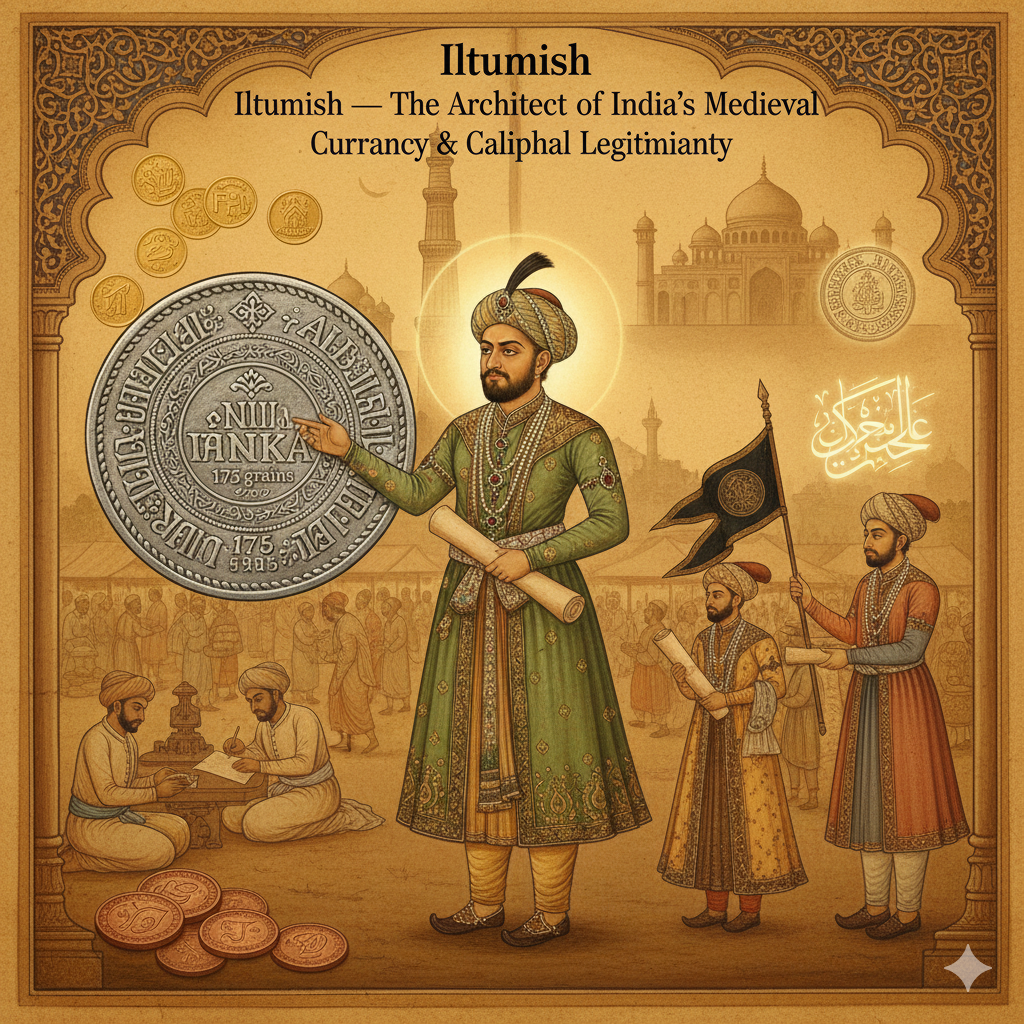
Introduction of Coins by Iltutmish
Iltutmish introduced major reforms in the currency system of the Delhi Sultanate and established a standardized monetary structure. His silver Tanka and copper Jital became the foundation of the Sultanate’s economy and improved trade and administration across the empire.
Background of the Currency Reforms
- Before Iltutmish, there was no uniform currency system in the Delhi Sultanate.
- Different regional and foreign coins circulated in the markets.
- This created confusion in trade, taxation and administration.
Objectives of the New Coinage System
- To establish economic stability in the Sultanate.
- To create a common currency throughout the empire.
- To strengthen trade and commercial activities.
- To gain recognition within the Islamic world.
Major Coins Issued by Iltutmish
1. Silver Tanka
- The Tanka was made of pure silver and weighed about 175 grains (11.66 grams).
- It became the official currency of the Delhi Sultanate.
- The coin carried Quranic inscriptions and the Sultan’s name.
- Its weight and quality matched international Islamic standards.
2. Copper Jital
- The Jital was mainly used for daily transactions and local markets.
- It was affordable and widely used by common people.
- The coin simplified local trade and economic exchange.
3. Gold Dinar
- Iltutmish also issued limited quantities of gold dinars.
- These were mainly used for royal ceremonies and high-value trade.
Features of Iltutmish’s Coins
Islamic Influence
- The coins carried Quranic verses and Arabic inscriptions.
- Names of the Abbasid Caliph were also included to show legitimacy.
Standardized Weight and Size
- The Tanka and Jital had fixed standards of weight and measurement.
- This uniformity increased trust in the currency system.
Symbol of Political Authority
- The Sultan’s name engraved on the coins represented royal authority.
- The coins strengthened the political legitimacy of the Delhi Sultanate.
Impact of the Currency Reforms
- Economic Stability: The reforms strengthened the Sultanate’s economy and improved financial administration.
- Growth of Trade: A common currency increased commercial activities and trade relations.
- Foundation for Future Coinage: The Tanka later influenced Mughal and medieval Indian currency systems.
Recognition of the Caliphate
Recognition from the Abbasid Caliph was one of the most important political and religious achievements of Iltutmish. It strengthened the legitimacy of his rule and increased the prestige of the Delhi Sultanate in the Islamic world.
Background
- In Islamic tradition, the Caliph was regarded as the supreme religious and political authority.
- Recognition from the Caliph symbolized lawful and legitimate rule.
- The Delhi Sultanate faced internal rebellions and political instability during its early years.
Objectives of Iltutmish
- To gain religious legitimacy for his rule.
- To weaken the opposition of rival Turkish nobles.
- To establish the Delhi Sultanate as a recognized Islamic state.
Recognition from the Abbasid Caliph
Sending Envoys to Baghdad
- Iltutmish sent ambassadors to the Abbasid Caliph Al-Mustansir Billah in Baghdad.
- He requested formal recognition of his authority as Sultan of Delhi.
Official Recognition in 1229 CE
- In 1229 CE, the Abbasid Caliph formally recognized Iltutmish.
- He received the title “Sultan-e-Azam” and recognition as a legitimate Islamic ruler.
Symbols of Honor
- The Caliph sent ceremonial gifts including a robe of honor (khilat), flag and sanad.
- These symbols represented political and religious legitimacy.
Importance of Caliphal Recognition
- Religious Legitimacy: Iltutmish’s rule gained recognition according to Islamic traditions.
- Political Stability: Recognition strengthened the Sultan’s authority over nobles and governors.
- International Prestige: The Delhi Sultanate gained respect across the Islamic world.
- Expansion of Influence: The recognition supported diplomatic and trade relations with Central and West Asia.
Impact on the Delhi Sultanate
- The recognition helped Iltutmish consolidate the empire.
- Later Sultans followed the tradition of seeking symbolic approval from the Caliph.
- It strengthened the connection between political power and religious authority.
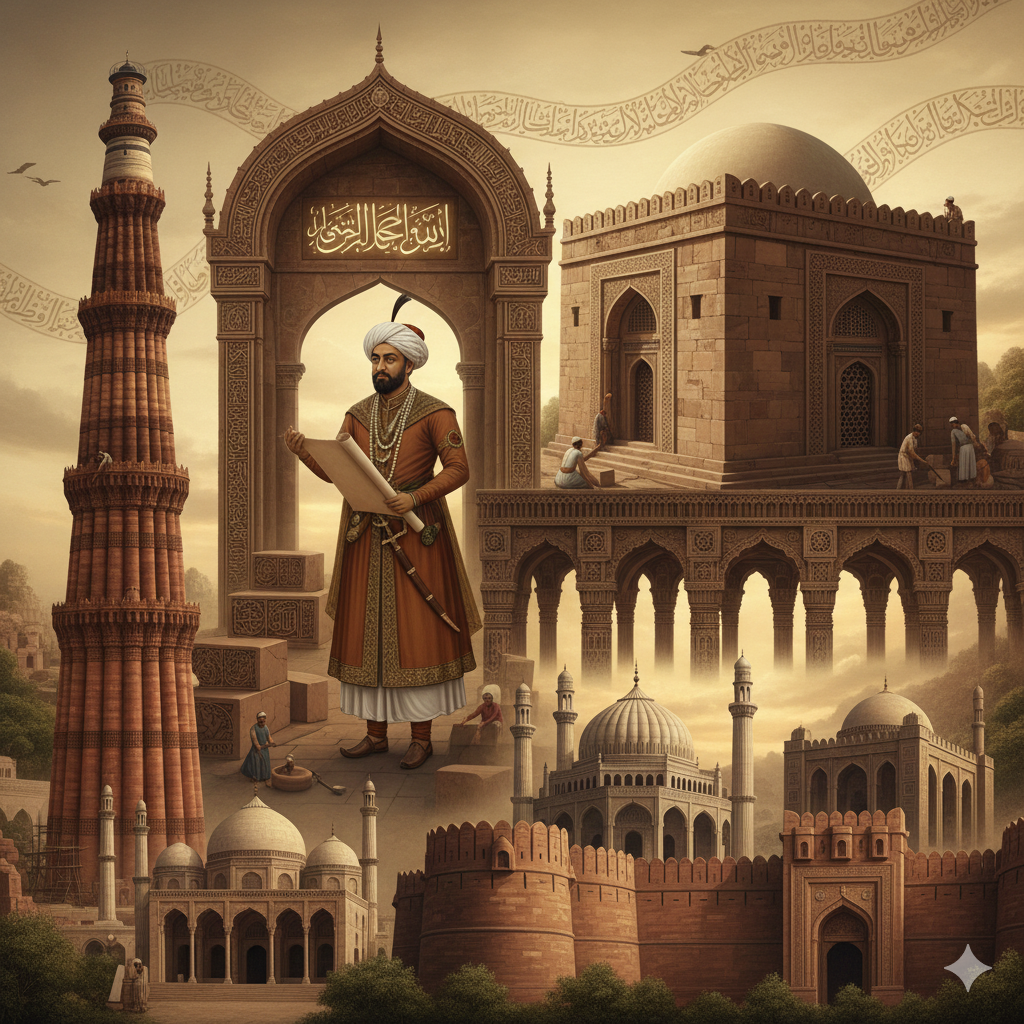
Contribution to Architecture by Iltutmish
The reign of Iltutmish marked an important phase in the development of Indo-Islamic architecture in India. He strengthened the architectural foundations of the Delhi Sultanate by constructing mosques, tombs, forts, and monumental structures that combined Turkish Islamic styles with Indian craftsmanship.
1. Completion of the Qutub Minar
- The famous Qutub Minar was completed during the reign of Iltutmish.
- Its construction was started by Qutbuddin Aibak but remained unfinished.
- Iltutmish completed additional storeys around 1220 CE.
- The monument became a symbol of Islamic authority and architectural excellence.
2. Construction of Sultan Garhi Tomb
- In 1231 CE, Iltutmish built the tomb of his son Nasiruddin Mahmud.
- The structure, known as Sultan Garhi, is considered the first Islamic tomb in India.
- It beautifully combines Hindu and Islamic architectural elements.
3. Construction of Mosques
- Iltutmish built several mosques across the Sultanate.
- These mosques featured arches, domes, minarets, and Quranic inscriptions.
- Arabic calligraphy and geometric designs became prominent architectural features.
4. Use of Hindu and Jain Architectural Elements
- Many monuments reused pillars and stones from earlier Hindu and Jain temples.
- This fusion created a unique Indo-Islamic architectural style.
- The Qutub complex is one of the best examples of this cultural blend.
5. Construction of Forts and Administrative Buildings
- Iltutmish constructed forts and palaces across strategic regions.
- These structures strengthened military security and administrative control.
- The architecture reflected royal authority and political stability.
Architectural Features During Iltutmish’s Reign
Blend of Turkish and Indian Styles
- Turkish features like domes and arches were combined with Indian carvings and pillars.
Arabic Inscriptions
- Monuments were decorated with Quranic verses and Arabic calligraphy.
Development of Domes and Arches
- Iltutmish’s period improved the engineering of arches and domes.
- These techniques later influenced Mughal architecture.
Religious and Political Importance
- The structures served both religious and administrative purposes.
Importance of Iltutmish’s Architecture
- Foundation of Indo-Islamic Architecture: His monuments established the base for future Sultanate and Mughal architecture.
- Cultural Blend: His buildings reflected harmony between Indian and Islamic artistic traditions.
- Symbol of Power: The monuments represented the strength and stability of the Delhi Sultanate.
Qutub Minar – Symbol of the Delhi Sultanate
The Qutub Minar is one of the most famous historical monuments in India and an outstanding example of early Indo-Islamic architecture. Construction began under Qutbuddin Aibak and was completed by Iltutmish. Today, it is recognized as a UNESCO World Heritage Site.
history of Qutub Minar
Beginning of Construction
- Construction started in 1193 CE under Qutbuddin Aibak.
- The monument symbolized the establishment of Muslim rule in Delhi.
- It was originally called “Qutb Minar-e-Islam”.
Completion by Iltutmish
- Iltutmish completed additional storeys of the minar.
- He also enhanced its architectural beauty with inscriptions and decorative patterns.
- Later, Firoz Shah Tughlaq repaired damaged sections.
Architectural Features of Qutub Minar
Height and Structure
- The monument stands at approximately 72.5 meters (238 feet).
- It consists of five distinct storeys with projecting balconies.
Construction Material
- The lower portions are built mainly with red sandstone.
- Upper sections include marble and sandstone.
Decorative Elements
- The walls contain Quranic inscriptions and floral carvings.
- Geometric patterns reflect Turkish Islamic art.
Nearby Structures
- The famous Iron Pillar stands near the Qutub complex.
- Several ancient mosques and gateways surround the monument.
Suggested Image Alt Text: "Qutub Minar built during Delhi Sultanate under Iltutmish"
Purpose of Qutub Minar
Religious Purpose
- The minaret was used for the adhan (Islamic call to prayer).
- It symbolized the spread of Islam in North India.
Political Purpose
- It represented the political dominance of the Delhi Sultanate.
- The structure became a symbol of victory and authority.
Importance of Qutub Minar
- Architectural Masterpiece: One of the finest examples of Indo-Islamic architecture.
- UNESCO World Heritage Site: Recognized globally for its cultural significance.
- Tourist Attraction: Millions of visitors explore the monument every year.
- Historical Legacy: It reflects the rise and consolidation of the Delhi Sultanate.
Safety and Restoration
- The Qutub Minar was built with thick internal walls for stability.
- It has survived earthquakes and natural damage through multiple restorations.
Succession and Death of Iltutmish
The succession and death of Iltutmish marked an important turning point in the history of the Delhi Sultanate. His death created a power vacuum that led to political instability and internal struggles within the empire.
Succession
No Clear Successor
- Iltutmish did not clearly appoint any one of his sons as his successor during his lifetime.
- He had several sons, including Nasiruddin Mahmud, Ruknuddin Firuz, and others.
- He preferred that only a capable ruler should succeed him to maintain stability.
Ruknuddin Firuz’s Brief Rule
- After Iltutmish’s death, his son Ruknuddin Firuz briefly came to power.
- However, he proved to be an inefficient ruler and failed to control the administration.
- His rule led to widespread disorder and weakened central authority.
Rise of Razia Sultan
- Due to Ruknuddin’s failure, the nobles removed him from power.
- Razia Sultan, daughter of Iltutmish, was then placed on the throne.
- She became the first and only female ruler of the Delhi Sultanate.
Death of Iltutmish
- Iltutmish died in 1236 CE.
- His death marked the beginning of a period of political instability.
- Power struggles among nobles increased after his demise.
Condition of the Sultanate After His Death
- The central authority weakened significantly after his death.
- Nobles and military chiefs began to gain more influence.
- The empire faced internal conflicts and succession crises.
- Later rulers struggled to restore the stability created by Iltutmish.
Significance of His Rule
- Iltutmish is regarded as the real organizer of the Delhi Sultanate.
- He strengthened administration, currency, military, and governance systems.
- His reforms laid the foundation for future rulers of the Sultanate.
- His reign is considered one of the most stable phases of early medieval India.
Conclusion
Iltutmish’s reign represents a defining phase in the history of the Delhi Sultanate. He successfully transformed a weak and fragmented state into a stable and organized empire.
His achievements in administration, military organization, and diplomacy made him one of the most important rulers of early medieval India.
The introduction of the iqta system, standardized currency (Tanka and Jital), and central authority reforms strengthened the economic and political structure of the Sultanate.
His architectural contributions, especially the completion of the Qutub Minar, marked the beginning of Indo-Islamic architectural tradition in India.
Although his death led to instability, the foundation laid by Iltutmish continued to shape the Delhi Sultanate for generations.
For these reasons, Iltutmish is rightly regarded as the true founder and consolidator of the Delhi Sultanate.
References
- Satish Chandra, Medieval India: From Sultanat to the Mughals (1206–1526)
- R.C. Majumdar (ed.), The Delhi Sultanate
- Ishwari Prasad, History of Medieval India
- Encyclopaedia Britannica – “Iltutmish”
- Irfan Habib, Medieval India: The Study of a Civilization
- Peter Jackson, The Delhi Sultanate: A Political and Military History
1. Why is Iltutmish called the real founder of the Delhi Sultanate?
Iltutmish is called the real founder of the Delhi Sultanate because he transformed a weak and unstable kingdom into a strong, centralized empire through administrative reforms, military victories, and effective governance.
2. Which administrative system was introduced by Iltutmish?
Iltutmish reorganized the iqta system, under which land revenues were assigned to nobles and military officers in exchange for administrative and military services.
3. Which coins were introduced by Iltutmish?
Iltutmish introduced the Silver Tanka and Copper Jital, creating a standardized currency system that promoted trade and economic stability across the Delhi Sultanate.
4. What was the Chalisa or Turkan-e-Chahalgani?
The Chalisa was a group of forty elite Turkish nobles formed by Iltutmish to assist in administration, military affairs, and governance of the Delhi Sultanate.
5. How did Iltutmish protect India from the Mongol threat?
Iltutmish used diplomatic policies and avoided direct confrontation with Genghis Khan, successfully protecting the Delhi Sultanate from Mongol invasions.
6. What were the architectural contributions of Iltutmish?
Iltutmish completed the Qutub Minar, built the Sultan Garhi Tomb, and promoted Indo-Islamic architecture through the construction of mosques, tombs, and administrative buildings.
7. who succeeded Iltutmish after his death?
After Iltutmish's death in 1236 CE, his daughter Razia Sultan eventually became the ruler of Delhi, making her the first and only female Sultan of the Delhi Sultanate.