
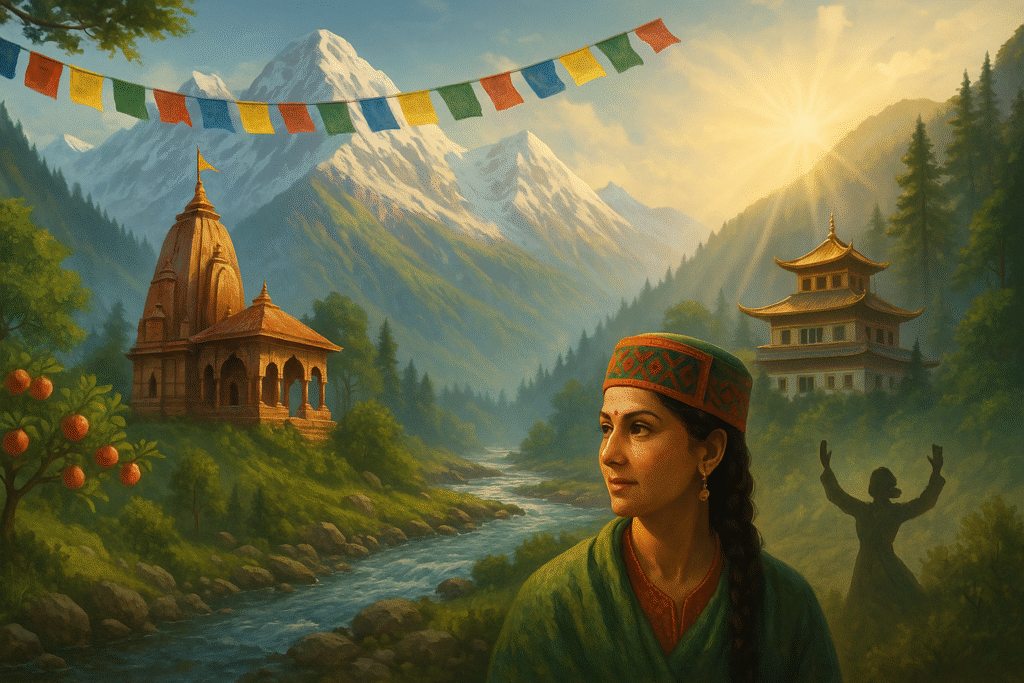
Himachal Pradesh – My Understanding of Devbhoomi, Nature, Culture, and Spirituality
Himachal Pradesh, a beautiful hill state in northwestern India, has always inspired me. Popularly known as “Devbhoomi” — the land of the gods — this region is blessed with ancient temples, sacred sites, peaceful landscapes, and a rich spiritual aura. Its lush green mountains, snow-capped peaks, rivers, and welcoming culture have made it one of India’s most cherished destinations.
Key Information About Himachal Pradesh
Capital Cities
- Summer Capital: Shimla
- Winter Capital: Dharamsala
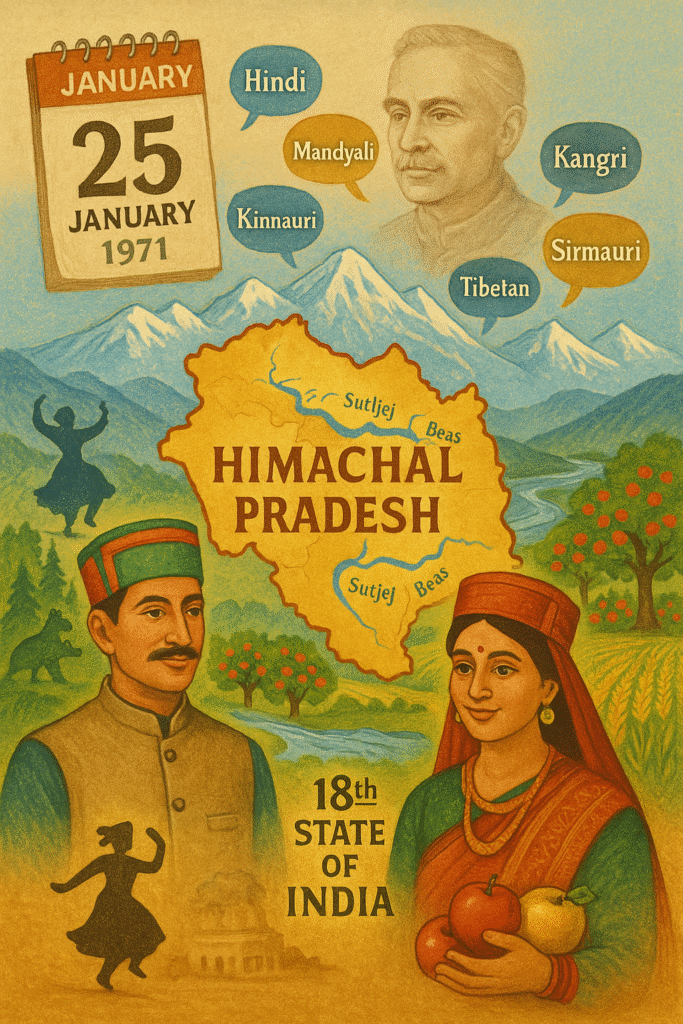
Establishment: Himachal Pradesh became a full state on 25 January 1971.
Language: Hindi (official), with several Pahari dialects also spoken widely.
Major Tourist Destinations
- Shimla: Famous for snowfall and colonial architecture.
- Manali: Known for adventure sports and scenic beauty.
- Dharamsala & McLeodganj: Home to Tibetan culture and the Dalai Lama.
- Kasauli, Kufri, Spiti Valley, and Kinnaur are also very popular.
Culture and Festivals
- Folk Dance: Nati is widely popular.
- Major Festivals: Dussehra, Shivaratri, and Losar.
natural resources
- Important rivers such as the Beas, Sutlej, and Ravi originate here, supporting irrigation and hydroelectric projects.
- Himachal Pradesh is India’s leading apple producer.
Devbhoomi – The Spiritual Heritage
In India, regions with deep religious, mythological, and spiritual significance are known as “Devbhoomi.” Himachal Pradesh fits this description perfectly. Every valley, peak, and river here carries a story, a deity, or a centuries-old tradition.
Why Himachal Pradesh Is Called Devbhoomi
1. Ancient Temples
Himachal hosts many historical temples, including:
- Jwalamukhi Temple (Kangra)
- Naina Devi Temple (Bilaspur)
- Chintapurni Temple
- Bhimakali Temple (Sarahan)
- Bajreshwari Devi Temple (Kangra)
2. Mythological Importance
Many Hindu scriptures and Puranas mention this region. The mountains of Himachal appear in stories from the Mahabharata and Ramayana.
3. Shakti Peethas
Several Shakti Peethas dedicated to Goddess Durga are located across the state.
4. Yoga & Meditation
Its peaceful Himalayan environment makes Himachal ideal for yoga, meditation, and spiritual retreats. Dharamsala and McLeodganj are leading global meditation hubs.
5. Nature & Spirituality Together
The blend of mountains, rivers, forests, and sacred sites gives Himachal a divine atmosphere. People visit to seek peace, clarity, and inner balance.
Uttarakhand – Another Devbhoomi of India
Like Himachal, Uttarakhand is also known as Devbhoomi because it hosts the sacred Char Dham — Kedarnath, Badrinath, Gangotri, and Yamunotri, along with Haridwar and Rishikesh.
Major Religious Places of Uttarakhand
- Haridwar and Rishikesh
- Kedarnath, Badrinath, Gangotri, Yamunotri
- Hemkund Sahib (a holy Sikh pilgrimage site)
Common Features of Devbhoomi Regions
- Spiritual Significance: Peaceful environments perfect for meditation and prayer.
- Mythology: Deep connections to Hindu scriptures and epics.
- Tourism & Pilgrimage: Millions of visitors seek blessings and natural beauty each year.

⭐ Editor's Choice
Discover a highly rated product selected for its quality, functionality, and positive customer feedback.
View Details & Reviews →Capital Cities of Himachal Pradesh
The capitals of Himachal carry administrative, political, and cultural importance.
Shimla – The Summer Capital
Location
Situated in the Shivalik hills at an altitude of about 2,276 meters.
Historical Importance
- Declared the summer capital of India during British rule in 1864.
- Still rich in colonial heritage.
Major Landmarks
- Mall Road
- The Ridge
- Jakhu Temple
- Kufri
- Indian Institute of Advanced Study
Climate
- Summer: Pleasant (15°C to 30°C)
- Winter: Snowfall is common
Tourism Significance
Millions of tourists visit Shimla every year for its forests, mountains, and charming climate.
Dharamsala – The Winter Capital
Location & Climate
Located in the Kangra district at 1,457 meters above sea level. Winter temperatures range between 0°C and 10°C.
Political Importance
- Became the winter capital of Himachal Pradesh in 2017.
- The winter session of the Legislative Assembly is held here.
Religion & Culture
Dharamsala is a major center of Tibetan culture and is home to the Dalai Lama (in McLeodganj).
Major Landmarks
- McLeodganj – Known as “Little Lhasa”
- Namgyal Monastery
- Dhauladhar Hills
- Bhagsunag Temple & Waterfall
- Kangra Fort
Tourism & Experience
- Snowfall during winter
- Popular for trekking, nature walks, yoga, and meditation
- Famous Tibetan dishes including Momos and Thukpa
Dharamsala offers a peaceful blend of nature, spirituality, and cultural diversity, attracting travelers from across the world.
Language of Himachal Pradesh
The language landscape of Himachal Pradesh reflects its rich cultural and linguistic diversity. The primary language of the state is Hindi, which serves as the official language. Along with Hindi, various Pahari languages and regional dialects are spoken widely across different districts.
Main Languages of Himachal Pradesh
⭐ Editor's Choice
Discover a highly rated product selected for its quality, functionality, and positive customer feedback.
View Details & Reviews →1. Hindi
- Hindi is the official and most widely spoken language of Himachal Pradesh.
- It is used extensively in government Administration, education, and official communication.
2. Pahari Languages
Pahari languages represent the cultural identity of the state. These languages belong to the Indo-Aryan language family. Different regions have their own distinct Pahari dialects, such as:
- Mandyali – spoken in the Mandi region
- Kangri – spoken in Kangra district
- Kinnauri – spoken in Kinnaur region
- Chambyali – spoken in Chamba district
- Sirmauri – spoken in Sirmour region
3. Tibetan Language
In areas like Dharamshala and McLeodganj, the Tibetan language is widely used due to the large Tibetan community living there. These regions are also global centers of Tibetan culture.
4. Kinnauri and Bhotiya Languages
These languages are primarily spoken in the districts of Kinnaur and Lahaul-Spiti. They show strong influence from the Tibeto-Burman language family.
Importance of Linguistic Diversity
- The linguistic variety of Himachal Pradesh reflects its deep cultural heritage.
- Every district has its own unique dialect, accent, and style of communication.
- Folk songs, storytelling traditions, and folk tales are also preserved and narrated in these regional languages.
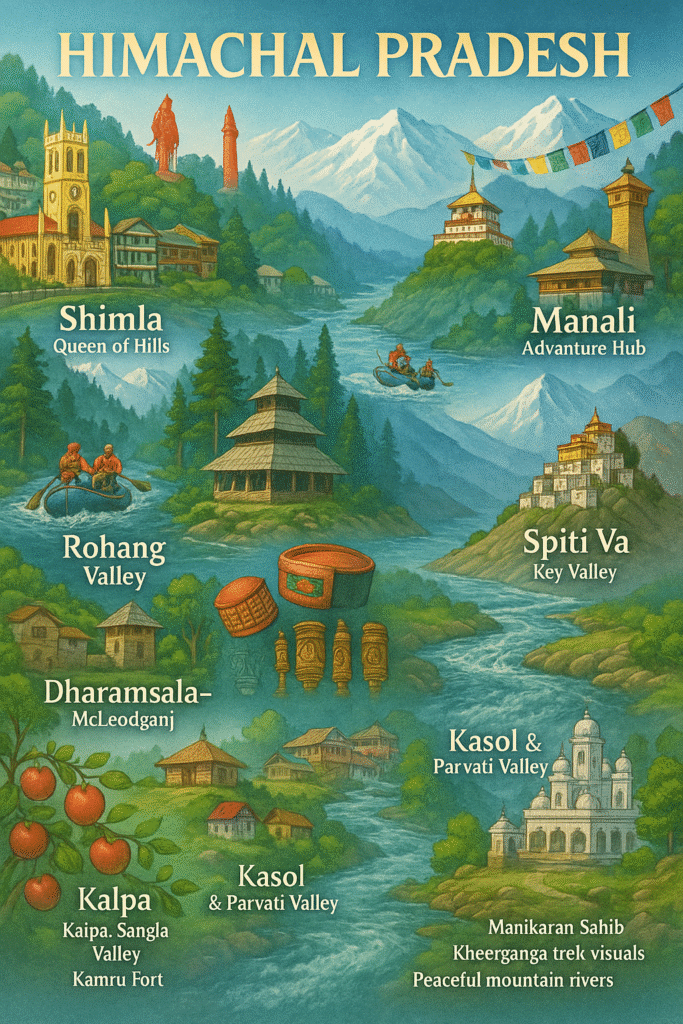
Major Tourist Spots of Himachal Pradesh
Himachal Pradesh is one of India’s most popular tourist destinations, known for its natural beauty, religious heritage, and adventure activities. Its snow-covered peaks, dense forests, waterfalls, and peaceful surroundings attract millions of tourists every year.
Top Tourist Places in Himachal Pradesh
1. Shimla
Speciality: Capital city, colonial architecture
- Ridge Ground
- Mall Road
- Jakhu Temple
- Kufri (snow sports)
- Christ Church
2. Manali
Speciality: Honeymoon destination and adventure sports
- Solang Valley
- Rohtang Pass
- Hidimba Devi Temple
- Vashisht Hot Water Springs
3. Dharamsala & McLeodganj
Speciality: Tibetan culture and religion
- Dalai Lama’s Residence
- Namgyal Monastery
- Bhagsunag Waterfall
- Triund Trek
4. Kangra
Speciality: Historical and religious places
- Kangra Fort
- Bajreshwari Devi Temple
- Masroor Rock Cut Temple
5. Kasol & Parvati Valley
Speciality: Trekking and peaceful environment
- Kheerganga Trek
- Tosh Village
- Manikaran Sahib (Gurudwara & hot springs)
6. Spiti Valley
Speciality: Cold desert, Tibetan culture
- Key Monastery
- Chandratal Lake
- Kaza
- Pin Valley National Park
7. Kinnaur
Speciality: Peaceful villages and religious sites
- Kalpa
- Sangla Valley
- Kamru Fort
8. Chamba & Dalhousie
Speciality: Natural beauty and British architecture
- Khajjiar (Mini Switzerland)
- Chamunda Devi Temple
- Panchpula
9. Bilaspur
Speciality: Lakes and dams
- Bhakra Nangal Dam
- Naina Devi Temple
10. Solan
Speciality: Mushroom city and monasteries
- Shoolini Devi Temple
- Karol Tibba
Adventure Tourism in Himachal Pradesh
- Trekking: Triund, Kheerganga, Hamta Pass
- River Rafting: Beas and Sutlej rivers
- Paragliding: Bir-Billing
- Skiing: Kufri and Narkanda
Shimla – Queen of Hills
Shimla, the capital of Himachal Pradesh, is known as the “Queen of Hills.” Famous for its cool climate, green mountains, and colonial architecture, Shimla is one of India’s top tourist destinations.
Important Information About Shimla
Location
- Situated at an altitude of 2,276 meters above sea level
- Located among the Shivalik hills
history
- Declared the Summer Capital of British India in 1864
- Its colonial charm still remains intact
Climate
- Summer: Pleasant (15°C to 30°C)
- Winter: Cold with snowfall (0°C to –7°C)
Major Tourist Places in Shimla
1. Ridge Ground
- Main attraction of Shimla
- Offers stunning views of the mountains
- Christ Church and Shimla Library are located here
2. Mall Road
- Shopping, food, and sightseeing
- Popular for handicrafts, woollens, and local textiles
3. Jakhu Temple
- Dedicated to Lord Hanuman
- Located on Shimla’s highest peak
- Has a 108-feet tall Hanuman statue
4. Kufri
- Located 16 km from Shimla
- Famous for skiing and snow adventure activities
- Horse riding and trekking are popular here
5. Indian Institute of Advanced Study (IIAS)
- Former residence of British Viceroys
- Now a major research institute
6. Tara Devi Temple
- Located on a hilltop
- Offers a panoramic view of Shimla
7. Chadwick Falls
- Perfect for nature lovers
- Located a short distance from the city
Adventure Activities in Shimla
- Trekking: Jakhu and Kufri Trek
- Ice Skating: Asia’s oldest open-air rink
- Paragliding and camping
How to Reach Shimla
- Rail: Kalka–Shimla Toy Train (UNESCO World Heritage Site)
- Road: Direct buses and taxis from Delhi and Chandigarh
- Air: Shimla Airport (Jubbarhatti), 22 km from the city
Manali – The Adventure Hub
Manali is a major tourist destination famous for its snow-covered mountains, natural beauty, and adventure sports. It is especially popular among honeymooners and thrill-seekers.
Key Information About Manali
Location
- Situated at 2,050 meters (6,726 ft)
- Located along the Beas River in the Kullu Valley
Climate
- Summer (March–June): 15°C to 25°C
- Winter (Nov–Feb): Snowfall with temperatures dropping to -10°C
Importance
Manali is a major center for honeymoon tourism, trekking, skiing, river rafting, paragliding, and many adventure activities.
Major Tourist Places in Manali
1. Solang Valley
Famous for skiing, paragliding, and snowboarding.
2. Rohtang Pass
Located 51 km from Manali at an altitude of 3,978 meters. Ideal for snow activities.
3. Hadimba Devi Temple
Dedicated to Hidimba Devi, surrounded by deodar forests.
4. Kasol & Manali Route
Ideal for peaceful stays, camping, and river rafting.
5. Vashisht Hot Water Springs
Natural hot springs with religious significance.
6. Beas River
Perfect for river rafting and scenic views.

⭐ Editor's Choice
Discover a highly rated product selected for its quality, functionality, and positive customer feedback.
View Details & Reviews →7. Naggar Fort
A historic fort offering beautiful valley views.
Adventure Activities in Manali
- Skiing: Solang Valley, Rohtang Pass
- River Rafting: Beas River
- Trekking: Hamta Pass, Solang Valley
- Paragliding: Solang Valley, nearby sites
How to Reach Manali
- Rail: Nearest stations – Kullu (125 km), Jammu (350 km)
- Road: Direct buses and taxis from Delhi & Chandigarh
- Air: Bhuntar Airport (50 km)
Residence of the Dalai Lama & Tibetan Culture
The residence of the Dalai Lama and the heart of Tibetan culture is located in McLeodganj, near Dharamsala. This area is a global center for Tibetan Buddhism, peace, and Meditation.
Dalai Lama’s Residence – McLeodganj
Centre of Tibetan Culture
- McLeodganj is also called “Little Lhasa.”
- Home to the Tibetan refugee community and headquarters of the Dalai Lama.
Dalai Lama’s Residence
- The Dalai Lama settled here after his exile in 1959.
- The Tsuglagkhang Complex houses his residence and religious activities.
Religious & Cultural Importance
- Major center for Buddhist studies, meditation, and teachings.
- Monasteries promote Tibetan language, literature, and art.
Tibetan Culture & Traditions
Tibetan Buddhism
Monasteries and Spiritual teachings shape the cultural identity of the region.
Major Monasteries
- Namgyal Monastery
- Kangra Monastery
- Rekong Peo Monastery
Tibetan Food
- Momos
- Thukpa
- Butter Tea
- Shabhaley
Traditional Arts & Crafts
- Thangka paintings
- Tibetan pottery
- Woollen garments
- Buddhist statues & calligraphy
Tibetan Festivals
- Losar: Tibetan New Year
- Cultural programs and festivals at monasteries
Influence of the Dalai Lama
The Dalai Lama’s teachings on peace, non-violence, and compassion have made Dharamsala an international spiritual destination.
Kasauli, Kufri, Spiti Valley & Kinnaur
1. Kasauli
- Located in Solan district at 1,927 meters altitude
- Known for its peaceful environment and British-era charm
Major Attractions
- Solani Khad
- Kasauli Club
- Kasauli Church
- Himalayan Botanical Garden
2. Kufri
- Located 16 km from Shimla
- Famous for snow activities and winter sports
Major Attractions
- Kufri Lake
- Kufri Ski Resort
- Fun & Adventure Park
3. Spiti Valley
- Located in Lahaul-Spiti district at 3,500 meters
- A cold desert and center of Tibetan Buddhism
Major Attractions
- Key Monastery
- Chandratal Lake
- Kaza
- Langza Village
4. Kinnaur
- Located in eastern Himachal at 2,500 meters altitude
- Famous for natural beauty & religious culture
Major Attractions
- Kalpa
- Sangla Valley
- Kamru Fort
- Badrinath (local Vishnu temple)
Best Time to Visit
- Kasauli & Kufri: March–June & November–February
- Spiti Valley: May–October
- Kinnaur: Summer is ideal; winter also sees snowfall
Culture and Festivals of Himachal Pradesh
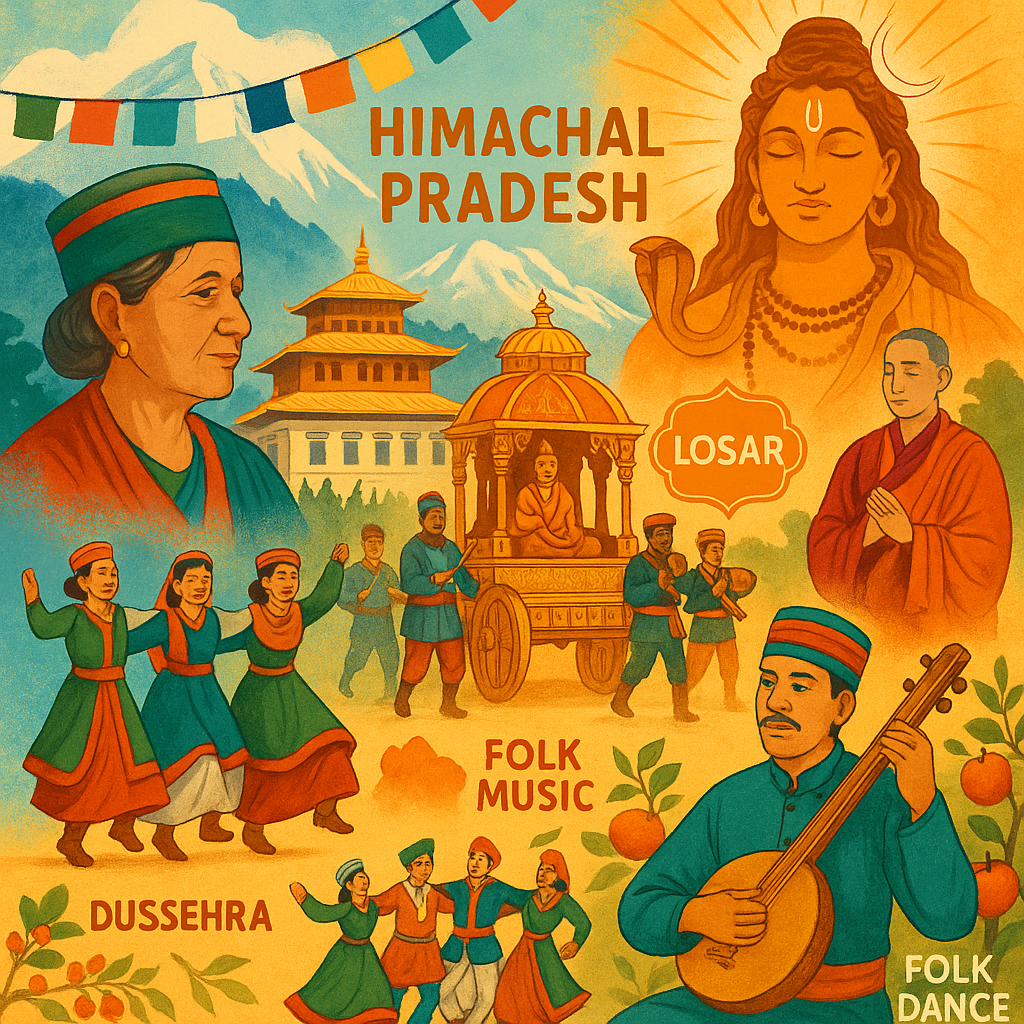
The culture of Himachal Pradesh is a beautiful blend of diversity, traditional lifestyle, and religious beliefs. Deeply rooted in hill life, nature, and Spirituality, the state is home to various castes, languages, traditions, and customs. Its festivals reflect religious devotion, local music, folk dance, and colorful attire—making Himachal’s cultural heritage vibrant and unique.
Culture of Himachal Pradesh
Languages
Many languages are spoken across Himachal Pradesh, including Hindi, Punjabi, Kullvi, Kangri, Mandi, Himachali, and Tibetan. Hindi is the official language of the state, but regional dialects flourish across various districts.
Religion and Spirituality
Himachal Pradesh is predominantly a Hindu-majority state. However, followers of Buddhism, Sikhism, and Islam also live here. Tibetan cultural influence is especially visible in Dharamsala and McLeodganj, where the Dalai Lama resides. The state has numerous temples, monasteries, and gurdwaras that serve as important religious and cultural landmarks.
Art and Craft
- Kullu Shawls
- Kangra Paintings
- Himachali Handicrafts
- Tibetan Clothing & Crafts
Handmade beads, woollen garments, and woodcraft items are also popular. Kangra paintings are among the oldest and most refined art styles of India, originating from the Kangra region.
Music and Dance
Music and dance are integral to Himachal’s cultural heritage. Traditional instruments like the violin, sanduri, drums, and clarinet are commonly used. popular dance forms include Nautanki, Lahuli Dance, Kullvi Dance, and Bhagat Dance.
Major Festivals of Himachal Pradesh
Kullu Dussehra
Time: September–October
Kullu Dussehra is the most important and grand festival of Himachal Pradesh. Unlike other places where Ravana is burnt, here the festival revolves around the worship of gods and goddesses. A grand Rath Yatra is organized, and beautifully decorated chariots of various deities are taken out in a massive procession. Traditional dance, folk music, and rituals fill the entire valley with celebration.
Lohri
Date: 13 January
Lohri marks the end of winter. People gather around bonfires, perform folk dances, and offer peanuts, sesame, and jaggery to the fire. It symbolizes prosperity, happiness, and the beginning of the harvest season.
Maghi Purnima
Date: January–February
Celebrated mainly in the Kangra and Chamba regions, this festival involves holy dips in rivers and prayers. It symbolizes renewal, peace, and the strengthening of relationships.
Shivaratri
Date: February–March
Shivaratri is celebrated with devotion across Himachal, especially in Mandi, Kangra, and Kullu. Devotees observe fasts, perform night-long prayers, and visit Shiva temples. The Mandi Shivratri Fair is one of the most popular religious gatherings.
Baisakhi
Date: 13 April
Celebrated as the harvest festival, Baisakhi marks the beginning of a new agricultural cycle. It is especially significant in Kangra and Una districts.
Losar (Tibetan New Year)
Date: February–March
Losar is an important Tibetan festival celebrated in McLeodganj and Dharamsala. It marks the Tibetan New Year and includes traditional dances, prayers, music, and special Tibetan dishes. Tibetan monasteries organize grand events and rituals.
Conclusion
The culture of Himachal Pradesh is a harmonious blend of traditions, beliefs, art, music, and festivals. The rich cultural expressions of the people, combined with colorful celebrations, truly reflect the unity and joy of Himachali society.
Folk Music and Dance of Himachal Pradesh
Folk music and dance are crucial elements of Himachal’s cultural heritage. They symbolize religious devotion, storytelling traditions, and social celebrations. Each region has its own distinctive music and dance style, showcasing the diversity of the state.
Major Folk Music Traditions
Nautanki
Description: Nautanki is a dramatic form combining music and dance, popular in Kangra and Mandi regions. It includes songs, dialogues, and theatrical performances related to cultural or religious stories.
Speciality: Known for humor, emotion, and social messages.
Gaddi Folk Music
Description: Sung by the Gaddi community of Lahaul-Spiti and Chamba, expressing their daily struggles and lifestyle in the mountains.
Speciality: Often includes drums and sitar-like instruments.
Lahuli Music
Description: Traditional music of the Lahaul region, blending classical and folk tunes.
Speciality: Uses instruments like sarangi, dholak, and pakhawaj.
Kullu Folk Music
Description: Known for its vibrant compositions, often performed during social events and celebrations.
Speciality: Uses veena, flute, and tambourines.
Major Folk Dances
Nati
Description: The most famous folk dance of Himachal, performed during festivals in Kullu, Mandi, and Kangra.
Speciality: Performed in a circular formation with traditional attire and rhythmic steps.
Dhammal
Description: Popular in Kullu and Chamba, mainly performed during religious fairs.
Speciality: Men dance energetically while playing drums and bells.
Barmoh
Description: Performed in Chamba and Kangra during harvesting or festive occasions.
Speciality: Group dance performed with rhythmic steps and traditional attire.
Kullu Dance
Description: Performed during Kullu Dussehra, featuring fast movements and colorful costumes.
Shawar Dance
Description: Traditional dance performed in Sirmour and Solan during religious events.
⭐ Editor's Choice
Discover a highly rated product selected for its quality, functionality, and positive customer feedback.
View Details & Reviews →Conclusion
The folk music and dances of Himachal Pradesh are not just entertainment—they are the heartbeat of the state’s cultural identity. They reflect daily life, devotion, and the traditions passed down across generations.
Dussehra, Shivaratri & Losar – Major Festivals of Himachal Pradesh
1. Dussehra
Date
Celebrated on the day of Vijayadashami (Dashami of Ashwin month).
Description
Kullu Dussehra is famous across India. Instead of burning Ravana, the festival focuses on the worship of gods and goddesses. Beautifully decorated chariots (Rath Yatra), traditional dance, and folk music fill the valley.
Speciality
The deities from various villages are brought in decorated chariots to honor Lord Raghunath. It is a major religious and cultural event of the state.
2. Shivaratri
Date
Celebrated on the Chaturdashi of the dark fortnight of the month of Magha.
Description
Shivaratri is celebrated with great devotion across Mandi, Kangra, and Kullu. People observe fasts, worship Lord Shiva, and participate in the famous Mandi Shivratri Fair.
Speciality
Night-long prayers, cultural performances, and decorative tableaux make the festival special.
3. Losar
Date
Falls between February and March according to the Tibetan calendar.
Description
Losar celebrates the Tibetan New Year. Families clean their homes, wear new clothes, worship deities, and enjoy traditional dances, songs, and feasts.
Speciality
Traditional Tibetan food, folk music, and grand ceremonies are performed in monasteries.
Conclusion
Dussehra, Shivaratri, and Losar showcase the religious diversity and rich cultural traditions of Himachal Pradesh. Each festival reflects devotion, unity, and the age-old customs passed down through generations.
natural resources of Himachal Pradesh
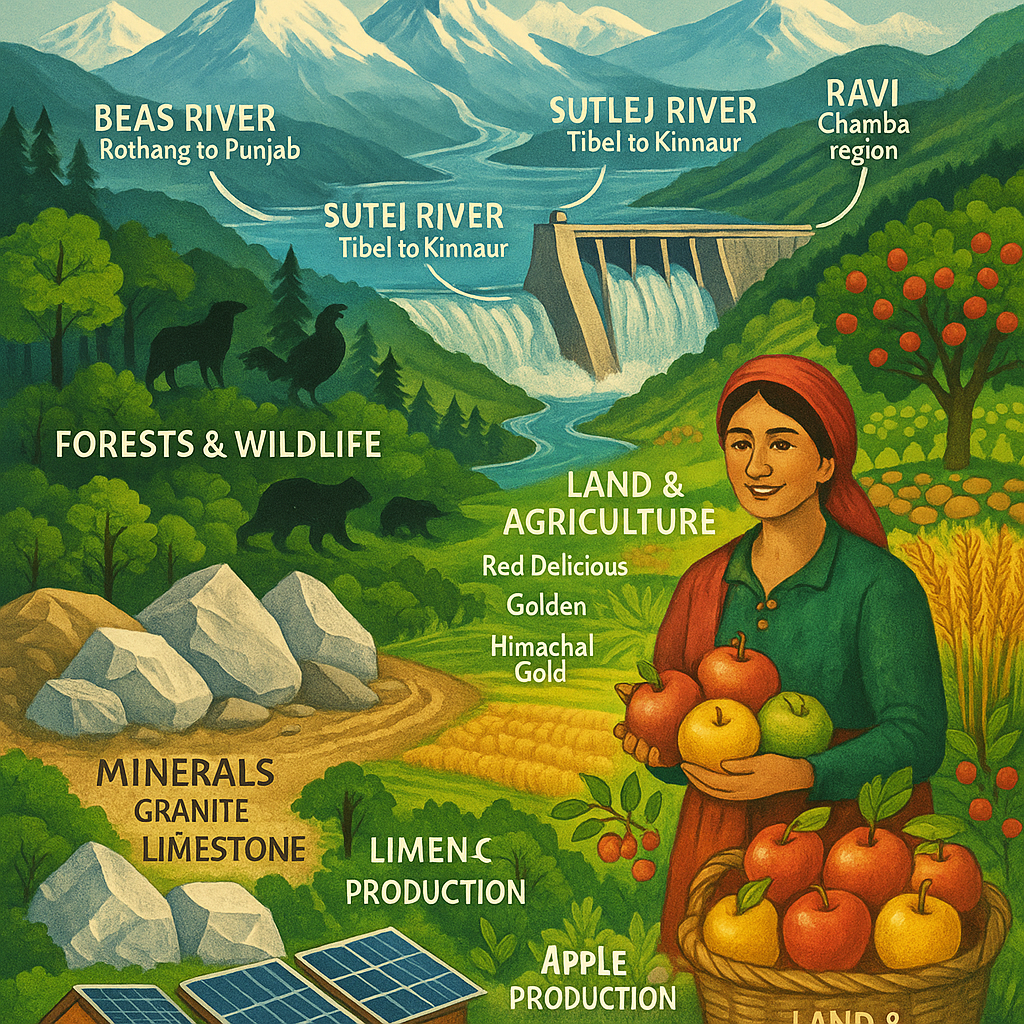
Natural resources are substances provided by nature that support human life, development, and daily needs. Himachal Pradesh is blessed with abundant natural resources due to its unique geography and diverse climatic conditions. These resources contribute significantly to the state’s economy and help maintain environmental balance.
Major Natural Resources of Himachal Pradesh
1. Water Resources
Himachal Pradesh is often called the “Water Tank of India” because of its numerous rivers, lakes, and natural water sources.
- Major Rivers: Sutlej, Beas, Ravi, Tawi, Chenab
- Uses: Irrigation, water supply, and hydroelectric power generation
Large reservoirs and dams such as Bhakra Nangal, Kangra, and Sopdi contribute significantly to power generation in the state.
Lakes
- Barshal Lake
- Spiti Lakes
- Kullu region lakes
These lakes are not only water sources but also major tourist attractions.
2. Forest Resources
Himachal Pradesh has extensive forest cover. The forests include:
- Deodar
- Sal
- Pine
- Ban
- Walnut and apple trees
Medicinal Herbs & Plants
The higher Himalayan regions are rich in medicinal herbs. These are used for manufacturing herbal medicines and products.
Wildlife
The forests are home to tigers, leopards, bears, Himalayan blue sheep, and various bird species—forming a vital part of the state’s biodiversity.
3. Mineral Resources
Himachal Pradesh contains several mineral deposits:
- Marble
- Bauxite
- Granite
- Slate
- Limestone
- Silica
- Coal
- Sodium sulphate
Marble mining is prominent in Chamba and Kinnaur regions.
4. Land Resources
The state has limited agricultural land due to its mountainous terrain, but fertile valleys support high-quality crops.
Agricultural Crops
- Wheat
- Rice
- Maize
- Potato
- Apple
Horticulture
Apple, plum, pear, and grape cultivation is widespread in Kullu and Kinnaur districts.
5. wind energy
High wind speeds in mountainous regions make Himachal suitable for wind energy projects. Several wind power plants have been set up as part of green energy initiatives.
6. Solar Energy
Regions like Una, Solan, and Mandi receive abundant sunlight. Solar panels are installed in many villages, providing clean and sustainable electricity.
7. Environmental Resources
Himachal Pradesh is rich in greenery, national parks, and wildlife sanctuaries. Its Himalayan ecosystem supports diverse flora and fauna, making it a global biodiversity hotspot.
8. Climate & Weather
The climate varies from temperate summers to snowy winters, enabling the cultivation of both summer and winter crops. Monsoon rains replenish water resources and support irrigation.
Conclusion
The natural resources of Himachal Pradesh support its economy, environment, and daily life. Sustainable use and conservation of water, forests, minerals, land, and energy resources are essential for future development and ecological balance.
Beas, Sutlej, and Ravi – Major Rivers of Himachal Pradesh
The rivers of Himachal Pradesh—Beas, Sutlej, and Ravi—play a vital role in irrigation, drinking water, and hydroelectric power generation. Their importance extends beyond the state, supporting agriculture and energy production in northern India.
1. Beas River
Source
The Beas River originates near Rohtang Pass in Kullu district. It flows through Himachal Pradesh and enters Punjab before merging with the Sutlej River.
Irrigation
The Beas River is vital for irrigation in Kangra, Mandi, and Hamirpur. Canal systems distribute water for crops such as rice, wheat, maize, potatoes, and horticulture produce.
Hydroelectric Projects
- Sahib Hydroelectric Project
- Verziri Project
- Kangra Hydroelectric Project
2. Sutlej River
Source
The Sutlej River originates from Langchhen Lake in Tibet, flows through Kinnaur district in Himachal, then passes into Punjab and Pakistan.
Irrigation
- Used extensively for agriculture in Himachal and Punjab
- Distributed through the Sutlej–Yamuna Link (SYL) Canal
Hydroelectric Projects
- Bhakra Nangal Hydroelectric Project – One of India’s largest (Approx. 1,325 MW)
- Nangal Headworks
- Sicholi Hydroelectric Project
3. Ravi River
Source
The Ravi River originates from Chandra Lake in Himachal Pradesh and flows through Chamba district before entering Pakistan.
Irrigation
Ravi River water is used primarily in Chamba, Lahaul-Spiti, and Kinnaur for irrigation, especially for apple, plum, and other horticultural crops.

⭐ Editor's Choice
Discover a highly rated product selected for its quality, functionality, and positive customer feedback.
View Details & Reviews →Hydroelectric Projects
Small hydro projects are established along the Ravi River to support local power supply.
Importance of Irrigation & Hydropower
Irrigation
Irrigation ensures agricultural productivity, supports food security, and helps cultivate diverse crops across valleys.
Hydropower
Himachal’s rivers support clean energy production. Hydroelectricity powers industries, towns, and rural regions and creates employment opportunities.
Conclusion
The Beas, Sutlej, and Ravi rivers are lifelines of Himachal Pradesh. They contribute to agriculture, drinking water, and renewable energy production, making them essential for sustainable development.
Himachal Pradesh Leading in Apple Production
Himachal Pradesh is one of India’s leading states in apple production. Apple horticulture forms the backbone of the state’s economy and directly supports the livelihood of thousands of farmers.
Apple Production Regions
Apple cultivation is concentrated in:
- Kullu
- Kinnaur
- Bilaspur
- Solan
- Mandi
- Kangra
- Chamba
The cool, dry climate of the mountains and altitudes between 900m–2,500m create ideal conditions for apple farming.
Popular Apple Varieties
- Red Delicious
- Golden Delicious
- Himachal Gold
- Kimberly
- Almighty
- MacIntosh
- Fuji
Importance of Apple Farming
Economic Contribution
Apple cultivation is a significant source of income and employment for Himachali farmers. Sales of apples contribute heavily to the state’s agricultural revenue.
Modern Techniques
- Drip irrigation
- Organic fertilizers
- Pest control technologies
- Advanced horticultural tools
Marketing & Exports
Himachali apples are marketed across India and exported to Dubai, Kuwait, Saudi Arabia, and other countries. Apple fairs and exhibitions help farmers learn about new techniques and pricing trends.
Government Initiatives
- National Horticulture Mission
- Himachal Horticulture Department schemes
- Subsidies, training, and grants for farmers
Challenges in Apple Production
- Climate change (irregular snowfall & rising temperatures)
- Pest attacks and fungal infections
- Market price fluctuations
Conclusion
Apple production plays a crucial role in Himachal’s economy, employment, exports, and farming innovation. Districts like Kullu, Kinnaur, Solan, and Mandi lead the state’s apple revolution, making Himachal Pradesh a powerhouse of horticulture in India.