
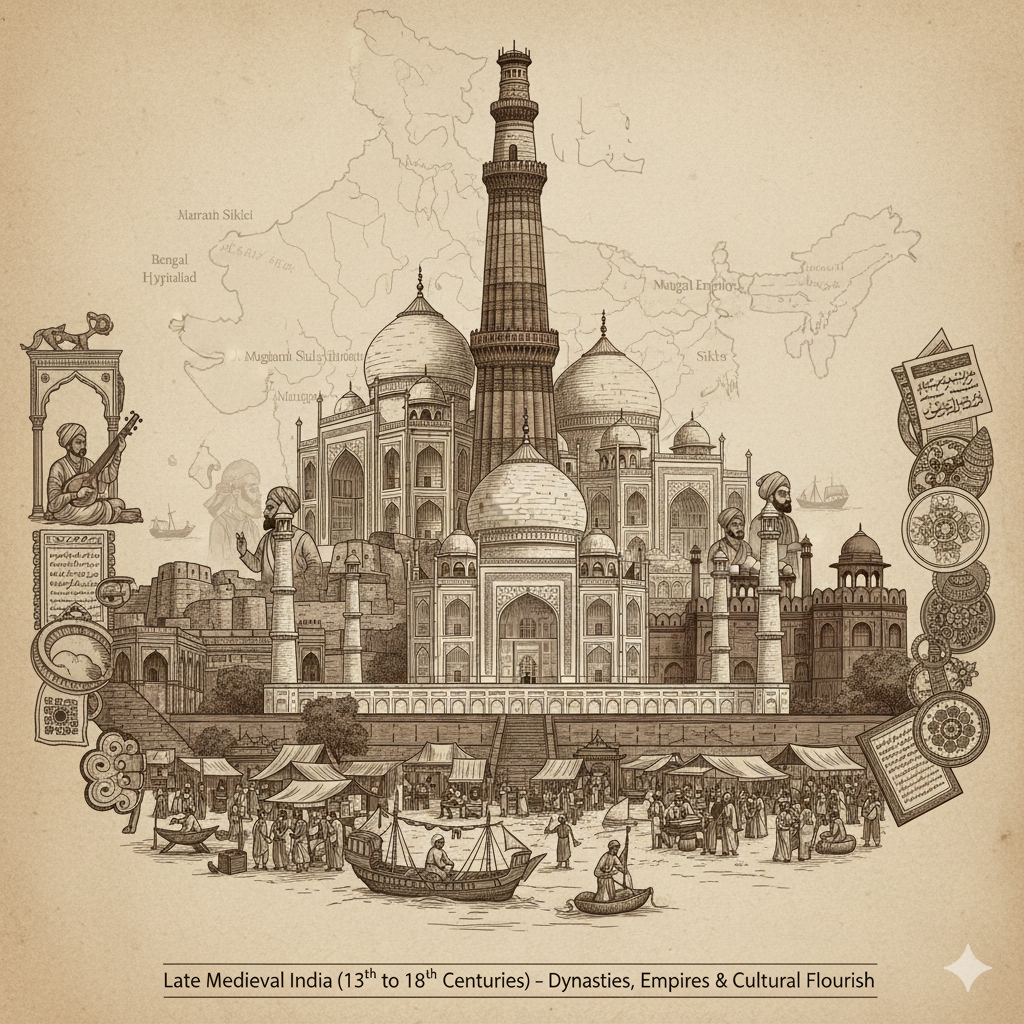
Late Medieval India (13th to 18th Centuries)
Late Medieval India (13th to 18th centuries) was an important phase in Indian history, marked by major political, social, cultural, and religious transformations. This era is primarily associated with the rise and fall of the Delhi Sultanate and the Mughal Empire. The period can be broadly divided into the following stages:
1. Delhi Sultanate (1206–1526)
The Delhi Sultanate was a significant political era in the Indian subcontinent, during which various Turkish and Afghan dynasties ruled from Delhi. It is mainly divided into five prominent dynasties. The Sultanate laid the foundation of Islamic culture, administrative reforms, and Indo-Islamic architecture in India.
Major Dynasties of the Delhi Sultanate
Slave Dynasty (1206–1290)
Founder: Qutbuddin Aibak
Important Rulers: Iltutmish, Razia Sultan, Balban
- The administrative structure was established, and Turkish influence expanded in India.
- Qutbuddin Aibak, known as “Lakh Baksh,” initiated the construction of Qutub Minar.
- Iltutmish strengthened the Subah and Iqta systems and completed the Qutub Minar.
- Razia Sultan became the first woman ruler of India but faced strong opposition.
- Balban introduced strict governance and strengthened borders to resist Mongol invasions.
Khilji Dynasty (1290–1320)
Founder: Jalaluddin Khilji
Important Ruler: Alauddin Khilji
- Defence against Mongol invasions.
- South Indian conquests led by Malik Kafur.
- Market control measures and strict price regulations.
Tughlaq Dynasty (1320–1414)
Founder: Ghiyasuddin Tughlaq
Important Rulers: Muhammad bin Tughlaq, Firoz Shah Tughlaq
- Muhammad bin Tughlaq implemented bold but controversial reforms such as the capital shift and token currency.
- Firoz Shah Tughlaq built canals, forts, and cities, and introduced labour and agricultural reforms.
Sayyid Dynasty (1414–1451)
Founder: Khizr Khan
This dynasty remained politically weak due to external pressures and rising regional powers.
Lodhi Dynasty (1451–1526)
Founder: Bahlol Lodi
Last Ruler: Ibrahim Lodi
- Sikandar Lodi introduced Agrarian reforms and developed the city of Agra.
- Ibrahim Lodi was defeated by Babur in the First Battle of Panipat (1526), ending the Delhi Sultanate.
Features of the Delhi Sultanate
- Administrative Reforms: Iqta system, land revenue administration, Persian language in government work.
- Social Impact: Fusion of Hindu-Muslim cultural elements.
- Architecture: Qutub Minar, Alai Darwaza, Tughlaqabad Fort.
- Religious Influence: Expansion of Sufi and Bhakti movements.
2. Mughal Empire (1526–1707)
Prominent Mughal Rulers
Babur (1526–1530)
- Won the First Battle of Panipat (1526).
- Laid the foundation of the Mughal Empire.
Humayun (1530–1556)
- Forced into exile by Sher Shah Suri.
- Regained the throne in 1555.
Akbar (1556–1605)
- Considered the Golden Age of the Mughal Empire.
- Introduced administrative reforms and religious tolerance.
- Established Din-i-Ilahi.
Jahangir (1605–1627)
- Patronised art and architecture.
- Influence of Nur Jahan on court politics.
Shah Jahan (1628–1658)
- Known for architectural achievements—Taj Mahal, Red Fort.
- Engaged in prolonged Deccan conflicts.
Aurangzeb (1658–1707)
- Adopted religion-based policies.
- Expanded the empire to its greatest territorial extent.
- Faced conflicts with Rajputs, Marathas, and Sikhs.
⭐ Editor's Choice
Discover a highly rated product selected for its quality, functionality, and positive customer feedback.
View Details & Reviews →3. Rise of Regional Powers
After the weakening of the Mughal Empire, several regional powers emerged, including:
- The Maratha Empire
- The Sikh Empire
- Regional kingdoms such as Bengal, Awadh, and Hyderabad
Social and Cultural Characteristics
- Bhakti Movement: Tulsidas, Mirabai, Surdas.
- Sufi Movement: Khwaja Moinuddin Chishti, Nizamuddin Auliya.
- Language & Literature: Flourishing of Hindi, Urdu, and Persian.
- Architecture: Qutub Minar, Taj Mahal, Fatehpur Sikri.
Economic Condition
- Agriculture-based economy.
- Growth of trade, handicrafts, and guilds.
- Expansion of foreign trade with the Portuguese, Dutch, and British.
The political conflicts, cultural developments, and administrative systems of Late Medieval India laid a strong foundation for the evolution of modern Indian society.
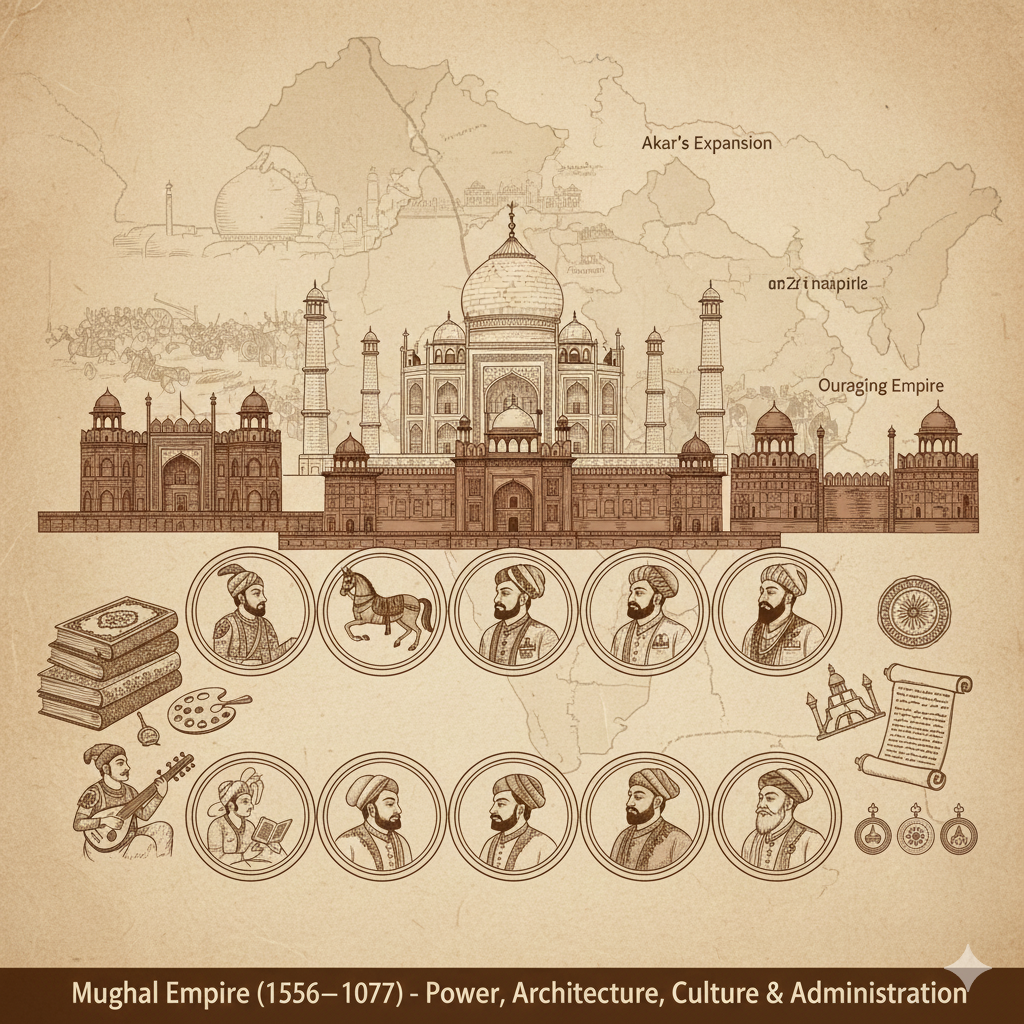
Mughal Empire (1526–1707)
The Mughal Empire (1526–1707) was one of the most influential periods in the history of the Indian subcontinent. During this era, art, culture, administration, architecture, and politics flourished on an unprecedented scale. Founded by Babur in 1526, the empire reached its zenith before gradually declining after the death of Aurangzeb in 1707.
Extent and Characteristics of the Mughal Empire
1. Babur (1526–1530): Founder of the Mughal Empire
First Battle of Panipat (1526): Babur defeated Ibrahim Lodi, marking the end of the Delhi Sultanate.
Special Achievements
- Use of modern warfare techniques, especially artillery.
- Gained control over regions such as Chunar and Gwalior.
- Baburnama: Autobiography of Babur.
- Laid the foundation of the empire, though he could not fully stabilize it.
2. Humayun (1530–1556): Struggle and Reconquest
Conflict with Sher Shah Suri
- Defeated in the Battle of Kannauj (1540).
- Took refuge in Persia during exile.
- Recaptured Delhi in 1555.
Death of Humayun (1556): He died after falling from the stairs of his library.
3. Akbar (1556–1605): Beginning of the Golden Age
Second Battle of Panipat (1556)
- At the age of 14, Akbar defeated Hemu and secured the throne.
Expansion of the Empire
- Conquered Gujarat, Bengal, Rajasthan, Malwa, and parts of the Deccan.
- Formed matrimonial and political alliances with Rajput rulers.
administrative reforms
- Mansabdari System: Categorization of military and administrative ranks.
- Removal of the Jaziya tax imposed on non-Muslims.
- Establishment of Din-e-Ilahi.
religious tolerance
- Promoted the study of diverse religious ideas through the Ibadat Khana.
Architecture
- Construction of Fatehpur Sikri.
- Agra Fort.
Navratnas (Nine Gems)
- Birbal
- Tansen
- Abul Fazl
- Faizi
- Raja Todarmal
- Raja Man Singh
4. Jahangir (1605–1627): The Age of Art and Justice
Jahangir succeeded Akbar and continued to strengthen the empire.
Influence of Nur Jahan
- She actively participated in administration.
- Promoted art and Mughal painting.
Development and Foreign Contacts
- Jahangir admired the beauty of Kashmir and documented his travels.
- The East India Company arrived at the Mughal court in 1615.
5. Shah Jahan (1628–1658): Golden Age of Mughal Architecture
Major Achievements
- Taj Mahal (built in memory of Mumtaz Mahal).
- Red Fort (Delhi).
- Jama Masjid.
- The Peacock Throne.
Under Shah Jahan, the empire reached prosperity and architectural brilliance. He was later imprisoned by Aurangzeb until his death.
6. Aurangzeb (1658–1707): Peak and Decline of the Empire
Expansion of the Empire
- Conquered Bijapur and Golconda in the Deccan.
- The empire expanded to its maximum territorial extent.
- However, administration weakened due to overextension.
Religious Policies
- Reimposed the Jaziya tax.
- Ordered the demolition of temples and construction of mosques.
Major Conflicts
- Continuous struggles with Marathas, Sikhs, Rajputs, and Jats.
- Notable conflict with Shivaji.
Administrative Issues
- Provincial discontent due to strict religious policies.
- The empire began declining after Aurangzeb’s death in 1707.
Salient Features of the Mughal Empire
1. Administrative Setup
The Mansabdari System
- Officials appointed by the emperor for military and civil duties.
- Troops were maintained through revenue assignments.
Centralised Administration
- The emperor held supreme authority over the state.
2. Cultural Contributions

⭐ Editor's Choice
Discover a highly rated product selected for its quality, functionality, and positive customer feedback.
View Details & Reviews →Architecture
- Taj Mahal
- Red Fort
- Agra Fort
- Fatehpur Sikri
Music and Literature
- Tansen
- Abul Fazl
- Faizi
- Growth of Persian and Urdu literature
Mughal Painting
- Blend of Indian and Persian artistic styles.
3. Religious and Social Policy
- Akbar’s religious tolerance versus Aurangzeb’s religious orthodoxy.
- Integration of Hindu and Muslim cultural elements.
4. Economic System
- Agriculture-based economy.
- Revenue reforms such as Todarmal’s land measurement system.
- Growth of foreign trade due to European traders.
Decline of the Mughal Empire
- Rise of Regional Powers such as Marathas, Sikhs, Jats, Bengal, and Hyderabad.
- Internal rebellions and administrative weaknesses.
- Increasing influence of the British and European powers.
- Aurangzeb’s rigid policies and inability to effectively manage the vast empire.
The Mughal Empire left a deep and lasting impact on Indian society, culture, and governance. Their contributions in art, architecture, and administration continue to influence modern India.
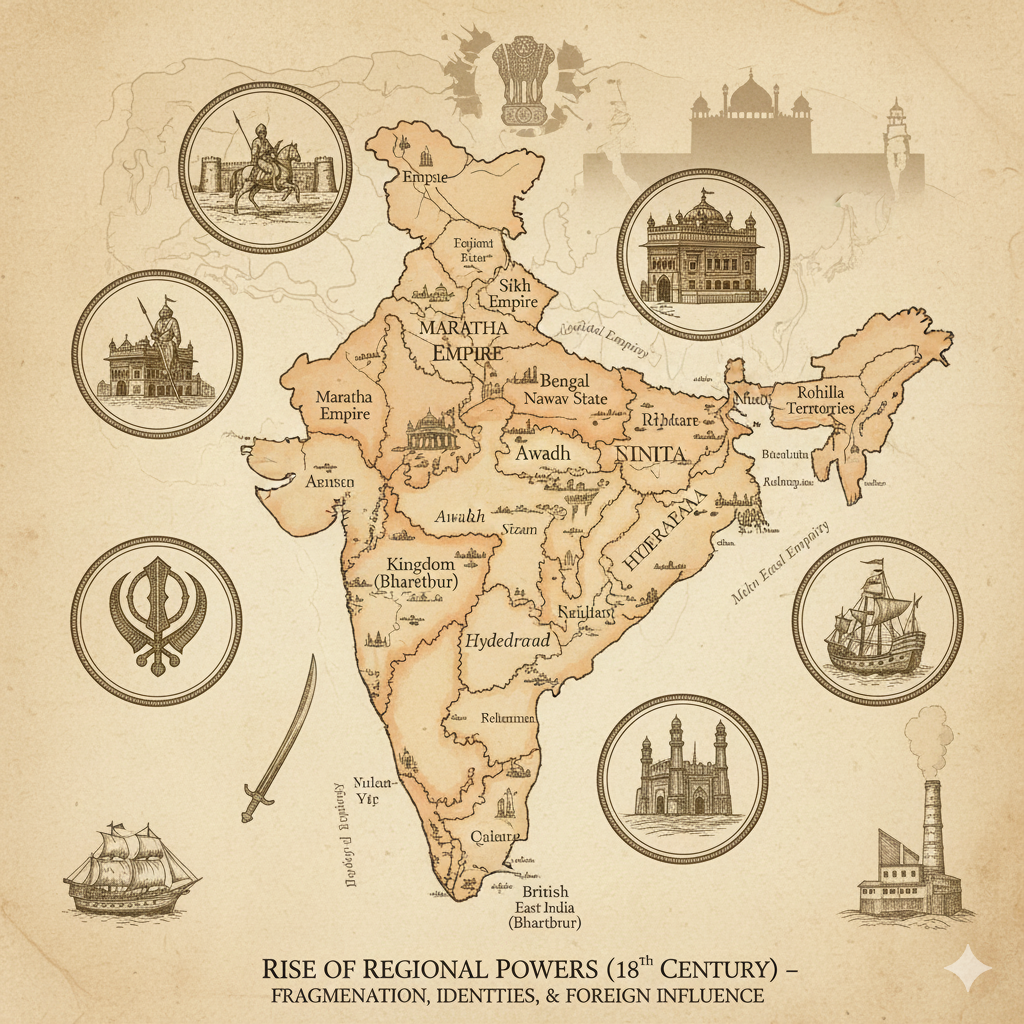
Rise of Regional Powers
The Rise of Regional Powers in the 18th century marks an important phase in Indian history. During this period, several regional powers emerged following the decline of the Mughal Empire. These powers became politically, socially, and culturally independent and played a major role in various parts of the Indian subcontinent. Several new kingdoms emerged, and older powers such as the Marathas and Sikhs grew stronger.
Reasons for the Rise of Regional Powers
1. Decline of the Mughal Empire
- The Mughal Empire weakened after the death of Aurangzeb in 1707.
- Central authority eroded due to succession struggles and weak rulers.
2. Rise of Regional Princely States
- With the weakening of the Mughal Empire, provincial rulers and governors began declaring independence.
3. Foreign Invasions
- Nadir Shah’s invasion in 1739 and Ahmad Shah Abdali’s invasion in 1761 weakened Delhi and surrounding regions.
4. Growing Influence of Local Rulers
- Local rulers such as the Marathas, Sikhs, Rajputs, and Jats established independent authority in their regions.
5. Arrival of British and European powers
- European trading companies increased their trade activities and political influence.
Main Regional Powers
1. Maratha Empire
Leadership
- Founded by Shivaji.
- Peshwa (Prime Minister) system developed further.
- Reached its peak under Peshwa Balaji Bajirao in the 18th century.
Area
Western India, the Deccan, and parts of Northern India.
Importance
- Defeated by Ahmed Shah Abdali in the Third Battle of Panipat (1761).
- Division of the empire led to the formation of the Maratha Confederacy.
Contribution
- Development of guerrilla warfare.
- Promotion of the idea of Hindavi Swarajya.
2. Sikh Empire
Leadership
- Guru Gobind Singh founded the Khalsa.
- Maharaja Ranjit Singh later established the Sikh Empire (1799–1849).
Area
Punjab, Kashmir, and North-Western regions.
Importance
- Strong military organization and religious identity.
- Frequent conflicts with the British Empire.
3. Nawab State of Bengal
Leadership
- Independent Nawabs such as Mir Jafar and Mir Qasim.
Area
Modern Bengal, Bihar, and Odisha.
Importance
- Defeat in the Battle of Plassey (1757) led to the rise of British rule.
- Bengal became the first major region under British control.
4. Nawab State of Awadh
Leadership
- Saadat Ali Khan and his successors.

⭐ Editor's Choice
Discover a highly rated product selected for its quality, functionality, and positive customer feedback.
View Details & Reviews →Area
Modern Uttar Pradesh and surrounding areas.
Importance
- Major center for culture, art, and music—especially in Lucknow.
- Eventually came under British dominance.
5. Nizam State of Hyderabad
Leadership
- Founded by Mir Qamaruddin of the Asaf Jahi dynasty.
Area
Regions of modern Telangana, Andhra Pradesh, and Maharashtra.
Importance
- Maintained political autonomy.
- Developed strong trade connections.
6. Rajput States
Leadership
- States such as Jaipur, Jodhpur, and Udaipur.
Area
Rajasthan and nearby regions.
Importance
- Maintained autonomy after Mughal decline.
7. Jat and Rohilla States
Leadership
- Jats: Surajmal of Bharatpur.
- Rohillas: Afghan leaders in Rohilkhand.
Area
Jats: Regions of Uttar Pradesh and Haryana.
Rohillas: Rohilkhand (Uttar Pradesh).
Influence of Regional Powers
Social Impact
- Promotion of local art, culture, and traditions.
- Greater diversity and cultural exchange among regions.
Political Influence
- Rise of political fragmentation across India.
- European powers gained opportunities to expand their dominance.
Economic Impact
- Growth of regional trade and crafts.
- Independent tax systems and revenue policies.
Conclusion
The rise of regional powers led to decentralization in Indian politics. This period witnessed cultural, social, and political growth across different regions of the Indian subcontinent. However, this fragmentation also created opportunities for the British and other European powers to strengthen their influence, eventually leading to the colonial era in India.
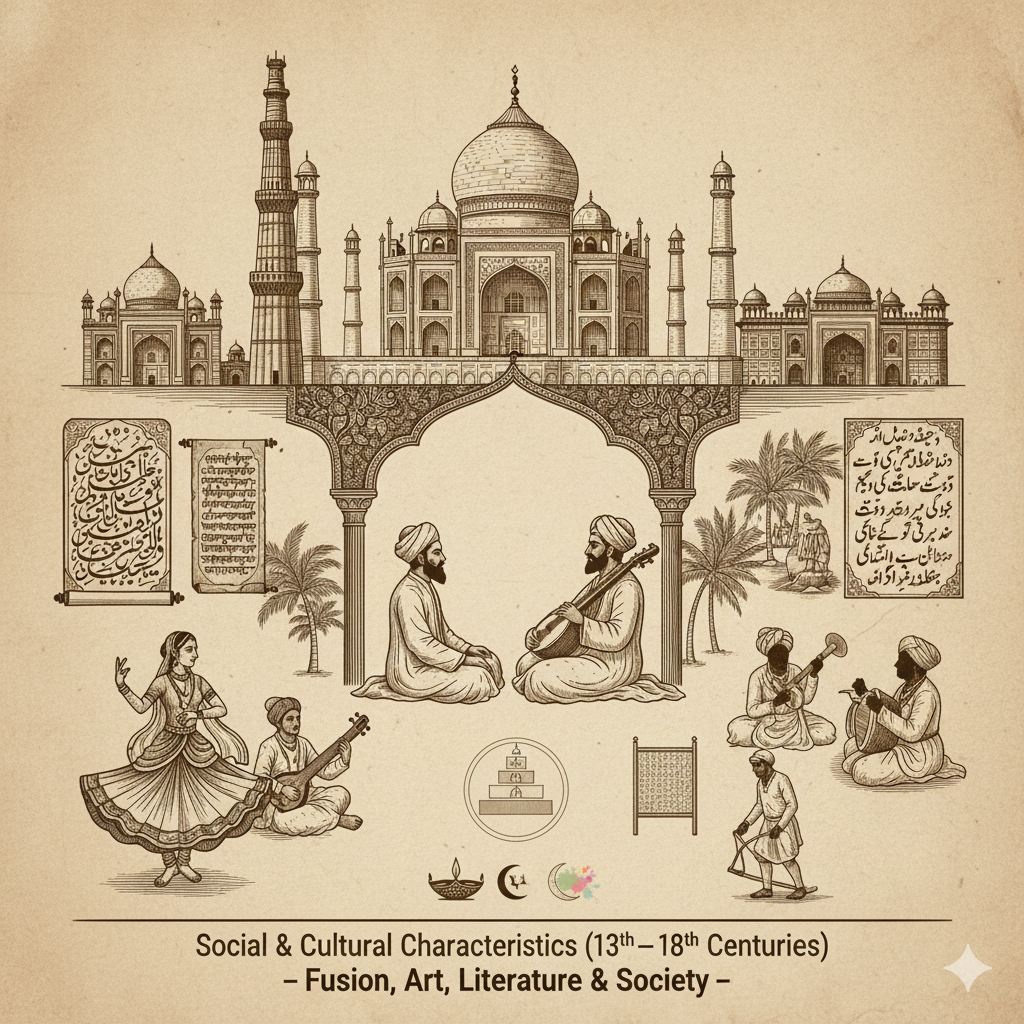
Social and Cultural Characteristics
The period from the 13th to the 18th century was marked by significant social and cultural changes in Indian history. During the Delhi Sultanate and the Mughal Empire, various religions, cultures, and languages intermingled, resulting in a rich and multi-layered society. This era witnessed the evolution of unique traditions, Social Structures, and artistic advancements.
1. Social Characteristics
(a) Caste System and Social Structure
Caste System in Hindu Society
- The caste divisions were rigid and hierarchical.
- The four major castes—Brahmins, Kshatriyas, Vaishyas, and Shudras—continued.
- Occupations and social rights were caste-based and restricted.
Structure of Muslim Society
- Ashraf: Upper class (Arabic, Persian, Turkish origin).
- Ajlaf: Lower class (local converted Muslims).
Status of Women
- Women held a lower social status than men.
- Purdah and child marriage were common.
- Social issues such as sati, dowry, and prohibition of widow remarriage existed.
Lower Classes and Slavery
- Lower classes, including peasants, workers, and slaves, faced social and economic exploitation.
- Slavery was widely practiced, especially in the Delhi Sultanate and Mughal courts.
(b) Religion and Religious Coexistence
Influence of Islam
- Islam spread widely under the Delhi Sultanate and Mughal Empire.
- Sufi saints connected people through spiritual teachings and humanity.
Bhakti Movement
- Saints such as Mirabai, Tulsidas, Kabir, and Guru Nanak promoted harmony beyond caste and religion.
Rise of Sikhism
- Guru Nanak founded Sikhism based on equality, devotion, and service.
Fusion of Hindu and Muslim Culture
- Shared festivals, customs, and lifestyle patterns enriched cultural unity.
2. Cultural Characteristics
(a) Art and Architecture
Architecture of the Delhi Sultanate
- Qutub Minar, Alai Darwaza, and Tughlaqabad Fort.
- Blend of Islamic and Indian architectural features.
Mughal Architecture
- Taj Mahal, Red Fort, Fatehpur Sikri.
- Use of domes, arches, intricate designs, and geometric gardens.
- Fusion of Persian and Indian architectural styles.
(b) Literature and Language
Persian Language
- Persian served as the court language.
- Scholars like Abul Fazl and Faizi enriched Persian literature.
Development of Urdu
- Urdu evolved from the blend of Hindi and Persian.
- Became a popular language among common people and poets.
Devotional Literature
- Tulsidas's Ramcharitmanas.
- Works of Surdas and Bhakti poets strengthened Hindi literature.
Sufi and Saint Literature
- Sufi poets expressed ideas of love, devotion, and humanity.
(c) Music and Dance
Evolution of Music
- Growth of Hindustani (North Indian) and Carnatic (South Indian) music.
- Musicians like Tansen contributed immensely to Mughal court music.
Dance
- The Kathak dance form evolved significantly.
- Music and dance flourished in royal courts.
(d) Science and Technology
- Progress in astrology and astronomy during the reigns of Akbar and Jahangir.
- Growth of Unani and Ayurvedic systems of medicine.
(e) religious tolerance and Social Harmony
Sufi Movement
- Saints like Nizamuddin Auliya and Khwaja Moinuddin Chishti spread messages of peace and brotherhood.
Bhakti Movement
- Kabir, Mirabai, and Guru Nanak sought to bridge religious divides.
Festivals and Traditions
- Festivals such as Diwali, Eid, and Holi promoted mutual harmony and cultural integration.
Conclusion
Late medieval India witnessed remarkable social and cultural transformations. The Bhakti and Sufi movements played a crucial role in promoting social unity, while architecture, music, and literature enriched India’s cultural heritage. This period stands as a testament to diversity and shared cultural identity.

Trending Amazon Product
Premium quality product with excellent customer reviews. Reliable, durable and perfect for everyday use.
👉 Buy Now on AmazonAgriculture-Based Economy
An agriculture-based economy was the defining characteristic of Late Medieval India (13th–18th centuries). Agriculture was the primary source of livelihood, the backbone of the revenue system, and the foundation of the social and political structure.
1. Characteristics of an Agriculture-Based Economy
(a) Land Use and Farming System
Main Features of Farming
- Traditional methods of cultivation were used.
- Both irrigated and rain-fed agriculture existed.
Main Crops
- Cereals: Rice, wheat, sorghum, millet.
- Commercial Crops: Cotton, sugarcane, indigo, spices.
- Fruits & Vegetables: Mango, banana, potato, brinjal.
Land Ownership
- Land was owned by rulers or feudal lords.
- Farmers cultivated land on a rental basis.
Means of Irrigation
- Use of canals, wells, ponds, and lakes.
- Several irrigation projects were constructed during the Delhi Sultanate and Mughal period.
(b) Efforts to Increase Agricultural Production
Reforms During the Mughal Period
- Sher Shah Suri and Akbar introduced the land measurement system.
- Taxes were imposed based on crop productivity.
Revenue System
- Land revenue was the primary source of state income.
Todarmal’s Settlement System
- Land measurement and classification.
- Revenue assessment based on crop type and yield.
Farming Equipment & Labour
- Use of ploughs, oxen, hoes, and other manual tools.
- Farmers and wage labourers were engaged in all agricultural tasks.
(c) Farmers and Their Lives
- Most farmers lived in poverty.
- High taxes and exploitation by feudal lords continued.
- Natural calamities increased risks for farmers.
- Many farmers became bonded labourers due to unpaid debts.
(d) Relationship Between Agriculture and the Economy
- Agriculture formed the economic foundation of the empire.
- The state collected one-third to half of the crop as tax.
- Surplus produce encouraged trade, both local and international.
- Cash crops like indigo, cotton, and spices were exported.
- Village economies were self-sufficient, with farmers, potters, carpenters, and blacksmiths contributing.
2. Challenges of an Agriculture-Based Economy
(a) Natural Disasters
- Famines, floods, and droughts frequently damaged crops.
- Farmers lacked storage facilities for grains.
(b) Exploitation and Taxation
- High taxes made farmers’ lives difficult.
- Even during the Mughal period, farmers paid taxes in cash or grain.
(c) Decline in Production
- Limited technology reduced productivity.
- Shortage of manure and improved seeds.
3. Mughal Empire and Agriculture
Revenue Reforms of Akbar
- Provided stability to farmers.
- Taxes determined based on land fertility.
Promotion of Agriculture
- Large-scale irrigation projects increased crop production.
Agriculture and Trade
- Cash crops like cotton and indigo boosted internal and foreign trade.
4. Influence of Agriculture-Based Society
- Impact on Social Structure: Inequalities between peasants and feudal lords persisted.
- Economic Prosperity: Agricultural surplus encouraged trade and urbanization; India was known as the “Golden Bird.”
- Employment: Agriculture provided employment to most rural populations.
5. Conclusion
The agriculture-based economy significantly shaped society and governance in Late Medieval India. Despite challenges and limited technological progress, agriculture ensured economic stability and contributed to political strength. It played a central role in sustaining the social and economic framework of the period.
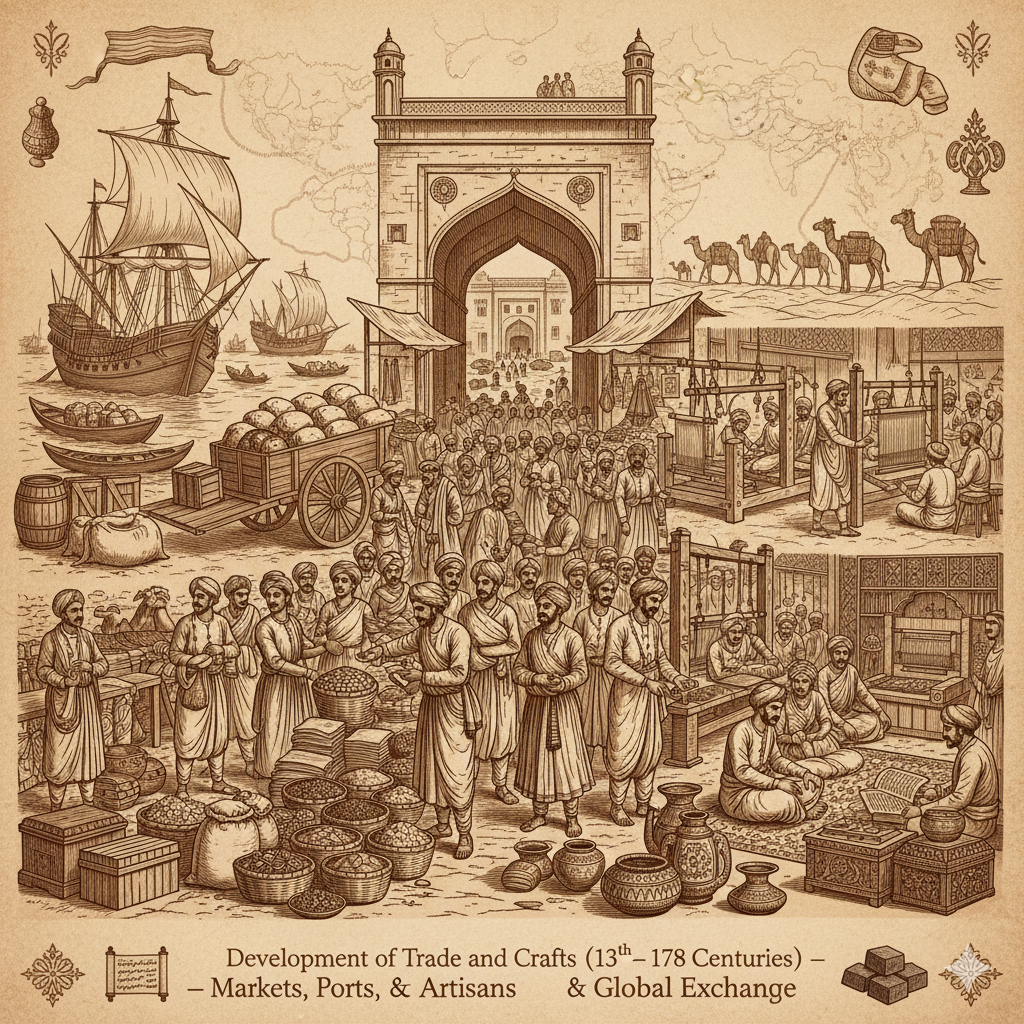
Development of Trade and Crafts
In late medieval India (13th to 18th centuries), trade was a crucial aspect of the economy. During the Delhi Sultanate and the Mughal Empire, internal, regional, and international trade flourished, leading to economic prosperity. The growth of Trade routes, the rise of trading cities, and advancements in craftsmanship made India an important global economic center.
1. Development of Trade
(a) Internal Trade
Local Markets and Haats
- Weekly markets (haats) were common in villages and towns.
- Farmers and artisans exchanged their products locally.
Regional Trade
- Cotton, grains, spices, and craft items were traded regionally.
- Trade routes linked rural and urban centers.
Major Trading Cities
(b) International Trade
Asian Trade Routes
- India traded with Persia, Arabia, Central Asia, and China.
- Trade grew along the Silk Road and maritime routes.
Medieval India and Europe
- Spices, textiles, gems, and handicrafts were exported to Europe.
- European interest in Indian trade increased after Vasco da Gama’s arrival.
Exports and Imports
- Exports: Spices, cotton, silk, indigo, jewels.
- Imports: Horses, paper, tools, silk.
(c) Trade Guilds
Merchants’ Associations
- Guilds regulated internal and international trade.
- They provided support to merchants and ensured fair practices.
Parsi and Gujarati Traders
- Parsi and Gujarati merchants were prominent in maritime trade.
- Ports such as Surat and Cambay were major trading centers.
2. Development of Craftsmanship
(a) Major Areas of Craftsmanship
Textile Industry
- India became a global leader in textiles.
- Bengal and South India were famous for muslin, silk, and cotton fabrics.
Metallurgy and Jewelry Manufacturing
- Gold, silver, copper, and brass utensils and ornaments were produced.
- Jaipur, Banaras, and Lucknow were major jewelry centers.
Handicrafts and Woodwork
- Wood carving and furniture-making flourished.
- Kashmir became known for shawls and carpets.
Paper and Painting
- Paper manufacturing grew.
- Mughal miniature painting developed greatly.
(b) Conservation of Artwork
Contribution of Mughal Rulers
- Mughal rulers patronized artisans and craftsmen.
- Royal workshops (karkhanas) encouraged artistic creativity.
Social Significance
- Craftsmen were essential contributors to society.
- Their products met both domestic and global demand.
(c) Major Handicraft Centres
- Surat and Ahmedabad: Textiles and spices.
- Banaras: Banarasi silk and handicrafts.
- Lahore and Agra: Gemstone work and Persian-style art.
- Kashmir: Carpets, shawls, and woolen garments.
3. Factors Behind the Development of Trade and Crafts
- Political Stability: Stability under the Delhi Sultanate and Mughals encouraged commerce.
- International Demand: Indian spices, textiles, and gems were highly sought after.
- Development of Ports: Surat, Cochin, and Machilipatnam developed into global trading ports.
- Arrival of Foreign Traders: Arab, Persian, and European traders expanded trade networks.
4. Influence of Trade and Crafts
(a) Economic Impact
- Trade and craftsmanship increased economic prosperity.
- Provided employment to farmers and artisans.
(b) Social Impact
- Rise of merchant and artisan classes.
- Growth of cultural exchange across regions.
(c) Cultural Influence
- Indian handicrafts and arts gained global recognition.
5. Conclusion
The development of trade and craftsmanship in late medieval India formed the backbone of the Indian economy and contributed greatly to cultural growth. Although the arrival of European traders eventually disrupted this prosperous system, the period remains an important chapter in India’s economic history.
Amazon Bestseller Product
Compact, reliable and highly rated product with excellent performance. Perfect choice for daily use and great value for money.
👉 Buy Now on AmazonForeign Trade (Portuguese, Dutch, British, French)
Foreign trade and the arrival of European powers such as the Portuguese, Dutch, English, and French had a deep impact on late medieval India. These powers gradually gained control over maritime trade and established political and economic influence in India.
1. India’s Position Before Foreign Trade
- India was a major center of global trade.
- Indian spices, silk, cotton, and jewelry were in high demand worldwide.
- Flourishing trade relations existed with Persia, Arabia, China, and Southeast Asia.
2. Arrival of Foreign Powers in India
(a) Portuguese (1498)
Arrival of Vasco da Gama
- In 1498, Vasco da Gama arrived in Calicut (Kozhikode).
- The Portuguese became the first Europeans to reach India.
Main Objectives
- Control the spice trade.
- Dominate maritime routes.
Major Ports
- Goa, Daman, and Diu.
Effects
- Portuguese gained control over sea routes.
- Spices, silk, and tea were exported to Europe.
- Missionary activities spread Christianity.
(b) Dutch (1602)
Formation of Dutch East India Company
- Established in 1602 for Asian trade.
- Main aim: Control of the spice trade.
Major Centres
- Cochin, Nagapattinam, and the Coromandel Coast.
Business Activities
- Trading posts in Malacca, Java, and Sumatra.
- Mainly involved in cloves and nutmeg trade.
Decline
- Dutch influence declined in the 18th century due to British and French competition.
(c) English (1600)
Formation of the British East India Company
- Established in 1600.
- In 1615, Jahangir allowed the British to trade in Surat.
Major Trading Centres
- Surat, Madras, Bombay, and Calcutta.
Merchandise
- Silk, spices, cotton, indigo.
Political Dominance
- British influence increased after the Battle of Plassey (1757) and the Battle of Buxar (1764).
(d) French (1664)
Formation of the French East India Company
- Established in 1664.
- Aimed to expand trade in India.
Major Centres
- Puducherry, Chandannagar, Mahe.
Conflict with the British
- Frequent conflicts with the British weakened French influence.
- Declined after 1761.
3. Foreign Trade and the Indian Economy
(a) Merchandise
- Exports: Spices, silk, cotton textiles, indigo, tea.
- Imports: Horses, metals, tools.
(b) Trade Routes and Ports
- Surat, Calicut, Cochin, Bombay, and Madras were major maritime ports.
- Foreign powers transported Indian goods from these ports to Europe.
(c) Impact on India
Economic Impact
- Foreign traders exploited Indian textiles and spices.
- Indian craftsmen became dependent on European traders.
Social and Cultural Influence
- Spread of Christianity.
- Introduction of European lifestyle and traditions.
Political Influence
- British and French gradually expanded political power.
- The British eventually gained control over India.
4. Rivalry Among European Powers
- The Portuguese, Dutch, British, and French competed for maritime and trade dominance.
- The British ultimately established monopoly over Indian trade.
- By the 18th century, the British East India Company became the strongest power in India.
5. Conclusion
Foreign trade connected late medieval India with global markets. However, the arrival of European powers weakened India’s craft and trade systems. Through trade and political manipulation, foreign powers—especially the British—were able to establish control over India, leading to colonial rule.