
Punjab

Introduction to Punjab – History, Culture, Geography & Economy

Introduction to Punjab

Punjab is a rich and historical state of India located in northwestern India. Its name is derived from the words ‘panj’ (five) and ‘aab’ (water), which translates to “land of five rivers.” These five rivers—Sutlej, Beas, Ravi, Chenab, and Jhelum—make the region exceptionally fertile.

1. Geographical Location

Punjab is situated in the northwestern corner of India and shares its western border with Pakistan. It is bordered by Himachal Pradesh and Haryana to the east, Rajasthan to the south, and the Union Territory of Jammu and Kashmir to the north.

2. Capital and Major Cities

The capital of Punjab is Chandigarh, which is also a Union Territory. Chandigarh was designed by the famous architect Le Corbusier. Other major cities of Punjab include Amritsar, Ludhiana, Jalandhar, Patiala, and Hoshiarpur.

3. History

The history of Punjab is extremely rich and diverse. This region has been an important center of civilization since ancient times.

  • During the Vedic period, Punjab was part of the Indus Valley Civilization.
  • Punjab played a major role during the Maurya and Gupta Empires.
  • In the medieval period, Punjab became the birthplace of Guru Nanak Dev Ji and other Sikh Gurus.
  • Maharaja Ranjit Singh, the founder of the Sikh Empire, established Punjab as a strong and unified state.

4. Culture and Language

The culture of Punjab is vibrant, rich, and diverse. The state has a strong tradition of festivals, music, dance, literature, and art. The primary language of Punjab is Punjabi, written in the Gurmukhi script.

Folk Art and Music

  • Traditional dances like Bhangra and Giddha are famous worldwide.
  • Folk songs, ghazals, and poetry gatherings also hold great cultural importance.

Festivals

  • Baisakhi
  • Lohri
  • Diwali
  • Guru Nanak Jayanti

5. Economy

The economy of Punjab is primarily based on agriculture. It is one of India’s leading grain-producing states.

  • Major crops include wheat, rice, tobacco, fruits, and vegetables.
  • Food items like butter, curd, paneer, lassi, and chapati are popular in Punjab.

6. Religion

Punjab is a secular state, but it is closely associated with Sikhism. Hindu and Muslim communities also live here prominently. The Golden Temple (Harmandir Sahib) in Amritsar is the most important religious site for Sikhs.

7. Natural Resources and Tourism

Punjab's natural beauty and historical sites attract tourists from all over the world.

  • Golden Temple (Amritsar)
  • Wagah Border (Indo-Pak Border)
  • Kiratpur Sahib and Anandpur Sahib
  • Shivalik Hills and lush green fields

8. Sports and Entertainment

Punjab is known for its enthusiasm for sports, especially Hockey, Cricket, and Kabaddi. The state has a long and proud tradition in Kabaddi in particular.

Geographical Location of Punjab

The geographical location of Punjab is extremely important in the Indian subcontinent. Its position in northwestern India gives it historical, cultural, and strategic significance. Below is a detailed explanation:

1. Boundaries with Other States

  • West – Pakistan: Punjab shares its western border with Pakistan’s Punjab Province. The Wagah Border, a famous transit point, is located here.
  • North – Jammu and Kashmir: The northern boundary meets Jammu and Kashmir near the Himalayan ranges, surrounded by picturesque hills and rivers.
  • East – Himachal Pradesh and Haryana: The eastern side touches Himachal Pradesh (mountainous region) and Haryana (fertile plains).
  • South – Rajasthan: The southern border touches Rajasthan, which has semi-desert conditions unlike Punjab’s fertile plains.

2. Rivers and Climate

The name Punjab itself reflects its five major rivers, which are the lifeline of the state. These rivers enrich the land with natural resources and fertility.

  • Sutlej
  • Beas
  • Ravi
  • Chenab
  • Jhelum (currently in Pakistan)

The Sutlej flows through the central part of Punjab and is one of its most important water sources.

3. Geographical Structure

Punjab’s geographical structure mainly consists of three major regions:

Plains

The Indo-Gangetic plains cover most of Punjab. These fertile lands support crops like wheat, rice, maize, and sugarcane.

Shivalik Hills

Located in the northeast, the Shivalik Hills are part of the Himalayan range, known for their greenery, rivers, and scenic beauty.

Confluence of the Rivers

Historically, the Ganges and Indus river systems influenced Punjab, making irrigation extremely valuable in the region.

4. Climate

The climate of Punjab is a blend of northern temperate and tropical weather. It experiences three major seasons:

  • Summer (March–June): Temperature can reach up to 45°C.
  • Rainy Season (July–September): Receives monsoon rainfall essential for agriculture.
  • Winter (November–February): Temperature can drop as low as 5°C.

5. Strategic Importance

Punjab holds immense strategic importance for India due to its border with Pakistan. It is known as the Western Defence Gate of India. Cities like Amritsar and Chandigarh add to its geopolitical significance.

Capital and Major Cities of Punjab – Detailed Information

Capital and Major Cities of Punjab

The detailed information about the capital and major cities of Punjab is as follows:

1. Capital: Chandigarh

Chandigarh is the capital of Punjab, but it is itself a Union Territory. This means that Chandigarh is neither a part of Punjab nor Haryana, but an independent administrative region. The name Chandigarh is derived from “Chandi” (a Hindu goddess) and “Garh” (fort). It is known for its historical, cultural heritage and is also famously called a Planned City. Chandigarh was designed by the renowned architect Le Corbusier.

Key Aspects of Chandigarh

Architectural Design

Chandigarh was designed by the famous French-Swiss architect Le Corbusier and Indian architect Pierre Jeanneret. It was developed in the 1950s, following a vision by India’s first Prime Minister, Jawaharlal Nehru, to build a modern city.

City Structure

Chandigarh is a well-planned and organized city where roads and areas are divided into numbered sectors (e.g., Sector 1, Sector 10). The city is filled with greenery, wide roads, and scenic lakes, which make it peaceful and beautiful.

Major Landmarks

  • Rock Garden (Created by Nek Chand): A unique garden built using waste material and broken objects.
  • Sukhna Lake: An artificial lake where visitors enjoy boating and a peaceful environment.
  • Punjab and Haryana High Court, Raj Bhavan, and Secretariat: Important administrative buildings located in Chandigarh.

2. Amritsar

Amritsar is one of the most important and historical cities of Punjab. It is a major religious center for Sikhism and is home to the Golden Temple (Harmandir Sahib), the holiest shrine for Sikhs.

Key Aspects of Amritsar

Religious and Historical Importance

The Golden Temple is world-famous for its golden architecture, spiritual significance, and large complex. Millions of people visit it every year.

Wagah Border

Located near the India-Pakistan border, the Wagah Border is famous for the daily military parade performed by Indian and Pakistani soldiers.

Historical Events

Amritsar was the site of the Jallianwala Bagh Massacre (1919), where British General Dyer opened fire on peaceful Indian protestors. This incident became a pivotal moment in India’s freedom struggle.

3. Ludhiana

Ludhiana is a major industrial city of Punjab and is often called the “Manchester of Punjab” due to its strong textile industry.

Key Aspects of Ludhiana

Industrial Centre

Ludhiana is the largest industrial hub of Punjab with a strong presence in textile manufacturing, bicycle production, sports goods, and automobile parts.

Educational Institutions

It is home to major institutions like Punjab Agricultural University (PAU) and Govind National College.

4. Jalandhar

Jalandhar is another major city of Punjab known for sports goods manufacturing, education, and trade.

Key Aspects of Jalandhar

Sports Hub of India

Jalandhar is considered the Sports Capital of India, especially known for hockey. It is home to many industries that manufacture world-class sports equipment.

Trade and Industry

The city is also famous for manufacturing leather products, footwear, fitness equipment, and household goods.

5. Patiala

Patiala is a historical and cultural city of Punjab known for its royal heritage, music, and traditions.

Key Aspects of Patiala

Royal Legacy

Patiala was once the capital of the Patiala State, and its palaces, forts, and heritage buildings still reflect its royal past.

Patiala Peg

This popular term refers to a large peg of alcohol served traditionally in Patiala.

Musical Heritage

The Patiala Gharana, one of the most prominent schools of Indian classical music, originated here.

6. Hoshiarpur

Hoshiarpur is a peaceful and agriculturally rich city of Punjab.

Key Aspects of Hoshiarpur

Agriculture

Hoshiarpur is known for its fertile land where major crops like wheat, rice, and fruits are cultivated.

Cultural Importance

The city holds traditional significance with active practices of Punjabi music, art, and dance.


History of Punjab

The history of Punjab is one of the richest and most significant in the Indian subcontinent. Its cultural heritage and major events have played a crucial role in shaping Indian society and politics. Punjab’s history is marked by ancient civilizations, medieval kingdoms, and modern political developments.

1. Ancient History

Indus Valley Civilization

The region of Punjab formed an important part of the Indus Valley Civilization (Harappan Civilization), which flourished between 3300–1300 BCE. Major sites like Mohenjo-daro and Harappa are located in this region (now in Pakistan). The civilization was advanced in town planning, metallurgy, drainage systems, and architecture.

Vedic Period

During the Vedic period, Punjab became a meeting point of Dravidian and Aryan cultures. The people here followed the Vedas, worshipped deities like Shiva, and lived primarily agricultural lives. The Rigveda mentions the region as Sapta Sindhu (land of seven rivers).

2. Maurya and Gupta Period

Punjab was an important region during the Maurya Empire. Emperors Chandragupta Maurya and Ashoka included Punjab in their empire and encouraged the spread of Buddhism.

During the Gupta Empire (4th–6th century CE), Punjab flourished in science, mathematics, arts, and culture.

3. Medieval History

Ghazni and Ghori Invasions

Mahmud Ghazni invaded Punjab multiple times in the 11th century, bringing destruction and establishing Islamic influence in the region. Later, Qutbuddin Aibak and Muhammad Ghori expanded their rule in Punjab.

Delhi Sultanate and Mughal Empire

From the 13th to the 18th century, Punjab was a crucial region under the Delhi Sultanate and later the Mughal Empire. Mughal rulers strengthened administration, culture, and architecture in Punjab. The foundation of the Golden Temple was laid during the Mughal period.

4. Rise of the Sikh Empire

From Guru Nanak to Guru Gobind Singh

Guru Nanak Dev Ji (1469–1539) founded Sikhism based on equality, unity, and devotion. The ten Gurus shaped Sikh identity, culminating in Guru Gobind Singh Ji establishing the Khalsa Panth.

Sikh Empire

In the 18th century, Maharaja Ranjit Singh established the Sikh Empire with Lahore as his capital. His reign was known for strong administration, military power, and cultural harmony. The empire later fell to the British in 1849.

5. Modern Period (British Rule to Freedom Struggle)

The British annexed Punjab in 1849, leading to infrastructural growth such as railways and industries. However, resentment grew over colonial rule.

Jallianwala Bagh Massacre

In 1919, British General Dyer opened fire on peaceful Indians in Jallianwala Bagh, marking a turning point in India's freedom movement.

Contribution of Sikhs

Sikhs played a major role in the Indian freedom struggle, working alongside national leaders and organizations.

6. Partition and Reorganisation of Punjab

In 1947, India was partitioned, and Punjab was divided between India and Pakistan. Millions were displaced, and the region witnessed intense violence. In 1966, the Indian part of Punjab was reorganized, leading to the creation of the separate state of Haryana.
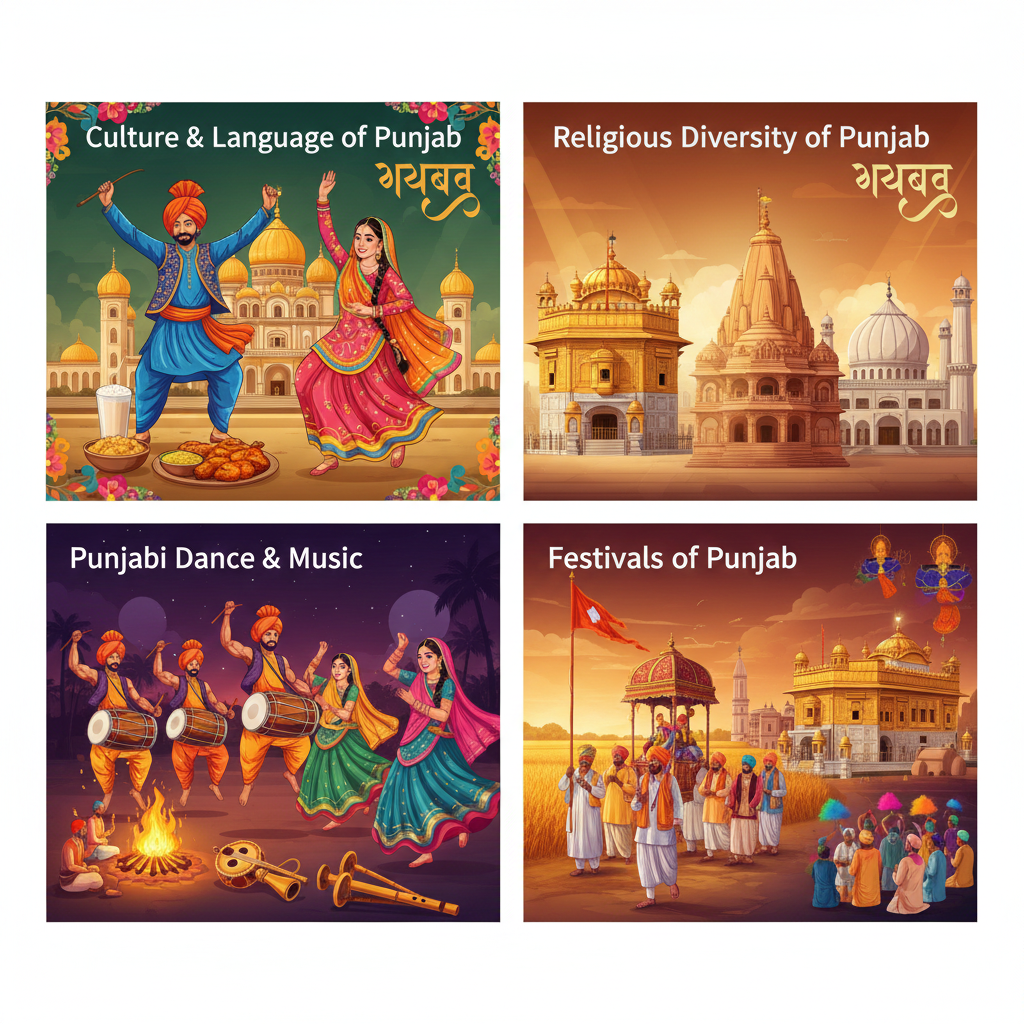
punjab culture language traditions banner
Culture, Language and Festivals of Punjab – Complete Explanation

Culture and Language of Punjab

The culture and language of Punjab are considered among the richest and most diverse in the Indian subcontinent. Punjab’s culture, religious diversity, traditions, art, music, dance, food, and language are unique and distinct compared to other Indian cultures. Let us understand them in detail.

1. Culture of Punjab

The beliefs, values, and traditions of the Punjabi people are deeply influenced by their historical and religious background. A blend of Indian and Islamic elements is also visible in Punjabi society, especially among Sikh and Muslim communities.

Religious Diversity and Influence

Sikhism

Sikhism originated in Punjab, and the state is its central hub. Sikh ideology emphasizes equality, social justice, religious tolerance, and brotherhood.

The Golden Temple (Harmandir Sahib) in Amritsar is the holiest site in Sikhism. Sikhs believe in the oneness of God and equality among all humans.

Guru Nanak Dev Ji, the founder of Sikhism, revolutionized religious thought in the 15th century. Later, Guru Gobind Singh Ji established the Khalsa Panth, giving Sikhs a distinct identity.

Hinduism

Hinduism also has a significant presence in Punjab. Many important Hindu temples are located here. Festivals like Diwali, Holi, Raksha Bandhan, and Dussehra are celebrated with great enthusiasm.

Islam

A portion of Punjab lies in Pakistan, and hence the Muslim community also holds prominence. Festivals such as Eid, Muharram, and Ramadan are celebrated with devotion.

Variety of Festivals and Fairs

Punjab is known for its vibrant and colourful festivals that reflect its cultural richness.

  • Baisakhi: Marks the founding of the Khalsa Panth by Guru Gobind Singh Ji and is also a harvest festival.
  • Lohri: Celebrated around Makar Sankranti to mark the end of winter and arrival of new crops.
  • Diwali & Holi: Major Hindu festivals celebrated with lamps, colours, music, and cultural gatherings.
  • Guruparva: Celebrations on the birth anniversaries of Sikh Gurus such as Guru Nanak Dev Ji and Guru Gobind Singh Ji.

Punjabi Dance and Music

Dance and music are integral parts of Punjabi culture. Traditional dance forms and folk music add energy to every festival and celebration.

Bhangra

The most famous dance of Punjab, performed mainly during harvest season, festivals, and weddings. It is energetic, vibrant, and performed with enthusiasm.

Giddha

A traditional female dance, performed with rhythmic hand movements and folk songs. It is especially popular during Lohri and Teej.

Qawwali & Dhrupad

These music forms hold importance among the Muslim community and are based on Sufi traditions, performed during religious gatherings.

Punjabi Food

Punjabi cuisine is famous for its rich flavours, generous use of ghee, curd, butter, and fresh spices.

  • Aloo Paratha, Sarson da Saag, Makki di Roti
  • Tandoori dishes like Tandoori Chicken and Naan
  • Lassi, Gajar ka Halwa, Kulfi, Jalebi

2. Punjabi Language

Punjabi is the main language of Punjab and belongs to the Indo-Aryan family. It is spoken widely in both India and Pakistan. In Indian Punjab, Punjabi is the official language of the state.

Linguistic Features

The Punjabi language uses the Gurmukhi script, developed under Sikh influence. Earlier, Punjabi was written in the Shahmukhi script (Perso-Arabic), but Guru Angad Dev Ji standardized the Gurmukhi script.

Punjabi is known for its sharp phonetics and expressive tonal quality.

Literature and Poetry

Punjabi has a rich heritage of poetry, fiction, and folk literature:

  • Waris Shah’s epic “Heer Ranjha” is a classic love story.
  • Shiv Kumar Batalvi, one of the greatest Punjabi poets, enriched Punjabi literature with his emotional poetry.

Punjabi Dialects

Punjabi is spoken in various dialects due to geographical differences:

  • Majhi: Considered the standard and most prestigious dialect.
  • Doabi: Spoken in the Doab region.
  • Malwai: Spoken in the Malwa region.
  • Pothohari: Spoken in areas of Pakistan.
  • Bari & Shahmukhi: Other major dialects used in different regions.

Festivals of Punjab

Festivals hold special significance in Punjab. They are not just religious events but also strengthen the cultural identity, traditions, and family ties within society. Due to the influence of Sikhism, Hinduism, and Islam, the festivals of Punjab are diverse and colourful.

1. Baisakhi

Time: 13 April (every year)
Importance: Marks harvest season and the beginning of a new agricultural year.
Religious Significance: Guru Gobind Singh Ji founded the Khalsa Panth in 1699 on this day.
Celebration: Fairs, devotional programs, Bhangra, Giddha, and special prayers in the Golden Temple.

2. Lohri

Time: 13 January (every year)
Importance: Marks the end of the winter season and arrival of new crops.
Events: Bonfires, Giddha, Bhangra, singing traditional songs, and offering til, rewri, and peanuts.

3. Diwali

Time: October–November
Importance: Symbolizes the victory of light over darkness.
Religious Significance: Connected with Lord Rama’s return to Ayodhya and Guru Hargobind Singh Ji’s release from captivity.
Celebration: Lighting lamps, fireworks, and grand celebrations at the Golden Temple.

4. Holi

Time: March
Importance: Festival of colours symbolizing joy and renewal.
Religious Significance: Related to Prahlad and Holika’s story; symbolizes the victory of good over evil.
Events: Playing with colours, singing folk songs, dancing, and enjoying festive drinks like thandai.

5. Guruparva (Gurpurab)

Time: Birth anniversaries of Sikh Gurus
Importance: Celebrates the birth of Guru Nanak Dev Ji, Guru Gobind Singh Ji, and other Gurus.
Events: Kirtan, langar, prayers, processions, and community service.

6. Karwa Chauth

Time: October–November
Importance: A major festival for married Punjabi and Hindu women who fast for the long life of their husbands.
Celebration: Women fast all day and break their fast after seeing the moon. Special rituals and traditional foods are prepared.

7. Eid

Time: End of Ramadan
Importance: A major festival for Muslims marking the end of fasting.
Events: Eid prayers, charity (zakat), family gatherings, and traditional sweets like seviyan and laddu.

8. Makar Sankranti

Time: 14 January
Importance: Festival dedicated to the Sun God and associated with agriculture.
Celebration: Celebrated alongside Lohri. People enjoy sweets made of til and jaggery and fly kites.

punjab economy overview agriculture industry services
Economy and Religion of Punjab – Complete Explanation

Economy of Punjab

The economy of Punjab is an important part of the Indian economy. The state contributes significantly in agriculture, industry, trade, and the service sector. Traditionally based on agriculture, Punjab’s economy has expanded over time with rapid industrial and service sector growth. Let us understand the various aspects of Punjab’s economy in detail.

1. Agriculture and Allied Sectors

Agriculture is the main pillar of Punjab’s economy. Punjab plays a major role in India’s agricultural production, especially in the production of rice and wheat. Due to its high agricultural output, Punjab is known as the “Grain Bowl of India.”

Major Agricultural Products

  • Rice: Punjab is one of India’s leading paddy-producing states, especially known for Basmati rice, which is exported worldwide.
  • Wheat: Punjab is one of the largest wheat-producing states due to advanced agricultural policies and irrigation systems.
  • Sugarcane: Sugarcane is grown for supplying raw material to sugar mills.
  • Milk and Dairy Products: Punjab has a strong dairy industry. Animal husbandry contributes significantly to milk production.
  • Fruits and Vegetables: Crops like potatoes, tomatoes, peas, and cauliflower are widely grown.

Major Agricultural Problems

  • Water Crisis: Excessive groundwater use for irrigation has led to a decline in water levels.
  • Decline in Soil Fertility: Continuous farming and overuse of fertilizers have caused soil nutrient depletion.

2. Industry

The industrial sector of Punjab has developed rapidly and is a crucial part of the state’s economy. Punjab has diverse industries including food processing, textiles, automobile manufacturing, and solar energy.

Major Industries

  • Agro-Based Industries: Rice mills, flour mills, oil mills, and dairy industries form a major segment.
  • Basmati Rice & Ghee: Produced and processed on a large scale.
  • Sugar Mills: Punjab has many sugar mills that support sugarcane farmers.
  • Textile Industry: Known for woollens, blankets, hosiery, and machine-made garments.
  • Chemical & Petrochemical Industries: Synthetic resins and fertilizers are major products.
  • Automobile Industry: Ludhiana is a major center for bicycle and automobile parts manufacturing.
  • Solar Energy: Several solar energy projects are operational in the state.

Problems in the Industrial Sector

  • Pollution: Industrial activities contribute to air and water pollution.
  • Loss of Employment: Mechanization and automation reduce traditional labor requirements.

3. Service Sector

The service sector has also emerged as a significant part of Punjab’s economy. It includes education, health, banking, tourism, and hospitality.

Major Components of the Service Sector

  • Banking & Finance: Punjab is home to major banks like Punjab National Bank and the former State Bank of Patiala.
  • Education & Research: Prestigious institutions like Panjab University (Chandigarh), Guru Nanak Dev University, and Baba Farid University contribute to academic growth.
  • Health: A strong network of private and government hospitals provides quality healthcare.
  • Tourism: The Golden Temple, Wagah Border, historical gurdwaras, and cultural sites attract tourists.

Problems in the Service Sector

  • Shortage of Skilled Workers: Skilled manpower is still limited in some service areas.
  • Quality Issues: Health and education sectors sometimes face quality gaps.

4. Trade and Export

Punjab’s trade and export sector holds an important place in the state economy. Key export products include Basmati rice, ghee, textiles, petroleum products, and processed foods.

Major Export Products

  • Basmati Rice: Exported globally and is one of Punjab’s major foreign exchange earners.
  • Food Products: Items like sugar, oil, milk, and various agricultural products.
  • Textiles: Punjab’s textile industry has a strong presence in international markets.

Problems in Trade

  • Market Competition: Increasing global competition affects exports.
  • Infrastructure Gaps: Storage and transportation facilities need improvement.
5. Economic Growth and Prosperity

Punjab has seen steady economic development over the past decades. The state maintains fiscal stability and receives central assistance under various development schemes.

Positive Aspects of Economic Development

  • Impact of the Green Revolution: Punjab witnessed a major boost in agricultural productivity.
  • Infrastructure Development: Roads, railways, and airports have improved significantly.
  • Growth of Small & Medium Enterprises: SMEs have played an increasing role in the economy.

Challenges to Prosperity

  • Economic Inequality: Some regions still experience disparities in development.
  • Unemployment: Mechanization has reduced job opportunities, especially in agriculture.

Religion of Punjab

The religious structure of Punjab is extremely diverse. Followers of Sikhism, Hinduism, Islam, Christianity, and other religions coexist peacefully. Punjab’s religious culture is rooted in ancient traditions that hold global significance. Let us explore the religious aspects of Punjab in detail.

1. Sikhism: The Major Religion of Punjab

Origin of Sikhism

Sikhism was established in the 15th century by Guru Nanak Dev Ji. It is based on monotheism, humanity, service, and social equality. Sikhism rejected casteism, idol worship, and blind beliefs prevalent in society.

The ten Sikh Gurus contributed to developing the core principles of Sikhism, emphasizing meditation, God’s remembrance, equality, and service.

Main Principles of Sikhism

  • Ek Omkar: God is one and formless.
  • Service & Humility: Langars in gurdwaras feed all people without discrimination.
  • The Five Ks: Kesh, Kada, Kanga, Kachhera, Kirpan—symbols given by Guru Gobind Singh Ji.
  • Holy Book: The Guru Granth Sahib is the central scripture of Sikhism, containing spiritual teachings.

Influence of Sikhism in Punjab

  • Major Gurdwaras: Golden Temple (Amritsar), Namdhari Gurdwara, Gurdwara Bangla Sahib.
  • Guruparva: Celebrations of Guru Nanak Jayanti, Guru Gobind Singh Jayanti, and other Sikh Gurus’ birthdays.

2. Hinduism in Punjab

Historical Background

Hinduism has deep roots in Punjab. In ancient times, Vedas and Puranas were studied in this region. Several events of the Ramayana and Mahabharata are connected to Punjab.

In modern Punjab, Hindu communities include Brahmins, Rajputs, Banias, and Kayasthas.

Major Hindu Festivals

  • Diwali: Celebrated with lights, symbolizing the return of Lord Rama and the victory of good over evil.
  • Holi: The festival of colours celebrated with dance, music, and gatherings.
  • Dussehra: Symbolizing the victory of Lord Rama over Ravana.
  • Makar Sankranti: Celebrated to worship the Sun and mark seasonal change.

Major Hindu Temples

  • Harimandir Sahib (Patiala)
  • Darshangarh Temple (Ludhiana)
  • Other regional temples with cultural significance

3. Islam in Punjab

Historical Entry of Islam

Islam entered Punjab during the 12th century under the Delhi Sultanate. Sufi saints played a major role in spreading Islamic teachings.

Saints like Baba Farid, Sheikh Bahauddin, and Hazrat Miyan Mir influenced Punjabi culture deeply. Shrines and dargahs are still visited by devotees.

Islamic Festivals

  • Eid-ul-Fitr: Celebrated at the end of Ramadan.
  • Eid-ul-Adha: Commemorates the sacrifice of Prophet Ibrahim.
  • Milad-un-Nabi: Birth anniversary of Prophet Muhammad.

Mosques and Dargahs

  • Dargah Shah Baba (Ludhiana)
  • Masjid Faridi (Amritsar)
  • Dargah Hazrat Miyan Mir (Ludhiana)

4. Christianity in Punjab

Christianity also has a significant presence in Punjab. Christian missionaries established schools, colleges, and hospitals during British rule.

  • Large Christian communities exist in Gurdaspur and Hoshiarpur.
  • Churches celebrate Christmas, Easter, and other festivals with devotion.

5. Spirituality and Secularism

Punjab is a strong example of religious harmony. People from different religions visit gurdwaras, temples, mosques, and churches, reflecting India’s secular and diverse culture.

punjab natural resources overview collage
Natural Resources, Tourism, Sports & Entertainment of Punjab

Natural Resources and Tourism of Punjab

Punjab, apart from being historically and culturally rich, is also blessed with abundant natural resources. These natural resources not only strengthen the state’s economy but also promote the tourism sector. Below is the detailed information related to the natural resources and tourism of Punjab.

1. Natural Resources

Punjab has a variety of natural resources that play an important role in its economic development. These include water, soil, minerals, forests, vegetation, and animal husbandry.

(i) Water Resources

  • Major Irrigation Sources: Indira Gandhi Canal, Bhakra Canal, and rivers like Sutlej, Ravi, and Beas are the main sources of irrigation.
  • Groundwater: Punjab heavily relies on groundwater, though the water level is decreasing due to excessive irrigation.
  • Climate & Rainfall: Punjab experiences hot summers, cold winters, and monsoons. Monsoon rains support agriculture, though water scarcity remains a major challenge.

(ii) Land and Soil

  • Soil Types: Alluvial, loamy, and red soils are found here, suitable for crops like wheat, rice, sugarcane, and maize.
  • Irrigated Land: Most agricultural land in Punjab is well irrigated, boosting agricultural productivity.

(iii) Mineral Resources

  • Coal: Coal mining is limited and occurs on a small scale.
  • Sand & Gravel: Extensively mined for construction activities.
  • Other Minerals: Small deposits of gypsum, silica, and metallic minerals.

(iv) Forest Resources

  • Although forest area is limited, Punjab has parks, public forests, and sanctuaries.
  • Chintpurni Wildlife Sanctuary and Bir Bhadson forests are major conservation areas.

(v) Animal Husbandry & Agriculture-Based Resources

  • Animal Husbandry: Milk, ghee, meat, wool, and dairy products play a key role. Punjab is known for high-yield cow and buffalo breeds.
  • Agriculture: Major crops include wheat, paddy, sugarcane, potatoes, vegetables, and fruits. The state adopted Green Revolution technologies widely.

2. Tourism

Punjab is rich in natural beauty, historical monuments, and religious places, making it a major tourist destination. It offers religious, cultural, historical, nature, adventure, and agri-tourism experiences.

(i) Religious Tourism

  • Golden Temple, Amritsar: The holiest Sikh shrine known worldwide for its spiritual significance and langar seva.
  • Wagah Border: Famous for the daily flag-lowering ceremony between India and Pakistan.
  • Gurdwara Data Buxar Sahib (Batala): Associated with Guru Nanak Dev Ji.
  • Gurdwara Jassewal Sahib (Barnala): An important Sikh religious site.
  • Shiv Temple (Patiala): A major Hindu pilgrimage place.

(ii) Historical and Cultural Tourism

  • Vijayanagar Fort (Ludhiana)
  • Lahore Gate (Amritsar)
  • Qila Mubarak (Patiala): A classic example of Mughal architecture.
  • Allahabad Fort (Ferozepur)

(iii) Nature Tourism

  • Kangar Hills: Known for natural beauty and wildlife.
  • Kabir Sagar Lake (Amritsar): A serene place combining nature and spirituality.
  • Ramsar Wetland: Famous for migratory birds and bird-watching.
  • Sutlej River: Peaceful riverside landscapes and water activities.

(iv) Adventure Tourism

  • Hiking
  • Kayaking
  • Camping
  • Trekking (in Shivalik & Kangar Hills)

(v) Agri-Tourism

Agricultural tourism is becoming popular. Visitors experience farm life, crop harvesting, and traditional Punjabi food.


Sports and Entertainment in Punjab

Punjab is not only culturally and historically rich but also a powerhouse of sports and entertainment. People here are passionate about sports, music, dance, and other cultural activities. Let us understand these in detail.

1. Sports

Punjab has produced many renowned sportspersons. Sports are celebrated at both grassroots and professional levels.

(i) Major Sports

Hockey

  • Hockey is one of Punjab’s traditional and most significant sports.
  • Cities like Amritsar, Ludhiana, and Patiala have top hockey training centers.
  • Legendary players like Balbir Singh Sr. and Balbir Singh Saini hail from Punjab.
  • Numerous state hockey leagues and national tournaments are hosted here.

Cricket

  • Punjab has produced many cricketers such as Harbhajan Singh, Mohit Sharma, and Deepak Hooda.
  • Regular tournaments and clubs promote cricket across cities like Chandigarh and Amritsar.

Punjabi Wrestling & Volleyball

  • Traditional wrestling (Kushti) and volleyball are popular in rural Punjab.
  • The state has produced many national-level volleyball players.

Kabaddi

  • The most popular rural sport of Punjab.
  • Punjab players have significantly contributed to the Pro Kabaddi League (PKL).
  • Large kabaddi tournaments attract massive audiences.

Football

  • Football clubs and academies exist in cities like Ludhiana and Chandigarh.

Badminton

  • Punjab has produced renowned players and hosts several tournaments.

(ii) Sports Infrastructure and Training

  • Punjab Sports Board runs programs for national and international sports training.
  • Major stadiums include Guru Nanak Stadium (Ludhiana), Swarn Jayanti Stadium (Amritsar), and Jawaharlal Nehru Stadium (Chandigarh).

2. Entertainment

Punjab offers diverse entertainment options—music, dance, theatre, cinema, and digital media.

(i) Punjabi Music and Dance

Bhangra

A vibrant folk dance performed during festivals, weddings, and celebrations.

Giddha

A traditional dance performed by women, accompanied by folk songs.

Punjabi Music

Punjabi music is globally popular, including folk, pop, and Bhangra genres. Famous Punjabi singers include Gurdas Maan, Sukhwinder Singh, and many more.

(ii) Punjabi Film Industry (Pollywood)

The Punjabi film industry has grown rapidly. Punjabi movies often highlight rural life, family values, and culture.

Popular actors include Diljit Dosanjh, Gippy Grewal, Ninja, and others.

(iii) Punjabi Theatre and Arts

Theatre, folk drama, and traditional arts are important aspects of Punjab’s cultural identity.

(iv) TV and Digital Entertainment

Punjabi shows, comedy programs, and web content on YouTube and OTT platforms are widely popular.


Conclusion

Punjab is a historically, culturally, and agriculturally rich state. Its natural resources, climate, fertile land, and strategic location make it one of India’s most significant regions.

The state stands out due to its rich heritage, vibrant culture, strong agricultural base, sports excellence, and diverse tourism attractions. From Sikhism’s birthplace to the cradle of the Green Revolution, Punjab has always contributed immensely to India’s progress.

The unity, hospitality, cultural pride, and energetic spirit of Punjabi people make Punjab a unique and dynamic state—deeply rooted in tradition yet moving forward with modernization.

Leave a Comment

Your email address will not be published. Required fields are marked *

Scroll to Top