
Indian Councils Act 1892 — History, Impact, and My Personal Insights

Introduction: The Context of 1892

When I first opened a brittle, handwritten page dated 1892, I did not expect to feel a modern pulse behind the faded ink. The Indian Councils Act 1892 was more than a technical adjustment to colonial administration—it was a tentative step toward widening political conversation in British India. Reading the Act alongside diaries, petitions and newspaper columns of that era made me realise how law, rhetoric and everyday lives intersect: a single statute can shift expectations, open small spaces for participation, and simultaneously reveal the limits of reform under imperial power.

This introduction sets out the purpose and structure of the article. I will first locate the Act within its historical and political moment: the pressures that produced it, the actors who shaped it, and the debates that accompanied its passage. Next, the piece will unpack the Act’s main provisions in accessible language—what changed, what remained unchanged, and why those choices mattered. Finally, I will connect those technical points to lived experience through personal anecdotes and reflections that show how abstract legal changes affected individuals, local institutions and public discussions.

Throughout this article I aim to strike a balance between legal explanation and narrative engagement. The Act’s clauses can be dry; my goal is to translate them into a human story without losing precision. After each analytical section you will find a short takeaway that summarises why the detail matters for broader debates about representation, authority and reform. This format is meant to help both specialist readers seeking clear exposition and general readers looking for historical context enlivened by personal observation.

Key questions this introduction prepares you to consider are:

  • Why was the Indian Councils Act 1892 introduced at that particular moment in colonial governance?
  • What were the formal changes to council composition and advisory powers, and how substantial were they in practice?
  • Who benefitted from the Act’s limited reforms, and who remained excluded?
  • How can individual experiences—letters, petitions, local meetings—illuminate the Act’s actual impact beyond statutory language?

Search engines and scholars often flag the phrase “Indian Councils Act 1892” and its Hindi equivalent as the primary keywords for this topic; you will see both terms used in headings and explanations to aid discoverability. If you prefer to skip ahead, the article contains direct links to the historical background, clause-by-clause analysis, my personal narratives, and the conclusions about legacy and later reforms.

With that roadmap in place, we now turn to the nineteenth-century political terrain in which the Act was debated: the institutional anxieties, the emerging political voices in India, and the imperial calculations that together produced a reform at once modest and consequential.

Historical Background: The Political and Social Context of 1892

By the late nineteenth century British India was a polity in slow, uneven transition. The shock of 1857 had convinced many imperial administrators that a firmer and more adaptive administrative framework was necessary; at the same time, the spread of modern education, the growth of English-language print culture, and the emergence of an organized political voice—exemplified by the founding of the Indian National Congress in 1885—had created new expectations about participation and representation. The Indian Councils Act 1892 must be read against this backdrop: it was not a radical rewriting of power, but a calculated adjustment intended to mediate rising pressures without relinquishing substantive authority.

Political pressures and the demand for representation

Across provincial towns and cities a growing middle class of lawyers, teachers, professionals and merchants began to insist on a place within formal governance structures. Municipal bodies, university senates and district boards had already provided limited sites of local influence; now national and provincial elites pushed for advisory roles in the councils that shaped legislation and budgets. For metropolitan British policymakers, the demand posed a dilemma. Outright refusal risked amplifying unrest and delegitimising colonial rule in the eyes of an educated Indian public; unguarded concession risked creating institutional pathways that might progressively shift decision-making away from imperial control.

Administrative motives: reform as control

Reformers within the Indian administration tended to present incremental change as both modernization and careful management. The 1892 Act expanded the size of legislative councils and formalised limited channels for the inclusion of “non-official” members—figures drawn from local elites, municipal bodies, universities and commerce. Crucially, however, these additions were framed as advisory rather than autonomous: powers of scrutiny and recommendation were allowed to a degree, but decisive authority remained with the executive and appointed officials. In other words, the Act was designed to absorb dissent into an institutional frame while preserving the core mechanics of imperial governance.

Social and economic factors

Economic stresses—crop failures, indebtedness, and burdensome taxation—intensified public scrutiny of administrative performance. The press amplified grievances and created publics that expected responsiveness; petitions and deputations became routine features of civic life. The elites who articulated demands for representation were often motivated by a combination of reformist ideals and practical interests: improved channels of consultation could mean better influence over fiscal policy, legislation affecting trade, or the administration of local services. Thus the push for inclusion was partly principled and partly instrumental.

Contemporary reactions: hopes and scepticism

The Act’s reception was fractious. Moderates and some local leaders hailed it as an opening—however limited—toward constitutional governance and a recognition of Indian opinion. Others, especially more radical voices, dismissed the revisions as cosmetic. They pointed out that the nomination mechanisms, narrow franchise for selecting certain members, and the advisory nature of the councils left real power largely unchanged. Commentators in the vernacular and English press debated whether small institutional concessions could arrest the momentum of political mobilisation or whether they would instead become stepping stones to larger claims.

Immediate administrative consequences

Practically, the Act produced modest shifts in council composition and procedure. It encouraged more regular consultation with local bodies and made space—albeit constrained—for Indian opinion to be recorded within legislative forums. Over time this changed expectations: councils became spaces where grievances were aired, petitions debated, and a public record of dissent and recommendation created. That public record would prove important in subsequent decades, both as a rehearsal of argument and as a documentary trace that reformers and critics could mobilise.

Longer-term legacy and connection to later reforms

Viewed retrospectively, the 1892 Act is best understood as an early link in a longer chain of constitutional adjustments. It neither created representative government nor satisfied demands for popular control; instead it institutionalised a pattern—gradual expansion of consultative mechanisms, limited enfranchisement of elites, and persistent executive primacy—that characterized subsequent reforms. Later Acts and reforms, including those in the early twentieth century, built upon and contested the precedents established in this period. For historians and political analysts, 1892 therefore matters less as an endpoint than as an indicator of how colonial power negotiated reform under pressure.

Takeaway

The Indian Councils Act 1892 emerged from a tension between rising political consciousness in India and imperial calculations of control. It expanded the consultative architecture of colonial governance without fundamentally altering who made the final decisions. Its significance lies in the way it redefined the forms and expectations of political participation—creating both opportunities for engagement and new arenas for critique.

The Political Landscape of British Rule

In the late nineteenth century, British administration prioritized administrative stability and legal control, even as the spread of education, print culture and local institutions posed new challenges to colonial governance. After the Revolt of 1857, officials increasingly sought a more responsive and organised framework—one that could accommodate limited reforms while preserving imperial authority. This balance shaped much of the official thinking behind incremental constitutional changes such as the Indian Councils Act 1892.

Demands for Local Representation

Calls for local representation emerged from towns, universities, municipal bodies and commercial associations. A growing educated middle class—lawyers, teachers, merchants—sought advisory roles in policymaking so that decisions affecting their communities would reflect local input. These demands were typically pursued through constitutional channels: petitions, deputations and municipal meetings. The colonial government responded with constrained measures—allowing a modest increase of non-official members in councils and formalising consultative links—while ensuring that ultimate decision-making powers remained with appointed officials.

indian councils act 1892 provisions document

Main Provisions and Mechanisms

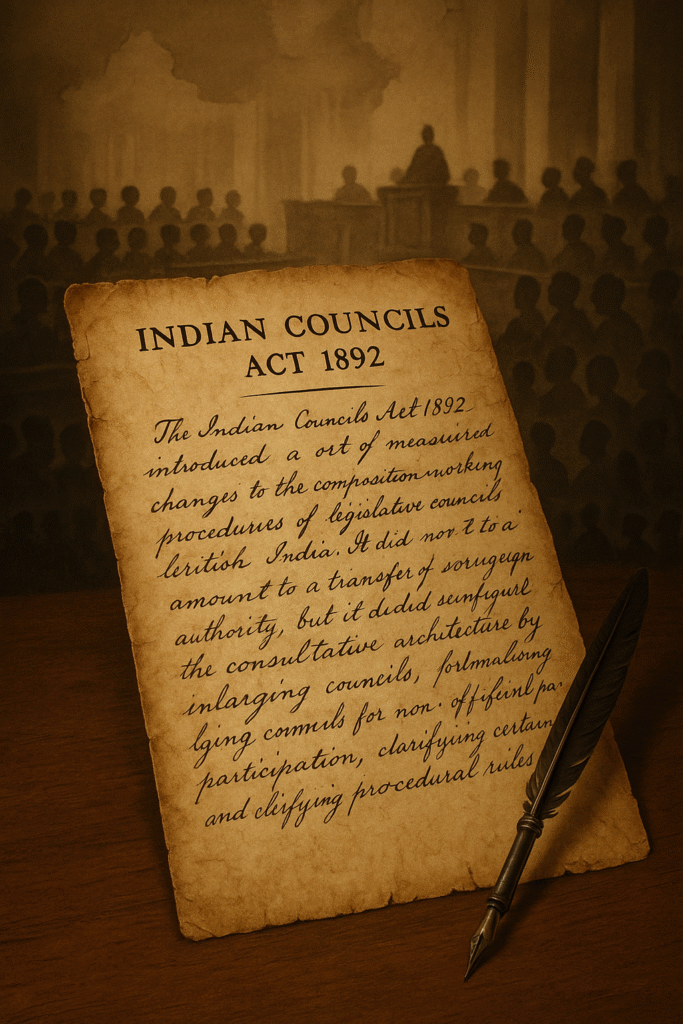
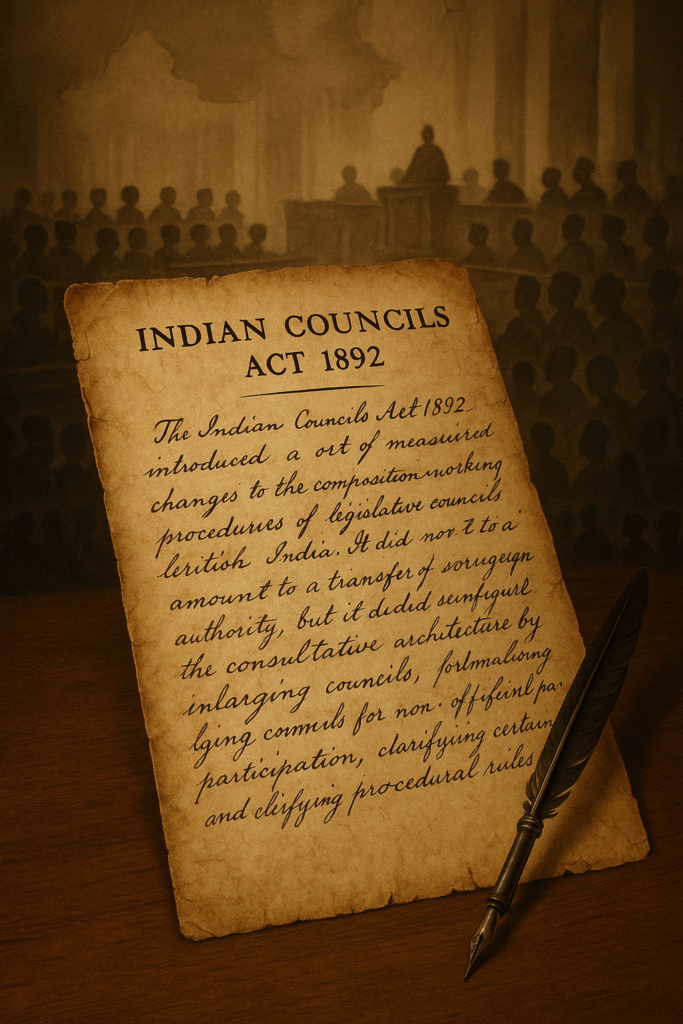
The Indian Councils Act 1892 introduced a set of measured changes to the composition and working procedures of legislative councils in British India. It did not amount to a transfer of sovereign authority, but it did reconfigure the consultative architecture by enlarging councils, formalising channels for non-official participation, and clarifying certain procedural rules. The following analysis explains those core provisions in plain language and evaluates their practical implications for governance and representation.

Expansion of the Councils

One of the Act’s clearest technical effects was to permit an increase in the number of members in both provincial and central legislative councils. The intention was to create space for a greater number of “non-official” members—representatives drawn from municipal bodies, universities, commerce and other local institutions—so that a broader variety of opinions could be recorded within a formal forum.

Key features of this expansion included:

  • Numerical increase: Councils were allowed to grow in size, enabling the inclusion of additional voices without redesigning the entire institutional framework.
  • Wider social representation: Seats could be occupied by individuals recommended by local bodies such as municipal committees, district boards and university senates, thereby broadening the social and occupational backgrounds represented.
  • Procedural recognition: The Act clarified some aspects of how questions could be raised, how petitions were to be treated, and how non-official members’ contributions should be recorded—measures aimed at making consultative practice more regular and visible.

Despite these changes, expansion did not equate to autonomy. The numerical increase functioned primarily to increase the recording of opinion rather than to shift legislative control. Councils remained advisory in many respects, and their enlarged membership was insufficient to overcome the pre-existing dominance of the executive and appointed officials.

Appointment and Rights of Members

The Act differentiated between two broad categories of council membership: official members (those holding government office) and non-official members (local elites or persons nominated by recognised bodies). It clarified the modalities by which non-official members could be brought into councils and set out certain limits on their tenure and functions.

Important points regarding appointment and rights were:

  • Nomination and recommendation: Many non-official members entered councils not through a universal franchise, but through nomination or recommendation processes. Municipalities, universities and commercial associations were typical recommenders, and in practice local elites often influenced who was suggested.
  • Fixed terms and reappointment: The Act provided for defined terms of service for council members and for rules governing reappointment. This introduced a degree of regularity and predictability in membership, but also preserved the government’s discretion over continuity.
  • Consultative rights: Non-official members were typically empowered to discuss bills, ask questions and put forward resolutions or petitions. However, their capacity to enact or veto legislation—especially on financial matters—remained limited.

The net effect created a form of semi-representative participation. Indian voices were increasingly documented in legislative records and proceedings, but the mechanisms of appointment and the limited scope of practical authority constrained the transformative potential of that participation.

Voting Power and Advisory Role

Perhaps the most politically sensitive aspect of the 1892 Act concerned voting rights and the balance between advisory opinion and decisive authority. The Act clarified certain procedural voting rules but simultaneously preserved wide executive control over key domains—particularly finance and constitutional decision-making.

Some salient features regarding voting and advisory power were:

  • Primacy of advisory functions: Non-official members could voice opinions, submit amendments of a limited kind, and participate in debate; however, the transformation of those opinions into binding decisions typically required the assent of the executive or the vote of a body still dominated by official members.
  • Restrictions on financial authority: Financial proposals and budgetary matters were areas where the executive retained decisive latitude. Councils could discuss and comment, but their direct powers to alter fiscal measures were circumscribed.
  • Formal recording and transparency: A constructive consequence of the Act was that council debates, questions and petitions began to be more systematically recorded. This created a public paper trail that critics and reformers could later cite and mobilise—an important legacy for subsequent political claims.

In short, the Act institutionalised a controlled form of participation: consultative mechanisms were expanded and made somewhat more transparent, but substantive decision-making power continued to rest with the colonial administration. The purpose of this balance was explicit—absorb and pacify moderate demands for inclusion while maintaining executive supremacy.

Takeaway

The Indian Councils Act 1892 reconfigured legislative councils by increasing membership, formalising nomination channels for non-official members, and clarifying procedural rules for debate and record-keeping. These adjustments improved the visibility of Indian opinion within official forums, yet the Act stopped well short of transferring real policymaking power. It therefore represents a calibrated constitutional reform: one that created new consultative spaces and documentary precedents while preserving the centrality of executive authority. Over the long term, those consultative spaces became arenas for argument and documentation that later reformers would build upon.

1892 archival documents petitions council table.png

My Story: How the Act Changed the Way I See Things

For many readers, statutes exist as tidy pages in dusty law books. For me, the Indian Councils Act of 1892 became a living thing the day I began handling petitions, minutes and handwritten notes from a local records room. Those brittle papers revealed not only administrative procedure but human hopes — small, persistent attempts to be heard. Below are three short anecdotes from my own encounters with those documents and the people behind them. Each anecdote concludes with a clear lesson and links back to the technical analysis and historical context in this article (see Main Provisions and Mechanisms and Historical Background).

Anecdote 1: The Panchayat Letter that Refused to be Ignored

While cataloguing local archives I found a letter sent by a village panchayat in 1895 complaining about mining-runoff that destroyed fields and wells. The language was simple, pleading, and full of local names and landmarks. It had been forwarded to the provincial council and the file showed a thin note: “Recorded and placed on file.” There was no dramatic decree in response, but the fact that the grievance had been recorded mattered. That entry ensured the complaint entered the public record and could be cited later by other petitioners.

Lesson: Having a voice formally recorded is a kind of legitimacy. The Act’s procedural changes that made council records and petitions more systematic meant ordinary grievances could accumulate into documentary pressure. This directly connects to the Act’s emphasis on expanded councils and procedural recording, which turned isolated appeals into traceable evidence for later reformers.

Anecdote 2: The Teacher Who Was Heard but Not Heeded

I once interviewed descendants of a teacher whose name appeared several times in council minutes as a proposed non-official member. He submitted a short proposal for modest curriculum reforms and even secured a formal “mention” in the council’s proceedings. Yet when budgets were drawn up, few changes followed. The teacher’s tone in a private letter I found — a quiet disappointment rather than outrage — stayed with me. He felt that being consulted without real influence was a doubtful consolation.

Lesson: Consultation without commensurate policy power can dampen expectations. The Act did extend access but maintained executive dominance, particularly in financial matters. The teacher’s experience illustrates the gap discussed in the sections on appointment, rights and voting limitations, reminding us that representation can be partly symbolic unless structural authority changes.

Anecdote 3: The Young Lawyer Who Turned Questions into Momentum

At a public meeting I attended in a small town, a young lawyer — who later showed up in council suggestions lists — delivered a vigorous speech shadowing the issues in a recent council debate. His motion carried no immediate legislative effect, yet people in the crowd began to speak in terms they had heard: rights, petitions, and appeals to the council. The visible presence of an arena for dialogue — even a limited one — sparked civic confidence. In subsequent months, that lawyer became a focal point for local petitioners.

Lesson: The mere visibility and ritual of consultation produce political habit. The 1892 reforms increased the occasions and forums for public speech; those forums, though constrained, created networks of argument, practice and mobilisation. This outcome echoes the article’s discussion of how consultative spaces function as seeds for broader political organisation in the historical context.

Conclusion and Takeaways

These personal episodes suggest a complex moral: reforms that look small or technical on paper can reshape public life by creating durable practices. Recording a complaint, allowing a non-official member to speak, or offering a formal forum for debate may not immediately transfer power — yet they change expectations and provide tools for future claim-making. The Indian Councils Act 1892 therefore matters not only for its clauses but for the everyday routines and documents it normalised. If consulted and contested properly, those routines become resources for political action.

1892 council impact analysis documents.png

Impact and Critique

The Indian Councils Act 1892 altered the outward shape of colonial governance without fundamentally transferring political control. Its immediate legal effects—expanded councils, formal procedures for petitions and questions, and a greater presence of “non-official” members—produced visible change. Yet the social and political consequences were uneven: the Act generated new opportunities for public voice and record-keeping while simultaneously exposing the limits of consultative reform under imperial rule. Below I examine first the contemporary reactions of students, intellectuals and political leaders, and then assess the Act’s longer-term implications for political practice and institutions. For contextual detail see Historical Background and Main Provisions and Mechanisms.

Students, Intellectuals and Leaders: Mixed Reactions

Educated urban communities—universities, professional associations, and municipal bodies—took a particularly keen interest in the limited openings the Act provided. Many moderate leaders and scholars welcomed the changes as an incremental but practical step toward constitutional participation. The Act’s formal recognition of non-official members and its procedural clarifications made councils slightly more accessible to elites who already had social and educational capital. For these groups, representation through council participation seemed an avenue to influence budgets, raise local grievances and make legal arguments in a public forum.

At the same time, more radical or impatient voices criticized the Act as superficial. Student groups and younger activists, many of whom were gaining political consciousness in university halls and through vernacular publications, argued that the reforms were largely symbolic. They pointed out that nomination and recommendation—rather than popular election—remained the primary route for non-official membership; that fiscal authority and executive discretion were largely untouched; and that formal consultation did not guarantee policy change. Newspapers and pamphleteers amplified this scepticism, framing the Act either as a cautious administrative adjustment or as a tactic to co-opt moderate opinion and blunt the momentum for more substantial reform.

Thus the Act produced a split: some leaders used the new channels pragmatically, seeking to extract incremental benefits and to normalise constitutional means of redress; others intensified demands for broader enfranchisement and stronger institutional checks on executive power. The consequence was a plural, often contentious public discourse that both integrated and polarised political activity in the decades that followed.

Longer-term Implications

Viewed over the long term, the Act’s most durable contributions were procedural and cultural rather than transformative. Three interlocking legacies stand out: the routinisation of consultative practice, the creation of archival records, and the cultivation of political habits.

First, consultative practice—raising questions, lodging petitions and participating in recorded debate—became more regularised. These practices, though often limited in immediate effect, institutionalised ways of making claims that later movements and legal actors could adapt and intensify.

Second, the Act encouraged more systematic record-keeping of debates and petitions. Those records produced an evidentiary trail that reformers, lawyers and historians could later mobilise. Documents that originally seemed to yield little policy change became sources of legitimacy and argument for future campaigns demanding greater rights and accountability.

Third, and perhaps most importantly, the presence of consultative forums nurtured political habits among a range of social actors: local leaders learned to frame grievances in constitutional terms; lawyers and teachers practised public argument; and citizens grew accustomed to the idea of formal petitioning. Over time these habits coalesced into organisational capacity that could be drawn upon in larger, more sustained movements for constitutional change.

Nonetheless, the Act’s limitations were substantive and consequential. Because nomination and elite recommendation dominated access to councils, many poorer, rural and marginalised communities remained excluded from these forums. Financial authority stayed largely with the executive, blunting the councils’ capacity to alter policy outcomes. In practice, the Act therefore widened the space for elite consultation without significantly democratizing decision-making. For social groups outside the circle of elite recommenders, the Act could appear more as token recognition than as meaningful empowerment.

Takeaway

The Indian Councils Act 1892 catalysed new forms of consultation and documentation in colonial governance and helped to normalise constitutional channels of claim-making. Yet its consultative expansion coexisted with substantial continuities in executive control—producing an ambivalent legacy. The Act should be read as an institutional compromise: it created forums that mattered for political practice and historical record, while leaving intact the structural limits that would fuel later demands for deeper reform.

1892 council legacy timeline documents.png

After 1892: Development and Legacy

The Indian Councils Act 1892 is best read not as an endpoint but as an early stage in a longer process of constitutional adjustment. By creating limited consultative space within the colonial administrative framework, the Act set patterns that subsequent reforms would extend, contest, and sometimes overturn. Its immediate legal changes were modest, yet its institutional and cultural consequences reverberated through the twentieth century in three interrelated ways: constitutional trajectory, political organisation, and archival-legal resources.

Constitutional Trajectory

Rather than inaugurating representative government, the 1892 Act institutionalised a mode of incremental reform: gradual enlargement of councils, formal recognition of certain non-official voices, and continued executive primacy. This model produced precedents and vocabularies—about petitioning, nomination, and consultative procedure—that later reformers employed when arguing for more extensive change. Subsequent measures in the early twentieth century drew on the technical and administrative groundwork of 1892, even as political mobilisations pushed for deeper and more democratic transformation.

Political Organisation and Capacity

The Act’s practical effect on political life was to normalise certain routines of engagement. Municipal committees, university senates, and commercial bodies that recommended members to councils became nodes in wider networks of communication and mobilisation. Regularised debates, formal petitions and public records encouraged leaders—lawyers, teachers, merchants—to develop the skills, alliances and reputational capital necessary for larger campaigns. Small victories, public visibility and repeated practice helped convert episodic complaint into organised political habit.

Archival and Legal Legacy

One of the Act’s most durable consequences was documentary. By making council debates, questions, and petitions more routinely recorded, the period produced an evidentiary archive that later actors could mobilise. Documents that initially seemed procedural or symbolic became sources of legitimacy in later constitutional and legal claims. Lawyers and historians could cite council records as precedents or proof of grievance; activists could point to prior discussions as grounds for renewed demands. In this way, the Act’s procedural formalities supplied substantive resources for future struggle.

At the same time, the Act’s limited franchise and nomination mechanisms meant that many social groups—rural poor, labourers, and marginalised castes—remained outside the emerging consultative arenas. The reforms therefore expanded elite consultation more than popular empowerment, which in turn fuelled subsequent political campaigns for broader enfranchisement and institutional accountability.

Takeaway

The Indian Councils Act 1892 mattered less for immediate redistribution of power and more for the institutional practices, documentary traces, and political capacities it helped create. Its legacy is ambivalent: it widened the spaces for consultative politics and produced archival tools for later claim-making, while simultaneously preserving the structural limits that would provoke further demands for democratic reform.

Conclusion: What We Learned and What Comes Next

The Indian Councils Act 1892 was modest in immediate effect but consequential in practice. It widened consultative spaces within colonial governance without transferring decisive authority—yet the procedural openings it created mattered. By enabling more systematic recording of petitions, establishing regular forums for questions and debate, and allowing a limited number of non-official voices into council chambers, the Act helped to normalize constitutional modes of claim-making and produced documentary resources that later actors would mobilize.

Key Takeaways

  • Procedures have power: Formal mechanisms for recording petitions and debates turned isolated complaints into traceable evidence for future advocacy.
  • Representation did not equal control: Nomination-based participation gave voice but not full policymaking power; executive primacy remained the decisive factor.
  • Durable change often grows slowly: The Act’s greatest legacy was cultural—habits of petitioning, debating and public argument that seeded later, more substantial reforms.

Frequently Asked Questions (FAQ)

1. What was the Indian Councils Act 1892?

It was a colonial-era constitutional reform that modestly expanded legislative councils in British India, introduced more non-official members, and formalised procedures for asking questions, submitting petitions and recording debates.

2. Did the Act mark the beginning of democratic governance in India?

Only in a limited procedural sense. While it widened consultative space, it did not transfer decisive policymaking power. Executive control remained dominant, making the Act a small step rather than a democratic breakthrough.

3. What reforms followed after 1892?

Several early 20th-century reforms built upon the patterns established in 1892—gradual council expansion, nomination-based representation and increased debate. These later measures pushed more explicitly toward representative and responsible government.

4. What role did non-official members play?

They could debate bills, raise questions, and submit resolutions or petitions. However, their authority in financial or executive matters was highly restricted, keeping their participation largely advisory rather than decisive.

5. Did the Act benefit all social groups?

No. The opportunities it created were largely accessible to educated urban elites. Many rural, labouring and marginalised communities remained effectively outside the consultative structure.

6. What was the main criticism of the Act?

The principal critique was that it offered symbolic representation without substantive power. Critics argued that it aimed to manage dissent by absorbing moderate voices rather than granting meaningful political authority.

Sources and References

The historical analysis and legal discussion presented in this article draw upon a range of credible primary and secondary sources. These include official legislative records, archival materials, contemporary newspapers, and scholarly works that examine colonial governance and constitutional reforms in British India. For further reading and deeper research, the following references are particularly useful:

  • Government of India Records: Legislative Council Proceedings (1892–1900), National Archives of India.
  • British Parliamentary Papers: India Office Reports on Legislative Reforms (1885–1905).
  • Historical Studies: R.C. Majumdar, History of Modern India; Bipan Chandra, India’s Struggle for Independence.
  • Contemporary Newspapers: The Hindu, Amrita Bazar Patrika, Bombay Gazette (archival issues).
  • Academic Research: Peer-reviewed articles on JSTOR and Oxford Academic covering council reforms and colonial administrative structures.

These sources form the evidentiary foundation of the interpretations provided here, supporting both the constitutional analysis and the socio-political context discussed throughout the article.

Leave a Comment

Your email address will not be published. Required fields are marked *

Scroll to Top