
Plastic Pollution and the Oceans: A Personal Journey Into a Changing World
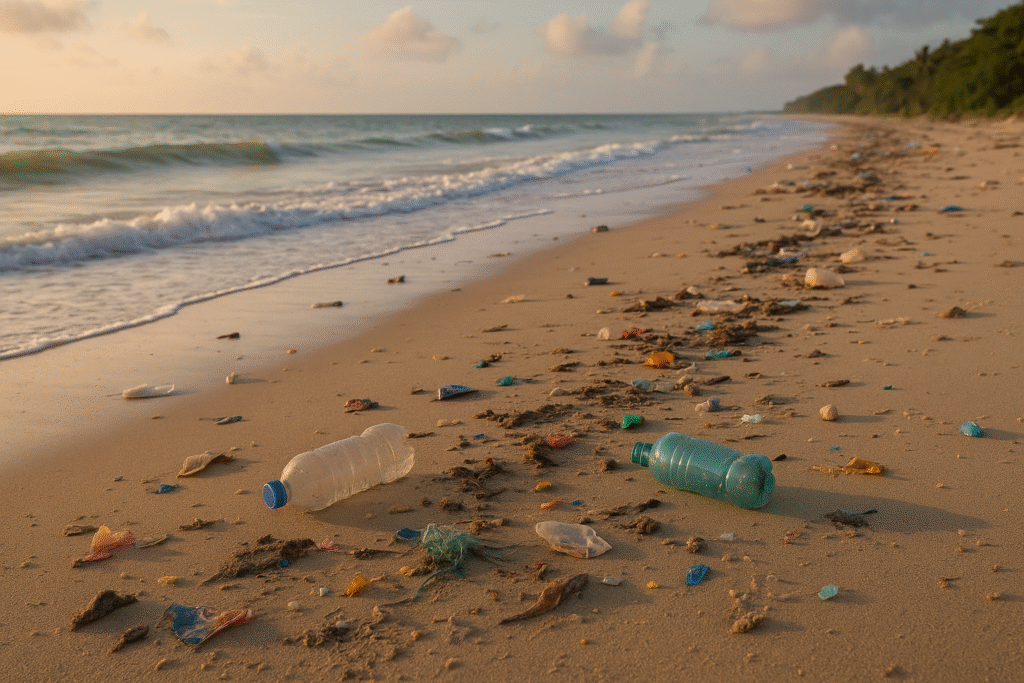
Sometimes a simple moment becomes powerful enough to change the way we think, live, and look at the world. For me, that moment came during a quiet morning walk on a remote beach—a place I had always imagined as pure, untouched, and full of life. The sky was soft with early sunlight, the breeze carried a gentle salty scent, and the waves rolled in with a calm that felt almost meditative. But that peaceful scene shattered when I noticed something floating on the shimmering surface of the water—plastic.
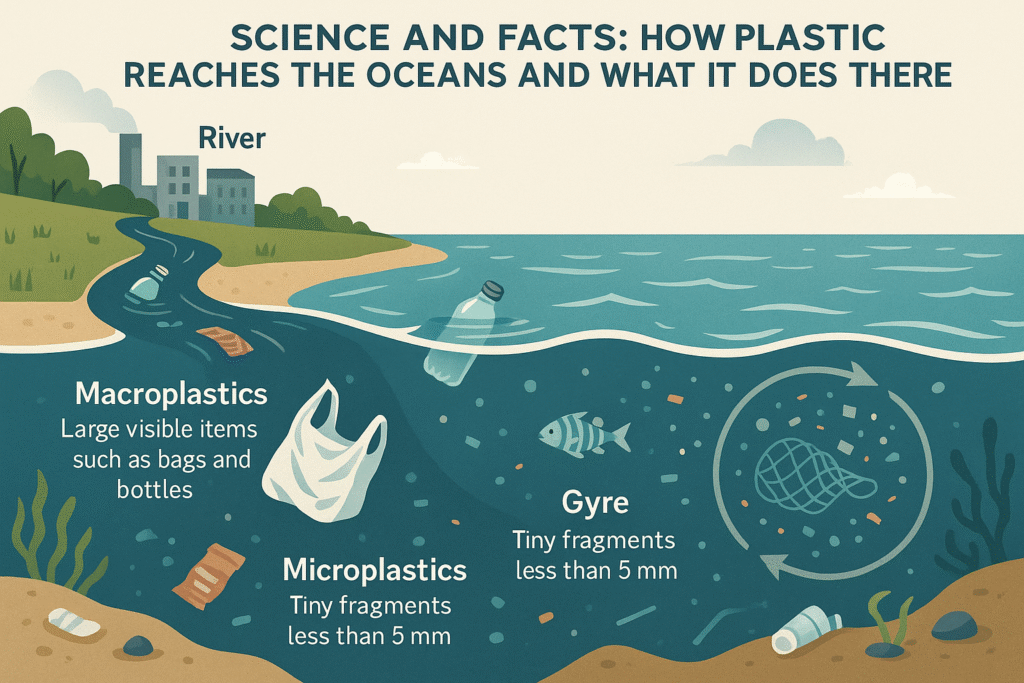
At first, I assumed it was just a stray bottle left behind by a careless visitor. But as I walked further, I began to see more and more of it—broken containers, food wrappers, discarded fishing gear, colorful fragments, and tiny microplastic particles glistening like false jewels. Every incoming wave brought new plastic waste to the shore, as if the ocean itself was trying to return everything humanity had thrown into it.

| 👉 Buy on Amazon |
| As an Amazon Associate I earn from qualifying purchases. | |
Confused and concerned, I spoke with a few local fishermen who were preparing their nets. Their expressions said more than words. They told me how, in recent years, marine creatures have been declining—fish caught with plastic in their stomachs, sea turtles trapped in plastic rings, and coral reefs suffocating under layers of waste. Their stories were not complaints; they were quiet cries for help—from people whose lives depended on a healthy ocean.
I stood there in silence, realizing the uncomfortable truth. We use plastic in cities and homes far from the coast, yet the ocean pays the biggest price. The problem wasn’t just visible on that beach—it was deep, widespread, and heartbreakingly real. Plastic pollution was no longer a distant global issue; it had become a story unfolding right before my eyes.
That morning changed something inside me. I understood that “plastic pollution” isn’t just an environmental term— it’s a growing threat silently poisoning the heart of our planet. It’s a story of marine life struggling to survive, of communities losing their livelihoods, and of an ocean fighting against the weight of our consumption-driven habits.
From that moment on, I promised myself to learn more, speak louder, and share these truths with others. Because real change begins with awareness—and awareness begins with a story.

| 👉 Buy on Amazon |
| As an Amazon Associate I earn from qualifying purchases. | |
3. My Personal Observations: Three Moments That Changed How I Look at the Ocean
After witnessing how plastic reaches the ocean and transforms into a silent killer, I began paying closer attention to the places I visited, the people I met, and the small details that often go unnoticed. Over time, I encountered three moments—three stories—that reshaped my understanding of what plastic pollution truly means. These experiences were not statistics or research findings; they were emotional, real, and impossible to forget. They revealed the human side, the ecological side, and the generational side of this crisis.
3.1 A Calm Morning and an Injured Sea Turtle (≈250–350 words)
It was a peaceful morning—the kind where the sky slowly turns golden, the waves whisper gently, and the world feels untouched. As I walked along a quiet stretch of beach, I saw something struggling near the shoreline. At first, I thought it was driftwood caught in the waves, but when I moved closer, I realized it was a sea turtle. Its neck was trapped inside a tight plastic ring, the kind used to hold bottle packs together.The turtle kept lifting its head out of the water, as if gasping for relief, only to fall back in pain. Its shell was scratched, and deep wounds marked its skin where the plastic had been cutting into it for weeks—maybe months.A few local fishermen rushed over to help. One of them, an elderly man with sunburnt skin, shook his head and said, “This used to be a healthy place. Now every week we find turtles, fish, or birds tangled in plastic.”We carefully cut the ring and freed the turtle. It tried to swim away, weak but determined, leaving behind ripples that seemed to carry a message—one we humans often ignore. Watching it disappear into the water, I felt both relief and guilt. Relief that we helped it. Guilt that our plastic had put it in danger in the first place.In that moment, it struck me: plastic pollution is not just about trash in the ocean. It is about suffering—silent suffering that very few people ever see.

| 👉 Buy on Amazon |
| As an Amazon Associate I earn from qualifying purchases. | |
3.2 The Fishermen’s Nets Filled With Plastic Instead of Fish (≈300–400 words)
The second incident happened in a small coastal village where fishing was not just an occupation— it was a heritage passed down through generations. I joined a group of fishermen one morning, hoping to understand their connection with the sea. Their boat smelled of salt, diesel, and years of hard work.When they pulled out their first net of the day, I expected to see fish shimmering under the sunlight. Instead, the net was heavy with plastic bottles, torn wrappers, broken toys, old sandals, food containers, and countless fragments of colorful plastic debris. There were barely a few fish struggling among the trash.One fisherman, Ramlal, sighed deeply and said, “Years ago, these nets were full of life. Now they carry the waste of people we will never meet. We did not create this plastic, but we are paying its price.”He held up a crushed bottle and added, “This bottle traveled from somewhere far away. Maybe a city. Maybe a river. But it ends up here, in our nets, in our hands, in our lives.”Their boat kept filling with plastic faster than fish. They had to stop twice to clean out the nets before setting them again. What struck me most was the look of quiet fear on their faces—not for themselves, but for their children.Fishing was their identity. But plastic was slowly erasing that identity, replacing hope with uncertainty.Watching them struggle made me realise that ocean plastic is not only an environmental problem. It is an economic problem, a social problem, and a human problem.
3.3 Children Playing on a Plastic-Littered Beach (≈300–380 words)
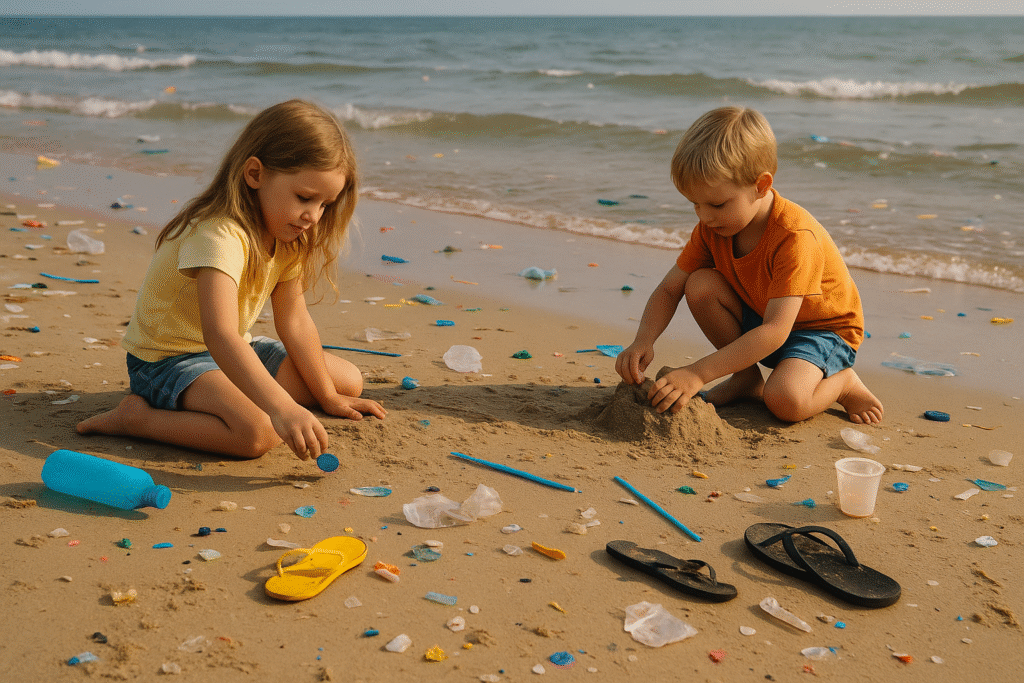
The third moment was the most emotional—because it involved children. I visited a popular beach one afternoon where families were relaxing, and children were building sandcastles, racing with the waves, and laughing freely. Their joy was infectious.But as each wave reached the shore, it brought with it hundreds of plastic pieces—bottle caps, straws, broken flip-flops, food wrappers, and tiny microplastic fragments that sparkled like fake jewels in the sun.One little girl picked up a bright blue plastic piece and cheerfully said, “Look, it’s so pretty!” Her mother immediately took it from her hands and threw it away, saying softly, “This is not pretty, sweetheart. This is what’s making the ocean sick.”The little girl looked confused, and I felt a knot in my chest. How do you explain to a child that the ocean, a place of joy and magic, is being suffocated by human carelessness?Nearby, a group of volunteers was conducting a beach cleanup. They told me they collect several bags of plastic each week, yet every new tide brings more. “It feels endless,” one volunteer said. “But we can’t give up. If we don’t fight, these kids will inherit a coastline made of plastic instead of sand.”That sentence stayed with me long after I left. It reminded me that this crisis is not just ours—it belongs to the next generation. Their laughter will someday be replaced by worry if the ocean continues to drown in plastic.Standing on that beach, I realized that plastic pollution threatens more than marine life. It threatens childhood itself. It threatens wonder. And it threatens the simple, beautiful moments that every child deserves.
4. Impacts: How Plastic Pollution Affects Ecology, Economy, and Human Health
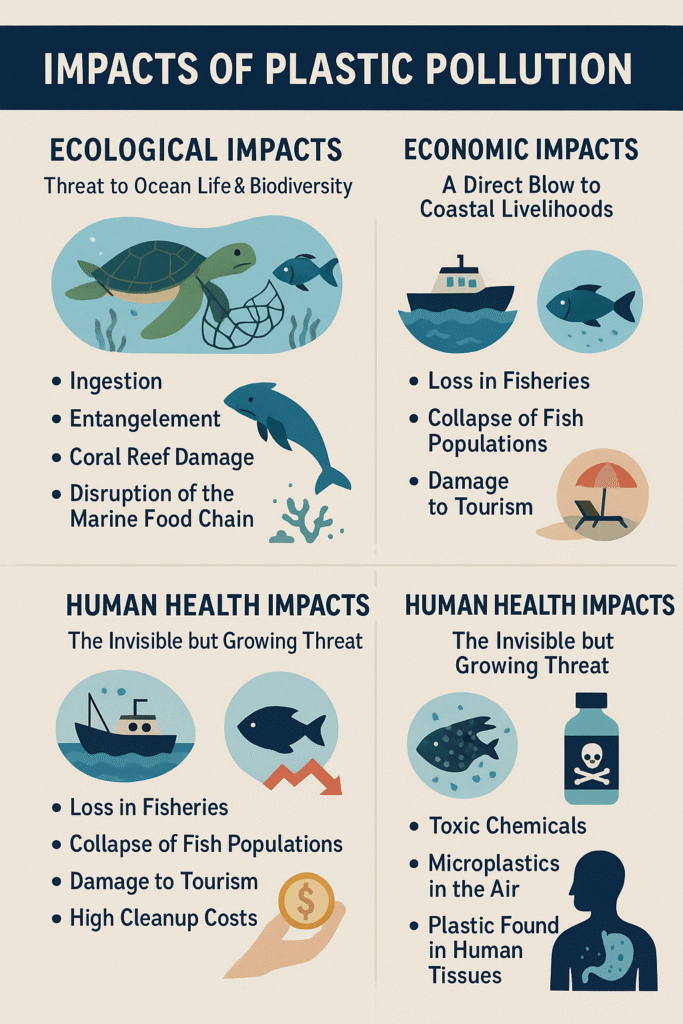
The impact of plastic pollution extends far beyond what we see on beaches or floating on the ocean surface. Its consequences are deeply rooted in marine ecology, the livelihoods of coastal communities, and even the health of human beings. This crisis is not isolated—it is interconnected, long-lasting, and powerful enough to reshape ecosystems and societies. In this section, we explore the multi-layered impacts of plastic pollution.
4.1 Ecological Impacts: A Threat to Ocean Life and biodiversity
The ocean is home to more than half of Earth’s biodiversity. It regulates climate, produces oxygen, and supports life systems that sustain the planet. However, plastic pollution has disrupted these delicate ecosystems.
1. Ingestion (Eating Plastic Mistaken as Food): Many marine species mistakenly eat plastic. Sea turtles often confuse plastic bags with jellyfish. Seabirds swallow colorful fragments assuming they are food. Fish, crabs, and shellfish ingest microplastics because the particles resemble plankton or small prey. Once inside their bodies, plastic causes blockages, internal injuries, starvation, and eventually death.
2. Entanglement (Being Trapped in Plastic Waste): Discarded fishing nets, ropes, and plastic straps entangle dolphins, seals, sea lions, turtles, and birds. These “ghost nets” can cut into their flesh, restrict movement, prevent them from surfacing for air, and often lead to slow and painful deaths.
3. Coral Reef Damage: Floating plastics frequently get stuck on coral reefs, injuring them and causing infections. Corals are vital—often called the “rainforests of the sea”—and their destruction weakens entire marine ecosystems.
4. Disruption of the Marine Food Chain: Plankton—the foundation of marine food webs—consume microplastics. These particles then accumulate up the food chain, affecting fish, seabirds, and eventually humans. A poisoned base means a poisoned ecosystem.
When marine ecology collapses, the ocean loses its balance. And when the ocean suffers, the entire planet feels the consequences.
4.2 Economic Impacts: A Direct Blow to Coastal Livelihoods
Plastic pollution is not only an environmental issue; it is an economic disaster for communities that depend on healthy oceans. Fisheries, tourism, and coastal infrastructure all face growing challenges as the ocean fills with debris.
1. Loss in Fisheries: When nets pull up more plastic than fish, fishermen lose income. Many species are declining due to habitat damage and ingestion of plastic. This reduces catch size and threatens the future of marine-based livelihoods.
2. Collapse of Fish Populations: Plastic affects reproductive ability in several marine species. As fewer fish survive to adulthood, populations shrink. The economic effects of this decline may last decades.
3. Damage to Tourism: Beaches littered with plastic drive tourists away. Hotels, restaurants, boat tours, and local businesses all suffer when coastlines become polluted. For many regions, tourism losses amount to millions of dollars each year.
4. High Cleanup Costs: Coastal cities and governments spend enormous resources cleaning beaches, rivers, and ports. Yet the problem repeats because plastic continues to flow from upstream sources.
Plastic pollution, therefore, erodes not just ecosystems but also livelihoods, identity, and long-term economic stability for communities around the world.

| 👉 Buy on Amazon |
| As an Amazon Associate I earn from qualifying purchases. | |
4.3 Human Health Impacts: The Invisible but Growing Threat
Perhaps the most alarming consequence of plastic pollution is its direct impact on human health. Plastic is now entering our bodies through food, water, and even the air we breathe.
1. Microplastics in Food: Seafood—especially fish, crabs, and shellfish—often contains microplastics. When humans consume these foods, the particles enter our digestive system and may accumulate in our tissues.
2. Toxic Chemicals: Plastics contain harmful chemicals such as BPA, phthalates, and flame retardants. These substances can disrupt hormones, affect fertility, alter metabolism, and weaken the immune system.
3. Microplastics in the Air: Tiny plastic particles from synthetic fabrics, car tyres, and urban dust float in the air and can be inhaled. These particles may irritate the lungs and contribute to respiratory diseases.
4. Plastic Found in Human Tissues: Recent studies have detected microplastics in human blood, lungs, and even the placenta. This indicates that plastic pollution is not just an environmental problem—it has entered our biological systems.
Plastic acts like a slow poison, silently accumulating in the environment and inside our bodies. Its long-term health consequences are still being studied, but the early signs prove one thing: the danger is real, widespread, and urgent.
Ultimately, plastic pollution is a combined ecological, economic, and health crisis. It threatens the ocean’s life, the livelihood of millions, and the well-being of human generations to come.
5. Solutions: From Personal Actions to Global Policies — What We Can Do
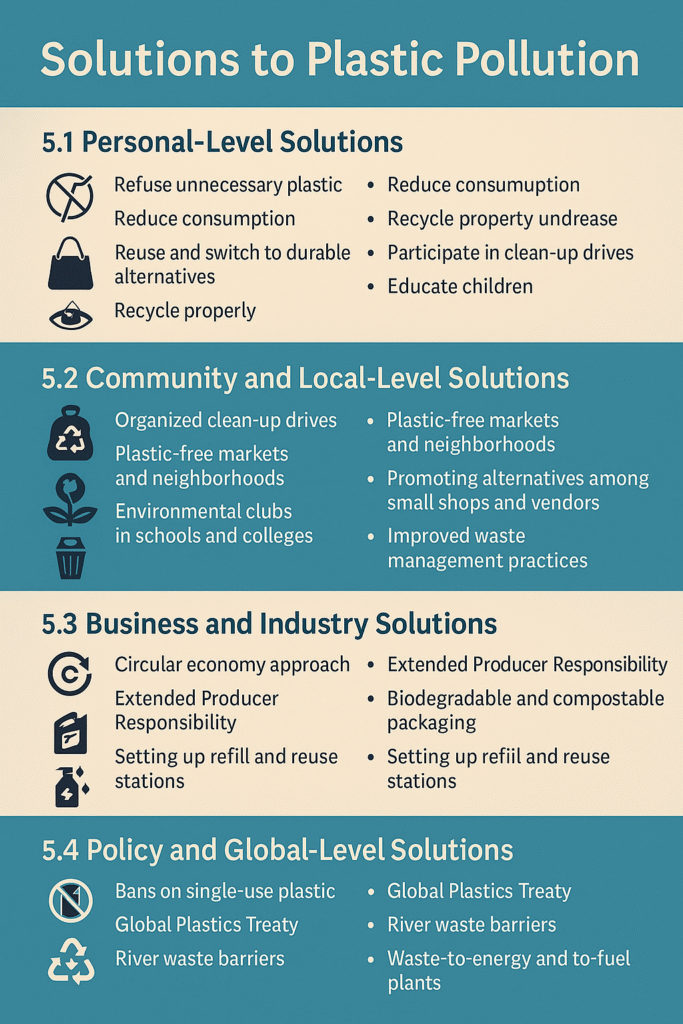
Plastic pollution may seem overwhelming, but solutions exist at every level of society. From individual steps to community-led initiatives, from business innovations to global policies, every action contributes to reducing the plastic burden on our oceans. The key to change is understanding that this crisis can be reversed—not by one solution alone, but through a collective chain of solutions working together. Below is a complete roadmap of what we can do at multiple levels.
5.1 Personal-Level Solutions: Small Daily Actions With Huge Impact
Change begins at home. Individual choices may feel small, but when millions of people make the same environmentally conscious decisions, the impact is enormous. Here are practical daily steps anyone can adopt to reduce plastic pollution:
- 1. Refuse unnecessary plastic: Say no to plastic straws, disposable cutlery, extra packaging, and single-use bags. The easiest way to reduce waste is to stop it from entering your life in the first place.
- 2. Reduce consumption: Choose products with less packaging, buy in bulk, and avoid overly packaged snacks and consumer goods.
- 3. Reuse and switch to durable alternatives: Stainless steel bottles, cloth bags, glass containers, and reusable cups significantly reduce single-use plastic waste.
- 4. Recycle properly: Separate dry and wet waste, clean plastic containers before recycling, and ensure they reach authorized recycling facilities.
- 5. Reduce microplastic release: Synthetic clothes shed microfibers during washing. Choose cotton, linen, and other natural fabrics when possible.
- 6. Participate in clean-up drives: Beach or river clean-ups not only remove waste but also inspire others to join.
- 7. Educate children: Teaching kids about plastic-free living builds responsible future generations.
Though simple, these actions form the foundation of global change. A cleaner planet begins with conscious choices made by individuals.
5.2 Community and Local-Level Solutions: When People Work Together
Communities have the power to create long-lasting impact. When a neighborhood, school, market, or village works together, plastic pollution can be drastically reduced. Collective action multiplies the effect of individual efforts.
- 1. Organized clean-up drives: Weekly or monthly beach, lake, or river clean-ups prevent plastic from entering the ocean and strengthen community spirit.
- 2. Plastic-free markets and neighborhoods: Some communities declare entire zones as “No Plastic Zones.” This model often inspires other areas to adopt similar initiatives.
- 3. Environmental clubs in schools and colleges: Young people bring energy, creativity, and long-term commitment. Activities like awareness sessions, recycling competitions, and plastic audits make a difference.
- 4. Promoting alternatives among small shops and vendors: Providing paper bags, cloth bags, or biodegradable packaging helps reduce plastic at local levels.
- 5. Improved waste management practices: Installing trash traps on drains, improving waste collection schedules, and setting up small recycling centers can prevent massive plastic leakage.
When a community works together, it becomes a force stronger than any policy. Local action protects local ecosystems—and that protection ripples outward.
5.3 Business and Industry Solutions: Responsibility at the Production Level
Businesses play a crucial role in shaping plastic use. They are part of the problem but also essential to the solution. If industries adopt responsible practices, the flow of plastic into oceans can be reduced by nearly half.
- 1. Circular economy approach: Designing products so they can be reused, repaired, or recycled multiple times.
- 2. Extended Producer Responsibility (EPR): Companies take responsibility for collecting and recycling the waste created by their products. Many countries are now making EPR mandatory.
- 3. Biodegradable and compostable packaging: Switching from plastic to plant-based or compostable materials reduces long-term pollution.
- 4. Setting up refill and reuse stations: Stores offering refill options for detergents, cereals, oils, and soaps greatly cut down plastic packaging.
- 5. Investment in waste management technology: AI-based sorting systems, compactors, shredders, and advanced recycling technologies improve waste recovery and reduce landfill pressure.
| 👉 Buy on Amazon |
| As an Amazon Associate I earn from qualifying purchases. | |
Businesses influence millions of consumers. When they lead responsibly, society follows.
5.4 Policy and Global-Level Solutions: Long-Term, Systemic Change
While individual and local actions create momentum, large-scale success requires strong governmental policies and international cooperation. Plastic pollution is a global crisis, and only unified global action can reduce it permanently.
- 1. Bans on single-use plastic: Many countries have already banned certain items, reducing plastic waste by up to 30% immediately.
- 2. Global Plastics Treaty: Nations are working toward an international agreement to control plastic production and manage plastic waste worldwide.
- 3. River waste barriers: Since rivers carry large amounts of plastic into oceans, installing barriers can prevent nearly half of river-driven pollution.
- 4. Waste-to-energy and waste-to-fuel plants: Hard-to-recycle plastics can be converted into energy or fuel, reducing environmental load.
- 5. Ocean and environmental education in school curricula: Awareness at a young age creates a generation that values and protects nature.
Policy gives direction, communities give strength, and individuals create the spark. Only when all three work together can we build a world free from plastic pollution.
The ocean gives us life—oxygen, food, climate balance, and beauty. In return, it asks for care and responsibility. The real solution begins the moment we decide to respect the ocean as much as it supports us.