
Introduction and Historical Background of Rigvedic Society
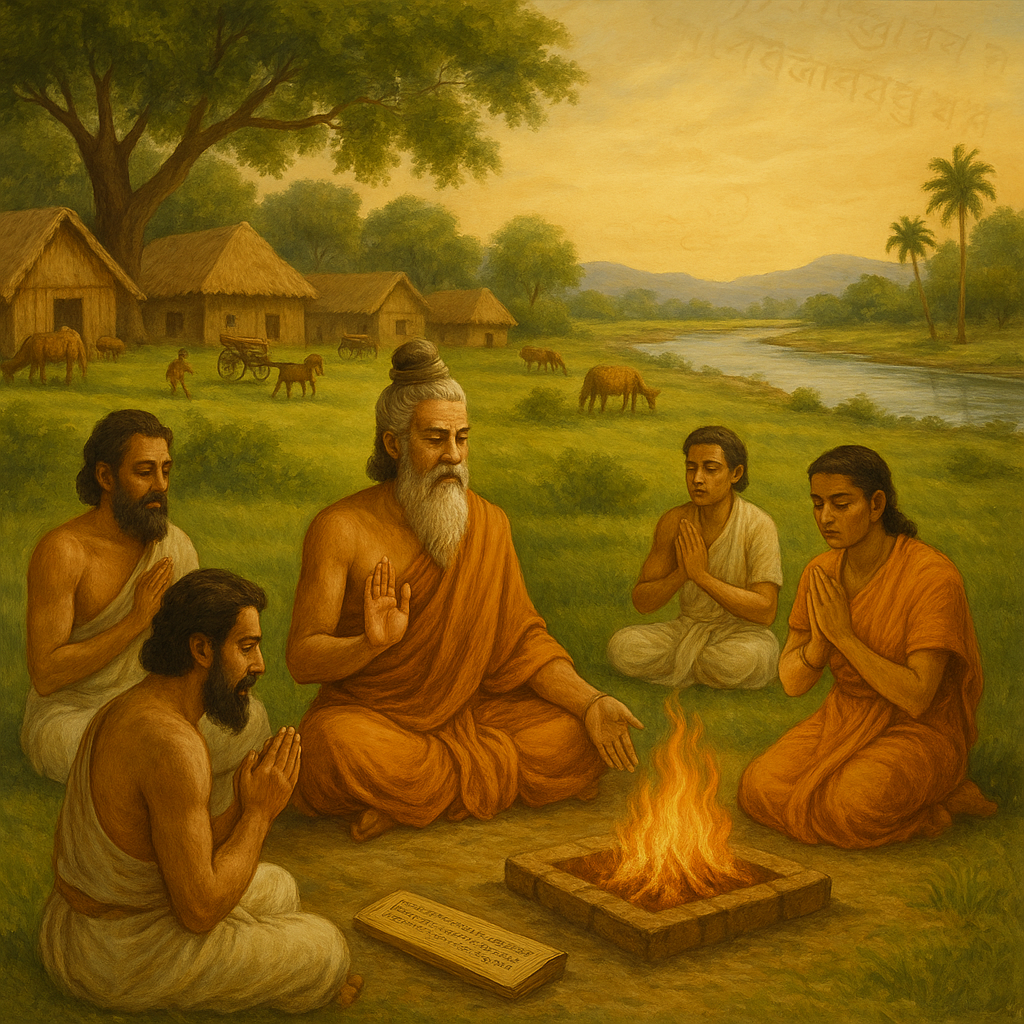
The Vedic Age occupies a foundational place in the history of South Asia — a period when ritual, poetry, and communal life combined to shape lasting social patterns and spiritual ideas. Within this broader framework, Rigvedic Society represents the earliest and most formative phase of Vedic civilization. Often referred to as the early Vedic period, the Rigvedic Society is particularly important because it preserves a large body of hymns and references that give us a window into the everyday concerns, values, and worldviews of early Indo-Aryan speaking communities. Far from being a static or monolithic culture, this society was dynamic, adaptive, and rooted in close relationships with its natural surroundings. In this section we outline the broad historical contours and then focus on the two key anchors — the textual sources (primarily the Rigveda) and the geography that sustained this civilization.
Scholars reconstruct the Vedic Age and the development of Rigvedic Society by combining linguistic evidence, comparative textual study, archaeology, and ecological inference. The picture that emerges is of small, often semi-nomadic and village-centered communities that gradually settled into more permanent riverine and plain environments. Social life revolved around rituals, cattle and pastoral wealth, reciprocal obligations among kin and clan, and a priestly culture that transmitted sacred knowledge through memorized chants and oral disciplines. The result is an intricate blend of religion, economy, and social practice — one that continues to inform later Indian thought and institutions.

| 👉 Buy on Amazon |
| As an Amazon Associate I earn from qualifying purchases. | |
Timeframe of the Vedic Age and Sources (Role of the Rigveda)
Dating the Vedic Age precisely is difficult and has been the subject of substantial scholarly debate. A commonly used broad window places the early Vedic or Rigvedic phase roughly between the late second millennium BCE and the early first millennium BCE. Rather than single-point dates, researchers rely on internal linguistic layers, comparative philology, and cultural markers to order the development of the texts. The Rigveda itself — a collection of hymns addressed to deities and natural forces — is the oldest and most crucial textual witness for understanding Rigvedic Society.
The Rigveda contains ten books (mandalas) and over a thousand hymns composed in archaic Sanskrit. Its verses praise gods such as Indra, Agni, and Soma, but they also record social practices, references to cattle, pastures, seasonal cycles, and conflict. Because the Rigvedic corpus was preserved through rigorous oral tradition, its language retains extremely archaic features that are valuable for reconstructing both religious practice and aspects of material culture. In short, the Rigveda acts as both sacred scripture and an ethnographic source that allows historians to infer patterns of economy, ideology, and social organization within Rigvedic Society.
Geographical Context — Rivers, Environment, and Everyday Life
Geography shaped life in Rigvedic Society in decisive ways. Early communities were centered in the northwestern parts of the South Asian subcontinent, inhabiting river valleys, plains, and fertile stretches where water and pastures supported mixed pastoral and agrarian economies. Rivers and seasonal watercourses were lifelines: they supplied drinking water, enabled grazing, supported some forms of cultivation, and provided natural corridors for movement and exchange. In the hymns the landscape — rivers, mountains, pastures and forests — is often invoked with sacred language, reflecting how closely religious imagination and environmental reality were entwined.
The environment of the period was more varied than later arid descriptions suggest: grasslands, floodplains, and wooded tracts offered grazing for cattle and wild resources for communities. Such ecological diversity supported a mixed economy where cattle wealth functioned as a key social measure, while emerging cultivation supplemented subsistence and allowed for settled hamlets. Daily life in Rigvedic Society therefore balanced mobility with increasing sedentarization — seasonal movements for pasturing alongside the slow rise of permanent settlements.
Economy and Daily Life in Rigvedic Society
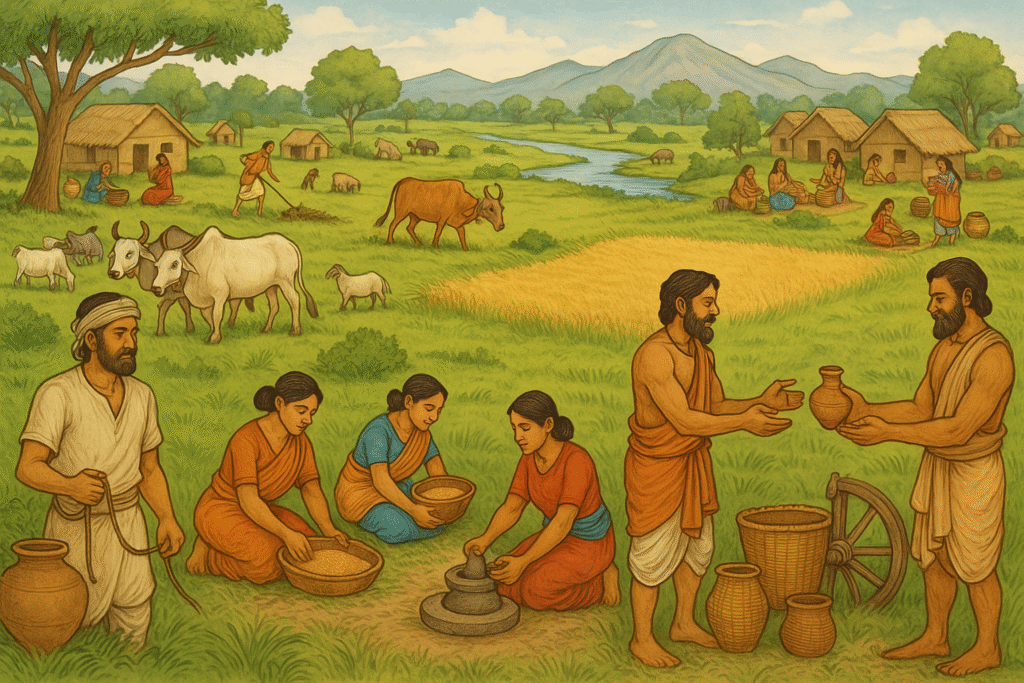
The economic foundations and daily routines of Rigvedic Society were deeply intertwined. Communities depended on local natural resources — pastures, rivers, woodlands, and arable strips — and structured their social, religious and familial life around these resources. Wealth was measured less by coin and more by livestock and productive land. In Rigvedic Society, cattle in particular functioned as a medium of exchange, a store of value, and an important symbol of social status. At the same time, developing practices of cultivation, craft and exchange slowly created more settled patterns of life that balanced mobility with growing permanence.
Pastoralism, Agriculture, and Trade in Rigvedic Society
Pastoralism occupied a central place in the economy of Rigvedic Society. Herds of cows, sheep, goats and horses provided milk, ghee, hides and draft animals; these products were essential for household consumption, ritual offerings and social gifting. The prominence of cattle in the hymns and the frequent references to pastoral wealth underline how livelihood, ceremony, and prestige were connected. Over time, agricultural activity became more pronounced. Cereals such as barley and millets were cultivated, and the introduction of basic ploughing and sowing techniques allowed communities to settle in favourable floodplains.
Trade in Rigvedic Society was mostly local and operated through barter. Surplus grain, livestock, pottery and handcrafted goods were exchanged between neighbouring settlements and seasonal markets. River channels and overland routes enabled movement of people and goods, while reciprocal gift-giving during rituals reinforced social bonds and redistributed resources. Though long-distance merchant networks of later ages had not yet formed, there is evidence of specialist crafts — metalworking, textile-making, and pottery — which supported early exchange networks and added diversity to the local economy.
| 👉 Buy on Amazon |
| As an Amazon Associate I earn from qualifying purchases. | |
Village Life versus Urban Centers in Rigvedic Society
The majority of people in Rigvedic Society lived in village-based settings organized around kinship, clan ties and shared access to pasture and water. Villages operated as cooperative units: decisions were typically resolved through assemblies of elders or leading families, and communal obligations — such as contributions to ritual offerings — helped maintain cohesion. Daily life emphasized mutual dependence, shared labour, and the transmission of customary knowledge from elders to younger generations.
Small town-like clusters or proto-urban centres also existed within Rigvedic Society, though they were not comparable to the fully urbanized cities of later civilizations. These centres often functioned as nodes for specialized craft production, ritual activity and limited trade. Where multiple lineages and specialists gathered—priests, artisans, and occasional merchants—the pace of exchange increased and social interactions broadened. Still, the overall pattern remained predominantly rural, with urban features present in embryonic form.
Everyday Tasks, Useful Objects, and Technology
Everyday work in Rigvedic Society combined routine tasks with ritual duties. Men commonly tended herds, maintained pastures, guarded community holdings and managed seasonal agricultural tasks. Women played central roles in household management, food processing (including churning butter and preparing grains), weaving, and the preparation of ritual offerings. Children learned practical skills through participation in family tasks — a living apprenticeship that reinforced social values and occupational continuity.
Material culture in Rigvedic Society was modest but highly functional. Pottery, woven textiles, carved wooden implements, simple ploughs and sickles, and stone or bronze tools were all part of daily life. Fire technology — from cooking hearths to specialised ritual fires — held both domestic and sacred importance. Craftsmanship shows attention to local materials: leatherwork, bone tools, basketry, and early metallurgy were adapted to community needs.
The economic and day-to-day arrangements of Rigvedic Society teach a number of enduring lessons: resource awareness, the value of distributed (non-monetary) wealth, the importance of social reciprocity, and the virtue of skills transmitted across generations. Even in contemporary contexts, the balance between mobility and settlement, community-based resource management, and practical, low-impact technologies remain relevant for sustainable livelihoods.
Religious Practices and Yajña Culture in Rigvedic Society
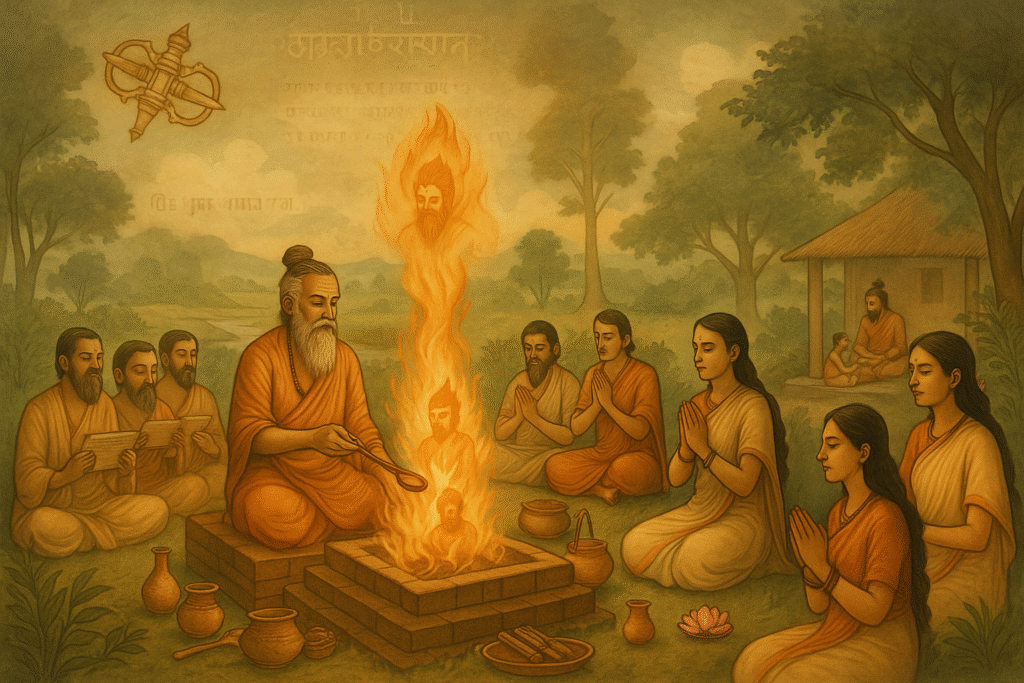
Religious life in Rigvedic Society was not confined to private devotion; it shaped communal identity, economic redistribution, and moral order. Rituals, hymns, and public sacrifices (yajñas) structured time and social interaction, providing regular occasions for collective participation, gift-giving, and reaffirmation of shared values. In Rigvedic Society, the sacred and the social were braided together: liturgy organized social obligations, while community structures gave ritual its force. In what follows we explore the primary gods, the social meaning of yajña, and the institutional forms—mantras, āśramas, and priests—that sustained this ritual culture.
Major Deities in Rigvedic Society: Indra, Agni, Soma and Others
The pantheon of Rigvedic Society is rich and somewhat different from later classical Hinduism. Several deities dominate the hymns because they embody forces that mattered most to early communities. Indra appears as the warrior and storm-god — a symbol of martial courage, the breaker of obstacles and the bringer of rains. Many hymns celebrate his feats, especially the slaying of Vṛtra, a mythic act that releases waters and fertility for humankind.
Agni, the fire, holds a central mediating role in Rigvedic Society. As the household hearth and the sacrificial fire, Agni is the communicator between humans and gods: offerings poured into the fire are believed to reach the gods through Agni’s agency. Agni’s presence ties domestic life to public sacrifice, and his invocation is essential in almost every ritual context.
Soma is complex — a sacred plant or its pressed juice, a ritual drink, and a divinized power. Soma’s consumption in ritual intoxication is associated with ecstatic insight, poetic inspiration, and poetic praise. The hymns addressed to Soma describe its energizing and purifying effects, binding the community of Rigvedic Society through shared ritual experience.
Alongside these principal figures are a constellation of other powers — Varuṇa (cosmic order and moral oversight), Pūṣan (guide and protector), the Maruts (storm-entities), and various nature-forces invoked as deities. Together these gods reflect the worldview of Rigvedic Society, in which social life, environment, and cosmic order are inseparable.

| 👉 Buy on Amazon |
| As an Amazon Associate I earn from qualifying purchases. | |
The Social and Religious Meaning of Yajña in Rigvedic Society
Yajña (sacrifice) was the focal practice that bound Rigvedic Society together. It combined liturgical precision with communal consumption: offerings were presented to gods, priests performed exacting rites, and the ritual culminated in shared feasting and redistribution. This cycle transformed ritual giving into social capital — kings and notable households used yajña to display generosity, consolidate alliances, and reaffirm political legitimacy.
Yajñas operated at multiple scales within Rigvedic Society. Household rites regulated life-cycle transitions — birth, marriage, death — while larger public sacrifices mobilized wider networks and redistributed wealth. A well-conducted yajña created reciprocal obligations: patrons gave gifts to priests and guests, recipients reciprocated in time or service, and networks of obligation helped stabilize social order. Thus the ritual had political, economic, and moral dimensions, not merely a theological one.
Importantly, yajña also functioned as an ethical technology in Rigvedic Society: it taught discipline (through ritual order), encouraged generosity (through gift-giving), and reminded participants of interdependence (through communal consumption). The ceremonial calendar, tied to seasons and pastoral cycles, knitted spiritual concerns to ecological realities.
https://gsstudyhub.com/kautilya-arthashastra-timeless-economic-wisdom/Mantras, Āśramas, and the Place of Priests in Rigvedic Society
Mantras — metrically arranged, orally transmitted hymns — were the engine of ritual power in Rigvedic Society. Their correct pronunciation, rhythm, and intonation mattered; precision was believed to affect the efficacy of the ritual. The oral schooling that produced such performers demanded long apprenticeships and strict memory training, ensuring cultural continuity across generations.
Educational and social forms such as āśramas or gurukulas functioned as centers where young members of Rigvedic Society learned ritual, ethics, and practical skills. Teachers (ṛṣis or gurus) combined spiritual instruction with social mentorship, reinforcing a shared cultural repertoire and transmitting specialized knowledge in an oral civilization.
Priests (hotṛs, adhvaryus, udgātṛs — different ritual specialists) held authoritative positions in Rigvedic Society because they guaranteed the correct performance of rites. Their role was technical (performing rites), social (mediating disputes, advising patrons), and educational (teaching mantras and techniques). While priests did not always wield direct political authority, their ritual expertise lent moral weight to decisions and cemented their role as cultural custodians.
In sum, religious life in Rigvedic Society was an embodied system: gods, sacrifices, chants, teachers, and communal ritual all worked together to form a coherent social order. These practices taught discipline, distributed resources, and integrated ecological rhythms into social calendars — lessons that continue to offer insight into how ritual can shape ethical and communal life today.
Politics, Leadership, and Warfare
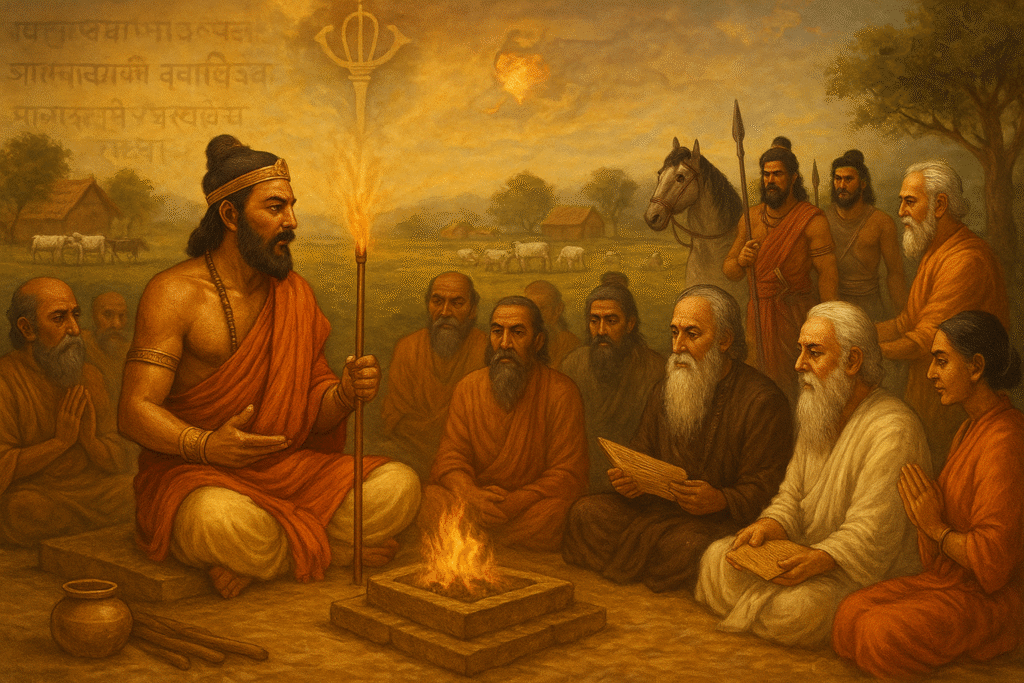
Political life in the Rigvedic world combined local autonomy, communal decision-making, and the occasional assertion of martial power. Authority was distributed: kings (rājan) and chiefs played prominent roles, but their legitimacy rested on consent, prestige, and the backing of assemblies rather than absolute command. This mixed arrangement allowed communities to respond to threats and opportunities while retaining social cohesion and shared responsibility.
Leadership therefore had multiple faces — the rājan as protector and war-leader, elders and clan heads as custodians of local order, and ritual specialists as moral and diplomatic advisors. Rather than a rigid bureaucracy, power operated through networks of allegiance, gift-exchange, and public reputation. Decisions that affected the group — whether about land use, inter-clan disputes, or ceremonial obligations — were often taken in collective forums where elders, warriors and priests deliberated together.

| 👉 Buy on Amazon |
| As an Amazon Associate I earn from qualifying purchases. | |
Village Rule and Collective Decision-making
At the heart of political organization was the village or clan assembly. Known in later sources as sabha and samiti, these gatherings functioned as deliberative bodies: they adjudicated disputes, allocated resources, decided on defensive measures, and organized communal rites. Authority in these contexts flowed from consensus, custom, and the persuasive standing of senior figures, not from coercive fiat.
The rājan often presided over or participated in such assemblies, but his role resembled that of a first-among-equals — a leader whose effectiveness depended on personal valor, generosity (especially through ritual gifts), and alliances. Lineage leaders, respected elders, and ritual experts could all check or advise the ruler. This plural structure promoted accountability: leaders who lost the trust of their community risked losing influence or being replaced by more capable figures.
Collective decision-making fostered transparency and mutual obligation. When resources such as pastures, watercourses, or grazing rights were scarce, communal mechanisms helped manage allocation and reduce conflict. Similarly, public ceremonies and yajñas reinforced social bonds that underpinned political cooperation.
The Warrior-Kṣatriya Role and External Conflicts
Warfare in the Rigvedic period was closely tied to economic stakes — control of pastures, herds, trade routes, and seasonal resources — as well as to honor and prestige. The Kṣatriya or warrior class bore the responsibility for defense and, when necessary, offensive action. Their training emphasized courage, formation, martial skill, and loyalty to the rājan and the clan.
Battles were often localized and seasonal, directed against rival clans, raiders, or competitors for grazing land and livestock. Many hymns celebrate martial exploits, prizes won, and the courage of fighters, indicating that military prowess was a respected source of social authority. At the same time, alliances and diplomacy — forged through marriages, gift-exchange, and shared ritual sponsorship — played a major role in preventing or resolving conflicts.
Priests and ritual specialists sometimes acted as mediators and legitimizers in inter-group disputes, using ceremonial reciprocity and oath-bound exchanges to stabilize relationships. Thus warfare and politics were entwined with ritual practice: victory required both force and the moral sanction that ritual endorsement provided.
In summary, Rigvedic politics combined communal deliberation, charismatic leadership, and a warrior ethic calibrated to protect and expand community interests. This configuration produced a resilient social order where authority was balanced by obligation, and where military action was framed by social norms and ritual legitimacy.
Literary and Intellectual Life
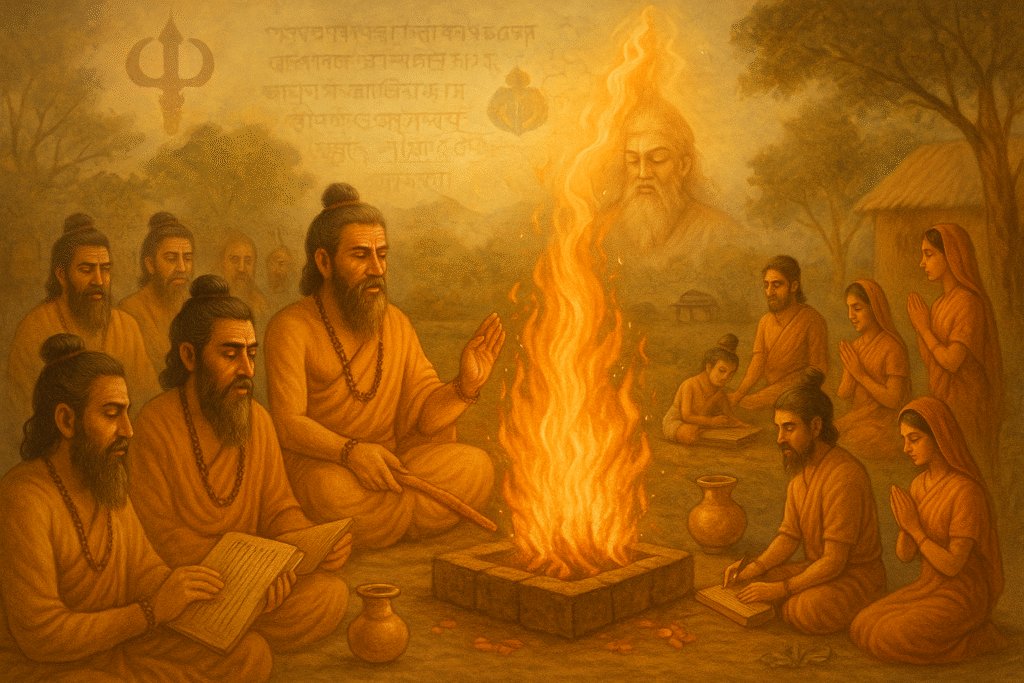
The Rigvedic period was not only an age of ritual and economy but also a vibrant era of poetic composition, intellectual exchange, and disciplined pedagogy. The corpus of hymns, prayers and ritual formulas preserved in the Rigveda captures a lively conversation between composers (ṛṣis), performers, and their communities. This literary culture combined aesthetic invention with mnemonic discipline, producing texts that functioned as both devotional performance and repositories of communal knowledge.
Rishi Tradition, Āśramas, and Modes of Education
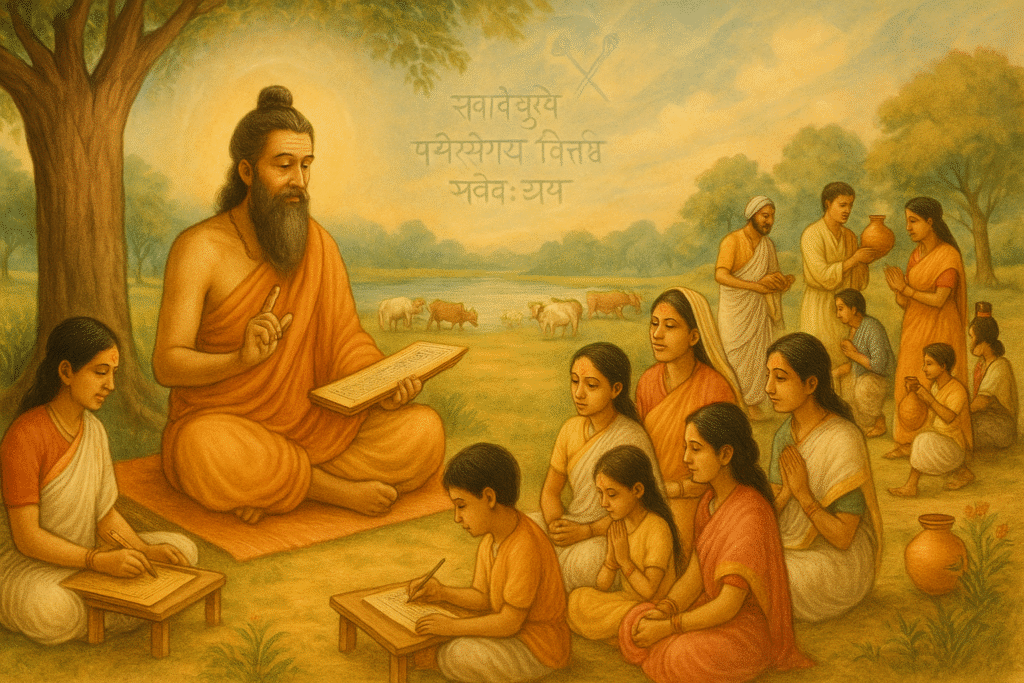
Central to Rigvedic intellectual life was the rishi tradition. Rishis were poet-seers—figures who composed hymns, transmitted ritual technique and acted as moral guides. They often gathered disciples and students around them in early forms of āśramas or gurukula-like households. Education was primarily oral, apprenticeship-based and experiential: students learned by listening (śravaṇa), meditating on verses (manana) and reciting them aloud (nididhyāsana). Accuracy of pronunciation, meter and intonation was treated as a moral and technical imperative because ritual efficacy depended on it.
Training in an āśrama combined spiritual instruction with practical skills. Young learners memorized hymns and ritual sequences, practiced ritual enactments, and acquired knowledge about seasons, cattle management, and social duties. Teachers (gurus, rishis) cultivated both intellectual acuity and disciplined habit: memory exercises, repetition, and correction ensured textual fidelity across generations in an otherwise non-literate environment.
Folk Songs, Mantras, and the Preservation of Knowledge
Two complementary channels preserved and circulated knowledge: folk expression and formal mantra tradition. Folk songs—ballads, seasonal laments, work-songs and celebratory chants—carried local memory, social norms and historic recollections. Their simpler idiom and communal performance made them powerful vehicles for shared identity and moral instruction.
Mantras, by contrast, were specialized, metrically strict compositions used in ritual contexts. Their efficacy was believed to hinge on precise enunciation, rhythm and placement. Different ritual specialists (hotṛ, adhvaryu, udgātṛ) mastered distinct chant-corpora, and their technical expertise made them custodians of ritual knowledge. Because writing was rare, this elaborate oral discipline functioned as a robust archive: mnemonic forms, melodic contours and social teaching together preserved a complex body of liturgical and ethical material.

| 👉 Buy on Amazon |
| As an Amazon Associate I earn from qualifying purchases. | |
The interplay of folk creativity and ritualized recitation also supported intellectual plurality. Hymns contain philosophical speculation, cosmological questioning and poetic images that reveal an enquiring mind at work. Debates about fate, the origin of the cosmos and the human role in the world appear not as abstract scholasticism but as living conversations embedded in song and sacrifice.
In short, the literary and intellectual life of the Rigvedic age relied on disciplined oral pedagogy, a rishi-led culture of composition, and the twin streams of vernacular song and formal mantra. This combination ensured both continuity and creativity—preserving tradition while allowing it to be reinterpreted by each generation. The result is a legacy of sound-based knowledge transmission that offers modern readers lessons about education, memory, and the social grounding of learning.

| 👉 Buy on Amazon |
| As an Amazon Associate I earn from qualifying purchases. | |
Social Structure and Family
The social framework of Rigvedic Society was organized around kinship, shared responsibilities, and a flexible distribution of roles. The household (gṛha) functioned as the nucleus of economic production, ritual performance, and the transmission of values. Unlike later rigid hierarchies, early Vedic social relations were more fluid, shaped primarily by function, skill, and community expectations. The family was regarded as a sacred unit — a place where moral discipline, practical knowledge, and ritual conduct were learned and preserved. This interconnected network of families formed the backbone of social stability and communal cohesion.
Varṇa System — Early References and Their Meaning
While references to the four varṇas — Brāhmaṇa, Kṣatriya, Vaiśya, and Śūdra — appear in the Rigvedic corpus (notably in the Puruṣa Sūkta), the system in this early period was neither rigid nor entirely birth-based. Instead, it likely represented broad functional distinctions within society. Priestly duties and preservation of sacred knowledge were associated with the Brāhmaṇas; protection, governance and leadership with the Kṣatriyas; agriculture, pastoralism and trade with the Vaiśyas; and various forms of service or craft labour with the Śūdras.
Importantly, this classification was not a strict hierarchy but a means of organizing tasks essential for communal life. Evidence suggests that mobility between roles existed, and expertise or merit could influence one’s position. The rigid, hereditary caste structure of later centuries had not yet crystallized. Thus, the early varṇa framework should be understood as a proto-social division of labor rather than an instrument of inequality.
Status and Education of Women (Upanayana, Female Scholars)
Women in Rigvedic society enjoyed a relatively high degree of respect, autonomy and participation in social as well as religious life. Numerous hymns portray women as articulate, wise, and spiritually capable. Female sages such as Ghoṣā, Apālā, Viśvavārā and Lopāmudrā contributed hymns to the Rigveda and actively engaged in philosophical and ritual dialogue. These attest to their intellectual agency.
Educationally, there is evidence that some women underwent upanayana, the initiation traditionally associated with Vedic study. This implies that women were not excluded from spiritual education or ritual recitation. They participated in yajñas as co-performers, offered prayers, and managed several domestic rituals. In household life, their role extended to food preparation, resource management, early childhood education, and maintaining ritual purity — responsibilities that shaped the family’s religious and social character.
Such involvement demonstrates that women were central not only to the household economy but to cultural continuity and knowledge transmission. Their participation highlights a period in early Indian society where gender roles, while differentiated, were not restrictive in the rigid sense found later.
Marriage, Sacraments, and Social Customs
Marriage (vivāha) was considered a sacred and social institution. It united not only two individuals but two families and lineages. Rituals such as saptapadī (the seven steps), fire circumambulation, and vows of mutual cooperation formed the core of the ceremony. These rites emphasized partnership, reciprocity, and the shared responsibilities of household life. Dowry existed in the form of gifts, but it functioned primarily as a cultural practice of goodwill rather than an economic burden as seen in later periods.
Samskāras (life-cycle rituals) structured an individual’s entire journey — from birth (jātakarma) and naming (nāmakaraṇa) to initiation (upanayana), marriage, and funeral rites (antyeṣṭi). These rituals reinforced the individual’s place within the community, ensured moral upbringing, and aligned personal milestones with cosmic and social order.
Social customs in the Rigvedic age were grounded in collective participation. Festivals, yajñas, communal feasts, and village councils brought people together, enabling dialogue, cooperation and resolution of disputes. Group deliberation, respect for elders, and shared decision-making were considered essential virtues. This participatory ethic strengthened both familial bonds and community governance.
Overall, the social and familial structure of the Rigvedic period reflects a balanced, cooperative, and ethically anchored society. It demonstrates how functional roles, mutual respect, flexible organization and educational opportunities helped create a stable and progressive civilization — laying early foundations for the cultural continuity that would follow in subsequent ages.