
Introduction — Archaeology and the Tradition of Historical Writing
Archaeology and the Tradition of Historical Writing together form a powerful framework for understanding the past. History is not confined only to written documents; it also survives in ruins, inscriptions, artifacts, and cultural memories. Archaeology gives voice to these silent remnants, allowing us to reconstruct societies, beliefs, and political systems that shaped earlier civilizations.
In India, historical writing has always reflected more than just dates and dynasties. From the Vedic hymns and epics to Buddhist chronicles and regional texts, the tradition of recording the past evolved alongside philosophical thought and social experience. Archaeology strengthens this intellectual tradition by adding material proof to textual narratives, sometimes confirming them and sometimes reshaping them.
Exploring archaeology alongside the tradition of historical writing reveals that history is not static — it is continuously interpreted and reinterpreted. Every excavation, inscription, or manuscript adds new dimensions to our understanding. Together, they create a balanced perspective where evidence and narrative interact to produce a deeper and more reliable account of the past.
1. The Historical Context of the Tradition
1.1 Roots of Indian Historical Writing
When we speak of the “tradition of historical writing,” we are not merely talking about recording facts from the past — we are referring to a living intellectual dialogue that has continued for thousands of years. In India, History was never just a record of kings and wars; it was a reflection of the philosophical and cultural consciousness of society. The ancient traditions of shruti and smriti, the epic narratives of the Mahabharata and Ramayana, and the Buddhist and Jain chronicles all reflect a deep-rooted historical awareness.
From sage Vyasa to poet Kalidasa, and later to Banabhatta, who wrote Harshacharita, Indian writers perceived history not as a sequence of political events, but as an experiential philosophy. This broader worldview later shaped what we now understand as Archaeology and the Tradition of Historical Writing — a blend of material evidence and philosophical interpretation that distinguishes Indian historiography.
1.2 Colonial Period and the Reinterpretation of History
The nineteenth century marked a turning point in India’s historiography. With the introduction of European research methods, archaeology and textual criticism were institutionalized. This phase significantly influenced Archaeology and the Tradition of Historical Writing in India, as inscriptions, monuments, and ancient sites began to be studied systematically.
While colonial scholarship brought scientific rigor, it also carried interpretative biases. In response, Indian historians sought to reclaim a balanced perspective, combining modern methodology with indigenous intellectual traditions. This effort ensured that historical writing remained rooted in cultural identity while embracing academic precision.
1.3 Archaeology: The Silent Language of History
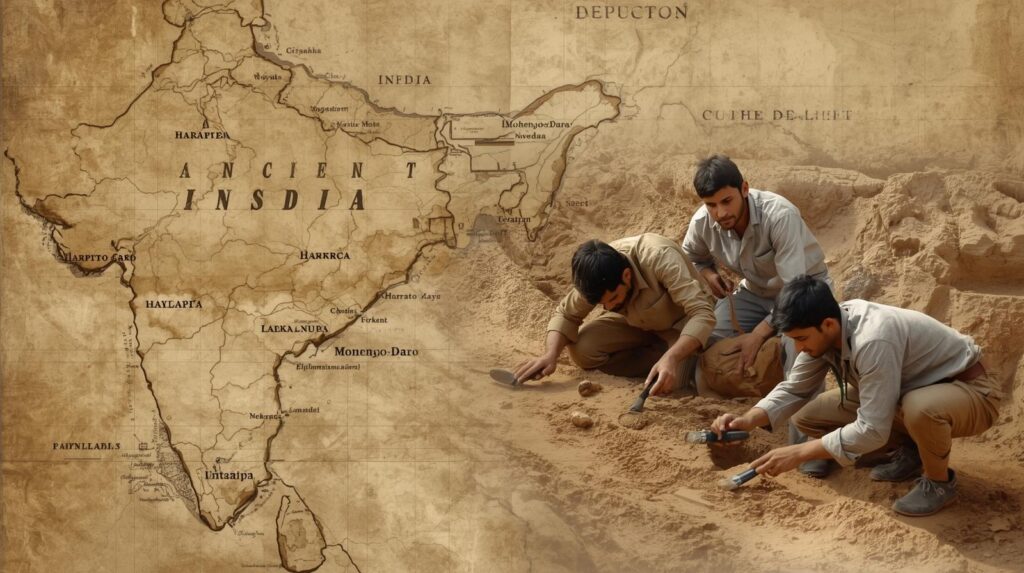
Archaeology became a decisive force in reshaping our understanding of history. The discoveries of Mohenjo-Daro and Harappa transformed the timeline of Indian civilization, revealing an advanced urban culture thousands of years old. Through such discoveries, archaeology strengthened the tradition of historical writing by providing tangible proof where texts were silent.
Every artifact, inscription, and structure speaks in what may be called a silent language. In this way, archaeology does not merely supplement written records — it completes them. The fusion embodied in Archaeology and the Tradition of Historical Writing allows history to emerge as both narrative and evidence.
1.4 Modern Perspectives and Continuity
Today, history writing has become a multidisciplinary pursuit. Digital mapping, satellite imaging, and scientific excavation techniques have expanded the scope of archaeological research. Yet the essence of Archaeology and the Tradition of Historical Writing remains unchanged — it continues to bridge material discovery with intellectual reflection.
This continuity teaches us that history is not merely about the past; it is a way of understanding identity, culture, and collective memory. The historical context of this tradition is therefore not confined to a period — it is an ongoing dialogue between discovery and interpretation.
2. My Education and the Transformation of My Perspective
2.1 The Journey from Learning to Awareness
For me, the study of History was never just about memorizing dates and events—it was a process of understanding existence itself. When I chose “History and Archaeology” as my major at university, I was simply curious about the past. But as my studies deepened, I realized that history is not merely a record of what happened; it is a lens through which we understand who we are today. My professors often said that the true purpose of history is not just “to know,” but “to comprehend,” and that comprehension requires sensitivity, curiosity, and respect for evidence.
During my undergraduate years, I studied the “Tradition of Historical Writing in India” in detail. Reading scholars like R.C. Majumdar, Romila Thapar, and Irfan Habib made me realize how every historical perspective is shaped by its social and political context. This deeper engagement gradually introduced me to Archaeology and the Tradition of Historical Writing as an interconnected field, where material discoveries and written narratives together shape our understanding of the past. The more I read, the more I understood that history is not just a discipline; it is a dialogue between the observer and the observed.
2.2 Lessons from Research and Archaeology
During my postgraduate research, I chose the topic “Ancient Urban Civilizations and Inscriptions of Rajasthan: A Social Study.” That was the first time I got the opportunity to engage in real fieldwork. Initially, it felt like an academic assignment, but the moment I began excavating around ancient temple sites and discovered fragments of pottery, coins, and inscriptions, I realized that history breathes beneath the soil—it lives in silence and dust.
I still remember one moment vividly: during an excavation in the Jhunjhunu district, our team found a copper plate inscribed in early Brahmi script. Holding that artifact in my hands was a deeply emotional experience—it was as if a voice from thousands of years ago was speaking directly to me. In that instant, I wasn’t just “reading” the past; I was “conversing” with it. That experience strengthened my belief in Archaeology and the Tradition of Historical Writing as a living dialogue between evidence and interpretation, rather than a static record of events.
2.3 How Education Transformed My Writing
The academic environment I was part of did more than teach me research methods—it taught me the ethics of expression. I learned that historical writing is not about transmitting information; it’s about building a dialogue with the reader. I began to adopt a narrative approach in my writing, blending analytical facts with human stories.
Gradually, my writing found a balance between research and empathy. I realized that the true value of archaeology and historical writing lies in connecting people with their own roots. Education taught me that the study of history never truly ends—it is an endless journey where every discovery raises a new question and every question opens a new window into human understanding.
2.4 Expanding Vision: From Past to Present
My education and field experiences taught me that there is no wall between the past and the present—they complement and define each other. Understanding the past helps us interpret the present with greater depth and awareness. This realization continues to inspire me even today: that history should not be seen merely as a subject of study, but as a guide for life itself.
Whenever I write about history or archaeology now, I still feel like that same student who once held a fragment of ancient earth in his hands. That moment became the foundation of my vision—a reminder that education doesn’t just provide knowledge; it provides perspective. And that perspective, I believe, is the soul of historical writing: it teaches us that the study of the past is, in truth, the key to understanding the future.
3. Field Stories: A Series of Experiences
3.1 History Beneath the Sand — My First Excavation
Location: Nagargarh, Rajasthan | Year: 2017
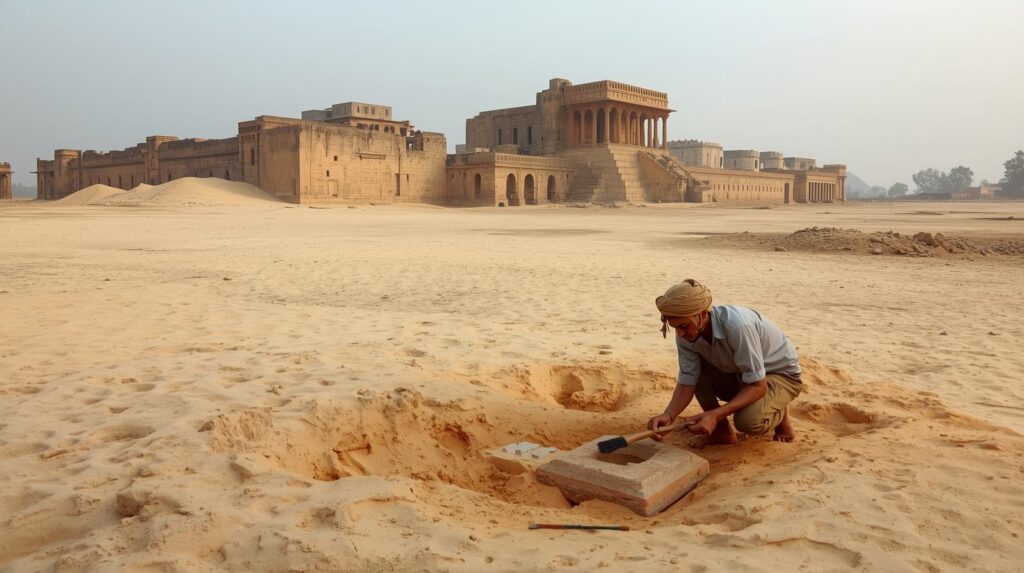
It was the day when history leapt out of textbooks and settled into the palms of my hands. In a small town called Nagargarh, Rajasthan, our team had begun an excavation project at an ancient mound. It was my very first field assignment, and I remember feeling a mixture of excitement and nervousness. As the cool morning breeze brushed against the sand, I realized that I wasn’t just digging soil — I was uncovering a forgotten story.
For the first few hours, we found only broken pieces of brick and stone. But by noon, one of my teammates shouted, “Sir, I think we found something!” Carefully brushing away the dust, we unearthed a small earthen pot. It looked simple, but its shape and texture revealed an ancient craftsmanship. Our supervisor examined it and estimated that it dated back to around the 2nd century BCE. In that moment, the pot no longer seemed like an object — it became a witness to a civilization that once lived, dreamed, and created.
That evening, as I walked back from the site, I felt a strange calmness within me. I realized that history is not merely studied; it is discovered — and sometimes, that discovery reflects the deepest layers of our own soul. Experiences like this deepened my understanding of Archaeology and the Tradition of Historical Writing, where field evidence and narrative interpretation come together to shape meaningful historical insight.
3.2 A Conversation with the Earth — When Time Answered Back
Location: Jhunjhunu District | Year: 2019
During my research years, I was assigned to study the remnants of an ancient temple in a small village in the Jhunjhunu district. To the villagers, the site was ordinary, but to me, it was a mystery waiting to be unraveled. As we began digging near the temple’s foundation, we discovered a stone plaque inscribed with early Brahmi script. My heart started pounding — were we about to hear the voice of a forgotten age?
We made an impression of the inscription and later analyzed it in our university lab. The translation revealed that it mentioned a ruler who had built a resting house near a riverbank for travelers and monks. What astonished me was that this detail perfectly matched the oral traditions of the local community. It was as if the past was confirming its own story through the soil — a powerful example of how archaeology strengthens historical writing.
That discovery taught me that archaeology is not merely about finding artifacts — it’s about building bridges between evidence and memory. In many ways, this is the essence of Archaeology and the Tradition of Historical Writing: connecting inscriptions, oral narratives, and lived experiences into a coherent understanding of the past.
3.3 The Past Hidden in Village Walls — Encountering Living Traditions
Location: Bugala Village, Jhunjhunu | Year: 2021
My third and most impactful field experience took place in Bugala village, where I studied the traces of history preserved in folk architecture and oral traditions. The elders of the village told me that an old mansion was built using “ancient bricks” taken from a nearby ruined temple. Their curiosity and stories drew me in, and I decided to investigate.
When we examined the structure, we found that several bricks indeed had carvings resembling ancient temple motifs. After careful observation, I concluded that these materials likely belonged to a 10th-century construction. This small yet revealing observation showed me how rural spaces continue to preserve the past — often unknowingly — through everyday architecture and collective memory.
When I later included these experiences in my research paper, I understood that fieldwork is not just a scientific practice — it is also a reflective journey. The soil, the stones, and the scripts don’t merely reveal data; they whisper meaning. They connect us not just with the past, but with our own sense of belonging in the present. That, to me, is the true lesson of field stories — history is not only discovered; it is felt.

4. Methodology and Source Management
4.1 From Field Notes to a Finished Article
For every archaeologist, writing is a sacred process — because what the soil and stones cannot say in words, we must express through language. When I return from the field, I don’t just bring artifacts with me; I bring stories, contexts, and experiences. Organizing these experiences into coherent narratives is the first step of historical writing.
My process always begins with detailed field notes. During excavations, every observation — the sequence of soil layers, the direction of artifacts, their texture, color, and depth — is carefully recorded. These notes are not mere data; they are the language through which the past communicates. My field diary is not just a notebook — it is the first draft of living History.
In the next stage, I attempt to connect factual data with human experience. The purpose of my writing is not merely to convey information but to explore how each piece of evidence reveals human thought, belief, and social structure. This integration reflects the deeper philosophy of Archaeology and the Tradition of Historical Writing, where scientific discovery and narrative interpretation work together.
4.2 Classification and Interpretation of Sources
The most critical stage in historical writing is source management. Without a structured approach to sources, even the most fascinating discoveries lose their meaning. I classify my materials into three primary categories — material, archival, and oral sources.
Material sources include excavated objects, architectural remains, pottery, coins, and tools. Archival sources consist of inscriptions, copper plates, manuscripts, and ancient texts. Oral sources come from folk traditions, local songs, and community legends, preserving the living memory of history.
The real strength of research lies in the integration of these three forms of evidence. When inscriptions align with oral traditions and archaeological findings, they create a bridge between proof and memory. This harmony forms the backbone of Archaeology and the Tradition of Historical Writing, ensuring that interpretation remains both rigorous and meaningful.
4.3 Structuring and Presenting the Narrative
Once all data and sources are organized, I design the structure of the article by combining chronological and thematic approaches. This allows events to unfold in order while deeper ideas flow naturally.
For me, writing is not just a technical task; it is a moral responsibility. When we give voice to the past, we must ensure that our words serve as reliable knowledge for future readers. Transparency through references, documentation, and field notes remains essential.
4.4 Balancing Sensitivity and Scientific Rigor
The greatest challenge in archaeology and historical writing is maintaining a balance between sensitivity and scientific precision. If we focus only on facts, writing becomes dry; if we focus only on emotion, it loses credibility.
Whenever I complete a draft, I ask myself a simple question — “Does this piece bring the past to life?” True methodology transforms evidence into understanding and understanding into wisdom. That balance, in essence, defines responsible historical scholarship.

5. Case Study: The Story of a Discovery
5.1 Introduction to the Project
This is the story of a discovery that not only gave my research a new direction but also allowed me to hear the living voice of History. In 2022, I was fortunate to join an excavation project in a small village named Khetri in the Shekhawati region of Rajasthan. Preliminary surveys had indicated that the site might contain the remains of an ancient settlement or a religious center.
The objective of our project was to study stratigraphy, document inscriptions and artifacts, and understand whether the site was connected to ancient trade routes. At that time, I did not realize that this excavation would become a defining example of Archaeology and the Tradition of Historical Writing — where field evidence gradually transforms into structured historical interpretation.
5.2 The Moment of Discovery
On the third day of excavation, as we reached the third layer of soil, a faint metallic glimmer caught our eyes. Carefully brushing away the surrounding earth, we uncovered a copper-plate inscription with ancient characters etched upon it. The plate was immediately preserved and sent to the university laboratory for analysis.
The inscription, written in Gupta Brahmi script, mentioned a ruler named Devadatta, who ordered the construction of a rest house and water reservoir in a settlement called Khetpura Nagar. It soon became evident that “Khetpura” could be the ancient name of present-day “Khetri.”
The reference to water management and public infrastructure revealed an advanced civic consciousness. For me, this was not merely an archaeological object; it was living proof of how archaeology enriches historical writing by adding material depth to narrative history.
5.3 Analysis and Findings
Laboratory studies confirmed that the copper plate dated back to the 5th century CE. Its script style and metallurgical composition aligned with the late Gupta period. Comparative research suggested that the site may have served as an administrative or cultural hub.
When cross-referenced with local oral traditions, a remarkable connection emerged. The elders often spoke of “Devsthan Talab,” believed to have been constructed by a ruler named Devadatta. The harmony between oral memory and inscriptional evidence beautifully illustrated Archaeology and the Tradition of Historical Writing in practice — where tangible artifacts and living traditions validate one another.
5.4 Lessons from the Discovery
This discovery taught me that every artifact carries both material and philosophical meaning. The copper plate was not just metal; it was a preserved voice of time. Holding it reminded me that history is a dialogue between evidence and interpretation.
Ultimately, this case study reaffirmed that archaeology and history are inseparable companions. Evidence provides structure, while interpretation gives it meaning. The inscription from Khetri was not just a relic of the past — it was a reminder that civilization survives through continuity, memory, and documentation.
6. Conclusion: Lessons and Future Directions
Every journey leaves behind not only memories but lessons — and my journey through the realms of archaeology and historical writing has been no different. In many ways, Archaeology and the Tradition of Historical Writing have shaped my understanding that History is not a closed chapter of time; it is an open conversation between humanity and its own existence. Archaeology has taught me patience, humility, and the art of listening — listening not with ears, but with the mind and heart, to what the earth wishes to reveal.
One of the most profound lessons I have learned is that the past is never truly “past.” It continues to shape our thoughts, identities, and decisions in ways we often overlook. Every artifact, every inscription, and every story we uncover holds within it the seeds of our collective consciousness. The deeper we dig, the more we understand ourselves — not just as individuals, but as a civilization that has continuously evolved through inquiry, creativity, and resilience.
As a researcher and writer, I now realize that archaeology extends far beyond unearthing ruins or classifying artifacts. It is a discipline that connects evidence with imagination, science with sensitivity, and facts with philosophy. This balance lies at the heart of Archaeology and the Tradition of Historical Writing, where material discovery and thoughtful interpretation together bring the past to life.
Looking to the future, archaeology must embrace new technologies while preserving the essence of humanistic inquiry. Digital mapping, AI-based analysis, and satellite imaging are transforming documentation and interpretation. Yet, amidst these innovations, the human touch — the ability to interpret context with empathy — remains irreplaceable.
For me personally, the journey does not end here. I aspire to make history more accessible and emotionally engaging, encouraging young scholars to see archaeology not as a dry academic pursuit, but as a living exploration of identity and continuity. Every discovery, no matter how small, reminds us that we are part of a story much larger than ourselves.
In the end, archaeology and history are not about digging into the past — they are about uncovering truth. The tools may change, but the purpose remains the same: to understand humanity through time. As long as we pursue that understanding with sincerity, the dialogue between past and present will continue to thrive.
Frequently Asked Questions (FAQ)
1. What is Archaeology and the Tradition of Historical Writing?
Archaeology and the Tradition of Historical Writing refer to the combined study of material evidence and written records to understand the past. Archaeology uncovers artifacts, structures, and inscriptions, while historical writing interprets these findings within social, political, and cultural contexts.
2. How does archaeology support historical writing?
Archaeology supports historical writing by providing physical evidence such as pottery, coins, inscriptions, and architecture. These discoveries validate, challenge, or expand textual narratives and help historians reconstruct a more accurate picture of the past.
3. Why is the Indian tradition of historical writing unique?
The Indian tradition of historical writing is unique because it blends philosophy, culture, and lived experience with historical narration. Unlike purely chronological Western models, Indian historiography often integrates moral, spiritual, and social dimensions alongside political events.
4. What role do inscriptions and oral traditions play in historical research?
Inscriptions provide primary documentary evidence about rulers, administration, and social practices, while oral traditions preserve community memory. When studied together, they create a balanced framework within Archaeology and the Tradition of Historical Writing.
5. How can modern technology improve archaeology?
Modern technologies such as GIS mapping, satellite imaging, digital reconstruction, and AI-based analysis enhance archaeological documentation and interpretation. However, human insight and contextual understanding remain essential for meaningful historical writing.
References / Further Reading
The study of Archaeology and the Tradition of Historical Writing draws upon diverse academic scholarship, archaeological surveys, and historiographical research. The following sources provide authoritative insights into Indian archaeology, epigraphy, and historical methodology.
1. Books and Academic Works
- Chakrabarti, D. K. (2006). The Oxford Companion to Indian Archaeology. Oxford University Press.
- Habib, I. (2001). Indian Economy 1858–1914. Tulika Books.
- Majumdar, R. C. (1977). Ancient India. Motilal Banarsidass.
- Ray, H. P. (2010). The Archaeology of Seafaring in Ancient South Asia. Cambridge University Press.
- Thapar, R. (2002). Early India: From the Origins to AD 1300. Penguin Books.
2. Epigraphy and Archaeological Reports
- Cunningham, A. (1871–1887). Archaeological Survey of India Reports. Government of India.
- Sircar, D. C. (1965). Indian Epigraphy. Motilal Banarsidass.
- Archaeological Survey of India (ASI). Annual Reports. Government of India.
3. Online Academic Resources
- Archaeological Survey of India (ASI)
- Indira Gandhi National Centre for the Arts (IGNCA)
- JSTOR Academic Database
Together, these works highlight how archaeological discoveries, inscriptional studies, and textual analysis interact within the broader framework of Archaeology and the Tradition of Historical Writing. They offer both methodological guidance and interpretative depth for scholars and researchers.