
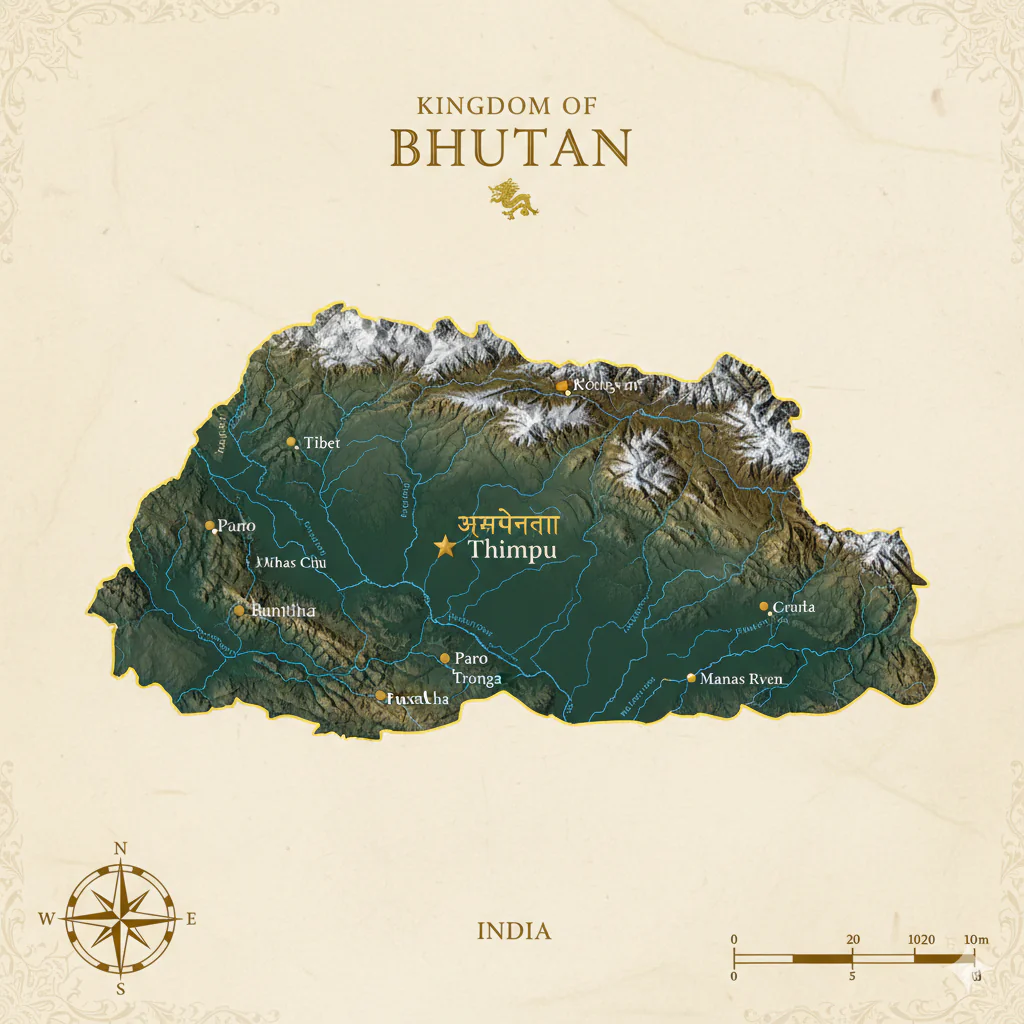
India-Bhutan Relations
India and Bhutan share close diplomatic, economic, and strategic relations. India is Bhutan’s largest trade partner and supports Bhutan’s Hydropower projects and infrastructure development.
- Treaty of Friendship signed in 1949
- Hydropower cooperation is the backbone of bilateral relations
- Bhutan is strategically important for India’s Himalayan security
- Doklam region is geopolitically significant
GEOGRAPHICAL FEATURES OF BHUTAN
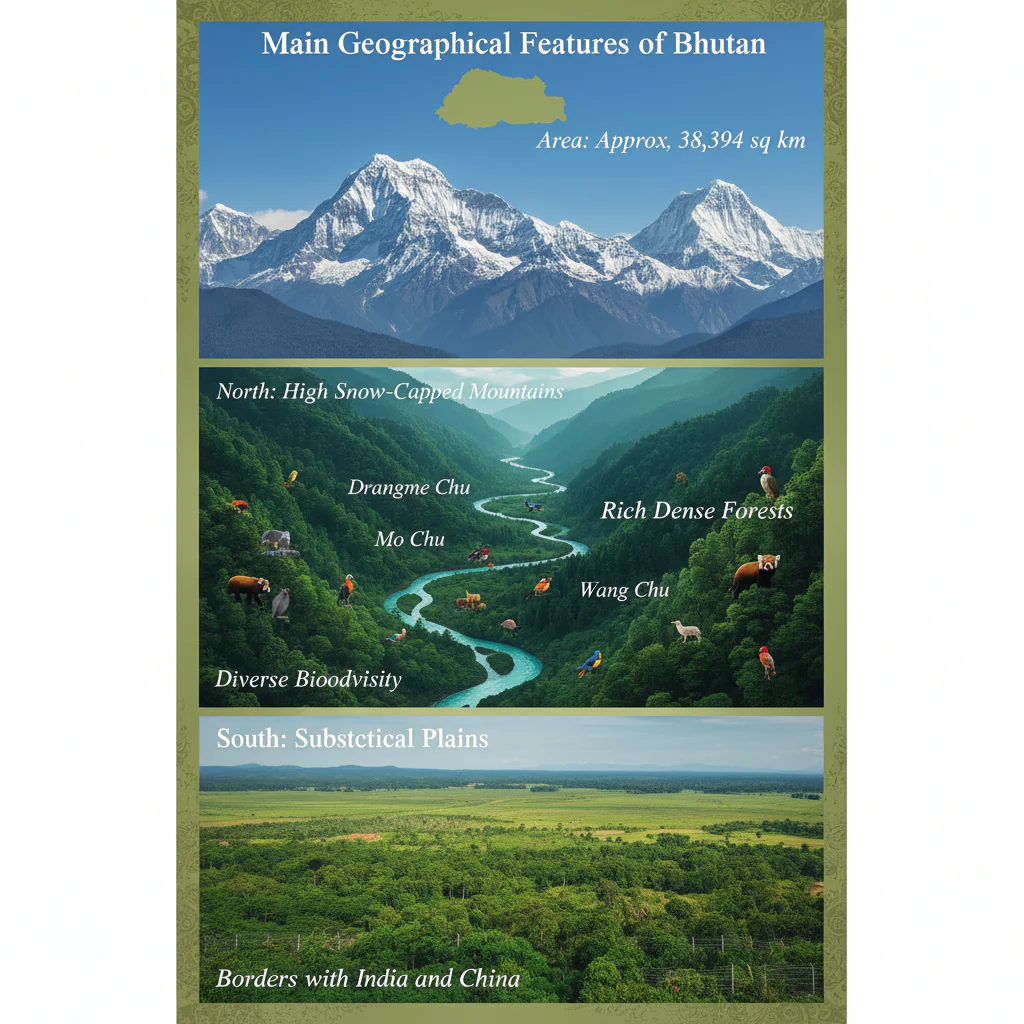
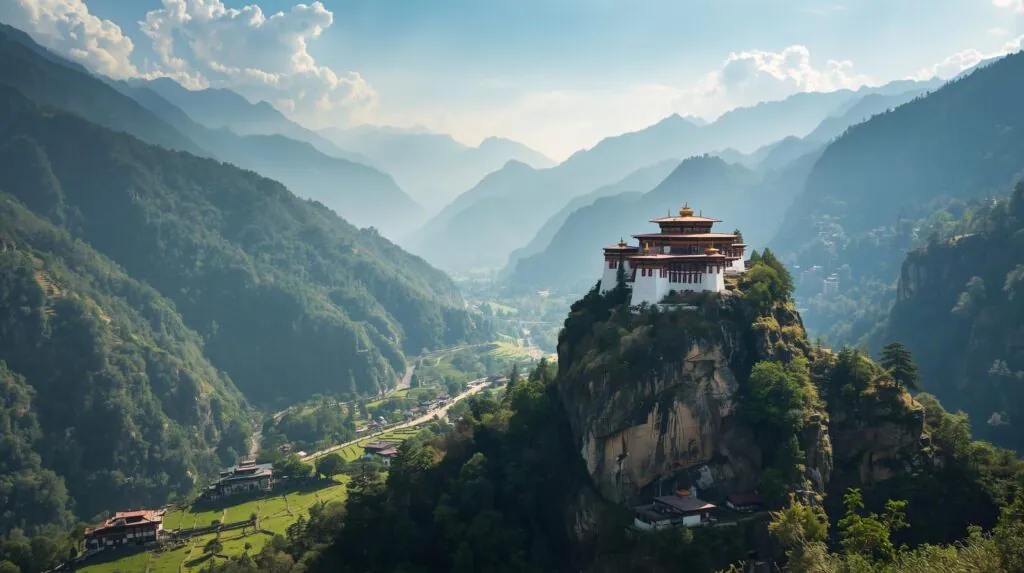
The Geography of Bhutan for UPSC is important because of its Himalayan location and Biodiversity.Bhutan’s geography is rich in natural diversity. The towering Himalayan peaks, fertile valleys, and the southern Terai region together create a unique and remarkable geographical landscape.
1. Mountain Ranges
- Northern Bhutan is home to the lofty Himalayan peaks, rising above 7,000 meters.
- The highest mountain, Gangkhar Puensum (7,570 meters), is considered the world’s highest unclimbed mountain.
2. Valleys
- Bhutan’s valleys are fertile, scenic, and culturally rich.
- Thimphu Valley and Paro Valley are the most prominent, known for their historical and cultural importance.
3. Rivers
Bhutan’s rivers originate from the Himalayan glacial meltwaters.
- Major rivers: Drangme Chu, Mo Chu, Wang Chu, and Torsa.
- These rivers serve as key sources of hydropower, irrigation, and freshwater supply.
4. Climate
The climate of Bhutan varies significantly with altitude:
- Northern Region: Extremely cold and snowy.
- Central Region: Mild, temperate, and suitable for agriculture.
- Southern Region: Hot, humid, and experiences heavy rainfall.
5. Biodiversity
- Bhutan is among the world’s most forested countries, with around 70% of its land under forest cover.
- Rare species such as the snow leopard, red panda, golden langur, and black-throated crane are found here.
NORTHERN PART OF BHUTAN
The northern region of Bhutan is entirely surrounded by the high Himalayan mountain ranges and forms the border with China (Tibet).
Key Features
- Altitude ranges from 4,500 meters to 7,500 meters.
- Snow-covered mountains and glaciers remain throughout the year.
- Major rivers like Drangme Chu and Mo Chu originate from this region.
- The climate is extremely cold and dry.
- Due to its inaccessibility, the region has a very low population, and yak rearing is the primary livelihood.
👉 The northern region provides natural protection to Bhutan and plays a critical role in maintaining Asia’s river systems and climatic balance.
SOUTHERN PART OF BHUTAN
The southern region lies in the subtropical zone and shares a border with India (Arunachal Pradesh, Assam, and West Bengal). This region has lower elevations and a warmer, wetter climate.
Key Features
- Elevation: 200–1,500 meters.
- Climate: Hot, humid, and receives high rainfall.
- Forests & Wildlife: Dense forests home to tigers, elephants, rare birds, and tropical fauna.
- Agriculture: Ideal for rice cultivation and farming activities.
- Population: The most populated region of Bhutan.

Amazon Product
Click below to see full product details and price on Amazon.
👉 View on Amazon*As an Amazon Associate, I earn from qualifying purchases.
The southern region is both economically and environmentally vital, as its fertile land, river systems, and forest resources support Bhutan’s agriculture and local livelihoods.
MAJOR RIVERS OF BHUTAN
Bhutan’s rivers play a crucial role in shaping the country’s geography, economy, and ecological balance. Originating in the Himalayas, they support hydropower, agriculture, and biodiversity.
Major Rivers
1. Drangme Chhu
- The longest river in Bhutan.
- Flows through eastern Bhutan.
- A key contributor to major hydropower projects.
2. Mo Chhu
- A major river in western Bhutan.
- Flows through Paro and Punakha valleys.
- The confluence near Punakha Dzong is a famous landmark.
3. Wang Chhu
- Originates near Thimphu.
- Flows close to the capital city.
- Supports irrigation and hydropower generation.
4. Torsa River
- Flows through southern Bhutan.
- Continues into Assam and West Bengal in India.
- Important for agriculture and freshwater needs in the south.
Characteristics of the River System
- Most rivers flow from north to south.
- High potential for hydropower generation.
- Valleys and plains along the rivers are fertile and suitable for settlement and farming.
Bhutan Quick Facts for UPSC
- Capital: Thimphu
- Official Language: Dzongkha
- Currency: Ngultrum
- Government: Constitutional Monarchy
- Religion: Vajrayana Buddhism
- Highest Peak: Gangkhar Puensum
- Known For: Gross National Happiness (GNH)
HISTORY OF BHUTAN
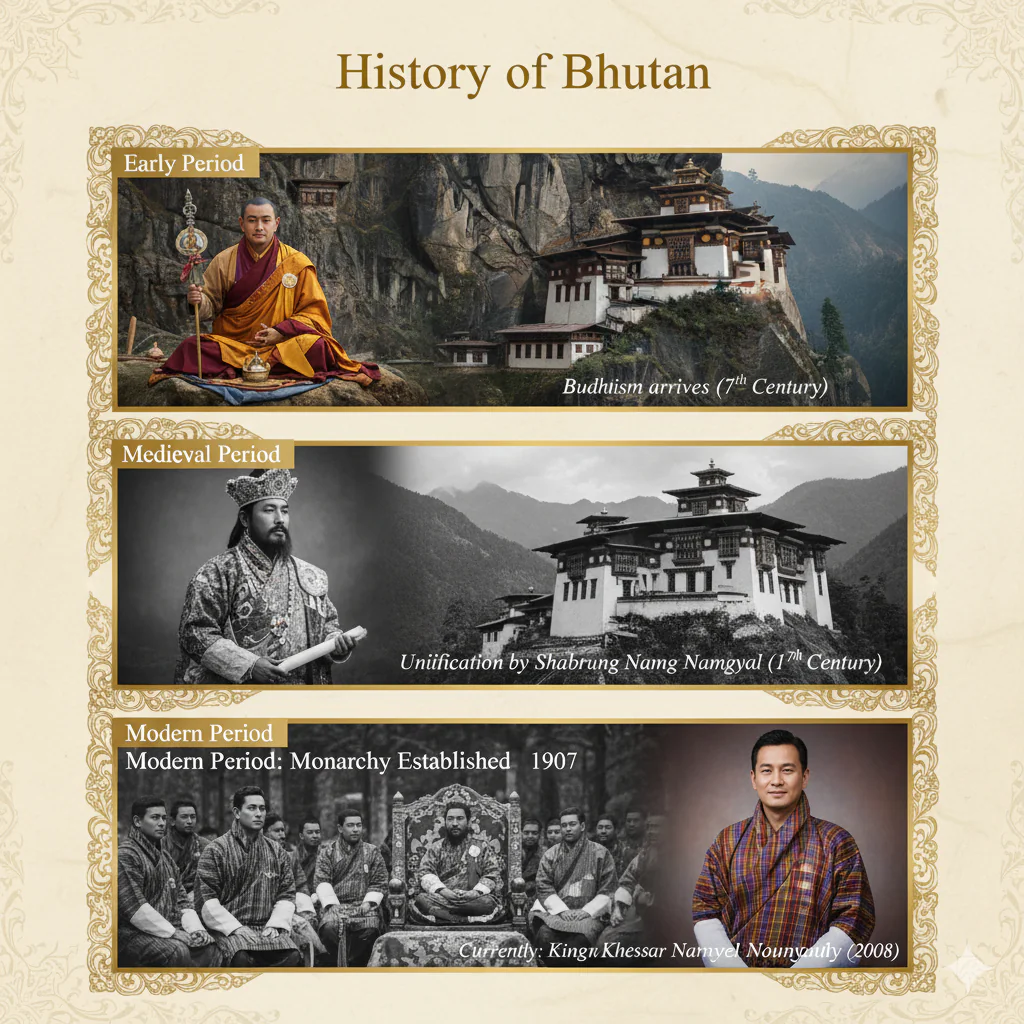
Bhutan’s history spans thousands of years and is deeply enriched with culture, religion, and political evolution. The country’s historical development can broadly be divided into three main periods: the Early Period, the Medieval Period, and the Modern Period.
Early Period of Bhutan
The early history of Bhutan is closely associated with religious and cultural development. Ancient tribes, spiritual seekers, and small clan groups shaped the foundation of Bhutanese society.
Key Features
- Arrival of Buddhism: Buddhism arrived in Bhutan around the 7th century through Guru Padmasambhava. He is regarded as the primary force behind the spread of Buddhism in the region.
- Local Tribes: Tribes such as the Lokrang, Newa, and Lhopa are considered the original inhabitants of Bhutan.
- Religious Centers: Early monasteries and small religious centers became an integral part of social and cultural life.
- Political Organization: There was no unified state. Various regional khanates and petty kings ruled independently.
This period laid the cultural and spiritual foundations of Bhutan, which continue to influence Bhutanese lifestyle and identity today.

Amazon Product
Click below to view full product details and the latest price on Amazon.
👉 View on Amazon*As an Amazon Associate, I earn from qualifying purchases.
Medieval Period of Bhutan
The medieval era marked a turning point when Bhutan was politically and religiously unified in the 17th century.
Key Features
- Shabdrung Ngawang Namgyal:
- He unified Bhutan by ending regional fragmentation and resisting local rulers.
- He established a balanced system combining religious and political power.
- Establishment of Dzongs and Gumphas:
- Shabdrung constructed fortified monasteries (Dzongs) and religious centers, which became hubs of governance and spiritual practice.
- Major Dzongs include Punakha Dzong, Thimphu Dzong, and Paro Dzong.
- Dzong System:
- A unique administrative-religious structure where each Dzong housed both officials and monks.
- Cultural Development:
- Buddhism gained a stronghold during this period.
- Art, architecture, music, and festivals flourished dramatically.
The medieval period gave Bhutan political stability and a strong cultural and religious identity.
Modern Period of Bhutan
The modern period witnessed significant social, political, and economic reforms in the 20th and 21st centuries.
Key Highlights
- Establishment of the Monarchy (1907):
- Bhutan established a hereditary monarchy, and King Ugyen Wangchuck became the first Druk Gyalpo.
- Political Reforms and Constitutional Democracy (2008):
- Bhutan adopted a constitutional monarchy.
- Democratic elections were introduced, marking Bhutan’s emergence as a modern democratic nation.
- King Jigme Khesar Namgyel Wangchuck:
- The current king of Bhutan.
- He has strengthened the education, health, and economic sectors.
- He reinforced Bhutan’s global identity through environmental protection and the Gross National Happiness policy.
- Global Recognition:
- Bhutan is globally recognized as the world’s only Carbon Negative Country.
- The economy has been supported by Hydropower, tourism, and cultural preservation.
The modern era transformed Bhutan into a nation that beautifully balances tradition and modernity while prioritizing sustainability, cultural heritage, and citizen well-being.
CULTURE AND SOCIETY OF BHUTAN
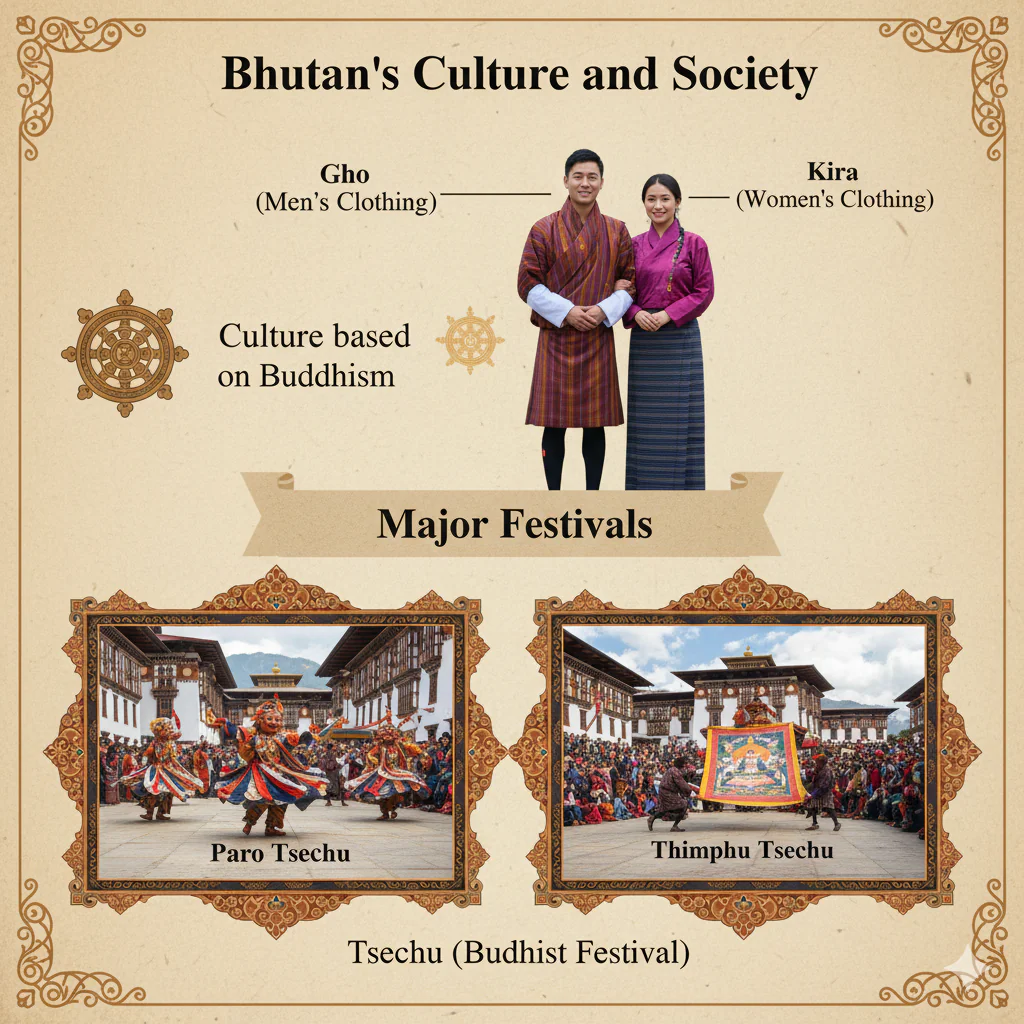
Bhutan’s culture and society are deeply rooted in its religious traditions, art, music, architecture, and social values. The country is known for maintaining a harmonious balance between cultural preservation and modernization.
Religious and Cultural Life
- The main Religion in Bhutan is Vajrayana Buddhism.
- Buddhism influences Bhutan’s art, architecture, festivals, and everyday life.
- Monasteries and Dzongs (fortified monasteries) serve as both religious and administrative centers.
Traditional Dress and Lifestyle
- Gho: Traditional attire for men.
- Kira: Traditional attire for women.
- Bhutanese society values simplicity, cooperation, and community harmony.
Major Festivals
Festivals are an integral part of Bhutan’s cultural and religious life. They celebrate traditions, spirituality, music, and dance.
- Tshechu: A major Buddhist festival featuring traditional mask dances.
- Paro Tshechu: Celebrated in the Paro Valley with vibrant cultural performances.
- Thimphu Tshechu: One of the largest festivals held in Bhutan’s capital.
Social Structure and Values
- Bhutanese society emphasizes community, harmony, and mutual support.
- Education and healthcare are given high importance.
- The Gross National Happiness (GNH) policy prioritizes emotional, social, and mental well-being.
Language and Communication
- Official Language: Dzongkha
- Many tribal languages and dialects are spoken across valleys and rural regions.
- Modern communication and technology are expanding, while local traditions are preserved.

Amazon Product
Click below to view product details and the latest price on Amazon.
👉 View on Amazon*As an Amazon Associate, I earn from qualifying purchases.
MAJOR FESTIVALS OF BHUTAN
Bhutanese festivals highlight religious devotion, social unity, cultural expression, and traditional art forms.
Tshechu
- The most prominent Buddhist festival in Bhutan.
- Features mask dances, traditional performances, and religious rituals.
- Celebrated in various Dzongs across the country.
- The main purpose is to promote spiritual teachings and social harmony.
Paro Tshechu
- Celebrated in the beautiful Paro Valley.
- Locals wear colorful traditional attire and enjoy music and dance.
- Offers a mix of religious rituals and social gatherings.
Thimphu Tshechu
- Held in the capital city, Thimphu.
- One of Bhutan’s largest and most spectacular festivals.
- Features elaborate mask dances and vibrant cultural showcases.
Lungchhu Tshechu & Other Local Festivals
- Celebrated in various valleys and tribal regions.
- Help preserve local traditions and strengthen community bonds.
Bhutanese festivals preserve cultural identity, promote unity, and ensure that traditions pass from one generation to the next.
ECONOMY OF BHUTAN
Bhutan’s economy is driven by agriculture, Hydropower, and tourism. The country follows a Sustainable Development model based on environmental protection and cultural preservation.
Main Industries and Economic Activities
Agriculture
- A primary source of livelihood for most Bhutanese.
- Main crops: rice, maize, potatoes, wheat, and bell peppers.
- Animal husbandry includes yak, sheep, goat, and cattle rearing.
- Traditional farming practices are common in mountainous regions.
- Bhutan promotes organic farming and uses minimal chemical fertilizers.
Agriculture is deeply linked to Bhutan’s rural lifestyle, culture, and economic stability.
Hydropower
- Bhutan’s fast-flowing rivers make it ideal for hydropower generation.
- Most of the electricity produced is exported to India.
- Major Hydropower Projects:
- Chukha Hydroelectric Project
- Tala Hydroelectric Project
- Kunzang Hydroelectric Project
- Environmental protection and community cooperation are priorities during project development.
Hydropower is central to Bhutan’s foreign exchange earnings and economic sustainability.
Tourism
- Bhutan follows a “High Value, Low Impact” tourism policy.
- Tourism is controlled to protect the environment and local culture.
- Major tourist attractions include:
- Tiger’s Nest Monastery
- Paro Valley
- Thimphu City
- Punakha Dzong
Economic Policies and Global Recognition
- Bhutan’s development is guided by the Gross National Happiness philosophy.
- environmental conservation is a national priority.
- Bhutan is the world’s only Carbon Negative Country.
- It follows a balanced approach to foreign trade and investment.
Overall, Bhutan’s economy is progressing in a sustainable manner, using its natural resources, hydropower potential, and cultural tourism as key strengths.

Amazon Product
Click below to view full product details and the latest price on Amazon.
👉 View on Amazon*As an Amazon Associate, I earn from qualifying purchases.