
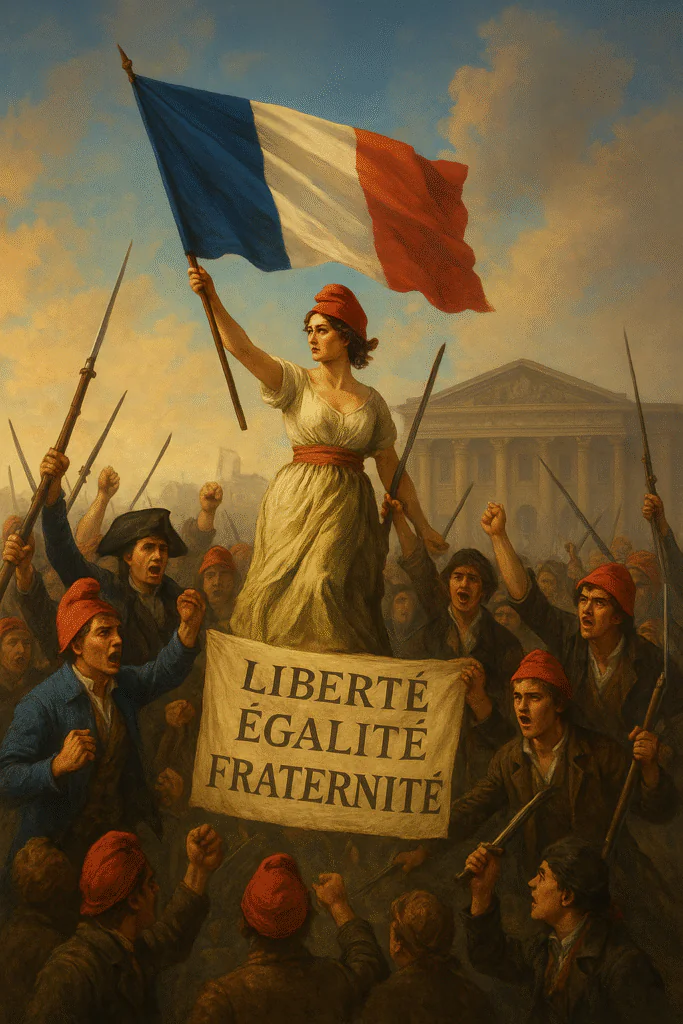
What if ordinary people could overthrow a powerful monarchy?
The French Revolution (1789) proved that when injustice reaches its limit, people can change history.
It was not just a revolt—it was the birth of modern democracy.
French Revolution 1789 – Causes, Events, Effects & Important Facts
French Revolution (1789–1799) — Causes, Events, Effects and History
Introduction
The French Revolution (1789–1799) was a transformative decade that reshaped France’s politics, society, and economy. It introduced the principles of Liberty, Equality, Fraternity into public life and laid foundations for modern democracy. This guide presents the causes, key events, consequences, and essential facts in a clear, exam-friendly format while highlighting the lasting lessons of the revolution.
Main Causes of the French Revolution
Multiple long-term and immediate factors combined to trigger the revolution. The major reasons can be grouped under social, economic, political and ideological headings.
1. social inequality
French society was organised into three estates:
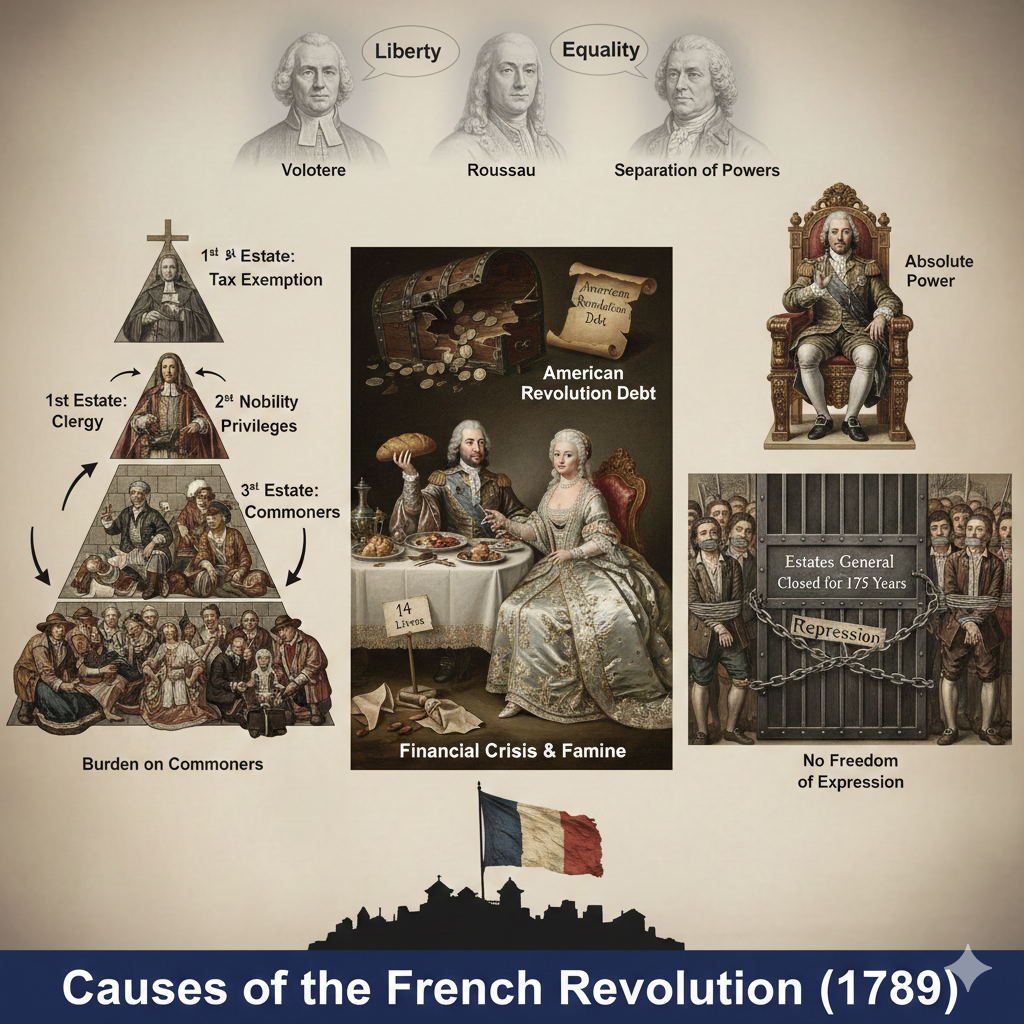
- First Estate — Clergy (privileged, tax-exempt)
- Second Estate — Nobility (large landowners, tax-exempt)
- Third Estate — Commons (farmers, urban workers, merchants, intellectuals) who bore the tax burden
This unequal system created deep resentment, because the common people paid high taxes while having little political power.
2. economic crisis
The royal treasury was nearly empty by the late 1780s. Reasons included:
- Massive war spending and debts (including support for the American War of Independence)
- Extravagant expenses at the royal court
- Rising taxes and inflation that made life harder for ordinary people

3. Political absolutism and corruption
King Louis XVI's absolutist system concentrated power at the top. Ordinary citizens had little or no participation in governance, and corruption and administrative disorder were common.
4. Influence of the Enlightenment
Enlightenment thinkers such as Voltaire, Rousseau and Montesquieu popularised ideas about rights, the social contract and representative government. These philosophies inspired people to demand political change.
Other immediate causes
- Bad harvests and famine (1788–1789), causing bread prices to soar
- Ignorance and dismissal of the third estate's complaints during the Estates-General
Main Events — Timeline
Key milestones of the French Revolution:
1789 — The Revolution begins
- May 5: Estates-General convened to address the Financial Crisis.
- June 17: The Third Estate declared itself the National Assembly.
- July 14: Storming of the Bastille — a symbolic beginning of the revolution.
1791 — New Constitution
A constitution was adopted that limited monarchal powers and moved France toward a constitutional monarchy.
1792 — Republic declared
France abolished the monarchy and declared a republic, moving toward rule by elected representatives (in practice the period was tumultuous and violent).
1793 — Execution of the King
January 21: King Louis XVI was sentenced to death. Queen Marie Antoinette was also executed later that year.
1793–1794 — Reign of Terror
Under leaders such as Maximilien Robespierre, thousands accused of counter-revolutionary activity were executed. The Reign of Terror marked one of the bloodiest phases of the revolution.
1799 — Rise of Napoleon
November 9: Napoleon Bonaparte took power (the Coup of 18 Brumaire), effectively ending the revolutionary decade and starting a new political era.
Results and Effects of the French Revolution
Effects on France
- End of absolute monarchy and the feudal order.
- Establishment and spread of democratic principles and civil rights.
- Deep social and administrative reforms that transformed French society.
Effects on the world
- Inspiration for democratic and independence movements across Europe and in colonial territories.
- Promotion of the ideology of human rights and political freedom.
- Long-term influence on modern constitutions and political thought worldwide.
Important Facts (Exam Notes)
Key points to remember
- Slogan: Liberty, Equality, Fraternity
- Symbol: Bastille Day — 14 July (National Day of France)
- Major leaders: Robespierre, Danton, Mirabeau, Napoleon Bonaparte
Conclusion & Takeaways
The French Revolution was more than a political event in France — it marked a turning point in world history. Its ideas and actions helped dismantle feudal and monarchical privilege, advanced the concept of citizens' rights, and inspired later movements for democracy and national self-determination.
My learnings (short reflection)
The revolution shows how social inequality, economic hardship and powerful ideas together can produce profound change. It also warns that revolutionary change can lead to both progress and violence — making wise leadership, rule of law, and protection of rights critical for lasting reform.
Main Causes of the French Revolution
1. social inequality
The biggest reason for the French Revolution was social inequality. At that time, French society was divided into three estates.
First Class (Clergy)
- Church officials and religious leaders.
- They had special privileges and did not pay any kind of tax.
- They owned a large portion of the country’s land.
Second Class (Nobility)
- Feudal lords and high officials associated with the king’s court.
- They also had complete exemption from taxes.
- They collected rent from farmers but did nothing for public welfare.
Third Class (Commoners)
- Included farmers, laborers, traders, artisans and intellectuals.
- More than 90% of the population belonged to this class.
- They paid the highest taxes and had almost no political or social rights.
📌 Conclusion
Due to the tax exemptions and privileges of the first and second estates, the dissatisfaction of the third estate grew—which ultimately became the main cause of the revolution.
2. Financial Crisis
The second major cause of the French Revolution was the severe economic crisis, which made life extremely difficult for the common people.
Main Reasons:
Excessive Expenditure on Wars
- France fought many expensive wars, including its support to America against Britain in the American War of Independence (1775–1783).
- Huge amounts of money spent on wars emptied the French treasury.
Luxury of the King and the Court
- King Louis XVI and Queen Marie Antoinette lived in extreme luxury.
- Massive expenditure on palaces, celebrations and royal feasts increased financial burdens.
- The public, meanwhile, struggled with hunger and rising prices.

Unjust Tax System
- The entire tax burden was placed only on the third estate.
- The first and second estates were completely exempt from taxes.
Bad Harvest and famine
- Bad weather in 1788 and 1789 reduced wheat production.
- The price of bread increased sharply, making food unaffordable for the poor.
Burden of Government Debt
- France was heavily indebted, forcing the government to increase taxes.
- The increased tax burden again fell only on the third estate.
📌 Conclusion
War expenses, royal luxury, unjust taxation, bad harvests and heavy debt deepened the economic crisis, increasing the feeling of rebellion among the common people.
3. Political Corruption and Autocracy
Another major cause of the French Revolution was the corrupt and autocratic political system.
Main Points:
Absolute Autocratic Monarchy
- France followed an Absolute Monarchy, where the king held complete authority.
- King Louis XVI made decisions without taking anyone’s opinion.
Lack of Public Participation
- The general public had no rights to participate in governance or law-making.
- No democratic institution like a functioning parliament existed.
Corruption and Favoritism
- Corruption was widespread in the royal court and administration.
- High positions were given based on kinship and flattery instead of merit.
Repressive Policies
- Those who raised revolutionary ideas were punished harshly.
- Freedom of press and expression was heavily restricted.
Neglect of the Estates General
- The Estates General was not convened for nearly 175 years after 1614.
- When it was finally convened in 1789, the demands of the third estate were ignored.
📌 Conclusion
Autocratic rule, suppression of public opinion and widespread corruption created deep dissatisfaction among the people, becoming a significant cause of the revolution.
4. Influence of the Enlightenment Era
The Enlightenment Era greatly influenced the French Revolution. It was an intellectual movement that spread ideas of logic, science, freedom and equality across Europe during the 17th and 18th centuries.
Main Points:
Contribution of Thinkers
- Voltaire – Advocated religious tolerance, free expression and rational thinking.
- Jean-Jacques Rousseau – In his “Social Contract,” he argued that power should lie with the people, not the king.
- Montesquieu – Introduced the idea of separation of powers, strengthening democratic governance.
Public Awareness
- Their ideas spread through books, pamphlets and public discussions.
- People began to realize that autocratic monarchy and social inequality were unjust.
Desire for Freedom and Equality
- Enlightenment ideas encouraged people to demand personal freedom and equal rights.
- This inspired farmers, workers and the middle class to revolt.
Effect of Other Revolutions
- The success of the American Revolution (1776) proved that Enlightenment principles could work in reality.
- This increased the confidence of the French people.
📌 Conclusion
The Enlightenment Era awakened the masses with ideas of equality, liberty and democratic rule. This intellectual revolution eventually evolved into a political revolution.
The Beginning of the French Revolution: Main Events
Main Events of the French Revolution
1789 – Beginning of the Revolution
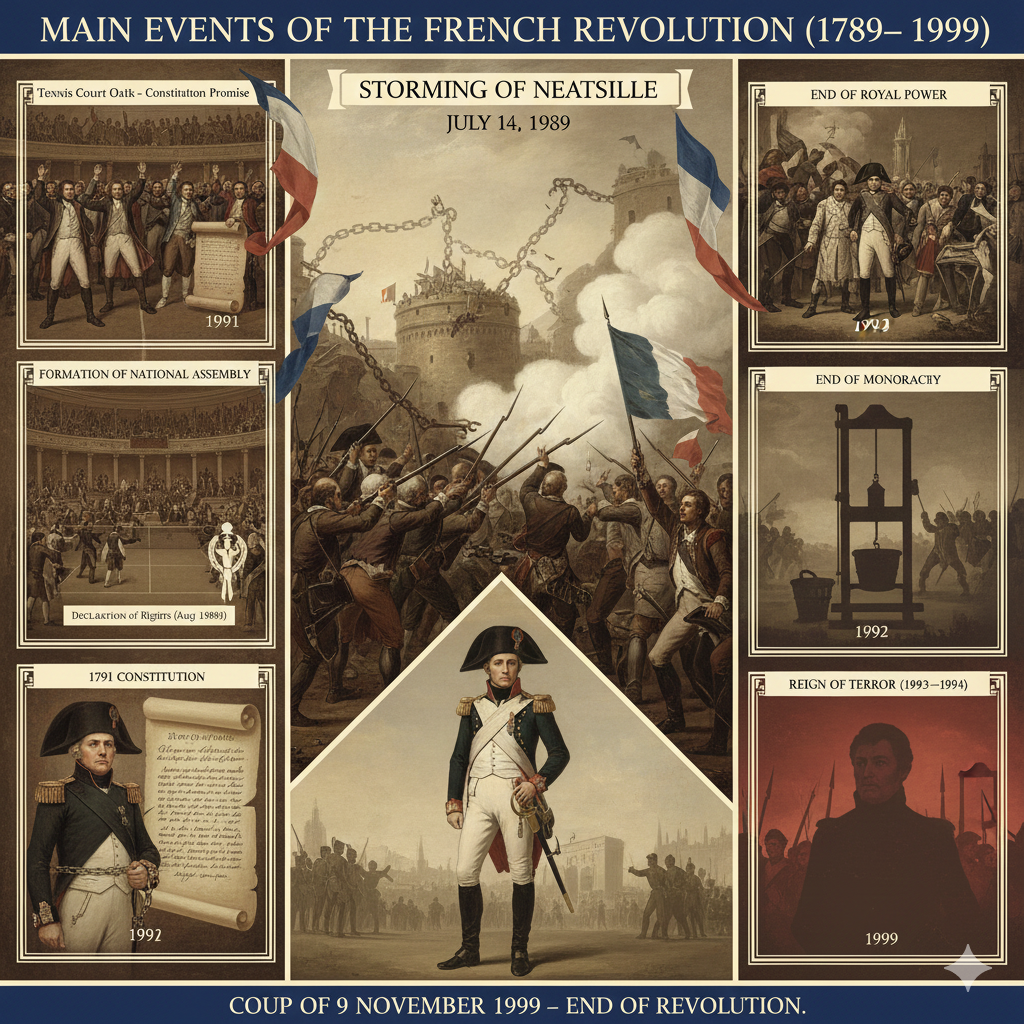
- 5 May 1789: King Louis XVI called a meeting of the Estates-General to solve the economic crisis.
- 17 June 1789: The Third Estate declared themselves the National Assembly and pledged to write a constitution.
- 20 June 1789: Tennis Court Oath – The National Assembly took an oath not to separate until a new constitution was made.
- 14 July 1789: The public attacked the Bastille Fort – the symbolic beginning of the Revolution.
- August 1789: Feudal system abolished and the “Declaration of the Rights of Man and of the Citizen” passed.

1791 – New Constitution
- France’s first written constitution came into force.
- The king's powers were limited and a constitutional monarchy was established.
1792 – Declaration of the Republic
- War began between France and Austria–Prussia.
- 21 September 1792: Monarchy abolished and France declared a republic.
1793 – End of the King and Reign of Terror
- 21 January 1793: King Louis XVI was executed by guillotine.
- Queen Marie Antoinette was also executed.
- 1793–1794: The Reign of Terror led by Robespierre executed thousands of people accused of anti-revolutionary activities.
1794 – End of the Reign of Terror
- Robespierre and his supporters were executed in July 1794.
- The Revolution took a more moderate direction.
1795 – New Constitution
- A new constitution created a five-member executive body called the Directory.
1799 – Rise of Napoleon
- 9 November 1799: Napoleon Bonaparte seized power through a coup.
- The French Revolution ended; the Napoleonic Era began.
📌 Conclusion
Between 1789 and 1799, the French Revolution abolished monarchy, established democratic principles, and spread the ideas of liberty and Equality across the world.
1789 – The Revolution Begins
The year 1789 marked the beginning of the French Revolution. It became a symbol of public revolt against political dissatisfaction, economic crisis and social inequality.
Main Events of 1789
5 May 1789 – Meeting of the Estates-General
- King Louis XVI called a meeting to solve the economic crisis.
- Representatives of all three estates participated.
- The Third Estate demanded voting “by person” instead of “by class.”
17 June 1789 – Formation of the National Assembly
- The Third Estate declared itself the National Assembly.
- They resolved to draft a constitution limiting the king’s powers.
20 June 1789 – Tennis Court Oath
- The Third Estate members gathered in a tennis court after being locked out of the Assembly Hall.
- They took an oath not to separate until a constitution was made.
14 July 1789 – Attack on Bastille Fort
- People attacked the Bastille prison and released political prisoners.
- The event symbolized public anger and demand for freedom.
- 14 July is celebrated as “Bastille Day,” the National Day of France.
August 1789 – End of Feudal System
- National Assembly abolished feudal privileges.
- The “Declaration of the Rights of Man and of the Citizen” guaranteed liberty, equality and rights.
📌 Conclusion
The events of 1789 marked the first steps towards ending monarchy in France and establishing democracy.
1791 – New Constitution
The year 1791 was crucial, as France adopted its first written constitution, transforming governance and limiting the king’s autocratic power.
Main Events of 1791
Establishment of Constitutional Monarchy
- The Constitution of 1791 established a constitutional monarchy.
- The king became only the head of state; real power went to elected representatives.
Division of Power
- Executive: King and Council of Ministers
- Legislature: Unicameral Assembly
- Judiciary: Independent Courts
Voting Rights
- Only “active citizens” (taxpayers with property) could vote.
- The poor were excluded from voting rights.
Confirmation of Human & Civil Rights
- The 1789 Declaration of Rights was included in the Constitution.
- Guaranteed liberty, equality, and freedom of expression.
Flight to Varennes
- King Louis XVI and Marie Antoinette attempted to escape France.
- They were arrested at Varennes, increasing public distrust.
📌 Conclusion
The Constitution of 1791 laid the foundation of French democracy, limiting monarchy and empowering the people.
1792 – Declaration of the Republic
In 1792, monarchy ended and France became a republic. The people rejected royal authority and handed power to elected representatives.
Main Events of 1792
Beginning of the War
- France declared war on Austria and Prussia in April 1792.
- The aim was to protect the Revolution and spread democratic ideals.
- Initial defeats increased public anger.
10 August 1792 – Attack on Tuileries Palace
- People attacked the palace where the king lived.
- The king was imprisoned and stripped of political power.
September Massacres
- Thousands were killed on suspicion of being anti-revolutionaries.
- Marked the violent turn of the Revolution.
21 September 1792 – Declaration of the Republic
- The National Convention abolished monarchy.
- The First French Republic was established.
Trial of the King
- Louis XVI was put on trial for treason.
- The trial ended with his death sentence in 1793.
📌 Conclusion
1792 completely freed France from monarchy and shifted the Revolution firmly toward democratic rule.
1793 – The End of the King
The year 1793 was the most dramatic year, marking the execution of King Louis XVI and the beginning of the Reign of Terror.
Main Events of 1793
Trial of the King
- Louis XVI was accused of treason for conspiring with foreign powers.
21 January 1793 – Execution of the King
- The king was executed by guillotine.
- Symbolic end of monarchy in France.
Reaction in Europe
- European monarchies panicked.
- Britain, Spain, Austria and others declared war on France.
Beginning of the Reign of Terror
- Robespierre and the Jacobins imposed strict measures.
- Thousands were executed.
- Queen Marie Antoinette was also executed.
political instability
- Civil war and anti-revolutionary rebellions increased instability.
- Army was empowered and strict laws were passed.
📌 Conclusion
The execution of the king ended monarchy forever but pushed France into a violent and fearful phase.
1793–1794 – Reign of Terror
The Reign of Terror was the most violent phase, marked by mass executions and severe restrictions.
Main Features
Dominance of the Jacobin Party
- Robespierre and Jacobins controlled the government.
- Anyone suspected of opposition was punished.
Fear of the Guillotine
- The guillotine became the symbol of terror.
- 16,000 executed; more than 200,000 imprisoned.
- Victims included Marie Antoinette and several revolutionary leaders.
Strict Laws
- The Law of Suspects allowed arrest on slightest suspicion.
- Freedom of expression and press was restricted.
Economic and Social Changes
- Price controls on food and essentials.
- Land distribution among peasants.
- Religious symbols and traditions suppressed.
Fall of Robespierre
- Robespierre executed on 27 July 1794.
📌 Conclusion
Though it introduced some reforms, the Reign of Terror became infamous for violence and mass executions in the name of protecting the Revolution.
1799 – Rise of Napoleon and End of the Revolution
The year 1799 marked the end of the Revolution and the rise of Napoleon Bonaparte, bringing stability after a decade of chaos.
Main Events
Political Instability
- The Directory was corrupt and inefficient.
- Public dissatisfaction increased due to war, inflation and unemployment.
9 November 1799 – Coup d’état
- Napoleon captured power through a coup.
- The Directory was dissolved and the Consulate was formed.
- Napoleon became First Consul.
Expansion of Napoleon’s Power
- Reforms in administration and judiciary.
- Reorganization of the army.
- Centralized executive and military power.
End of the Revolution
- Napoleon’s rise marked the end of the French Revolution.
- Some revolutionary ideals continued, but power shifted to a single strong ruler.
📌 Conclusion
Napoleon’s rise brought stability but also created the foundation for authoritarian rule. The Revolution ended, but its ideals influenced the world for centuries.
Results and Effects of the French Revolution
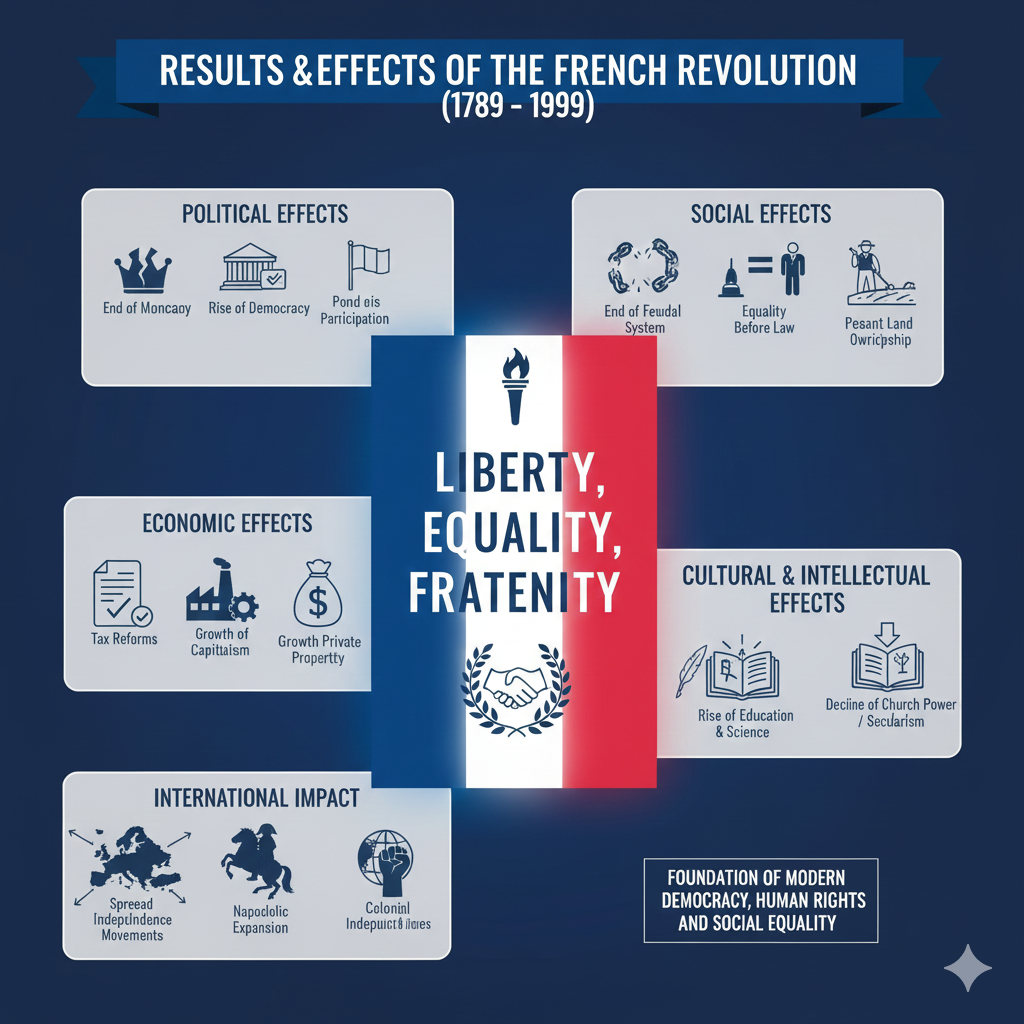
The French Revolution (1789–1799) changed the course of history not only in France but across the world. It brought deep political, social, economic and cultural changes whose influence continued for centuries.
Political Effects
(a) End of Absolute Monarchy
- The centuries-old absolutist power of the Bourbon dynasty ended.
- A republic was established and people gained the right to participate in governance.
(b) Spread of Democratic Ideas
- Ideals like liberty, Equality and fraternity became globally influential.
- Inspired democratic movements in America, Italy, Germany and Latin America.
Social Effects
(a) End of Feudal System
- Feudal privileges of lords and clergy were abolished.
- Peasants gained ownership of land and were freed from taxes and bonded labour.
(b) Establishment of Social Equality
- All citizens became equal before the law.
- Birth-based privileges were removed.
Economic Effects
(a) Reforms in the Tax System
- The old unfair tax system was abolished.
- A uniform and transparent taxation system was implemented.
(b) Development of Capitalist System
- Trade and industry were freed from excessive government controls.
- Private property received legal protection.
Cultural and Intellectual Effects
(a) Victory of Enlightenment Ideas
- Ideas of Voltaire, Rousseau and Montesquieu were applied in governance.
- Education, science and art were encouraged.
(b) Expansion of Secularism
- The power and influence of the Church were limited.
- A clearer separation between religion and the state was established.

International Impact
(a) Wave of Revolution in Europe
- Inspired rebellions and reform movements across European nations.
- Napoleon’s campaigns spread revolutionary ideas throughout the continent.
(b) Independence Movements in Colonies
- Latin American independence movements grew stronger.
- Awareness against colonialism increased in Asia and Africa.
📌 Conclusion
The French Revolution shattered the old system and established the foundation of a new socio-political order. Its ideals still inspire democratic values, human rights and social justice worldwide.
Effects of the French Revolution
The French Revolution brought major transformations to France’s political, social, economic, cultural and administrative systems.
Impact on France
(a) Political Changes
- End of Monarchy: The Bourbon dynasty ended and a republic was established.
- Rise of People’s Power: Governance shifted into the hands of representatives chosen by the people.
- Legal Reforms: All citizens were granted equality before the law.
(b) Social Changes
- Feudal privileges of nobles and clergy ended.
- Equality replaced birth-based discrimination.
- Farmers were freed from heavy taxes and forced labour.
(c) Economic Changes
- Taxation was made equal and transparent.
- Trade and industry flourished with fewer restrictions.
- Private property rights were legally protected.
(d) Cultural and Intellectual Changes
- Secularisation: Church power was limited; state and religion were separated.
- Education Reforms: Education became accessible to the public.
- Spread of Enlightenment Ideas: Liberty, equality and fraternity became national principles.
Impact on the World
(a) Spread of Democratic Ideas
- Freedom, equality and fraternity became universal ideals.
- Democratic and republican movements began in the U.S., Italy, Germany, Spain and Latin America.
(b) Revolutionary Wave in Europe
- Anti-monarchy rebellions spread across Europe.
- Napoleon’s campaigns carried revolutionary principles across the continent.
(c) Independence Movements in Colonies
- Latin American colonies intensified their struggle against Spain and Portugal.
- Growing awareness against colonial rule in Asia and Africa.
(d) Legal and administrative reforms
- The Napoleonic Code influenced law and justice systems worldwide.
- Modern administrative principles and uniform tax systems were adopted globally.
(e) Rise of Nationalism
- The Revolution strengthened national unity and independence.
- Nationalist movements grew in Germany, Italy and Greece.
📌 Conclusion
The French Revolution showed the world that the power of the people can overthrow any autocratic rule. Its message—democracy, human rights and freedom—still inspires nations across the globe.
French Revolution – Important Facts
Key Highlights of the French Revolution
Time Period
- The French Revolution lasted from 1789 to 1799.
Slogan
- The main slogan of the Revolution was: “Liberty, Equality, Fraternity”.
Social Division
French society was divided into three estates:
- First Estate: Clergy
- Second Estate: Nobility
- Third Estate: Commoners
Main Reasons
- social inequality
- economic crisis
- Political corruption
- Influence of Enlightenment ideas

Important Dates
- 14 July 1789: Attack on the Bastille Fort – symbolic start of the Revolution.
- 1791: Implementation of the first French Constitution.
- 1792: Declaration of the Republic.
- 21 January 1793: Execution of King Louis XVI.
- 1799: Rise of Napoleon Bonaparte.
Major Leaders and Thinkers
- Revolutionary Leaders: Maximilien Robespierre, Georges Danton, Jean-Paul Marat
- Enlightenment Thinkers: Voltaire, Jean-Jacques Rousseau, Montesquieu
International Influence
- The Revolution inspired democratic and freedom movements across Europe, America, Latin America and parts of Asia.
📌 Conclusion – The French Revolution
The French Revolution (1789–1799) is one of the most significant events in world history. It proved that the collective power of the people can overthrow autocratic regimes and establish the principles of equality, liberty and fraternity.
It brought the end of feudalism, the decline of absolute monarchy, the rise of democratic systems, and major legal-social reforms in France. Its influence triggered waves of independence and democratic movements across Europe, Latin America, Asia and beyond.
Even today, the ideals of the French Revolution remain the backbone of modern democratic societies, reminding us that united people can change the course of history.
References – French Revolution
The information and historical details about the French Revolution have been collected from the following credible sources:
Books
- A History of the Modern World – R.R. Palmer & Joel Colton
- The French Revolution: From Enlightenment to Tyranny – Ian Davidson
- Citizens: A Chronicle of the French Revolution – Simon Schama
Online Sources
- National Archives of France
- Encyclopaedia Britannica – britannica.com
- History.com – history.com
Educational Resources
- NCERT – History textbooks and reference booklets
- Publications of the Department of History, University of Paris